Water in the Earth’s interior

March 14, 2013

Phase diagram for water substance. image – craigssenseofwonder.wordpress.com

Water at supercritical conditions is a strange beast and has some remarkable chemistry. It is a fluid with properties that are a blend of gas and liquid properties. Steam at supercritical conditions (around 220 – 250 bar and about 600 °C)  is in common use in large power plants since it can be expanded in steam turbines for power generation. It has gas-like properties such that – as an Oxygen carrier – it could even support combustion/oxidation processes. It has liquid like properties and can be used as a solvent.

It would seem that if water is contained in the interior of the earth’s crust it could be at pressures above 22 MPa (220 bar) and temperatures above 374°C, beyond the critical point, and its properties as a very aggressive solvent  could be controlling the behavior of magma. So perhaps plate tectonics is all down to water?

I am a little skeptical since I observe – in passing – that the behaviour of supercritical steam does not seem to dissolve away steam turbine blades or casings when used in power generation!

A new paper on the 

Microscopic structure of water at elevated pressures and temperatures  by C. J. Sahle, C. Sternemann, C. Schmidt, S. Lehtola, S. Jahn, L. Simonelli, S. Huotari, M. Hakala, T. Pylkkanen, A. Nyrow, K. Mende, M. Tolan, K. Hamalainen and M. Wilke.

 Proceedings of the National Academy of Sciences, 2013; DOI: 10.1073/pnas.1220301110

From the press release from the Helmholtz Centre, Potsdam

13.03.2013 | Potsdam: Earth is the only known planet that holds water in massive quantities and in all three phase states. But the earthly, omnipresent compound water has very unusual properties that become particularly evident when subjected to high pressure and high temperatures. In the latest issue of the Proceedings of the National Academy of Science (PNAS), a German-Finnish-French team published what happens when water is subjected to pressure and temperature conditions such as those found in the deep Earth. At pressures above 22 MPa and temperatures above 374°C, beyond the critical point, water turns into a very aggressive solvent, a fact that is crucial for the physical chemistry of Earth’s mantle and crust.

“Without water in Earth’s interior there would be no material cycles and no tectonics. But how the water affects processes in the upper mantle and crust is still subject of intense research”, said Dr. Max Wilke from the GFZ German Research Centre for Geosciences, who carried out the experiments along with his colleague Dr. Christian Schmidt and a team from the TU Dortmund. To this end, the research team brought the water to the laboratory. First, the microscopic structure of water as a function of pressure and temperature was studied by means of X-ray Raman scattering. For that purpose, diamond anvil cells of the GFZ were used at the European Synchrotron Radiation Facility ESRF in Grenoble. Inside the cell, a very small sample of water samples was enclosed, heated and brought to high temperatures and pressures. The data analysis was based on molecular dynamics simulations by the GFZ scientist Dr. Sandro Jahn.

“The study shows that the structure of water continuously develops from an ordered, polymerized structure to a disordered, marginally polymerized structure at supercritical conditions,” explains Max Wilke. “The knowledge of these structural properties of water in the deep earth is an important basis for the understanding of chemical distribution processes during metamorphic and magmatic processes.” This study provides an improved estimate of the behavior of water under extreme conditions during geochemical and geological processes. It is believed that the unique properties of supercritical water also control the behavior of magma.

Finale! Climategate 3.0 released and speculation about Mr. FOIA is rife

March 14, 2013

The anonymous disseminator of the Climategate emails (Climategate and Climategate 2.0) has been dubbed Mr. FOIA in the blogosphere. He still remains anonymous but he has now released the password for the large email dump he released under CG2.0. The password has been released to some selected bloggers  in the hope that they will have the time to sift through them, leave out any personal or irrelevant indiscretions and focus on the unprofessional and unethical manipulations of data by the “climate science” clique/hierarchy that was first revealed in Climategate.

We shall no doubt be hearing much over the next few weeks as this “crowd-sourced” analysis of the emails proceeds.

Mr. FOIA has probably achieved more than any other single individual in applying some brakes to the runaway train that was the global warming orthodoxy before Copenhagen. There is much speculation as to the identity of Mr. FOIA and my current speculative summary of his profile is:

    • not resident in the US or UK (>99%)
    • unlikely (<30%) to be usually resident in one of the old Commonwealth countries (Australia, Canada, S. Africa, India, N. Z., ….)
    • probably (>99%) not a native English speaker but with a formidable command of English
    • has possibly (>60%) been assigned to the University of East Anglia for some time (any faculty)
    • may have been (c. 30%) temporarily assigned to the CRE of the UEA
    • high probability of being resident in Europe (>70%)
    • could possibly (>30%) be originally from Scandinavia/Baltic States/N. Europe
    • has spent considerable time in the IT/programming fields (>99.9%)
    • IT experience perhaps only as support for his mainstream activities (>60%)
    • probably (>95%) male
    • probably (>75%) “white”
    • probably (>80%) aged under 50
    • probably (c. 80%) now agnostic/humanistic
    • probably (>50%) brought up as a Protestant/Lutheran
    • probably (> 50%) prefers wine to beer
    • probably (>50%) prefers beer to whiskey
    • probably (>60%) prefers soccer to baseball
    • probably (>80%) does not play golf

A photograph of Phil Jones – one of the Climategate stars – in his office from Tom Nelson’s blog.  I can see why FOIA requests are far too time consuming for him! A good thing that the science is settled. If only Phil had learnt to use Excel.

Phil Jones in his office with his data. Good thing the science is settled.

Pope Francis (first of that name)

March 13, 2013

An important event even if I have not much of value to add.

Cardinal Jorge Mario Bergoglio, a a 76 year old Jesuit from Argentina and a relative outsider has been elected the 266th Pope and will take the name Pope Francis (1).

Of course he is just “Pope Francis” for now and being the first of that name he will NOT  be “Pope Francis the first” until there is a second.

Francis is a French and English surname of Latin origin.

Famous Francises (first name)

and not forgetting my childhood favourite – FRANCIS the talking mule

My Brazilian friend sounded a little disappointed.

Japanese test confirms successsful extraction of gas from deep-sea methane hydrate

March 13, 2013

Methane hydrates represent the largest source of hydrocarbons in the earth’s crust.

“The worldwide amounts of carbon bound in gas hydrates is conservatively estimated to total twice the amount of carbon to be found in all known fossil fuels on Earth”.

JOGMEC has put out a press release:

Japan Oil, Gas and Metals National Corporation which has been conducting preparation works for the first offshore production test off the coasts of Atsumi and Shima peninsulas, started a flow test applying the depressurization method and confirmed production of methane gas estimated from methane hydrate layers on March 12, 2013.
JOGMEC will start analyzing data while it continues the flow test.

Methane hydrate receives attention as one of the unconventional gas resources in the future.
During the period from FY2001 to FY2008, which is Phase 1 of the “Japan’s Methane Hydrate R&D Program”, seismic surveys and exploitation drillings were conducted at the eastern Nankai trough, off the coast from Shizuoka-pref. to Wakayama-pref., as the model area, where a considerable amount of methane hydrate deposits is confirmed.
In Phase 2 of the Program starting from FY2009, aiming to develop a technology to extract natural gas through dissociation of methane hydrate, this is the first offshore test ever conducted. The first offshore production test is planned over a span of two years. In February and March last year, the preparatory works including drilling a production well and two monitoring wells were conducted. From June to July, the pressured core samples were acquired from methane hydrate layers. In this operation, a flow test through dissociation of methane hydrate is conducted after the preparatory works including drilling and installing equipments for the flow test.

Deposits of methane hydrates have been reported in marine sediments in the Nankai Trough off the Pacific coast of central Japan, where the water depth is more than 500 meters. Some estimates indicate that the reserves of methane hydrate correspond to a 100-year supply of natural gas for Japan, making it an important potential source of energy. The Japan National Oil Corporation (JNOC) began research work on methane hydrates in 1995, and JOGMEC has overseen the project since the JNOC’s restructuring. An international joint research team including Japan has obtained successful results in experimental production of methane gas by injecting hot water into a borehole in the Mackenzie Delta in the arctic region of Canada.

With shale gas and shale oil adding to the known reserves of oil and gas and now with the potential exploitation of deep-sea methane hydrates, “peak-oil” and “peak-gas” would seem to have been postponed by a millenium.


Neanderthals died out because they could see better than humans

March 13, 2013

Hot on the heels of the theory that Neanderthals died out because they couldn’t adapt from hunting big game to hunting rabbits comes this new theory that they died out because they developed bigger eyes than humans’ in the cold dark Northern latitudes!  The theory goes like this:

Their large eyes led to too much of their brain capacity being used for processing visual information and since more of their brain capacity was also needed to handle the motion of their larger, heavier bodies, this  resulted in less brain capacity being available for cognitive reasoning. They therefore had less brain to deal with other functions like social networking” and had “fewer friends to help them out in times of need”Obviously they then remained culturally trapped in the Stone Age and could not develop written language or Facebook or Agriculture as competing humans eventually did. Apart from a few intrepid and promiscuous Neanderthals who managed to participate in contributing their genes to the human gene pool, all the rest died out.

A novel theory but a little far-fetched!

Eiluned Pearce

This is the theory of  Eiluned Pearce a DPhil student at Oxford and is published in  a paper published today in the Proceedings of the Royal Society B (but where it is beyond a pay wall). A press release has been issued by the University of Oxford.

The only data are measurements of eye sockets in 13 Neanderthal skulls compared to those in 32 human skulls from the same time. All the rest is just conjecture – and then further conjecture based on the original speculation.  It would seem to be a little light on data and a little heavy on conjecture. It is still an interesting conjecture nevertheless.

… Looking at data from 27,000–75,000-year-old fossils, mostly from Europe and the Near East, they compared the skulls of 32 anatomically modern humans and 13 Neanderthals to examine brain size and organisation. In a subset of these fossils, they found that Neanderthals had significantly larger eye sockets, and therefore eyes, than modern humans. 

The researchers calculated the standard size of fossil brains for body mass and visual processing requirements. Once the differences in body and visual system size are taken into account, the researchers were able to compare how much of the brain was left over for other cognitive functions.

Previous research by the Oxford scientists shows that modern humans living at higher latitudes evolved bigger vision areas in the brain to cope with the low light levels. This latest study builds on that research, suggesting that Neanderthals probably had larger eyes than contemporary humans because they evolved in Europe, whereas contemporary humans had only recently emerged from lower latitude Africa.

‘Since Neanderthals evolved at higher latitudes and also have bigger bodies than modern humans, more of the Neanderthal brain would have been dedicated to vision and body control, leaving less brain to deal with other functions like social networking,’ explains lead author Eiluned Pearce from the  Institute of Cognitive and Evolutionary Anthropology at the University of Oxford.

‘Smaller social groups might have made Neanderthals less able to cope with the difficulties of their harsh Eurasian environments because they would have had fewer friends to help them out in times of need. Overall, differences in brain organisation and social cognition may go a long way towards explaining why Neanderthals went extinct whereas modern humans survived.’

‘The large brains of Neanderthals have been a source of debate from the time of the first fossil discoveries of this group, but getting any real idea of the “quality” of their brains has been very problematic,’ says Professor Chris Stringer, Research Leader in Human Origins at the Natural History Museum and co-author on the paper. ‘Hence discussion has centred on their material culture and supposed way of life as indirect signs of the level of complexity of their brains in comparison with ours.

‘Our study provides a more direct approach by estimating how much of their brain was allocated to cognitive functions, including the regulation of social group size; a smaller size for the latter would have had implications for their level of social complexity and their ability to create, conserve and build on innovations.’

Professor Robin Dunbar observes: ‘Having less brain available to manage the social world has profound implications for the Neanderthals’ ability to maintain extended trading networks, and are likely also to have resulted in less well developed material culture – which, between them, may have left them more exposed than modern humans when facing the ecological challenges of the Ice Ages.’

The relationship between absolute brain size and higher cognitive abilities has long been controversial, and this new study could explain why Neanderthal culture appears less developed than that of early modern humans, for example in relation to symbolism, ornamentation and art.

The Smithsonian blog writes:

One of the easiest differences to quantify, they found, was the size of the visual cortex—the part of the brain responsible for interpreting visual information. In primates, the volume of this area is roughly proportional to the size of the animal’s eyes, so by measuring the Neanderthals’ eye sockets, they could get a decent approximation of their the visual cortex as well. The Neanderthals, it turns out, had much larger eyes than ancient humans. The researchers speculate that this could be because they evolved exclusively in Europe, which is of higher latitude (and thus has poorer light conditions) than Africa, where H. sapiens evolved.

Along with eyes, Neanderthals had significantly larger bodies than humans, with wider shoulders, thicker bones and a more robust build overall. To account for this difference, the researchers drew upon previous research into the estimated body masses of the skeletons found with these skulls and of other Neanderthals. In primates, the amount of brain capacity devoted to body control is also proportionate to body size, so the scientists were able to calculate roughly how much of the Neanderthals’ brains were assigned to this task.

After correcting for these differences, the research team found that the amount of brain volume left over for other tasks—in other words, the mental capacity not devoted to seeing the world or moving the body—was significantly smaller for Neanderthals than for ancient H. sapiens. Although the average raw brain volumes of the two groups studied were practically identical (1473.84 cubic centimeters for humans versus 1473.46 for Neanderthals), the average “corrected” Neanderthal brain volume was just 1133.98 cubic centimeters, compared to 1332.41 for the humans.

This divergence in mental capacity for higher cognition and social networking, the researcher argue, could have led to the wildly different fates of H. sapiens and Neanderthals. “Having less brain available to manage the social world has profound implications for the Neanderthals’ ability to maintain extended trading networks,” Robin Dunbar, one of the co-authors, said in a press statement. “[They] are likely also to have resulted in less well developed material culture—which, between them, may have left them more exposed than modern humans when facing the ecological challenges of the Ice Ages.”

New insights into differences in brain organization between Neanderthals and anatomically modern humans by Eiluned Pearce, Chris Stringer and R. I. M. Dunbar

Published online March 13, 2013 doi:10.1098/rspb.2013.0168 Proc. R. Soc. B 7 May 2013 vol. 280 no. 1758 20130168 

Related articles

Surprise! 99.8% of Britishers on the Falklands wish to stay British!!

March 12, 2013

While there seems to be very little merit in the Argentine claim to the Falkland Islands (they didn’t discover the islands, they didn’t settle there permanently and they haven’t invested there), the results of the vote by the Falklanders showing that 99.8% wish to remain British is little more than an exercise in packaging.

The numbers for the referendum are interesting:

  • Population – 2841
  • Registered voters – 1649
  • Turnout 92%
  • Votes counted 1517 (excluding 1 spoiled vote)
  • Votes for 1514 (99.8%)
  • Votes against 3

But this reminds me of a Sales Manager I once worked for who managed to convince his new bosses during his annual performance review that he was due a massive bonus because he had achieved a “100% market share of his market”.  He taught me a great deal about what “selling” was all about!

But there is no denying that 99.8% of Britsishers on the Falklands wish to stay British.

I don’t suppose it would be very difficult to identify the 3 people who voted against.

(Alex Salmond should learn his lesson for the referendum on Scottish independence due in the autumn of 2014. As of now only some 20% of the expected electorate are likely to support him in breaking away from the UK and having to reapply to the EU for membership. If he can just make sure that non-permanent residents (say people with less than 3 or 5 generations born in Scotland) and those who have the majority of their assets outside Scotland don’t get to vote, he could  get a much larger market share of his market. He does not stand much chance unless he manages  – more by crook than by hook – to restrict the vote to just his supporters and even if he does – he still won’t win.)

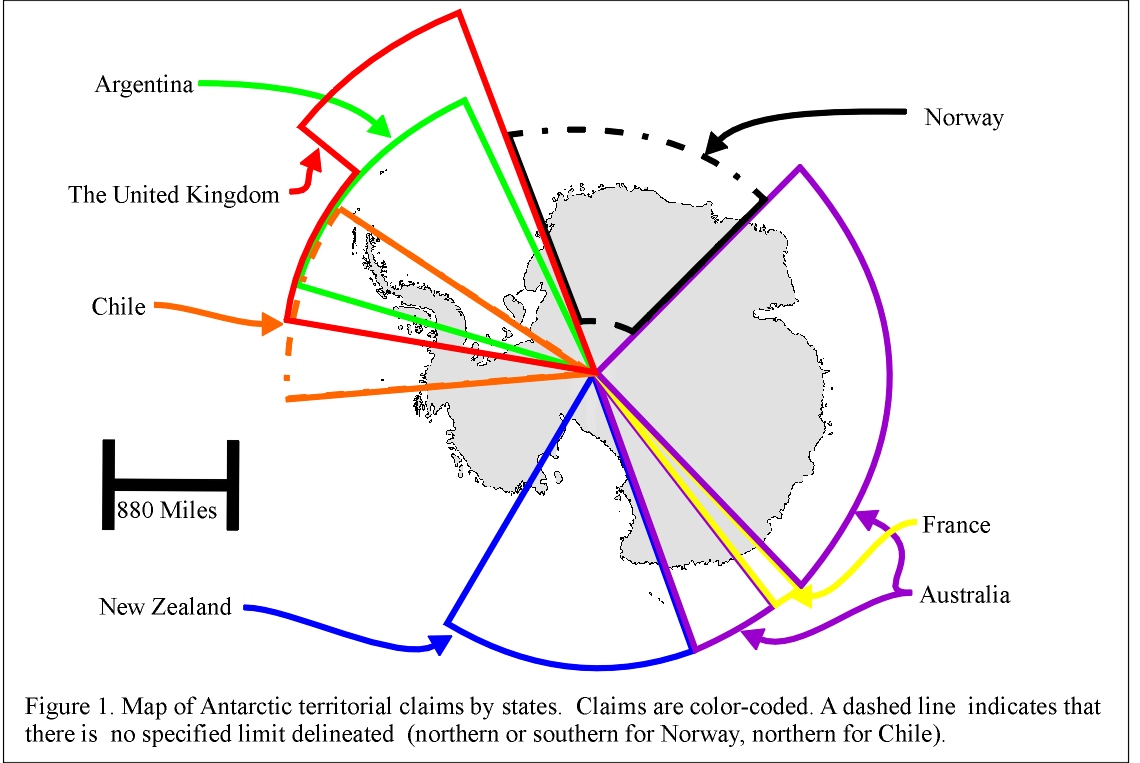
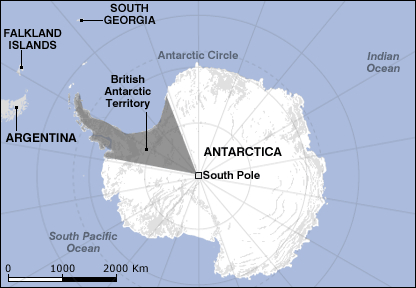
Of course the real interest in “owning” the Falklands – for Argentina and for Britain – is the proximity to Antarctica, the basis it provides for territorial claims and the access it ensures. Territorial claims in  Antarctica have been frozen since 1961 till when 7 nations had registered claims. Currently the entire Argentinian claim falls within the British Antarctic Territory and it must be terribly frustrating for Argentina to find the UK leveraging its ownership of the Falklands all the way to the South Pole.

Antarctic territorial claims(graphic - http://geography.osu.edu/grads/jdavis/fig1.jpg)

Antarctic territorial claims
(graphic – http://geography.osu.edu/grads/jdavis/fig1.jpg)

falklands and antarctica (BBC)

falklands and antarctica (BBC)

Greenland votes today on whether to let the Chinese in

March 12, 2013

Greenland flag

UPDATE!

Greenland’s main opposition leader, who campaigned on a platform of greater control and higher taxes of foreign miners, gained the biggest number of votes in a national parliamentary election, underscoring a backlash against the island’s fast globalisation.

Aleqa Hammond’s Siumut party won around 42 percent of votes, or around 14 seats in the 31-seat parliament, meaning she will need to form a coalition. Prime Minister Kuupik Kleist won around 34 percent of votes, according to official results published by Greenland’s national KNR broadcaster.

=====================================================

Not that it is very relevant to the “general” election being held in Greenland today, but I had not really appreciated that Greenland (and half of Iceland and a large chunk of Siberia and part of Japan) are part of the North American Continental plate.  Greenland has been inhabited – off and on – for some 5000 years (from c. 2500 – 3000 BCE) and initially by the ancestors of the Arctic peoples (paleo-Eskimos). The Scandinavian link goes back to around 1200 years ago (900 CE).

 Norsemen settled on the uninhabited southern part of Greenland beginning in the 10th century. Inuit peoples arrived in the 13th century. The Norse colonies disappeared in the late 15th century. In the early 18th century, Scandinavia and Greenland came back into contact with each other, and Denmark established sovereignty over the island. Having been ruled by Denmark-Norway for centuries, Greenland became a Danish colony in 1814, and a part of the Danish Realm in 1953 under the Constitution of Denmark. In 1979, Denmark granted home rule to Greenland, and in 2008, Greenlanders voted to transfer more power from the Danish royal government to the local Greenlandic government. Under the new structure, in effect since June 21, 2009, the Danish government retains control of foreign affairs, national defence, the police force, and the justice system. …

Following World War II, the United States developed a geopolitical interest in Greenland, and in 1946 the United States offered to buy Greenland from Denmark for $100,000,000, but Denmark refused to sell.

Kuupik Kleist, prime minister of Greenland Рус...

Kuupik Kleist, prime minister of Greenland (wikipedia)

The Inuit Ataqatigiit Party which is currently in power in the “Home Rule” Government is a curious mixture of being both left-leaning and somewhat nationalistic. Their target is for an economic and politically independent Greenland and want to reduce the financial support from the Danish government by increasing the rate at which Greenland’s mineral resources are exploited. But to do that they will need labour and it seems that this could come from China. If they win the election today it could open the door for 2,000 – 3,000 Chinese engineers and miners. The opposition Siumut Party seems to have very similar goals but they don’t agree with bringing the Chinese in.

Aleqa Hammond Siumut leader

The BBC reports:

Voters go to the polls in Greenland on Tuesday, in an election dominated by the question of how the territory should exploit its mineral riches. Nearly 70% of 57,000 inhabitants are eligible to vote in Greenland, a Danish territory with partial autonomy.

Many are keen to reduce reliance on Denmark’s annual subsidy of $576m (£387m).

Iron, uranium and rare earths lie underground, but opinions differ over how to extract them. The latest poll predicts a tight race between the governing left-leaning Inuit Ataqatigiit party (IA) and the opposition Siumut party, reports the BBC’s Malcolm Brabant from the Danish capital, Copenhagen.

They will be fighting for 31 seats in a home rule government. There is only one polling station in the capital, Nuuk – a town of 15,000 with only two traffic lights.

The IA – headed by Prime Minister Kuupik Kleist – is in favour of importing cheap, foreign, mainly Chinese labour to mine iron ore. Siumut – led by Aleqa Hammond – is opposed to the plan, which could see Greenland’s population increase by 5%.

The election will be monitored in China, which wants Greenland’s iron for its expanding economy, and in turn by European Union officials who have expressed concern about China’s influence in the territory. ..

Two years on and Japan returns to nuclear power

March 11, 2013

It is two years today since the Great 2011 Tohoku Earthquake and Tsunami and the meltdown at 3 reactors of the Fukushima Daiichi nuclear plant.

It was the most powerful known earthquake ever to have hit Japan, and one of the five most powerful earthquakes in the world since modern record-keeping began in 1900. The earthquake triggered powerful tsunami waves that reached heights of up to 40.5 metres in Miyako in Tōhoku’s Iwate Prefecture and which, in the Sendai area, travelled up to 10 km inland. The earthquake moved Honshu (the main island of Japan) 2.4 m  east and shifted the Earth on its axis by estimates of between 10 cm  and 25 cm.

On 12 September 2012, a Japanese National Police Agency report confirmed 15,881 deaths, 6,142 injured and 2,668 people missing across twenty prefectures, as well as 129,225 buildings totally collapsed, with a further 254,204 buildings ‘half collapsed’, and another 691,766 buildings partially damaged. … 

The tsunami caused nuclear accidents, primarily the level 7 meltdowns at three reactors in the Fukushima Daiichi Nuclear Power Plant complex, and the associated evacuation zones affecting hundreds of thousands of residents.

In the knee-jerk reaction to the Fukushima accident all Japan’s 50 nuclear reactors in operation were shut down. Ongoing nuclear power plant projects were suspended. The global debate was more an emotional wave rather than rational discussion. The fear was real of course but what was generally ignored was that while the earthquake and tsunami killed some 18,000 the Fukushima accident did not cause any direct radiation related fatalities. The reality is that the Fukushima reactors were designed in the 1960’s and yet managed to survive the magnitude 9.1 earthquake but they could not cope with and succumbed to the massive tsunami. After the earthquake the reactors were actually shut down – automatically and in good order – but the emergency power to the cooling systems were knocked out by the subsequent tsunami. The failure was a failure of anticipating and designing for a tsunami that was as large and as powerful as it was. Tsunami’s as large as the 2011 event have occurred in Japan roughly every 1000 years. The Fukushima failure was not so much a fault of the nuclear plant as the failure of the designers in anticipating a sufficiently large tsunami within the lifetime of the plant.

But two years on, some rationality is returning to the debate. Two reactors have been turned back on and construction has gingerly been restarted on the new 1383 MW advanced boiling-water reactor at Oma.

Map credit Washington Post

Washington Post: 

In the aftermath of March 2011 meltdowns in Fukushima that contaminated 700 square miles with radiation and forced 150,000 to flee their homes, most never to return, Japan’s utility companies paused nearly all nuclear-related projects. The accident sparked a global debate about nuclear power, but it was especially fierce in Japan, where all 50 operable reactors were taken offline and work was halted on three new plants where building had been underway.

But two of the existing reactors are back in action, and the resumption of construction at the Oma Nuclear Power Plant here — a project that broke ground in 2008 and was halted by the operator, J-Power, after the accident — marks the clearest sign yet that the stalemate is breaking. ….. 

At the national level, Japan has cycled through three prime ministers since Fukushima — the first fiercely anti-nuclear, the next moderately anti-nuclear, the current one cautiously pro-nuclear. The previous ruling party tried last fall to plot a nuclear phaseout by the 2030s, but anti-nuclear advocates say the pledge was watered down to the point of being meaningless. The new prime minister, Shinzo Abe, plans this month to convene the latest in a series of expert panels to help overwrite the phaseout plan, and its makeup suggests that he prefers a role for nuclear power.

Japan’s anti-nuclear movement, which swelled after the Fukushima accident, could still play a role, but it is politically disorganized and has grown quieter in recent months. Individual activists cite the resumption at Oma as controversial but note that the move did not prompt mass-scale protests. ….. 


Archive of posts on management behaviour

March 10, 2013

A reader has suggested I collect my posts on management behaviour on a separate site, but I am not sure I would be able to do justice to yet another blog even though it would have the advantage of being a much more focused site. However to address – at least partially – the reader’s difficulty in finding some of my past posts on the subject, they are re- linked below. (These and all other posts tagged “management” can be found here).

  1. Ethics and Business  April 19, 2010

  2. Why Forecasts need to be wrong October 7,2010

  3. “Essence of a Manager” released March 29, 2011

  4. The Art of Motivation April 21, 2011

  5. Power and empowerment April 30, 2011

  6. Strength in a Manager: The materials analogy May 8, 2011

  7. Japan Colloquium: Lessons for crises management July 24, 2011

  8. What makes a “good” manager? April 12, 2012

  9. Manager Selection: Using hypothetical scenarios in interviews June 10, 2012

  10. How to use your CV to “control” the subsequent interview November 20, 2012

  11. The need for communication leads to speech and grammar and language February 25, 2013

Flu vaccine strongly linked to narcolepsy in children

March 9, 2013

I believe that massive public health programs every winter for the consumption of flu vaccines are driven more by commercial rather than medical considerations. Now comes the news that the risk of narcolepsy in children is enhanced 14 times by the use of Pandemrix. Indiscriminate use of flu vaccines – especially with their limited effectiveness  – do a major public disservice by providing ammunition for the “anti-vaccination brigade”. Whether the success rate of the flu vaccines is high enough to justify the expense of mass campaigns is not clear for me. Certainly I am uncomfortable with the links  between pharmaceutical companies and those who authorise mass campaigns of vaccination.

(Reuters)Growing evidence of a link between GlaxoSmithKline Plc’s pandemic flu vaccine and an increase in narcolepsy cases among children who received it in Europe, is giving pause to health regulators weighing approval of a similar vaccine in the United States.

Data published recently in the British Medical Journal found that children in England who received GSK’s Pandemrix vaccine during the 2009-10 H1N1 swine flu pandemic had a 14-fold heightened risk of developing narcolepsy, a chronic and potentially debilitating sleep disorder that can cause hallucinations, daytime sleepiness and cataplexy, a form of muscle weakness precipitated by strong emotion.

Authors of the study – whose results echo those of similar studies in Sweden, Finland and Ireland – said the data had implications for the approval and use of future vaccines that, like Pandemrix, contain AS03, a new adjuvant, or booster, that turbo-charges the body’s immune response to the vaccine.

Scientists believe AS03 may be the culprit in the narcolepsy cases though they have yet to decipher the precise nature of the association.

…. A 14-member panel of advisors to the FDA voted unanimously in November to recommend the vaccine to protect against bird flu. The panel considered early studies from Europe showing an increase in the number of narcolepsy cases but concluded that the potential benefit of the vaccine outweighed the risk.

Since then, however, new data, including the study results from Britain, suggest the scale and strength of the narcolepsy link could be greater than first thought. At least one committee member would like the FDA to reconvene the panel.

…. According to GSK, some 30 million doses of the vaccine were administered across Europe and 800 people, mostly children, developed narcolepsy. While acknowledging an association, the company says there is insufficient evidence to prove Pandemrix is the cause. ……

I am not sure if the numbers (except the revenues and profits) actually add up.