Dark and mysterious ways of Turkish academia

March 7, 2013

Professor Debora Weber-Wulff addresses some of the dark and mysterious ways of Turkish academia on her blog. Academic misconduct is apparently wide-spread, largely ignored and is condoned making for a culture with very dubious ethics which has become self-perpetuating . It does not paint a very pretty picture but it is noteworthy that the picture is coming to light only because of the work of a group of other academics. But to break out of the vicious circle will not be so easy.

The Dark Alleys of Turkish Academia

I published a short note in September 2012 about the work of a group of academics in Turkey. A. Murat Eren has now organized a translation of their work into English so that a wider group of scientists can take a peek into the very dark alleys of Turkish academia. …..

….. And then there is the list of academics in Turkey with the most retractions to their name — and their current occupation. Let me quote these here, because it is so shocking:

Only one of the authors with multiple retracted papers is not affiliated with academia. Anyone who knows how difficult it is to get a paper retracted will understand the depth of concern here. How can these people teach at university and mentor doctoral students when they themselves have multiple retractions to their names?

The same chapter also reports on the Sezen case, one that I blogged about in June 2012.

Eren’s conclusions:

  • Turkey’s bad academia is self-perpetuating.
  • People who have committed ethical violations in their dissertations and publications are allowed to become thesis supervisors. Students who are misguided by these create dissertations that equally violate ethics, publish insignificant or duplicated papers, and some of them become the new academic generation, in turn completing the cycle.
  • One of the major problems that perpetuates this cycle is the difficulty of access to dissertations. University libraries limit access with arbitrary reasons, and improvements in YÖK Thesis Archive are far from solving the problem in practice.
  • Even when a dissertation is accessed and plagiarism is seen, penalties are far from being deterrent, due to legal and executive roadblocks.
  • While advanced societies take science theft very seriously, actors of science theft in Turkey silently go on with their duties, thus deleteriously undermining the credibility of the field.
  • Even though today’s scientists in Turkey are not proactive, and they are mostly mute unless they have to defend themselves, I believe that self-criticism will become a way to reveal and eventually eradicate academical problems in Turkey in the future.

I am indebted to the Turkish scientists who have worked on this. I have corresponded with them and did some proofreading on the English version. I hope that this will shine a bright light down the dark alleys

“Half of deer population in UK should be culled” to protect countryside and birdlife!!

March 7, 2013

There is a large amount of hypocrisy and no small measure of irony here!

The bio-diversity creed seems to have become “Kill off the successful species and protect the unsuccessful ones”.

BBCDeer: 50% cull ‘necessary to protect countryside’

Around half of the UK’s growing deer population needs to be shot each year to stop devastation of woodlands and birdlife, a group of scientists says. A study published in the Journal of Wildlife Management says this would keep numbers stable.

The deer population is currently estimated at around 1.5 million. The researchers from the University of East Anglia suggest creating a venison market to make a cull ethically and economically acceptable. The Royal Society for the Protection of Animals (RSPCA) commented that any cull must be carried out in a humane and controlled way and be supported by “strong science”.

There are now more deer in the UK than at any time since the last Ice Age. …

…. Dr Paul Dolman, ecologist at the University of East Anglia and lead author, said: “We know deer are eating out the… vegetation of important woodlands, including ancient woodlands.

“Deer are implicated as the major cause of unfavourable conditions in terms of woodland structure and regeneration.

“There is evidence that deer reduce the number of woodland birds – especially some of our much loved migrant birds species like Blackcap and Nightingale, and resident species like Willow Tip. We have a problem.”

Dr Paul M Dolman

Dr Paul M Dolman – Bambi killer

Dr Paul Dolman is one of the “biodiversity” brigade and seems to be a bird-watcher of some note. But like most of this advocacy group he seems more than a little confused. I note that he invokes “strong science” – whatever that may be – to support his vision of a string of farm-shops and gastro-pubs serving venison. It would take more than a few pubs to handle 750,000 deer every year. I like his comment that such meat would be “ethically sourced”! I suppose that makes it all right then. This is not science – it is religion.

“We are not killing something and then incinerating the carcass – what we are talking about is harvesting a wild animal to supply wild free-ranging venison for or tables – for farm shops, for gastro pubs.

“What we are advocating isn’t removing deer from the countryside – what we are advocating is trying to get on top of the deer population explosion and try to control the problems that are being caused.

“And in a way, [venison] provides a sustainable food source where you know where it comes from, you know it is ethically sourced, you know it is safe to eat, and that puts food on people’s tables. As much as I love deer, to be a meat eater but then to object to the culling and harvesting of deer seems to be inconsistent.”

Being on-line and anonymous does not eliminate accountability and responsibility

March 6, 2013

The Washington Post considers the pluses and minuses of anonymity in the on-line world but typically just stays on the fence. “It’s complicated”. In an abundance of indecision and of  “political correctness” it reaches no conclusion.

But I take a rather simplistic and uncomplicated view. “On-line” is just one more medium through which “publishing” can take place. This medium may be much more immediate and with greater global spread than other media. But whatever the medium may be, responsibility and accountability for what is published cannot just vanish. It cannot just disappear into some black hole between an author and his publisher. Either the publisher or the author must take responsibility and be accountable for whatever is published. The publisher controls the medium. Whether he wishes to allow anonymity or not is his prerogative. But if the publisher (the on-line web-site host) allows his authors to keep their identities secret from the public then he must take responsibility and be accountable for what is published.  It is also then his call as to whether he himself wishes to know the identity of those using the platform he provides. Where, however, the author is publicly identified then the publisher is effectively indemnified.

Where comments (on a blog or a web-site or a forum) are allowed anonymously then applying moderation is the host’s call but he cannot escape the responsibility or the accountability for the content he allows.

Anonymity does not eliminate responsibility and accountability. It merely shifts responsibility from the author to the publisher. The buck has to stop somewhere.

Washington Post: It shields the whistleblower from blowback and the deep-background source from getting deep-sixed. It helped women publish novels way back when . . . when that was a pretty novel idea. But it can also embolden the kook to get kookier and the racist to get . . . well, you get the picture.

….. Fey and Pexton, whose thoughts have gotten the viral launch that only a lengthy discussion on NBC’s “Today” show can provide, veer toward an age-old question. Does anonymity make us good? Or does it make us bad? And now that we’ve had a good long while to get used to splashing around online, there’s another question to ponder: Does the Internet make it easier for us to be anonymously bad or anonymously better?

The answer isn’t so simple. Consider 4Chan, a hugely popular and emphatically anonymous Internet board that began as a place to discuss Japanese anime and has swelled into dozens of boards focused on everything from “science & math” to “Sexy Beautiful Women.”

The site can get raunchy. The posters can get rough with each other. Anonymity has the effect of making the users less inhibited, said Michael S. Bernstein, who studied the site’s “/b/ – random” board with colleagues at MIT and the University of Southampton in Britain. That lack of inhibition has led to plenty of “gore, pornography and racism,” Bernstein, now a computer science professor at Stanford University, said in an interview.

But amid all the offensive behavior, Bernstein and his fellow researchers also found that anonymity had a lot of positive effects. One of the most notable was the creation of a culture that fostered experimentation and new ideas. Since no names were being used, the users felt more comfortable taking risks. They’ve ended up contributing to the creation of an Internet culture and to a proliferation of memes. ….

…. The American Association for the Advancement of Science (AAAS), publisher of the respected journal Science, was concerned enough to commission a study that concluded anonymity was something worth striving to preserve. “There was talk at the time about making anonymity difficult or impossible,” said Albert H. Teich, a professor at George Washington University who was director of science and policy programs at AAAS when the study was released.

The scientists wanted the Internet to be a place where political opinions could be expressed freely without fear of repercussions; where, say, a teen struggling to come to grips with his sexuality could discreetly seek advice.

…. Still, he’s torn. Terrorism gives him an argument against anonymity. Protecting contacts who were helping AAAS combat human rights violations in Central America gives him a reason to protect anonymity. …..

Rabbits (or a lack thereof) killed off the Neanderthals!

March 4, 2013

A new paper in the Journal of Human Evolution claims that the diet of the Neanderthals contained far fewer rabbits than that of Modern Humans. The paper then suggests that this was because Neanderthals could not shift from hunting large prey to hunting small animals. The data may well be valid but the interpretations of the data and the conclusions drawn are so lacking in common sense that the entire paper may well qualify as “idiot science”.

Rabbits and hominin survival in Iberia

by John E. Fa, John R. Stewart, Lluís Lloveras and J. Mario Vargas

Abstract

High dependence on the hunting and consumption of large mammals by some hominins may have limited their survival once their preferred quarry became scarce or disappeared. Adaptation to smaller residual prey would have been essential after the many large-bodied species decreased in numbers. We focus on the use of a superabundant species, the rabbit, to demonstrate the importance of this taxon in Iberia as fundamental to predators. We show that the use of the rabbit over time has increased, and that there could have been differential consumption by Neanderthals and Anatomically Modern Humans (AMH). Analysis of bone remains from excavations throughout Iberia show that this lagomorph was a crucial part of the diet of AMH but was relatively unutilised during the Mousterian, when Neanderthals were present. We first present changes in mammalian biomass and mean body mass of mammals over 50,000 years, to illustrate the dramatic loss of large mammalian fauna and to show how the rabbit may have contributed a consistently high proportion of the available game biomass throughout that period. Unlike the Italian Peninsula and other parts of Europe, in Iberia the rabbit has provided a food resource of great importance for predators including hominins. We suggest that hunters that could shift focus to rabbits and other smaller residual fauna, once larger-bodied species decreased in numbers, would have been able to persist. From the evidence presented here, we postulate that Neanderthals may have been less capable of prey-shifting and hence use the high-biomass prey resource provided by the rabbit, to the extent AMH did.

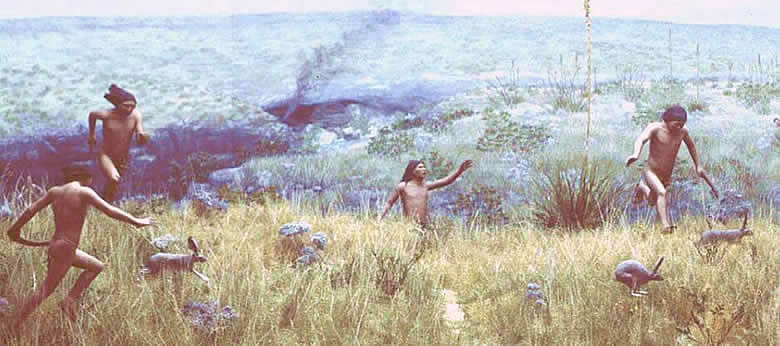
painting of prehistoric hunters

Prehistoric hunters prepare to unleash their throwing sticks at a group of jack rabbits on the run. Painting by Nola Davis, courtesy Texas Parks and Wildlife Department.

That Anatomically Modern Humans ate more rabbits than Neanderthals may well be true but to then leap to the amazing conclusion that Neanderthals were incapable of hunting small prey and then to the even more dubious suggestion that this may have something to do with the demise of Neanderthals as a species takes legitimate speculation into the fantasy worlds of the Land of Painted Caves. We could just as well assume that eating rabbits led to a virulent disease which AMH were immune to but which led to the eradication of the Neanderthal species (except of course for the offspring of those who had mated with AMH) !!

Baby cured of HIV?

March 4, 2013

A baby has apparently been cured of HIV by very early treatment. There are headlines around the world.

A giant leap forward it would seem and it ought to be a cause of great celebration

But my reaction is completely dominated by this one sentence buried within Reuter’s report:

There are no samples that can be used by other researchers to confirm the findings, which may lead skeptics to challenge how the doctors know for sure that the child was infected.

I am extremely wary about hype surrounding “great advances” especially when a huge amount of research funding is possibly at stake.

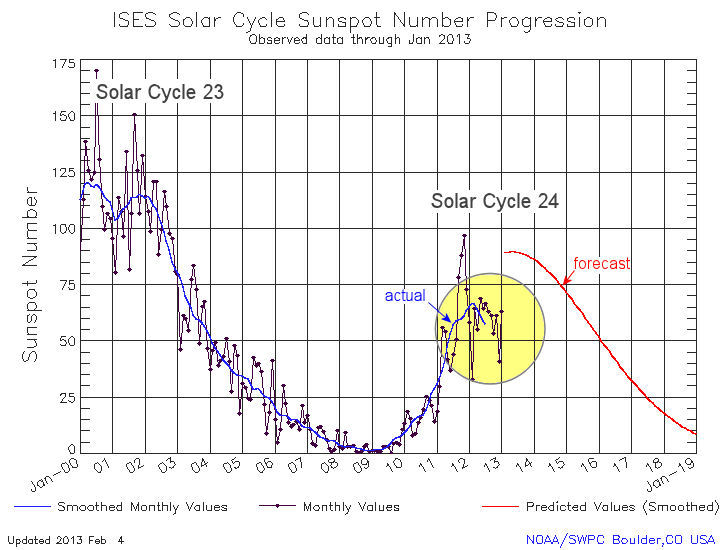
Double peak in Solar Cycle 24? as in SC14 and in SC5?

March 4, 2013

The NOAA/NASA Solar Cycle Prediction Panel is puzzled. They don’t know if we are reaching solar maximum or whether another little peak could be on its way which would shift solar maximum for SC24 to 2014 from 2013.

And should we compare SC24 with SC14 or should it be SC5?

But SC24 will still show the lowest sunspot activity for 100 years. I note that not only SC14 but even SC5 had a double peak – so my expectation remains that this Landscheidt Minimum may be comparable to the Dalton Minimum – though not perhaps to the Maunder Minimum.

credit Dr. Tony Phillips

credit Dr. Tony Phillips

This Sciencecast video is a good summary of what we don’t know:

Landscheidt’s prediction is that this Minimum will last till 2060 so we can expect low sunspot activity for the next 4 sunspot cycles (till SC28).

Landscheidt’s predicted solar minima

The Sc24 –  SC5 comparison looks like a repeating pattern but it would be wrong to assume that the Sun cares about this and it will surely continue to keep us perplexed as it does its own thing.

SC24 compared to SC5

The Big Picture is persuasive – even if we don’t really know what the sun is upto and even less about how the Earth dances to the Sun’s music.

Recent solar activity (Wikipedia) showing the Maunder and Dalton minima

Related:

Solar cycles and the Landscheidt minimum

Theodor landscheidt: Sun-Earth-Man and the Kepler ratios

A Guard fit for a Queen

March 4, 2013

BBC

Police officers outside the King Edward VII Hospital in London, where the Queen has been admitted

Britain’s tallest police officer – PC Anthony Wallyn, who is 7ft 2in – was among the officers standing guard at the hospital on Sunday

PC Anthony Wallyn


An almost hidden message

March 2, 2013

from Ilusoes Optica

How many colours?

Jaguar Land Rover poised to “make in India, export to the emerging world”

March 2, 2013

Jaguar Land Rover sells around 250,000 Land Rovers and about 55,000 Jaguars worldwide.  In 2011/12 this generated about £13.5 billion sales with a profit of £1.5 billion.  They will spend around £2 billion in the 2013 financial year on new products including a new £350 million engine plant in the West Midlands.

JLR’s Strategy (Sustainability Report), JLR Strategy, states:

In 2011 we expanded assembly operations into India, one of our key markets, and announced plans for our first manufacturing facility abroad in another key market, China, through a joint venture with Chery Automobile Company Ltd. We predict Jaguar Land Rover sales will more than double in volume by 2020, largely due to increasing demand in emerging markets.

Now Reuters reports that the emerging market strategy is progressing fast and that JLR is poised to move from just assembly to the complete manufacture of some brands in India. They join the growing number of players who now see India as a sort of export hub to emerging markets.

Jaguar Land Rover (JLR) is investigating the potential of manufacturing cars in India, company sources said, as the British luxury carmaker looks to build on its growth in emerging markets with the help of Indian parent Tata Motors.

JLR, which has ridden a wave of surging demand in China and other emerging markets to post record profits over the past year, is “actively exploring the possibility” of building cars from scratch in India, said one company source.

“The idea is being looked into, with the (Jaguar) XF and (Land Rover) Freelander the obvious candidates,” said another source with knowledge of the matter.

The British brands, which already assemble two models in India using parts and engines shipped from factories in the UK, will also begin assembling its popular Range Rover Evoque in the country soon, the first source said without providing details.

Building cars in India, which has developed into an emerging market export hub for many global carmakers, would allow JLR to skirt high import taxes on luxury cars, which the country’s finance minister proposed raising to 100 percent from 75 percent in his budget speech last week.

… JLR will exhibit a new 9-speed automatic Evoque and an electric-powered version of its Land Rover Defender at the Geneva Motor Show next week.

Bought by Tata for $2.3 billion from Ford in 2008, JLR has defied those skeptical of its future under Indian ownership to roar back into profit over the past three years as the main growth driver for its now-struggling parent.

Continued growth in emerging markets such as India and China, which accounted for 22.3 percent of its sales in the December quarter, is key for JLR as it embarks on an expensive overhaul of its production and product clout. The carmaker is investing $1.7 billion with local partner Chery Automobile Co in a factory in China.

JLR lags rivals BMW AG, Volkswagen AG’s Audi and Daimler AG’s Mercedes-Benz in assembling cars in India, where the luxury market is expected to swell by around six times by 2020 to 300,000 cars a year, according to business consultancy Frost & Sullivan. ….

…. Earlier this year JLR started the assembly of the 2.2-litre diesel version of the Jaguar XF saloon at a plant in Pune, west India, tucked away in a corner of a sprawling production site where Tata builds its heavy duty trucks and hatchbacks.

Screwed together using engines and components shipped from JLR’s Castle Bromwich plant in Birmingham, central England, the company has also been assembling its Land Rover Freelander 2 in Pune since May 2011.

The XF and the Freelander 2 are JLR’s best-selling models in India, where it sold 2,288 cars in the year to March 2012, up 157 percent from the previous year. ….. 

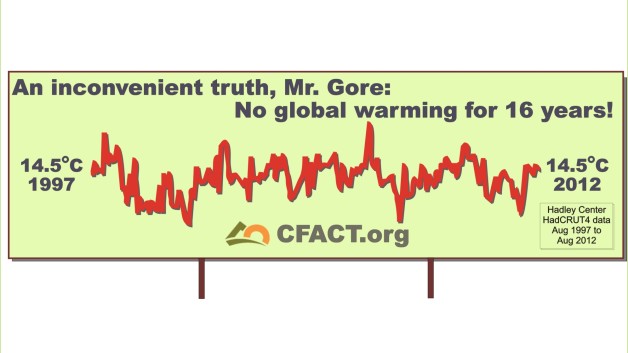
Global warming on hold (courtesy of the sun)

March 2, 2013
  • CO2 lags global temperature.
  • CO2 keeps increasing while temperature stands still.
  • Man made CO2 is about  3.6 % of all CO2 production

An inconvenient truth it’s the sun stupid!

16 years

CFACT Billboard