Falcon 9 launches as Dragon sets off on its second cargo supply mission

March 2, 2013

SpaceX has launched CRS-2 — its second  mission to the International Space Station. The Dragon capsule aboard the Falcon 9 rocket will dock with the ISS today, delivering 677 kg of cargo to the astronauts currently there, and will return in about 2 weeks.

Initial thruster problems threatened the mission but these seem to have been solved.

But vexing trouble with the capsule’s rocket thrusters quickly turned the $133 million flight into a high-tech cliff hanger. Six-and-a-half hours after launch, follwoing extensive troubleshooting and analysis, it appeared company engineers had resolved the problem, bringing all four sets of thrusters on line and setting the stage for a delayed rendezvous with the space station.

From Space X press release: 

Hawthorne, Calif. – Today, Space Exploration Technologies (SpaceX) successfully launched its Falcon 9 rocket and Dragon spacecraft to orbit for SpaceX’s second mission under its Commercial Resupply Services (CRS) contract with NASA. Falcon 9 completed its job perfectly, continuing its 100 percent success rate.

“Falcon 9 was designed to be the world’s most reliable rocket, and today’s launch validated this by adding to Falcon 9’s perfect track record with our fifth success in a row,” said Gwynne Shotwell, President of SpaceX.

After Dragon separated from Falcon 9’s second stage approximately nine minutes after launch, a minor issue with some of Dragon’s oxidation tanks was detected. Within a few hours, SpaceX engineers had identified and corrected the issue, normalizing the oxidation pressure and returning operations to normal. Dragon recomputed its ascent profile as it was designed to and is now on its way to the International Space Station (ISS) with possible arrival on Sunday, just one day past the original timeline.

Dragon is the only spacecraft in the world today capable of returning significant amounts of cargo to Earth. Dragon will stay on station for a three-week visit, during which astronauts will unload approximately 1,200 pounds of cargo and fill the capsule with return cargo, for return to Earth. Dragon is filled with supplies for the ISS, including critical materials to support science investigations. Later this month, Dragon will return a payload that includes research results, education experiments and space station hardware.

Updates on the CRS-2 mission can be found at www.spacex.com/webcast. Broadcast quality video may be downloaded at vimeo.com/spacexlaunch and high-resolution photos are posted at spacexlaunch.zenfolio.com.

About SpaceX

SpaceX designs, manufactures, and launches the world’s most advanced rockets and spacecraft. The company was founded in 2002 by Elon Musk to revolutionize space transportation, with the ultimate goal of enabling people to live on other planets. Today, SpaceX is advancing the boundaries of space technology through its Falcon launch vehicles and Dragon spacecraft. SpaceX is a private company owned by management and employees, with minority investments from Founders Fund, Draper Fisher Jurvetson, and Valor Equity Partners. The company has more than 3,000 employees in California, Texas, Washington, D.C., and Florida. For more information, visit SpaceX.com.

Obama’s sequester

March 1, 2013

From this side of the Atlantic, it looks like the sequester in the US is going to come into effect and some $85 billion of public spending will – eventually – be avoided. Last minute chit-chat at the White House has not led to any agreement.

I read that President Obama was blaming Congress and warning of the pain ahead.

Somehow this does not ring true.

The President of the US has or controls all the cards and it is he who sets the agenda. He could – I think –  have reached a compromise with Congress whenever he wanted – if he wanted to. But any compromise he could have reached would have contained spending cuts which he may well know is absolutely necessary but which would not have gone down well with his supporters. I note that the markets are not very perturbed and this also suggests that the pill may be bitter but it may well be the correct thing to do.

It seems to me – albeit from very far away – that Obama is actually using the sequester to do some of what is absolutely necessary but where he can – perhaps – avoid blame for the necessary and unavoidable pain.  The US has been more profligate even than Italy for far too long and the public debt cannot be sustained. But nobody wants to be seen as being responsible for the pain that must be borne. It does not seem to me that Obama wanted a compromise to be reached at all. Hence the almost intransigent positions taken by the White House in discussions with Congress. They were intended to fail.

Nothing is as what it seems. This sequester is actually Obama’s opportunity of getting the US to swallow some very bitter medicine without having to take the blame – and he knows it.

If he signs off on it later today it will be because it is his sequester.

Fighting against species extinction is to deny evolution

February 27, 2013

I was reading an article today about the threat of extinction for leather-backed turtles and once again I started wondering as to why extinction of a species or a language or of an isolated tribe arouses moral outrage or is an emotional matter for so many people. I don’t want these turtles to become extinct just as I don’t want tigers or polar bears or pandas to become extinct. But this is purely an emotional reaction because each of these animals is attractive – to my human eye – in its own right. Outside of TV documentaries, zoos and safari parks I have never seen any of them. I don’t have the same reaction when I read that guinea worms or disease-carrying species of mosquitoes are being eradicated. “Good riddance” is then the predominating feeling that I have. Yet whether a mammal or a bacterium becomes extinct the genetic loss is about the same. That dinosaurs became extinct millions of years ago or even that humans killed off the dodo or the thylacine or the Javan tiger in more recent times arouses some feelings of regret but not any moral outrage or much emotional response from me. The article about the turtles – like most other articles about the extinction of species  – is permeated with the politically correct assumption that extinction would be a “bad thing”. But I never see properly addressed the question as to why the extinction of a species is a “bad thing”.

This is essentially a value-judgement and is taken for granted and yet – in the rational plane – I can only conclude that there is nothing “unnatural” about this. In fact it is this emotional desire that species considered “attractive” should not become extinct when their time is due that is irrational. Normal or natural evolution is always a result of change. It is the result of species responding to change where the individuals of a species most suited to the changed circumstances continue and reproduce. Where the variety existing within a species is insufficient to provide any individuals who can survive and reproduce in the changed environment, the species dies out. It is said that about 90% of all species that have ever lived have become extinct. If they had not there would be no room for the 10% that exist today. Just as homo sapiens would never have evolved without the environmental changes which led to the extinction of the dinosaurs, most of the species alive today would not have succeeded their extinct ancestors if conditions had not led to their extinction. Where a species cannot compete with another – in whatever the prevailing circumstances – it dies out. It makes room for the more successful species.

Siberian Tiger Français : Tigre de sibérie Ita...

Siberian Tiger Français : (Photo credit: Wikipedia)

So what then is the objection to – say – tigers becoming extinct which is not just an emotional reaction to the disappearance of a magnificent but anachronistic creature?  The bio-diversity argument is not very convincing and is of little relevance. To artificially keep an unsuccessful species alive in a specially protected environment has no genetic value. It increases the mis-match between the existing environment and the genetic profile needed to survive in that environment. In fact the biodiversity argument is only relevant for “life” in general and never for any particular species or group of species.  It can serve to maintain a very wide range of genetic material in the event of a catastrophe such that some form of life has a chance of continuing. But given a particular environment biodiversity in itself is of little value.

Returning to the tiger as an example, the variety of individuals within the tiger population does not provide any which have the characteristics necessary for adapting to the reality of co-existing with humans in some form of urban living. Foxes, on the other hand, are evolving within our lifetimes. In a few more fox generations, urban foxes will out-compete their “wild” cousins who may well become extinct. But urban foxes will thrive. Many bird species and insects are throwing up the individuals to succeed in the shadow of the success of the human species. Bacteria and no doubt viruses are also throwing up their survivors. Some bacteria are changing faster than we would like. The polar bears who visit Churchill every year are evolving. Those who know how to forage in human communities have a distinct advantage over their less intelligent brethren. And of those who visit Churchill it is the ones who avoid attacking humans which have the best chance of surviving. (Polar bears are of course thriving and are in no danger of extinction – but that is another story). Langur and rhesus monkey troops in Delhi are in the process of becoming urbanised and “evolving” to succeed in their human-filled environment. These species are not domesticated. They are still wild but they are evolving – by selection – into new species suited to their new environment.

All those species which succeed into the future will be those which continue to “evolve” and have the characteristics necessary to thrive within the world as it is being shaped and changed by the most successful species that ever lived (though we cannot be sure how far some particular species of dinosaur may have advanced). Putting a tiger into a zoo or a “protected” environment actually only preserves the tiger in an “unsuccessful” form in an artificial environment. Does this really count as “saving the species”? We might be of more use to the future of the tiger species if we intentionally bred them to find a new space in a changed world  – perhaps as urban tigers which can co-exist with man.

If a polar bear were to hunt and kill a seal – even if it was the last individual of a seal species – it could be a matter of some regret but it would not generate any moral outrage. And then if the polar bears did not themselves adapt to find alternative food sources – then they too would fail to survive. The loss of a species can always be a matter of some regret but so is the death of any individual. Both are equally inevitable but the regret is mitigated by what comes after.

The thought occurs to me that while there is no doubt that human activity is altering the environment for many species, it is of little benefit to try and deny evolution. Species protection must consist of helping “threatened species”  to evolve and not in standing-still in some artificial environment.

Perhaps the answer is – for example – to breed and train a new species of Siberian tiger to manage vast reindeer herds where they could also be allowed to hunt and devour a few!

Chelyabinsk Meteoroid tracked back to the Apollo asteroid group

February 26, 2013

Astronomers at the University of Antioquia, Medellin in Colombia have back-tracked the trajectory of the Chelyabinsk meteoroid and have concluded that it was from the Apollo asteroid group which regularly intersect with Earth’s orbit. The Apollo group contains at least 5,000 asteroids and more than 240 of these are over 1 km in size. The largest known Apollo asteroid is 1866 Sisyphus, with a diameter of about 10 km.

The Chelyabinsk meteoroid crossed from northeast to southwest on February 15th at an angle of 20 degrees above the horizontal at a speed of about 18 km/s. It is estimated to have been about 17-m in size with an estimated mass of between 7,000 and 10,000 tonnes. It exploded at 03:20:26 GMT over 55° 10′ N, 61° 25′ E at an altitude of 15 to 20 kilometers (9.3 to 12.4 miles) with a force of 500 kilotons – the equivalent of 30 Hiroshima atomic bombs.

The astronomers have published their findings:

A preliminary reconstruction of the orbit of the Chelyabinsk Meteoroid

by Jorge I. Zuluaga, Ignacio Ferrin

http://arxiv.org/abs/1302.5377 (abstract)

complete paper (pdf)

Reconstructing the orbit

The Chelyabinsk Meteor Friday 15th Feb. 2013: image from http://www.sott.net

BBC:…. Astronomers have traced the origin of a meteor that injured about 1,000 people after breaking up over central Russia earlier this month.

Using amateur video footage, they were able to plot the meteor’s trajectory through Earth’s atmosphere and then reconstruct its orbit around the Sun. Using the footage and the location of an impact into Lake Chebarkul, Jorge Zuluaga and Ignacio Ferrin, from the University of Antioquia in Medellin were able to use simple trigonometry to calculate the height, speed and position of the rock as it fell to Earth.

To reconstruct the meteor’s original orbit around the Sun, they used six different properties of its trajectory through Earth’s atmosphere. Most of these are related to the point at which the meteor becomes bright enough to cast a noticeable shadow in the videos.

…. The results suggest the meteor belongs to a well known family of space rocks – known as the Apollo asteroids – that cross Earth’s orbit.

Of about 9,700 near-Earth asteroids discovered so far, about 5,200 are thought to be Apollos. Asteroids are divided into different groups such as Apollo, Aten, or Amor, based on the type of orbit they have.

MIT Technology Review: 

“According to our estimations, the Chelyabinski meteor started to brighten up when it was between 32 and 47 km up in the atmosphere,” say Zuluaga and Ferrin, who estimate the velocity at between 13 km/s and 19 km/s relative to Earth.

They then calculated the likely orbit by plugging these figures into a piece of software developed by the US Naval Observatory called NOVAS, the Naval Observatory Vector Astrometry. This allowed them to include the gravitational influence on the rock of the Moon and the 8 major gravitational bodies in the Solar System.


The need for communication leads to speech and grammar and language

February 25, 2013

Extracts from a recent lecture

from liu presentation -Communication for Managers

  1. Thinking gives rise to words
  2. Words are not necessary for thought –but they help
  3. Many words and many people give rise to the need for cooperation which needs communication
  4. The need for communication leads to speech and grammar and language
  5. Grammar is not necessary for thought – but it helps
  6. Language is not necessary for communication – but it helps
  7. Speech is not necessary for language – but it helps
  8. Message is an information package
  9. Meaning comes first and is necessary for message and needs an algorithm for the conversion
  10. Information is whatever can be detected by our senses (sensory, aural, visual, olefactory…..)


Junkies versus Non-junkies: Junk genes are not junk — or maybe they are

February 24, 2013

Myopic “scientists” bitching about each other is always interesting. Scientific theories have their own evolutionary life as some wither and die and some – gradually – become accepted and “proven”.  But it is the behaviour of the protagonists of rival theories which is entirely human. Rivalry, back-biting and childish insults in the world of evolutionary biology between junk-gene supporters and junk-gene debunkers are now getting entertaining.

Animation of the structure of a section of DNA...

from wikipedia

In September last year the ENCODE Project made a major splash when they published some 30 papers in front-line journals showing that most of the human genome dismissed earlier as as “junk genes”  did in fact show biological activity and probably had some as yet unknown function. They reported that they had transcribed some 76% of “junk” DNA and that more than 50% of all genes could be accessible to proteins which can control genetic behaviour and they concluded that over 80% of human DNA serves some purpose.

The term “non-coding” DNA, then popularised as”junk” genes, was coined in 1972. This idea  gradually gained favour and by 2003 the human genome was supposed to consist of some  26,000 protein-coding genes within a large amount of non-coding DNA where the non-coding or “junk” DNA represented some 98% of the whole genome. The results of the ENCODE project turned this idea on its head. The junk gene supporters were not amused. It has taken them a little while to circle the wagons and formulate a response to the flood of papers published in September. And the response resorts to unusually harsh language for scientific discourse. It would seem that the “junk” gene protagonists have been prodded in their vitals and feel their life-work and their livelihoods being threatened!

Junkies versus Non-junkies! The battle-lines have been drawn. They have now published an open-access diatribe: On the immortality of television sets: “function” in the human genome according to the evolution-free gospel of ENCODE

The Guardian: “Everything that Encode claims is wrong. Their statistics are horrible, for a start,” the lead author of the paper, Professor Dan Graur, of Houston University, Texas, told the Observer. “This is not the work of scientists. This is the work of a group of badly trained technicians.”

Scientists are being called technicians — no less!

The junkies write:

From an evolutionary viewpoint, a function can be assigned to a DNA sequence if and only if it is possible to destroy it. All functional entities in the universe can be rendered nonfunctional by the ravages of time, entropy, mutation, and what have you. Unless a genomic functionality is actively protected by selection, it will accumulate deleterious mutations and will cease to be functional. The absurd alternative, which unfortunately was adopted by ENCODE, is to assume that no deleterious mutations can ever occur in the regions they have deemed to be functional. Such an assumption is akin to claiming that a television set left on and unattended will still be in working condition after a million years because no natural events, such as rust, erosion, static electricity, and earthquakes can affect it. The convoluted rationale for the decision to discard evolutionary conservation and constraint as the arbiters of functionality put forward by a lead ENCODE author (Stamatoyannopoulos 2012) is groundless and self-serving.

Would the Junkies  – I wonder – allow 98% of their DNA – or that of their children – to be excised if it could be?

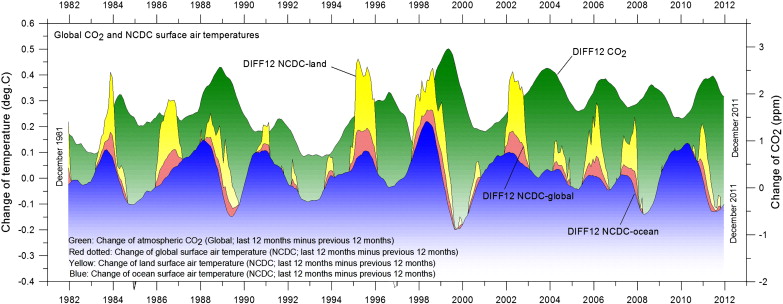
Carbon dioxide lags “global temperature” by 9 – 12 months

February 23, 2013

Just another case of an effect being taken as a cause and yet another nail in the coffin of the “CO2 causes global warming” fantasy.

A new paper in Global and Planetary Change Volume 100, January 2013, Pages 51–69

The phase relation between atmospheric carbon dioxide and global temperature 

by Ole HumlumKjell Stordahl and Jan-Erik Solheim

Highlights:

  1.  Changes in global atmospheric CO2 are lagging 11–12 months behind changes in global sea surface temperature. 
  2. Changes in global atmospheric CO2 are lagging 9.5–10 months behind changes in global air surface temperature.
  3. Changes in global atmospheric CO2 are lagging about 9 months behind changes in global lower troposphere temperature.
  4. Changes in ocean temperatures explain a substantial part of the observed changes in atmospheric CO2 since January 1980.
  5. Changes in atmospheric CO2 are not tracking changes in human emissions.
Figure 5 Humlum et al 2013

Fig. 5. 12-month change of global atmospheric CO2 concentration (NOAA; green), change in global surface air temperature (NCDC; blue), land surface air temperature (NCDC; yellow) and ocean surface air temperature (NCDC; red dotted). All graphs are showing monthly values of DIFF12, the difference between the average of the last 12 months and the average for the previous 12 months for each data series.

On being 65!

February 23, 2013

If I’d been out till quarter to three
Would you lock the door,
Will you still need me, will you still feed me,
When I’m sixty-four?

I was 65 last Sunday and still sometimes go out till quarter to three. But I carry a key.

I am now officially “past-it” and this is wonderful. Nothing of earth-shattering significance is any longer expected of me. Anything I can manage to do now makes me an over-achiever.

People ask whether I have “retired” and here in Sweden I am asked if I am a “pensioner”, but I never know how to reply correctly. A “pensioner” is used here as a kind of a label which I find less than flattering. While I have activated some “pensions” as sources of income, I take on consultancy assignments and lecture and write and that also generates some income.  So, yes I have stopped being an “employee” but  no – I have not retired from life  – yet!. I don’t mind if strangers offer me a seat in crowded places!  I don’t mind being called “uncle” when I am visiting India but I’m still getting used to being addressed as “the old man” or as “Grandfather”. I am expected to be opinionated – which I was anyway. My natural arrogance is less offensive or perhaps I have mellowed and have lost some of my cutting edge. I am not dishevelled but I don’t worry much about how I look any more or if my colour combinations are bizarre. I only need to – or wish to – wear a tie once or twice a month. I can even get away with wearing my old shoe-string ties from the 60’s or broad flowered ties from the 70’s. If I could have gotten into some of my old bell-bottomed trousers I would have (and I don’t know why I am still preserving them). I get reminders about influenza vaccinations but they don’t convince me. I get diabetes diets sent to me by post and e-mail but they don’t offer anything better than what common sense tells me. I get special health insurance offers but they are just junk-mail. Investment opportunities for “seniors” come through tele-marketeers or drop through the letter box but I suspect that they use “senior” as a euphemism for “senile”.

Back in my youth when I turned 60 my son – very dispassionately – said to me, “You studied for 20 years , worked for 40 and you have 20 years left. Why would you want to do anything you did not want to?”. At that time I was deciding whether to continue working for a large multi-national or to do my own thing. With the question formulated as my son did, the answer became a “no-brainer”. Well I have been doing what I wanted to since then. Now I have 15 years to go and don’t intend to do anything I don’t want to. I may be past-it but the list of things I want to do – and can do – keeps expanding. Fifteen years won’t come close to being long enough to get through the entire list so I will have to make priorities. Paradoxically, I am in no rush though.

I wrote my first book a couple of years ago and 3 more are burgeoning in my head. I want to get at least a couple of these written and published. I have idle thoughts about combining onions and red chillies with management theory. It will have to be a cookery book on odd numbered pages and management analogies on even numbered pages! That will take some doing and I have no idea  – yet – of how to make it work. I must still organise my books and establish my “library”. I have still to be fully converted to Kindle. Over the years I have visited some 100 countries while “on business” but now I want to see some of those places without the constraints of having “business” to do. I want to retrace my father’s steps in 1942 when he journeyed 3000 miles to freedom and that is a major project spanning 6 countries which may take a year or so to set up. I want to continue lecturing and especially to young graduates as long as I can still maintain relevance and connect with them. I want to continue holding workshops and seminars for managers as long as I can stay abreast of what is happening in industry and I can add value. I want to drive slowly across what was once called Eastern Europe but I have no desire to sacrifice comfort while doing so. I want to go on a leisurely safari in South Africa. I would like to cruise to the Galapagos and Easter Island. I would like to participate – for a day or two – in an archaeological dig. I would like to truly find a fossil in the field (and not from a museum shop).

I don’t believe in catastrophe theories. Generations to come will solve their own problems far more effectively than us trying to anticipate and eliminate their challenges. The world is far from perfect. But more people are being fed and clothed then ever before in the history of humanity. The glass is more than half-full.

To be without the burden of the expectations of others is a luxury and being 65 looks like fun!

The world is lovely, dark and deep,
But I have promises to keep
and miles to go before I sleep

(apologies to Robert Frost)

Noted in Passing – why I write this blog

February 23, 2013

A few weeks ago I started a “Noted in Passing” feature which I hoped would become a regular weekly post with interesting links to other sites about subjects I did not have time to blog about. I find I have now missed a couple of weeks and a weekly post is going to be too onerous and this will now become an occasional feature.

However my failure to be able to keep up the weekly feature led me to review why I actually write this blog and I find that:

  1. I write primarily for myself on any and all topics that interest me and this interest varies over time and with my reading.
  2. I write when time allows and my posts reduce when I am on assignment or if I am travelling abroad.
  3. My posts here increase in frequency when I get “stuck” with my other writing projects but I find that just writing a blog post can often “relieve” the “writer’s block”. (And that I think is because a blog post is not directed at anyone in particular but my other writing is).
  4. I have no commercial interests or consequences connected with this site.
  5. Posts that are vaguely connected to my “6,000 Generations” project are posted on that site – sometimes with a link from this site.
  6. Sometimes what starts out as a blog post then becomes a longer essay which moves into one of my other projects.
  7. I don’t have any particular target profile of my readers because my own views seem to cut across all traditional religious and political boundaries and are often “politically incorrect”.
  8. Where I have actively formed an opinion it is the only opinion of consequence – for me. A consensus view – on anything – is inherently worthy of suspicion. Democracy has no place in science.
  9. I look at blog statistics from time to time but I  find I am not much motivated to “tailor” my posts in response to the statistics. (Typically this site has 400-500 visitors per day – 300 over the weekend – and occasionally a few thousand with 5,000 visitors being the peak for a single day).
  10. I have no political ambitions even though I am quite certain that if everybody agreed with me, all the world’s problems would be solved.
  11. I am content to observe and have no desire to be an “activist”, a “do-gooder” or “unprofessional” (which – it should be obvious – are the 3 most insulting epithets I can imagine).

So this blog is just a place for letting off steam, for getting my thoughts in order, for keeping my writing flowing and generally for developing my own views in areas that are relatively new to me. It is merely an extension of my space in the world – for good or ill.

When posts are of sufficient interest to attract many (or even any) readers then that is just an added bonus.

Callous UN claims immunity to escape compensation for introducing cholera to Haiti

February 22, 2013

The UN has claimed immunity to avoid any compensation for introducing cholera to Haiti.

Sometime in October / November 2010, cholera was introduced into Haiti by Nepali UN troops. These troops were not sufficiently screened by the UN before being deployed and many were carriers of a Nepali strain of cholera. Even though they were being introduced into a region recovering from an earthquake the troops received no information or training regarding good practices regarding sewage handling or preventing the spread of infection.  The outbreak of cholera that was caused by broken sewage pipes from their camp developed into a virulent and catastrophic epidemic  in the infrastructural chaos that prevailed in Haiti after the January 2010 earthquake.  There is little doubt that this was the cause of the outbreak though this has never been acknowledged by the UN. The subsequent efforts made by the UN and the WHO  to fight the epidemic were not also free of criticism. Cheap but untested vaccines were deployed to contain costs. Till UN cholera arrived, Haiti had been free of cholera for over 100 years. Some 600,000 were infected in currently the largest outbreak in the world and almost 8,000 people have died. This virulent South Asian strain of cholera is now established in the Americas.

UN Cholera: image Reuters - Allison Shelley

UN Cholera: image Reuters – Allison Shelley

And now the UN has claimed immunity to avoid having to pay any compensation. The immunity is claimed under its own “UN’s Convention on the Privileges and Immunities of the UN”. Of course the moral compass of the UN is only as good as that of its worst member but considering the overwhelming poverty in Haiti, invoking this convention seems a particularly callous and cowardly path to follow. It would seem that the UN (read the “world community”) does not put a very high value on a Haitian life. Cheap troops, cheap vaccines, cheap practices and no compensation! Perhaps the “world community” represented by the UN believes that Haiti has already received more than its fair share of economic support?

BBC: 

The United Nations has formally rejected compensation claims by victims of a cholera outbreak in Haiti that has killed almost 8,000 people. UN Secretary General Ban Ki-moon called Haitian President Michel Martelly to inform him of the decision.

The UN says it is immune from such claims under the UN’s Convention on the Privileges and Immunities of the UN. Evidence suggests cholera was introduced to Haiti through a UN base’s leaking sewage pipes. The UN has never acknowledged responsibility for the outbreak – which has infected more than 600,000 people – saying it is impossible to pinpoint the exact source of the disease, despite the mounting evidence the epidemic was caused by poor sanitation at a camp housing infected Nepalese peacekeepers. 

In a terse statement, Mr Ban’s spokesman said damages claims for millions of dollars filed by lawyers for cholera victims was “not receivable” under the 1947 convention that grants the UN immunity for its actions. …… 

……. The lawyer, Brian Concannon, said the victims’ legal team would challenge the UN’s right to immunity from Haitian courts, on the grounds that it had not established an alternative mechanism for dealing with accountability issues, as stipulated in its agreement with the government.

He also said lifting immunity would not challenge UN policy, which is protected by the convention, but its practice, such as how to test troops for disease and properly dispose of sewage.