Math and Reading gender differences are not affected by level of gender equality

March 18, 2013

A new paper suggests that  math and reading differences between the genders persist  regardless of a country’s “gender equality” level. Though I am not sure why there should be so much surprise about such a finding. That the genders are fundamentally different – I would have thought – was self-evident. That some of the biological differences between the sexes must lie in the brain also seems obvious. It has always confused me as to why legislation – which should be for ensuring the equality of opportunity between the genders – often tries to suppress or deny gender differences in futile attempts to try and make the genders “equal”. We will – I think – only achieve a real equality of opportunity when we truly understand and acknowledge all the inherent differences between the sexes. Legislation can surely help to address behaviour but it cannot do away with the inherent differences. As Prof. Geary states “Educational systems could be improved by acknowledging that, in general, boys and girls are different.” And I would add that equality of opportunity between the genders has to start by acknowledging that men and women are different. It could well be that “Swedish boys fall behind in reading more so than in most other highly developed nations” just because Sweden spends so much effort to create gender equality by suppressing gender difference.

Stoet G, Geary DC (2013) Sex Differences in Mathematics and Reading Achievement Are Inversely Related: Within- and Across-Nation Assessment of 10 Years of PISA Data. PLoS ONE 8(3): e57988. doi:10.1371/journal.pone.0057988

The University of Missouri has a press release:

… even in countries with high gender equality, sex differences in math and reading scores persisted in the 75 nations examined by a University of Missouri and University of Leeds study. Girls consistently scored higher in reading, while boys got higher scores in math, but these gaps are linked and vary with overall social and economic conditions of the nation. 

“Educational systems could be improved by acknowledging that, in general, boys and girls are different,” said David Geary, MU professor of psychological science. “For example, in trying to close the sex gap in math scores, the reading gap was left behind. Now, our study has found that the difference between girls’ and boys’ reading scores was three times larger than the sex difference in math scores. Girls’ higher scores in reading could lead to advantages in admissions to certain university programs, such as marketing, journalism or literature, and subsequently careers in those fields. Boys lower reading scores could correlate to problems in any career, since reading is essential in most jobs.”

Generally, when conditions are good, the math gap increases and the reading gap decreases and when conditions are bad the math gap decreases and the reading gap increases. This pattern remained consistent within nations as well as among them, according to the study by Geary and Gijsbert Stoet of the University of Leeds that included testing performance data from 1.5 million 15-year-olds in 75 nations. The top five percent of scores within nations generally showed girls to be lower in math and boys to be lower in reading. That pattern continued in lower scoring groups until reaching the lowest scoring students, where the math achievement of boys and girls evened out but the reading gap increased, according to Geary.

“The consistent pattern within nations suggests the sex differences are not simply related to socio-economic factors,” said Geary. Socio-economic and cultural factors are important in that they influence the performance of all students, but boys, as a group, respond more strongly than girls, perhaps due to a biological difference in sensitivity to wider conditions.”  For example, in nations with impoverished or violent conditions, boys’ scores tended to fall faster and further than girls. On the other hand, in wealthier, socially stable nations boys’ scores benefitted more than girls. This resulted in boys reducing the reading gap and widening the math gap.

“This finding has important implications for how we interpret the math gap of other countries,” said co-author Gijsbert Stoet of the University of Leeds. “For example, policy makers often take Sweden as an example of being particularly good for reducing the gender gap in science, technology, engineering and math, but they do not realize that Swedish boys fall behind in reading more so than in most other highly developed nations. This is a good example of the inverse relation between the math and reading gaps. This phenomenon urgently needs more attention.” ……

Life below the seabed which does not depend on photosynthesis

March 18, 2013

A new paper describes the finding of  live microbial communities in the earth’s crust deep below the seabed. Without recourse to sunlight and photosynthesis these bacteria seem to have found a different source of energy. “The bacteria feed on chemicals that are released when water seeps down through the rocks. The rocks contain iron ions that can react with sea water and produce hydrogen, which the bacteria can use as an energy source for producing their own organic matter,” says author Mark Lever. “This form of chemical synthesis, which is an alternative energy source to photosynthesis, also occurs elsewhere on Earth, for instance around warm springs in the seabed. But this is the first time that it has been found in the earth’s crust below the sea.”

M.A. Lever et al., “Evidence for microbial carbon and sulfur cycling in deeply buried ridge flank basalt,” Science, 339:1305-08, 2013DOI:10.1126/science.1229240

The Scientist: Tiny fissures in 3.5-million-year-old rock hundreds of meters below the seabed are home to microbes that gain their energy from the rock itself, according to a paper published in Science today (March 14). The study suggests that the largest ecosystem on the planet depends on energy, not from the sun, but from chemical reactions.

“The fact that you can get viable microbes out of those rock samples—and they’re clearly indigenous; they’re not contaminants—that’s just tremendously exciting,” said Andy Fisher, a professor of earth and planetary sciences at the University of California, Santa Cruz, who was the lead scientist on the drilling vessel.

The oceanic crust of volcanic-derived basalt rock lies below the sedimentary seabed, covers approximately two thirds of the Earth’s surface, and is on average 7 kilometers thick. Although scientists have found evidence of life within this vast expanse of rock, the samples obtained were of crustal fluids, rather than the basalt itself, explained Mark Lever, an ecologist at Aarhus University in Denmark, who led the study. “Ours was the first direct study that conclusively showed that there is life within these rocks,” he said. …..

….. The thick layer of sediment “acts like a blanket” to keep the relatively young crust warm, around 64°C, explained Damon Teagle, a professor of geochemistry at Southampton University in the UK, who was not part of the team. It also largely prevents seawater from entering the rock from above, he said. There is, however, horizontal flow of water through the rock from distant sediment-free entry points created by small seamounts. But, by the time that water has reached the site where Lever’s rock samples were collected, “it’s suggested to be over 10,000 years old,” said Lever. The water in the samples is also free of oxygen and chemically quite distinct from seawater due to the filtering effect of passing through rock. …..

…… Back in his land-based lab, Lever and colleagues extracted DNA from the fissure samples and identified genes for methane and sulfur metabolism, consistent with microbes living in an oxygen-free environment. He also observed that the chemical composition of the rock samples was in line with methane and sulfur metabolism by resident microbes.

The presence of microbial genes and characteristic rock chemistry was not sufficient to confirm the existence of life, however. “The sulfur and carbon isotopes that were analyzed could, in theory, have been produced thousands or millions of years ago,” said Lever, and the microbial DNA could have been from fossils. But, he added, “we didn’t just find DNA.”

The team also found that rocks incubated for several years under conditions resembling the crustal environment exhibited rising methane levels. “[It’s] evidence that [the microbes] are active and directly gaining energy from reactions with the rocks,” Lever said. ….

Fire Ice (methane hydrate) success in Japan gets India all excited

March 17, 2013

I get the impression that not only the oil and gas industry but also countries with limited energy resources have not been this energised about prospects for energy independence for a long time ( and perhaps not since the discovery of North Sea Gas). First came Shale gas and then Shale oil and now Fire Ice is catching the imagination. The sheer abundance of methane hydrates around the globe and the thought that much of this gas could soon be economically extractable is almost intoxicating for those involved.

“The worldwide amounts of carbon bound in gas hydrates is conservatively estimated to total twice the amount of carbon to be found in all known fossil fuels on Earth”.

I posted recently about the successful flow test for extracting gas from deep sea methane hydrate conducted in Japan. Of course commercialisation of this technology is still many years away (though Japan hopes this could be as early as 2016). Deposits of methane hydrate are known to be extensive and generally exist either under permafrost or under the sea. The deep sea deposits were laid down under conditions of high pressure (deep sea conditions). India is known to have substantial deposits and this is now getting some people very excited:

Types of methane hydrates deposits

Economic Times:

Estimates of global reserves are sketchy, but range from 2,800 trillion to 8 billion trillion cu.metres of natural gas. This is several times higher than global reserves of 440 trillion cu. metres of conventional gas. However, only a small fraction of hydrate reserves will be exploitable.

Methane hydrate is a mixture of natural gas and water that becomes a solid in cold, high-pressure conditions in deep sea-beds (where the temperature falls to 2 degrees centigrade). It is also found in onshore deposits in the permafrost of northern Canada and Russia. Heating the deposits or lowering the pressure (the technique used by JOGMEC) will release gas from the solid. One litre of solid hydrate releases around 165 litres of gas.

India has long been known to have massive deposits of methane hydrate. These are tentatively estimated at 1,890 trillion cu.m. An Indo-US scientific joint venture in 2006 explored four areas: the Kerala-Konkan basin, the Krishna-Godavari basin, the Mahanadi basin and the seas off the Andaman Islands. The deposits in the Krishna Godavari basin turned out to be among the richest and biggest in the world. The Andamans yielded the thickest-ever deposits 600 metres below the seabed in volcanic ash sediments. Hydrates were also found in the Mahanadi basin.

Formidable economic and environmental challenges lie ahead. Nobody has yet found an economic way of extracting gas from hydrates. Industry guesstimates suggest the initial cost may be about $30/ mmBTU, double the spot rate in Asia and nine times higher than the US domestic price. JOGMEC is optimistic that the cost can be cut with new technology and scale economies.

The Indian National Gas Hydrate Program (NGHP) Expedition was conducted together with the US Geological Service

The World’s Largest Potential Energy Resource
Released: 2/7/2008 9:21:21 AM

An international team led by the U.S. Geological Survey (USGS) and the Directorate General of Hydrocarbons, which is under the government of India’s Ministry of Petroleum and Natural Gas, conducted the expedition.

Highlights include:

  • gas hydrate was discovered in numerous complex geologic settings, and an unprecedented number of gas hydrate cores and scientific data were collected;
  • one of the richest marine gas hydrate accumulations ever discovered was delineated and sampled in the Krishna-Godavari Basin;
  • one of the thickest and deepest gas hydrate occurrences yet known was discovered offshore of the Andaman Islands and revealed gas hydrate-bearing volcanic ash layers as deep as 600 meters below the seafloor;
  • and for the first time, a fully developed gas hydrate system was established in the Mahanadi Basin of the Bay of Bengal.

“NGHP Expedition 01 marks a monumental step forward in the realization of gas hydrates becoming a viable energy source,” said USGS Director Mark Myers. “This partnership combines the expertise of two organizations dedicated to understanding gas hydrates, and research results provide new and exciting information about this important potential energy resource.”

Directorate General of Hydrocarbons Director General and NGHP Program Coordinator V. K. Sibal said, “The global gas hydrate resources are estimated to be huge. Although the exploration and exploitation of gas hydrates pose significant challenges, the opportunities are unlimited. The combined wisdom of the scientific community from across the world could provide the answers and solutions to many of these challenges. The Indian gas hydrate program has been fortunate in having the benefits of a truly global collaboration in the form of the first gas hydrate expedition in Indian waters. The results of the studies are not only encouraging, but also very exciting. I believe that the time to realize gas hydrate as a critical energy resource has come.”

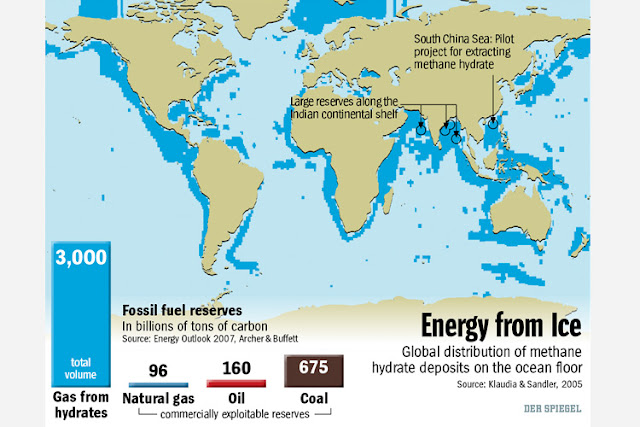
Methane hydrate deposits around the world: Graphic Der Spiegel


The McIntyre – The Bane of Climate Dogma and Mighty Slayer of Hockey Sticks

March 17, 2013

Steve McIntyre is

known in particular for his statistical critique, with economist Ross McKitrick, of the controversial hockey stick graph, which shows a sharp, and arguably unprecedented, increase in late 20th century global temperature.

He is at his sleuthing best again and Science will soon have to retract this new “hockey stick” paper

A Reconstruction of Regional and Global Temperature for the Past 11,300 Years, by Shaun A. Marcott, Jeremy D. Shakun, Peter U. Clark and Alan C. Mix, Science 8 March 2013: Vol. 339 no. 6124 pp. 1198-1201 DOI: 10.1126/science.1228026

This paper is apparently based on Marcott’s PhD thesis but the thesis contains no hockey stick!

By the time the paper was published a hockey stick had appeared.  In the most generous interpretation  the paper was “modified” to fit in with global warming dogma before being published in Science. A less generous – but more likely –  interpretation is that this is just fraud instigated probably by the global warming pundits who were the reviewers of the Science paper.

McIntyre’s latest post is a breathtaking indictment of the paper:

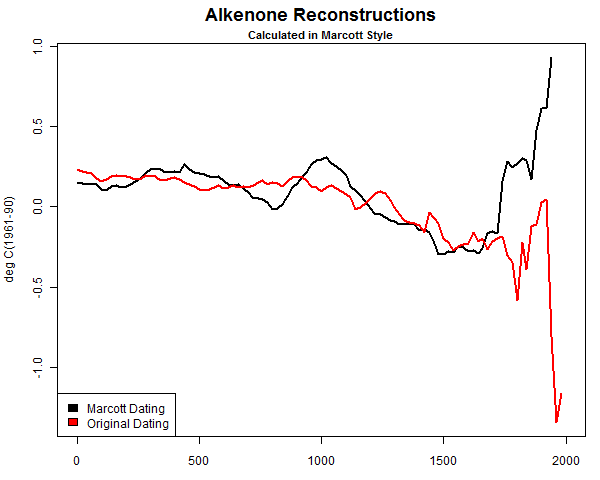
Marcott, Shakun, Clark and Mix did not use the published dates for ocean cores, instead substituting their own dates. The validity of Marcott-Shakun re-dating will be discussed below, but first, to show that the re-dating “matters” (TM-climate science), here is a graph showing reconstructions using alkenones (31 of 73 proxies) in Marcott style, comparing the results with published dates (red) to results with Marcott-Shakun dates (black). As you see, there is a persistent decline in the alkenone reconstruction in the 20th century using published dates, but a 20th century increase using Marcott-Shakun dates. (It is taking all my will power not to make an obvious comment at this point.)
alkenone-comparison
Figure 1. Reconstructions from alkenone proxies in Marcott style. Red– using published dates; black– using Marcott-Shakun dates.

Read More

The media went bonkers in reporting the Marcott paper  and this diagram will now go down in infamy:

marcott et al

This scandal is causing much attention ( here and here) but there is a deafening silence from the authors, from Science and from the – no doubt – anonymous reviewers.

I cannot draw but I have a clear image of a lone McIntyre battling against the Hockey Sticks. Perhaps a Josh can do justice to the image in my head.

The McIntyre slaying the Hockey Stick

The McIntyre slaying the Hockey Stick

Boeing’s PR upsets Japanese Civil Aviation Board – and this will delay the Dreamliner flying again

March 16, 2013

Boeing’s upbeat announcement that the Dreamliner could be flying in a matter of weeks has upset the Japanese Civil Aviation Board. It would seem that Boeing did not clear their PR blitz in Tokyo in advance with the CAB. Their optimistic statements about the Dreamliner flying again “in a matter of weeks” to try and reassure the market place may prove to be a PR blunder and could backfire.

ET: Japanese regulators immediately warned that the timetable was impossible to predict, in part because investigators still do not know what had caused lithium-ion batteries to overheat on two 787s. 

“At this time we are not yet in a position to say when flights will restart,” said Shigeru Takano, the air transport safety director at Japan’s Civil Aviation Board (CAB), which will assess and approve Boeing’sproposed fix. …

…. “If we look at the normal process and the way in which we work with the FAA, and we look at the testing that’s ahead of us, it is reasonable to expect we could be back up and going in weeks, not months,” the 787’s chief engineer, Mike Sinnett, said at an earlier briefing in Tokyo. 

But the CAB, the FAA’s counterpart in Japan, dismissed Sinnett’s prediction, saying it was too early to predict when 787 operations could resume, since regulators in the United States and Japan are still investigating. Takano, the air transport safety director at the CAB, said Sinnett’s comment on the battery probe was “inappropriate.”

To call Boeing’s statement “inappropriate” is tantamount to an outright rejection. I think Boeing has shot itself in the foot since the CAB clearly perceives their role being usurped by Boeing’s PR pronouncements. There is now no way that the CAB can or will allow any “fast-tracking” of approvals.

Reuters: Japan is Boeing’s biggest customer for the fuel-efficient aircraft, which has a list price of $207 million. JAL and ANA combined account for almost half the global Dreamliner fleet. Japanese firms also build 35 of the aircraft.

And until the CAB approves, other countries will also hold off their approvals. It is going to be at least 2 months now before Dreamliners fly again commercially.

Boeing’s three-layered fix for the Dreamliner batteries approved for testing

March 16, 2013

Boeing’s planned fix for the Dreamliner’s lithium-ion battery has been approved by the FAA and while this is only approval of the plan it at least represents the start of the process to get the Dreamliner back into the air. The FAA approval will allow two Dreamliners to return to the air to test various aspects of the proposed fix. Results from both in-flight and laboratory tests will have to be evaluated to obtain the new certifications and approvals necessary to get back into the air.

NY Times: The F.A.A. could still demand changes if problems develop in the laboratory and flight tests. While Boeing hopes to begin fitting its redesigned batteries in the grounded 787 fleet by mid- to late April and resume commercial flights quickly after that, government officials are not sure the process will move that fast. …

….. the tests would subject the battery to the most extreme conditions it was likely to face and determine if the case could withstand a battery explosion. The tests will include bursts of power to put stress on the battery and check its flammability as well as how it performs in hot weather.

The F.A.A. has also approved limited test flights for two aircraft. One plane will test the old battery, while the other will test how the new system performs under normal flight conditions. The flight tests will begin within a week.

The agency will approve the redesign only if the company successfully completes all required tests and analyses. The F.A.A. said it was continuing a review of the 787’s design, production and manufacturing.

But there is a downside. The fixes being introduced will increase the weight of the aircraft by 150 lbs which almost nullifies the advantage gained by using the lighter lithium-ion batteries in the first place. The fuel efficiency gains – at least those due to the lighter battery – will no longer be available and no doubt customers will want compensation for this. An extra 150 lbs is just about equivalent to one passenger and compensation claims could also be for the equivalent of one passenger less for every commercial flight through the life of the aircraft. This would be in addition to any compensation claims for losses suffered during and because of the grounding  and for delivery delays.

The three-layered approach that Boeing is taking consists of

  1. preventing a fire within any individual battery cell,
  2. preventing the fire from spreading to other cells in the event that a fire does occur, and
  3. preventing the fire from spreading or impacting anything outside the battery enclosure in the event that the fire does spread to multiple cells
Dreamliner Battery Fix (via Aviation Week, Credit Boeing)

Dreamliner Battery Fix (via Aviation Week, Credit Boeing)

The Dreamliner still has a way to go to complete all the testing and while Boeing is talking about “weeks rather than months”, it seems unlikely that the planes will be released for commercial flying before June.

Aviation Week: Among the tougher tests to be conducted will be an evaluation of the containment system’s ability to withstand a deliberately induced thermal runaway. This self-propagating phenomenon was cited by the National Transportation Safety Board (NTSB) in its March 7 interim report on the first battery failure on a Japan Airlines 787 in early January. Although not identifying a specific cause, the report described several shortcomings in both the baseline battery system design and the original means of testing and certification of the device.

The NTSB has announced plans to hold a forum and investigative hearing in April to review the battery’s technology, safety and process used in its certification. The agency’s investigation found—among other things—no record of the final production-standard charging system having been tested with the actual GS Yuasa-made battery. According to the NTSB report, Securiplane, the charging system developer, tested the unit with a simulated electric load instead of an actual battery. The company apparently took this precaution after having earlier suffered a fire at its facility during battery testing.

The three layers of the Boeing fix are structured as below:

1. The first layer of improvements is taking place during the manufacture of the batteries in Japan. Boeing teamed with Thales, the provider of the integrated power conversion system, and battery maker GS Yuasa to develop and institute enhanced production standards and tests to further reduce any possibility for variation in the production of the individual cells as well as the overall battery.  … Four new or revised tests have been added to screen cell production, which now includes 10 distinct tests. Each cell will go through more rigorous testing in the month following its manufacture including a 14-day test during which readings of discharge rates are being taken every hour. This new procedure started in early February and the first cells through the process are already complete. There are more than a dozen production acceptance tests that must be completed for each battery. Boeing, Thales and GS Yuasa have also decided to narrow the acceptable level of charge for the battery, both by lowering the highest charge allowed and raising the lower level allowed for discharge. Two pieces of equipment in the battery system – the battery monitoring unit and the charger are being redesigned to the narrower definition. The battery charger will also be adapted to soften the charging cycle to put less stress on the battery during charging.

2. Changes inside the battery will help to reduce the chances of a battery fault developing and help to further isolate any fault that does occur so that it won’t cause issues with other parts of the battery. To better insulate each of the cells in the battery from one another and from the battery box, two kinds of insulation will be added. An electrical insulator is being wrapped around each battery cell to electrically isolate cells from each other and from the battery case, even in the event of a failure. Electrical and thermal insulation installed above, below and between the cells will help keep the heat of the cells from impacting each other. Wire sleeving and the wiring inside the battery will be upgraded to be more resistant to heat and chafing and new fasteners will attach the metallic bars that connect the eight cells of the battery. These fasteners include a locking mechanism. Finally, a set of changes is being made to the battery case that contains the battery cells and the battery management unit. Small holes at the bottom will allow moisture to drain away from the battery and larger holes on the sides will allow a failed battery to vent with less impact to other parts of the battery.

3. The battery case will sit in a new enclosure made of stainless steel. This enclosure will isolate the battery from the rest of the equipment in the electronic equipment bays. It also will ensure there can be no fire inside the enclosure, thus adding another layer of protection to the battery system. The enclosure features a direct vent to carry battery vapors outside the airplane. New titanium fixtures are being installed in the electronics equipment bays to ensure the housing is properly supported. “Our first lines of improvements, the manufacturing tests and operations improvements, significantly reduce the likelihood of a battery failure. The second line of improvements, changes to the battery, helps stop an event and minimize the effect of a failure within the battery if it does occur. And the third line of improvements, the addition of the new enclosure, isolates the battery so that even if all the cells vent, there is no fire in the enclosure and there is no significant impact to the airplane,” said Sinnett.

Two aircraft will be used for the testing:

Flight tests of the prototype revised battery containment system will be conducted using Line No. 86, an aircraft designated for LOT Polish Airlines. Aviation Week was the first to report this same aircraft being previously used for ground tests of the battery system in mid-February (AW&ST Feb. 18, p. 32). The modified battery has also been installed in test aircraft ZA005, though Boeing says this is to allow testing to resume of the planned General Electric GEnx performance improvement package (PIP) II engine upgrade. The FAA says flight tests will validate instrumentation for the battery and testing its enclosure in addition to improvements for other systems.

Mutation in gene SIRT1 which protects against cancer and heart disease may cause Diabetes type 1

March 15, 2013

I was diagnosed with Diabetes Type 2 a few years ago but a number of friends have children and grandchildren suffering from Diabetes Type 1.  This is a life-long condition and with modern drugs is manageable but not apparently curable. But treatment starts as babies and the children have a tough time in handling all the injections. The causes are not very clear but a genetic origin has long been suspected since the highest prevalence of Diabetes Type 1 is in Northern Europe, particularly in Scandinavia. Incidence varies from 8 to 17 per 100,000 in Northern Europe and the US, with a high of about 35 per 100,000 in Scandinavia to a low of 1 per 100,000 in Japan and China.

Now Danish researchers have found that a mutation in a particular gene  – SIRT1 – may be a prerequisite for the development of Diabetes Type 1.

Identification of a SIRT1 Mutation in a Family with Type 1 Diabetes

Anna Biason-Lauber, Flemming Pociot et al, Cell Metabolism, Volume 17, Issue 3, 448-455, 5 March 2013, 10.1016/j.cmet.2013.02.001

  • Individuals carrying mutation in SIRT1 are susceptible to type 1 diabetes
  • Human SIRT1 regulates the production of nitric oxide and cytokines
  • SIRT1 regulates immune and metabolic function in humans

Summary

Type 1 diabetes is caused by autoimmune-mediated β cell destruction leading to insulin deficiency. The histone deacetylase SIRT1 plays an essential role in modulating several age-related diseases. Here we describe a family carrying a mutation in the SIRT1 gene, in which all five affected members developed an autoimmune disorder: four developed type 1 diabetes, and one developed ulcerative colitis. Initially, a 26-year-old man was diagnosed with the typical features of type 1 diabetes, including lean body mass, autoantibodies, T cell reactivity to β cell antigens, and a rapid dependence on insulin. Direct and exome sequencing identified the presence of a T-to-C exchange in exon 1 of SIRT1, corresponding to a leucine-to-proline mutation at residue 107. Expression of SIRT1-L107P ininsulin-producing cells resulted in overproduction of nitric oxide, cytokines, and chemokines. These observations identify a role for SIRT1 in human autoimmunity and unveil a monogenic form of type 1 diabetes.

ScienceNordic reports:

“Scientists have known for years that type 1 diabetes has a strong genetic component. But this is probably the first time that a mutation has been discovered in a single gene that causes type 1 diabetes,” says Professor Flemming Pociot, MD, a research group leader at Glostrup Hospital, Denmark, who took part in the international study. .. 

It is normally very difficult to locate the right places in the genome as there are some 20,000 different genes in the human body to go through. ”For this reason, scientists often search for defective genes in families where many members are affected by the same disease. That way we can see whether the affected family members share any specific gene mutations,” explains Pociot.

In the new study, the researchers examined an Israeli family in which four members suffered from T1D. Having searched through the family’s genome, they located a mutation in a gene known as SIRT1. ”This gene is incredibly interesting because other studies indicate that it could play a part in prolonging life, and that it can for instance prevent cancer and cardiovascular disease.”

In most T1D patients, the disease is autoimmune, i.e. the patient’s immune defence attacks the body’s own cells. This was also the case with the Israeli patients, and it soon became clear that the defective sirtuin protein was partly responsible for these faults in the immune system. “We compared the cell behaviour in the patients to that of the healthy family members. It turned out that the patients were far more sensitive to some of the factors we know are central in autoimmune diseases,” says the researcher.

They also carried out a series of experiments on mice to see if they could identify the detailed mechanisms behind the defective sirtuin protein.

They noted that the sirtuin proteins appeared to affect the so-called cytokines – a type of protein that plays a key role in the regulation of the immune system.

The researchers’ theory is, simply stated, that the mutated sirtuin proteins cause the cytokines in the immune system to kill the wrong cells, including those that produce the body’s vital hormone insulin.

The lack of insulin, which helps regulate the blood sugar, is one of the hallmarks of T1D.

Piers Corbyn: Mini Ice Age is upon us and the CO2 story is over

March 15, 2013

Piers Corbyn is not the most popular figure in “scientific” circles and is probably detested among “main-stream” weather pundits.  He just seems to get his forecasts right more often than conventional weather-men do, but he does not reveal his methods and this causes many to dismiss him as a lucky charlatan. They prefer to consider him an astrologer rather than a colourful but serious astrophysicist who might actually be considering the correct parameters. That he might also be making some money from his commercial weather forecasts is even more galling to some.

Weather Action: Our forecasts, which have independently proven peer-reviewed significant skill – unlike all others in the field – are based on our revolutionary Solar-Lunar-Action-Technique (SLAT) which is increasing in scope and skill as our researches advance.

But I like that he gives due importance to solar effects. And his track record in forecasting cannot be denied and I am inclined to take him rather seriously in spite of his  use of horribly garish colours in his presentations. His results if not his methods are getting some attention in Parliament.

Climate Realists have his article claiming that the Mini Ice Age is already here (pdf).

The new Mini Ice Age is upon us!

“MIA fingerprint now overwhelming” – astrophysicist

“March 10th 1947** was the day of the thaw ending the late snowy cold winter of 1947 in Britain & Europe and there was a giant sunspot group at the centre of the solar disc. This year, three magnetic (22yr) solar cycles later, solar activity has been generally very low and this day marked deep cold” – heralding more snow, on 12th , when snow-blizzards hit S/E England (Pic Folkstone) as WeatherAction forecasted in detail 25 days ahead (see map). “This is further evidence of the inevitable plunge – from now – into the new Mini-Ice Age we warned of some years ago”, said Piers Corbyn, astrophysicist of  WeatherAction.com, March 10th. “The CO2 story is over. It has been pointing the world in the wrong direction for too long. The serious implications of the developing MIA to agriculture and the world economy through the next 25 to 35 years must be addressed.”

(** Piers’ birthday!)

● The CO2 story is over

● World cooling is now ‘locked-in’

● Average solar activity way down

● Jet stream often way south

●Jet Stream develops wild waves giving very extreme weather events – hail, thunder, floods etc

Another Clinton, another Bush

March 15, 2013

From across the Atlantic, Hillary Clinton versus Jeb Bush is not only plausible, it now seems to me to be becoming inevitable. It is not so very far away to 2016 in calendar time – though it could be an eternity in political time.

But all those who harbour any pretensions to standing for President of the US in 2016 must already be planning their campaigns – at least in the confines of their own minds. But the crucial need for financing means that they have probably confided their ambitions to a very small and select group who are already sounding out potential donors for a potential campaign.

The energised campaign of 2008 was exciting (to an observer) but it has proven to be extremely divisive for the country. Perhaps campaign energy – if it is at too high a level – actually leads to divisions. But a lack of energy does not correlate with unity or a removal of divisions. This energy of 2008 was certainly missing in 2012 but the parties remain just as far apart and divisions among the electorate are not being bridged. Perhaps there is some optimum level of energy which is desirable for a campaign. It remains to be seen how the legacy of Obama’s Presidency will be seen but I think there is a large risk that the divisiveness during his two terms will mean that he is remembered primarily as the first “black” President. Any other achievements will seem quite mundane. He has proven to very risk-averse and so it is unlikely he will be remembered for any catastrophic blunders either. A Hillary Clinton – Jeb Bush race may actually get the balance right; an energised campaign which captures the imagination of the bulk of the electorate but does not drive them to the extreme positions of the fanatics.

I cannot see Jeb Bush bringing an Obama-style energy into either the Primaries or the Presidential Campaigns but he will not be devoid of energy. From the splinters of the Tea Party and the depths to which the Republicans have sunk, having another Bush scion to call on may seem to provide a “safe”, low-energy, compromise choice for the GOP. But Jeb Bush may actually be the brightest of all the Bushes.

NPR: The former two-term governor of Florida has not run for office since 2002, and has up to now refused to get caught up in public presidential speculation. Widely acknowledged as a power behind the scenes, he is seen as politically savvy and astute. It’s long been thought that had he won his 1994 gubernatorial campaign against Lawton Chiles in Florida, it would have been Jeb — not brother George W. — whom the GOP turned to in 2000. What he says carries great weight, and when he criticized his party last year for its approach to overhauling the nation’s immigration laws, people sat up and paid attention. You’re not going to win over the hearts of Latino voters, Bush said over and over, by talking about self-deportation and blocking paths to citizenship for those who are here illegally.

But in his new book, Immigration Wars: Forging an American Solution (co-authored with Clint Bolick), Bush is no longer focusing on a path to citizenship. Let’s talk instead about residency rights. “A grant of citizenship,” Bush now says, “is an undeserving reward for conduct we cannot afford to encourage.” Pay a fee, he says of those 11 million people here illegally. Pay back taxes. Do community service. Learn English. But the end would be residency, not citizenship. For many, however, the headline was about 2016.

Hillary Clinton is the heir apparent.  She is uniquely qualified of course. If  her health is up to it and she runs, it is unlikely that any other Democratic candidate will challenge her seriously except to get some exposure and her attention. She cannot any longer be held responsible for any blunders the administration now makes. As potentially the first woman President she will arouse much of the same energy that Obama did in 2008 but perhaps without the same divisiveness and with a reach that – unlike Obama’s – could cut across party lines.

Politico: The ranks of Democratic governors are filled with ambitious politicians boasting records that would probably play well with primary voters in 2016.

But even as they eye a move from the statehouse to the White House, there’s broad recognition among the chief executives that the next generation of Democrats may have to wait longer than four more years to take their place as President Barack Obama’s heir.

Nowhere is The Hillary Factor felt more acutely, and painfully, than in the same elite club of policy innovators and budget balancers that vaulted her husband onto the national political scene in the 1980s. ….

“It’s just a very unique situation in which an extremely qualified candidate with a long history of public service who has been fully vetted is considering running for the presidency,” noted Nixon, who easily won reelection last year to his second term in conservative-leaning Missouri. “She’s entitled to her time of analysis. It does, I think, in many ways freeze the field until she more clearly states what she wants to do with the rest of her life”. ….

So Clinton-Bush in 2016 may not be such a bad thing. Bush may actually be able to bring the Republican Party together again and repair the self-inflicted damage wrought by the loony right. Clinton would energise – for or against – every woman in the US and that energy will spread to others. The winner would have a much less divided country to contend with. I think Hillary Clinton would win such a race but with Jeb Bush as her opponent it will not be a walk-over. She will provide the US – at long-last – with a female head of state. And the Democrats will have been in power for 16 years in 2024 when she leaves office after her second term.

Prof. Peter A. Ziegler: Solar effects drive climate change not CO2

March 14, 2013
Peter Ziegler

Peter Ziegler: image The Geological Society

Prof. Peter Ziegler (b. 1928) is a Swiss geologist  and Titular Professor of Global Geology at the Geological-Paleontological Institute, University of Basel. He is a member of the Royal Netherlands Academy of Sciences, the Polish Academy of Arts and Sciences, the Russian Academy of Natural Sciences and the Academia Europaea. His presentation on the “Mechanisms of Climate Change” from February this year is pretty self-contained and self explanatory and my comments would only be superfluous.

Climate Change Ziegler 2013 (pdf)

I reproduce his conclusions slide below:

  • Climate change during industrial times can be fully explained by natural processes
  • During the last 550 Million years major natural climate changes involved large fluctuations in temperature and atmospheric CO2 concentrations
  • Apart from orbital forcing and the distribution of continents and oceans, variations in solar activity and the galactic cosmic ray flux controlled climate changes during the geological past and probably still do so
  • Despite rising atmospheric CO2 concentrations we may experience during the coming decades a serious temperature decline akin to the Maunder Minimum due to decreasing solar activity
  • There is overwhelming evidence that Temperature forces the Carbon Cycle and not vice-versa, as postulated by IPCC
  • IPCC underestimates the effects of direct and indirect solar climate forcing but overestimates CO2 forcing by assuming unrealistic positive temperature feedbacks from a concomitant water vapor and cloud increase
  • The IPCC consensus on anthropogenic CO2 emissions causing Global Warming cannot be reconciled with basic data and is therefore challenged