Stealing by the state from depositors in Cyprus is a dangerous precedent for all weak banks in the Euro zone

March 23, 2013

A one off tax is not a regular tax but just confiscation. When done by a State it is Grand Theft. It is some kind of nationalisation where some selected private assets are appropriated. Whatever it is called, it is just plain stealing from bank depositors. When banks are weak or badly managed it is the owners of the bank who should be held both responsible and accountable. But to blatantly and arbitrarily just “confiscate” a part of some of the depositors holdings  is a dangerous precedent.

If this is what happens in Cyprus and seemingly with the acquiescence –  if not the encouragement – of the Euro zone then it bodes ill for all depositors in weak Euro zone banks or banks in weak Euro zone countries. Cyprus can set a precedent of what is acceptable behaviour in the Euro zone. Certainly the banks and the owners will like this. After all it shifts risk from the bank’s equity to the bank’s depositors. And for profligate countries it provides a cover for stealing the money of large depositors.

For depositors having more than €100,000 in Cyprus it is already too late. Robbery by the State has been sanctioned by the European Union including Germany. Rationalising such a move by saying it is to get at black Russian money is disingenuous. If this is acceptable in Cyprus today then it may well be acceptable for banks – and not just the State – to confiscate their customer’s savings whenever an “emergency” arises.

For those with substantial deposits  – and not just over €100,000 – in Greece or Spain or Italy or Ireland it is probably high time to get out.

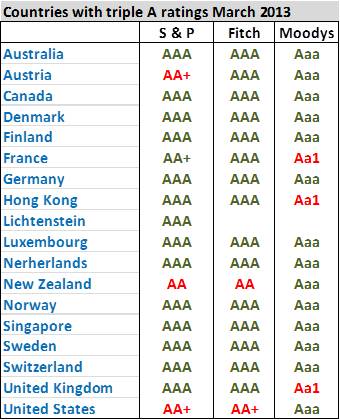
The shrinking list of triple A credit rated countries

March 23, 2013

As Fitch puts the Uk’s country rating on negative watch, the number of countries left with triple A ratings has continued to shrink in 2013. Only countries given a triple-A rating by at least one of the big-3 rating agencies are included here.

triple A countries march 2013.emf

Spring delayed – 2013 World Pooh Sticks championship cancelled!

March 23, 2013

That spring is delayed all over Europe and North America is bad enough (the sun is shining here at latitude 58.7057° N but the temperature is all of – 10 °C).

That people will be “celebrating” Earth hour today is even worse.

But that the annual Pooh Sticks competition (world championship) scheduled for tomorrow has been cancelled in the UK is beyond the pale.

And those to blame are clearly the CRU of the UEA, the IPCC and the WWF.

pooh

CANCELLED
We are very sorry to announce that we have to cancel this Sunday’s World Pooh Sticks Championships.
 
If we had just had a little rain on the day then we would have still played and we would have splashed around in wellington boots and dropped our coloured sticks over the bridges, however we’ve had so much rain over the last few weeks that the river is still too high and fast to have our safety boats on the river and there’s no sign of the rain stopping this weekend.

“I think we all ought to play Poohsticks,” So they did. And Eeyore, who had never played it before, won more times than anybody else; and Roo fell in twice, the first time by accident and the second time on purpose, because he suddenly saw Kanga coming from the Forest, and he knew he’d have to go to bed anyhow. So Rabbit said he’d go with them; and Tigger and Eeyore went off together Because Eeyore wanted to tell Tigger How to Win at Poohsticks.  (from “The House at Pooh Corner”)

‘The official Pooh Corner Rules for Playing Poohsticks’ was written in 1996 to commemorate the 70th anniversary of the publication of ‘Winnie-the-Pooh’.

pooh sticks

  1. First, you each select a stick and show it to your fellow competitors. You must agree which stick is which – or whose, as it were.
  2. Check which way the stream is flowing. Competitors need to face the stream on the side where it runs in, under the bridge (upstream). Note: If the stream runs out, from under the bridge you are standing on the wrong side! (downstream).
  3. Choose someone to be a Starter. This can be either the oldest or the youngest competitor.
  4. All the competitors stand side by side facing upstream.
  5. Each competitor holds their stick at arms length over the stream. The tall competitors should lower their arms to bring all the sticks to the same height over the stream as the shortest competitor’s stick.
  6. The starter calls, ‘Ready – Steady – Go!” and all the competitors drop their sticks. Note: the stick must not be thrown into the water.
  7. At this point in the game all the players must cross to the downstream side of the bridge. Please take care – young players like to race across. Remember, other people use bridges and some of them have vehicles or horses.
  8. Look over the edge of the bridge for the sticks to emerge. The owner of the first Stick to float from under the bridge, is the winner.

Remember: Falling into the water is SAD (Silly And Daft)!

Earth hour is a morally bankrupt, self-indulgent, “feel-good” gesture

March 22, 2013

I have experienced the rigours of real blackouts and brownouts many times in my life.

I have seen what it was like in Kobe after the 1995 earthquake when no power was available.

The availability of electricity for the bulk of the world’s population has been by far the most important factor in the development of humans in recent times and possibly ranks with the discovery of fire and the wheel as the most important advances ever made.

A self-indulgent, “feel-good” gesture such as Earth Hour is not just meaningless and futile – it is the stridently self-righteous action of  a morally bankrupt group which from a position of relative comfort and abundance would deny the aspirations of millions to improve their lot. It is a gesture which scorns the efforts of those who would try and provide the benefits that cheap and readily available electricity brings.

I doubt whether many in the northern latitudes who will indulge in this silliness tomorrow by turning off some of their lights will actually turn off any heating during this bitterly cold March. I shall not respond in kind by the equally arrogant gesture of  turning on all the lights in my house.

Earth hour is a morally bankrupt, self-indulgent, “feel-good” gesture. It is a “cheap” and mean action. It does a disservice to humanity. It diverts attention from the real issues of development that face the world’s poor. And the availability of electric power is fundamentally necessary to this development.

And during Earth Hour tomorrow it will be business as usual for me. I shall not be turning off any lights and I shall not be turning off the heating in my house. 

When it comes to radical innovation, the customer is not always right

March 22, 2013

We are all customers and and we are all essentially conservative at heart. We tend to prefer to stick to what we know and like.  So while listening to your customers is paramount when it comes to incremental improvements of products or services, the existing customer may not be the best when it comes to radical innovation and the introduction of something completely new.

Customer co-creation in service innovation: a matter of  communication? by Anders Gustafsson, Per Kristensson and Lars Witell, Journal of Service Management, 23(2012)3: 311-327. dx.doi.org/10.1108/09564231211248426. 

The paper (available as an Open Access manuscript) reports on the results of a survey among 334 managers who all had experience with innovation in the creation of new products or services. The researchers selected 284 real development projects  divided into two main groups:

  • Incremental innovation: 207 of the projects dealt with minor improvements of products or services.
  • Radical innovation: The remaining 77 projects dealt with development of radically new products or services not previously known to the market.

… The implication for the dysfunctional model is that the communication process – and therefore co-creation – is different for radical innovations than for incremental innovations. The model for radical innovations produced two significant paths (using adjusted t-tests), frequency (0.336, p< 0.05), and content (-0.246, p< 0.05). The results indicate that companies should interact frequently with their customers; this is similar to the findings in the case of incremental innovations. The path coefficient for content is negative, which indicates that customers should not be too highly involved in developing the actual content of radical innovations. …..

…. The results of the present study contribute to a deeper understanding of why new offerings developed through market research techniques based on co-creation with customers are more profitable than those developed with traditional market research techniques. ……

However, the communication process of co-creation for radical innovations seems to behave quite differently in that the four suggested dimensions are not entirely applicable in the same way for radical innovation as they are for incremental innovation. The different dimensions in the communication process behave differently in the two conditions, which suggests that companies must apply different communication strategies in co-creation depending on the degree of innovativeness of a development project. The two dimensions that are significant in radical innovation are frequency (positive) and content (negative). Direction and modality did not have a significant impact on product success. This implies that companies should learn from customers through frequent contact, which is the same as in the case of incremental innovations. However, companies should not be overly concerned with suggestions of the content of a potential new offering. Radical solutions can often be considered unthinkable in advance, which can make radical solutions hard to imagine, but customers know a good idea when they see and use it. Customers create solutions based on their previous experiences of usage of different products or services, which makes it difficult to suggest solutions that are truly radical.

Calculating Doomsday – An interesting but ultimately meaningless probability game

March 21, 2013

A new paper playing probabilistic games – this time about the Doomsday Argument.

Universal Doomsday: Analyzing Our Prospects for Survival, by Austin Gerig, Ken D. Olum, Alexander Vilenkin,  arxiv.org/abs/1303.4676 , Cosmology and Extragalactic Astrophysics (astro-ph.CO)

The full version of the paper (pdf) is here

Doomsday argument Gerig et al

Doomsday argument Gerig et al

The Doomsday Argument is the idea that we can estimate the total number of humans that will ever exist, given the number that have lived so far. The argument goes that since around 100 billion is the number of humans that have ever lived and assuming that there is a 95% probability that we are among the last 95% of humans who will ever live then there is a 95% probability that the number of humans who will ever live will lie between 1.4 and 2.0 trillion. A fairly trivial conclusion since any probability greater than 0 and less than 100% would be valid for the exercise.

In this paper the authors try to formalise the probability calculations and introduce the effect of known existential threats. Just like in Drake’s equation for the number of extra-terrestrial civilisations that may exist in the Milky Way, all the probabilities are unknown and could be assumed to be anything you like. The Doomsday Argument like Drake’s equation is really no more than a probability game, based on nothing at all. But it is fascinating to consider which terms are relevant and necessary in any such game.  And that is what makes these games interesting.

The author’s conclusions could be considered a trifle obvious and almost cliched – but none the less they are perfectly true!! The Earth will surely experience catastrophic events in the future which threaten human existence – whether by earthquake or volcanos or meteors and even if we survive all of these, eventually by the inevitable death of our sun.  In fact you could play another – and equally valid – probability game and calculate how many humans will have lived if humanity continues to survive till the death of our sun. And this probability is surely not zero.

To avoid Doomsday, humanity needs to make sure that asteroids don’t crash into earth and that catastrophic earthquakes, volcano eruptions or the like don’t occur until  such time as humanity has spread into space and  developed colonies on other planets.

From the Conclusions:

With the priors that we considered, the fraction of civilizations that last long enough to become large is not likely to exceed a few percent. If there is a message here for our own civilization, it is that it would be wise to devote considerable resources (i) for developing methods of diverting known existential threats and (ii) for space exploration and colonization. Civilizations that adopt this policy are more likely to be among the lucky few that beat the odds. Somewhat encouragingly, our results indicate that the odds are not as overwhelmingly low as suggested by earlier work. 

Abstract (Submitted on 19 Mar 2013)

Given a sufficiently large universe, numerous civilizations almost surely exist. Some of these civilizations will be short-lived and die out relatively early in their development, i.e., before having the chance to spread to other planets. Others will be long-lived, potentially colonizing their galaxy and becoming enormous in size. What fraction of civilizations in the universe are long-lived? The “universal doomsday” argument states that long-lived civilizations must be rare because if they were not, we should find ourselves living in one. Furthermore, because long-lived civilizations are rare, our civilization’s prospects for long-term survival are poor. Here, we develop the formalism required for universal doomsday calculations and show that while the argument has some force, our future is not as gloomy as the traditional doomsday argument would suggest, at least when the number of early existential threats is small.

Comet C/2013 A1 (Siding Spring) could impact Mars on 19th October 2014

March 21, 2013

Comet Shoemaker–Levy 9  broke apart and collided with Jupiter in July 1994, providing the first direct observation of an extraterrestrial collision of Solar System objects.

The collision provided new information about Jupiter and highlighted its role in reducing space debris in the inner Solar System.

But a much closer event could be in the offing for next year. A newly discovered comet has been found to have an orbit which takes it extraordinarily close to Mars in October 2014 and the possibility of an impact is 1 in 600. The size of the comet is still uncertain but some estimates are of the nucleus being 50 km in diameter. An impact crater on Mars – if an impact occurs – could then be about 500 km in diameter.

C/2013 A1 (Siding Spring) is a comet originating from the Oort cloud and was only discovered in January this year by Robert H. McNaught at Siding Spring Observatory in Australia,  using a 0.5-meter  Schmidt telescope. By looking at observations made before the comet was identified as a comet on 3rd January, NASA states “Pre-discovery observations located in the archives have extended the observation interval back to Oct. 4, 2012”.

NASA/JPL Near-Earth Object Program Office 
March 5, 2013

On Oct. 19, 2014, Comet 2013 A1 (Siding Spring) will pass extraordinarily close to Mars, almost certainly within 300,000 km of the planet and possibly much closer. Our current best estimate has it passing about 50,000 km from the surface of Mars. This is about 2.5 times the distance of Mars’ outermost satellite Deimos or less than twice the Earth close approach distance of 2012 DA14 on February 15, 2013. Since the observation span available for orbit determination is still relatively short, the current orbit is quite uncertain and the nominal close approach distance will change as additional observations are included in future orbit estimates. Currently, Mars lies directly within the range of possible paths for the comet and we can’t exclude the possibility that the comet might impact Mars. Our current estimate for the impact probability is less than one in six hundred and we expect that future observations will allow us to completely rule out a Mars impact.

This computer graphic depicts the orbit of comet 2013 A1 (Siding Spring) through the inner solar system. Image credit: NASA/JPL-Caltech

This computer graphic depicts the orbit of comet 2013 A1 (Siding Spring) through the inner solar system. Image credit: NASA/JPL-Caltech

Although the current heliocentric orbit is hyperbolic (i.e., eccentricity greater than one), the orbit is elliptic when expressed in the frame of the solar system’s barycenter. After more than a million year journey, this comet is arriving from our solar system’s distant Oort cloud. It could be complete with the volatile gases that short period comets often lack due to their frequent returns to the sun’s neighborhood.

During the close Mars approach, the comet will likely achieve a total visual magnitude of zero or brighter as seen from Mars-based assets. The attached illustration shows the comet’s approximate, apparent visual magnitude and its solar elongation angle as a function of time as seen from Mars. Because the comet’s apparent magnitude is so uncertain, the brightness curve was cut off at apparent visual magnitude zero. However, the comet may get brighter than magnitude zero as seen from Mars. From Earth, the comet will not likely reach naked eye brightness but it could brighten to visual magnitude 8 as seen from the southern hemisphere in mid-September 2014.

This illustration, prepared by Jon Giorgini, shows the apparent total visual magnitude and solar elongation angle as seen from the center of Mars

This illustration, prepared by Jon Giorgini, shows the apparent total visual magnitude and solar elongation angle as seen from the center of Mars image NASA

Atomic Rat strikes at Fukushima

March 20, 2013

You Dirty Little Rat, You!!!!

BBC: 

A rat may have caused this week’s power outage at Japan’s tsunami-hit Fukushima nuclear power plant, says the Tokyo Electric Power Co (Tepco).

The company suspects the rodent may have caused a short-circuit in a switchboard, triggering the power cut.

“We have deeply worried the public, but the system has been restored,” Tepco spokesman Masayuki Ono was quoted as saying by AFP news agency.

Two years ago a quake-triggered tsunami caused meltdowns at the plant.

This week’s outage was a reminder that the plant remains vulnerable despite the government’s claim that the reactors are in a “cold shutdown” state and no longer releasing high levels of radiation.

Reading habits change as “newspapers of record” have become my “sites of record”

March 20, 2013

English newspapers

There was a time when one or two newspapers in every country had the reputation of being the “newspaper of record”. The Times of London, The Daily Telegraph, The New York Times, Washington Post, Pravda, Frankfurter Allgemeine Zeitung, Le Monde, The Times of India, El Pais and Corriere della Sera to name but a few.  They had reputations for objective news reporting and separated news and opinion rigorously. Of course, this reputation was never fully deserved since they often also represented “political correctness” or the “establishment view”.  Financial news of any note had to be in The Financial Times or the Wall Street Journal. Reuters and AFP and AP and UPI were the wire services considered infallible. The coming of Radio added immediacy but did not change the power structure in news reporting very much except to add a few more names to the “media of record”. The BBC and the Voice of America led the way but while the BBC was perceived as being fairly objective, the Voice of America was always seen as being mainly factual but with an obvious propagandist agenda.

The advent of TV news started an irreversible change. As news-only channels and cable TV proliferated and as countries all developed their own wire-services, radio and TV stations (often state owned), the blending of factual reporting with opinion was both inevitable and unavoidable. Even the factual reporting became selective depending upon the opinion to be disseminated. All that has evolved further with the coming of the internet and the explosion of the blogosphere. “Factual news” devoid of opinion is almost impossible to find anymore though the wire services probably come closest. To make life even more confusing – but also more interesting – opinion now often masquerades as fact.  Fantasy can be presented as reality and opinion presented as science. Every medium has a political agenda. Journalism sometimes consists as much of making news as reporting it. Polls of how readers “think it should be” replaces “how it is”.  Consensus opinion is taken to be fact. It places an increasing demand on the reader to be discerning, to try and sort out fact from opinion and reality from propaganda.  And trying to be a discerning reader takes time.

The number of news sites available on-line is enormous and I only visit a selected few. No doubt my selection of sites itself represents and reinforces my biases. My selections do change – but not daily. There is no single site I completely trust to have separated fact from opinion. Sites with intrusive or aggressive advertising are irritating, tend to become very slow and lose my interest. I do go to some Murdoch sites but many are behind stringent pay-walls. They are all very strong on opinion and I perceive that they tend to “doctor” news – by omission – to suit their opinions. The Times has completely abdicated its former position and is no longer of much significance. The Times of India has become a nightmare of rather ineffective advertising and I don’t visit unless directed there for something specific. The Hindu has taken over from the ToI and is the only “quality” paper left in India. The Guardian and the Washington Post are  prone to omitting facts they don’t like or which don’t fit their opinions. They still see themselves as virtuous crusaders and they always know what is best for others. But I still do visit them to keep some balance. CNN on TV is just too flaky and some of their journalists are intolerably incompetent. I do watch CNN and Al Jazeera on hotel room TV’s when I am travelling but only if BBC is not available.  For on-line news CNN is eclipsed by the BBC and I visit CNN only for “breaking US news”. But the BBC itself is not immune to “political correctness” as they perceive it.

It used to take me not more than about 45 – 60 minutes every morning with 2 cups of coffee to go through 2 or 3 print newspapers (with the choice dependent upon where I was living) . It now takes me about 90 minutes and two cups of coffee every morning before I am ready to start doing “my own thing”. I usually start the morning 0n-line by scanning the world news starting with the BBC and then shifting to  Japan and moving around the world East to West. It takes me about 30- 45 minutes to scan my selected sites and bookmark some 5 – 8 articles for a further 30 – 45 minutes of reading. I usually go to specialist subject sites and the blogosphere only after that and when I have time during the day.  But this probably represents another 2 hours of my time every day. Compared to 30 years ago I probably spend 3 or 4 times as much time today on reading news. The news I cover is much wider in scope than it ever was. It is also deeper because trivia is more strictly ignored and subjects for further reading are selected with greater precision. I certainly have opinions on many more subjects today than I would have had 30 years ago. The sites where opinion masquerades as fact are the most time consuming. It is noticeable that though there is a large grey zone between the newspapers (on-line) and blogs, the blogs are much more transparently opinionated. I tend to balance many of the more blatantly biased blogs against each other (e.g. HuffPo against Drudge or Daily Kos against Red State) as a matter of course but I don’t avoid them.  But I still look for confirmation of blog information at the traditional newspapers or wire services. Blogs are a way for me to stop getting stuck in the rut of “political correctness” but the blogs alone do not serve.

So this is my current list of my “sites of record” which are my regular ports of call. They are – individually – not as authoritative or as objective as “newspapers of record” were perceived to be, but together – after eliminating opinion – they are probably a more accurate and more comprehensive “record” of happenings around the world than the newspapers of old ever were. And 30 years ago there was no way I could have covered the world news as I can do now. I perceive that I can choose to be as informed as I wish to be about any subject anywhere in the world and not – as 30 years ago – be restricted to whatever was dished up for my consumption.

Is Facebook a forum for narcissists (and maybe also for narcissistic researchers?)

March 19, 2013

Facebook is providing a fertile hunting ground for simplistic “research” by a new breed of “researchers”. Social psychology is still just a discipline and has yet to reach the level of a “science”. But I note that surveys of Facebook users is multiplying and seems to have  become a new field of social psychology. The surveys are easily done, usually include a sample size of just a few hundred (small enough to access on a University campus or in a town square) and draw fanciful conclusions to capture the headlines. They provide an easy way to publication. Such “Facebook research” is not “bad science” – if even “science” at all – but much of it is trivial and just provides a quick, cheap way of getting published. In this case the “research” has been done by someone from the School of Computing at the University of Portsmouth.

The University of Portsmouth has issued a press release  about a survey which finds that “Using Facebook to look at old photos of yourself and wall posts that you have written could be as soothing as a walk in the park” and this has received much coverage. But whereas the “researchers” find this beneficial, what they they seem to be describing is a sort of narcissistic – and not very healthy – behaviour. Narcissism is when a healthy self-esteem crosses over into being an unhealthy obsession with one’s self and I would have thought that the survey results are a warning sign. But of course the behaviour described would be considered beneficial – by another narcissist.

Using Facebook to look at old photos of yourself and wall posts that you have written could be as soothing as a walk in the parkAlmost 90 percent of users access the site to look at their own wall posts, and three quarters look at their own photos when they are feeling low, new research has found.

A report by Dr Alice Good, of the University of Portsmouth, has found that this kind of ‘self soothing’ use of Facebook is actually beneficial to the user’s mood, especially if they are prone to feeling low. This directly contradicts previous research that has suggested that looking at Facebook can be bad for your mental health.

Dr Alice Good

Dr Good said: “We were very surprised by these findings, which contradict some recent reports.  Although this was only a small study, we will go on to study larger groups to see if the results remain consistent.”

Dr Good, of the School of Computing, quizzed 144 Facebook users and found that people often use the social network to reminisce, using old photos and wall posts as a form of comfort.

Looking back at older photos and wall posts is the main activity, and the one that made them happiest.

Psychologist Dr Clare Wilson, of the University of Portsmouth says:

“Although this is a pilot study, these findings are fascinating. Facebook is marketed as a means of communicating with others. Yet this research shows we are more likely to use it to connect with our past selves, perhaps when our present selves need reassuring.

“The pictures we often post are reminders of a positive past event. When in the grips of a negative mood, it is too easy to forget how good we often feel. Our positive posts can remind us of this.”

The survey also found that people who have experienced mental health issues are particularly comforted by the site. Dr Good said: “The results indicate we could use self-soothing as a form of treatment for low moods.”

The study has concluded that looking at comforting photos, known as reminiscent therapy, could be an effective method of treating mental health.

Scientists already know that reminiscent therapy helps older people with memory problems.

The use of old photos, items and films can provide a way for people with short-term memory loss to feel comforted by objects that are familiar to them.

This new research shows that it could also an effective treatment for people with depression or anxiety.

The act of self-soothing is an essential tool in helping people to calm down, especially if they have an existing mental health condition. If a patient self soothes there is less chance of a problem escalating.

The report also looked at ways of accessing Facebook, with phones being the most popular method and 94 per cent admitting they had their phone on them at all time, with around 70 per cent actually preferring to access Facebook using their phone over more conventional methods, such as a PC or laptop, suggesting people have a desire for immediacy, both in accessing the site as well as for viewing photos.

This study is part of a larger research project that looks at how applications can support wellbeing and effectively self soothe.

This research is published in the journal ‘Lecture Notes in Computer Science: Universal Access in Human-Computer Interaction’. Springer Berlin / Heidelberg.