On biodiversity and conservation and the number of frog species

September 17, 2011

One of the politically correct and alarmist themes that pervades the conservation movement is that biodiversity is vital and is dangerously threatened. Generally biodiversity can be considered to include

  1. gene diversity within a particular species, and
  2. species diversity within some particular region
Sometimes having different ecosystems and environments within a particular region is also included as being a form of ecological biodiversity. Yet it has always been inexplicable to me as to why human intervention for the protection of a species which has been out-competed by other species is not considered unnatural and artificial. Extinction of species happens naturally as a consequence of natural selection and evolution as some species succeed and others fail. If species did not fail and become extinct there would be diminishing space for evolution of other species. More species are thought to have become extinct than are in existence today.
I find that there is a fundamental conflict between allowing evolution to happen naturally with successful species (and that includes humans) eliminating unsuccessful species and the conservationist view of interfering with this normal development in favour of artificially maintaining failed species.
Conservationism at heart is a conservative (with a small “c”) and backward looking philosophy trying to prevent development and evolution because of fear. I suppose that is why I find “conservationsim” unattractive – because it is based on fear subordinating actions and that – by definition – is cowardice. King Canute trying to hold back the tide!
As I have posted earlier: The problem is not only that we have not identified all the eukaryote species in existence (and about 1.3 million have been classified and named) but we have no idea whether the number in existence is to be measured in millions or in hundreds of millions. About 15,000 new species are identified and catalogued each year. If  Bacteria and Archaea are added to eukaryotes, the total number of species could be in the billions.
Vub night frog
And with so many species around why should humans interfere to protect some but not others. In fact some species are considered interlopers in some regions and then conservation is all about exterminating these.
We do not know how many frog species exist and new species are being “discovered” continuously. Species thought to have become extinct are rediscovered. Of course a “discovery” of a species has nothing to say about how long that species has been in existence. And the importance of any particular species to the future of humans and the environment humans survive and thrive in is an unknown unknown.
Wired  – which is a very politically correct on-line journal – reports that 12 New and 3 Lost Night-Frog Species Discovered in India. Researchers in India have found a dozen new frog species belonging to the night frog group, named for their nocturnal habits, and rediscovered three species, one of which had not been seen in nearly a century. The findings appeared in the journal Zootaxa on Sept. 15. …… half of the newly discovered species reproduce without any physical contact between the sexes, with the female depositing her eggs on a leaf and the males later fertilizing them.
All the frogs were spotted in a region known as the Western Ghats, a mountain range than runs along the western coast of India that has been identified as one of the ten hottest biodiversity hotspots in the world. Because of the small area they occupy, at least six of the new species are sensitive to habitat loss and will require immediate steps toward conservation.
I find the conclusion that “the new species are sensitive to habitat loss and will require immediate steps toward conservation”  illogical and inexplicable.
Why interfere?
Just the number of articles about frogs in Wired in recent times further deepens the mystery. It only demonstrates all we don’t know that we don’t know. Even if out of fear of what is to come, humans were to try and intervene and protect every discovered species, the intervention would still fail and would not return us to the time of the dinosaurs.

Conservationism – as an ism – has no clear purpose that I can see.

Bruno Frey and his habitual self-plagiarising by the “cloning” of papers

September 16, 2011

Handelsblatt, Germany’s business daily has been investigating Bruno Frey and his habitual self-plagiarising for some months now. Bruno Frey is an economics professor at the University of Zurich and has been making a habit of publishing the same paper in multiple journals. He is also apparently a potential candidate for a Nobel prize!! Frey apparently carried out a fairly trivial analysis of the people who survived the Titanic sinking but then went and got it published – with very minor variations – in 5 different journals. That such mundane and repetitive material would be published in fairly heavyweight journals does not say much for their review processes.

Olaf Storbeck is an author and Economics editor with Handelsblatt and is responsible for the weekly economics section. He has been leading the charge and he writes in Economics Intelligence:

One of the most senior economists of the German speaking world faces serious questions about his scientific modus operandi. Bruno Frey and his research team are accused of self-plagiarism. Additionally, they at least showed an amazing degree of sloppiness with regard to literature research. Five older publications from different authors on exactly the same research question are missing from the references.

This blog (among others, especially Andrew Gelman’s as well as “Economic Logic” and the EJMR forum) has played a role in making the whole thing public. On Wednesday, 6 July the University of Zurich has started a formal investigation against Frey, based on the “suspicion of unethical scientific conduct”.

Bruno Frey (University of Zurich), Benno Torgler (Queensland University of Technology) and Torgler’s Ph.D. student David Savage simultaneously published a series of papers dealing with the sinking of the Titanic, but neither cross-reference their own work nor  cite a number of older papers by other researcher addressing exactly the same topic.

The articles by Frey, Torgler and Savage appeared in the “Journal of Economic Behaviour and Organization”“PNAS”“Rationality and Society” and the“Journal of Economic Perspectives” in 2010 and 2011. They used individual-level passenger data showing the age, gender, ticket class and nationality of 2207 people sailing on the Titanic and employed an econometrical analysis on the determinants of survival. For several months the authors have been criticised because they simultaneously published nearly identical papers in four different journals without mentioning their other work on the same topic to the editors.

the article continues>>>>

Professor Debra Weber-Wulff comments on Bruno Frey on her blog:

The “Journal of Economic Perspectives” (JEP) has formally censured him, the “Journal of Economic Behaviour and Organization” (JEBO) has blacklisted the authors and will not accept any further papers from them. Frey and Torgler have said that Savage is not at fault and have tendered excuses at 3 of the 4 journals [German language detail: The article says that they “excused themselves”, I always thought you had to ask the other party to excuse you –dww]. Apparently, Frey had not gotten around to writing to the “Proceedings of the National Academy of Sciences” (PNAS) before the Handelsblatt started its investigations. 

The whole issue seems to have started with the blog Economic Logic and an entry entitled On the ethics of research cloning. The author of the blog had a good look at the CVs of the senior authors and finds evidence both of slicing results very thin in order to get much publication mileage out of them, as well as republishing the same results multiple times. In the comments a number of other clones showed up, and a  FreyPlagWiki (the currently popular German way to collect evidence on scientific misconduct and plagiarism) was set up. 

Interesting things have popped up, such as Frey exempting his doctoral students from coursework now required by the University in Zürich, or his being dropped from an editorial board without explanation.

Olaf Storbeck has found further examples of Frey’s multiple publications which he documents in this  Google Table  describing the “cloning” of 5 publications. But Storbeck’s article contains some disturbing reports of the behaviour of Journal Editors – in particular Jürgen Backhaus Professor of Finance and Fiscal Sociology at the Political Sciences Faculty of the University of Erfurt and Editor-in-chief of Springer’s European Journal of Law and Economics (EJLE).

Bruno Frey: More cases of self-plagiarism unveiled …. However, when I talked to Jürgen Backhaus on Sunday, the editor-in-chief was strongly backing Bruno Frey. Backhaus argued that Frey is known for his new and unconventional ideas. According to Backhaus, it was necessary to repeat them again and again to get them through to a reluctant audience. Backhaus told me:

“It is well known in the profession that Bruno Frey works like this.”

He said that it was an honour to be able to publish an article by Frey:

“He is an internationally renown academic who is a candidate for the Nobel prize.”

According to Backhaus, publishing an article by Frey enhances the attention for other articles in the journal. I asked him how he would explain to a PhD student that the official submission guidelines of the journals apparently are not applicable to Frey. His answer was:

“Bruno Frey is a trademark. The PhD student still has to build one.”

I was really stunned by these remarks. I emailed those quotes (in German) to Backhaus prior to publication. He confirmed that I quote him correctly. (Translations from German into English were done by me, however.) …… If the EJLE wants to retain any credibility and if Springer takes the COPE guidelines seriously, they won’t have any choice but to officially retract both articles. Additionally, I don’t see how Frey can stay on the editorial board of a journal which submission guidelines he repeatedly has clearly violated.


To “terja”: time to introduce a new verb into English from the Swedish?

September 16, 2011

One result of the revelations of the fraudulent manipulation of images by Terje Hellesö – a former award winning photographer (with the award now retracted) by the on-line community on the Swedish Flashback forum has been the introduction of a whole new vocabulary in Swedish with variations of his first name to describe stolen and manipulated images.

A comment on my earlier post led me to look at

  1. English words which were of Swedish and Scandinavian origin, and
  2. English words dealing with manipulation of images.
The Viking legacy has left many place names which are Scandinavian in whole or in part. In modern times many English words have been assimilated into all the Scandinavian languages. I have the impression that there may be more words of Scandinavian origin perhaps in the Celtic languages. But I was a little surprised that the list of English words emanating from Swedish or the old Scandinavian languages was not very long.

List of English words of Swedish origin

List of English words of Scandinavian origin 

Coming then to the manipulation of images there are a number of words in English which refer to some specific type of image manipulation. Manipulation has been evident from the onset of photography. Initially these referred to multiple-exposures or various dark-room techniques such as retouching , splicing negatives, scratching or air-brushing. The advent of computers and digital technology has led to “photoshopping” now becoming an accepted word (v. to photoshop which is an example of a noun becoming a verb). Digital manipulation may include resizing, shadowing, duplicating, cropping, re-scaling, retouching, emphasising, enhancing, splicing, color balancing, painting or “editing” all or part of the images being manipulated.

But there does not seem to be a word which particularly describes the act of stealing an image and then manipulating and combining it with other images. It seems therefore that there is space in English for a new word to describe the specific type of manipulation that Hellesö has carried out. My perception is that this form of manipulation may be quite wide-spread. It is also probably high time that Swedish contributed a new word to come into English usage. From the proposed verb “terja” I have chosen to go to “terjading” in preference to “terjaing” as being less difficult to pronounce.

ter.ja (tair – yah)

verb – to terja

the manipulation of a digital image by stealing images available on the internet and creating a montage of  stolen and or manipulated images together with other images and the representation of such images as one’s own original work without attribution to the original image creator.

Related forms – terjad ¦ terjas ¦ terjading

Adjective – terjad

Origin(2011) after Terje Hellesö and his theft and manipulation of  wild-life images disclosed on an internet forum

Examples :

I terjad yesterday, I terja today , he terjas always, he will terja tomorrow.

To terja an image is as reprehensible as to plagiarise.

Terje terjad his images probably starting from when he acquired his first digital camera. 

While image manipulation may well be permissible, terjading is always unethical. The penalties for terjading  however are not enshrined in law except – incidentally – for any theft or intentional fraud that can be proven.

His terjad photographs won him an award.

Diamonds from the deep: Carbon cycle extends down to earth’s lower mantle

September 16, 2011
S-waves do not pass through the Earth's core, ...

Image via Wikipedia

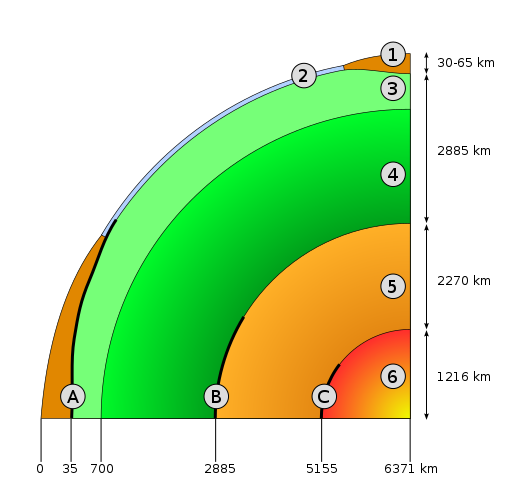
What we know about the layers forming the interior of the earth are mostly inferred from mapping the propagation and refraction of earthquake waves. The earth’s lower mantle starts some 700km down and extends to a depth of about 2900km. The upper and lower mantle demonstrate – in fluid dynamic terms – a viscous chaotic flow but the mechanisms by which material is exchanged between the upper and lower mantle are not fully understood.

Science Daily: Michael Walter of the University of Bristol and colleagues in Brazil and the United States analyzed a set of “superdeep” diamonds from the Juina kimberlite field in Brazil. Most diamonds excavated at Earth’s surface originated at depths of less than 200 kilometers. Some parts of the world, however, have produced rare, superdeep diamonds, containing tiny inclusions of other material whose chemistry indicates that the diamonds formed at far greater depths

M. J. Walter, S. C. Kohn, D. Araujo, G. P. Bulanova, C. B. Smith, E. Gaillou, J. Wang, A. Steele, S. B. Shirey. Deep Mantle Cycling of Oceanic Crust: Evidence from Diamonds and their Mineral Inclusions. Science, 2011; DOI: 10.1126/science.1209300

ABSTRACT

A primary consequence of plate tectonics is that basaltic oceanic crust subducts with lithospheric slabs into the mantle. Seismological studies extend this process to the lower mantle, and geochemical observations indicate return of oceanic crust to the upper mantle in plumes. There has been no direct petrologic evidence, however, of the return of subducted oceanic crustal components from the lower mantle. We analyzed superdeep diamonds from Juina-5 kimberlite, Brazil, which host inclusions with compositions comprising the entire phase assemblage expected to crystallize from basalt under lower mantle conditions. The inclusion mineralogies require exhumation from the lower to upper mantle. Because the diamond hosts have carbon isotope signatures consistent with surface-derived carbon, we conclude that the deep carbon cycle extends into the lower mantle.

“This study shows the extent of Earth’s carbon cycle on the scale of the entire planet, connecting the chemical and biological processes that occur on the surface and in the oceans to the far depths of Earth’s interior,” according to Nick Wigginton, associate editor at Science.

The carbon cycle generally refers to the movement of carbon through the atmosphere, oceans, and the crust. Previous observations suggested that the carbon cycle may even extend to the upper mantle, which extends roughly 400 kilometers into Earth. In this region, plates of ocean crust — bearing a carbon-rich sediment layer — sink beneath other tectonic plates and mix with the molten rock of the mantle.

Seismological and geochemical studies have suggested that oceanic crust can sink all the way to the lower mantle, more than 660 kilometers down. But actual rock samples with this history have been hard to come by

File:Slice earth.svg

Schematic view of the interior of Earth. 1. continental crust - 2. oceanic crust - 3. upper mantle - 4. lower mantle - 5. outer core - 6. inner core - A: Mohorovičić discontinuity - B: Gutenberg Discontinuity - C: Lehmann discontinuity: image Wikipedia

PhysOrg: The diamonds were analyzed for carbon at Carnegie. Four of the diamonds contained low amounts of carbon-13, a signature not found in the lower mantle and consistent with an ocean-crust origin at Earth’s surface. “The carbon identified in other super-deep, lower mantle diamonds is chiefly mantle-like in composition,” remarked co-author Steven Shirey  at Carnegie. “We looked at the variations in the isotopes of the carbon atoms in the diamonds. Carbon originating in a rock called basalt, which forms from lava at the surface, is often different from that which originates in the mantle, in containing relatively less carbon-13. These super-deep diamonds contained much less carbon-13, which is most consistent with an origin in the organic component found in altered oceanic crust.

Tilburg University on terms of reference for Diederik Stapel misconduct inquiry

September 15, 2011

Following the suspension (pending dismissal) of Diederik Stapel for faking data, Tilburg University has published the terms of reference of the Levelt investigation committee and which is to report latest by the end of October.

Universiteit van Tilburg

Rector Magnificus of Tilburg University Prof. P. Eijlander has asked the Levelt Committee to investigate the extent and nature of the breach of scientific integrity committed by mr. Stapel. There are two elements to the task:

  1. The committee will examine which publications are based on fictitious data or fictitious scientific studies and during which period the misconduct took place.
  2. The committee should form a view on the methods and the research culture that facilitated this breach of scientific integrity, and make recommendations on how to prevent any recurrence of this.

The committee will publish its (interim) report by the end of October at the latest. The universities of Groningen and Amsterdam have both appointed staff members responsible for communication with the inquiry. 

Members committee
Prof.dr. W.J.M. Levelt, Prof.mr. M.S. Groenhuijsen, Prof.dr. J.A.P. Hagenaars,

Dr.ir. S.A.M. Baert (secretary)

Prof. Levelt is a psycho-linguist and former president of the Royal Netherlands Academy of Arts and Sciences while Prof. Groenhuijsen and Prof. Hagenaars are from Tilburg’s Law School.

Stapel has agreed to cooperate fully with the investigation and to help identify every instance of data fabrication. There are likely to be a number of retractions to come from among his published papers. It would though be a good sign if the Journals involved were to be pro-active in identifying these rather than starting their processes only after the investigation was complete. Some of the journals involved could be ScienceEuropean Journal of Social Psychology, Journal of Personality and Social Psychology and Journal of Experimental Social Psychology.

Nobel laureate resigns from American Physical Society because of its stand on global warming

September 14, 2011

In October last year Professor Hal Lewis resigned from the American Physical Society because “It is of course, the global warming scam, with the (literally) trillions of dollars driving it, that has corrupted so many scientists, and has carried APS before it like a rogue wave”.

Yesterday another high profile member (Nobel prize winner for physics in 1973  Dr. Ivar Giaever) also resigned for much the same reason.

WUWT:

Nobel prize winner for physics in 1973 Dr. Ivar Giaever resigned as a Fellow from the American Physical Society (APS) on September 13, 2011 in disgust over the group’s promotion of man-made global warming fears. 

Here’s the resignation letter:

From: Ivar Giaever [ mailto:giaever@XXXX.com]
Sent: Tuesday, September 13, 2011 3:42 PM
To: kirby@xxx.xxx
Cc: Robert H. Austin; ‘William Happer’; ‘Larry Gould’; ‘S. Fred Singer’; Roger Cohen
Subject: I resign from APS
Dear Ms. Kirby
Thank you for your letter inquiring about my membership. I did not renew it because I can not live with the statement below:
“Emissions of greenhouse gases from human activities are changing the atmosphere in ways that affect the Earth’s climate. Greenhouse gases include carbon dioxide as well as methane, nitrous oxide and other gases. They are emitted from fossil fuel combustion and a range of industrial and agricultural processes.
The evidence is incontrovertible: Global warming is occurring.
If no mitigating actions are taken, significant disruptions in the Earth’s physical and ecological systems, social systems, security and human health are likely to occur. We must reduce emissions of greenhouse gases beginning now”.
In the APS it is ok to discuss whether the mass of the proton changes over time and how a multi-universe behaves, but the evidence of global warming is incontrovertible? The claim (how can you measure the average temperature of the whole earth for a whole year?) is that the temperature has changed from ~288.0 to ~288.8 degree Kelvin in about 150 years, which (if true) means to me is that the temperature has been amazingly stable, and both human health and happiness have definitely improved in this ‘warming’ period.Best regards,
Ivar Giaever
Nobel Laureate 1973PS. I included a copy to a few people in case they feel like using the information.
Ivar Giaever
XXX XXX
XXX
USA
Phone XXX XXX XXX
Fax XXX XXX XXX  

The supposedly “settled” science is looking decidedly wobbly.  And any science justifed on the basis of a “consensus” is fundamentally suspect .

Misuse of peer review by UK Research Councils leads to mediocrity

September 14, 2011

The 7 UK Research Councils are publicly-funded agencies responsible for the funding of most research in the UK. They have often been criticised for being much too “establishment” driven such that any line of research considered heretical is strangled of any funding. Donald W. Braben is honorary professor in the department of earth sciences, University College London and known for his support for academic freedom and “blue-skies” research. In an article in The Times Higher Education Supplement,  he comes down hard against the research councils and their use of “peer review”. He argues that they inherently discourage  any “pioneering” research and drive towards mediocrity.

Until about 1970, academic researchers were usually given modest funds to use as they pleased. This apparent profligacy led to a prodigious harvest of unpredicted discoveries and huge stimulants to economic growth. ……. 

It is said that peer review is like democracy: it’s not the best but it’s the best we know. But science is not democratic. One doubtful scientist can be right while 100 convinced colleagues can be wrong. Indeed, the physicist Richard Feynman once defined science as “the belief in the ignorance of experts”. Specifically, peer review of grant applications, or peer “preview”, is inimical to radically new ideas. Today, however, the all-powerful peer-preview bureaucracy is the determinant of excellence. It is taboo even to criticise it. So the natural inclination to oppose major challenges to the status quo has become institutionalised. For radical research, one can argue that “the best we know” has become the worst. 

“Independent expert peer review” is contradictory. One submits a proposal and the councils ask experts to assess it. But these experts are likely to include proposers’ closest competitors, even if they are selected internationally, because science is global – and real pioneers have no peers, of course. How then can the councils ensure that reviews are independent? To make matters worse, these experts can pass judgement anonymously: applicants don’t know who put the boot in.

I suggest that the misuse of peer review is at the heart of the research councils’ problems. Before about 1970, they largely restricted its use to the assessment of applications for large grants or expensive equipment. Scientific leaders protected the seed corn, ensuring that young scientists could launch radical challenges if they were sufficiently inspired, dedicated and determined. Today, the experts whose ignorance they would challenge might also influence their chances of funding. ………

….. The research councils are taking UK research down pathways to mediocrity and using peer review as justification. We – the academic community – must stop them, or accept the dire consequences.

Read the whole article

Political goals distort the science done by the US National Parks Service

September 13, 2011

This is not the first time of course that slanted and pre-determined conclusions to suit a political agenda are drawn from supposedly “rigorously peer-reviewed research”. Peer-review carried out correctly is no doubt very effective but it also always discourages the non-establishment view. And if the establishment has a preconceived “belief”, then any views dissenting from that orthodoxy are easy to suppress.

ABC reports:

There are new allegations of scientific misconduct being directed at the National Park Service. A park service study claims an oyster farm in the Point Reyes National Seashore is harming wildlife, but there are disturbing new questions about the science behind that study. 

The Drakes Bay Oyster Company has been at Point Reyes since the 1930s, but the National Park Service says it must close in 2012 in order to return it back to wilderness. The park service released a study in April claiming to have evidence the oyster farm is a threat to harbor seals, driving them out of their home in Drakes Estero. However, an independent analysis by outside experts shows that evidence is slanted to make the oyster farm look bad.

Addendum (21st September 2011)

It seems (not yet confirmed) that the paper in question is Modeling the effects of El Nino, density-dependence,and disturbance on harbor seal (Phoca vitulina) counts in Drakes Estero, California: 1997–2007 by Becker, Press and Allen,
MARINE MAMMAL SCIENCE, 25(1): 1–18 ( January 2009), Society for Marine Mammalogy, DOI: 10.1111/j.1748-7692.2008.00234.x

I think the problematic paragraph could be this one in the Results section
Disturbance rates in the upper estero (subsites OB, UEF, UEN) significantly
increased with oyster harvest (rs = 0.55, P < 0.03) (Fig. 2B). This correlation
is highly robust to sample size. For example, there was still a significant positive
correlation (rs = 0.53, P < 0.04) of disturbance rate with oyster harvest even
when removing the 2006 disturbance, four of the 2007 disturbances (including two
disturbances on 1 day in 2007 that the mariculture company challenged), and four of
the 1996 disturbances (nine total) from the analysis. Similarly, oyster harvest levels
in years with oyster related disturbances were significantly higher (U = 43, n =
13, P1−tail < 0.04). 

The independent study itself seems to have been done by heavyweights in the world of science led by Corey S Goodman:

“This is a published paper, it’s publicly available, it’s been supported by taxpayer dollars, it’s done by government scientists,” said biologist Corey Goodman, Ph.D. Goodman is a member of the National Academy of Sciences and he has published more than 200 scientific papers. He was asked by a Marin County supervisor in 2007 to look into how the park was conducting scientific research and he’s been pouring over data ever since. ……. 

It took the National Park Service three months to hand over their data to Goodman. When he finally got it, he shared it with statisticians at Stanford and U.C. Davis to see if they could replicate the results. “And what I find is that none of the conclusions in the paper are valid,” said Goodman. ……That’s why Goodman is charging the park service with distorting science to fit their ultimate goal of closing the oyster farm. 

Further details of Dr. Goodman’s charges of scientific misconduct are here.

The author of the Parks Service paper seems to have gone into hiding and the Parks Service is in a defensive mode.

ABC7 wanted to hear from the park service scientist who wrote the study, Dr. Ben Becker, director of the Pacific Coast Science and Learning Center at Point Reyes National Seashore. We asked the park service for an interview, left messages for Becker, and sent emails, but never heard back. We even went to his house to get answers, but Becker refused to answer our questions.

Park service spokesman Melanie Gunn told us in an email that Becker’s paper “went through a rigorous peer review process.”

But merely invoking peer-review -which is notoriously patchy in its quality – and which often ends up as being “pal-review” is unlikely to be enough in this case.

Goodman’s concerns were still enough to raise the interest of Sen. Dianne Feinstein, D-California. The senator has asked the Marine Mammal Commission to do an independent review of the park service study and now she wants the park service to delay its environmental impact statement on the oyster farm until after that review. She sent a letter to Interior Secretary Ken Salazar.

In it the letter, Feinstein says: “I fear that if the Department of Interior does not stand behind the independent analysis, it will be another example of a lack of credibility at Point Reyes National Seashore.”

The park service says it is cooperating with the review but still plans to release its report this month, adding that “Dr. Becker continues to work with the Marine Mammal Commission on any remaining questions the Commission may have.”

Related: Peer review and the corruption of science

Hellesö apologises – sort of – and only further antagonises his Flashback nemesis

September 13, 2011

UPDATE! Hellesö says on his website that he has removed 96 pictures – presumably all manipulated. 93 were pictures of lynxes, 2 of badgers and one of a raccoon dog. 

Terje Hellesö, an award winning nature photographer, has been revealed to be  a massive fraud and a cheat. Many of his photographs have been manipulated with stock images of wildlife from the internet having been inserted into landscapes with many “artistic” effects. The skilful detective work in finding his manipulations and the source of the original images  has come from the on-line community of the Swedish Flashback forum. They have also put together a web site where all the manipulations discovered have been posted.  At least some 20 pictures have been manipulated and another 10 or so are suspicious. But Hellesö has removed all his old images from his web-site and it is unclear how many images he may have manipulated  and when he first started his fraudulent career. It seems to go back at least 3 or 4 years and it could be that the start of his manipulations coincided with his use of  digital images or perhaps with his learning how to use Photoshop. A new vocabulary has emerged for the fraudulent manipulation of images and based on his name as an adjective –  a “terjade” picture has now become an accepted  word-form!!!

The Swedish Environmental Protection Agency which had named him as the Nature Photographer of the Year 2010 has now withdrawn their award since their jury have now come to the conclusion that some of his his photographs even before 2010 were probably manipulated. Their press release (in Swedish) is here. However they are not asking him to return the prize money (about 15,000 kronor or $2,500) because they have no regulations about what to do when a prize is withdrawn. But, as some of the Flashback readers have pointed out, there should then be no hindrance in asking for the prize money to be returned precisely because there are no governing regulations.

But now Hellesö has posted a long, rambling, self-serving, self-pitying sort of apology on his website – which seems to be no apology at all but instead a form of damage control and an attempt to take charge of the narrative and to resurrect himself. He does not reveal how many pictures he has manipulated – perhaps thousands – and when he started his nefarious career. He does not offer to recompense the thousands who paid the expensive fees he charged for attending his photography courses. He does not offer to compensate the organisations who paid him dearly for including his images in exhibitions and publications and often lost money in their enterprises. He does not apologise for the heart-rending stories he invented from thin air about the circumstances surrounding his encounters with the imaginary wildlife that he was supposed to have photographed.

His “apology” is much too long, too badly written and much too self-serving to be reproduced or translated in full. But there are some sections which reveal his intentions quite clearly and that his remorse is no more than a micron or two deep.

I ask for pardon because I made a number of photomontages in which I gave you all 
a very different picture than the reality I was trying to convey. This I will never ever repeat in the same way. If in the future I manipulate images, I will reveal exactly how I do so. I never ever again will have a desire to cheat anyone. Or of having to lie to hide the truth. …. I hope with all my heart that you can forgive me, and that maybe I will come to get a second chance from you. …

It begs the question if he is admitting that his previous manipulations were intended to cheat people (as they did).

I will come to speak publicly about this in different places, in ways you will discover later. I will share much of that here in this blog as well. 

Indeed!! A new “show and tell” career perhaps.

I would also say sorry to the Environmental Protection Agency who gave me the award 
“Nature Photographer 2010”. The pressure that you had to endure in this, is not something I would have wished for you. I know you did not know anything about my current lynx project when you gave me this award, and I have read your reasoning 
numerous times. I understand that you now choose to withdraw the award from me, , but I will keep in mind your justification (for the award) for myself so that I can draw some strength for tomorrow. Over time, I hope that my pictures – including here on this blog – will be some form of redress for the choice you originally made.

He promises that his future pictures will be available for scrutiny and for expert comments which will be published on his blog. It seems to be just an attempt to create a way for his fan club to post nice things about him.

He clearly sees his resurrection – phoenix-like – from the ashes of his present career. He has been accused of being a narcissist, an ego-maniac, and much worse. But his “apology” has only served to anatagonise the on-line community even further and they are now mobilised and energised to scrutinise everything he has ever done.

But to me he sounds like Tricky Dicky did in 1974 – and I am old enough to remember his self-serving TV performances! An attempt to control the narrative of his own demise.

“Where no man has gone before” – 50 new exoplanets discovered

September 12, 2011

Fifty New Exoplanets Discovered by HARPS

Astronomers using ESO’s world-leading exoplanet hunter HARPS have today announced a rich haul of more than 50 new exoplanets, including 16 super-Earths, one of which orbits at the edge of the habitable zone of its star. By studying the properties of all the HARPS planets found so far, the team has found that about 40% of stars similar to the Sun have at least one planet lighter than Saturn.

The HARPS spectrograph on the 3.6-metre telescope at ESO’s La Silla Observatory in Chile is the world’s most successful planet finder. The HARPS team, led by Michel Mayor (University of Geneva, Switzerland), today announced the discovery of more than 50 new exoplanets orbiting nearby stars, including sixteen super-Earths. This is the largest number of such planets ever announced at one time. The new findings are being presented at a conference on Extreme Solar Systems where 350 exoplanet experts are meeting in Wyoming, USA.

The harvest of discoveries from HARPS has exceeded all expectations and includes an exceptionally rich population of super-Earths and Neptune-type planets hosted by stars very similar to our Sun. And even better — the new results show that the pace of discovery is accelerating,” says Mayor.

In the eight years since it started surveying stars like the Sun using the radial velocity technique HARPS has been used to discover more than 150 new planets. About two thirds of all the known exoplanets with masses less than that of Neptune were discovered by HARPS. These exceptional results are the fruit of several hundred nights of HARPS observations.

Working with HARPS observations of 376 Sun-like stars, astronomers have now also much improved the estimate of how likely it is that a star like the Sun is host to low-mass planets (as opposed to gaseous giants). They find that about 40% of such stars have at least one planet less massive than Saturn. The majority of exoplanets of Neptune mass or less appear to be in systems with multiple planets.

Read the full European Southern Observatory Press Release

Artists’s impression of one of more than 50 new exoplanets found by HARPS: the rocky super-Earth HD 85512 b: image ESO