The VW Glass factory in Dresden

September 12, 2011

I had the pleasure of visiting VW’s glass factory in Dresden in 2008 when I was living in Görlitz.

A most impressive factory. We had clean suits on and shoe coverings to visit the assembly line on a wood panelled factory floor!!! Since I was driving a rental VW Phaeton at the time I seemed to get special treatment – but perhaps it was just the same fantastic treatment that all visitors got. It was a specially organised visit and we had dinner in the glass atrium after the tour.

The Phaeton is a lovely car but I have to admit that I don’t drive a Phaeton any more and I still prefer my Mercedes as being better value for money.

With thanks to  Frizztext from whose site I got the video.

Dutch social psychologist sacked for faking data over a “prolonged period”

September 12, 2011

On September 7th, Tilburg University officially suspended Diederik Stapel, who heads the Tilburg Institute for Behavioral Economics Research. University Rector Philip Eijlander said that Stapel had admitted to using faked data and said that he would not be allowed to return.
Diederik Stapel

Stapel’s homepage on the Tilburg University website has been removed “by the administrator”.

Mark van Vugt is a Netherlands evolutionary psychologist who currently holds a professorship in psychology at the VU University (Vrije Universiteit) Amsterdam, the Netherlands, and has affiliate positions at the Institute for Cognitive and Evolutionary Anthropology at University of Oxford, UK, and the University of Kent, UK. Mark van Vugt writes about his colleague Diederik Stapel in Psychology Today:

After the high profile case of Marc Hauser, the Harvard psychologist found guilty of serious scientific misconduct there is the recent case of my colleague, Diederik Stapel, a social psychology professor in the Netherlands who has been suspended by his university after admitting to have fabricated experimental data over a prolonged period.

The extent of his fraud is yet unclear but it has produced shock waves among the international social psychology community.

Stapel was the poster boy of Dutch social psychology, having published in the major psychology journals, and receiving various grants and prestigious awards for his research on social cognition and stereotyping. In a recent article published in Science, he and his colleagues showed that in a messy environment (a dirty railway station) White participants were more prejudiced against a Black person. The authenticity of these results is now being investigated…

The Science article that is being investigated is Coping with Chaos: How Disordered Contexts Promote Stereotyping and Discrimination by Diederik A. Stapel and Siegwart Lindenberg, Science 8 April 2011: Vol. 332 no. 6026 pp. 251-253 DOI: 10.1126/science.1201068

But this is not the only article being investigated and there may be a rash of retractions to come.

Science Insider writes:

A Dutch social psychologist whose eye-catching studies about human behavior were fodder for columnists and policy makers has lost his job after his university concluded that some of the data in those studies were fabricated.

Tilburg University today officially suspended Diederik Stapel, who heads the Tilburg Institute for Behavioral Economics Research. But in a TV interview today, university Rector Philip Eijlander said that Stapel had admitted to using faked data and said that he would not be allowed to return.

Stapel has worked at the university, located in southern Netherlands, since 2006. He is known as a prolific researcher and a successful fundraiser. His studies appeared to offer new insights into the workings of the human mind; for instance, a Science paper published in April showed that people are more likely to stereotype or discriminate in messy environments.

In the TV interview, Eijlander says he was first contacted on 27 August by “junior researchers” in Stapel’s lab who alleged that his conduct was fraudulent. Stapel immediately admitted that there was “something strange” in his papers, Eijlander says, and “yesterday, he told me that there are faked data.” The university has asked Willem Levelt, a psycholinguist and former president of the Royal Netherlands Academy of Arts and Sciences, to lead a panel investigating the extent of the alleged fraud. Eijlander says that all “tainted papers” will be retracted.

As to the whistleblowers, Eijlander told the television interviewer that “I have a lot of respect for them, because they found it very difficult.”

Just last week, Stapel made headlines with a press release claiming that thinking of eating meat makes people “more boorish” and less social. The announcement, which said that “meat brings out the worst in people,” raised eyebrows because the study hadn’t yet been written up, let alone published.

Roos Vonk, a psychologist at Radboud University Nijmegen and a collaborator on the study, wrote on her blog today that she believes the latest study is likely among those based on fabricated data. She writes that her conclusion is based on the fact that, although the results had been collected by Stapel’s group, “when we discussed [them], I thought it was odd that Diederik didn’t mention the name of his assistant.” But at the time, she writes, the possibility of fraud didn’t occur to her.

Roos Vonk writes further as she apologises on her blog

I regret very much that this has happened and I will do everything what I can so that trust in the scientific work within social psychology will recover. It is conceivable that this extensive lapse of a few colleagues effects the reputation of our entire profession. I understand that this way can work, but I want to stress that this is a single exception  probably much more shocking and shameful for me and my colleagues than for outsiders, because we all in our education are imbued with the importance of integrity.

An interesting UPDATE from Retraction Watch:

An alert Retraction Watch reader has pointed us to a 1999 paper by Stapel with the impossibly ironic title: Framed and misfortuned: identity salience and the whiff of scandal.”

In the article, which appeared in the European Journal of Social Psychology, Stapel and two colleagues reported the results of survey they’d conducted of Dutch psychologists in the wake of a major plagiarism scandal involving an unidentified Dutch clinical psychologist (“we decided to use neither the name of the person who was accused of plagiarism nor the university to which he was affiliated,” they wrote).

Put briefly, the researchers claimed to have found (rather unsurprisingly) that hows psychologists identified themselves professionally dictated how strongly they were affected personally by the scandal. Money quote:

Whether social psychologists view an article about a plagiarist clinical psychologist as relevant or irrelevant to the self may thus be determined by whether their social identity is narrowly defined (‘social  psychologists’), so as to exclude the plagiarist, or broadly define (‘psychologists’) to include the plagiarist.

Stapel’s group also showed that psychologists from the accused’s own university felt the shame of his alleged misdeeds more than those from other institutions.

And from what Roos Vonk has written it would seem that his collaborators indeed feel a stronger sense of shame than others.

It would seem that much of the research by Diederik Stapel will now be investigated and a number of his papers are likely to be retracted. In addition to the Science paper which is already under investigation some of his other earlier publications are:

I wonder whether cognitive psychology is particularly subject to the faking of data – possibly because faking is relatively easy when the data are so often subjective and so little of it is required to be reproducible or quantitative.
The Heidelberg affidavit: German Universities take action to prevent PhD fraud

September 12, 2011

I have long felt that the work of researchers and scientists cannot and should not be devoid of liability (whether criminal or civil liability) in cases of scientific misconduct or fraud. Recently two University of Toronto law professors argued that medical ghostwriting where medical or pharmaceutical companies finance the writing of favourable, peer-reviewed,  scientific articles should be considered fraud and liable as such.

Now after the retraction of a splurge of PhD’s awarded to German politicians, the academic community is acting to protect the reputation and the value of their PhD’s. Heidelberg University and Bonn University – among others – are tightening their regulations. The NY Times  reports:

The plagiarism scandals that rocked the political world in Germany this year have led to a period of soul-searching among academics and researchers around the country. They have also prompted calls for stricter controls at German universities. …. After several cases in which doctoral theses were described as using unattributed material from earlier works — the most prominent of which pushed Karl-Theodor zu Guttenberg to resign as defense minister — German universities have questioned the way doctoral candidates are tested. Some academics insist that the system is generally sound, pointing out that in the half-dozen high-profile cases where plagiarism was found, the doctoral degree was ultimately retracted.

… the University of Bonn, which in July retracted the doctoral title of Jorgo Chatzimarkakis, a member of the European Parliament, the university will publish extensive and explicit guidelines so that doctoral students know exactly what is expected.

Heidelberg University, which in June formally retracted the doctorate of Silvana Koch-Mehrin, a member of the European Parliament, announced in August that it would begin demanding that doctoral students sign a legally binding affidavit, attesting original authorship. Signing a false statement on such an affidavit can prompt legal action in the local courts, which can lead to a fine and even to a prison sentence of up to three years under the German penal code.

Professor Thomas Pfeiffer, speaking for the university, said the threat of possible legal action, in addition to the embarrassment of a retracted doctorate, would act as a further deterrent.

Faculties at the University of Bonn, Heidelberg University and the University of Bayreuth have all retracted doctorates after internal commissions determined that students-turned-politicians had plagiarized. They are demanding that all doctoral theses be submitted as an electronic copy, to help spot-checking with plagiarism-detection software, a step considered just as important as a deterrent for would-be plagiarists as it is a detection mechanism.

Read the whole article

The Heidelberg affidavit seems a relatively simple and effective way to go. It is pre-emptive and should act as a deterrent without being oppressive. Of course one would wish scientific research to be carried out in an open atmosphere which is not clouded by suspicion. But since the rewards of scientific misconduct – whether as academic or political advancement or in monetary gain – can be very high, suspicion and rivalry will remain unless a system of liability is introduced. This would not only create accountability but would also encourage the taking of responsibility for one’s own work. In fact, if scientists and researchers automatically bear a certain liability for the integrity (not the quality) of their work, then an open atmosphere could actually be promoted.

I see no reason why an extension of the “Heidelberg affidavit” could not be applied to all research workers regarding the integrity of their work and be an integral part of any employment contract.

Chang’e 2 is now “liberated” from earth and lunar gravity

September 11, 2011

China’s lunar probe Chang’e 2 completed its mission orbiting the moon three months ago and has now reached Lagrange (liberation) Point L2.

It has now reached a point in space where neither the moon nor the earth’s gravity will affect the probe. This point is called L2. It’s the farthest a Chinese spacecraft has ever been.

Chang’e 2’s primary mission was to orbit the moon at only 100 kilometers from the surface, taking high resolution photos. After completing this, scientists decided that there was enough fuel to continue with the second part of the mission. But sending the probe from the moon was unprecedented. Similar missions has previously left directly from Earth, so keeping the satellite on course was a technological challenge.

Zhou Jianliang, Deputy Chief Designer, Measure & Control System of Chang’e 2, said, “The satellite faced various disruptions on its journey, which could have led it off course. We had planned four readjustments to keep it on track. But we only need(ed) to do it once since the first adjustment proved so accurate.”

China’s ambitious three-stage moon mission is steadily advancing. The next phase will be the launch of Chang’e-3 in 2013. The probe’s mission is to land on the moon together with a moon rover. In the third phase, the rover should land on the moon and return to Earth with lunar soil and stones for scientists to study. The Chang’e program was named after the legendary Chinese goddess who flew to the moon. With the progress in technology and experience from the Chang’e mission, sending a Chinese astronaut to the moon is now clearly feasible.

On Lagrange Points:

The Italian-French mathematician Joseph-Louis Lagrange discovered five special points in the vicinity of two orbiting masses where a third, smaller mass can orbit at a fixed distance from the larger masses. More precisely, the Lagrange Points mark positions where the gravitational pull of the two large masses precisely equals the centripetal force required to rotate with them. Those with a mathematical flair can follow this link to a derivation of Lagrange’s result (168K PDF file, 8 pages).

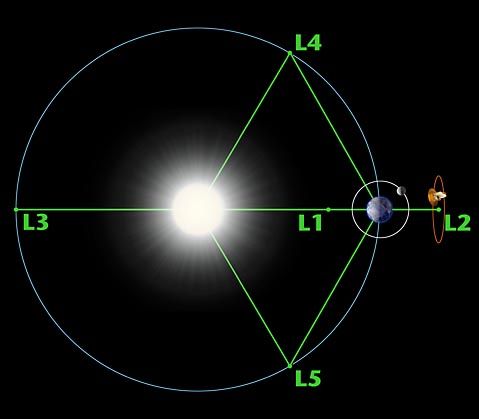
Of the five Lagrange points, three are unstable and two are stable. The unstable Lagrange points – labeled L1, L2 and L3 – lie along the line connecting the two large masses. The stable Lagrange points – labeled L4 and L5 – form the apex of two equilateral triangles that have the large masses at their vertices.

Lagrange Points

Lagrange Points of the Earth-Sun system (not drawn to scale!): NASA

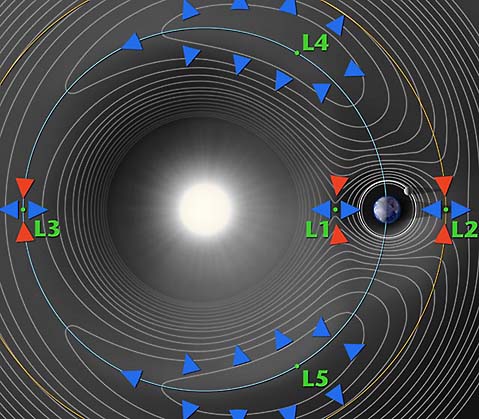
 The easiest way to see how Lagrange made his discovery is to adopt a frame of reference that rotates with the system. The forces exerted on a body at rest in this frame can be derived from an effective potential in much the same way that wind speeds can be inferred from a weather map. The forces are strongest when the contours of the effective potential are closest together and weakest when the contours are far apart. In the contour plot below we see that L4 and L5 correspond to hilltops and L1, L2 and L3 correspond to saddles (i.e. points where the potential is curving up in one direction and down in the other).

Effective Potential

A contour plot of the effective potential (not drawn to scale!): NASA

Arab – Iranian feuding continues at Utah University’s Middle East Center

September 11, 2011

H/T to reader Ron.

The mud-slinging and back stabbing at the University of Utah’s Middle East Center is less than edifying and continues unabated. Charges and counter-charges include plagiarism, cronyism, sexual harassment, insubordination and even contributing to a student’s suicide. It begins to seem like a B-grade movie with bad actors and a melodramatic script. An Arab- Iranian feud – with under-currents of Shia-Sunni rivalry – being played out in Utah!! And the roots of the feuding go back some 1500 years to the very rapid Arab conquest of Persia in 644 AD. Ever since there has been a feeling of Persian “shame” at not resisting the takeover very strongly and is the root cause of the Persian disdain for Arab culture and influence which continues today. Just to complicate the picture there is much back-biting and intrigue within the Arabists themselves.

The Salt Lake Tribune now reports that officials at University of California, Los Angeles said on Thursday that

..they can find no record of awarding a degree beyond a master’s to Ibrahim Karawan, who led the Middle East Center until 2008, when he was succeeded by Bahman Bakhtiari. 

That would seem to support allegations by Bakhtiari, recently terminated for plagiarism, that Karawan does not hold a doctorate and never was qualified to be a professor, sign off graduate students’ work and seek federal grants. In a lawsuit filed Sept. 2, Bakhtiari alleges a colleague concealed Karawan’s “academic fraud” for at least two decades and orchestrated Bakhtiari’s firing by inciting graduate students to drum up evidence of plagiarism and then publicize what they found.

Bakhtiari is now using the confusion over Karawan’s academic status in his legal fight with former colleagues whom he blames for his expulsion from his tenured faculty appointment. Bakhtiari, whose name also appears in print as “Baktiari,” claims he is guilty of little more than sloppiness with attribution, while alleging Karawan perpetrated a fraud on the university, its students and the federal government, which awarded grants to the MEC on the basis of Karawan’s doctorate.

“The University’s failure to take any action against a proclaimed professor who did not hold the mandatory credentials and, for nearly 25 years, signed his name to graduate degrees and solicitations for public monies through the United States Department of Education as one holding those credentials in violation not only of university policy but also federal law, while conversely seeking the academic death penalty for me based on minimal allegations, is discriminatory at best,” Bakhtiari wrote in an Aug. 17 e-mail to the Tribune.

Bakhtiari’s suit targets history professor Peter Sluglett, who was the center’s director from 1994 until 2000, when Karawan took the reins, as well as several “John Does.” Sluglett, who left this week for a year in Singapore, had a leadership position on the center’s executive committee and worked closely with Karawan over the years. Administrators’ abrupt dismissal of Sluglett and another scholar from the center is what precipitated Karawan’s resignation as director in 2008, setting the stage for Bakhtiari’s hiring from the University of Maine. Sluglett later was reinstated at the center and resumed a central role in its management.

The principal cast of villains consist of Bakhtiari (of Iranian origin – fired as Director), Karawan (an Arab, a former Director and currently acting Director) and Sluglett ( an Arabist, former Director and now in Singapore for a year).

Cast of villains at the Mid-East Center: Bakhtiari-Kerawan-Sluglett

There is a large supporting cast of actors of students and faculty consisting among others of university interim President, Lorris Betz,  and humanities dean Robert Newman.

But this appears to be a movie where the entire cast are bad-guys and there is no hero in sight!

Significance of differences of significance: Erroneous statistics in neuroscience

September 10, 2011

Experimental work where a difference between tests is observed must also be analysed statistically to show that the difference observed is significant. But when the significance of difference observed in one group of tests is compared to that observed in another group, then the significance of the difference of the differences is often wrongly analysed according to a new paper in Nature Neuroscience.

The authors  analysed 513 behavioral, systems and cognitive neuroscience articles in five top-ranking journals (Science, Nature, Nature Neuroscience, Neuron and The Journal of Neuroscience). Of the 157 papers where this error could have been made 78 used the correct procedure and 79 used the incorrect procedure. Suspecting that the problem could be more widespread they “reviewed an additional 120 cellular and molecular neuroscience articles published in Nature Neuroscience in 2009 and 2010 (the first five Articles in each issue)”. They did not find a single study that used the correct statistical procedure to compare effect sizes. In contrast, they found at least 25 studies that used the erroneous procedure and explicitly or implicitly compared significance levels.

Erroneous analyses of interactions in neuroscience: a problem of significance by Sander Nieuwenhuis, Birte U Forstmann & Eric-Jan Wagenmakers, Nature Neuroscience 14, 1105–1107 (2011) doi:10.1038/nn.2886

(These) statements illustrate a statistical error that is common in the neuroscience literature. The researchers who made these statements wanted to claim that one effect (for example, the training effect on neuronal activity in mutant mice) was larger or smaller than the other effect (the training effect in control mice). To support this claim, they needed to report a statistically significant interaction (between amount of training and type of mice), but instead they reported that one effect was statistically significant, whereas the other effect was not. Although superficially compelling, the latter type of statistical reasoning is erroneous because the difference between significant and not significant need not itself be statistically significant.

Full paper is here: PDF Nieuwenhuis et al 

AbstractIn theory, a comparison of two experimental effects requires a statistical test on their difference. In practice, this comparison is often based on an incorrect procedure involving two separate tests in which researchers conclude that effects differ when one effect is significant (P < 0.05) but the other is not (P > 0.05). We reviewed 513 behavioral, systems and cognitive neuroscience articles in five top-ranking journals (Science, Nature, Nature Neuroscience, Neuron and The Journal of Neuroscience) and found that 78 used the correct procedure and 79 used the incorrect procedure. An additional analysis suggests that incorrect analyses of interactions are even more common in cellular and molecular neuroscience. We discuss scenarios in which the erroneous procedure is particularly beguiling.

The authors conclude

It is interesting that this statistical error occurs so often, even in journals of the highest standard. Space constraints and the need for simplicity may be the reasons why the error occurs in journals such as Nature and Science. Reporting interactions in an analysis of variance design may seem overly complex when one is writing for a general readership. Perhaps, in some cases, researchers choose to report the difference between significance levels because the corresponding interaction effect is not significant. Peer reviewers should help authors avoid such mistakes. … Indeed, people are generally tempted to attribute too much meaning to the difference between significant and not significant. For this reason, the use of confidence intervals may help prevent researchers from making this statistical error. Whatever the reasons for the error, its ubiquity and potential effect suggest that researchers and reviewers should be more aware that the difference between significant and not significant is not itself necessarily significant.


Another harsh winter is expected as La Niña returns

September 9, 2011

Yesterday the NOAA finally confirmed that  La Niña was back. 

The Indian monsoon has been reasonably good and we can expect  greater evaporation leading to increased rains in the Western Pacific and in Australia. There should be less rain in the Eastern Pacific on the western coast of S. America (coastal Chile and Peru) but increased rain on the east coast in southern Brazil and  northern Argentina. Dry conditions should persist in the Southern US but the Northern hemisphere can now expect another harsh winter for the third year in a row. Forecasters are beginning to warn about this and local authorities are preparing to stock adequate amounts of salt and grit.

Sweden: Forecasters promise another harsh winter 

While Swedes are still enjoying the relatively clement weather of early autumn, weather experts are already forecasting another freezing winter to follow the last two. ”It is true that they generally follow each other,” said meteorologist Lisa Frost from the Swedish Meteorological and Hydrological Institute (SMHI) to daily Aftonbladet.
According to experts, the last two winters have been the coldest for the last few decades and statistics from the institute all point to cold winters coming in threes. …. The three extremely cold winters 1940-43, during the war, were followed by four very clement winters. Since then, the weather would seem to have followed this 3.5 year pattern.

Scotland: New bid to avoid repeat of winter road chaos 

The Scottish Government has called in the Red Cross to help prepare for the possibility of another harsh winter. In a bid to avoid a repeat of last year when motorists were stranded for hours on snow- bound motorways, transport minister Keith Brown has called a ‘Get Ready For Winter’ week next month.

Ireland: Heavy snow promised in Ireland  

The Irish Government has told Irish households to stock up on disposable barbecues to avoid disasters during the freezing weather promised for the forthcoming winter. After studying the last two years bitterly cold winters and the situations which arose the Government has advised that citizens should have “some barbecue trays” to hand in case they get snowed in.

UK: Forecaster Predicts Early Winter Snowfall For Ireland And Britain 

A long range weather forecaster is predicting an early start to winter 2011-2012 for many regions of the United Kingdom and Ireland.  James Madden of Exacta Weather says heavy snowfalls are likely in places as soon as late October and early November.

US: Resurgent La Niña may enhance snowfall for northern Colo. ski areas this winter 

… the Climate Prediction Center (CPC) at the National Oceanic and Atmospheric Administration (NOAA ) has issued a La Niña Advisory. This means La Niña conditions are likely to drive weather trends this winter. … “At this time, the Climate Forecast System (CFS) models are predicting an episode rivaling the same strength as last winter, but that forecast may change quite a bit as we get closer to the winter.”

Last winter, a moderate La Niña in the Pacific Ocean helped generate conditions just right for continuous massive snowfall in the Rocky Mountains of central and northern Colorado.

Related: Newborn La Niña: An Illustrated Guide

Internet forum unveils the compulsive photoshopping of an award-winning nature photographer

September 9, 2011

It started on August 26th when Gunnar Glöersen, a wildlife management expert for the Swedish Hunting Association (Svenska Jägareförbundet) received a call from a journalist – Jan Henricson of  Svensk Jakt – asking him to comment on the authenticity of a suspicious photograph of a lynx taken by Terje Hellesö. Hellesö is a well-known nature photographer who received the 2010 Swedish Environmental Protection Agency’s Nature Photographer of the Year award.

On the 26th Glöersen wrote in his blog about his suspicions not only about this photograph but also of other wildlife photographs by Hellesö. His blog post was taken up in the on-line Flashback forum which exploded with all Hellesö’s photographs being investigated by the on-line community (and the knowledge and expertise and ingenuity with the amateur investigators is truly impressive). In the 2 weeks since Glöersen’s blog post the Flashback forum post has had over 800,000 readers.

Last Monday (5th September) The Local reported:

Photographer Terje Hellesö, recipient of the Swedish Environmental Protection Agency’s Nature Photographer of the Year award, has been reported to police after admitting that he manipulated a number of his pictures of predatory animals. …

“Doesn’t this lynx in the July greenery have a winter furr? How about the lynx that’s reflected in the pool, is it walking in the air or on land, and can you really see the paws in that angle?”, Glöersen wrote in a blog post dated August 26th. Glöersen also questioned the authenticity of the picture, and decided to examine more of Hellesö’s work. Based on his wildlife expertise, he began to suspect that Hellesö’s alleged accomplishments were simply too good to be true.

Among Hellesö’s claims called into question by Glöersen are reports that the nature photographer had seen 150 lynx in nine months, when Glöersen himself had only seen 15 in 52 years. Glöersen also questioned Hellesö’s claim to have photographed a raccoon dog from a meter away, in an area where they’re not even supposed to exist.

In a debate between Glöersen and Hellesö on Sveriges Radio (SR) on August 30th, Hellesö at first denied the allegations that he had doctored his images. “No no no, of course not. Not under any circumstances,” he said. However, four days later, on September 3rd, he changed admitted the forgeries to his wife. “I didn’t know about this myself. I’m still in shock,” Malin Hellesö told SR. …..

On Monday, Tommy Berglund, an inspector and wildlife tracker at the County Administrative Board of Västra Götaland, reported Hellesö to the police for fraud.
While he filed the report as a private citizen, rather than as a part of his official duties, Berglund is nevertheless concerned about the affect Hellesö’s claims have meant for local wildlife management efforts. “Raccoon dogs are among the worst carriers of rabies,” Berglund told newspaper Dagens Nyheter (DN). “Tons of resources have been used in vain to find wildcats and raccoon dogs that don’t exist.”

Because of the time and money they’ve spent, and the fact that numerous concerned people have called the Administrative Board, Berglund thinks this is an important issue, and certainly a matter for the police.

But what is truly impressive is the speed and skill with which the investigative work was done by the on-line community and in a way which I think the main stream media would not dare to do. The depth of knowledge and skill available on-line is now beyond the ability and the competence of the main stream media.  In general Hellesö seems to have used stock pictures of wildlife from the internet, flipped them, resized them and then inserted them into forest landscapes which he presumably had photographed himself. The following are animations of how just some of the pictures were manipulated by Hellesö:

The award winning Lynx picture

Another lynx in the woods

And Lynx No.3

A raccoon dog in the wild

Update: The latest count gives at least 19 manipulated (Terjade) photographs.

Hellesö’s career as a wild-life photographer is over but he probably has a new book and a new career in the field of “How I fooled the world”!

A hotbed of intrigue: Bahman Bakhtiari sues Peter Sluglett after being fired from Utah University’s ME Center

September 8, 2011

Two months ago Bahman Bakhtiari was fired from the University of Utah’s Middle East Center for a pattern of plagiarism. Now he has filed  a suit last Friday in 3rd District Court against Peter Sluglett, the center’s senior-most faculty member and a former Director of the Center himself.

Deseret News:  Bakhtiari alleges that two senior faculty leaders at the center conspired to eliminate him after personality conflicts. He also alleges in the lawsuit that a senior faculty member, who was a former center director, lied about having a Ph.D. from UCLA and that faculty conspired to cover it up.

Bakhtiari served as center director from July 2009 to June 2011. He was brought in from the outside by the Dean of the College of Humanities to replace an existing faculty member. The suit states that from the onset, Bakhtiari was disliked by senior center faculty and that the political science department, which oversees the center, refused to support his tenure. The suit states that the dean of humanities ended up granting him tenure through the department of languages and literature.

Last June, a U. faculty committee investigated complaints of alleged plagiarism against Bakhtiari. In a unanimous vote, the committee found that Bakhtiari committed “a pattern of plagiarism that is harmful to the university’s academic integrity.” …

Although the committee stopped short of termination and revocation of tenure, University of Utah Interim President A. Lorris Betz overrode the decision and terminated Bakhtiari on June 30. ….

Bakhtiari alleges in his suit that center faculty actively dug through his career history to find justification to get rid of him. According to U. documents, evidence of plagiarism was found in six scholarly publications, including Bakhtiari’s 1984 Ph.D. dissertation, an online newsletter and an op-ed piece published in The Salt Lake Tribune. The suit states Bakhtiari is seeking damages for interference with economic relations, invasion of privacy, breach of contract and defamation.

Both Peter Sluglett and the Middle East Center are no strangers to internecine dispute, intrigue and academic “dirty tricks”. Sluglett gets mixed reports as a teacher.

Sluglett is also apparently  a self-anointed expert in recent Iraq history:

February 03, 2006  

Sluglett gets SluggedI noted with some pleasure that Wafaa’ Al-Natheema knocked Peter Sluglett down a peg or two. She posts the full email exchange on her blog. Professor Peter Sluglett considers himself an expert on modern Iraqi history with good reason – he has studies the subject for 30 years. Along with his late wife, Marion Farouk Sluglett, they wrote one of the important books on modern Iraqi history called “Iraq since 1958”. However, he uses that position to stifle any debate on Iraqi history. He considers himself the expert and nobody has the right to contradict him. The problem is that in many cases he is wrong.

The Middle East Center itself is no stranger to controversy where Sluglett was Director before Ibrahim Karawan – who resigned and was then succeeded by Bahman Bakhtiari.

April 4, 2008 

Karawan Resigns over Middle East Center Dismissals  

Ibrahim Karawan, director of the Middle East Center, announced his resignation yesterday before a lecture at the Hinckley Institute of Politics. Karawan said he is resigning because two of his colleagues were forced out of the center by Dean Robert Newman of the College of Humanities. “They were basically moved out of the center, not according to what they wanted, and moved to other departments,” Karawan said.

He questioned whether the action was justified and what the impact will be on the governing structure of the center and its ability to receive funding from the U.S. Department of Education. … Peter Sluglett, a professor of Middle Eastern history, and Harris Lenowitz, a professor in Hebrew, both received letters from Newman informing them that they could continue teaching but would no longer be able to hold leadership positions in the center. Sluglett and Lenowitz both have joint appointments in the center and their departments — history and languages and literature, respectively — and both teach cross-listed courses. ….

On March 13, Lenowitz said he received a letter from Newman that read: “It has come to my attention that you have contributed consistently toward creating an atmosphere in the Middle East Center that lacks collegiality and can no longer be tolerated.” Sluglett said he also received this letter, but he doesn’t think other faculty members have any problems with his behavior…….

Leaving aside the legal positions and claims and counter-claims which will run their course, the Middle East Center and its faculty strike me as being a bunch of  rather petty, uncivilised, amoral and childish group of academics. Petty intrigue, academic dishonesty and scientific misconduct seems to come quite naturally to them.

Playing their games of intrigue appears far more important to them than academic rigour or integrity. Whether they should be getting any funding at all from the US Department of Education ought to be a question being asked.

Was Tony Blair just doing Murdoch’s bidding on Iraq?

September 5, 2011

Even the distance of history may never reveal all the real reasons for the Iraq War.  That Rupert Murdoch through his media outlets was one of the most strident advocates of the Iraq war because of their (non-existent) weapons of mass destruction was always clear. But quite how close he was to Tony Blair is becoming apparent only now.

The latest revelations – let-slip by Wendi Deng Murdoch in an interview with Vogue – show that Tony Blair was very close indeed to Rupert Murdoch. The claim of Tony Blair being in Murdoch’s pocket is no longer so far-fetched. His just following Murdoch’s orders regarding the Iraq war would also explain Blair’s obduracy in “sexing-up” the Iraq dossier with a bunch of lies and half-truths.

BBC News

Former UK Prime Minister Tony Blair is godfather to one of Rupert Murdoch’s young children, it has emerged. Mr Blair was present last March when Mr Murdoch’s two daughters by his third wife, Wendi Deng, were baptised. The revelation comes in an interview with Ms Deng in a forthcoming issue of fashion magazine Vogue. Tony Blair’s office declined to comment on the report, which sheds new light on Mr Blair’s ties with the media mogul. Mr Blair, who is said to have been “robed in white” during the ceremony, is the godfather to Grace, the second youngest of Mr Murdoch’s six children.

As The Guardian puts it 

So much falls into place with the revelation that Tony Blair became godfather to one of Rupert Murdoch’s two young daughters and attended their baptism on the banks of the river Jordan last year. …. Murdoch’s third wife, Wendi Deng, who let slip the information in an interview with Vogue, described Blair as one of Rupert’s closest friends. Blair’s account of the relationship in his memoirs is somewhat different, portraying Murdoch as the big bad beast, who won his grudging respect. That is clearly disingenuous. As other memoirs and diaries from the Blair period are published, we see how close Murdoch was to the prime minister and the centre of power when really important decisions, such as the Iraq invasion, were being made.

image : guardian.co.uk

But bringing this back to what is known about Rupert Murdoch’s views and what was thought to be his staunch support of the neo-conservative cause suggests that Murdoch may have been a leader rather than just a supporter. And in that scenario Murdoch led Tony Blair by the nose into the quagmire of Iraq.

Before the Iraq war Murdoch declared that the war would ensure oil at $20 per barrel which would be the equivalent of a tax cut. The three members of the Coalition of the willing were Australia, the US and the UK — all countries where Murdoch is the most powerful media player. Spain was the tentative fourth member of the Coalition and when Spanish Prime Minister Jose Maria Aznar was defeated in 2004, Rupert showed his loyalty to those who backed the Iraq invasion by promptly installing him on the News Corp board.

After running the unsuccessful Tory campaign in 2004, former federal Liberal Party director Clinton Crosby publicly stated that News International backed one last term for Blair because of his support for the Iraq invasion. John Howard received similar treatment. Some Murdoch papers may have endorsed Kevin Rudd at the 2007 federal poll, but Howard was strongly supported by the Murdoch press in 1998, 2001 and 2004. Besides, News Corp’s Harper Collins book division ended up paying John Howard the biggest six-figure cheque of his career for his memoirs after leaving office.

Rupert Murdoch Profile

Considered a close ally of neoconservative activists, Murdoch has helped bankroll neoconservatism’s more important media outlets, including the William Kristol-edited Weekly Standard, the Wall Street Journal’s editorial page, and Fox News. A sign of Murdoch’s commitment to this rightwing faction’s causes was his willingness to support the Standard in spite of yearly losses in the millions. The magazine is widely credited as a pivotal force in building support for the 2003 invasion of Iraq. According to a report by Fairness & Accuracy in Reporting, “With a circulation of about 65,000 and annual losses estimated from $1 million … to $5 million … the Standard represented only a tiny fraction of Murdoch’s vast media empire.”

Murdoch is frequently criticized for using his media empire to advance his political agenda. During the lead up to the U.S. invasion of Iraq, for example, the editors of Murdoch’s media holdings vociferously supported President George W. Bush and Prime Minister Tony Blair’s pro-war campaign. One British newspaper opined: “You have got to admit that Rupert Murdoch is one canny press tycoon because he has an unerring ability to choose editors across the world who think just like him. How else can we explain the extraordinary unity of thought in his newspaper empire about the need to make war on Iraq? After an exhaustive survey of the highest-selling and most influential papers across the world owned by Murdoch’s News Corporation, it is clear that all are singing from the same hymn sheet. Some are bellicose baritone soloists who relish the fight. Some prefer a less strident, if more subtle, role in the chorus. But none, whether fortissimo or pianissimo, has dared to croon the antiwar tune. Their master’s voice has never been questioned.”

It does begin to seem very plausible – and not just some conspiracy theory – that Rupert Murdoch – and not Bush or Cheney or Blair – was the “deep” force behind the entire Iraq adventure and all the hundreds of thousands killed there. And the price of oil at $80 – 100 in these days is a long way from $20.