Sangiliyandi Gurunathan on his way to another private University in South India

September 5, 2011

Kalasalingam University recently took strong action against a Professor and 6 PhD students for scientific misconduct which included data manipulation and plagiarism. Dr. G Sangliyandi, Senior Professor and Head, Department of Biotechnology, and Dean, International Relations, Kalasalingam University was directed to resign from the University. The 6 PhD students involved had their registrations cancelled.

His name has been removed from the Department of Biotechnology page at the university website but still appeared on the International Relations page last week.

It seems that Dr. Gurunathan has been offered (and is said to have accepted) a position at another private University in Southern India – also at a Department of Bio-technology but it has not been possible to confirm this. 

One reader comments that all the six students involved are still continuing at Kalasalingam University

All the 6 research scholars, whose Ph.D registration has been cancelled are still doing (continuing) their research work in the department itself on the support of Prof. Dr. K. Sundar.

If this is true then it seems that Sangiliyandi Gurunathan is being assigned all the blame for the wrong-doings at his lab and not primarily the students he had initially blamed. Presumably the students have new PhD registrations and stern warnings about maintaining good conduct and about the ethics of plagiarism and image manipulation!

UN is only as good as its worst member: Uruguay troops misbehave in Haiti

September 5, 2011

As if Haiti hadn’t enough problems.

The United Nations Stabilization Mission in Haiti (MINUSTAH) was established in 2004 and was given a new mandate to help maintain order and security following last year’s devastating earthquake. Earlier this year the UN mission was heavily criticised in the handling of the cholera outbreak which killed some 6,000 people. To make it worse it seems that the cholera was introduced into Haiti by peacekeeping troops from Nepal (where cholera is endemic).

Related: Whole-Genome Study Nails Haiti-Nepal Cholera Link

Now the UN and the Haitians have been let down badly by part of the contingent from Uruguay.

AFP: 

MONTEVIDEO — Uruguay announced it has sacked a navy commander with the UN mission in Haiti after a video was circulated of an alleged sexual assault on a young Haitian man by members of a Uruguayan peacekeeping unit.

The Defense Ministry said in a statement that in addition to the dismissal of the official — who was not immediately named — a military justice board had been convened and paperwork for the return home of the five allegedly involved had been started.

“The navy wants to go beyond the simple fact of the video (to determine) if there are other violations of conduct,” spokesman Sergio Bique told local media. The suspects will be tried and sentenced appropriately, he stressed.

In Haiti, Magistrate Paul Tarte said Friday that officials were examining testimony from the alleged suspect and images of the incident taken by a cell telephone camera at the base in southern Haiti, which have also been circulated on the Internet. Medical evidence of the attack also was obtained.

UN peacekeeping spokesman Kieran Dwyer said the United Nations acted immediately after hearing about the incident late last week.

The UN is an easy target for criticism and is often castigated from all sides of the political divide (and I am just as guilty in indulging in some of the criticism). But of course the UN is only as good as its worst member and it is the Lowest Common Factor which applies.

UN in Haiti (MINUSTAH): Current strength (31 July 2011)

  • 12,252 total uniformed personnel
    • 8,728 troops
    • 3,524 police
  • 564 international civilian personnel
  • 1,338 local civilian staff
  • 221 United Nations Volunteers

Country contributors

Military personnel – Argentina, Bolivia, Brazil, Canada, Chile, Ecuador, France, Guatemala, Japan, Jordan, Nepal, Paraguay, Peru, Phillipines, Republic of Korea, Sri Lanka, United States and Uruguay.

Police personnel – Argentina, Bangladesh, Benin, Brazil, Burkina Faso, Burundi, Cameroon, Canada, Central African Republic, Chad, Chile, China, Colombia, Côte d’Ivoire, Croatia, Egypt, El Salvador, France, Grenada, Guinea, India, Indonesia, Jamaica, Jordan, Kyrgyzstan, Lithuania, Madagascar, Mali, Nepal, Niger, Nigeria, Norway, Pakistan, Philippines, Romania, Russian Federation, Rwanda, Senegal, Serbia, Sierra Leone, Spain, Sri Lanka, Sweden, Turkey, United States, Uruguay and Yemen.

Remote Sensing: A case of editorial cowardice in the face of bullying from the orthodoxy

September 3, 2011

If this had been the middle ages there would have been witch-hunts and burnings at the stake (but of course it would then have been during the Medieval Warm Period).

Spencer and Bracewell had their paper On the Misdiagnosis of Climate Feedbacks from Variations in Earth’s Radiant Energy Balance published in the Journal Remote Sensing. The paper was refereed in the normal way and gained a lot of attention because it went against global warming orthodoxy. The global warming cabal were not amused and their blogs were full of objections to the paper. (This was all before the CERN CLOUD experiments).

The Editor-in-Chief of the Journal – a certain Wolfgang Wagner – obviously faced a lot of heat from the members of the global warming orthodoxy for publishing such heresy. He was clearly threatened by having the flow of scientific articles to his new journal throttled. But he could not retract the paper – not having any basis for doing so. Instead he has resigned in a blaze of publicity saying that the paper should not have been published!! Where peer review failed to find any fault with the paper, the editor has resorted to grandstanding to attack the paper.

It seems a simple case of the high priests of a religion threatening to excommunicate the poor little editor-in-chief of this new journal who has caved in on the basis of blog comments (and no doubt some irate telephone calls). A simple case of editorial cowardice.

The full story is detailed in these posts:

Editor-in-chief of Remote Sensing resigns over Spencer & Braswell paper

Critiques and responses 

Comment On The Resignation of Wolfgang Wagner

Are Universities cracking down on academic and scientific misconduct?

September 3, 2011

It may just be a passing gust of a cleansing wind but I do have a perception that universities are becoming much more responsive to allegations of academic dishonesty and scientific misconduct.

Investigations of misconduct at academic institutions have long been notorious for the amount of time they take (usually many years) and for always protecting “the establishment”. But I think I detect a change.

Investigations are speeding up and sanctions against those found guilty are beginning to be more than symbolic slaps on the wrist. The frequency of enforced resignations and dismissals seem to be increasing. I perceive a trend and I hypothesise that it is partly in response to the on-line scrutiny and negative publicity which comes from the blogosphere. 

Close on the heels of the recent Ahluwalia resignation /dismissal come these two cases:

1. Academic impropriety with Professor Julius Nyang’oro considered to have improperly helped athletes to cheat at the University of North Carolina. He is tied to two athletes who were kicked off the football team. In one case he did not detect or ignored blatant plagiarism and in the other he allowed a freshman to take a senior graduate level course and awarded him a suspiciously high grade. Nyang’oro apparently rarely gave low grades in his classes:

College athletes and accommodating professors

UNC professor resigns amid football investigation

UNC’s Afro-American studies head resigns amid questions of football …

2. A well known cardiac researcher Zhiguo Wang has been dismissed from the Montreal Heart Institute for scientific misconduct following retraction of two papers in the Journal of the Biological Chemistry just a month ago.  Wang also has an appointment at the University of Montreal, and is senior research scholar of the Fonds de Recherche en Sante de Quebec, a ChangJiang scholar professor, and a LongJiang scholar professor of China. The dismissal comes less than a month after the publication of the retraction notices.

Authors retract two JBC papers on how heart rhythms go awry; Montreal Heart Institute looking into why

Montreal heart studies ‘withdrawn’ – Zhiguo Wang’s arrhythmia research being investigated after retractions 

Montreal hospital dismisses cardiac researcher over misconduct allegations

There have been a number of other cases recently in Germany as well where the speed of the investigations by the academic institutions have been unprecedented (zu Guttenberg and Bulfone-Paus as examples).

Perhaps it’s all just in my mind – or even wishful thinking – but I have the distinct impression that a cleansing wind is beginning to blow. The world wide web may already be having an impact on combating academic dishonesty and scientific misconduct by forcing institutions to be more responsive. There is much on-line which is still malicious or untrue or just plain rubbish. But the amount of “solid” comment has achieved a  “critical mass”. The blogosphere can no longer be merely ignored it seems.

Chasing losses for Corporate tax planning

September 2, 2011

Loss making companies have acquired a new value in M & A activity, especially if they have accumulated losses which can be carried forward against future profits.  In some countries carry-forward losses are as high as 25% of GDP.

Shifting profits to tax havens has been used by corporates (and individuals) increasingly since the 1970’s, but shifting losses to high-taxed countries can be just as effective. A new report has just been issued by the OECD, Corporate Loss Utilisation through Aggressive Tax PlanningISBN Number: 9789264119215, Publication Date: 12/08/2011, Pages: 92

An OECD press release  states:

30/08/2011Due to the recent financial and economic crisis, global corporate losses have increased significantly. Numbers at stake are vast, with loss carry-forwards as high as 25% of GDP in some countries. Though most of these claims are justified, some corporations find loop-holes and use ‘aggressive tax planning’ to avoid taxes in ways that are not within the spirit of the law.  

This aggressive tax planning is a source of increasing concern for many countries and they have developed various strategies to deal with it. Working cooperatively, countries can deter, detect and respond to aggressive tax planning while at the same time ensuring certainty and predictability for compliant taxpayers.

.. countries have identified financial instruments that create artificial losses or obtain multiple deductions for the same loss. They have also seen loss-making companies acquired solely to be merged with profit-making companies and loss-making financial assets artificially allocated to high-tax jurisdictions through non arm’s length transactions.

Reuters reports that

The OECD report, which singled out one industry — financial services — said banks headquartered in high-tax countries were buying and selling derivatives among operating subsidiaries in low-tax jurisdictions and then shifting losses to higher-tax jurisdictions to “manage large loss-making financial assets” held on their balance sheets.

Martin Sullivan, an economist at Tax Analysts, a trade publication, said he thought the majority of the loss-shifting described in the report “pertains to banks, since they are the ones that had huge losses in 2008 and now are making profits.”

The tax-boosting principle at work centers on loss carry-forwards, a legal accounting technique that allows corporations to apply their current year’s net operating losses to profits in future years. While the move is designed in part to help companies avert bankruptcy, it also allows them to reduce their tax bills. ..

The OECD report identified what it called three high-risk schemes designed to maximize the tax value of carry-forward losses. They are:

  • Corporate reorganizations, in particular those in which profitable companies buy money-losing companies solely for the tax benefits of their losses, which is illegal in the United States.
  • Certain financial instruments, including currency swaps and schemes that “refresh” soon-to-expire losses.
  • Non-arm’s-length transfer pricing, or the prices companies charge between subsidiaries for goods and services. This is not legal in the United States and is a subject of growing scrutiny by the Internal Revenue Service.

Etna erupts for 12th time this year

September 1, 2011

Mt. Etna has been erupting regularly since January this year and erupted for the 12th time on Monday. Fantastic images but no great hazard apparently.

mount-etna-eruption-2011 video

Etna erupting for 12th time in 2011: image http://www.inquisitr.com

Harvard criticised for being too lenient with Hauser

September 1, 2011

I don’t know to what extent the Harvard Crimson represents student opinion at Harvard but it is likely that they represent at least a substantial body of opinion among the student body.  In an editorial today, they come down very hard against what they perceive as being the rather lenient treatment of Marc Hauser by the University. He was found guilty of scientific misconduct, sent on a years “gardening” leave but kept his tenure and his lab. He was then allowed to return and continue his research but was not allowed to teach. He then resigned or was allowed to or invited to resign. The University investigation seems to be over though the Office of Research Integrity investigation into the misuse of Federal grants may still be ongoing.

The Crimson thinks that allowing him to save face was a little too lenient:

In April, we argued that Harvard should have taken a more aggressive stance in response to the findings of the investigative committee and fired Hauser. Hauser’s prohibition from further research and teaching would have been a logical consequence of his actions. It would have forcefully upheld the imperative for honesty and accuracy in the sciences. Tenure, a privilege given to distinguished professors, is no shield for academic misconduct.

.. despite (a) measure of closure that Hauser’s resignation brings to this situation, it remains that the University should have taken stronger and earlier disciplinary action against him. 

.. By firing Hauser, Harvard would have sent a firm message that academic dishonesty is not tolerated. In contrast, Hauser’s resignation is an evasion of full culpability and deemphasizes the gravity of his actions. Allowing Hauser to save face and graciously depart his position offers little recourse for the multitude of scientific malfeasances that were committed.

.. Harvard undergraduates are held to high standards regarding academic discipline—professors with positions of influence should be equally, if not more, accountable for their deeds. By refusing to take bold action and instead allowing for a willing resignation, the University has downplayed the severity of his academic dishonesty.

Strong words.

Of course the University has also been criticised by Hauser’s friends and supporters  for being too hard on him!

Blogging as therapy: My 1000th post

August 30, 2011

I started this blog in April 2010 but I was still occupied completing my book and did not really start posting until the summer vacations in June 2010.

This is now my 1000th post.

Since then I have averaged between 2 and 3 posts a day though there have been periods for a week or two with very light posting and some long winter nights with many posts. Some things are however becoming clear to me:

  1. I post primarily for myself as a way of expressing whatever might be engaging or attracting or disturbing me at that moment. Just putting a post together is a little exercise which itself forces feelings or emotions into expressible text.
  2. Having posted on a particular subject functions as a form of catharsis. Sometimes I may never return to a subject for a long while or even at all.
  3. I cannot judge – and no longer concern myself greatly – which posts will get read and which will not. Old posts which had very few readers when initially posted may suddenly attract readers for no discernible reason. Posts I felt were not very well written can attract many more readers than others which I thought were well expressed.
  4. I find that some sense of achievement occurs at the time when I complete the post and not – surprisingly – when the views of the post become high. (Just as the main sense of achievement was when I completed my book manuscript and not when I found a publisher!)
  5. The structure of my web reading has changed as a consequence of posting. I find I look for different viewpoints and not just supporting viewpoints much more regularly. I am continuously amazed at the amount of quality writing available on the web. There is a great deal of utter rubbish also. But it does not seem to be too difficult – or too onerous – to separate the wheat from the chaff. In fact some of the rubbish – if well written – can be quite entertaining.
  6. I seem to straddle all political labels of every persuasion.  On some subjects I would be labelled a fascist, and on others a socialist. I appear to be conservative and liberal simultaneously. Sometimes I find I support some views which would be considered environmentalist views and on many others I find I am totally opposed to what would fit that label. Some left-wing and some right wing causes attract me as often as others which repel. But I am quite comfortable in not finding any label which fits me. Being politically correct was not and is not of any relevance.
  7. A natural cynicism I have had about all politicians and all “do-gooders” is now I think a little more nuanced and analytic under the heading of “behaviour”.
  8. Blogging is a wonderful way of venting indignation.

In essence blogging functions as therapy for myself. It helps in sorting out my disjointed and chaotic thoughts. It forces me to read opposing views. I have even been forced to change my initial view as I have read more. It functions as a means of expressing indignation and a vent for letting off steam. It enforces some self-discipline. It creates some identity markers. It helps me to continue writing though it does take some time away from my next manuscripts. Whether it improves my writing is uncertain but it is certainly addictive.

It is – without doubt -therapeutic.

Some notes to myself for future posts include:

  1. It is perfectly OK to write for myself and not for any specific reader
  2. Avoid preaching
  3. Use fewer extracts from others and let the link do the work
  4. Don’t pretend to be a reporter
  5. Resist posting a link without comment
  6. Resist the temptation to “slander” which can be very strong but does not add much literary merit

The simple truth is that I shall continue blogging primarily for myself and I have no agenda other than to feel better in my own mind. It is an extension of my personal space; entirely under my control, my responsibility and for which I alone am accountable. But I am well aware that this space is also in the public domain. But this is precisely why  – because it allows public scrutiny- I think it is therapeutic.

If in addition some people read what I write and if some few find it readable or provoking or just interesting then that is a bonus. But what readers – if any -may think is entirely secondary.

7 billion people from October 31st by UN decree – but it is an opportunity not a problem

August 30, 2011

Sometime soon the world’s population will exceed 7 billion. No one knows exactly when. According to the UN Population Reference Bureau, this will happen on 31st October in India or in China. The world’s 6 billionth living person was “suppposedly” born just 11 years ago in Bosnia, and world population is expected to reach 9 billion by 2050.

Monsters&Critics

The billion mark was reached only after 1800. As many as a billion have been added in the eleven years of the 21st century alone, and predictions on future population growth are now treated with the same caution and scepticism as long-range weather forecasts. David Bloom of the Harvard School of Public Health says that the multitude of unpredictable factors means that taking a global view is problematic. ‘Among them are infectious diseases, war, scientific progress, political change and our capacity for global cooperation,’ he says.

The general expectation is, however, that population growth will tail off, with UN predictions for 2050 ranging from 8.0 to 10.5 billion.

Interactive UN map is here

source: UN (via Time)

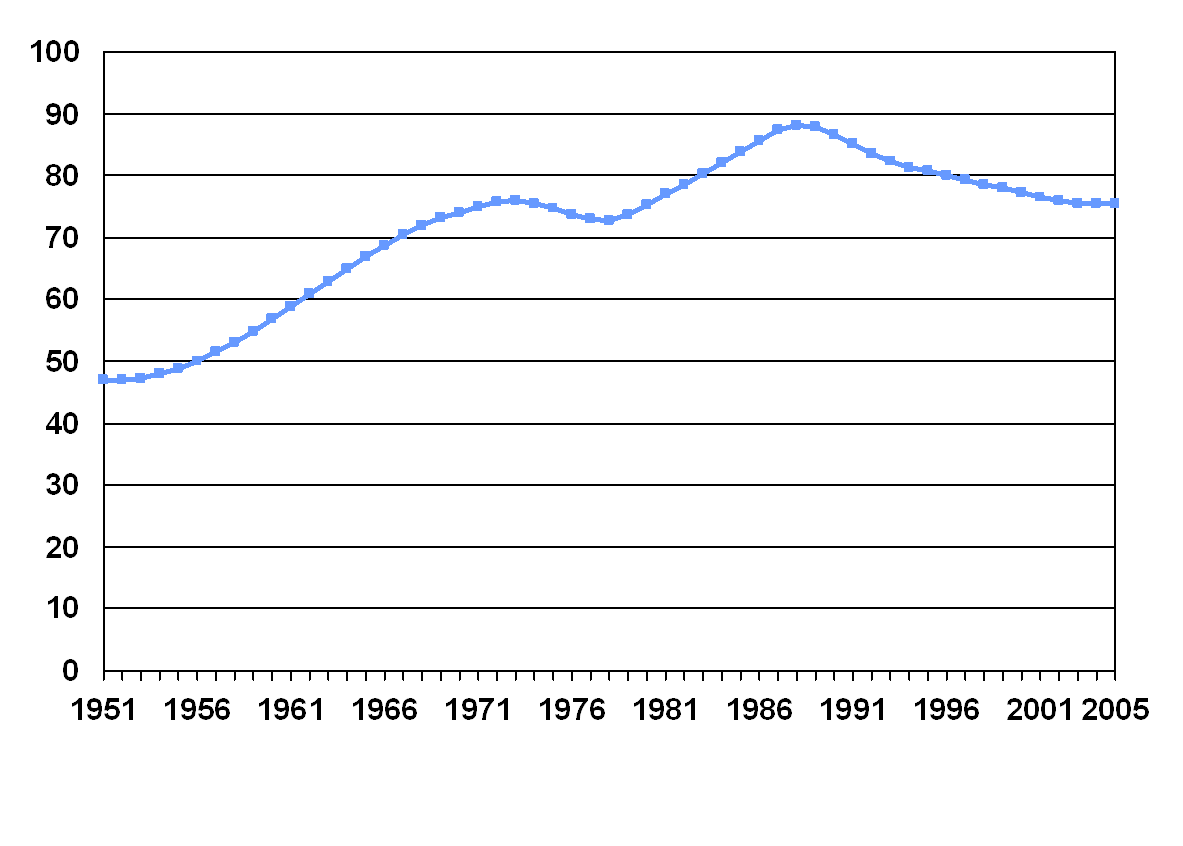
The annual rate of increase seems to have peaked around 1988 and is decreasing slowly. The UN medium scenario seems to be close to the actual development.

Annual increase of world population: Source United Nations, World Population Prospects: The 2004 Revision, 2005.

But I am no Malthusian and have a strong belief that the catastrophe theories are fundamentally misguided. Peak gas will never happen. Peak oil is a long way away and will be mitigated by new ways of creating oil substitutes as oil price increases. All the dismal forecasts of food production not being able to cope with population have not transpired. In my own lifetime I have only seen human ingenuity increase. Every doomsday scenario has had to give way before human ingenuity responding to human needs. I also believe that our children and our grandchildren will be considerably “smarter” than we are and will have (or will develop) technologies and tools that we cannot even dream of. I am not very convinced or impressed by those who would ban things today “for the sake of our children and our grandchildren”.

Even by the wildest stretch of his imagination my grandfather – who died around 1918 – would not have been able to imagine the technologies available today. Even my father – an engineer – who died in 1988 would not have been able to forecast the technologies we have at our command today.

With the definition below I would have no problem to be labelled a cornucopian.

cornucopian is a futurist who believes that continued progress and provision of material items for mankind can be met by similarly continued advances in technology, and the abundance of matter and energy in space would appear to give humanity almost unlimited room for growth.

What population problem? More brains and hands could well cater for the extra mouths to feed


University of Peshawar Vice Chancellor defends himself

August 30, 2011

The Vice-Chancellor of the University of Peshawar,  Dr Azmat Hayat Khan was found guilty of plagiarism by a three-member committee of the Higher Education Commission that was constituted to probe the matter. The Higher Education Commission had submitted its report to the Governor of Khyber-Pakhtunkhwa who is also the Chancellor of the university.

The Vice Chancellor has now put forward his story publicly and explained the plagiarism claims are not justified:

The News

Speaking out for the first time since he was accused of plagiarism, Vice-Chancellor of the University of Peshawar Prof Dr Azmat Hayat Khan Sunday rejected the allegations against him as baseless. A pressure group in the university is politicising the issue for its personal gains, he told The News in an exclusive interview.

… He said that the case was in the court and he could not comment much about it. However, I have challenged the jurisdiction of the Higher Education Commission. The letter of the HEC was written on malafide intention to the Khyber Pakhunkhwa governor in May 2011, he argued….

The Vice-Chancellor said that he had done his PhD in 1990 on the Durand Line and his thesis were challenged after 21 years, which was self-explanatory of the malafide intent behind the issue. He said that the Indian Office Library was the primary source of files for him. If you see my book you will come to know that I have quoted the original sources of information which is the same that Mst Kulwant Kaur has done. I mean both the authors have quoted original sources with different citations, he argued. In my book on several occasions I have mentioned in the footnotes that for further details see Kulwant Kaur’s book, Pak Afghan Relations. Now if I wanted to steal somebody’s work, I would not have referred to his or her book, he added.

Regarding the letters of a faculty member of the university to various quarters accusing him of giving life threats to him and his family members, Dr Azmat Hayat said he was an academician and believed in the sanctity of pen and book. ìAlso, I belong to a well-reputed family of Peshawar. People know me and my family very well. I cannot even think about such mean practices, he stated.

Read whole interview