Global warming paper withdrawn for being “false and impossible”

January 20, 2011

Global warming enthusiasts are getting desperate it would seem. Perhaps they are disturbed by their crumbling credibility as the entire faith is being debunked. Polar bears are thriving and the Sun is very quiet and we are in for 20 or 30 years of a cooling trend and the effect of man-made CO2 having any significant effect on warming is looking more and more implausible. Catastrophe claims are being exaggerated to the level of the impossible and draconian measures are being called for. The global warming crowd are sounding more like eco-fascists whose creed is that discipline, prohibition, enforcement and oppression” are the only solution.

On the one hand we have one of the high priests of the global warming faith (NASA’s James Hansen) calling for authoritarian measures a la China to enforce de-carbonisation – http://hauntingthelibrary.wordpress.com/2011/01/12/hansen-us-democracy-not-competent-to-deal-with-global-warming-calls-on-communist-china-to-save-humanity/

The NASA scientist at the heart of the global warming fiasco seems set to stir more controversy after declaring in an op ed piece for The South China Morning Post and a personally published follow-up that American democracy is not competent to deal with global warming, and communist China now represents the world’s “best hope”.

In the op ed piece for the Chinese newspaper, which he entitled Chinese Leadership Needed to Save Humanity (published as The Price of Change) Hansen placed the blame for the vast majority of Co2 emissions supposedly causing global warming on his home country of America, and appealed to China not to follow the same path. Hansen said that China was the world’s “best hope” and called for them to “lead the world through the most dangerous crisis that humanity and nature have ever faced”.

In a follow-up article published on his website Hansen calls Americans “barbarians” and slams American democracy, calling for China to raise tariffs on American-made products until such time as America falls into line. …….

Hansen goes on to condemn the current democratic system in America as “dysfunctional” as it will not enact the carbon taxes he has been calling for. All is not lost, though, as he advises the Chinese government what to do about Congress in a truly incredible passage in his letter:

“However, there is a way around that, which becomes obvious with the realization that an initially modest carbon fee is in China’s own interest. After agreement with other nations, e.g., the European Union, China and these nations could impose rising internal carbon fees. Existing rules of the World Trade Organization would allow collection of a rising border duty on products from all nations that do not have an equivalent internal carbon fee or tax.

The United States then would be forced to make a choice. It could either address its fossil fuel addiction with a rising carbon fee and supportive national investment policies or it could accept continual descent into second-rate and third-rate economic well-being”.

And now we have Canadian TV revealing that

“A study warning that the planet would warm by 2.4C by 2020, creating deadly consequences for the global food supply, is being debunked as false and impossible”.

The study came from a little-known, non-profit group based in Argentina, called the Universal Ecological Fund. An embargoed copy of the study appeared on Eurekalert!, a news service operated by the American Association for the Advancement of Science (AAAS) that’s followed by many journalists.

The study was picked up by a number of international news organizations Tuesday. But it appears the study’s claims were erroneous. …… The correction came after The Guardian newspaper in the U.K. published a reaction piece to the study. The paper said it had interviewed climate scientists who told them that rapid global warming at the rates projected by the study was impossible.

“2.4 C by 2020 (which is 1.4C in the next 10 years – something like six to seven times the projected rate of warming) has no basis in fact,” NASA climatologist Gavin Schmidt told the newspaper in an email.

According to The Guardian, the study’s lead author Liliana Hisas, who is the UEF’s executive director, erred by overlooking how the oceans, which absorb heat, will compensate for global warming by delaying the effects of increasing concentrations of greenhouse gas emissions in the atmosphere.

Hisas said she stands by her report’s findings, which have been endorsed by Nobel Prize-winning Argentine climate scientist, Osvaldo Canziani.

The AAAS says that after receiving complaints that the study’s conclusions were impossible, it has removed all references to the study from its website.

“EurekAlert! deeply regrets the accidental posting of an erroneous news release on 18 January 2011,” the news service wrote in a notice to journalists who subscribe to the service.

  1. It should be noted that the Universal Ecological Fund is just another lobby group, and
  2. that “the Nobel Prize-winning Argentine climate scientist, Osvaldo Canziani” who supervised this work got his much-maligned Peace Nobel as part of the IPCC for lobbying activities and not for any scientific endeavour, and
  3. the paper seems to have received little or no competent scientific review before being published by EurekAlert

Drug smuggling pigeon ring broken

January 19, 2011
Carrier Pigeon

Carrier Pigeon: Image via Wikipedia

From the BBC:

Colombian police say they have captured a carrier pigeon that was being used to smuggle drugs into a prison.

The bird was trying to fly into a jail in the north-eastern city of Bucaramanga with marijuana and cocaine paste strapped to its back, but did not make it.

Police believe the 45g (1.6 ounce) drug package was too heavy for it. Bucaramanga police commander Jose Angel Mendoza said “This is a new case of criminal ingenuity”. The pigeon is thought to have been trained by inmates or their accomplices.

Police said carrier pigeons had been used in the past to smuggle mobile phone Sim cards into the jail.

Good thing this was Colombia and not Singapore – otherwise the pigeon would be facing capital punishment!!

100 year old whiskey from Shackleton’s hut and a shipwreck gives three 200 year old champagnes

January 19, 2011

I am not sure if being frozen for 100 years adds to the process of ageing in a whiskey and in any case ageing usually only takes place in a cask and not in the bottle. Even ageing in a cask is said to be negligible after about 20 years. Champagne however should not benefit from ageing of more than a few years and even a 10 year old champagne may be little better than vinegar. So the value of a 200 year old champagne is historic rather than intrinsic. Shackleton’s whiskey will of course be valued on the historical importance though it may well be very drinkable.

From Discovery News:

Three bottles of whisky abandoned in the Antarctic ice by British explorer Sir Ernest Shackleton have been returned to Scotland.

  • The bottles, from the British Antarctic Expedition 1907, were frozen solid at minus 30 degrees Celsius temperatures but the whisky inside was still liquid.
  • The bottles of Mackinlay’s were part of a cache recovered last year from beneath Shackleton’s Antarctic hut.
  • Tests are now under way to see how the whisky fared after being preserved in the polar chill for so long.

The bottles of Mackinlay’s were part of a cache recovered last year from beneath Shackleton’s Antarctic hut, built in 1908 as part of his failed attempt to reach the South Pole. They made it home Monday to Whyte and Mackay, the brand’s owner, for analysis to see how they have fared after so long preserved in the polar chill.

The wooden crate containing the whisky, marked British Antarctic Expedition 1907, was frozen solid in the minus 30 degrees Celsius (minus 22 degrees Fahrenheit) temperatures but the whisky in the bottles was still liquid. Two more crates of whisky, along with two of brandy, were also discovered but they were left under the floorboards of the hut.  The whisky is believed to have been bottled in Scotland in 1896 or 1897, making it among the oldest in the world. Richard Paterson, Whyte and Mackay’s master blender, said the analysis would be “for the benefit of the whisky industry”.

Also from Discovery News:

Champagne experts have discovered what are believed to be the oldest existing bottles of Heidsieck champagne, salvaged from a shipwreck near the Finnish province of Aaland, local authorities said Monday. Divers stumbled across a cargo of around 150 champagne bottles last July in a two-masted schooner which had run aground sometime between 1825 and 1830, and by last November experts had already identified the world’s oldest Juglar and Veuve Clicquot brands among the bottles. “When re-corking the almost 200-year-old bottles a third brand has now been discovered,” Aaland authorities said in a statement.

Four bottles have been identified as having come from the Heidsieck & Co Monopole house, which is now owned by Vranken Pommery Monopole. Juhlin, who has been helping local authorities re-cork and catalogue the champagnes, added that only one of the Heidsieck bottles was in prime condition.

“The Heidsieck Monopole is around 75 percent pinot noir… It has some flower notes, slightly more toasty notes than the Veuve Clicquot,” he said. Juhlin said he couldn’t put an exact price on the Heidsieck, but said he would not be surprised if it turned out to be the most sought-after and expensive of the three brands. He had earlier estimated that the bubbly from Veuve Clicquot and the now-extinct Juglar could fetch up to 100,000 euros (132,000 dollars) per bottle.


Dreamliner delayed again and Qantas dramatics continue – now with B747 engines

January 19, 2011

Boeing has delayed the Dreamliner again — for the seventh time!

The Telegraph reports:

Boeing told investors on Tuesday that the 787 will now be delivered to launch customer All Nippon Airways in the third quarter of the year, rather than the first, after a fire on one of the test planes in November. All test flights were suspended for six weeks after the fire.

The 787, which seats 210 to 250 passengers and has a list price of $202m, promises to be the company’s greenest and most efficient airliner yet and uses advanced composite materials to achieve these savings. However, technical problems have pushed the aircraft behind schedule and it is now into its third year of delays. Boeing is under pressure to deliver the 787, which has become the company’s fastest-selling airliner.

Shinichiro Ito, the president of All Nippon, said last week the airline is having a “hard time” dealing with the delay. Boeing has secured 847 orders for the 787, which took its maiden flight in December 2009. Boeing insisted the latest setback will not have a “material impact” on its results, something investors appeared to agree with.

Meanwhile Qantas experiences further problems with its Rolls Royce engines . AFP reports on two Boeing 747 Qantas flights with engine problems:

A Qantas passenger jet bound for New York made an unscheduled stop in Fiji after it developed a problem with one of its engines, the Australian airline said Wednesday.

Qantas said flight QF107, a Boeing 747, carrying 375 passengers from Sydney to New York via Los Angeles, touched down in Nadi on Tuesday for repairs to a fuel valve supplying one of its engines…..

…… The hitch comes just days after another Qantas Boeing 747, QF11 to Los Angeles, experienced a contained engine failure on the runway of Sydney airport due to a turbine blade defect.

Media reports on that incident said that passengers heard “a loud bang” and saw black smoke pour from the affected engine, with the captain reportedly telling those on board that the engine had “cooked itself” over the plane’s intercom.

The “contained”  engine failure is the more serious issue. The Boeing 747 long-reach aircraft flown by Qantas uses  Rolls-Royce RB211-524G-T engines. The “T” at the end signifies that it includes some of the Trent modifications. The Trent 900 engines are used on the Airbus A380s while the Trent 1000 is  planned for the Boeing Dreamliner.

A Trent 1000 experienced an uncontained failure on the test-bed last year while the Trent 900 has had an uncontained failure and a number of other difficulties on the A380.

Related:

https://ktwop.wordpress.com/2010/09/28/rolls-royce-trent-1000-fix-is-defined/

https://ktwop.wordpress.com/2010/10/25/in-flight-failure-of-rb-211-524-engine/

https://ktwop.wordpress.com/2010/11/04/qantas-a-380-suffers-in-flight-rr-trent-900-engine-failure/

https://ktwop.wordpress.com/2010/11/05/trent-900-vs-gp7200-competitive-pressures-getting-too-hot/

https://ktwop.wordpress.com/2010/11/07/further-boeing-dreamliner-delays-and-rolls-royce-shares-feeling-the-heat/

Sea Of Okhotsk rescue not quite over yet

January 19, 2011

While the icebreakers had broken through the worst of the ice, the rescue is not yet over and my previous post was a little premature.

A report of the latest news is available here: http://eureferendum.blogspot.com/2011/01/its-not-over.html

I was not expecting to be writing about the Okhotsk Sea today, but in yesterday’s account there were warnings that the crisis was not quite over. And indeed that is the case, with Voice of Russia observing that the rescue operation “will not be over today”. Conditions appear to have deteriorated sharply and, last night, the four-ship convoy covered “no more than three miles”. A helicopter is out reconnoitring the ice situation today.

The convoy in the Sea of Okhotsk

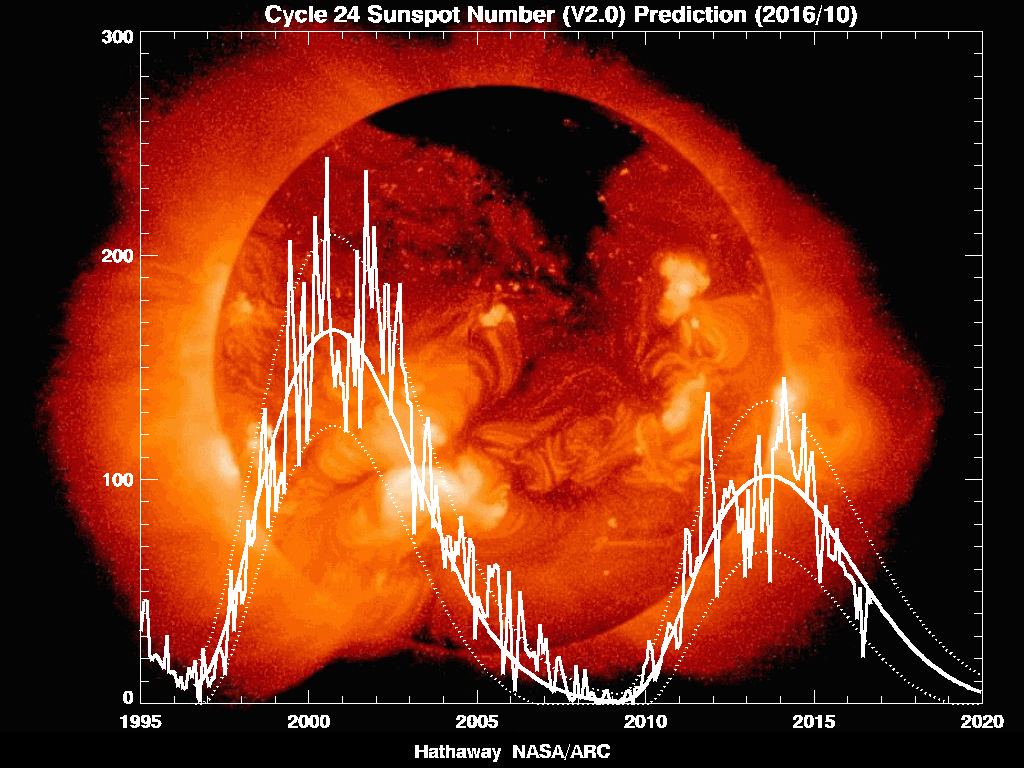
NASA reduces forecast for Solar Cycle 24 again

January 19, 2011

In December NASA had reduced its forecasts for SC24 to a peak sunspot number of 64 being reached in June 2013. Now less than two months later, the latest forecast has been reduced again to a peak sunspot number of 59 to be reached in June / July 2013.

We find a starting time of May 2008 with minimum occurring in December 2008 and maximum of about 59 in June/July of 2013.

NASA SC24 forecast - January 2011: image NASA

At these levels the current Landscheidt minimum is comparable to SC5 and SC6 – the Dalton Minimum of 1790 to 1830 – where peak sunspot numbers were just over 50. (The earlier Maunder Minimum – 1645 to 1715- was before the modern period of sunspot number measurement and nominally was a period with no significant sunspots – presumably at sunspot numbers of less than 20 in today’s measurement values).

From my previous post:

It is not inconceivable that the SC24 will not peak till early 2014 and will only achieve peak sunspot numbers around 55. Solar cycle 24 could well have a length of 150+ months instead of the nominal 132 months.

The development of the NASA predictions are in the table below:

NASA Forecasts for SC24

Date of

forecast

Expected date

of peak

Expected peak

sunspot number

March 2006 June 2010 168
October 2008 March 2012 137
January 2009 June 2012 104
January 2010 June 2013 90
December 2010 June 2013 64
January 2011 June / July 2013 59


Related:

https://ktwop.wordpress.com/2010/12/23/is-the-landscheidt-minimum-a-precursor-for-a-grand-minimum/

Goldman Sachs cools on China and India

January 18, 2011

The growing inflation in India and China is a clear signal of overheating in their economies and Goldman Sachs (who are credited with inventing the term “BRIC”) are reducing their exposure to the BRIC countries.

The BRIC countries (Brazil, Russia, India, China)

The Telegraph reports:

Goldman Sachs has issued a short-term alert on China and India as inflation rears its ugly head, advising clients to rotate into Wall Street and Old World bourses as a safer bet over coming months.

“We’re not as tactically positive on the BRICs as we have been,” said Tim Moe, the bank’s chief Asia-Pacific strategist, referring to the quartet of Brazil, Russia, India, and China.

“To be frank, we may have held on too long to our overweight position in China last year. We have decided that discretion is the better part of valour and have tactically reduced our weight. Asia is not in the sweet part of the cycle. The longer-term picture of Asia outperforming the US is taking a breather,” he said, speaking at a Goldman conference in London.

The cooling ardour for China is significant shift for the bank that invented the term BRICs and has been the cheerleader of the emerging market story over the past decade.

India is an even bigger worry, with yawning twin deficits, and overheating visible on all fronts. The nation’s central bank warned this week of “surging inflation”.

“India’s current account deficit is running at a record pace of 4.1pc of GDP and it is 100pc funded by short-term portfolio flows, which cannot be relied on indefinitely,” said Mr Moe, describing Mumbai’s bourse as “crowded”.

Read more….

A shrine for Paul the psychic octopus

January 17, 2011

Paul the psychic octopus who shot to fame in the 2010 World Cup passed away last October. Now his former home is to erect a shrine in his honour.

Photo: DPA

Paul in action during the 2010 World Cup: image thelocal.de

Paul, a ‘psychic’ octopus who shot to fame last year for his ability to predict World Cup matches, will get a shrine three months after his untimely demise, his German aquarium said Monday.

The tentacled tipster will on Thursday be honoured with a “Paul Corner” at his former home, containing his ashes and a “huge memorial,” the Sea Life Centre in Oberhausen announced.

“There will be a statue around 1.80 metres high (six feet) of Paul, on top of a football, in the middle of which will be a see-through window with the golden urn containing Paul’s ashes,” spokeswoman Tanja Munzig told news agency AFP.

Paul thrilled punters and cost bookmakers a small fortune during the World Cup in South Africa in June and July by defying the odds to tip correctly seven German matches and Spain’s 1-0 triumph against the Netherlands in the final.


Earthquake deaths mainly due to corruption

January 17, 2011

Most fatalities from earthquakes in the last 30 years can be linked to corruption in building practices and lack of building standards.

“While a 7.0 magnitude earthquake that struck in New Zealand in 2010 resulted in zero fatalities, an identical 2010 quake in Haiti resulted in a death toll reaching six figures”.

A new assessment of earthquake fatalities in Nature:

Nicholas Ambraseys, Roger Bilham. Corruption killsNature, 2011; 469 (7329): 153 DOI: 10.1038/469153a

Science Daily reports:

A new assessment of global earthquake fatalities over the past three decades indicates that 83 percent of all deaths caused by the collapse of buildings during earthquakes occurred in countries considered to be unusually corrupt.

Authored by Professor Nicholas Ambraseys of the Imperial College of London and Professor Roger Bilham of the University Colorado at Boulder, the study also found that in some relatively wealthy countries where knowledge and sound business practices would be expected to prevail, the collapse of many buildings is nevertheless attributable to corrupt building practices…… The authors determined that there is roughly a one-to-one relationship between a nations’ wealth and its perceived level of corruption. “Less wealthy nations are the most corrupt,” said Bilham, also a fellow in the CU-Boulder based Cooperative Institute for Research in Environmental Sciences. “We found that fully 83 percent of all deaths from earthquakes in the last 30 years have occurred in nations where corruption is both widespread and worse than expected.”

Corrupt building practices — which are generally covert and hard to quantify — can include the use of substandard materials, poor assembly methods, the inappropriate placement of buildings and non-adherence to building codes, said the authors……

The poorest countries are the most corrupt, but some are more corrupt than others. A weighted regression line (dashed) divides nations that are perceived as more corrupt (below the line) than might be expected from the average income per capita.

……. The authors noted that while a 7.0 magnitude earthquake that struck in New Zealand in 2010 resulted in zero fatalities, an identical 2010 quake in Haiti resulted in a death toll reaching six figures. “Widespread anecdotal evidence points to the collapse of structures in devastating earthquakes as a result of corrupt building practices,” said Bilham. “In this study we have attempted to quantify that perception.

“Corruption is found to be far worse in some countries than others, despite a measure of wealth that tells us they should do better,” said Bilham. “It is in the countries that have abnormally high levels of corruption where we find most of the world’s deaths from earthquakes.”

The global construction industry, currently worth $7.5 trillion annually and which is expected to double in the next decade, is recognized by experts as being the most corrupt segment of the world economy, said the authors.

Since 1980, deaths due to an absence of effective earthquake engineering activity have averaged about 18,300 per year, according to the authors.


When plagiarism is not plagiarism : part 2

January 17, 2011

Plagiarism has never been considered misconduct in the political arena. And it would seem it is not considered misconduct when purported science is used in a political or religious cause.

I posted earlier about how plagiarism is not plagiarism in the eyes of a journal editor when it is done in his own journal.

https://ktwop.wordpress.com/2010/12/31/ethics-of-journals-when-plagiarism-is-not-plagiarism/

Steve McIntyre reports on another case where science is subordinated to political and religious beliefs.

http://climateaudit.org/2011/01/16/trenberth-and-lifting-text-verbatim-2/

Apparently plagiarism is not plagiarism when carried out by Kevin Trenberth in support of his religious beliefs. But the actions reported here to hastily introduce attributions wherever plagiarism had been detected, suggest that Trenberth realises that if his scientific misconduct is shown then his religious positions are undermined and discredited.