OAS/CARICOM accept Haiti election results: Was voting necessary?

November 30, 2010

To have a result – of any kind and whether valid or not – seems to be more important than having a proper election result for OAS and CARICOM (Organisation of American States and the Caribbean Community).

Haiti Libre asks plaintively:

But we must remember that in these elections, Haiti did not have much to say. It is decided internationally what is good or what is not for us!

Sometimes we wonder why our citizens have been voting at all?

Election scrutineers are let in to the Santa Ana de Cité Soleil polling station in Port-au-Prince on 29th November. image The Independant

The BBC reports that

Haiti’s general election on Sunday was valid despite “serious irregularities”, international observers have said. The joint mission from the Organisation of American States and the Caribbean regional grouping, Caricom, said delays at some polling stations were not reason enough to cancel the election. Polling day on Sunday was marred by disorganisation and some violence, as well as allegations of fraud in favour of the governing party candidate, Jude Celestin.

The election was characterised by mismanagement and incidents of fraud, our correspondent says. There were multiple reports of would-be voters turning up at polling stations to find they were not registered to vote – and of others having the right papers but no idea where to vote. Some polling stations opened hours late, there were allegations that some people were voting multiple times, and thugs ransacked some polling stations.

Hopefully the cholera outbreak will not get a boost from the enhanced human contact during the campaigning and polling process. But the death toll has passed 2,000. The UN especially has displayed organisational incompetence.

Earliest winter in 50 years

November 30, 2010

Östergötland Sweden: image buscainmobiliarias.com

Here in the Östergötland region of Sweden, we have about minus 10 degrees Celsius today and the snow is thick on the ground. Folkbladet reports that winter has not come so early in over 50 years. It was back in 1965 when the winter came almost as early as this year.  Looking out over the current postcard like winter landscape the doomsday scenarios painted at Cancun yesterday seem not only surreal but also lacking common sense.

Free translation:

Winter came early to Norrköping this year. In fact, it has not been this early in 50 years. An unusual weather condition is to blame for the sudden start of
winter 2010.
Until this year 1965 was the earliest winter in common memory. Then the ground was covered with snow on November 14th. In 2010 we recorded the first “snow chaos” on 10th November. And since then the blanket has only become thicker and thicker. “We now have nearly 30 cm of snow”, said Jon Ekwall at SMHI (Swedish Meteorological and Hydrological Institute).

In 1965 we had “only” 7cm of snow on November 29th with a temperature of minus 8 degrees. Today it is minus 10 degrees.

The reason for the winter coming so hard and so early has not yet been analysed deeply. Meteorologists do not see any impending doom or any link to climate change either.
“We do not really know why we get this weather situation. It is only chance, “said Linnea Rehn, meteorologist at SMHI. “We have a weather situation that allows it to be colder than usual. Normally, there is a pressure over Iceland and a low pressure over the Azores, and this pressure difference means that you get a gentle western breeze blowing in”, Linnea explains further. “But at the moment the pressure difference is not as large as usual leading to the cold winds blowing down from the north into Sweden”. And Linnea adds that today’s temperature is much lower than normal. The average temperature is 8-9 degree below zero instead of being around zero.

And so a new record is set in the common memory.

Next target for Wikileaks will be a megadump of banking information

November 30, 2010

The information paradigm is changing, whether in the political or industrial or commercial or academic world. We are now in the age of megadumps of information and megaleaks from Wikileaks and its inevitable successors.

While the world’s governments threaten legal action against Wikileaks, and bemoan the damage to diplomacy, Australia is considering whether to revoke Julian Assange’s passport. Media which were not in the group of 5 who received the documents in advance are writing heavyweight editorials about the dangers to society of publishing “confidential” information. Some politicians want Wikileaks to be declared a terrorist organisation and many are warning of the “number of lives that will be put at risk”. Professors are weighing in with the dangers to history ! They are all attacking the messenger but “methinks they do protest too much”.

The risk, if any, emanates ultimately from the information or action that is the subject of the document released, not from the release in itself. Diplomats – or others – who are involved in “speaking with a forked tongue” must accept that their duplicity may be revealed. When governments – in the name of the society they represent – take upon themselves the right to tap telephones, intercept documents divert emails, search or arrest members of that society to collect “confidential” information then they will just have to live with the fact that members of that society may feel – technology permitting – the necessity to access and disseminate “confidential” government information. The information world has changed irreversibly and megadumps of information is a reality. It is not a genie which can be stuffed back into the bottle — though some politicians will try.

Attacking the messenger is essentially counter-productive.

I am sure that the self-righteous (and self-serving) indignation currently being exhibited by many politicians and diplomats as their dirty laundry becomes visible will not be present with the next megadumpaccording to Forbes – of Wikileaks revelations – concerning the banking sector. I find that this information may be of greater public interest than some of the secrets of governments – but that is because I have such low expectations of politicians and diplomats. I have the belief that being in government is inherently corrosive (the corruption of power) and all who attain “positions of power” will always engage in hypocrisy and double-talk. Forbes writes:

Early next year, Julian Assange says, a major American bank will suddenly find itself turned inside out. Tens of thousands of its internal documents will be exposed on Wikileaks.org with no polite requests for executives’ response or other forewarnings. The data dump will lay bare the finance firm’s secrets on the Web for every customer, every competitor, every regulator to examine and pass judgment on.

Sitting for a rare interview in a London garden flat on a rainy November day, he compares what he is ready to unleash to the damning e-mails that poured out of the Enron trial: a comprehensive vivisection of corporate bad behavior. “You could call it the ecosystem of corruption,” he says, refusing to characterize the coming release in more detail. “But it’s also all the regular decision making that turns a blind eye to and supports unethical practices: the oversight that’s not done, the priorities of executives, how they think they’re fulfilling their own self-interest.”

The diplomatic cable megadump is already a reality. The banking megadump will follow. And after banking it may be Energy.

The full transcript of Assange’s interview with Andy Greenberg is here.

Cancun kicks off with the Alarmist creed

November 29, 2010

The Cancun jamboree kicked-off today and started by reiterating the Global Warming Alarmist creed. Drastic – should we say Draconian? – measures would be needed. Some of the suggestions :

  • Stop economic growth in rich countries within 20 years
  • Introduce food rationing
  • Change lifestyles (reduce heating)
  • limit electricity usage
  • food transport be limited (to save on carbon footprint one understands!)
  • people compelled to use public transport

The usual dire warnings of rising sea levels, droughts in river basins and mass migrations were not left out.

It sounds remarkably like the rantings of Pentti Linkola and his ecofascism.

The Telegraph has the whole story but it requires a strong stomach to read it all in one sitting!

Cancun climate change summit: scientists call for rationing in developed world


Swedish 3rd Quarter GDP growth up to “Asian” levels at 6.9%

November 29, 2010

Sweden continues to show strong GDP growth and in the 3rd quarter of 2010 was significantly higher than the 5.2% forecast earlier by the Riksbank and reached  “Asian” levels at 6.9%. Unemployment is down and expected to continue to reduce slowly and is currently at about 8%. The growth is primarily export led and exports to Asia and Latin America are particularly strong.

Freely translated from Svenska Dagbladet:

Today came the news that Sweden’s GDP landed at 6.9 percent for the third quarter of this year. The positive figure may accelerate interest rate increases. “It’s a really good figure. This is well above the Riksbank’s assessment “said Annika Winsth, chief economist at Nordea Bank. The Riksbank believed that the increase in GDP would end up at 5.2 percent for  the third quarter and Nordea’s forecast was forjust 6.2 percent. This shows that Sweden’s economy is growing across the board, among households and businesses as well as in the state, according to Nordea’s chief economist Annika Winsth. “This means that there is still so much spare capacity left in companies, that there is a belief in the future. They dare to invest, “she says.

Robert Bergqvist, chief economist at SEB was surprised at the growth figure of 6.9 percent. “It’s a long way from what we thought. What strikes me is that the sun is shining so brightly in Sweden, while many countries in Europe have huge problems to contend with. Industry and employment have recovered remarkably quickly, although we are not 100 percent back yet”, he says. The main reasons for this is, according to Robert Bergqvist, that taxes and the krona exchange rate has made household purchasing power strong, helped the export industry and given strong public finances. The latter means that Sweden can avoid drastic tax increases, he says.

According to Annika Winsth  Sweden’s economy is almost back to a “normal” economic level. “There is little left to do on the employment side “, she says. “We went  stronger into the economic crisis than many other countries, and that means that we do not get hit as hard” she says.

But Nordea’s Chief Economist worries about the the crises in a number of European countries and believes growth will be slightly weaker in 2011. “Countries with large deficits lead to our exports declining”, she said.
SEB also believes in lower growth for 2011 at around 3.5 percent. Nordea and SEB’s assessment is that the strong growth will lead to the Riksbank raising the key bank rate by 0.25 percentage points in December and again in February and April. 

“The Swedish krona will strengthen compared with current levels, and then the interest rate will have to go up. We must be prepared”, says Robert Bergqvist.

FIFA’s dirty little secrets

November 29, 2010

We have recently had the scandal of the corruption and bribery at the 2010 Commonwealth Games held in Delhi. Now that the games are over the police and other investigative agencies in India are digging deep, heads have rolled and prosecutions are imminent.

But the greed and corruption that was on display at the Commonwealth games is  “peanuts” and pales into insignificance in relation to the amounts dealt with by corrupt FIFA officials when handling the selection of countries to host the World cup, the TV and advertising rights and the black market sale of tickets. In fact it seems as if the black market is itself controlled by FIFA officials. A BBC Panorama program to be broadcast later this week and before Thursday’s vote by FIFA’s executive committee to decide who will host the 2018 and 2022 World Cups reveals that at least three FIFA officials took bribes between 1989 and 1999. All three are due to vote on Thursday and since they have had no criticism since then and are still in office, it is highly probably that they have all continued their practices for Thursday’s vote.

With the World Cup as big as it is , the amounts involved are in the billions. FIFA is beginning to stink.

Fifa executives Ricardo Teixeira (l), Issa Hayatou and Nicolas Leoz (r)

Fifa executives Ricardo Teixeira (l), Issa Hayatou and Nicolas Leoz (r): image BBC/ Getty

The BBC reports:

Three senior Fifa officials who will vote on the 2018 and 2022 World Cup bids took bribes in the 1990s, according to the BBC’s Panorama. Nicolas Leoz, Issa Hayatou and Ricardo Teixeira took the money from a sport marketing firm awarded lucrative World Cup rights, the programme alleges.

The alleged bribes are included in a confidential document listing 175 payments totalling about $100m (£64m). The three men did not respond to Panorama’s allegations. Fifa, world football’s governing body, also declined interview requests to address the allegations.

Panorama, to be broadcast later, also reports on evidence of a fourth senior Fifa executive’s continued involvement in the resale of World Cup tickets to touts. The BBC has received criticism over the timing of the programme, which comes ahead of Thursday’s vote by Fifa’s executive committee on who will host the 2018 and 2022 World Cup finals. England is competing with Russia, Spain/Portugal and Netherlands/Belgium to host the 2018 tournament.

The BBC has defended the timing of Panorama, saying the programme is in the public interest. The alleged bribes to the three members of Fifa’s executive committee were paid by sports marketing company International Sport and Leisure (ISL) and date from 1989 to 1999, Panorama reports. The company collapsed in 2001.

Fifa granted ISL exclusive rights to market World Cup tournaments to some of the world’s biggest brands and ISL received millions more from negotiating television broadcast rights. A former account manager at ISL, Roland Buechel, said staff had long suspected bribes were being paid for the lucrative Fifa contracts.

“It is huge money, billions, that can be earned and all the sports marketing companies they fight, they want it,” Mr Buechel said. Some details of the alleged bribes emerged in 2008, when six ISL managers were accused of misusing company money. One Fifa official – Nicolas Leoz, of Paraguay, the head of South America’s football confederation – was named in court papers in connection with payments totalling $130,000 (£83,000). But Panorama has obtained a confidential ISL document which lists 175 secret payments. It shows Mr Leoz was paid a further $600,000 (£384,000 using current conversions) in three instalments of $200,000.

Read source report: http://www.bbc.co.uk/news/uk-11841783

Diplomacy in action? Two nuclear scientists attacked in Teheran, one killed

November 29, 2010

In view of the latest Wikileaks revelations where the Saudi’s were aggressively pushing for the US to attack Iran, this story about two nuclear scientists being attacked by car bombs, killing one, becomes particularly interesting. Perhaps this is an example of modern diplomacy in action. Whether carried out by Saudi or US or Israeli agents, the use of car bombs – long associated with terrorism – smacks of hypocrisy. But then in modern “diplomacy”, hypocrisy is not – it seems – considered particularly unethical and it seems that in relationships between nations the end does in fact justify the means. Judging from the reaction of the US State Department to the publication of their confidential cables, it could be concluded that politicians and diplomats do not think it necessary to have  – and are not expected to have  –  any firm ethical standards.

The BBC carries the story:

An Iranian nuclear scientist has been killed and another wounded in two separate but similar attacks, according to Iranian media reports. The scientists were targeted in Tehran by attackers who attached bombs to each of their cars, reports said. The scientist killed has been named as Majid Shahriari of Shahid Beheshti University in Tehran, according to the official Irna news agency.

Another scientist was killed in a bomb blast at the beginning of the year.

The state television website says attackers riding on motorcycles attached bombs to the car windows of the scientists as they were driving to their workplaces on Monday morning. “In a criminal terrorist act, the agents of the Zionist regime attacked two prominent university professors who were on their way to work,” Iran’s state television’s website reported.

Dr Shahriari was a member of the nuclear engineering department of Shahid Beheshti University. His wife is said to have been injured in the attack. The nuclear scientist injured in the second attack was named as Fereydoon Abbasi. His wife was also wounded. According to the conservative news website Mashreghnews, Dr Abbasi is “one of the few specialists who can separate isotopes” and has been a member of the Revolutionary Guards since the 1979 revolution.

The Iranian scientist killed in January this year, Masoud Ali Mohammadi, was said to be a nuclear scientist assassinated by counter-revolutionaries, Zionists and agents of the “global arrogance”, Iranian media said at the time.

But I cannot help reflecting that as ethics and values become selective or are diluted as and when judged to be necessary, then decadence has set in and civilisation begins to crumble. As Einstein once said “Relativity applies to physics not to ethics”.

Reindeer grazing not global warming is shifting the tree line in Torneträsk

November 29, 2010
Strolling reindeer (Rangifer tarandus) in the ...

Strolling reindeer: iImage via Wikipedia

New research shows that the advance of the tree line upwards in the Swedish mountains was due to reduced reindeer grazing and not due to any global warming.

Swedish Radio P1 reports today: (freely translated)

It is not primarily a warmer climate which causes the tree line to crawl
up in many places in the Swedish mountains. A new study from the Torneträsk area shows that there are several other factors that affect tree spread rather than just higher temperatures. Climate change plays a very minor role. It is mainly grazing reindeer, insect infestation, and several other factors that affect mountain forest coverage, rather than changing temperature conditions.
“That the tree line can go up or down or remain stationary within the same climate period has not been shown before “, says Professor Terry Callaghan, one of the researchers who carried out the study.

The tree line advanced up the mountains most during the cold period at the end of the 1960s and 1970s. It was primarily because it was a time with fewer reindeer. A warmer climate may actually have an indirect effect (to reduce the advance northwards) by adding to the number of  insects and insect infestations that can damage trees.

Many climate models expect that the forest in the tundra and other Arctic areas will expand considerably northwards in the next one hundred years because of higher temperatures. But the new research suggests that these simple assumptions can be grossly inaccurate. One must reckon with how to account for the impact of insects and grazing reindeer and moose. “It now requires that much more detailed information be added into the models”, says Professor Terry Callaghan, director of the Abisko research station.

The article is published in the Journal of Biogeography

Prematurely induced ageing reversed in mice

November 29, 2010

It is not quite the reversal of the normal ageing process but fascinating nevertheless. Mice deprived of telomerase suffered premature ageing and the reintroduction of the enzyme reversed it. But mice lacking telomerase are not necessarily a valid stand-in for the normal ageing process. Increasing the level of telomerase in humans could potentially encourage the growth of tumours.

A new paper in Nature:

Telomerase reactivation reverses tissue degeneration in aged telomerase-deficient mice

Nature advance online publication 28 November 2010 | doi:10.1038/nature09603; Received 8 May 2010; Accepted 26 October 2010; Published online 28 November 2010

Mariela Jaskelioff, Florian L. Muller, Ji-Hye Paik, Emily Thomas, Shan Jiang, Andrew C. Adams, Ergun Sahin, Maria Kost-Alimova, Alexei Protopopov, Juan Cadiñanos, James W. Horner, Eleftheria Maratos-Flier & Ronald A. DePinho

Nature News:

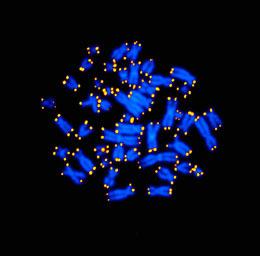
telomeres

Telomeres: Peter Lansdorp/Visuals Unlimited/Corbis

Premature ageing can be reversed by reactivating an enzyme that protects the tips of chromosomes, a study in mice suggests.

Mice engineered to lack the enzyme, called telomerase, become prematurely decrepit. But they bounced back to health when the enzyme was replaced. The finding, published online today in Nature, hints that some disorders characterized by early ageing could be treated by boosting telomerase activity.

It also offers the possibility that normal human ageing could be slowed by reawakening the enzyme in cells where it has stopped working, says Ronald DePinho, a cancer geneticist at the Dana-Farber Cancer Institute and Harvard Medical School in Boston, Massachusetts, who led the new study. “This has implications for thinking about telomerase as a serious anti-ageing intervention.”

After its discovery in the 1980s, telomerase gained a reputation as a fountain of youth. Chromosomes have caps of repetitive DNA called telomeres at their ends. Every time cells divide, their telomeres shorten, which eventually prompts them to stop dividing and die. Telomerase prevents this decline in some kinds of cells, including stem cells, by lengthening telomeres, and the hope was that activating the enzyme could slow cellular ageing.

Two decades on, researchers are realizing that telomerase’s role in ageing is far more nuanced than first thought. Some studies have uncovered an association between short telomeres and early death, whereas others have failed to back up this link. People with rare diseases characterized by shortened telomeres or telomerase mutations seem to age prematurely, although some tissues are more affected than others.

When mice are engineered to lack telomerase completely, their telomeres progressively shorten over several generations. These animals age much faster than normal mice — they are barely fertile and suffer from age-related conditions such as osteoporosis, diabetes and neurodegeneration. They also die young. “If you look at all those data together, you walk away with the idea that the loss of telomerase could be a very important instigator of the ageing process,” says DePinho.

To find out if these dramatic effects are reversible, DePinho’s team engineered mice such that the inactivated telomerase could be switched back on by feeding the mice a chemical called 4-OHT. The researchers allowed the mice to grow to adulthood without the enzyme, then reactivated it for a month. They assessed the health of the mice another month later.

Shrivelled testes grew back to normal and the animals regained their fertility. Other organs, such as the spleen, liver and intestines, recuperated from their degenerated state. The one-month pulse of telomerase also reversed effects of ageing in the brain. Mice with restored telomerase activity had noticeably larger brains than animals still lacking the enzyme, and neural progenitor cells, which produce new neurons and supporting brain cells, started working again.

The downside is that telomerase is often mutated in human cancers, and seems to help existing tumours grow faster. “Telomere rejuvenation is potentially very dangerous unless you make sure that it does not stimulate cancer,” says David Harrison, who researches ageing at the Jackson Laboratory in Bar Harbor, Maine.

Harrison also questions whether mice lacking telomerase are a good model for human ageing. “They are not studying normal ageing, but ageing in mice made grossly abnormal,” he says.

UN Elections in Haiti a shambles

November 28, 2010

The Los Angeles Times reports:

Amid allegations of stuffed ballot boxes and other fraud, 12 of 18 candidates for president (have) called for the elections to be cancelled, (and) accuse President René Préval of trying to fix the contest.

Elections on Sunday in a nation already racked by January’s earthquake and a cholera epidemic devolved into chaos, with thousands of voters unable to find their names on electoral rolls and a general outcry alleging widespread fraud. Twelve of the 18 presidential candidates issued a declaration saying the elections should be canceled and that the people should “mobilize” to prevent the government from accepting the results. They accused President René Préval of conspiring with the electoral council to install his party in Parliament and his pick to succeed him, Jude Celestin, in the National Palace. Celestin was second in recent polling, but a reporter talking to dozens of voters at the polls Sunday could not find a single one who was planning to vote for him. Allegations of fraud are a usual part of Haitian elections but not on the scale of the claims Sunday, coming from thousands of people and the majority of candidates, including at least two of the frontrunners, Manigat and Martelly, who signed the declaration.

But the electoral commission and UN officials seemed to be living in some other reality and declared that all was well. HaitiLibre also describes the status and the apparent fantasy the UN is living in.

Twelve of the 18 candidates in the Haitian presidential election, denounced at a press conference at the Karibe Convention Center, massive fraud and irregularities. They issued a unanimous call for the annulment of the election, following protests from voters who could not vote and many cases of fraud and irregularities observed since the official opening of polling stations.

Three candidates for the presidential election in Haiti, which are Mirlande Manigat, Yvon Neptune and Jacques Edouard Alexis have denounced the fraud and demanded the annulment of the elections, adding their voices to those of other candidates favorable to the end of this sham democratic election …

Patrice Dumond, spokesman for the candidate Manigat “It’s not just fraud, it’s a scandal, a real kidnapping of elections”. Mirlande Manigat during the press conference said “I request the formal CANCELLATION of all electoral activities throughout the territory, what is happening now it’s brigandage organized […] Some State institutions are complicit in this brigandage”. For his part Jacques Edouard Alexis, also requested the cancellation of the poll citing a series of irregularities and involving President René Préval “I do not want an election with him”.

As for Yvon Neptune, also in favor of a cancellation, asks “What can we do in the meantime for good elections? We need a solution between all candidates”.

At Acul-du-Nord and Trou du Nord elections were cancelled. Violent incidents also occurred at Acul du Nord and Trou du Nord, near Cap-Haitien.

Patrick Julien mayor of Acul-du-Nord, said that people were ready to vote, but supporters of the candidates have fired in the air, there have been wounded and he himself was not able to vote “men armed with machetes ransacked six polling stations, elections were canceled,” he said.

At Trou-du-Nord, Mayor Jacques Gustave said a crowd had entered the offices and ransacked polling stations, “the ballots were thrown everywhere, the president of the pooling station made an official report and canceled the election”

At Desdunes in the north, after incidents and gunfire that resulted in injuries, Minustah has sent Sunday morning a half-dozen of armored vehicles “to regain control of the situation.”

Recall that this morning the head of the UN mission in Haiti (Minustah ), Edmond Mulet stated “In general everything goes well, all is quiet. There have been some incidents at Desdunes, minor incidents.” Edmond Mulet said there is no reason to be afraid”. “It’s a electoral feast”… Une déclaration, qui devant les moyens utilisés pour rétablir l’ordre se passe de commentaire…