Here in Sweden we have not yet changed to winter time but we had minus 6 C yesterday and our first snow last night. I changed to winter tyres yesterday.

Finspång: October Snow
It is only weather but the long, cold winter may be starting.
Here in Sweden we have not yet changed to winter time but we had minus 6 C yesterday and our first snow last night. I changed to winter tyres yesterday.
Finspång: October Snow
It is only weather but the long, cold winter may be starting.
(Thanks to Phil Score for pointing out the typos which have been fixed)
A few days ago the paper in Nature “Systemic signals regulate ageing and rejuvenation of blood stem cell niches” by Shane R. Mayack, Jennifer L. Shadrach, Francis S. Kim & Amy J. Wagers was retracted at the request of 3 of the authors. Then the Journal Blood issued a Notice of Concern regarding a second paper with Shane Mayack as the lead author and published with Amy Wagers.
In both of these cases, Shane Mayack who was the post-doctoral fellow at the Joslin Diabetes Center of Harvard Medical School was the lead author and the implication was that they could be something untoward with her work.
Now Retraction Watch reports that a Scientist raised serious questions about 2008 Cell study by Amy Wagers. The questions were of a scientific and technical nature and in themselves carry no implications of impropriety.
Shane Mayack was not involved with this paper but since Amy Wagers led the team at the Joslin Diabetes Center, the question that arises is one of leadership and of the environment within which research is carried out. As I have posted earlier this atmosphere and the pressure of publication for the researchers may be leading to errors of judgement and misconduct. Professors and leaders of scientific teams cannot, I think, abdicate their responsibility for the environment in which their teams work especially where their names are included as co-authors of the resulting publications. The senior author on any published paper must be the first quality gate to be passed and must provide the final assurance of the integrity of the work being reported.

methane: Image via Wikipedia
A follow up to my previous post:
https://ktwop.wordpress.com/2010/09/12/microbes-ate-the-bp-oil-plume/
From EurekAlert:
Microbes may consume far more oil-spill waste than earlier thought
Microbes living at the bottom of the Gulf of Mexico may consume far more of the gaseous waste from the Deepwater Horizon oil spill than previously thought, according to research carried out within 100 miles of the spill site.
A paper on that research, conducted before the Deepwater Horizon rig exploded six months ago today, will appear in a forthcoming issue of the journal Deep-Sea Research II. It describes the anaerobic oxidation of methane, a key component of the Gulf oil spill, by microbes living in seafloor brine pools.
“Because of the ample oil and gas reserves under the Gulf of Mexico, slow seepage is a natural part of the ecosystem,” says Peter R. Girguis, associate professor of organismic and evolutionary biology at Harvard University. “Entire communities have arisen on the seafloor that depend on these seeps. Our analysis shows that within these communities, some microbes consume methane 10 to 100 times faster than we’ve previously realized.”
Girguis is quick to note that methane is just part of what spilled from the ruptured Deepwater Horizon well for three months earlier this year, and that the rate at which methane spewed from the damaged well far exceeds the flow that microbes would ordinarily encounter in the Gulf.
Key to the work by Girguis, Harvard research scientist Scott D. Wankel, and their colleagues was the ability to use on-site mass spectrometry to obtain direct, accurate measurements of seafloor methane. It’s been difficult to make such measurements because most tools don’t work accurately 5,000 to 7,000 feet below the surface, where pressures can reach roughly 220 atmospheres.
Using this new technique, the scientists were able to ascertain methane concentrations in brine pools surrounding gas seeps at the bottom of the Gulf — which were extremely high — as well as in the water column above the pools. Combining this data with measurements of microbial activity, they were able to extrapolate just how quickly the microbes were consuming the methane.
“In fact, we observed oxidation of methane by these microbes at the highest rates ever recorded in seawater,” Girguis says.
Methane is a greenhouse gas, up to 60 times more potent than carbon dioxide. Gigatons of the volatile gas are produced in seafloor sediments, above and beyond that generated by gas seeps that pockmark the floor of the Gulf of Mexico and other bodies of water. But, Girguis says, somewhere between the seafloor and the sea’s surface, much of the methane vanishes.
“We found that concentrations of methane in brine pools are tremendously high: five to six orders of magnitude higher than in the water column above,” Girguis says. “Mass spectrometry has given us a window on both the amount of methane diffusing into the water column and how much of this methane is consumed through anaerobic oxidation by microbes within the brine pool. It appears the microbes consume much of the methane, and the rest dissipates over time into the water column.”
A study published in the journal Science in August detailed a bacterial species reportedly able to degrade oil anaerobically in the Gulf. But a subsequent Science paper contended that these microbes mainly digested gases like methane, propane, ethane, and butane, not oil. The Deep-Sea Research II paper adds to scientists’ growing understanding of these species’ ability to degrade the byproducts of the Deepwater Horizon spill.
Girguis and Wankel’s co-authors are Samantha B. Joye and Vladimir A. Samarkin of the University of Georgia, Sunita R. Shah of the U.S. Naval Research Laboratory, Gernot Friederich of the Monterey Bay Aquarium Research Institute, and John Melas-Kyriazi of Stanford University.
Xinhua reports today from Wuhan:

Shennangojia in Hubei Province
Twenty-three unique new plant species have been found over the past five years in the mysterious Shennongjia Nature Reserve in central China’s Hubei Province, a researcher said Wednesday. “We are pretty much sure that the new species, which have not been discovered elsewhere in the world, are new members of the plant kingdom,” said Yang Jingyuan, head of the reserve’s research institute.
The new discoveries showed the “gene pool” of plants and animals was still expanding, said Yang. Researchers had identified 143 previously undocumented plant species in Shennongjia since 2006, excluding the 23 new varieties that are unique to the area, he added. Scientists had also discovered 16 kinds of snakes and 270 kinds of insects that were new to Hubei Province. The number of albino animals, including bears, snakes and magpies, found in the reserve have also baffled scientists.
The area is also believed to be home to the legendary Bigfoot-like ape man. The Hubei Wild Man Research Association said earlier this month that it was considering launching a high-profile search for the elusive creature, almost 30 years after the last organized expedition to seek the legendary beast in the early 1980s.

Shennangojia Nature Reserve : image http://english.cnhubei.com
There is hope for mankind when the Universe can be modelled in your kitchen!
From New Scientist
A black hole is a dense concentration of mass surrounded by an extremely powerful gravitational field. Nothing that falls within a certain radius surrounding it, known as the event horizon, escapes. A white hole is the opposite: its event horizon allows things to escape but prevents anything from entering. However, so far white holes only exist in theory, so cannot be studied observationally.
Horizon effects with surface waves on moving water is a new paper by Germain Rousseaux1, Philippe Maïssa1, Christian Mathis1, Pierre Coullet1, Thomas G Philbin2 and Ulf Leonhardt2 (Affiliations 1 Université de Nice-Sophia Antipolis, France, 2 School of Physics and Astronomy, University of St Andrews, UK ), 2010 New J. Phys. 12 095018
doi: 10.1088/1367-2630/12/9/095018
From Wired Science:
The ring-like ridge formed when a stream of fluid hits a flat surface behaves like a white hole event horizon (Image: Germain Rousseaux/U. Nice-Sophia Antipolis)
When a stream of tap water hits the flat surface of the sink, it spreads out into a thin disc bounded by a raised lip, called the hydraulic jump. Physicists’ puzzlement with this jump dates back to Lord Rayleigh in 1914. More recently, physicists have suggested that, if the water waves inside the disc move faster than the waves outside, the jump could serve as an analogue event horizon. Water can approach the ring from outside, but it can’t get in.
“The jump would therefore constitute a one-directional membrane or white hole,” wrote physicist Gil Jannes and Germain Rousseaux of the University of Nice Sophia Antipolis in France and colleagues in a study on ArXiv Oct. 8. “Surface waves outside the jump cannot penetrate in the inner region; they are trapped outside in precisely the same sense as light is trapped inside a black hole.”
The analogy is not just surface-deep. The math describing both situations is exactly equivalent. But so far, no one had been able to prove experimentally that what’s going on in the kitchen sink really represents a white hole.

plumber in the sky
If fluid mechanics provides the correct analogy for physics, then a black hole can be considered a “sink” and a white hole is then a “source”. In fluid mechanics flow is always out of a source and into a sink. So black holes in the universe provide the way out of the universe for matter into some great Cosmic Drain exhausting into some other universe. Then white holes must be the taps from which matter flows into our universe from the Great Unknown.
The only time that a backflow of fluids occurs through a sink is when the drains are backed up or a reverse pressure surge drives fluid back through the sink-hole.
Which begs the question: “What happens in a black hole when the Cosmic Drain gets clogged?”.
Which in turn leads to the answer “Just call the Great Plumber in the sky”!
Prime Minister Manmohan Singh on Tuesday inaugurated the 21st general meeting of the Academy of Sciences for the Developing World (TWAS) at the Hyderabad International Convention Centre here.
Dr. Singh presented the India Science prize, on behalf of the Indian National Science Academy, to C. Radhakrishna Rao. The prize carried a reward of Rs. 25 lakh (550,000$) in cash and a 200 gram gold medal.

Calyampudi Radhakrishna Rao: image connect.in.com
C R Rao (born September 10, 1920) is an Indian statistician. He is currently Professor Emeritus at Penn State University and Research Professor at the University at Buffalo. The American Statistical Association has described him as “a living legend whose work has influenced not just statistics, but has had far reaching implications for fields as varied as economics, genetics, anthropology, geology, national planning, demography, biometry, and medicine.” Among his best-known discoveries are the Cramér-Rao bound and the Rao-Blackwell theorem both related to the quality of estimators. Other areas he worked in include multivariate analysis, estimation and differential geometry. His other contributions include the Fisher-Rao Theorem, Rao distance, and orthogonal arrays.
CR Rao uses these lines from Robert Frost’s “Pertinax” to begin his book Statistics and truth: putting chance to work
Let chaos storm!
Let cloud shapes swarm!
I wait for form.

Doomsaying: Image by net_efekt via Flickr
Similar headlines have been common-place for the last 40 years. “The Limits to Growth” in 1972 was not the first time such dire predictions were made. They only carried on from where Malthus left off with his An Essay on the Principle of Population in 1798. And before Malthus there were plenty of alarmists and doom merchants at least as far back as mankind has lived in complex societies where opportunists could exploit people by fears of catastrophes and impending doom.
Unfortunately, today’s so-called conservationists have descended to the level of doom “merchants”. Either they are propagating fears of humanity running out of food or oil or coal or metals or water or rare earths or they are screaming about the Earth running out of biological species or of polar ice or sustainability.
But I am not convinced.
Actually, mankind destroys nothing. At the elemental level we neither create or destroy anything (except in the use of nuclear energy where some elemental transformation takes place and where some little mass is converted to energy). All the metals we use or the fuels we use are merely transformed from one compound to another and occasionally some molecules are reduced to their elemental form. The Earth as a system loses only heat (and if the global warming maniacs are to be believed we are not even losing that). The mass of the earth changes only by the accretion of meteors and the leakage of atmosphere and this change is of no material significance.
All the elements that were available remain available. The forms of compounds that we currently use and which have been created slowly by slow natural processes may well be used up. But so what? Mankind has always used what is available and when natural rubber was not enough we made synthetic rubber. We usually take what is available and transform it into the form we want. We take metal oxides, reduce them to the elemental metals and then recombine them into the qualities of steel or alloys we need. We take oil and convert it into plastics. We take plant material and make paper. We take other plant material and make oils. We take sand and make glass. We take limestone and make cement or concrete. We are a carbon-based life form. We use carbon in all its forms as diamonds and all organic materials and now as graphene for nano-materials. We take oil and make food. Nearly all the drugs we use are synthesised.
Even if we restrict ourselves to the known form of the resources we use, we cannot forget that 70% of the Earth’s surface is covered by water. We have not even begun to see what can be found there. Even the off-shore oil and gas we extract hardly scratches the (submerged) surface. We are crowding out some particular species but keep finding new ones. The number of mammals (but not necessarily species) in existence is increasing rather than reducing. The diversity of life in the sea is hardly touched.
The overwhelmingly pessimistic view of mankind and its future which drives the current-day conservationists to their creed of “stop everything” goes nowhere. “Stop the World, I wan’t to get off” is not something for me. A strategy for humanity – like any other strategy – cannot be based on “what not to do”.
I suppose it is the difference between an optimist and the doom sayers. I see no energy crisis – only some technological challenges to be met. I see no food crisis – only some tasks to be carried out, and these tasks do not need any technological breakthroughs. The Earth and the Sun will take care of climate as they see fit and our task is to adapt to whatever changes may come and not to waste our time in any futile attempt to try and control it. We could stop using all energy today and the Earth and the Sun will still cause climate change to happen and mankind is not even a bit player in that music.
I remain an optimist and I believe in the human ability to develop technology. As educational standards improve, human population will probably increase till about 2050, then reduce slightly from about 10 billion people and then stabilise at a very slow rate of growth. This development will be dynamically coupled to our rate of technological development which will continue but where we cannot predict the rate of breakthroughs appearing. A breakthrough in transportation methods (and since the invention of the modern internal combustion engine for transport in 1862, this is now overdue) or a breakthrough in food synthesising technology or finding new sources of energy (and I do not mean wind or solar) will have an obvious effect on quality of life and on rate of population growth.
A true environmentalist must be first concerned with the quality of life for humankind. The “environment” devoid of humans is no environment at all. I wish the so-called conservationists (who are not in my opinion true environmentalists) would stop telling me what not to do.
There is no resource crunch. There may come shortages of resources in the form we are used to but I have supreme confidence in our ability to develop the required technologies to keep improving on our quality of life – and to keep evolving.
The quiet nuclear renaissance continues with the UK now announcing its plans.
Chris Huhne, the UK Energy Secretary, has given the go-ahead for eight new nuclear power stations in Britain despite concerns about safety and the clean-up costs.
The new nuclear power stations will be built near existing sites in in Bradwell in Essex, Hartlepool, Heysham in Lancashire, Hinkley Point in Somerset, Oldbury in South Gloucestershire, Sellafield in Cumbria, Sizewell in Suffolk and Wylfa in Anglesey.
Three sites in Dungeness in Kent and Braystones and Kirksanton in Cumbria were ruled out due to concerns over the impact on wildlife and the Lake District National Park. The new stations will not start generating power until 2018 so the Government also plans to allow existing nuclear stations to extend their life.
Nuclear Engineering International reports that
AREVA EPR
The government also signed a regulatory justification for the AP1000 and EPR reactor designs. Following 2004 regulations, it is required to justify that new reactors are worth the potential radiological risk. Following three consultations have taken place—one on the regulatory review, and one on each design—the government decided not to launch a further public consultation on the matter.
The AP1000 is a Westinghouse designed 1154 MWe PWR nuclear power plant. The EPR reactor is an advanced Pressurized Water Reactor (PWR) offered by AREVA and which is being built in Finland, France and China.

Westinghouse AP1000: Westinghouse
Benoît Mandelbrot, the father of fractals, passed away on 14th October at the age of 85. He was suffering from pancreatic cancer.
I used to spend hours generating fractals for no other reason than to see what they looked like.
Born in Poland, on 20th November 1924 he moved to France with his family when he was a child. Mandelbrot spent much of his life living and working in the United States, acquiring dual French and American citizenship.

The Mandelbrot Set: Wikipedia
I posted a few days ago about the joint RAF / IAF exercises and its connection to the Indian need to acquire some 126 combat aircraft.
The $10.4 billion project to acquire 126 medium multi-role combat aircraft (MMRCA) for the Indian Air Force is in the final stages of the selection process. Apart from the Eurofighter, the other five contenders in the hotly-contested race for the lucrative MMRCA project are the F/A-18 `Super Hornet’ and F-16 `Falcon’ (both US), Gripen (Swedish), Rafale (French) and MiG-35 (Russian).

F/A-18E/F Super Hornet: Boeing
While all the technical evaluations will no doubt be done by air-force and MoD personnel, ultimately this is a political decision and the geo-political need to balance the growing Chinese might and to keep Pakistan in check will be paramount. The clear favourites in this game will be the US or the Russian aircraft. Domestically for the US government, an Indian order for either of the American fighters would be worth 27,000 jobs in the US. The commercial delegation accompanying Obama will be looking for a number of orders for nuclear power plant equipment to be finalised.

F-16 Figfhting Falcon: Lockheed-Martin
Considering
the choice, I think comes down to Boeing’s F/A Super Hornet or Lockheed Martin’s F-16 Falcon. The strength of the MIG-35 lies in its continuity with the MIG’s that the IAF already has and the familiarity of HAL in Bangalore with the MIG. But, I think the US will be seen as much more politically useful in the balance-of-power game and India would not like that the Russian aircraft enjoy a monopoly position. Europe will be fobbed off with the British Hawk trainers.
But the play between the US and Russia is complex:
In return for Washington removing strategic hurdles (withdrawing entities like the Defence Research and Development Organisation from the US Entities List; easing the curbs on US high-tech exports to India), India could open up some of its lucrative markets to American companies.
The big-ticket transactions are the ones involving the defence market. India is expected to sign a deal with Boeing to buy 10 C-17 transport aircraft for about $3.5 billion during the Obama visit.
The Americans are hoping that the Indian government will also opt for what The Financial Times described as the world’s biggest military hardware deal and buy 100 multi-combat aircraft worth $11.8 billion from US defence manufacturers.
Agreement on the latter aircraft will be more complicated since India is also negotiating with the Russians to jointly build a Fifth Generation Fighter Aircraft, which is expected to be the finest of its kind when operational. The Russians will also sell 150 Sukhoi-30 MKI fighters, the best of its kind, to the Indian Air Force.
India expects to conclude the agreement for the FGFA with the Russians when President Dmitri Medvedev visits New Delhi in December, a visit which will probably match the Obama excursion in its strategic significance, if not in its symbolism.
But Obama cannot return from India “empty-handed” and my “guess” would be that the Boeing F-18 Super Hornet will be the winner but that the “price” will include some other advanced US equipment as well. And perhaps the Russians will supply some 200 Sukhoi-30 MKI but maybe not the MIG 35.
But none of of these is as advanced as the F-22A Raptor from Lockheed-Martin. But that is not on the table – yet.
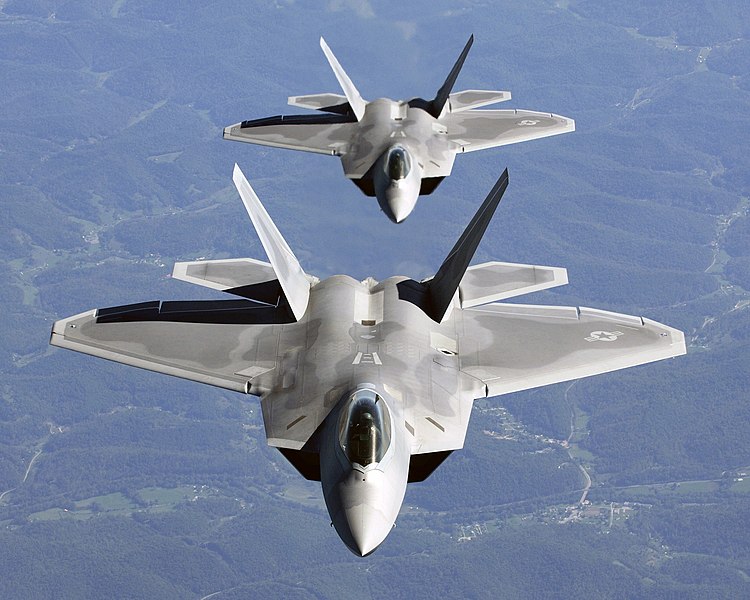
Two F-22A Raptor in column flight: Lockheed Martin


 The k2p blog