Commonwealth Games: The inquest begins

October 17, 2010

The “last minute syndrome” is a unique and peculiar asset in India

The Games were supposed to cost under Rs 2,000 Crores (about 450 Million$).

The actual cost is likely to be around Rs. 30,000 Crores (about 6.7 Billion $).

About 500 Million $ has probably been paid for fictitious work, over-invoiced and overpaid to contractors, skimmed off or pocketed by individuals connected to the Organising Committee headed by Kalmadi. Some individual fortunes have been made and squirrelled away into Swiss and Channel Island and Caribbean bank accounts.

CWG Delhi Closing ceremony: image bharatchronicle.com


The investigations have begun. Some scapegoats will have to be found. Shrill voices are questioning whether it was worth it or not. There is no shortage of suggestions about how all the money could have been better spent.

For example Vir Singhvi writes in the Hindustan Times:

We could have overhauled healthcare in our cities. We could have built thousands of new schools. We could have overhauled the chaotic traffic system. We could have spent that money on recruiting more policemen and giving them the facilities they need. We could have built hundreds of new courts and recruited more judges to reduce the backlog in our judicial system.

But I have a somewhat different take.

None of the predicted or feared catastrophe’s occurred. There were no terrorist attacks. There was no epidemic of dengue fever. The facilities at the Games village largely functioned well.  The logistics were chaotic to begin with but also largely functioned satisfactorily. As the performance of India’s athletes started bringing in the medals at the Games, the crowds which were initially absent started showing up. The opening ceremony was well carried out but the logistics on the opening day were chaotic and stressful for many athletes. But this was transformed by the time of the spectacular closing ceremony in front of a packed house.

In transforming an apparently hopeless situation into a qualified success by means of India’s patented “last minute syndrome” some heroes appeared. Sheila Dikshit the Chief Minister of Delhi and Dr Manmohan Singh, the Prime Minister can I think be credited with the success of the final mobilisation of effort. Politicians who were busy distancing themselves from the Games the week before it started were clamouring to be seen at the closing ceremony. The Delhi Police must take a bow not only for the security aspects but also for the handling of traffic. The organisers (and even the newly activated Committee who were now under the whip) and all the officials and “volunteers” and even the Delhi population pulled out all the stops. Many private contractors with their contract labour carried out a minor miracle on the last few days.

And this brings me to my point. One of the key issues in India is not – in the first instance – the availability of funding. The Indian weakness is in implementation, in using the money available well. Whatever the Games cost, the money was forthcoming when needed. About 10% was probably wasted. But because of the attention and pride (or more accurately the potential loss of face), a fiasco was averted. The “last minute syndrome” was activated. Implementation, and rather effective implementation, took place.

Even if there had been no Games and even if all the money had been poured into health care or traffic improvements or overhaul of the judicial system it would have achieved virtually nothing. Without attention and without visible deadlines to create a potential loss of face and -therefore – without a means of activating the “last minute syndrome” the money would have been frittered away.

It would be much more constructive if, instead of moaning about what could have been, every project being implemented in India could figure out a way of creating the real deadlines which could activate the “last minute syndrome”.
Summer delayed in the Southern Hemisphere?

October 15, 2010

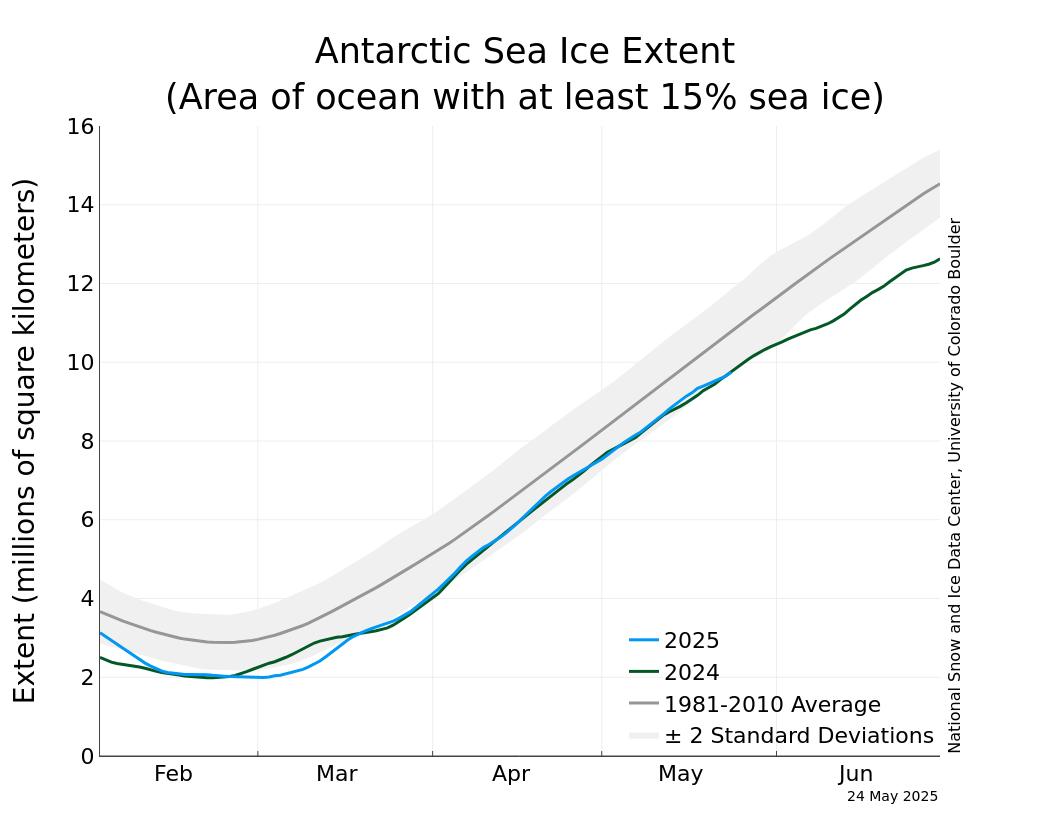
The Northern Hemisphre is anticipating a long cold winter which might even be a little early, but summer is a little late in the Southern Hemisphere.

Usually Antacrtic ice starts decreasing around 15th September but this year it seems to be still quite high and delayed by about a month.

http://nsidc.org/data/seaice_index/images/daily_images/S_stddev_timeseries.png

Meanwhile in Australia,

WARM weather may have teased the state into believing summer was on its way, but the wild weather predicted for the weekend could be winter’s last hurrah.

Meteorologists are warning of a wet and windy weekend with widespread rain, potential flash-flooding, and wind gusts of up to 110km/h. Snow is likely to fall on the alps and southern ranges, and even Orange could get a light dusting. The shift is being caused by a broad trough moving over NSW, which is expected to deepen into a low pressure system today, causing heavy rain and strong winds across central NSW.

Earth is starting to crumble due to global warming !

October 15, 2010


The Peteroa (burning bushes) volcano lies at t...

Planchón-Peteroa: Image via Wikipedia


Alarmism is alive and well at ENTRIX and at the New Scientist.

When in doubt it seems you can always get a paper published if you put it down to global warming. The key finding in this new paper seems to be that “large-scale glacial melting, including at the end of the Pleistocene, caused a significant increase in the incidence of large volcanic sector collapse and debris flows on then-active volcanoes”.

The Pleistocene is the period from  2.588 million to 12000 years ago. But since there is no explanation for the above finding there is no hesitation in jumping to the conclusion about the present “With current accelerated rates of glacial melting, glaciated active volcanoes are at an increasing risk of sector collapse, debris flow and landslide. These catastrophic events are Earth’s most damaging erosion phenomenon, causing extensive property damage and loss of life”.

The New Scientist then chips in with the headline “EARTH is starting to crumble under the strain of climate change”.

Daniel Tormey of ENTRIX, an environmental consultancy based in Los Angeles, studied a huge landslide that occurred 11,000 years ago on Planchón-Peteroa. He focused on this glaciated volcano in Chile because its altitude and latitude make it likely to feel the effects of climate change before others.

“Around one-third of the volcanic cone collapsed,” Tormey says. Ten billion cubic metres of rock crashed down the mountain and smothered 370 square kilometres of land, travelling 95 kilometres in total (Global and Planetary ChangeDOI: 10.1016/j.gloplacha.2010.08.003). Studies have suggested that intense rain cannot provide the lubrication needed for this to happen, so Tormey concludes that glacier melt must have been to blame. With global temperatures on a steady rise, Tormey is concerned that history will repeat itself on volcanoes all over the world.

He thinks that many volcanoes in temperate zones could be at risk, including in the Ring of Fire – the horseshoe of volcanoes that surrounds the Pacific Ocean . “There are far more human settlements and activities near the slopes of glaciated active volcanoes today than there were 10,000 years ago, so the effects could be catastrophic,” he says.

Maybe I am just a little cynical but I suspect that the author’s environmental consultancy business would be advantaged by getting a few more studies funded and that would be more likely if catastrophes were imminent. A clear case of a conflict of interest I would think.


German twin satellites now orbiting in close formation

October 15, 2010

The German aerospace centre announced today that

On 14 October 2010, the radar satellite TanDEM-X moved into close formation with its ‘twin’, TerraSAR-X. Before this, the two satellites were orbiting 20 kilometres apart – a flight time of almost three seconds. Now, there are only 350 metres separating the pair, which means their antennas are able to acquire radar images of the same area simultaneously.


 Premiere – TerraSAR-X and TanDEM-X now flying in close formation

Premiere – TerraSAR-X and TanDEM-X now flying in close formation


The objective of the mission is to create a high-precision, three-dimensional digital elevation model of Earth’s land surface. The project needs the satellites to operate in parallel for a period of three years. The transition to close formation flight marks the beginning of the final preparatory stage of the TanDEM-X mission. The routine operations phase is due to start in early January next year.

The TerraSAR-X and TanDEM-X orbit trajectories, patented by DLR researchers, are like the strands of a double helix – they circle around one another without crossing. The team of scientists based in DLR Oberpfaffenhofen took just three days to carry out the approach in preparation for the final formation flight. “First, we had to manoeuvre TanDEM-X to reduce its orbital period, so that the satellite could ‘catch up’, reducing the 20 kilometre gap between it and TerraSAR-X. After two further manoeuvres we brought the distance between the pair down to 350 metres,” explains DLR flight dynamics expert Ralph Kahle.

The reduced distance between the satellites means that the two radar systems can be synchronised for the first time. TerraSAR-X and TanDEM-X can also monitor each other’s ‘health’ via an inter-satellite link. “This is completely uncharted territory. Never before have two satellites worked in such close formation over a period of several years,” says Manfred Zink, Project Manager for the TanDEM-X Ground Segment. Eckard Settelmeyer, Director of Earth Observation and Science at Astrium, adds: “This dual mission will give another boost to satellite-supported applications and science.”

Read the whole article:

http://www.dlr.de/en/desktopdefault.aspx/tabid-1/117_read-27086/

Purple coloured wind turbines might save some bats

October 15, 2010

Reported by the BBC:


purple windmill


A study has revealed that a wind turbine’s colour affects how many insects it attracts, shedding more light on why the turbines occasionally kill bats and birds. Scientists say that turbines, most commonly painted white or grey, draw in insects. These then lure bats and birds – as they pursue their prey – into the path of the turbine blades. Support for the idea comes from another study showing that bats are most often killed by turbines at night and in summer, when insects are most abundant.

Bats are more likely to be killed by wind turbines at night and during the summer, researchers have discovered. The reason is thought to be because the turbines attract migrating insects. At some sites, 20 to 40 bats are killed each year per turbine, although rates of one to three bats are more typical.

Now scientists have ascertained that 90% of bat mortality occurs in northern Europe between late July and early October. A similar pattern occurs in North America. Observations from both continents also show that most bats are killed on relatively warm nights with low wind speed.

While the review by scientists does not provide all the answers, it suggests wind turbines are tall enough to attract insects migrating at night, which typically fly at heights of over 60m. Bats and birds are then killed by turbine blades as they feed on this insect bonanza.

PhD student Chloe Long of Loughborough University, UK. and her Loughborough colleagues, Dr James Flint and Dr Paul Lepper, conducted the first empirical study of insect attraction to wind turbines, the results of which are published in the European Journal of Wildlife Research.

In particular, they measured how a turbine’s colour alters how many insects gather around it. Most turbines are painted pure white or light grey, in a bid to make them as visually unobtrusive as possible. But insects, it seems, are unlikely to ignore these muted tones. The researchers measured how many insects were attracted to a range of paint colours, including pure white, light and dark grey, sky blue, red and purple.

Turbines painted pure white and light grey drew the most insects bar just one other colour; yellow. The colour they found least attractive was purple.


EUROPEAN JOURNAL OF WILDLIFE RESEARCH


The researchers also found that the ultraviolet and infrared components of paint colour, which humans cannot see but insects can, also had a significant impact, with higher levels of both attracting more insects.

Insect attraction to wind turbines: does colour play a role? by C. V. Long, J. A. Flint and P. A. Lepper

Mortality of bats at wind turbines links to nocturnal insect migration? by Jens Rydell, Lothar Bach, Marie-Jo Dubourg-Savage, Martin Green, Luísa Rodrigues and Anders Hedenström


German economic motor is still running strong

October 15, 2010

The weaknesses in various Eurozone countries are depressing the value of the Euro but this is contributing to the continued strong exports from Germany. The GDP growth forecast for 2010 has been revised upwards to 3.5%. A second recession in the US and global reduction of stimulus programmes through 2011 could depress exports but the hope is that lower unemployment and wage increases would favour the strengthening domestic consumption to be able to compensate.


Exports helped  the German economy rebound quickly

Exports helped the German economy rebound quickly


Deutsche Welle: German economy on course for strongest growth in decades

Five leading think tanks have predicted that the German economy will grow by 3.5 percent in 2010, up from a more modest prediction of 1.5 percent earlier this year. Unemployment is expected to drop below three million. In their twice-yearly report, Germany’s five leading economic think tanks also included ….. a sharp increase in exports in the first half of the year (which has) fuelled the rebound from the deepest recession since World War II.

“The upturn is stable,” said Kai Carstensen from the Munich-based Ifo institute, one of the think tanks involved in the report. “In Germany, it looks good. The risks are above all overseas.” In Germany, Berlin plans to bring the country’s finances back into shape by cutting back on government spending. The move could lead to the deficit falling below three percent of gross domestic product, the ceiling set out for Euopean Union countries that use the euro currency.

And Der Spiegel points out that

the DAX, Germany’s stock exchange index, topped 6,400 on Wednesday, reaching a level not seen since just days before the collapse of the US investment bank Lehman Brothers.

The report also indicated that climbing tax revenues will result in a 2011 budget deficit of just 2.7 percent, below the 3.0 percent maximum allowed by European Union rules. German wages are forecast to rise by up to 2.8 percent in 2011. The economic experts who authored the report anticipate that domestic consumption will continue to be strong next year as a result.

The report, which is used by the German government to develop its own economic forecasts, was not without warnings. A renewed recession in the US remains possible, the report warns, as does a massive correction in the overheated Chinese real estate market.

Climategate leads to Wikipedia action (finally)

October 15, 2010
Image representing Wikipedia as depicted in Cr...

Image via CrunchBase

There are some small encouraging signs that science may be returning to the subject of climate and man-made effects and carbon dioxide forcings and solar influences. This is one of them.

Lawrence Solomon pointed out back in December 2009 that:

The Climategate Emails describe how a small band of climatologists cooked the books to make the last century seem dangerously warm. The emails also describe how the band plotted to rewrite history as well as science, particularly by eliminating the Medieval Warm Period, a 400 year period that began around 1000 AD.

The Climategate Emails reveal something else, too: the enlistment of the most widely read source of information in the world — Wikipedia — in the wholesale rewriting of this history.

U.K. scientist and Green Party activist William Connolley took control of all things climate in the most used information source the world has ever known – Wikipedia. Starting in February 2003, just when opposition to the claims of the band members were beginning to gel, Connolley set to work on the Wikipedia site. He rewrote Wikipedia’s articles on global warming, on the greenhouse effect, on the instrumental temperature record, on the urban heat island, on climate models, on global cooling. On Feb. 14, he began to erase the Little Ice Age; on Aug.11, the Medieval Warm Period. In October, he turned his attention to the hockey stick graph. He rewrote articles on the politics of global warming and on the scientists who were skeptical of the band. Richard Lindzen and Fred Singer, two of the world’s most distinguished climate scientists, were among his early targets, followed by others that the band especially hated, such as Willie Soon and Sallie Baliunas of the Harvard-Smithsonian Center for Astrophysics, authorities on the Medieval Warm Period.

All told, Connolley created or rewrote 5,428 unique Wikipedia articles. His control over Wikipedia was greater still, however, through the role he obtained at Wikipedia as a website administrator, which allowed him to act with virtual impunity. When Connolley didn’t like the subject of a certain article, he removed it — more than 500 articles of various descriptions disappeared at his hand. When he disapproved of the arguments that others were making, he often had them barred — over 2,000 Wikipedia contributors who ran afoul of him found themselves blocked from making further contributions. Acolytes whose writing conformed to Connolley’s global warming views, in contrast, were rewarded with Wikipedia’s blessings. In these ways, Connolley turned Wikipedia into the missionary wing of the global warming movement.
The Medieval Warm Period disappeared, as did criticism of the global warming orthodoxy. With the release of the Climategate Emails, the disappearing trick has been exposed. The glorious Medieval Warm Period will remain in the history books, perhaps with an asterisk to describe how a band of zealots once tried to make it disappear.

But now over a year after the Climategate revelations, Watts Up With That reports that

in a vote of 7-0, the most prolific climate revisionist editor ever at Wikipedia, with over 5400 article revisions has been banned from making any edits about climate related articles for six months. Here’s the details at Wikipedia.

Commonwealth Games- Australians dominate the medals but athletes leave Delhi on a sour note

October 15, 2010

The Australian team totally dominated the Games with their haul of 177 medals including 74 Golds. But some of their athletes seem to have been involved in vandalising the Games village. Just high jinks perhaps.

Rank Country Gold Silver Bronze Total
1. Australia 74 55 48 177
2. India 38 27 36 101
3. England 37 59 46 142
4. Canada 26 17 32 75
5. South Africa 12 11 10 33

Zee News reports that

Some Australian athletes destroyed electrical fittings and furniture in their tower in the Games Village on Tuesday and Wednesday.
According to a newspaper report, the athletes shouted slogans against Indian ace batsman Sachin Tendulkar, who was named ‘Man of the match’ and ensured India’s victory in the Bangalore match, and tossed a washing machine down from the eighth floor of their tower.
According to newspaper sources in Delhi police, this hooliganism by Australian athletes started on Tuesday when Tendulkar scored a double century to force Australia out of the match. Irked by this match-winning performance, they first damaged electrical fittings and fixtures in their block. The report also says that Delhi Police, which received a complaint about this vandalism, has downplayed the incidents to prevent them from growing into a diplomatic embarrassment for Australia.
Meanwhile, confirming these vandalism reports, Australia’s Commonwealth Games boss Perry Crosswhite on Friday denied involvement of any Australian athlete in the incident at the Games Village.

The Sydney Morning Herald reports:

An Australian athlete was sent home from the Commonwealth Games for bad behaviour this week and a washing machine was dropped from a balcony in Australia’s section of the athlete’s village after the closing celebrations.

No one was injured by the washing machine but Perry Crosswhite, Australia Commonwealth Games association chief executive, said he was disappointed by the incident on Thursday night.

“We don’t know who did that,” Crosswhite told journalists today. “Delhi police came around and they’ve done a report and an investigation and we’ll hear about that.”

But by all accounts it was a spectacular closing ceremony and a qualified success. It was a long way away from being the fiasco that had been feared.


Tata Group gives 50 Million $ to Harvard Business School

October 14, 2010
This is a portrait of Mr.Ratan Naval Tata made...

Ratan Tata: Image via Wikipedia

Times of India

BOSTON: America’s prestigious Harvard Business School has received a whopping USD 50 million from Ratan Tata-led Tata Group, the largest gift from an international donor in the institution’s 102-year history.

The USD 50 million gift comes just days after Anand Mahindra, vice-chairman and managing director of Mahindra and Mahindra, gave USD 10 million dollar as gift to the Humanities Centre at Harvard.

Ratan Tata, Chairman of the Tata conglomerate, attended the school’s Advanced Management Programme–one of three comprehensive leadership programmes offered by HBS Executive Education–in 1975.

He received the school’s highest honour, the Alumni Achievement Award, in 1995.

The gift will fund a new academic and residential building on the HBS campus here for participants in the school’s broad portfolio of executive education programmes.

The school hopes to break ground for the building, which will be named Tata Hall, next spring.

Angry sea lion protects its habitat from encroaching rowers

October 14, 2010

If only there was an actual picture.

No comment needed.

The Sydney Morning Herald:

An aggressive sea lion attacked a university rowing boat in New Zealand’s Otago Harbour, took a chunk out of it and then chased the crew back to shore. The sea lion came up under the boat at it was gliding through the chilly harbour near Dunedin yesterday and broke the hull in two places, causing it to take on water, the Otago Daily Times reported.

“I saw this dark figure looming under the boat, I felt it hit and seconds after water came gushing up … it was panic stations,” rower Matt Smail told the paper. The eight-man University of Otago crew was about 200 metres offshore when the angry sea lion attacked.

The students decided to head to the closest boat ramp.

“It was the best one-kilometre we rowed all morning, we went flat tack,” crew member Adam Garden said. When the crew got to shore and pulled the boat out of the water the sea lion “came up for another inspection”, he said. “It walked up the ramp and gave us a bit of a snarl.”

Otago University rowing coach Sonya Walker said rowers often saw sea lions in the harbour and normally managed to avoid them.