John Howard faces a thrown shoe

October 26, 2010
U.S. President George W. Bush Had Two Shoes Th...

Shoe- throwing has become an unambiguous, easily understood and visible expression of political contempt, dissent and outrage coupled to a helplessness against the “establishment”. I have posted earlier about the spread of this behaviour mainly against political figures in the Middle East and Asia.

Now John Howard joins the ranks of George Bush, Pakistan President Asif Ali Zardari and Chinese premier Wen Jiabao in having a shoe thrown in their direction. The Sydney Morning Herald reports

A man who threw a shoe at John Howard on last night’s Q&A program on ABC TV said the former prime minister “deserves a lot worse” than having shoes thrown at him.

Hunter Valley man Peter Gray was unapologetic about his actions this morning, telling Newcastle ABC Radio he was angry about Australia’s involvement in the Iraq War and he “found the right type of protest” to get his point across.

“That is for Iraqi dead,” Mr Gray shouted as the shoes missed their target.


Hunter Valley man Peter Gray tosses his second shoe in the direction of John Howard as Tony Jones stands up to call for the man's removal.

Peter Gray tosses his second shoe in the direction of John Howard: Courtesy ABC


Mr Gray confirmed that ABC staff refused to return his shoes.

Mr Gray explained that it was a very difficult to stand up and conduct such a protest, especially because such action was against his nature. “Quite a few people said I throw like a girl.”


La Niña Strengthens further

October 25, 2010

The NOAA has released its annual winter outlook.

The Pacific Northwest should brace for a colder and wetter than average winter, while most of the South and Southeast will be warmer and drier than average through February 2011. A moderate to strong La Niña will be the dominant climate factor influencing weather across most of the U.S. this winter.

“La Niña is in place and will strengthen and persist through the winter months, giving us a better understanding of what to expect between December and February,” said Mike Halpert, deputy director of the Climate Prediction Center – a division of the National Weather Service. “This is a good time for people to review the outlook and begin preparing for what winter may have in store.”

“Other climate factors will play a role in the winter weather at times across the country,” added Halpert. “Some of these factors, such as the North Atlantic Oscillation, are difficult to predict more than one to two weeks in advance. The NAO adds uncertainty to the forecast in the Northeast and Mid-Atlantic portions of the country.”

This seasonal outlook does not project where and when snowstorms may hit or total seasonal snowfall accumulations. Snow forecasts are dependent upon winter storms, which are generally not predictable more than several days in advance.


Winter Outlook - Precipitation

NOAA Winter Outlook: Graphic NOAA


The beneficial effects of La Niña on the Indian monsoon have already been seen this year. But after the very cold winter in the Southern Hemisphere it remains to be seen if warm and dry conditions  are established in the South American summer now approaching.

From The Canadian Encyclopedia:

La Niña normally exerts much less of a global impact than El Niño, enhancing conditions that are more or less normal. Thus, under La Niña’s grip, normally wet Indonesia becomes wetter, and winters in Canada are often colder and snowier than normal. However, the weather associated with La Niña tends to be quite variable depending on such factors as its strength, the depth and geographic extent of the cool waters and the pre-existing atmospheric circulation. Among the normal weather effects of La Niña are wetter monsoons and flooding on the Indian subcontinent; torrential rains and floods in southeast Asia and northern and eastern Australia; cool and wet winters in southeastern Africa; and warm and dry conditions along the coast of Peru and Ecuador.

La Niña favours the formation of more and intense hurricanes in the North Atlantic Ocean. Three recent La Niña periods – 1988-89, 1995-96 and 1997-98 – were among the most active periods this century for Atlantic hurricanes.

North America typically feels the effects of La Niña during the winter and early spring. Wetter-than-normal conditions occur across the Pacific Northwest, British Columbia and Alaska. On the other hand, it delivers drier, warmer and sunnier weather along the southern tier of the United States from California through Texas to Florida. Northern states west of the Great Lakes generally experience colder and snowier winters. During La Niña episodes, there is also a greater risk of wildfires in Florida and dryness in the North American plains. The great dust bowl drought of the 1930s is thought to have been caused by a decade of La Niña-like conditions and was likely responsible, in part, for the severe drought in the American midwest in 1988.

During La Niña winters in Canada, the jet stream assumes its more normal mid-continental location. Because the mild air and cold air are never too far away, winters usually comprise alternating bouts of freezing and thawing. Overall, in Western and Central Canada, most La Niña winters tend to be colder than normal by 1 to 2°C, and snowfall amounts are greater than normal from the interior of BC to the St Lawrence Valley. During 8 La Niña episodes since 1950, 6 of the winters across Canada were colder than normal (2 were near-normal) and 7 were snowier than normal.


Global La Niña effects: graphic nbc33tv.com


In flight failure of RB 211-524 engine

October 25, 2010

WA Today reports:

Air safety investigators have found extensive turbine damage in the jet engine that exploded on a Qantas jumbo at 25,000 feet near San Francisco in August this year. Engine parts that were flung outwards tore not only a gaping hole on the far side of the engine cover but also peppered the near-side with holes, air safety investigators have revealed. As the engine vibrated, debris ejected through the engine hole hit the underside of the wing, puncturing the wing flaps, investigators have found.


A Qantas jet was forced to turn back to San Francisco after a hole was blown in the shell of the engine.

Flight QF74 failure of RB211-524 engine:Photo: Channel Ten


The findings are contained in a preliminary report by the Australian Transport Safety Bureau (ATSB) into the explosion on flight QF74, carrying 213 passengers and 18 crew, on August 30. The incident occurred 15 minutes after take-off.

The pilots shut down the engine, sought landing clearance, dumped fuel and landed safely at San Francisco, where the plane was met by fire crew, inspected and allowed to taxi to the terminal. This was an exceptionally rare event and the first time Qantas has experienced this type of engine failure,” a Qantas spokesman said.

All of the engine’s turbine blades had either fractured or broken away, investigators said. There was also damage of other engine internals including vanes, bearings, speed probes and a turbine shaft. Further testing of engine components will be undertaken by Rolls-Royce, overseen by UK air safety investigators. The Rolls-Royce RB211-524 engine was removed from the aircraft and taken to Hong Kong for examination. The investigation is continuing.


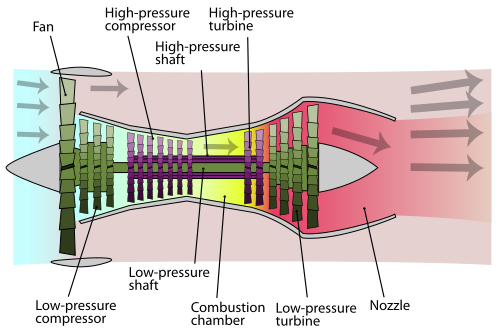
Turbofan engine operation: Wikimedia


RB 211-524: aircraftenginedesign.com


The RB 211 family is a high bypass turbofan engine originally designed for the Lockheed Tristar. The 211-524 engine was developed with increased thrust and efficiency for the Boeing 747-200 and further improvements led to the 211-524 G and 211-524H for the Boeing 747-400 and for the 767. The 211 family has led to the Trent engines and some features of the Trent could be retrofitted to create the 211-524G-T and the 211-524H-T. A newer version of the same family the 211-535 series is used in Boeing 727’s and 757’s.

An industrial version of the RB211 is used for power generation and another inter-cooled version is used in marine applications.

The Rolls Royce Trent 1000 engine designed for Boeing’s Dreamliner has had some initial testing setbacks which seem to be fixed but which has caused some of the delays to the Dreamliner.


That man-made carbon dioxide is the main driver of climate trends is irrational

October 24, 2010


Variations in temperature, CO 2 , and dust fro...

Vostok Ice core: Image via Wikipedia


One of a series of debate articles  in Ny Teknik by Professors Björnbom and Ribbing brings a refreshing whiff of sanity into the “closed and settled” science of global climate change. They conclude:

“To now stubbornly stick to the hypothesis that man-made carbon dioxide is the main driver of climate trends, is irrational in the headwinds from a growing number of critical articles based on measurements.”

Pehr Björnbom, Professor Emeritus, Chemical Engineering, KTH

Carl-Gustaf Ribbing, Professor Emeritus, Solid State Physics, Uppsala University

A free translation of their article is reproduced below:

Azar, Eriksson, Tjernström and Westerstrand, AETW, write: “strange that on the basis of only one study … rejecting decades of research “. This is a misleading summary of many years of development. For our article, and the references to the PDF version, showing a lower climate sensitivity than that shown by the UN’s Climate Change organisation, the IPCC, is not a new phenomenon. In less than ten years, the IPCC’s high values have been  disputed, partly because global warming has been lower than was predicted.

Instead of reducing the excessive carbon dioxide sensitivity the aerosol contribution has been increased to reduce climate sensitivity. In principle it is better to use measurements from high altitude, rather than parameter dependent adaptations to climate models to the Earth’s surface temperature.

AETW write about the glacial cycles that it is “.. very difficult to explain how Earth’s temperature can vary by as much as five degrees … between an ice age and a non-glacial climate when sensitivity is … one degree or less. ” It is “very difficult” only with today’s climate, which shows that the narrow focus on “explaining” the climate variations of carbon dioxide leads to absurdities.
We wonder why Per Ribbing blames us for over-simplification? What we are against is precisely the unilateral selection of the carbon dioxide created by human activity to be the dominant factor in climate regulation. We assert the contrary, that a half-dozen natural factors govern the very complex climate system. It will probably never be scientifically possible to completely describe this chaotic system.
Spencer and Braswell are making great progress with their phase diagram, so that variations in the natural driving forces can be separated from the feedbacks. This gives a higher correlation and a more accurate value of climate sensitivity: 0.6 degrees without the aid of climate models.
This uncertainty gives the obvious; that values can increase or decrease for longer periods than any measuring period. To now stubbornly stick to the hypothesis that man-made carbon dioxide is the main driver of climate trends, is unreasonable in the headwinds from a growing number of critical articles based on measurements.

Pehr Björnbom, Professor Emeritus, Chemical Engineering, KTH

Carl-Gustaf Ribbing, Professor Emeritus, Solid State Physics, Uppsala University

Following fiasco in Spain, electric car sales slump in the UK

October 23, 2010


G-Wiz Electric Vehicle parked outside 37 Savil...

G-Wiz Electric Car:Image via Wikipedia


In August it was apparent that Spain’s much-publicized plans to put thousands of electric cars on the road as part of a drive for a greener economy were way off target, with only 16 sold so far compared to the 2000 target for this year.

The Guardian reported today that

Sales of new electric cars in the UK plummeted by nearly 90% in 2009 compared with their peak in 2007, according to motoring trade association figures released this week. Just 55 of the green cars – whose fans include Boris Johnson, Jonathan Ross and Jade Jagger – were registered in 2009, in contrast to 397 in 2007, says the Society of Motor Manufacturers and Traders.

The huge fall is a blow to UK efforts to meet tough carbon emission cut targets in a decade, and comes just months before the government introduces a subsidy of up to £5,000 off new electric cars.

Nearly half of the electric vehicles sold last year were the tiny G-Wiz car. The latest modelhas a top speed of 50mph and a range of 48 miles between charges.

In January, the coalition will begin offering up to £5,000 towards the price of a series of newly launched electric cars, as part of a subsidy announced by the former Labour government. The Department for Transport (DfT) anticipates around 8,600 of the cars will be sold in the first year of the scheme. The government has so far committed £43m for the scheme to run until March 2012, with a review taking place in January 2012, but in yesterday’s spending review it talked of “supporting consumer incentives for electric and other low-emission cars throughout the life of this parliament,” suggesting the subsidy would continue after March 2012 though possibly at a lower rate.

In Spain the Industry Ministry’s plan was to have 2,000 electric cars on the road by the end of 2010 and 20,000 electric and hybrid vehicles operating the following year.

I cannot help concluding that most of these highly artificial “green” subsidies – whether for cars or for solar energy or  for wind turbines – are badly thought through, are chasing a mirage and will be counter-productive.

The ongoing evolution of humans

October 23, 2010

DNA. image ichromatography.com


The Yoruba of West Africa have been exposed, historically, to the dry conditions of the Sahel on the edge of the Sahara desert. To find out whether they had evolved to cope, Andres Moreno at Stanford University in California and colleagues looked at the variation of a gene known to be involved in water retention in the kidney, called FOXI1, in DNA samples from 20 Europeans, 20 east Asians and 20 Yoruba.

(BMC Evolutionary Biology, DOI: 10.1186/1471-2148-10-267).

The team found that 85 per cent of the Yoruba had an identical sequence of genetic information that was longer than it would have been if it was produced by random recombination and genetic shuffling. Instead, they suggest that it had been naturally selected.The length of the genetic signature suggests that the change occurred in the last 10,000 to 20,000 years, which could have coincided with the initial stages of the desertification of the Sahara. They also analysed a region of the gene in 971 samples from 39 human populations around the world, including the Yoruba, and found that the same genetic sequence was found at higher frequencies in lower latitudes. Since lower latitudes are more likely to be regions of water-stress, this suggests that the selection pressure was climate-related, says Moreno.

Humans are still evolving: the evidence

“Over the long term, if the Earth keeps warming, I would not be surprised to see genetic shifts,” says anthropological geneticist Anne Stone at Arizona State University in Tempe.

While we may look like the finished article, there is plenty of evidence that humans are still evolving. John Hawks at the University of Wisconsin-Madison even argues that population explosions and rapidly changing lifestyles are causing humans to evolve faster now than ever before. Evidence includes:

Coal India IPO: Coal becomes sexy again

October 23, 2010

Coal India Limited (CIL) is an Indian state-owned coal company headquartered in Kolkata, West Bengal, India and the world’s largest coal miner with revenue exceeding Rs 45,797 Cr or $10.3 billion U.S. (FY2008-09). It is owned entirely by the Union Government of India, under the administrative control of the Ministry of Coal.


Coal India Ltd.: Reuters graphic/ Christine Chan


As part of its divestment programme to raise about 9 Billion$, the Government of India has put up  10% of Coal India Ltd. in an IPO conducted this week. If priced at the top of its 225-245 rupee price range, the IPO would swell Government coffers by about 3.5 Billion$ and Coal India would have a market value of $35 billion, ranking it seventh among listed Indian firms. As the Economic Times puts it “The response to the Coal India (CIL) initial public offering (IPO) that finally closed early Friday morning, after lead managers were forced to extend the time limit to deal with a deluge of applications, has been phenomenal. Against the issue amount of Rs 150 billion, bids came in for Rs 2.54 trillion and the final total could be higher.
While retail investors seem to have been relatively circumspect — the retail portion was over-subscribed only 2.32 times — and employees even more so — the employee portion was not fully subscribed — both institutional and highnet-worth buyers seem to have participated with gusto.”


coal mine in India

Open cast coal mine in India: Image via Wikipedia


While a portion of the shares were held for employees the mining unions discouraged their members from applying. But with the opening price when the shares list on November 4th expected to be around Rs 300 – 320 there is a backlash among the union members who are going to have lost out. The institutional portion was oversubscribed 25 times.

Coal India has reserves of about 277 billion tonnes of which around 60 billions tonnes are currently recoverable by open cast mining. Current annual production is about 400 million tonnes and expected to rise to about 650 million tonnes in 5 years. India currently imports about 100 million tonnes of high grade coal mainly for steel making. Coal India has a major investment programme ongoing for the installation of coal washeries to improve the notoriously poor quality (high levels of abrasive ash) of Indian coals. Most Indian coals have very low values of Sulphur content so that sulphur dioxide emission is not a major concern.

The enormous interest of the institutional investors – both from within and from outside India – is a healthy indicator that simple business considerations rather than pseudo-environmentalism is still the governing factor.

Trade war! Cerium oxide price has risen 665% since April

October 22, 2010
Phase diagram of cerium in english

Phase diagram cerium: Image via Wikipedia

Freely translated from Dagens Industri

Cerium oxide, which is used to finish semiconductors and obtained from the rare earth element cerium, has risen in price from $ 4.70 per kg on April 20 to 36 U.S. dollars a kilo on Tuesday, October 19. An increase of 665 percent.

The price rise is primarily due to China scaling down its export quotas. In recent years there has been a gradual reduction of 5-10 percent per year, but in July alone it was reduced by 40 percent.  The country accounts for almost 95 percent of world supply of rare earths and in some cases almost 100 percent.

The official explanation from China is that the  country’s own industrial needs must be met first. These account  for 60 percent of global demand. Producing earth metals is a dirty business and China also gives environmental reasons as an explanation for the lower export quotas.

But many, especially in the U.S., suspect that it is a low-key trade war.

Lunar crater “Cabeus” contains more water than the Sahara

October 22, 2010

The New York Times reports on the latest results from the $79 million Lcross mission. Last October, as it neared impact, the Lcross spacecraft released the empty second stage and slowed down slightly so that it could watch the stage’s 5,600-mile-per-hour crash into a 60-mile-wide, 2-mile-deep crater named Cabeus.


Debris ejected from the Cabeus lunar crater about 20 seconds after the Lcross impact: image Science / AAAS


A series of articles reporting the Lcross results appear in Friday’s issue of the journal Science.

Last November, the team reported that the impact had kicked up at least 26 gallons of water, confirming suspicions of ice in the craters. The new results increase the water estimate to about 40 gallons, and by estimating by amount of dirt excavated by the impact, calculated the concentration of water for the first time. The Sahara sands are 2 to 5 percent water, and the water is tightly bound to the minerals. In the lunar crater, which lies in perpetual darkness, the water is in the form of almost pure ice grains mixed in with the rest of the soil, and is easy to extract. The ice is about 5.6 percent of the mixture, and possibly as high as 8.5 percent of it, Dr. Colaprete principal investigator of NASA’s Lunar Crater Observation and Sensing Satellite —  Lcross – said.

In lunar terms, that is an oasis, surprisingly wet for a place that had long been thought by many planetary scientists to be utterly dry. If astronauts were to visit this crater, they might be able to use eight wheelbarrows of soil to melt 10 to 13 gallons of water. The water, if purified, could be used for drinking, or broken apart into hydrogen and oxygen for rocket fuel — to get home or travel to Mars.

Also surprising was the cornucopia of other elements and molecules that Lcross scooped out of the Cabeus crater, near the Moon’s south pole. Lying in perpetual darkness, the bottom of Cabeus, at minus 370 degrees Fahrenheit, is among the coldest places in the solar system and acts as a “cold trap,” collecting a history of impacts and debris over perhaps a couple of billion years.

“This is quite a reservoir of our cosmic climate,” said Peter H. Schultz, a professor of geological sciences at Brown University and lead author of one of the Science papers. “It reflects things that hit the Moon.”

By analyzing the spectrum of infrared light reflected off the debris plume, Dr. Schultz and his colleagues identified elements like sodium and silver.


Microbes ate the oil and now plants clean up pollution

October 22, 2010

Not only do microbes eat up methane and other oil wastes faster than expected, it now seems that vegetation eats up air pollution to a much greater degree than thought. A new paper in Science finds that oxygenated volatile organic compounds (oVOCs) are taken up by deciduous plants at an unexpectedly fast rate–as much as four times more rapidly than previously thought.

T. Karl, P. Harley, L. Emmons, B. Thornton, A. Guenther, C. Basu, A. Turnipseed, K. Jardine. Efficient Atmospheric Cleansing of Oxidized Organic Trace Gases by VegetationScience, 2010; DOI: 10.1126/science.1192534

From Eurekalert:

“Plants clean our air to a greater extent than we had realized,” says NCAR scientist Thomas Karl, the lead author. “They actively consume certain types of air pollution.”

The research team focused on a class of chemicals known as oxygenated volatile organic compounds (oVOCs), which can have long-term impacts on the environment and human health. “The team has made significant progress in understanding the complex interactions between plants and the atmosphere,” says Anne-Marie Schmoltner of NSF’s Division of Atmospheric and Geospace Sciences, which funded the research. The compounds form in abundance in the atmosphere from hydrocarbons and other chemicals that are emitted from both natural sources–including plants–and sources related to human activities, including vehicles and construction materials.

The compounds help shape atmospheric chemistry and influence climate.

Eventually, some oVOCs evolve into tiny airborne particles, known as aerosols, that have important effects on both clouds and human health.

By measuring oVOC levels in a number of ecosystems in the United States and other countries, the researchers determined that deciduous plants appear to be taking up the compounds at an unexpectedly fast rate–as much as four times more rapidly than previously thought.

The uptake was especially rapid in dense forests and most evident near the tops of forest canopies, which accounted for as much as 97 percent of the oVOC uptake that was observed. Karl and his colleagues then tackled a follow-up question: How do plants absorb such large quantities of these chemicals?

The scientists moved their research into their laboratories and focused on poplar trees. The species offered a significant advantage in that its genome has been sequenced. The team found that when the study trees were under stress, either because of a physical wound or because of exposure to an irritant such as ozone pollution, they began sharply increasing their uptake of oVOCs. At the same time, changes took place in expression levels of certain genes that indicated heightened metabolic activity in the poplars.

The uptake of oVOCs, the scientists concluded, appeared to be part of a larger metabolic cycle. Plants can produce chemicals to protect themselves from irritants and repel invaders such as insects, much as a human body may increase its production of white blood cells in reaction to an infection.

But these chemicals, if produced in enough quantity, can become toxic to the plant itself.