Arctic melt season seems to be over for 2010

August 13, 2010

From the DMI mean temperatures above 80 degrees North it would seem that the Arctic melt season is over. Temperatures are now clearly below zero. This year it has been about 8 days shorter than the average melt season (green line below) of about 67 days.

Arctic tempereatures

IPCC / GISS: This is fraud !

August 12, 2010

Post by Willis Eschenbach in WUWT

There seems to be no end to the fraud-based advocacy being touted as science and propagated by the IPCC.

Temperatures in Nepal seem to have been particularly crudely “homogenised” by GISS.

IPCC Table 10.2 says: Nepal:  0.09°C per year in Himalayas and 0.04°C in Terai region, more in winter

The black line below is unadjusted temperatures and the red is temperatures after homogenisation. The yellow represents the level of “fudging” that was introduced to convert a cooling trend (in spite of the explosive urbanisation of Kathmandu and the consequent UHI effect) into a “warming” trend.

As Willis Eschenbach puts it

GISS has made a straight-line adjustment of 1.1°C in twenty years, or 5.5°C per century. They have changed a cooling trend to a strong warming trend … I’m sorry, but I see absolutely no scientific basis for that massive adjustment. I don’t care if it was done by a human using their best judgement, done by a computer algorithm utilizing comparison temperatures in India and China, or done by monkeys with typewriters. I don’t buy that adjustment, it is without scientific foundation or credible physical explanation.

This is not just shameless – it is simple fraud.

Indian “superbug” report is a scare to hurt medical tourism?

August 12, 2010

The Times of India is not impressed by the report in The Lancet Infectious Diseases Journal which claims that “India also provides cosmetic surgery for Europeans and Americans, and it is likely the bacteria will spread worldwide.”

cartoon from indianmta.blogspot.com

Scientists have tracked down a drug-resistant superbug that infects patients and causes multiple organ failure to Indian hospitals but doctors here see in it the germ of a move to damage the country’s booming medical tourism industry. While the study has the medical world turning its focus on infection control policies in Indian hospitals, the Indian Council of Medical Research has alleged a bias in the report and said it is an attempt to hurt medical tourism in the country that is taking away huge custom from hospitals in the West. “Such infections can flow in from any part of the world. It’s unfair to say it originated from India,” said ICMR director Dr VM Katoch. The superbug NDM-1 (New Delhi metallo-beta-lactamase) is named after the national capital, where a Swedish patient was reportedly infected after undergoing a surgery in 2008.

Senior doctors working in infection control said India lacks policies on antibiotics, infection control and registries for hospital-acquired infections. By the ICMR director’s own admission, India cannot scientifically fight back allegations of being the source of such superbugs, as the country does not have a registry of such hospital-acquired infections.

“Two in every five patients admitted to hospitals acquire infections. This extends the patient’s stay in the hospital, increases the expenses and causes side-effects,” said Dr Dilip Mathai, head of the department of internal medicine, Christian Medical College, Vellore.

The Lancet report  is causing some alarm within the medical tourism fraternity in India and doctors are rushing to defend the business.

But doctors in India said there was little chance this bacteria would infect overseas “health tourism” visitors. “Most of these bacteria are mostly transmitted to ICU patients, those in ventilators or critically ill patients. Since overseas patients come for selective surgeries, chances of them getting these bugs are negligible,” said Dr Monica Mahajan, senior consultant at Delhi-based Max Healthcare. Dr Amit Verma, director of critical care medicine at Fortis said he did not anticipate any major impact to medical tourism in India. The sample size of the study was very small to arrive at a conclusion, he said, adding that the chances of the bacteria becoming a global epidemic was negligible due to the restricted transmission capability of the bacteria.

Somehow the glib statement that Most of these bacteria are mostly transmitted to ICU patients, those in ventilators or critically ill patients. Since overseas patients come for selective surgeries, chances of them getting these bugs are negligible” does not inspire much confidence!

The pandemic is over but 300 million vaccines were sold for a small fortune

August 11, 2010

The world is no longer in the middle of an H1N1 pandemic, the World Health Organisation has announced. We are now in the “post pandemic period”, Margaret Chan, director-general of the WHO, has announced.

But as reported by the The  Star in Toronto,

Three members of the emergency committee that advised Director General Dr. Margaret Chan on the H1N1 pandemic work at public health agencies in the United States and United Kingdom that have received research funding from pharmaceutical companies or their industry associations, and a fourth member had previously worked as a paid consultant for five different vaccine manufacturers.

The international health authority came under fire in June when a prominent medical journal alleged scientists with undisclosed financial ties to drug manufacturers had helped develop its pandemic strategies.

The article noted that guidelines published in 2004 urged countries to stockpile antiviral medication in advance to avoid scrambling for supplies when an outbreak occurred, but the WHO failed to disclose that three of the committee members who contributed to the document had at one point received funding from companies that manufacture antiviral drugs.

The joint investigation by the BMJ (formerly called the British Medical Journal) and the London-based Bureau of Investigative Journalism also spoke out against the WHO for keeping the lid on the names of its 15-member H1N1 emergency committee.

Over 300 Million vaccines were sold during this alarmist nonsense.

Sounds like fraud.

Misconduct at Harvard or is it scientific fraud?

August 11, 2010

Harvard does not want to say very much but the story was broken by the Boston Globe.

Harvard University psychologist Marc Hauser — a well-known scientist and author of the book “Moral Minds’’ — is taking a year-long leave after a lengthy internal investigation found evidence of scientific misconduct in his laboratory.

Scientist Marc Hauser’s studies include work on the cognitive and evolutionary underpinnings of language.

As reported in Nature:

A 3-year investigation has found evidence of scientific misconduct in publications by prominent Harvard University psychologist Marc Hauser, the Boston Globe reports today.

Hauser’s research, which has frequently been highlighted in newspapers and on television, has addressed the evolutionary roots of human language, mathematical ability, and morality. His 2006 book, Moral Minds, argued that the human brain is programmed to embrace certain moral principles. Earlier this year, Hauser co-authored a study that found no impact of religion on how humans respond to moral dilemmas (for more, see ‘Morals don’t come from God’).

But by then, Hauser’s lab was already the subject of a Harvard University investigation. According to the Globe article, the trouble centers on a 2002 paper published in the journal Cognition (subscription required). Hauser was the first author on the paper, which found that cotton-top tamarins are able to learn patterns – previously thought to be an important step in language acquisition. The paper has been retracted, for reasons which are reportedly unclear even to the journal’s editor, Gerry Altmann.

Two other papers, a 2007 article in Proceedings of the Royal Society B and a 2007 Science paper, were also flagged for investigation. A correction has been published on the first, and Science is now looking into concerns about the second. And the Globe article highlights other controversies, including a 2001 paper in the American Journal of Primatology, which has not been retracted although Hauser himself later said he was unable to replicate the results. Findings in a 1995 PNAS paper were also questioned by an outside researcher, Gordon Gallup of the State University of New York at Albany, who reviewed the original data and said he found “not a thread of compelling evidence” to support the paper’s conclusions.

This sounds more like fraud.

Not for the first time at Harvard and surely not the last.

How many “peers” have been duped along the way?

Antarctic sea ice growing fast

August 10, 2010

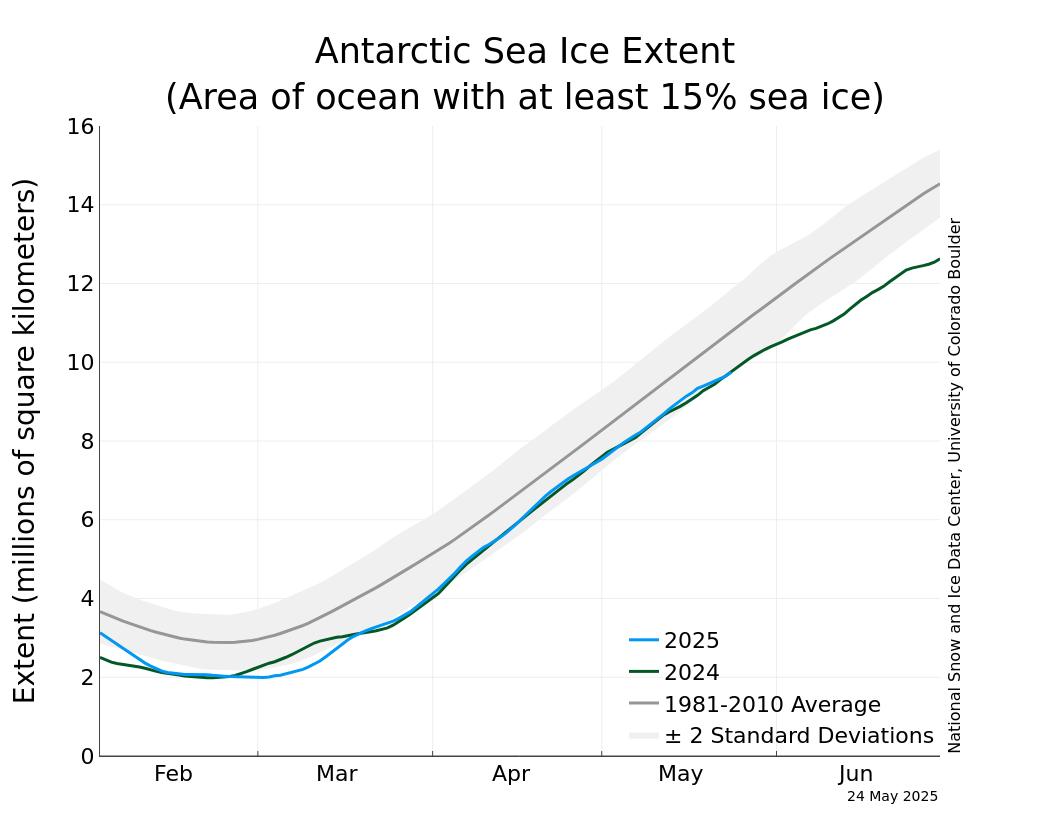
The sea ice extent in the Antarctic continues to be well above the 2009 level and more than 2 SD’s higher than the 1979-2000 average. Sea ice extent peaks at the end of September and, if anything, the growth is accelerating rather than slowing down when we are now in the middle of August.

http://nsidc.org/data/seaice_index/images/daily_images/S_stddev_timeseries.png

In the Northern Hemisphere, temperatures above the 80th parallel have dipped below freezing and are also clearly lower than the 1958 -2002 average.

http://ocean.dmi.dk/arctic/meant80n.uk.php

Looks like we are in for another long and cold winter.

La Niña conditions now established?

August 9, 2010

It would seem that La Niña conditions are no longer just a probability.  La Niña conditions are expected to strengthen towards the end of the year and through the first quarter of 2011.

In the latest bulletin issued by the NOAA (Update prepared by Climate Prediction Center / NCEP 9 August 2010) we see that

  • La Niña conditions are present across the equatorial Pacific. Negative sea surface temperature anomalies continue to strengthen across much of the Pacific Ocean.  La Niña conditions are likely to continue through early 2011
  • Since March 2010, positive SST anomalies have decreased across much of the equatorial Pacific. Since the beginning of May 2010, SST anomalies have become increasingly negative in the eastern half of the Pacific.
  • During the last four weeks, equatorial SST anomalies have been negative in the eastern half of the Pacific. During the last 30 days, negative SST anomalies increased in magnitude in the central equatorial Pacific
  • Since mid-June 2010, negative subsurface temperature anomalies have dominated the central and eastern equatorial Pacific, with only slight variations in the magnitude of the anomalies.

The formal designation of a La Niña is keyed to a 3 month mean of the Oceanic Niño Index (ONI) in Region 3.4 and is likely to happen in the first two weeks of September.


Ethanol more damaging to the Gulf than BP oil spill

August 8, 2010

Supposed environmental solutions often create new problems.

Dead zone in gulf linked to ethanol production

While the BP oil spill has been labeled the worst environmental catastrophe in recent U.S. history, a biofuel is contributing to a Gulf of Mexico “dead zone” the size of New Jersey that scientists say could be every bit as harmful to the gulf.

Each year, nitrogen used to fertilize corn, about a third of which is made into ethanol, leaches from Midwest croplands into the Mississippi River and out into the gulf, where the fertilizer feeds giant algae blooms. As the algae dies, it settles to the ocean floor and decays, consuming oxygen and suffocating marine life.

Known as hypoxia, the oxygen depletion kills shrimp, crabs, worms and anything else that cannot escape. The dead zone has doubled since the 1980s and is expected this year to grow as large as 8,500 square miles and hug the Gulf Coast from Alabama to Texas.

The gulf dead zone is the second-largest in the world, after one in the Baltic Sea. Scientists say the biggest culprit is industrial-scale corn production. Corn growers are heavy users of both nitrogen and pesticides. Vast monocultures of corn and soybeans, both subsidized by the federal government, have displaced diversified farms and grasslands throughout the Mississippi Basin.

“The subsidies are driving farmers toward more corn,” said Gene Turner, a zoologist at Louisiana State University. “More nitrate comes off corn fields than it does off of any other crop by far. And nitrogen is driving the formation of the dead zone.”

The sins of BP and “the greatest environmental disaster ever”

August 8, 2010

Thames in danger of impending catastrophe

Father Thames in Victorian England

Considering that the BP oil spill has been designated the “greatest environmental disaster ever”, the danger to the Thames from clumsy motorists has not been properly appreciated.

If we conveniently forget Bhopal and focus solely on the Gulf of Mexico, then spilling about 2 litres of engine oil into the Thames would be equivalent to the concentration of oil in the Gulf.

A very nice sanity check by Raedwald.

(More on Rædwald, of East Anglia here . He was called Rex Anglorum – King of the Angles by Bede but presumably has not been much of a role model for the University of East Anglia – Climatic Research Unit).

The volume of the Gulf of Mexico is 2,424,000 cubic kilometers, or 6.43 * 1017 US gallons. The volume of oil spilt is estimated at 20m gallons to 50m US gallons; let’s take the max, 5 * 107 gallons. That’s one part of oil to 1.29 * 1010 parts of water. The volume of the Thames at mid tide between Teddington and Gravesend is about 2.4 * 107 cubic metres (633 * 107 US gallons, or 127 times the total volume of the BP oil leaked). To replicate the ‘environmental disaster’ , I’ll therefore have to empty 1.87 litres of engine oil into the river.

Over 75% of the Gulf oil spill has now dispersed.

Has “peer review” failed??

August 7, 2010

An interesting, provocative and thought provoking post by Nigel Calder here.

It would seem that “peer review” which was intended to improve the quality of scientific papers has actually been a hindrance to new discoveries rather than a help. As Climategate has shown very clearly the “peer review” process is easily perverted by the ruling clique preventing anything opposing their views to be published and the prevailing group-think ensuring that anything “heretical” is suppressed.

“As there is not the slightest sign of any end to science, as a process of discovery, a moment’s reflection tells you that this means that the top experts are usually wrong. One of these days, what each of them now teaches to students and tells the public will be faulted, or be proved grossly inadequate, by a major discovery. If not, the subject must be moribund.”

Back in 1989, James Lovelock had this to say about “peer review”: ‘Before a scientist can be funded to do a research, and before he can publish the results of his work, it must be examined and approved by an anonymous group of so-called peers. This inquisition can’t hang or burn heretics yet, but it can deny them the ability to publish their research, or to receive grants to pay for it. It has the full power to destroy the career of any scientist who rebels.’

Galileo facing the inquisition

Calder continues:This month the life sciences magazine The Scientist has interesting articles on peer review.

One, entitled “Breakthroughs from the Second Tier”, describes five “high-impact” papers that should have been published in more prestigious journals than they were. You can see it here http://www.the-scientist.com/2010/8/1/30/1/.

Also in The Scientist is “I Hate Your Article” by Jef Akst, who quotes David Kaplan, professor of pathology at Case Western Reserve University:

Theoretically, peer review should “help [authors] make their manuscript better,” [Kaplan] says, but in reality, the cut-throat attitude that pervades the system results in ludicrous rejections for personal reasons—if the reviewer feels that the paper threatens his or her own research or contradicts his or her beliefs, for example—or simply for convenience, since top journals get too many submissions and it’s easier to just reject a paper than spend the time to improve it. Regardless of the motivation, the result is the same, and it’s a “problem,” Kaplan says, “that can very quickly become censorship.”

Akst’s full article is here: http://www.the-scientist.com/article/display/57601/ . It goes on to discuss some of the ideas on offer for easing the peer review problem. That’s the basis for this brief update to be added to Magic Universe.

Amid growing recognition of problems with peer review, a few scientific journals tested various remedies. As reported by The Scientist magazine, by 2010 they included ending the anonymity of reviewers, so that they could both be held responsible for their comments and be acknowledged for their work, which was time-consuming. Another policy was to insist that reviewers should concern themselves only with the rigour and proper reporting of the work, not with its impact or scope. And to speed up publication, reviewers’ comments made for one journal might be passed on to others. Some journals went so far as to publish preliminary versions of papers before the peer-review process was complete.

Peer review has to get back to being strictly a review of the quality of the work done and not a commentary on or a review of the conclusions to be drawn.