How can we – if we should – prepare for a new Little Ice Age?

August 22, 2010

It seems that we are in a Solar Cycle Minimum – a Landscheidt Minimum which will perhaps be comparable to the Maunder Minimum.

The last decade has seen flat or declining global temperatures.

The Ocean temperature oscillations could indicate 20 or 30 years cooling ahead of us.

If these are all indicators of a coming Little Ice Age, then it may be time to take some preparatory actions to help humans adapt. I think adaptation to Climate Change when it happens is the key not some mis-guided and futile attempt to prevent the Climate Change from happening (as being proposed by the IPCC and other global warming fanatics).

image: http://t2.gstatic.com/images?q=tbn:TtpOoja-ueuOLM:http://www.wilsonsalmanac.com/images3/frost_fair_C18.jpg

The question which is more for engineers rather than for scientists is “What are the actions that could be taken to prepare and help for such an adaptation?”

Applying Asimov’s Laws of Robotics

August 21, 2010

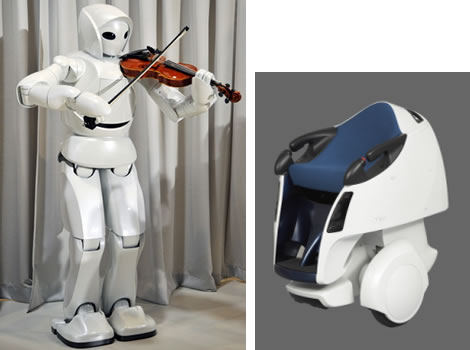
Isaac Asimov published his first short story about robotics in 1942 and his I Robot in 1950. The three laws of robotics he developed have now become the de facto basis for most science fiction dealing with robots and even in engineering:

First Law: A robot may not injure a human being, or, through inaction, allow a human being to come to harm, unless this would violate a higher order law.
Second Law: A robot must obey orders given it by human beings, except where such orders would conflict with a higher order law.
Third Law: A robot must protect its own existence as long as such protection does not conflict with a higher order law.
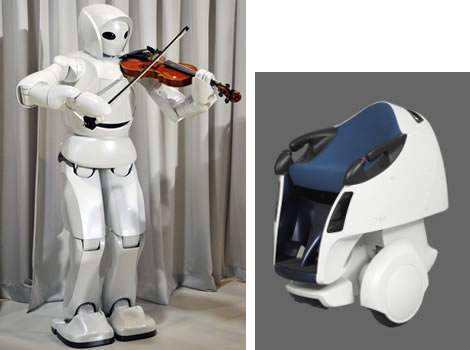
image: http://www.geekalerts.com/u/toyota-robots.jpg

Later as Asimov integrated his Robot series with his Foundation series he added a Zeroth Law:

Zeroth Law: A robot may not injure humanity, or, through inaction, allow humanity to come to harm.

A modern counterpart to Asimov’s fictional character is Eliza. Eliza was created in 1966 by Professor Joseph Weizenbaum of Massachusetts Institute of Technology who wrote Eliza — a computer program for the study of natural language communication between man and machine. She was initially programmed with 240 lines of code to simulate a psychotherapist by answering questions with questions.

Robotics and robot design has now advanced to the stage that engineers are now having to re-look at Asimov’s laws for practical implementation. David Woods, professor of integrated systems engineering at Ohio State University says “The philosophy has been, ‘sure, people make mistakes, but robots will be better — a perfect version of ourselves.’ We wanted to write three new laws to get people thinking about the human-robot relationship in more realistic, grounded ways.” He addresses the practical issues in his article: Beyond Asimov: The Three Laws of Responsible Robotics in IEEE Intelligent Systems by Robin Murphy , David D. Woods, July 2009, pp. 14-20. “Go back to the original context of the stories,” Woods says, referring to Asimov’s I Robot among others. “He’s using the three laws as a literary device. The plot is driven by the gaps in the laws — the situations in which the laws break down. For those laws to be meaningful, robots have to possess a degree of social intelligence and moral intelligence, and Asimov examines what would happen when that intelligence isn’t there.”

“His stories are so compelling because they focus on the gap between our aspirations about robots and our actual capabilities. And that’s the irony, isn’t it? When we envision our future with robots, we focus on our hopes and desires and aspirations about robots — not reality.”

In reality, engineers are still struggling to give robots basic vision and language skills. These efforts are hindered in part by our lack of understanding of how these skills are managed in the human brain. We are far from a time when humans can agree on a universal ethical or moral code and even further away from imbuing such a code into robots.

Woods and his coauthor, Robin Murphy of Texas A&M University, composed three laws that tries to put the responsibility back on humans.

The three new laws that Woods and Murphy propose are:

  • A human may not deploy a robot without the human-robot work system meeting the highest legal and professional standards of safety and ethics.
  • A robot must respond to humans as appropriate for their roles.
  • A robot must be endowed with sufficient situated autonomy to protect its own existence as long as such protection provides smooth transfer of control which does not conflict with the First and Second Laws.

Woods admits that one thing is missing from the new laws: the romance of Asimov’s fiction — the idea of a perfect, moral robot that sets engineers’ hearts fluttering.

Wind Power Sector struggles

August 21, 2010

Wind Power is still a long way from being commercial and is  still critically dependent upon subsidies. Austerity packages resulting from the financial crisis have sharply reduced subsidy programs and there have been a spate of cancelled and delayed projects. There is also some disillusionment evident as wind turbines demonstrated their weaknesses during the last cold winter when many had to be shut down in Europe for fear of ice on the turbine blades. The requirement for back-up power and the instability they add to the grid has not helped either. The Spanish support for renewables has dried up as the financial crisis has hit hard.

An injection of realism and common sense to the the use of renewable energy is long overdue. Wind and Solar and tidal and geothermal energies all have their place but they will not – and cannot – provide the base load power generation that coal, nuclear and hydro power have provided.

The FT reports that shares in Vestas Wind Systems lost more than a fifth of their value on Wednesday after the world’s largest wind turbine manufacturer slumped to its second consecutive quarterly loss and cut its profit guidance for the year.

image: http://www.pcdistrict.com/modules/productcatalog/product_images/132027-Windmill-3D-Screensaver.jpg

image. http://37signals.com/svn/images/dutch_windmill.jpg

Vestas warned that some expected orders from Europe and the US had been delayed as banks take longer to approve financing and deficit-laden governments review their support for wind power. Analysts highlighted regulatory uncertainty in Spain, which recently cut subsidies for renewable energy as part of its fiscal austerity programme, and the US, where legislation to promote clean energy has stalled on Capitol Hill. Low natural gas prices, caused in part by the surge in supplies from newly exploited US shale gas reserves, was another factor deterring investment in more costly renewable energy, analysts said.

New wind power installation in the US declined by more than two-thirds in the first half and fell below new coal power capacity for the first time in five years.

Increasing whiskey production can save the environment

August 21, 2010

By-products from distilling whiskey produce a biofuel with 30% more power output than ethanol !

Using samples from the Glenkinchie Distillery in East Lothian, researchers at Edinburgh Napier University have developed a method of producing biofuel from two main by-products of the whisky distilling process – “pot ale”, the liquid from the copper stills, and “draff”, the spent grains. The new method developed by the team produces butanol, which gives 30% more power output than the traditional biofuel ethanol. It is based on a 100-year-old process that was originally developed to produce butanol and acetone by fermenting sugar. The team has adapted this to use whiskey by-products as a starting point and has filed for a patent to cover the new method. It plans to create a spin-out company to commercialise the invention. Butanol is superior to ethanol — with 25 – 30% t more energy per unit volume. The biofuel can also be introduced to unmodified engines with any gasoline blend, whereas ethanol can only be blended up to 85 percent and requires engine modification.

Read more:http://solveclimate.com/blog/20100817/scottish-scientists-develop-whisky-biofuel

Professor Martin Tangney, who directed the project said that using waste products was more environmentally sustainable than growing crops specifically to generate biofuel. “What people need to do is stop thinking ‘either or’; people need to stop thinking like for like substitution for oil. That’s not going to happen. Different things will be needed in different countries. Electric cars will play some role in the market, taking cars off the road could be one of the most important things we ever do.”

“The production of some biofuels can cause massive environmental damage to forests and wildlife. So whisky powered-cars could help Scotland avoid having to use those forest-trashing biofuels,” said Dr Richard Dixon, of WWF Scotland.

“DRINK IT and then DRIVE IT” has a nice ring to it and  is something I could enjoy supporting.

Hausergate: An utter lack of ethics

August 19, 2010

Fiction passed of as science

Further revelations in The Chronicle of Higher Education provides sordid details about the Hauser paper published in 2002 in Cognition and which is now being retracted. But the pattern of behaviour described is that of an accomplished liar well-versed in creating bogus data. To become such an accomplished inventor of data must have taken years of practice.

For how long has Hauser been passing off works of fiction as works of science?

Hauser’s hectoring tone towards his research assistants to try and force his false interpretations on them are also very revealing. The author of Moral Minds exhibits an utter lack of ethics.

Rather than getting a year off to write another work of fiction should he not be required to return all the salary and grant money he has enjoyed as the fruits of his inventiveness?

Where are all the peers who have recommended his being published?

Document Sheds Light on Investigation at Harvard 1

An internal document, however, sheds light on what was going on in Mr. Hauser’s lab. It tells the story of how research assistants became convinced that the professor was reporting bogus data and how he aggressively pushed back against those who questioned his findings or asked for verification.

Read the rest of this entry »

IBM is second largest private employer in India

August 18, 2010

In 2006 IBM had 53,000 employees in India which grew to 73,000 employees in 2007. Since then, the company has maintained that it is a global company and geographic numbers do not have any meaning in that context. In 2010 IBM employees in India exceeded 100,000 and may be as many as 130,000.

IBM still employs the most people in the US but almost one in three of IBM’s total workforce of over 400,000 is now in India.

http://www.accessnorthga.com/img/stories/205230/ibm-india_medium.jpg

The Times of India reports that

The fact that IBM has over one lakh (100,000)  people on its rolls in this country is one of India Inc’s best-kept secrets.
Tata Consultancy Services is the largest private sector employer in the country. It had 163,700 employees as on June 30.

No one in US-headquartered IBM will admit that it employs such a large number of people in India — for fear of a backlash at home. There’s been rising anger in the US over the transfer of `American jobs’ to lower cost havens, particularly India. Faced with an economic slowdown and a politically-damaging high employement rate, Barack Obama himself has begun to sound jingoistic. He has issued barely-veiled threats against US companies that ship out work and promised candies to those who stay patriotic.Even as an IBM spokesperson declined comment when contacted, a source within the company said that in a couple of years, the India employee strength could cross that in the US, where it employs about 1,55,000 people, and where the pace of hiring is substantially slower than in India. IBM globally has a little over 4,00,000 employees. So, close to 1 in 3 of its employees is already an Indian.

Its staff strength is more than four times that of India’s biggest private sector company, Reliance Industries, which employs about 23,000 people. It is bigger than the combined employee base of the two Tata Group’s crown jewels, Tata Steel (81,000) and Tata Motors (24,000).

A cross-section of industry analysts and manpower recruitment firms TOI spoke with not only put IBM’s India workforce (including that of its wholly-owned subsidiary IBM Daksh) at over one lakh, some even went to the extent of saying it might be 1.3 lakh — well over Infosys’ 1.14 lakh as on June 30. Infosys is India’s second largest IT firm by revenue and third, it now transpires, by employees.

Since 2007, the company has stopped disclosing the geographic break-up of its employee numbers. The last time it provided figures was in 2007, when it said it had 73,000 employees in India. Since then, the company has maintained that it’s a global company and geographic numbers do not have any meaning in that context.
Read the rest of this entry »

Climate models don’t need the sun – “Venus is similar to Earth” !!!

August 17, 2010

Japanese Spacecraft Approaches Venus

Venus Climate Orbiter “AKATSUKI”

This from NASA Science News:

[Global view of Venus]

Imamura is the project scientist for Akatsuki, a Japanese mission also called the Venus Climate Orbiter. The spacecraft is approaching Venus and will enter orbit on December 7, 2010. Imamura believes a close-up look at Venus could teach us a lot about our own planet.

“In so many ways, Venus is similar to Earth. It has about the same mass, is approximately the same distance from the sun, and is made of the same basic materials,” says Imamura. “Yet the two worlds ended up so different. We want to know why.”

Considering NASA’s own Venus fact sheet and the fact that Venus is about 41 million km closer to the sun it is – in the kindest interpretation – sloppy to permit a statement that “Venus is similar to earth.. approximately the same distance from the sun”.

“By comparing Venus’s unique meteorology to Earth’s, we’ll learn more about the universal principles of meteorology and improve the climate models we use to predict our planet’s future” says Imamura.

Of course the models will no doubt take into account that solar radiation on Venus is about  2688 J while the Earth receives 1365 J or perhaps the models don’t need the sun and will base everything on the heating effects of carbon dioxide.

I would have thought that it is the differences between Venus and Earth which can be revealing and to consider a distance of 41 million km closer to the sun as being negligible does not inspire confidence in any subsequent climate modelling.

Flattening the Mann hockey stick

August 15, 2010

The shape of Mann’ s hockey stick is morphing. The long horizontal handle (obtained by eliminating the MWP)  actually turns out to be sloping and the sharp upturn gets flattened.

WUWT reports a new and important study on temperature proxy reconstructions (McShane and Wyner 2010) submitted into the Annals of Applied Statistics and is listed to be published in the next issue.

A Statistical Analysis of Multiple Temperature Proxies: Are Reconstructions of Surface Temperatures Over the Last 1000 Years Reliable?

BY BLAKELEY B. MCSHANE∗ AND ABRAHAM J. WYNER†
Northwestern University∗ and the University of Pennsylvania†
This paper is a direct and serious rebuttal to the proxy reconstructions of Mann. It seems watertight on the surface, because instead of trying to attack the proxy data quality issues, they assumed the proxy data was accurate for their purpose, then created a bayesian backcast method. Then, using the proxy data, they demonstrate it fails to reproduce the sharp 20th century uptick

FIG 16. Backcast from Bayesian Model of Section 5. CRU Northern Hemisphere annual mean land temperature is given by the thin black line and a smoothed version is given by the thick black line. The forecast is given by the thin red line and a smoothed version is given by the thick red line. The model is fit on 1850-1998 AD and backcasts 998-1849 AD. The cyan region indicates uncertainty due to t, the green region indicates uncertainty due to β, and the gray region indicates total uncertainty.

The Mann Hockey Stick
Multiproxy reconstruction of Northern Hemisphere surface temperature variations over the past millennium (blue), along with 50-year average (black), a measure of the statistical uncertainty associated with the reconstruction (gray), and instrumental surface temperature data for the last 150 years (red), based on the work by Mann et al. (1999). This figure has sometimes been referred to as the hockey stick. Source: IPCC (2001).

The authors conclude that:

“…..we conclude unequivocally that the evidence for a ”long-handled” hockey stick (where the shaft of the hockey stick extends to the year 1000 AD) is lacking in the data.…..Climate scientists have greatly underestimated the uncertainty of proxy based reconstructions and hence have been overconfident in their models.”


Germany: Highest growth rate since Reunification

August 15, 2010

The motor of the European economy is revving up again.

Der Spiegel reports:

Graphic: German growth forecasts for 2010

Germany just posted its strongest quarter of economic growth since reunification in 1990. During the second quarter, an exports boom, increased consumption and government stimulus helped the country chalk up growth of 2.2 percent. Buoyed by a surge in exports and continuing government stimulus programs, Germany’s economy is recovering at a faster pace than most economists expected. During the second quarter, gross domestic product increased by 2.2 percent on the previous quarter, the Federal Statistical Office in Wiesbaden announced on Friday, marking the largest quarterly economic growth since the country’s reunification in 1990.

There has been some criticism of the austerity package being introduced by the German government and of the ending of the stimulus packages. But perhaps the timing is right after all. But whether German growth can prevent a doubel-dip recession in the rest of Europe remains to be seen.

The 5 million unemployed in Germany in 2005 has now reduced and could soon be  less than 3 million.

In addition to benefiting the labor market, the German economic stimulus program also boosted consumer spending. Short-time workers have more disposable income than the unemployed, and as a result, German consumers were hardly forced to cut back during the crisis.

“Hausergate” and the perversion of peer review

August 14, 2010

It would seem that  Marc Hauser fudged or exaggerated or imagined or just plain made up some of the results in at least 3 papers which were published after peer review.

Predictably, Harvard is being very reticent with information but as reported by The Boston Globe the university has assured the world that all necessary corrections will be made. Harvard University confirmed yesterday that it has examined concerns about scientific work by prominent psychology professor Marc Hauser and said it has “taken steps to ensure that the scientific record is corrected’’ in three journal articles for which he was a coauthor.

Also predictably others at Harvard are rationalising and taking a sympathetic view. Greg Laden says: “I know Marc Hauser, and I trust him.”

http://homelessmanspeaks.files.wordpress.com/2008/11/circling-wagons-nov-27-2008.jpg

Hauser himself is taking a year off as penance and to purge himself of his misconduct.

1. A 2002 paper published in the journal Cognition is being retracted by Hauser and two coauthors. The retraction notes that an internal Harvard examination found that the data do not support the findings.

The journal ( or is it magazine) and Elsevier need to now defend their editorial process. Who were the peers and what did they review?

2. Also called into question by the investigation is a 2007 paper in the journal Science. Ginger Pinholster, a spokeswoman for the journal, said that one of the coauthors — Justin Wood, a former graduate student at Harvard who now is an assistant professor of psychology at the University of Southern California — wrote a letter to the journal in late June. According to Pinholster, the letter stated that an internal investigation at Harvard found there were missing field notes and that the team at Harvard had recreated its research as a result. Science has yet to make a formal change to the article.

Did the missing notes ever exist? Time for Science to open up.

3. A 2007 paper in the Proceedings of the Royal Society B has already been corrected, because of missing video records and field notes. Earlier this week, Victoria Millen, publishing editor of the British journal, confirmed that the authors contacted the journal last month and informed it of the investigation. The correction notes that incomplete video records and field notes were collected by “the researcher who performed the experiments,’’ a scientist named David Glynn, who has not responded to multiple e-mail and voicemail messages.

Hausergate and Climategate and all its associated “gates” show that the peer review process is sufficiently perverted and corrupted that it needs an overhaul. It is time for the assenting and dissenting peers to stand up and be counted and not hide behind the skirts of anonymous independance.

The Harvard statement said that in cases like Hauser’s, Harvard reports its findings to federal funding agencies, which do their own reviews.

But Harvard cannot pass the buck.