High irony in Swedish politics

August 2, 2018

The Swedish Social Democrats (the ruling party) have been in power for almost 80 of the last 100 years. They are not, however, very keen on talking about their past when it comes to the politics of racism. It was at the initiative of leading Social Democrats that the first ever state-run Institute for Race Biology was established in 1922. Within the workers’ movements, it was ingrained that Swedish workers were superior to other races. Even within the intellectual elite of the “Socialist” movement too it was “common wisdom” that Swedish culture and values were superior. It was this institute and their “scientific” work which was to prove the inspiration for the German version of eugenics. Whereas the German Institute was shut down after the war the Swedish Institute continued and later became part of Uppsala University and its genetics centre.
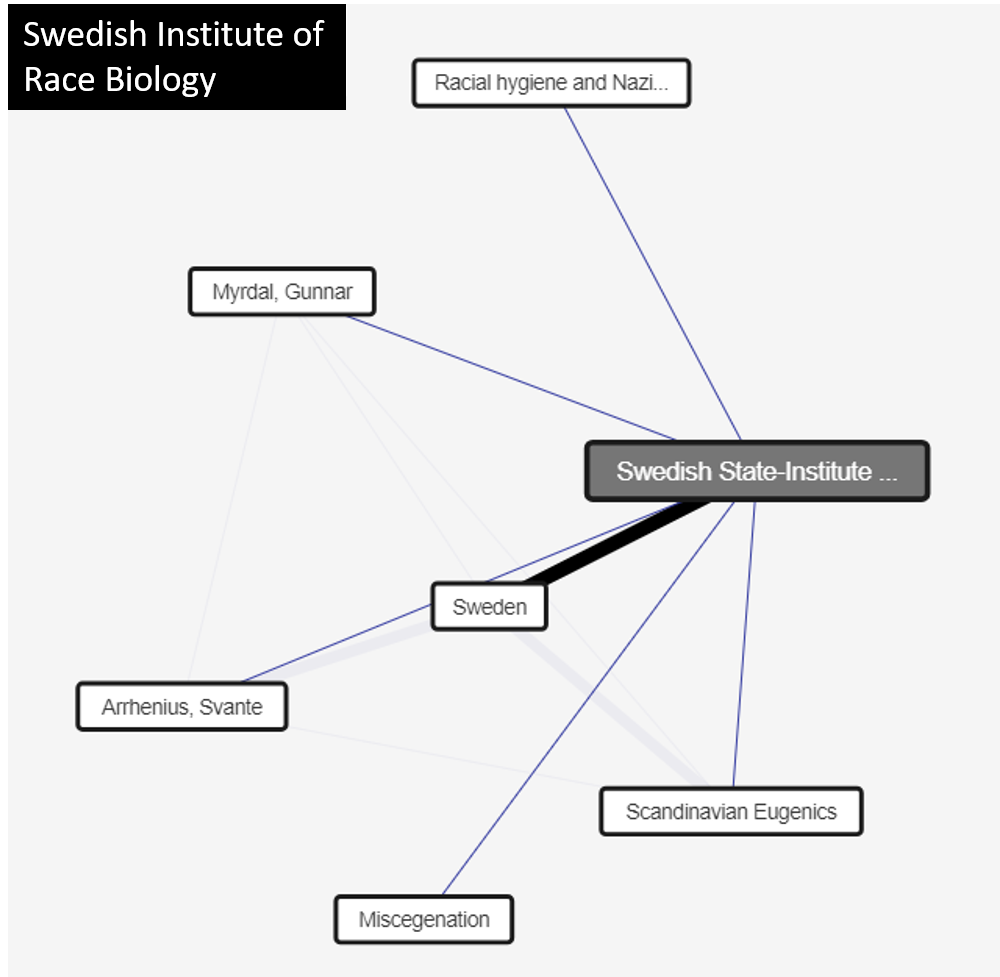
Eugenics Archive:

In 1918, it was suggested that an institute of racial biology be partially funded by the Nobel Committee (Lundborg, 1922). This was unanimously supported by the Nobel Committee itself, but the idea was seen as a misuse of Nobel funds and a race-biology institute was not created at that time. Lundborg argued that a race-biology institute was important to prevent racial degeneration in Sweden, and ultimately, the Swedish state-institute for race biology was created (Lundborg, 1922). ….

…… The purpose of the institute was to research genetics, heredity, and racial characteristics. (Lundborg, 1922; Broberg & Roll-Hansen, 2005). The data from this research was meant to be used to create practices that would supposedly improve the quality of the Swedish population (Lundborg, 1922). As eugenics became less popular in the public, the institute became controversial and was eventually renamed in 1958 (Broberg & Roll-Hansen, 2005).

Through their own eugenics program, where the Sami people were subjected, until as late as the 1970s, to forced sterilisations and abortions, the Swedish program was not so very far removed in its objectives from the Nazi program. The Nazi methods and the scale of their program were of a quite different magnitude. The Social Democrats would rather that this part of their history went away quietly. They have never really confronted the past or come to terms with it. Many leading Social Democrats (among them the Myrdals) were strongly involved in the vision of eugenically ensuring a population with the “right social attitudes”.

A Brave New World

In the mid-1970s Sweden’s parliament abolished the eugenics-inspired sterilization legislation enacted in 1935 by a social democratic government. During the four decades that passed between implementation and abolition, almost 63,000 Swedes were rendered infertile, in many cases in response to pressure from the state and sometimes as a result of outright compulsion. Furthermore, it was chiefly those regarded as ‘‘unproductive’’ who were the targets of that social policy.

The Sweden Democrats is the anti-immigration party which has seen increasing popular support over the last decade. Inevitably it is attacked for having its origins with, and having connections to, neo-Nazi (rather than Nazi) groups in their past. Other political parties have shunned them and have refused to contemplate working with them in any way. In this September’s general elections it is very likely that the Sweden Democrats will end up as the second largest party in parliament. The game is changing.

Yesterday I found it a case of very high irony indeed when the Sweden Democrats released a 1h 45 minute documentary about the place of race in the Social Democrats’ past. They use racism – which they are usually accused of – to attack the Social Democrats. Pure propaganda of course but not factually incorrect. The Social Democrats are trying to shrug this off as propaganda but they have some very dark skeletons in their closet.

One People, One Party

(Ett folk ett parti)

(You Tube keeps removing this video but it can be found quiet easily)

https://www.youtube.com/watch?v=1CekDXP7a6s

The video is still available here: https://vimeo.com/282930261

The Social Democrats with their eugenics program were probably as close, if not closer, to the Nazi eugenics of the 1930s and 40s, than the Sweden Democrats when they began, were to the neo-Nazis of their time.

 

Emotions (arational) and reason (rational) are the brain’s two operating systems

August 1, 2018

There is a debate current among students (I decline to call them scientists) of cognition and artificial intelligence about (1) whether the human brain is just a computer – albeit a very complex computer – and (2) whether a computer can ever truly replicate a human brain.

These are just examples of the debate

  1. The Empty Brain
  2. A response to The Empty Brain
  3. A response to a response to The Empty Brain

Robert Epstein threw down the gauntlet when he wrote

For more than half a century now, psychologists, linguists, neuroscientists and other experts on human behaviour have been asserting that the human brain works like a computer.

To see how vacuous this idea is, consider the brains of babies. Thanks to evolution, human neonates, like the newborns of all other mammalian species, enter the world prepared to interact with it effectively. A baby’s vision is blurry, but it pays special attention to faces, and is quickly able to identify its mother’s. It prefers the sound of voices to non-speech sounds, and can distinguish one basic speech sound from another. We are, without doubt, built to make social connections. …..

………… Senses, reflexes and learning mechanisms – this is what we start with, and it is quite a lot, when you think about it. If we lacked any of these capabilities at birth, we would probably have trouble surviving.

But here is what we are not born with: information, data, rules, software, knowledge, lexicons, representations, algorithms, programs, models, memories, images, processors, subroutines, encoders, decoders, symbols, or buffers – design elements that allow digital computers to behave somewhat intelligently. Not only are we not born with such things, we also don’t develop them – ever.

We don’t store words or the rules that tell us how to manipulate them. We don’t create representations of visual stimuli, store them in a short-term memory buffer, and then transfer the representation into a long-term memory device. We don’t retrieve information or images or words from memory registers. Computers do all of these things, but organisms do not.

I would frame the issue somewhat differently. The human brain is not like a computer but we need to understand the differences. Comparison of the operations of a human brain with that of a computer can, I think, be very revealing.

It is almost self-evident that the human brain is born with two operating systems in place. There is one operating system which is based on logic and reason; a rational operating system. Causality rules. This is what we also build into our computers. But all humans, from birth, also have an emotional operating system in place. This is not opposed to reason but lives on a different plane. It is arational rather than irrational. I take emotions to be a consequence of consciousness and result as judgements based on a perception of the self relative to the world. Whether fear or anger or pleasure or contempt, emotions represent a current judgement of the position of the conscious self in and relative to the world. Our emotional operating system constantly assesses our current state. On the emotional plane causality is incidental and logic is irrelevant. I observe that animals also have differing levels of consciousness and correspondingly different levels of emotion. They also, it would seem, have two operating systems in place. I observe, in my own behaviour, that in very similar situations where reason would demand the same response, my emotional operating system can override reason and create a different response. I observe also that reason is often in command over my behaviour and that my emotions are then suppressed. But it is also apparent that emotions and reason operate largely independently and in parallel. They are not completely independent and do, it seems, “touch base” from time to time.

The basic version of our emotional and rational operating systems would seem to be established by our genes at birth. They are “smart” systems capable of being updated as we grow but cannot be completely rewritten. They develop as our bodies and our brains develop. But what is unique to the living brain is that the two systems operate simultaneously. In every individual they achieve a balance which determines the thresholds when the one is subordinate to or overrides the other. Where some working balance is not achieved it shows up as internal stresses or psychoses.

Computer systems have been developed to “read” human emotions but no computer system has been imbued with the ability to feel emotion. That cannot happen until a computer system has developed some level of consciousness. But the corollary is that any computer which develops some level of consciousness will be capable of feeling emotion.

I come to the conclusion therefore that a computer will not resemble a human brain until we can imbue it with consciousness and – as a consequence – with emotions.


“Language” is discovered but “languages” are invented

July 23, 2018

Say I speak only English and you speak only Japanese. We meet and we

  1. have the desire to communicate, and
  2. attempt to communicate by speech

We hear only gibberish. We cannot decode the sounds we hear to discern any meanings. We do not have a shared language. But our communication is not doomed to failure. What we do share is

  1. that we both have language,
  2. the inferred knowledge that each of us does have a specific language,
  3. the knowledge that we are lacking an agreed vocabulary of signals (sounds, symbols….) representing meanings and an agreed  structure for combining these signals when we transmit and receive them from each other.

We have both already discovered language. What we lack is a shared language. With time and application and given that we each know that the other is both aware of, and capable of language, we can invent a shared vocabulary and an acceptable common grammar. We can invent a particular “Jinglish” for our communications.

That two or more brains can communicate if they have a shared system for the encoding of meanings into signals, which signals can then be transmitted and received and decoded into their meanings, is not an invention but a discovery.

The subsequent development of a specific agreed upon system – a specific language – is then invention. English and Japanese and Braille are invented. Hieroglyphs and alphabets and emojis are invented. Paintings on cave walls, impressions on clay tablets, writing on papyrus or palm leaves or on paper, are all inventions. They are invented to implement communication because it has been discovered that communication of meanings by transmitting and receiving signals has been discovered.

When children “acquire language”, as they do even without any instruction, they do so by absorbing it from their surroundings. Japanese surroundings produce a Japanese-speaking child, not one speaking French. A child acquiring language represents a voyage of discovery – not one of invention. It is actually a voyage of many discoveries; of the possibility of communication, of the ability and the need to communicate, of converting meanings into intelligible signals, of decoding signals and of the specific language it is surrounded by. It is the discovery that sounds can be generated and that some sounds can become speech. The child’s need or desire to communicate is no doubt enabled by its genes. Its ability to produce sounds or gestures or other signals to represent meanings is also governed by its biology and its genes. It is the physiology of the bodies we inhabit which allows speech and whistles and gestures but the limitations of our physiology prevent us from generating or sensing or using infra-sound or ultra-sound. Bluetooth capability is not embedded in our bodies but we can, and do, manufacture adjuncts to our bodies which are Bluetooth enabled.

The specific comes first and then leads to the general. “Languages” is to “language” as the special theory of relativity is to the general theory. As Euclid’s geometry leads to general geometries. It is the invention of specific languages which leads to the general definition of the concept of language.

Language has been called the greatest human invention. But it is a discovery and not an invention. It is what makes us human, it has been said. But that is far too homocentric (anthropocentric) a view. Language exists not because humans exist, but because brains desirous of communicating exist. On Earth it happens to be humans. It is not necessary that the communicating brains be of humans, or of individuals of the same species, or even that the brains be contained in living entities.

With dissimilar brains (whether of individuals of different species or between humans and AIs) it is not language in general that is the problem. It is finding a specific, shared set of signals that can be generated, transmitted and received and a specific language (vocabulary and grammar) which can then be used which poses the challenge. Limitations are set not by the concept of language but by

  1. the capability of the brains to generate meanings,
  2. the codification of meanings into signals, and
  3. the capability of generating, transmitting and receiving the signals

To invent and share a specific language with dogs or horses, the challenge is first in generating signals which can be received by the animals and second in receiving and decoding the signals they generate. Maybe if we used pseudo-tails with our dogs and pseudo-ears with our horses to send signals we might have a higher level of success. And when we meet our nearest aliens who “speak” to each other in bursts of X-rays we should not assume that they are backward because they don’t speak English.

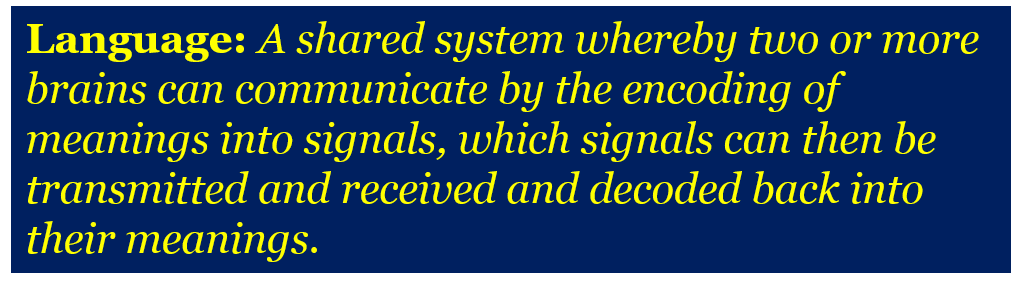
Language: A shared system whereby two or more brains can communicate by the encoding of meanings into signals, which signals can then be transmitted and received and decoded back into their meanings.


Language transcends its encoded signals

July 19, 2018

My phone “talks” to my desktop computer. It can also “speak” with other devices with which it is “paired” (portable speakers, my lawn mower and my house security system). Coupled devices send and receive short-wavelength UHF radio waves in the ISM band (Bluetooth) to communicate. They follow rules (a vocabulary and a grammar) which specify the “meaning” of the bursts of radio waves they send and detect. I cannot detect any of these signals with my senses. I am neither aware of the communication taking place nor can I enter the conversation except through a compatible device within my control and with which I can communicate using a system which is within the range of my sensory capabilities (touch, vision, sound).

Does the system of signals being used by the bluetooth devices for their communications constitute a language?

There is a vast discourse, starting from ancient times, on the definition and the purpose and the philosophy of language. The Encyclopedia Britannica puts it thus.

Many definitions of language have been proposed. Henry Sweet, an English phonetician and language scholar, stated: “Language is the expression of ideas by means of speech-sounds combined into words. Words are combined into sentences, this combination answering to that of ideas into thoughts.” The American linguists Bernard Bloch and George L. Trager formulated the following definition: “A language is a system of arbitrary vocal symbols by means of which a social group cooperates.” Any succinct definition of language makes a number of presuppositions and begs a number of questions. The first, for example, puts excessive weight on “thought,” and the second uses “arbitrary” in a specialized, though legitimate, way.

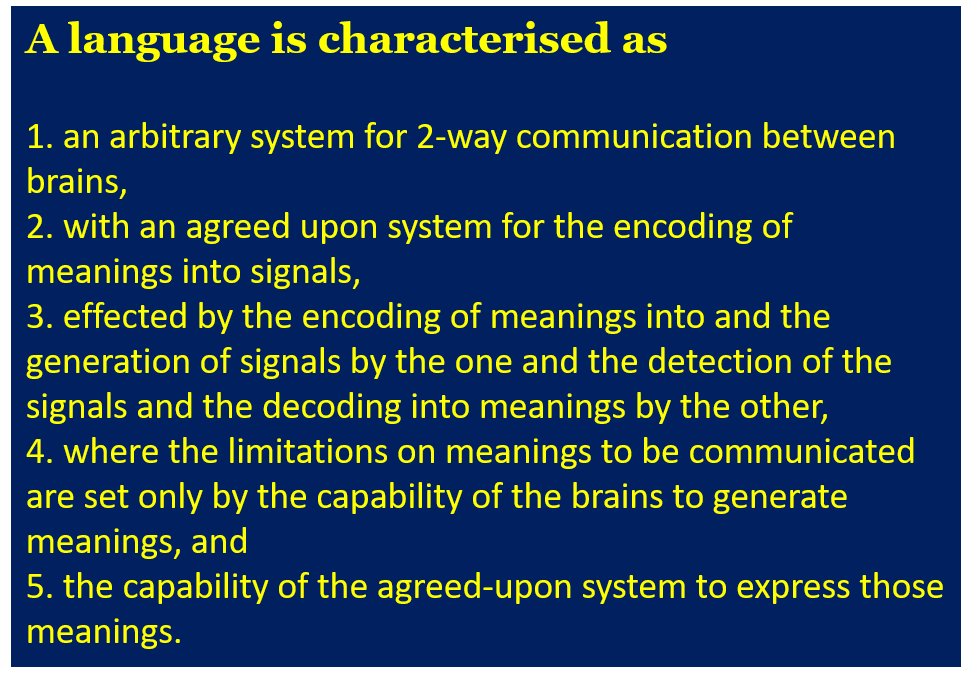
I find that much of the discussion is homocentric and tends to equate language with speech and writing. This I think is incorrect. I have therefore come to my own characterisation of what constitutes a language:

I find it is not necessary to specify that language is confined to human brains. It is claimed that the difference between human and animal communication is that human language is unrestricted.

EB again – “Human beings are unrestricted in what they can communicate; no area of experience is accepted as necessarily incommunicable, though it may be necessary to adapt one’s language in order to cope with new discoveries or new modes of thought. Animal communication systems are by contrast very tightly circumscribed in what may be communicated”. 

But this is unsatisfactory. Human thought is not in fact unlimited. It is limited by the very finite capability of the human brain. What a brain cannot perceive it cannot think about. What it cannot think about, it cannot communicate. Furthermore, the system agreed-upon restricts the meanings that can be transmitted and received. (A communication in French is of limited value to someone who knows little French. It is the lowest common level of shared encoding in the system which sets the constraint).

I also find the debate on language and thought, and language and philosophy, to be very often circular. It may be simplistic but I observe that the logic we perceive to exist in the universe is the same logic we embed in all our languages (including mathematics). We cannot then use language to prove or disprove the logic that is within it.

As in Gödel’s Incompleteness theorems: “The first incompleteness theorem states that in any consistent formal system F within which a certain amount of arithmetic can be carried out, there are statements of the language of F which can neither be proved nor disproved in F. According to the second incompleteness theorem, such a formal system cannot prove that the system itself is consistent (assuming it is indeed consistent).”

Which I paraphrase to be that “in a language embedded with a logic, that language can neither prove or disprove the logic that lies within it”.

I observe that we have more thoughts and emotions and perceptions than we have language for. We perceive more colours than any language we invent can describe. Which convinces me that thought precedes language. Moreover, it is the logic we perceive around us that we then build into the languages we invent. It cannot be, I think, that language circumscribes thought. It is our thoughts generated by our perceptions of what is around us that circumscribes the languages we invent.

Our senses come into play first in determining the meanings we wish to communicate. They then determine the shared system of encoding meanings into signals capable of being generated and detected. Our perception of a tree (vision/brain) is encoded into a particular sound (“tree”) which is generated (vocal chords) and detected and decoded by somebody else (aural/brain) and understood – according to the shared system of encoding – to mean a tree. The choice of encoding system is arbitrary but is primarily a matter of convenience. We use vision, sound and touch as a matter of convenience. We do not use olfactory signals because we cannot – at will – generate as great a range of smells as of sound. Besides, vision and sound can transmit signals across much greater distances than smells can. Sound can be transmitted in the dark. We do not have the capability in our bodies of generating or detecting radio waves or X-rays or infra-red radiation as encoded signals of meaning except through the use of specialised, instruments manufactured for the purpose. But if we had the same organs as bats do, we could use ultrasound signals in our languages. Our senses enable a convenient encoding of meanings into signals. Equally the limitations of our senses restrict the range of signals that we can generate and/or detect.

So my bluetooth devices do communicate with each other but the range of meanings they can transmit or receive are heavily circumscribed. They have not the freedom to express meanings which have not been predefined. They cannot initiate a conversation but can follow an instruction to do so. They do not have language.

But what is clear is that while language is a shared. agreed-upon system for encoding meanings into signals for the purpose of communication, language transcends its signals. While human language is mainly manifested as speech and writing, we also use sign-language and Braille and songs and music and art and dance within our languages. Photography and video are now part of the encoding we use in our languages. If we had organs for radio transmission and reception, we would no doubt have a word for “tree” but it would be expressed as a burst of radio-waves rather than a pressure wave or an image of a tree. Language is the system of conveying meanings where speech and writing and hand-signals are just specific forms of encoding. Language is a system which transcends the encoded signals it uses.


Acquisition of belief

July 18, 2018

Does it matter how a belief is acquired?

Take belief to be a proposition that is acquired or adopted though it cannot be proved. “Not being proven” then means that a truth value cannot be assigned to a belief. A belief proposition needs a mind to reside in. Merely stating a proposition that cannot be proved does not make it a belief. If the mind does not take further actions on the basis of that belief proposition being true, then that proposition cannot be said to have been “adopted” as a belief.

All knowledge is first belief. All knowledge is built on belief. The most fundamental belief adopted by every living thing is, I think, that “Time exists”. From that proposition we move on to “causality exists” and thence to every field of knowledge or endeavor.

In epistemology, knowledge is sometimes defined as being “true beliefs” or “justified true beliefs” though using “truth” to qualify “belief” makes me uncomfortable.

The Analysis of Knowledge.

There are three components to the traditional (“tripartite”) analysis of knowledge. According to this analysis, justified, true belief is necessary and sufficient for knowledge. 

The Tripartite Analysis of Knowledge:
S knows that p if

  1. p is true;
  2. S believes that p;
  3. S is justified in believing that p.

The tripartite analysis of knowledge is often abbreviated as the “JTB” analysis, for “justified true belief”.

Even if a belief-proposition cannot be proven, any proposition can be justified to a greater or lesser extent. Justification takes the form of collateral “evidence” which impacts the perceived probability of the proposition being true. This probability could be said to be the validity of the belief-proposition. (But it should be remembered that the very use of probability is an admission of ignorance. What then is the probability that an improbable proposition turns out to be true?)

Is a “brainwashed belief” less valid than a “freely adopted” belief? Is an imposed belief (whether by indoctrination or by peer pressure or by political correctness) less valid than a belief which has resulted from deep study and much thought? Is a “freely adopted belief” reached without thought and only because “my friend says so”, any less valid than one reached after years of study?

At first glance it might seem so. We could rank beliefs by the level of coercion involved in the acquisition of that belief. Generally the greater the level of coercion, the less critical thinking involved in adopting a belief.

  1. Brainwashing
  2. Indoctrination as an adult
  3. Indoctrination a a child
  4. Peer pressure
  5. Political correctness
  6. Conventional wisdom
  7. Freely adopted but without thought
  8. Freely adopted after much study

The same belief may be held both by a brainwashed person and also by someone after long years of study. The same belief may be held by the indoctrinator and the indoctrinated, by the mad mullah and the gullible youth, by the parent and the unknowing child. It would seem that the method by which a belief comes to be adopted is independent of the belief itself. But this is not entirely so. The less a belief can be justified the greater will be the resistance for another mind to adopt that belief. The greater will be the coercion necessary. There is a likelihood, therefore, that the greater the coercion necessary to inculcate a belief, the less likely it is that the belief in question is justified.

After all that, my fuzzy conclusion is that a belief is not dependent upon the method of its adoption. However, a belief adopted after coercion is likely to be less valid than a belief adopted without coercion – but not always. And validity of a belief is merely a probability.

Or it could be as Calvin believes that having a belief can increase the validity of that belief – or is it just that appearing to adopt some other person’s belief is more likely to extract benefits from the other.


No higher purpose

July 16, 2018

(Of course the ultimate purpose of life, the universe and everything is balance – which is indistinguishable from stasis. The imbalance at the core of time, the universe and everything.

If any change – including the state of change we call life – can be said to have a purpose, it is to eliminate the imbalance which caused the change or life in the first place. It would seem then that the ultimate purpose of all change must be to return to a state of complete equilibrium where even time does not have to flow. A state of stasis.

But let us suppose that there is such a thing as purpose).

Consider the characteristics of purpose.

  1. Purpose is not confined only to conscious minds or only to all living things. Purpose, as an objective or a direction, can be attributed to anything. But the attribution and its articulation seems confined to the existence of a conscious mind.
  2. Having (or being attributed with) purpose implies the flow of time. It implies a current state and actions to reach some other desired state at a later time. A purpose can not and does not address a past state.
  3. A purpose as an objective may describe a future state outside the space of perceived causality (and therefore of an imaginary state). But observe that even an imaginary future state can provide a real direction for current actions.
  4. A consciousness does not need to have a purpose and all its actions may be merely reactive. It also follows that if a conscious mind perceives no desired direction (no purpose), then its actions are reactive and merely respond to the prevailing imbalances it experiences.
  5. When more than one conscious mind is involved, individual purposes and the actions they engender, are additive and combine as vectors giving a “net” purpose.

The purpose of purposes is to give direction to actions. If an individual perceives no “higher” group purpose, that individual’s actions are then directed by that individual’s own purposes (or lack of purpose). Even where a group purpose is discernible, it can only be effected by the actions of individuals who subordinate their own purposes to that of the group. “Higher” purpose is irrelevant unless – and until – it is adopted by the entity carrying out the action. A “higher” purpose is ineffective except as disseminated and adopted by the actors.

Ultimately there is no higher purpose than that set or adopted by an individual for himself or herself.


The top 1%

July 12, 2018

Number games.


Imaginary realities (or why all history is imaginary)

July 12, 2018

History is causal.

Actual events in the past resulted in the present. What we think, now, about those events in the past or what stories we tell, now, about the past are of no consequence to the present (no matter how fascinating or revisionist those stories may be).

The consequences of past events reverberate into the future until their influence has reduced so as to be submerged into the background noise. Say it actually was an asteroid impact 65 million years ago which led to the mass extinction of large dinosaurs (even if some survive as birds today). The reverberations of that asteroid impact can no longer be definitively detected. It can still be inferred by other events but all direct consequences are now part of the background noise. We can imagine other alternative histories. It might have been a super-volcano eruption – the detectable impacts of which would now also be lost in the noise – which caused the decline of the dinosaurs. Large dinosaurs may have disappeared catastrophically over a very short period or dwindled gradually over a few million years. We can imagine any story we like as long as its effects are now lost within the background. The super-volcano eruption and the asteroid impact are equally real (or equally imaginary).

Is reality confined to the present?

A real event that occurred yesterday is not real now. If everything not-real is imaginary then everything in history is imaginary now. Events that did occur are imaginary in the now. But events that did not occur are also imaginary. For events from as close as yesterday there may be collateral evidence to support one particular imaginary reality that was. For recent events some imaginary reality may be more real than another. But for events from the more distant past all the supporting evidence may be buried within the background rumble from the past. Then all imaginary realities are equal on the reality scale of imaginary realities. But the “real” reality must be causally connected to the present and so must also be the realities of the future.

Clearly time has an impact on reality. Perhaps it is wrong to thing of reality by itself and we need to think instead of the space within which reality can exist and the reality time-line. The reality space is the space of causality.

Reality space

Perhaps reality has to have a time axis. From the now, past or future realities (which are imaginary in the now) are time-lines which can only exist in the reality space. The reality time-line then must be capable of being causally connected within the reality space and must pass through the now. The imaginary space is then that where events cannot be causally connected to the present.

That dinosaurs have become chickens lies within the reality space that we can discern now and is an imagined reality. That dinosaurs became tigers lies in the imaginary space but cannot be causally linked and, therefore, is not even an imaginary reality.


All wealth is not capital and all capital is not wealth

July 9, 2018

A note to myself.

I take capital to be an asset which can generate revenue and which can itself be converted to and consumed as revenue,

where

An asset is any thing (physical or abstract) which can be of use.  To be of use implies an entity capable of enjoying such use. I take an entity to be any living thing or any combination of such living things. The asset does not necessarily have to be in the ownership or the control of that entity. However, without ownership or control, the utility flowing from the asset is available diffusely to all entities and is not exclusive to a particular entity. An asset in the ownership of an entity is the property of that entity.

(The sun could be considered an asset for all entities and not in the control of any entity and its benefits flow diffusely to all entities. A physical characteristic of an entity, such as strength, would be an asset available exclusively to that entity. A house may be an asset owned by an entity where the disposition of that asset and and all utility flowing from it are exclusively in the power of that entity).

A revenue is an inward stream of utility, of usefulness, over time. The stream of utility is income only when it is in cash or in kind and is measurable and tradable. Something intangible could be revenue but, if not tradable, would not be income.

(Revenue and income are like electricity and can only exist as a flow over time. They can accumulate over time as capital or assets and are analogous to an electric charge).

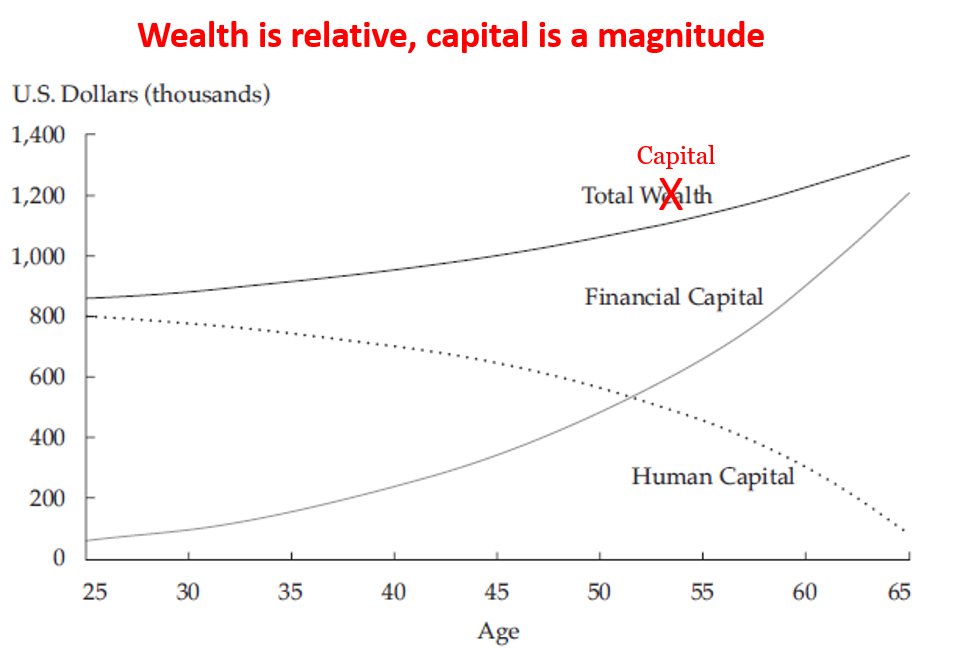
Wealth and poverty are judgements. Wealth is always a surplus to requirements and thus relative to some norm of need. Similarly, poverty is then a deficiency also relative to some standard of need. Wealth and poverty can be applied to any tangible or intangible property or characteristic. The magnitude of capital or of assets or of revenue or of income are not necessarily wealth or poverty. It is the judgement of whether something is in surplus or in deficiency which determines the existence of wealth or poverty.

Wealth is often used to describe magnitude (total wealth for example) but this is incorrect usage. As in this often used diagram:

 (Rich describes magnitude and richness may not necessarily be wealth. Similarly poor also describes magnitude and is not necessarily a judgement of a deficiency. Thus a rich man with much capital may be in poverty if his needs grossly exceed his capital. Or a poor man with little capital may be wealthy if it exceeds his needs. A surplus of an intangible asset – say some skill or happiness – is wealth but may not be capital. Rich and poor are magnitudes. Wealth and poverty are differences of magnitude).

All wealth is not capital and all capital is not wealth.


Atheism cannot cope with the unknowable

July 8, 2018

I take atheism to be a “lack of belief in gods”.

A lack of belief does not lie in the realm of knowledge. Neither does it lie in the realm of the unknown. A lack of belief is silent about the state of knowledge about the subject in question. A lack of belief does not imply a state of knowledge. A lack of a belief is not in itself a logical negation of that belief. Many extend this and take atheism to be a denial of the existence of gods as professed as a belief by others. I suspect that most of my acquaintances who claim to be atheists use the latter definition when they present arguments to support their denial of the existence of gods to try and negate the beliefs of others. But a denial of some belief is then an attempt to shift something unknown into the realm of knowledge. It shifts the conversation from ” I don’t myself believe in X” to “I know that your belief in X is false”.

This shift from the realm of belief to the realm of knowledge, I think, is incorrect, illogical and invalid. We are inevitably drawn into epistemology. The known, the unknown and the unknowable. The known and the unknown are realms that are self-apparent. Science is the process at the interface of these regions which leads to the growth of the region of the known. All beliefs by definition lie in the region of the unknown. Any statement and its negation ( X and not-X) must both either lie in the region of knowledge, or both in the region of the unknown. It is not possible for one to live in the realm of knowledge and its negation to live in the region of the unknown. A belief in gods lies in the unknown. A lack of belief in gods (which is atheism) is not in itself a commentary on that belief. A denial of the belief in gods cannot then be anything other than belief and cannot shift into the realm of knowledge. A denial of a belief – which by definition lies in the unknown – is to claim knowledge of an unknown thing which is self-contradictory.

Known, Unknown and Unknowable

Is some part (and maybe the major part) of the unknown then unknowable? Some scientists – and some atheists – would claim that the unknowable does not exist; that everything – eventually – can be explained. But I think they delude themselves. This trifurcation into the known, the unknown and the unknowable does not address who the observer is or the time element. “To know” requires cognition. Cognition requires a brain. Known to whom? when? for how long? What is “known” depends upon the brains alive to know. Facts which were once part of knowledge may become unknown, though they may well remain facts. I observe that most of past events are now unknowable, though they were once known. What was once known, may have first passed into the region of the unknown (but was still knowable) and then with the further passage of time may have passed into the region of the unknowable. Most of the past events in my own life are already in the region of the unknowable. The most basic questions of science that we can formulate always lead us first into the unknown and then into the unknowable.  When the unknowable is reached we use labels. Gods, The Big Bang, Dark Energy, Dark Matter, …….. . But they are all just labels for Magic.

But more fundamentally, the Great Unknowable – throughout all of space and all of time – is time and its nature. What came before time, when “before” was undefined, is unknowable. At the most basic level, our causal universe and all its laws and all our logic rely upon the existence of an inexorable and inexplicable Time Magic. (I take all events which occur but which are inexplicable to be Magic. It is my label for that which lies in the region of the unknowable). Beliefs in Gods or the Big Bang also lie in the region of the unknowable.

Atheism is about belief and does not address the nature of knowledge or confront the unknowable. An atheist’s lack of belief in gods then lies in the realm of the unknown and perhaps in the realm of the unknowable (Magic). Even an atheist believes in Time Magic (whether he acknowledges it or not).