Four years since MH370 vanished

March 8, 2018

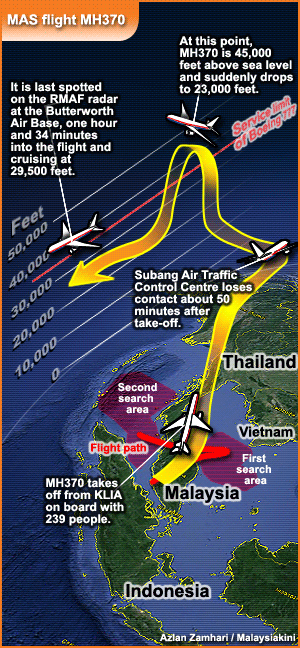
It is almost inconceivable that a commercial airliner with 239 passengers and crew just vanished off the face of the earth. But that is what happened 4 years ago today.

Somebody knows what happened.

Nothing much more is known since one year after the most perplexing incident of modern aviation.

MH370: One year on and those who know still aren’t telling

Some few do know what happened to MH370 a year ago.

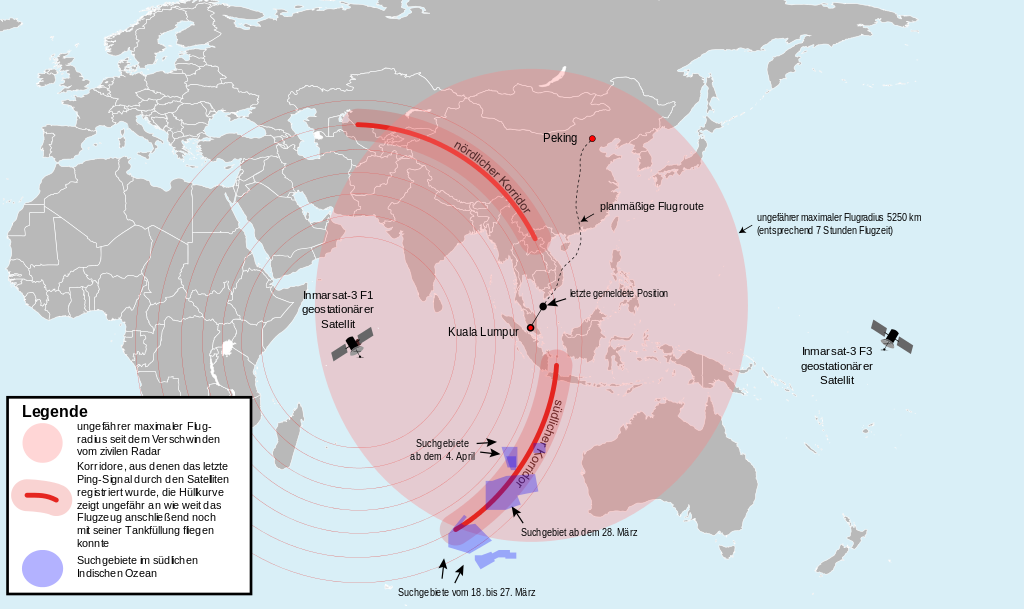
My post from April 13th last year speculating that this was a state sponsored and highly successful hijacking, is just as valid or invalid as it was then. There has been much speculation since but no new, certain, evidence has appeared. In fact even the “handshake” tracking which places the plane in the Southern Indian Ocean turns out to be fairly speculative in itself.

Whatever happened to MH370 was no accident. In one year there has been no evidence to alter my belief that this was the most successful hijacking and “disappearing” of a commercial airline and its 239 passengers and crew. And the objective – which was clearly achieved – was to prevent some passengers or cargo or both from reaching Beijing.

MH370: Emirates CEO suggests plane’s flight was controlled, October 11, 2014

MH370: Further indications of a deliberate event to prevent technology reaching Beijing, June 22, 2014

MH370: Very short preliminary report issued – could have been “laundered”, May 2, 2014

MH370: The most successful, state-sponsored hijacking ever?, April 13, 2014

MH370: The altitude excursion which could have rendered most unconscious, April 1, 2014

A deliberate excursion?

The calculations leading to the search area are speculative


You can’t claim a “human right” unless you can identify who guarantees it (part 2)

March 4, 2018

Human rights do not occur naturally. They must be created and they must be bestowed. They cannot be self-bestowed. Once bestowed, if their exercise is thwarted they cease to be rights. Human rights can only be created as a social contract where the parties to the contract are able to, and do, fulfill their obligations.

In part 1 I described the concept of a right taken as an entitlement.

right is entirely a social construct. When encompassed within a legal, moral or ethical system, it could be taken as a social contract. As a contract it requires to be between two parties; the grant-giver and a recipient. ….. I  take a right to be an entitlement. It is a possession of status within some specified human society which gives its owner a privilege to act or not act in some specific manner, and/or a claim on other entities within the relevant society to act or not act in some specified manner. ….  Rights can not – and do not – exist except when vested by a competent grant-giver in a qualified recipient.

Two parties are necessary for a right to be created. The granter must be competent to grant and to ensure the exercise of the right and the recipient must be qualified and “free” to exercise the right. If a right is claimed but it is not clear as to who grants it and who guarantees it, then it is not a right. It may still be a wish or a hope or a desired standard of behaviour, but it manifestly is not a right. The granting party needs, not only to be identified, but also to be competent to grant and guarantee the entitlement. A party – such as a government – may go some way towards the grant of an entitlement by enshrining it in law, but no law (except the laws of nature) can inherently guarantee compliance. Moreover, even the grant of the entitlement is restricted by the jurisdiction within which the granting party holds sway. The party owning a right needs to be a qualified party who has been explicitly vested with the right by a competent party. The very concept of “human rights” is constrained to be applicable only to humans. It is necessary requirement for any right that the grant giver identifies which humans are to be vested with the right. “Everybody” is not a proper definition of a right-holder since there is no grant-giver capable of granting any kind of a right to “everybody”. Any claim of a right being universal and applicable to “all human beings” always fails because

  1. there is no competent agency – human or divine – which is able to grant and guarantee such “universal” rights to all humans, and
  2.  every real claim of a “universal” right is constrained to not be available to some humans.

Most claims of “human rights” fail the test of being rights and are merely wishes. Even where a government can be identified as the party granting and purporting to guarantee the right, the reality is that the right is not guaranteed.

The UN “Universal declaration of human rights” proclaimed by the United Nations General Assembly in Paris on 10 December 1948 is unsatisfactory at very many levels. As a wish-list I have no great objection to it. As a list of standards to be achieved it has many admirable goals. But it is mainly a collection of platitudes – many undefined and many meaningless. It builds on questionable assumptions and a somewhat suspect philosophy. The title itself is ambiguous. Is the declaration universal or is it proclaimed that the desired rights are universal?

But the primary flaws with the UN document are that

  1. it refers to rights without considering what is necessary to constitute a right, and
  2. it ignores the qualifications necessary to own a “right” by claiming that rights should be universal

It starts by “recognising” the “equal and inalienable rights of all members of the human family” with no reference to any party which might be able to grant and guarantee the claimed rights. By claiming that such rights be available universally, it immediately undermines its own intent since there is no human agency capable of granting any right universally. The document contains 30 Articles, and every single Article fails the test of defining, or even trying to define, who grants and who guarantees the proclaimed “right” and to whom.

As a document laying out a social contract it is not fit for purpose.

But more of that in part 3.


Declaring a “human right” does not make it one (part 1)

February 27, 2018

There are no human rights which follow as an inevitable consequence of the natural laws of the universe.

Consider what is needed to create a right. Mere declaration does not suffice. A right is entirely a social construct. When encompassed within a legal, moral or ethical system, it could be taken as a social contract. As a contract it requires to be between two parties; the grant-giver and a recipient. In fact, our entire conception of rights has meaning only when applied to the social interaction between humans.  All rights are about the behaviour of humans.

I take a right to be an entitlement. It is a possession of status within some specified human society which gives its owner a privilege to act or not act in some specific manner, and/or a claim on other entities within the relevant society to act or not act in some specified manner

The granting of a right is a necessary condition but it is not sufficient for a right to exist. It must be granted by a party such that

  • ownership of the right is vested in the receiver, and
  • exercise of the right by the recipient is guaranteed by the grant-giver

Rights can not – and do not – exist except when vested by a competent grant-giver in a qualified recipient. The grant-giver must have the power to grant. The competence of the grant-giver is fundamentally necessary (but also not sufficient) to the creation of a “right”. An individual can grant a right to another individual only if it is within his power to do so. A grant which is outside the competence of the grant-giver to give creates no right for the receiver.

It is also a necessary condition – though not sufficient – for the recipient to be qualified to possess and exercise the granted right. No rights can exist if the grant-giver does not have the wherewithal to vest ownership of those “rights” in the recipient.  Nor can they exist if the recipient is not capable of exercising such vested rights or if such exercise is not ensured. Declaration of so-called animal rights does not create any animal recipient qualified to possess or exercise that right. Such declarations do not vest privileges or claims in any animal and are actually about human behaviour.

Anybody can declare a right but for any grant to be meaningful, the granting party must be able to guarantee and ensure the exercise of that right by the right-holder. A right which cannot be exercised is vitiated and empty. It fails, in fact, to be a right, whether of claim or of privilege. The grant of such empty rights then becomes merely a statement of wishes. A party which can only grant empty rights, where the exercise of such “rights” is not guaranteed, is a party not sufficiently competent to grant rights.

Human rights are neither universal nor absolute. They are not written into the laws of the universe. They are an expression of desires and wishes and hopes about standards of human behaviour. In reality there are no human, or even divine, agencies which have a competence sufficient to grant so-called human rights. They are declared – always – by bodies or entities which lack the full competence first, to vest ownership of the rights in the recipients and second, to guarantee and ensure their exercise.

The UN Declaration of Human Rights (UN DHR) is just that – a declaration.  What it describes are not rights. The UN can neither guarantee nor ensure the ownership or the exercise of those  declared rights or of the implied duties. Neither can the governments of the UN’s member countries guarantee the exercise of the rights declared. Without the ability to guarantee the exercise, the rights declared are not, in fact, rights at all but are merely pious hopes.

UN Declaration Human Rights

The UN Declaration of hopes and wishes is only as good as it is allowed to be, by the assumptions it starts with. The assumptions are not sound. It is a declaration of desirable standards of human behaviour. Unfortunately it ignores the basic requirements for any rights to exist. It does not specify the parties involved. It ignores the competence required of the party granting the rights and ignores the qualifications of the receiver of the rights. The fundamental claim in the UN DHR that “all humans”, independent of their behaviour, should possess these “rights” is untenable. How? Who is competent to grant such ownership? To whom? And who guarantees the exercise of these “rights”.

Whatever the UN Declaration of Human Rights may be, it is not about rights at all.


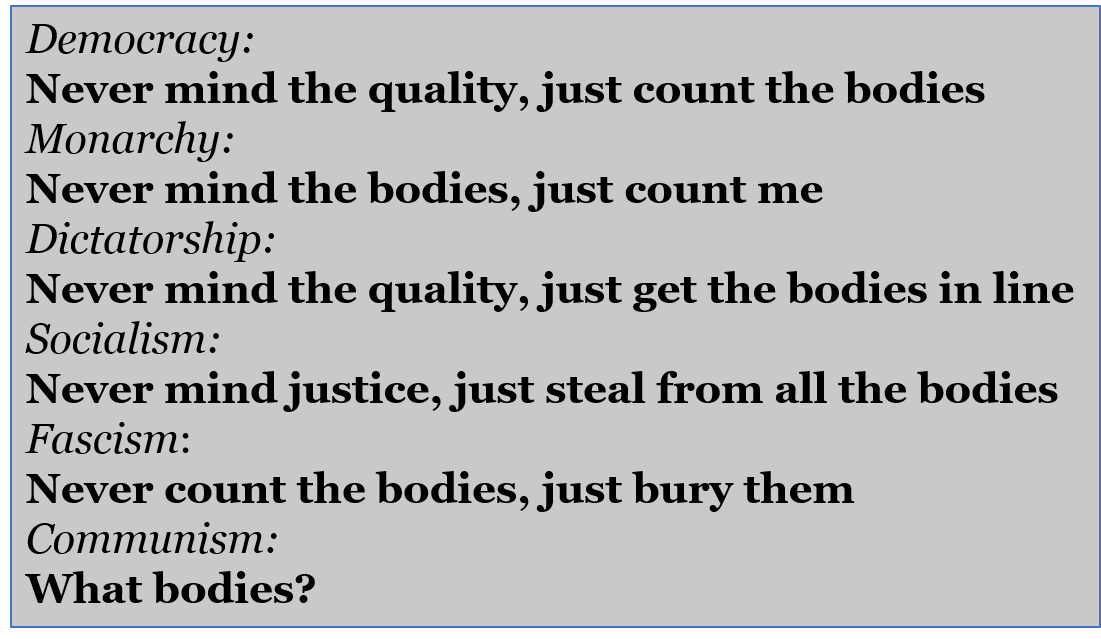
Never mind the quality

February 22, 2018

I am old enough now to be allowed to be cynical:


Being 70

February 19, 2018

So, I turned threescore and ten last week.

The Bible (Psalms 90)

The days of our years are threescore years and ten;
and if by reason of strength they be fourscore years,
yet is their strength labor and sorrow;
for it is soon cut off, and we fly away.

Shakespeare (Macbeth, II, 4)

Old man: Threescore and ten I can remember well: 
Within the volume of which time I have seen 
Hours dreadful and things strange; but this sore night 
Hath trifled former knowings.

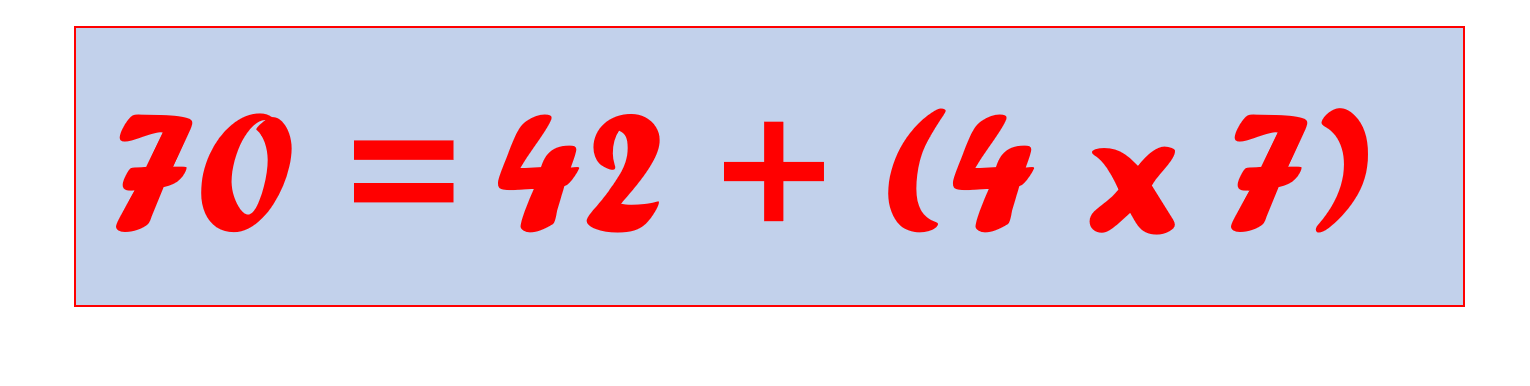
The angels were not visible but there was celestial music all day. Everything I ate tasted like an ambrosia gel and everything I drank was like a single-malt, 18 year old nectar. My understandings of all things philosophical turned profound. The mysteries of life, the universe and everything were revealed. It is not just coincidence that 42 plus the singularity is a prime and exactly half of 86. Ytterbium (Yb) has atomic number 70 and is a lanthanide. There have to be 52 cards in a pack because there are 52 weeks in a year. There must be 13 cards in a suit to account for the missing 13th month. I finally understood why there are 7 days in a week and humans have five digits on each limb. I solved the last missing theorem. A teenager’s speech was almost intelligible and didn’t turn me off. A car stopped in heavy traffic and allowed me to merge into the queue. And it snowed all day.

At 70, the answer to life, the universe and everything on any limb and on any day of the week becomes obvious.

Apart from that it was just another day.

In Sweden, to be 70 is no big deal. Around 16% of the population is 70 or over. In Japan 20% of the population is 70 and over. But in India and China only about 6% are over 70. Globally, the over-70s are just under 6% of the population.


The anatomy of a promise

February 8, 2018

(The basis of a recent talk)

A promise is always about the future but it is not a forecast. It is an agreement generally between two parties, but can even be an agreement with oneself. It is primarily a psychological agreement between the parties where one party (the promise giver) accepts the obligation to perform some action. Unlike a contract where there is a balance of obligations and duties between the parties, in a promise the second party (the promise receiver) has no duties A promise is not usually legally binding, but non-performance can have social overtones and consequences. 

Promises are integral to human relationships. They are what make human cooperation possible. Most of our daily actions are to keep promises – some explicit and some implied. Going to work every day. Taking care of the family. Meeting friends. Most of these promises are made in simple language, without ceremony or any great formality. Is it worth more if the promise is given as part of a ceremony with formal text? Is it of more intrinsic value if it is witnessed by hundreds of people instead of just one or two? What is the value of a promise if it is made to yourself in the secrecy of your mind?

The value of the promise is not to be confused with the value of the action being promised. These are two separate things. I take the inherent value of a promise to simply be the likelihood of it being fulfilled. It is a probability with a value lying between zero and one. An empty promise has a value of zero. Certainty that a promise would be fulfilled would give a value of one (100%).

Breaking it down, I see that the intrinsic value of a promise (not the perceived value) depends on three parameters multiplied together. They are all probabilities of a sort. The first is the feasibility of the action being promised. The second is the intention of the promise-giver to fulfill the promise and the third is the competence, or the ability, of the promise giver to implement the promised action. If any one of these parameters is zero or very low,  then the value of the promise must also be  zero or very low. Since these are all probabilities, the probability of a promise being fulfilled can never be higher than the lowest of the component probabilities.

To promise an impossible action leaves the promise with no inherent value. If there is no intention to fulfill the promise the value of the promise vanishes. If the promise-giver lacks the ability or the competence to perform the action the value of the promise reduces correspondingly. The action promised must be

  1. feasible, and
  2. there must be an intention to fulfill the promise, and
  3. there must be competence to implement.

Then, and only then, can a promise have value.

Language is important. But again we must differentiate between language which modifies the promised action and language which is about the promise itself. When rubber-words are used in agreements – “to the best of my ability” or “using best efforts” or “by mutual agreement” – they act on and modify the action that is to be performed. They make the action required to be less stringent, easier to perform, more feasible. Rubber-words, precisely by not being precise, make future compromises possible and compromises are a necessary part of human interaction. As I learnt after my years in Japan, compromises to be made actually ensure future negotiations and continuing interaction. Imprecision in an agreement may well be what allows an agreement to be made. That also applies to promises. Rubber-words soften the action, increase the feasibility of the action to be performed and thereby increase the probability of a promise being kept.

But we also use other words and ceremonies and rituals to qualify the promise itself. To swear in a formal way or to promise  “before God and man” or to have an elaborate ceremony are all designed to increase the probability of the promise giver’s intention to fulfill his promise. They apply pressure (a peer pressure) on the promise giver by implying a loss of honour for non-performance.

The perceived value of a promise is not the same as its inherent value. This is where belief and honour come into play. Broken promises consume honour and the absence of honour in an individual leads to a reduction of belief in him. A promise not believed has no perceived value.


Generations by date of birth

February 1, 2018

The “baby boomer” phenomenon is primarily seen in countries which participated in WW2. Globally however, this effect is swamped by the increasing population and longevity in Asia and Africa. Babies born per year have increased from just under 100 million in 1950 to about 140 million now.


Birth rates are of course sinking fast but the number of births will only decline once the rate of population increase can no longer compensate. This will happen but not for another 20 – 30 years. (source: UN World Population Prospect 2012 and 2017).


The Silent Generation applies to those born before 1945.

After the Baby Boomers comes Generation X. The “millennials” are Generation Y. Generation Z has now passed and a new name has to be coined for the current generation being born. Alpha Generation seems to be the favourite.

It should be remembered that the Silent Generation begat the Baby Boomers. In N America much of the whining comes from the Millennials. But it was Gen X and not the Baby Boomers who preceded the Millennials.


When all your email is only spam

January 27, 2018

Looking at some old class photographs I realised that about 15% of my school class has passed away.


God and The Big Bang are both just labels for Magic

January 22, 2018

The Universe was subject to a “Creation Event”. It was not, and then it was, (and if it always was it is even more troublesome). The Origin of Life is also a Creation Event. These two “creations” (of the universe and of life) are the great existential questions which require Magic.

Religion relies on the “inexplicable” to justify the invocation of Gods. God-magic. Atheism relies on the “power of reason” giving the lie to the existence of Gods.  But atheism is merely a rejection of one set of labels and explains nothing. Religions vest their Gods with sufficient attributes to explain away what cannot be explained. Atheism merely ignores the inexplicable or claims the inexplicable to be a consequence of random events. Theologians and physicists alike merely give labels to what they cannot explain – as if the label is in itself an explanation. Anything inexplicable is what Magic is. Of course, Magic itself is just a label. I take the view that the nature of humans is such that some things are unknowable. The Universe exists in dimensions we cannot access or even perceive. We can, through the process of science and reason, discover the laws applying to the universe we perceive but, at every step of increased knowledge, we find new “whys” we cannot address. We now believe there are four fundamental forces of nature (gravitation, electromagnetism, strong nuclear, weak nuclear) but have no idea why they should be just four and not five or a thousand. Depending on how you classify them there are 12 or 57 fundamental particles. Why 12 or why 57 is just as much magic as when the universe was considered to consist of just fire earth water and air. Gravity and electromagnetism are just as magical now as they ever were. You could as well have a gravity-god or space-time magic. “Why time” is the essence of magic. The Origin of Life is also just a label for a Creation Event. There are weird and wonderful theories about this, ranging from a random event in the primordial soup to extra-terrestrial intervention.

All religions and theologians – at best – indulge in lazy thinking. Creation Events are just assigned to an appropriately defined God. Gods are just labels generated to answer unanswerable questions. Physicists and biologists are not quite as intellectually lazy but still resort to labels to explain away inexplicable Magic. Physics and cosmology define their own Creation Event and call it the Big Bang. To resolve all the problems with the Big Bang theory, it is deemed a singularity where the laws of known physics did not apply. It is then stated to be the start of known time which neatly dismisses any need to consider what came before. We still have no idea of how life came to be, or can be, created from non-life. Theologians merely put it down to a convenient God.

Magic = inexplicable.

The universe was created by a magical event and dances to magical tunes played by magical instruments. Life was magically created by other magical music within this universe. Atheists and priests and physicists and theologians all actually believe in Magic. God-magic is no different to Big-Bang-magic or origin-of-life-magic. A belief in a God is just as much a belief in Magic as a belief in the Big Bang is.


Dwindling peers or The loneliness of the long-distance survivors

January 15, 2018

The global crude mortality rate is just under 1% (around 8/1,000 in developed countries with some countries up to about 15/1,000). As population ages the global rate will be around 9-10/1,000 by 2100.

Of those aged 50, the annual mortality rate is about 300/100,000. By the age of 60 this has increased to about 800/100,000 and then increases sharply to around 25,000/100,000 by 90 and encompasses virtually everybody by the age of 100. (There are currently about 300,000 people world-wide who are 100 years old and a handful who have reached 115 years old). On average women live around 4 -5 years longer than men.

Defining “peers” to be those of a similar age, I assume that most people probably reach a maximum number of peer-acquaintances at a little over the age of 50. In my own case I would guess that this was probably when I was around 55.

An increasing mortality then applies to a dwindling cohort of peer-acquaintances. The longer one survives the faster one’s peer-acquaintances shrivel.


Setting peer-acquaintances to be 100% at 50 (and ignoring accretion of new peer acquaintances), their number has dropped to around 80% at 70, and have halved by the time one has reached 80. At our 50th school graduation anniversary when we were all around 65, around 10% of our classmates had passed away. By the age of 90, peer-acquaintances have dwindled to less than 10% of those who were alive at 50. Those who live to 95 have virtually no acquaintances of their own age left alive.

For those who survive to 80, half their peers have died by then. Loneliness is I think governed, not by the number of people surrounding you, but the number of peers one can communicate with. It is a cliche of course, but the longer you survive the dwindling number of your peers ensures the increase of your loneliness. If loneliness is inversely proportional to the number of peer acquaintances, then between 70 and 90 loneliness increases by a factor of 8.