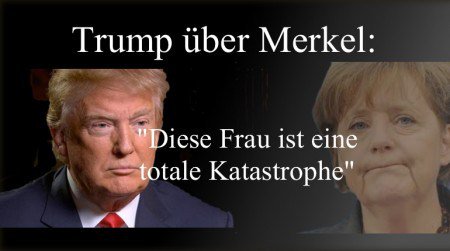
Now even Merkel starts adjusting to the Trump realities

January 22, 2017

Angela Merkel gets it. With Trump it is all about negotiation.

The Democrats still don’t get it. Hillary Clinton supporters still seem to be in denial but European leaders are beginning to adjust their positions. Teresa May was first out with her Brexit speech. She will even meet Trump on Friday next week for his first meeting as President with a foreign leader. About 8 days after the election a German weekly published a joint article by Obama and Merkel warning Trump not to disturb US/EU trade in particular and globalisation in general. A week ago Trump was castigating Merkel for her disastrous refugee policy. But things have moved on. Now much to the disgust of her Social Democrat partners in government Merkel has signaled that compromises are possible with regard to trade and military spending.

(European Social Democrats and left parties are so self-righteous and so convinced of their moral superiority that they may have some difficulty in adjusting to the new game).

Reuters:

German Chancellor Angela Merkel vowed on Saturday to seek compromises on issues like trade and military spending with U.S. President Donald Trump, adding she would work on preserving the important relationship between Europe and the United States.

“He made his convictions clear in his inauguration speech,” Merkel said in remarks broadcast live, a day after Trump vowed to put ‘America first’.

Speaking at a news conference in the south-western town of Schoental, Merkel struck a more conciliatory tone toward Trump than Vice Chancellor Sigmar Gabriel, who on Friday said Germany should prepare for a rough ride under the new U.S. president.

Relations with the United States, Germany’s biggest trading partner, are likely to be a hot topic in electioneering in coming months leading to a general election in September.

“I say two things with regards to this (speech): first, I believe firmly that it is best for all of us if we work together based on rules, common values and joint action in the international economic system, in the international trade system, and make our contributions to the military alliances,” Merkel said.

The conservative German leader, who is seeking a fourth term and enjoyed a close relationship with former president Barack Obama, is seen by liberals across the Atlantic as a voice of reason that counterbalances rising populist parties in Europe. 

Trump has criticized Merkel’s decision in 2015 to throw open Germany’s borders to asylum seekers fleeing wars and conflicts, and has said he believes other countries will leave the EU after Britain and that the NATO military alliance was obsolete.

……….. “And second, the trans-Atlantic relationship will not be less important in the coming years than it was in past years. And I will work on that. Even when there are different opinions, compromises and solutions can be best found when we exchange ideas with respect,” added Merkel.

German government sources told Reuters this week that Merkel was working to set a date this spring for a meeting with Trump.

Under fire from Trump for not meeting NATO’s goals of spending two percent of national output on defense, Germany said this week that it would meet that goal and demanded that the new U.S. administration map out a consistent foreign policy. ……

Image result for trump merkel

from Twitter

It will take some time before the European Social Democrats, in France and Sweden for example, to swallow their overweening pride and adjust to reality. But I expect Norway, Finland, Poland, Hungary, the Baltic States and even Italy to find a highly pragmatic approach to the new US administration.

Even the Pope is adjusting.


Will the EU fall in line when Trump joins with Russia and Turkey in Syria?

January 22, 2017

In 2011 the US, many EU countries (especially France), Turkey and Saudi Arabia started financing and providing weapons to anti-Assad groups in Syria. Many of these groups were, or were allied to, terrorist groups which have in turn warped to become ISIS or al Qaida or the Al Nusrah front. This support was instrumental in helping ISIS to grow into the monster it became. The focus was entirely one of regime change and the downfall of Assad. The EU countries even “encouraged” some of their more radical Muslim groups to send “freedom fighters” to Syria expecting that Assad would soon disappear. Instead these “freedom fighters” soon became willing recruits for ISIS and other terrorist groups. At that time the Russians and Iranians supported Assad but rather passively and through surrogates rather than directly.

Russian support (along with that from Iran and Hisbollah) kept Assad alive in a shrinking territory. Neither the US nor the EU was willing to put its own troops on the ground. With Obama’s risk aversion (indecision) and shifting red lines Assad was spared any knock-out blow. With the growing ISIS threat the Russians finally intervened directly (2014) and turned the tide for Assad and against ISIS. The beginning of the end for ISIS was when Turkey left the US strategy and joined the Russians (and Iran). Aleppo was retaken. ISIS still holds Mosul in Iraq.

Now it looks like the new US administration may very well acquiesce with, if not fully join, the Russian strategy. The US will probably now stop supporting the rebel, anti-Assad factions even though some of them are not allied with the terrorist groups (though many are).

As Trump takes over, a diminished ISIS awaits

ISIS’ caliphate shrinks in 2016 ISIS is losing ground across its self-proclaimed caliphate, according to a new report. Global intelligence and analysis firm IHS Conflict Monitor, which uses open-source intelligence including social media and on-the-ground sources, estimates that ISIS lost 17,600 square kilometers (6,800 square miles) of the land it held in Iraq and Syria over 2016. ISIS’ caliphate in the two countries shrunk by 23% over the course of the year, according to a survey and map released by IHS. The group lost 34% in the same region compared to January 2015. The US-led coalition say ISIS has lost 27% of its territory in Syria — and 61% in Iraq — from its peak. 

In addition to ISIS’ de facto capital of Raqqa, the militant group retains patches of land not far from Homs and around the ancient city of Palmyra — control of which it regained from the Syrian regime late last year. It also has a presence in the countryside around the eastern city of Deir Ezzor. IHS reported spikes in territory lost by ISIS when the US-backed Syrian Democratic Forces, or SDF, took control of the strategic city of Ash Shaddadi in March, moved on to Manbij in May, and in mid-October when Euphrates Shield, Turkey’s ground operation against ISIS in Syria, retook the symbolically significant town of Dabiq.

But what will the EU do now?

I expect that the UK will align itself behind Trump (and that alignment in other areas has already started as Teresa May starts implementing Brexit). With elections coming up in France, Hollande may not have much room to continue with his misguided support of his favourite rebel groups. Merkel is also facing elections and her open door policy has allowed – or is perceived to have allowed – many of the European Muslim, ISIS murderers to return to Europe. Nice and Berlin can be connected to that. My guess is that a splintered and fractured EU will do little and just gradually allow its once strong support of rebel groups to wither away.

Mohamad Bazzi has an insightful commentary in Reuters:

Islamic State lashes out as Turkey flirts with Russia

…. Islamic State is also lashing out at a new and burgeoning Turkish-Russian alliance, which is one of the main factors reshaping the Syrian war today. In late 2016, Turkey backed away from supporting Syrian rebels in Aleppo, which helped the Assad regime and its allies – including Russia, Iran and Shi’ite militias from Lebanon and Iraq – to force rebels from their strongholds in eastern Aleppo and regain full control of the city. In mid-December, Russian President Vladimir Putin announced that he was working with Turkish leaders to negotiate a new ceasefire between Assad and rebel groups, and to organize a fresh round of Syrian peace talks without Washington’s involvement. The talks are scheduled to start on Jan. 23 in Kazakhstan.

The Syrian conflict has turned into a proxy war that involves regional and world powers – including the United States, Russia, Iran, Turkey, Saudi Arabia and Qatar – whose interests sometimes overlap, but at other times lead to multiple conflicts. Soon after the war began in 2011, Turkey, Saudi Arabia and the United States started sending weapons and funds to rebel groups trying to topple Assad’s regime. Some of these rebels were forced into battlefield or tactical alliances with al Qaeda affiliated groups and other jihadists. More recently, Washington has shifted its focus to fighting Islamic State rather than ousting the Syrian regime. Assad’s two main backers, Russia and Iran, are mainly targeting rebel factions opposed to the regime, rather than trying to defeat Islamic State. ……..

…….. Turkish troops and allied rebels are trying to push Islamic State fighters from Al-Bab, a town north of Aleppo, and one of the jihadists’ last holdouts near the Turkish border. But Turkish forces are bogged down in an unexpectedly grueling battle: About 50 soldiers have been killed since Ankara sent its forces into Syria in August, including 16 killed in a single day during an Islamic State counter-attack in Al-Bab.

The battle for Al-Bab is causing other complications and setting up a potential battle between Turkish-backed Syrian rebels and American-supported Kurdish fighters of the People’s Protection Units (known by its Kurdish acronym, YPG). The YPG is part of the Syrian Democratic Forces, a coalition of rebel groups, which is leading a ground offensive of 30,000 fighters to oust Islamic State from the city of Raqqa, capital of its self-proclaimed caliphate. The campaign is supported by U.S. air strikes and more than 500 special forces who are helping the rebels gain ground.

In late December, Turkish leaders complained that Washington was not providing similar air support to help Turkish troops advance in Al-Bab. Within days, Russia began coordinating with the Turkish military and carrying out air strikes in the area.

In flirting with Russia, Erdogan’s government is sending a message to the incoming Donald Trump administration that Ankara has other options if the United States continues its support of Syrian Kurdish factions. But as it gets closer to Russia and more deeply involved in fighting Islamic State, Turkey risks incurring the group’s wrath.

Left wing and socialist governments in Europe have been particularly supportive of Palestine and anti-Israel to the verge of being anti-Semitic. (All European socialist parties have a strong anti-Semitic thread which has been hiding under a pro-Palestine, anti-Israel cloak). This support has not only been political but has also provided money for would-be terrorists from Europe. If Trump now moves the US Embassy to Jerusalem, the balance will shift away from the two-state solution, which cannot work, and the EU will face another dilemma.

A US / Russia alliance in the Middle East is a game changer and the EU is too slow, too fractured, too smug and too self-righteous to even realise when the game has changed.

 

The pushback begins

January 21, 2017

There are those who take Donald Trump literally and are terrified. I am not one of them. I am not sure where he might go but I am very glad that the Obama/Clinton, politically correct, platitudinous politics will not continue in the US. In my view Trump is the ultimate pragmatist. He is at heart a “deal-maker”. Everything he says is a negotiable position. Everything he does is part of a negotiation. My expectations are not sky-high, but I am pleased that he represents part of the pushback against the sanctimonious and misguided liberal/left thinking that has reached an extreme position after some five decades. It may have been needed after WW2 but it has gone too far. A globally uniform world consisting of uniformly cloned humans is a nonsense. The blind pursuit of a meaningless “equality” – irrespective of human variations and difference in behaviour – is a barrier rather than a help to fairness and justice.

The pendulum needs to swing back in many areas.

Universal human rights: The concept itself is heavily flawed. That the same “rights” can be enjoyed by and applied to every human, regardless of inherent differences of abilities and behaviour, is fundamentally unfair to good guys and protects the bad guys. The issue here becomes whether there is a difference between “good” and “bad”. The liberal/left position has become, effectively, a denial of the difference between good and bad behaviour. Movements for women’s rights, black rights, LGBT rights and minority rights have all forgotten that enforcing “equality” when natural (and desirable) differences exist, is only a recipe for unfairness. Denying gender difference or denying racial difference or denying behavioural difference is just wrong (and stupid). It is seeking fairness and justice – not equality – which is the goal. These “rights” movements have become vehicles, rather, for spreading injustice because they try to use a reverse discrimination to try and correct for some other perceived discrimination. Behaviour of an individual cannot be divorced from the rights of that individual.

Globalisation: The slogan used to be “think global, act local”. But that has degenerated over the years to ignore the local component. Global rules are now being used to coerce and suppress the local. The EU makes rules in Brussels and forces them, “equally”, down the throats of the labour intensive olive groves in Sicily and the highly automated Scandinavian dairy farms. Global corporations make decisions in their headquarters far away from the factories where their wealth and profits are produced. The UN has become representative of no one and no country. The balance between local and global, states versus central government, EU countries versus Brussels, bilateral deals versus global agreements has become badly skewed towards the global or centralised entities. It is a classic fight between centralised versus distributed. A balance is required and this balance is dynamic. This balance needs to shift back towards a distributed  – rather than a centralised – world.

Wealth and wealth distribution: The poor are not poor because the rich are rich. The focus has shifted too much in favour of taking away from the wealth creators and giving to wealth consumers – regardless of what is deserved. This has been a disincentive for wealth creation to the detriment of all. The distinction between poverty and being poor is being forgotten. A fight against poverty is laudable and desirable. There are two ways of attacking poverty and both are needed. There is a compassionate element and there is a sustainable element. The two are well illustrated by the saying “give the hungry man a fish or teach him how to fish”. Any attempt, however, to eliminate the poor is futile and meaningless. There will always be a distribution (thank goodness) and the bottom end will always be called “the poor” even if everybody is well above the “poverty line”. The traditional liberal/left line is focused on redistribution (deserved or undeserved) while the traditional conservative view is to promote wealth creation (and which assumes a trickle down). Here too the balance has to shift back towards “to each as he deserves” rather than “to each as he needs”.

Taxation: Ultimately taxation is always the confiscation of private property for the good of the majority as determined by the majority. The confiscation is always accompanied by an implied coercive element. It is the society versus the individual. There is nothing inherently wrong with that since any society can determine its own rules for individuals to be members of that society. Here too there is a balance to be struck and a pushback is needed. The balance needs to shift back towards promoting wealth creation and taxing wealth consumption. Taxation needs to shift back closer to the point of sale and further away from the production of wealth. In simple terms, more as sales taxes and less as income tax, more tax on sales of services and less on production of goods.

It is wait and see with Donald Trump. However the world does need a shift back towards the local interest guiding the global engagement rather than global rules being imposed on a local environment. Sovereign interests have to gain a greater sway in global organisations (UN, EU, IMF, WB ….), local manufacturing has to have a greater sway within multinational corporations, states have to have greater sway within central governments and towns have to have a greater sway within their states.  Effective bilateral deals are needed rather than grandiose, global, multi-lateral ones.

Maybe Trump can help with that.


CNN “hoping” that Trump/Pence get killed before inauguration

January 20, 2017

They can call it a scenario for analysis but what it really is, is wishful thinking at worst, or just the normal CNN perverted view of the world at best.


The US intellegentsia

January 20, 2017


Sweden’s population will exceed 10 million today

January 20, 2017

The Swedish population will pass 10 million later today.

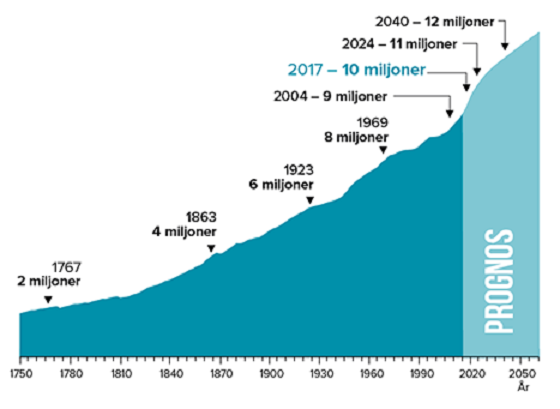
In 1969, 8 million people lived in Sweden. It took 35 years before the population passed 9 million in 2004. But only 13 years later, sometime in the first quarter of 2017, we will be more than 10 million inhabitants. Rapid growth will continue in the coming decades and we can be 12 million already by 2040.

The Swedish Central Bureau of Statistics has a population clock running on its website, and at 0700 on Friday 20th January 2017 reads:

sweden-population-clock

Swedish population clock at 0700, 20170120

It should reach 10 million by around noon.


UPDATE: 10am, 20th January 2017:

20170120 1000

20170120 1000


The population increase in the last 50 years has been quite “healthy” and robust in demographic terms.

Sweden Population - SCB

Sweden Population – SCB

In Europe, Sweden has perhaps the most robust development of demographics with respect to the ratio of non-working (under 19 and over 65) to working population (20 -65). And that has been thanks, in spite of falling fertility rates, mainly to immigration and the slightly higher fertility rate among newcomers (though that comes down quickly to the prevailing rate). Currently around 17% of Sweden’s population was born outside Sweden. This will increase to be over 20% by 2040.

The Swedish pensions system is less under pressure than in Southern and Eastern Europe. Even Germany and France and the UK have a somewhat lower pensions risk because of net immigration. However in all these countries an increase of the regular pension age from 65 to 70 can be expected before 2040.


Hollywood’s aversion to Trump is Chinese funded

January 20, 2017

It’s not too surprising to see all the Hollywood “stars” dancing to the tune of their Chinese masters.

Wanda’s Wang Jianlin Warns Against U.S. Protectionism in Entertainment Sector

“If China were to retaliate it would be bad for both parties — I do not wish to see that scenario materializing,” China’s richest man said during a Q&A session in Davos.

Addressing the global elite in Davos, Switzerland, China’s richest man urged the U.S. not to erect barriers against Chinese investment into Hollywood.

“That would be a step back,” Wang Jianlin, chairman of property and entertainment conglomerate Dalian Wanda Group, said during a Q&A session at the World Economic Forum on Wednesday. “That will be about protectionism emerging in the U.S.,” he added.

Wanda’s ongoing buying spree in Hollywood, including last year’s acquisitions of Legendary Entertainment and Dick Clark Productions, has raised alarm among some U.S. politicians. Bipartisan lawmakers, including the incoming Senate minority leader Chuck Schumer, have called for closer scrutiny of such deals to see whether they are being directed by Chinese government interests.

Wang argued that his investments in the U.S. have been “a good thing,” however. “We don’t interfere with the content — I just want the profit,” he said.

China Secretly Purchases Hollywood

Media industry analysts have warned that Hollywood has become so awash with Chinese funding that China now essentially owns and controls most of the Hollywood entertainment industry.  

A Beijing-based purchase of US film studio Legendary Pictures by Dalian Wanda Group represents the largest-ever film industry takeover by a Chinese company, with $3.5 billion spent on allowing China to become the second biggest box officer player in Hollywood.

Yahoo News reports: Legendary, the maker of “Jurassic World,” “Godzilla” and the latest Batman trilogy, has grossed more than $11 billion worldwide since it was founded in 2005, mostly with the kind of big-budget blockbusters popular with Chinese audiences.

“It’s a win-win situation… because the China market is really incredibly taking off and Hollywood has a real interest in that,” Stanley Rosen, a political science professor at the University of Southern California, told AFP. It is an arrangement that benefits both sides financially, with movies becoming increasingly expensive to produce but the Chinese hungry for Western-made films.

But China, which has yet to make a global hit, is also buying expertise. “Hollywood has what China lacks, which is storytelling ability, marketing, distribution,” Rosen told AFP. Wanda owner Wang Jianlin, who burst into the international spotlight in 2012 by buying US cinema chain AMC Entertainment for $2.6 billion, says the Legendary deal makes his company the highest revenue-generating movie unit in the world. It also gives future Legendary films direct access to China’s booming market, which has become crucial to foreign filmmakers, with North American ticket sales stagnant.

PricewaterhouseCoopers has projected China’s box office to rise from $4.3 billion in 2014 to $8.9 billion in 2019, meaning it would outstrip the US within two years. ……

…… Cumulative Chinese investment in the US since 2000 reached $63 billion in 2015, with a $4 billion going to the entertainment industry, according to research firm Rhodium Group. The trend looks set to accelerate, with Huayi Brothers planning to produce at least 18 films with LA studio STX Entertainment, and Shanghai-based Fosun International taking a stake in US media company Studio 8. Both Wanda and tech firm Alibaba have been touted as possible minority investors in Paramount, while Hunan TV has signed a $1.5 billion deal to fund Lionsgate movies and Perfect World Pictures is investing $250 million in Universal’s slate over five years.


If Trump’s negroes are “mediocre”, CNN’s negroes must lie under the first quartile

January 17, 2017

CNN is plumbing the depths and scraping the barrel!

No further comment needed.

PJmedia:

CNN’s Resident Racist Called Steve Harvey and MLK III ‘Mediocre Negroes’

CNN contributor Marc Lamont Hill has had a record of racial divisiveness and partisanship, but nothing compares to what he said today. He actually uttered these words about Steve Harvey and Martin Luther King III: “It was a bunch of mediocre negroes being dragged in front of TV as a photo-op for Donald Trump’s exploitative campaign.”

Can you even imagine if a conservative had said that?!? The outcry would be so extreme. CNN needs to fire this man for the outlandish racism that he has demonstrated! Marc Lamont Hill is a disgrace!!

trumps-mediocre-negroes

By responding to Trump, China blunders and ensures that “One China” is on the table

January 16, 2017

In the business world one of the first lessons we used to pound into our deal-makers (salesmen, contract negotiators, purchasers, …. ) was that it was “silence” that defined what was really “non-negotiable”. Bringing up such matters or even responding to any mention about what was “non-negotiable” was self-defeating and, in itself, put that matter on the table. Merely saying that something was “non-negotiable” was, in itself, sufficient for the opposing party to always try to keep it on the agenda.

Trump is bringing a business, deal-making approach to politics which even veteran diplomats are finding uncomfortable and incomprehensible. China’s Foreign Ministry has just declared that “One China” is “non negotiable”. That is a massive blunder by their conventional diplomats and bureaucrats. They have just ensured that in any future US/China talks, “One China” will always be present, even if only in pre-talk talks where China tries to keep it off the agenda.

By responding to Trump’s acceptance of a phone call from Taiwan’s president after his victory and a few tweets which followed his attacks on China’s economic “cheating” during the campaign, China has effectively just put “One China” on the table.

The Guardian: 

China has warned Donald Trump that he has no chance of striking a deal with Beijing involving Taiwan’s political status following the US president-elect’s latest controversial intervention on the subject.

The Chinese foreign ministry told Trump that the US’s longstanding “One China” policy, by which it does not challenge Beijing’s claim over the self-ruled island, was the political basis for all Sino-US relations.

In an interview with the Wall Street Journal on Saturday Trump said all options were on the table as he considered how he might reshape Washington’s relations with China, a country he accused of deliberately devaluing its currency in order to hamstring US businesses.

“Everything is under negotiation, including ‘One China’,” Trump said, referring to the US’s longstanding diplomatic decision not to challenge Beijing’s claim that Taiwan, an independently and democratically-ruled island, is part of its territory.

China’s foreign ministry hit back in a statement advising Trump, a billionaire property tycoon who has claimed “deals are my art form”, that he would never be able to achieve such a deal.

“There is only one China in the world, Taiwan is an inalienable region of China, and the government of the People’s Republic of China is the only legitimate government representing China,” spokesperson Lu Kang was quoted as saying.

“The ‘One China’ principle, which is the political foundation of the China-US relations, is non-negotiable.”

If this was a chess game, Trump’s tweets are giving him the first move with the white pieces. In chess parlance he has the “tempo”. So far, the Chinese – who are more conservative than is sometimes thought – have not quite caught onto the game that is being played. It is negotiation by tweets. They may well get the US to continue to accept “One China”. But it is going to cost them something else.

Trump has not even entered office and negotiations have started.


India was not completely isolated as it moved from Gondwanaland to Asia

January 15, 2017

India – from Gondwanaland to Asia (after Wikipedia)

About 135 million years ago India and Mandagascar broke away from Gondwanaland and started shifting North North East. Around 88 million years ago, India and Madagascar split and the movement of the Indian tectonic plate speeded up. It crashed into Asia from about 30 million years ago to around 10 million years ago (though the movement still continues today). It had been thought that India was biologically isolated from about 71 million years ago until about 30 million years ago when some species hopping occurred from Africa and Asia.

This period was also extraordinarily rich in the evolutionary history of the mammals. It was the time when snakes and ants first appeared. There was a mass extinction event about 66 million years ago. The dinosaurs disappeared and became birds. Birds proliferated and so did large flightless birds. The diversity of mammals exploded, perhaps just because of the space left by the disappearance of the large, unsuccessful dinosaurs. The first pigs and deer developed. The grasses arrived. Carnivorous mammals appeared as their prey increased. The first primates made an entrance. But whatever was evolving on the Indian land-mass was evolving largely in isolation from that taking place in the areas that were to become Africa and Eurasia. But there are tantalising indications that on its journey the Indian land-mass may have been connected for short periods by a land bridge to the Horn of Africa or to what is now Arabia.

However a new paper suggests that some biological movement – perhaps across island chains – was taking place as early as 54 million years ago.

Frauke Stebner, Ryszard Szadziewski, Hukam Singh, Simon Gunkel, Jes Rust. Biting Midges (Diptera: Ceratopogonidae) from Cambay Amber Indicate that the Eocene Fauna of the Indian Subcontinent Was Not Isolated. PLOS ONE, 2017; 12 (1): e0169144 DOI: 10.1371/journal.pone.0169144

Bonn University Press Release: 

India gradually drifted away from Africa and Madagascar towards the north and collided with the Eurasian plate. Scientists assumed for a long time that the subcontinent was largely isolated during its long journey through the ocean and unique species of plants and animals were therefore able to develop on it. However, paleontologists at the University of Bonn are now showing using tiny midges encased in amber that there must have been a connection between the apparently cut off India and Europe and Asia around 54 million years ago that enabled the creatures to move around. The surprising results are now presented in the journal PLOS ONE.

India harbours many unique species of flora and fauna that only occur in this form on the subcontinent. The prerequisite for such a unique development of species is that no exchange takes place with other regions. For a long time, scientists assumed that India was isolated in this way due to continental drift. The supercontinent Gondwana, which included South America, Africa, Antarctica, Australia, Madagascar and India, broke up over the course of geological history. What is now India also began moving towards the north east around 130 million years ago. It was common belief among researchers that, before it collided with the Eurasian plate, India was largely isolated for at least 30 million years during its migration.

However, according to current findings by paleontologists at the University of Bonn, the Indian subcontinent may not have been as isolated on its journey as we have thought. “Certain midges that occurred in India at this time display great similarity to examples of a similar age from Europe and Asia,” says lead author Frauke Stebner from the working group of Prof. Jes Rust at the Steinmann Institute at the University of Bonn. These findings are a strong indicator that an exchange did occur between the supposedly isolated India, Europe and Asia.

Mining for amber in the Indian coal seams

The scientist from the University of Bonn mined for amber in seams of coal near the Indian city of Surat. Small midges, among other things, were encased in tree resin 54 million years ago and preserved as fossils. The tiny insects, which are often not even a millimeter large, are “biting midges”. Their descendants can still be found today in Germany in meadows and forests – where the little beasts attack you in swarms and suck your blood.

The paleontologist investigated a total of 38 biting midges encased in amber and compared them with examples of a similar age from Europe and China. Scientists from the University of Gdańsk (Poland) and Lucknow (India) were also involved in this. It has been possible to assign a total of 34 of these insect fossils to genera that are already known. “There was significant conformity with biting midges in amber from the Baltic and Fushun in north-east China,” reports Stebner.

Chains of islands presumably created a link to India

How the insects were able to spread between drifting India and Eurasia has not yet been clarified fully. “Nevertheless, it also seems to have been possible for birds and various groups of mammals to cross the ocean between Europe and India at the time,” the paleontologist refers to studies by other scientists. However, it has now been possible for the first time, with the aid of biting midge fossils, to also demonstrate an exchange between India and Asia in this period.

Stebner assumes that a chain of islands that existed at that time between India, Europe and Asia could have helped the biting midges to spread. As if from stepping stone to stepping stone, the insects could have gradually moved forward along the islands. “Some of the biting midges found in Indian amber were presumably not especially good long-distance flyers,” smiles the paleontologist from the University of Bonn. It was therefore probably not so easy to reach the subcontinent or move from there during the migration of India.

Right click to download: Gedanohelea gerdesorum in 54 million-year-old Cambay amber from India:

Gedanohelea gerdesorum in 54 million-year-old Cambay amber from India: (c) Photo: Working group Prof. Ryszard Szadziewski/University of Gdańsk (Poland)