There is still a month to go for his inauguration, but …..
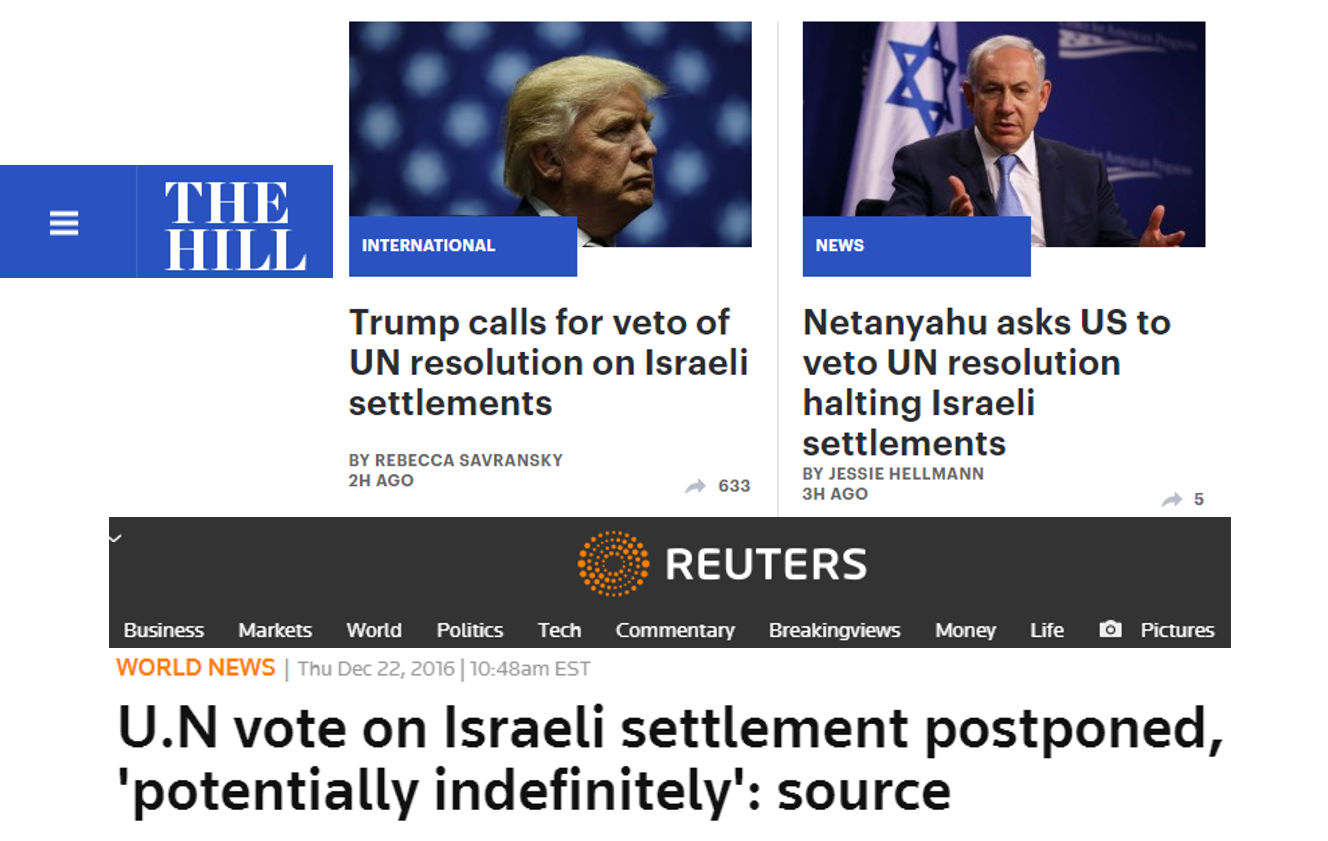
Trump already President?
There is still a month to go for his inauguration, but …..
Trump already President?
The opposition to Assad was primarily fueled (and maybe even initiated) by the EU and the US. It was a regime-change exercise where the expectations of the various rebel groups that Assad would be quickly overthrown did not materialise. The Obama/Kerry engagement in Syria can be characterised as being based on wishful thinking and without any implementable strategy.
Until the Russians intervened ISIS, the Al Nusrah front, Al Qaida and other diverse extremist and rebel groups were making daily gains. Turkey of course dislikes Assad, does not like any Kurdish success which helps the formation of a Kurdistan – or at least a Kurdistan which would include any part of Turkey. Nevertheless Turkey sees benefit in allying with Russia rather than with NATO – mainly because they always play both sides against the middle and certainly want to be part of any winning Russian coalition.
In any event, the EU and the US have had to accept a humiliating defeat of the opposition groups they supported in Aleppo. The French in particular have been extremely upset by the reverse suffered by their surrogates. (The attempt by Iraqi forces to retake Mosul with US support continues).
It has got to the point where now Iran and Russia and Turkey (along with Assad’s representatives) arrange meetings about the future of Syria where the EU and the US are not even invited.
But of course the EU and the US are full of high moral platitudes but have made it quite clear that they are not prepared to ‘walk their own talk’.
Yesterday, top Russian, Turkish, and Iranian officials met in Moscow and signed a declaration they billed as ending the US-instigated war in Syria. Coming after Russian-backed Syrian army units captured the key city of Aleppo from US-backed Islamist fighters, the deal shows that moves to improve ties between the three countries are continuing despite Monday’s assassination of Russia’s ambassador to Turkey, Andrei Karlov.
“Today, experts are working on the text of the Moscow declaration on immediate steps towards resolving the Syrian crisis. It is a thorough, extremely necessary document,” Russian Defence Minister Sergei Shoigu said at a meeting with his Iranian counterpart, Hossein Dehghan.
Shoigu dismissed US and European initiatives in Syria, declaring that “attempts to agree on joint efforts undertaken by the US or their partners were doomed. … None of them exerted real influence on the situation on the ground.”
The initiative was hailed by officials from Turkey, in a sharp turnaround from Turkey’s support for US-backed Islamist opposition militias in the early years of the war. “Now we are observing a very successful operation to liberate eastern Aleppo from fighters, the evacuation of the families of the opposition from Aleppo,” said Turkish National Defence Minister Fikri Işık.
Meeting with his Russian and Iranian counterparts, Sergei Lavrov and Javad Zarif, Turkish Foreign Minister Mevlüt Çavuşoğlu said cooperation between Russia, Turkey, and Iran had “brought about definite successes” in Aleppo. He said he hoped “to spread it to other districts of Syria.”
The expulsion of the Islamist opposition from Aleppo and developing collaboration between Moscow, Ankara, and Tehran mark a major setback for Washington and its European allies. For five years, US imperialism tried to topple Syrian President Bashar al-Assad by backing Islamist militias, a strategy it later expanded to include backing Kurdish nationalist forces in Syria, as well. While this operation was marketed as a revolution in the US and European media, it collapsed because the US-backed forces lacked any real popular support.
Though Turkey is a NATO ally of the United States, Ankara is reacting to the victory of the Syrian regime, Russia, and Iran in Aleppo by developing ever closer ties to Russia. During the launch of a Turkish-Russian joint investigation into Karlov’s murder, Turkish President Recep Tayyip Erdogan said Ankara and Moscow would “not let anyone harm Turkish-Russian relations.” …….
It could well be that if Trump’s administration starts a pull-back from NATO expansionism, the much feared departure of Turkey from NATO could be on the cards again.
…… Amid escalating damage to the Turkish economy and fears that NATO allies, notably in Europe, might not intervene to aid Turkey in a war with Russia, the Turkish regime shifted its foreign policy. It began mentioning a possible rapprochement with Russia and the Syrian regime. In May 2016, Erdogan discharged his prime minister, Ahmet Davutoglu, who had previously declared that he ordered the shooting down of the Russian fighter, and apologized to Russia.
This set the stage for Washington and Berlin to tacitly back a coup attempt that nearly succeeded against Erdogan on July 15, and which Ankara blamed on Gülen’s movement. It was reportedly averted thanks to timely warnings from Russia. This inflamed the already explosive tensions not only inside Turkey, but above all, between Erdogan’s government and the major NATO powers.
The Turkish government has reacted by manoeuvring ever more desperately between its ostensible allies in NATO and the major Eurasian powers, Russia and China. In recent months, amid growing economic ties between China and Turkey, Erdogan has repeatedly declared that Turkey might join the China-led Shanghai Cooperation Organization (SCO), claiming this would allow Ankara “to act more freely.”
This drew a sharp reaction from NATO. Visiting Istanbul last month for the NATO Parliamentarians Assembly, NATO Secretary-General Jens Stoltenberg met with Erdogan and said, “I am sure Turkey will do nothing that could impair the concept of joint defence … and NATO unity.”
Above all, however, Ankara sought closer ties to Russia. Earlier this month, the Russian and Turkish prime ministers, Dmitri Medvedev and Binali Yildirim, met in Moscow. They agreed that “the normalization of the Syrian situation is a priority task for our countries and it will definitely serve to the benefit of the whole region, not to mention Syria, which is currently in a very complicated situation.”
On December 6, Yildirim criticized NATO for “hesitation” and “foot-dragging” in Syria: “Nice words are exchanged about defending civilization against terrorism. But the big terrorist networks challenging us today operate across borders.” He described the Turkish-Russian initiative as a push for a “forceful and united international front to eradicate terrorism.”

Turkey, Russia, Iran Sign Deal On Syria
After Berlin, I recalled this broadcast on Swedish Radio just a few days ago. It would seem that the reverses they have suffered in Iraq and Syria and even Libya have caused a shift of focus within ISIS. A shift away from their dreams of establishing a Caliphate within their lifetimes to creating a parallel, segregated, Islamic population in Europe. Their focus has shifted from directing their European supporters to travel to the front line in the Middle East to instead, implementing terror attacks wherever they happen to be; in place, in Europe.
The Berlin terrorist is still at large. And so are many others – plucking up the nerve to kill indiscriminately. Berlin will be followed by other Islamic, Sunni Muslim, terrorist acts. Islamophobia is not the cause but the inevitable consequence. But a healthy dose of Islamo-skepticism – and amounting to terroristphobia – is absolutely necessary if Islamic terrorism is to be neutralised.
As the Islamic State loses territory in Iraq, Syria and Libya, the group’s propaganda changed. The terror group no longer invites their sympathizers to go to war. Reporter Fernando Arias is in conversation with Robert Egnell, a Professor at the National Defence University, about the terror group’s propaganda.
“It is too early to say what the effects are of the IS reversal of its propaganda”, says Robert Egnell. According to Robert Egnell propaganda has been important to recruit for the Islamic State and what they call their Caliphate. But now the propaganda has changed, he says, and points to three major differences with earlier:
- it has reduced in scale over the past year,
- it is more concerned with calls to take the fight where one is, and
- the positive images of the Caliphate has almost disappeared.
“It’s about being able to show a positive image that can attract. Previously, it has been the Caliphate and the dream of a better life, but it is difficult to show such images today when all the media coverage points to the contrary, and instead must then create success through terrorist attacks and publicise them” said Robert Egnell.
Several intelligence services report that fewer are travelling to Syria and Iraq, but we have yet to see the final effects of the reversal of IS propaganda on terrorists in place in Europe, according to Robert Egnell.
“We have had an increase of attacks in Europe, but it probably can not be linked so directly to just the propaganda, but it can probably rather be linked to a new IS strategy to focus on Europe”, he says.
Is it such a great difference that that people are now encouraged to carry out attacks at home instead of traveling to Iraq and Syria?
“Yes, it’s a very important distinction, and it is perhaps something to hope for. The threshold is much higher for committing acts of violence in the home country compared to follow a new dream of the Caliphate. This provided a kind of positive appeal to a certain type of people, and now there is only death and destruction (in the Caliphate). In a society they have grown up in, one can hope that the threshold (to act) is significantly higher than making the trip down to Syria and fighting for some ’cause’ “.
But the Caliphate dreams are certainly shrinking.

Shrinking Caliphate dreams
So Trump was confirmed by the Electoral College. It is not certain though that this will end the state of denial that Clinton’s supporters and the Clinton news media are stuck in.
The Democrats and Clinton’s campaign and her supporters are making much of her getting about 2.7 million votes more than Donald Trump – country wide – in the presidential election. This margin includes Clinton getting about 1.5 million more in New York than Trump and about 4.3 million more in California. But the race was never about the total popular vote but about winning the popular vote in each state and thereby winning the members of the Electoral College from that state. It is a mix of geography and population and not just population. It is the same mix of geography and population that gives the total number of members of Congress (Senate + House) from each state.
In the 48 states other than New York and California, Donald Trump won about 3.1 million more votes than Hillary Clinton.
Trump won 30 states compared to Clinton’s 20.
Therefore he should have won – without faithless electors – 306 votes to Clinton’s 232. In the event, 2 electors defected from Trump while 5 defected from Clinton giving a final result of 304 for Trump and 227 for Clinton.
Trump also won 2626 counties compared to Clinton’s 487 (AP data). But the number of counties in a state is of no relevance.
The criticism of the Electoral College, now, by sore losers is just a little stupid. The game was the Electoral College and not the popular vote. The arguments being put forward about the popular vote by Clinton devotees are also a little stupid. Those arguments would require that China and India each would have 4 votes in the UN to one for the US (and Sweden would then have 0.03 of a vote).
The counties only provide a picture of the geographic reach of the candidates. And the geographical picture is of an utter dominance of Republican counties.
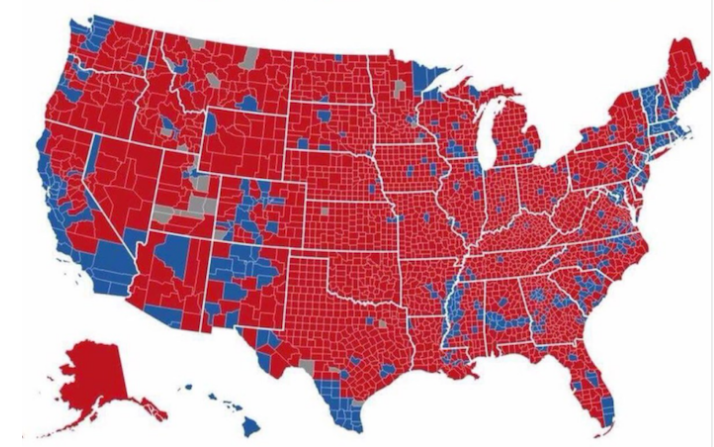
Trump’s reach by county
Yesterday, again, a number of Sunni Muslim terrorists killed indiscriminately.
Berlin. A Pakistani or Afghan asylum seeker in Germany, hijacked a Polish registered truck, killed the chauffeur and then drove into the crowd at a Christmas market killing 12 and injuring around 50 people.
It isn’t reported but it is fairly obvious that the terrorist identified himself as a Sunni Muslim.
BBC:
An articulated lorry has ploughed into a busy Christmas market in the heart of Berlin, killing 12 people and injuring 48. Germany’s Interior Minister, Thomas de Maiziere, said “many things” pointed to a deliberate attack. Police said on Twitter that the lorry driver had been arrested, and that a passenger died from his injuries. The market is at Breitscheidplatz, close to the Kurfuerstendamm, the main shopping street in the city’s west. Almost 50 people are in hospital and at least four have suffered serious injuries.
Security sources cited by the German news agency DPA said that the driver of the truck was an asylum seeker from Afghanistan or Pakistan who had arrived in Germany in February. Berlin police spokesman Winfried Wenzel said a suspect believed to be the person driving the vehicle was picked up about a mile (2 kilometres) away from the crash site, near Berlin’s Victory Column monument, and was being interrogated.
Turkey: The Russian Ambassador was killed by a Turkish policeman shouting “Allah is Great” and other Aleppo related slogans.
It isn’t reported but it is fairly obvious that the rogue policeman also identified himself as a Sunni Muslim.
Video of the event shows Mr Karlov making a speech when gunshots ring out. Eight bullets are said to have been fired. The camera pulls back to show a smartly dressed gunman, wearing a suit and tie, waving a pistol and shouting in Arabic and Turkish.
He can be heard yelling “don’t forget about Aleppo, don’t forget about Syria” and uses the Arabic phrase “Allahu Akbar” (God is great). He is said to have died in a shootout with police soon afterwards, but details have not been given.

The attacker shouted about Aleppo and Syria – image AP via BBC
Islamophobia is certainly the consequence of Islamic terrorism and without the Sunni Muslim fanatics it would have no reason to exist.
But Islamphobia is not the problem.
97% of the UK media thought Brexit would lose.
97% of US political pundits thought Trump couldn’t win.
97% of polling models had an inbuilt, politically correct, confirmation bias.
97% of the US media thought Clinton would trounce Trump.
97% of the politically correct think climate is science.
97% of AGW fanatics believe the sun does not drive climate but that man does.
97% of climate funding goes to the religiously correct.
97% of “climate science” is religious belief.
97% of climate models have an inbuilt, religiously correct, confirmation bias.
97% of “climate scientists” thought Trump would be trounced.
97% of “climate scientists” are charlatans.


There is hope for international debt resolution by good old-fashioned barter.
It would not be possible to wean the Czechs away from beer. And I rather like Slivovice. The only alternative left for Cuba is to run a marketing campaign in the Czech Republic to get people to shift from Becherovka to Rum.
That should not be impossible.
The problem for the Greeks to use a similar method would be that brainwashing would be needed for anyone to like ouzo.

BBC:
Cuba has come up with an unusual way to repay its multimillion dollar debt to the Czech Republic – bottles of its famous rum, officials in Prague say. The Czech finance ministry said Havana had raised this possibility during recent negotiations on the issue.
Cuba owes the Czech authorities $276m (£222m), and if the offer is accepted the Czechs would have enough Cuban rum for more than a century.
However, Prague said it preferred to get at least some of the money in cash.
Havana’s debt dates back from the Cold War era – when Cuba and what was at the time Czechoslovakia were part of the communist bloc. Cuba now does not have much money but it does have lots of rum – hence this unusual proposal, says the BBC’s Rob Cameron in Prague.
The Czech finance ministry said repayment was possible either with rum or pharmaceutical drugs.

Many, many years ago I remember a deal where we accepted that power plant equipment would be paid for with cotton. But that deal went very sour. If of only we had accepted banana liquor instead of cotton.
A new paper analysing dental plaque from a hominin molar suggests that this group did not use fire for cooking, but had a balanced diet of raw meat and plants. The molar is one of the earliest hominin fragments found in Europe and is thought to be 1.2 million years old. Of course they may have had some rudimentary control of fire which did not extend, till then, to cooking.
Hardy, K., Radini, A., Buckley, S. et al. Sci Nat (2017) 104: 2. doi:10.1007/s00114-016-1420-x, Diet and environment 1.2 million years ago revealed through analysis of dental calculus from Europe’s oldest hominin at Sima del Elefante, Spain
Abstract: Sima del Elefante, Atapuerca, Spain contains one of the earliest hominin fragments yet known in Europe, dating to 1.2 Ma. Dental calculus from a hominin molar was removed, degraded and analysed to recover entrapped remains. Evidence for plant use at this time is very limited and this study has revealed the earliest direct evidence for foods consumed in the genus Homo. This comprises starchy carbohydrates from two plants, including a species of grass from the Triticeae or Bromideae tribe, meat and plant fibres. All food was eaten raw, and there is no evidence for processing of the starch granules which are intact and undamaged. Additional biographical detail includes fragments of non-edible wood found adjacent to an interproximal groove suggesting oral hygiene activities, while plant fibres may be linked to raw material processing. Environmental evidence comprises spores, insect fragments and conifer pollen grains which are consistent with a forested environment.
The control of fire is thought to have been achieved between 1.5 million and 400,000 years ago and coinciding with the evolution of homo habilis to homo erectus. This research suggests that , at least in Europe, cooking had not been established by 1.2 million years ago. But whether the particular individual whose molar has been studies was a homo erectus or an evolving homo habilis is unknown.
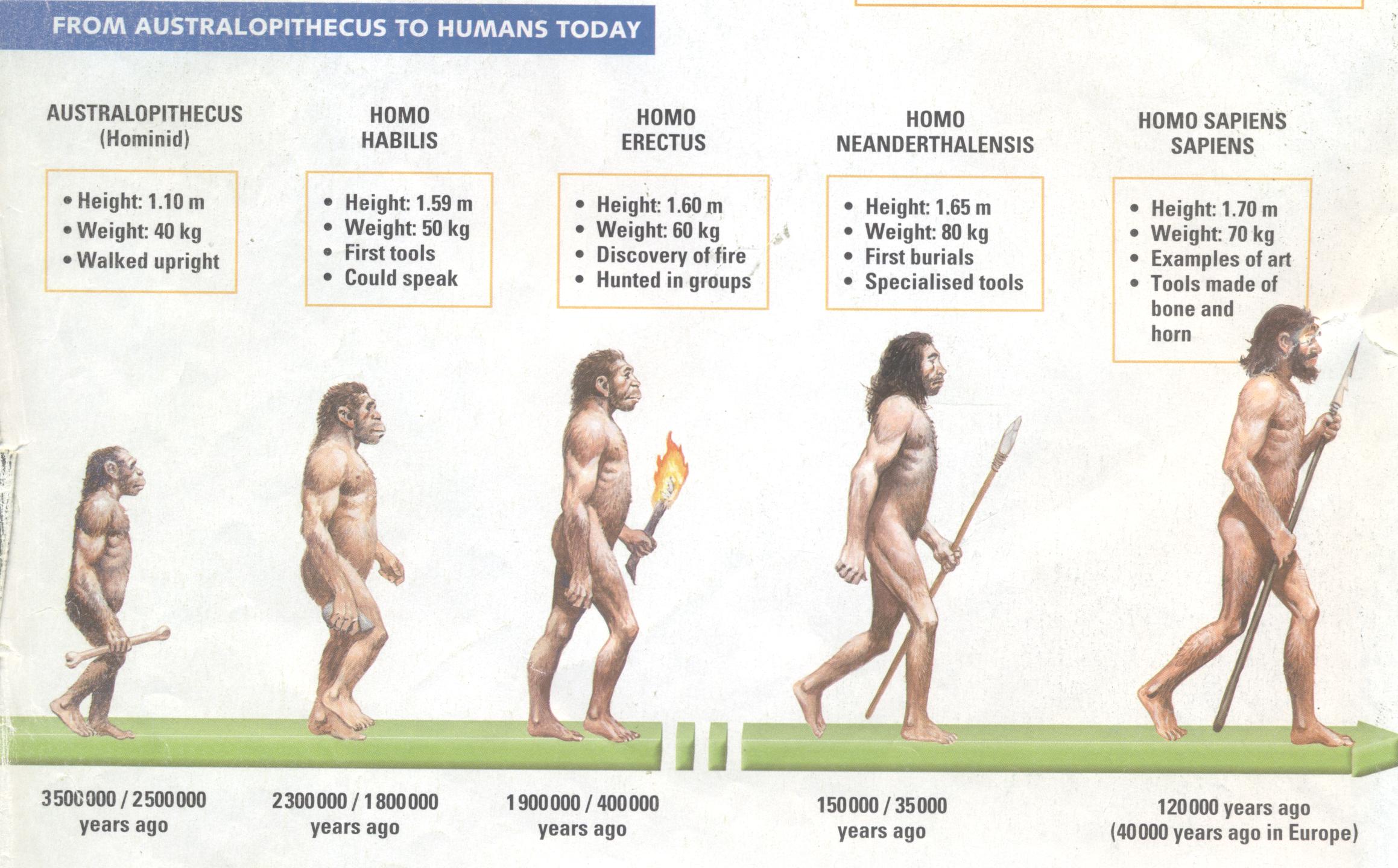
from Pinterest
The intriguing question, of course, is whether human evolution led to control of fire or whether the control of fire led to the evolution of homo sapiens from homo erectus. The archaeological evidence is that control of fire was certainly established by about 800,000 years ago and that hearths (specifically for cooking) were known some 400,000 years ago. This research is consistent with the eating of cooked meat not having begun by 1.2 million years ago. Probably this was not widespread till about 400,000 years ago.
I find it most plausible that the control of fire was the single critical development/advance which made the evolution to homo sapiens possible and which made human social and technological development inevitable. It also seems more than just plausible that the real increase in brain size was connected to cooking and the increase of energy available to the human physique by a diet based on cooking meat. It was the control of fire which was the true start of the anthropocene:
The advent and control of fire led – eventually but inevitably – to the Stone Age transforming into the Bronze Age and the Iron Age. And in due course it has given the Machine Age, the Electrical Age, the Plastics Age and the current Semiconductors Age. All these “Ages” are surely part of the Anthropocene. There is a case to be made for the advent of stone tools defining Man but I think there is a much stronger case to be made for the advent and control of fire being what defines and distinguishes “Man” from all other animals.
Once fire was harnessed, the dominance of Homo Sapiens not just over other species but also over the environment became inevitable. Fire saw humans through the Ice Ages. The Stone Age plus fire gave the Bronze Age. The Bronze Age + fire led to the Iron Age. It was fire in its various avatars (hearths to ovens to smelters, or energy to steam to electricity) which helped transform one Age to the next.
The one single capability which initiated the divergence of humans from all other animals and which has resulted in the inevitable development and domination of modern humans is the control of fire. And that was around 400,000 years ago. The Age of Man began when Homo Erectus learned to produce fire at will and to contain fire in a hearth. I would even speculate that without fire Homo Erectus would not have survived to evolve into Homo Sapiens. Without fire Homo Sapiens would not have thrived through the ice ages or left the tropics to colonise more northern climes.
This is the post-truth world.
Now we have unintelligence agencies. In their world, Saddam had WMD, ISIS does not exist, the US won the Vietnam war and Saudi Arabia is a democratic paradise.
And Putin personally hacked Hillary Clinton and DNC.
They lost the election, they lost the recount and now, the plan is to subvert the Electoral College. It seems the Clinton campaign and the Democratic party and media surrogates are still in denial.

Of course this is based on hard evidence from the unintelligence agencies. (How come all this evidence has come only after a lost election).
Oh Dear!
The evidence

Putin hacking personally
I like this from the American Thinker

image American Thinker
A new paper in Nature: Human Behaviour.
A. Caspi et al, Childhood forecasting of a small segment of the population with large economic burden, Nature Human Behaviour 1, Article number: 0005 (2016), doi:10.1038/s41562-016-0005
The study following 1000 children in New Zealand found that by age 38,
A segment comprising 22% of the cohort accounted for 36% of the cohort’s injury insurance claims; 40% of excess obese kilograms; 54% of cigarettes smoked; 57% of hospital nights; 66% of welfare benefits; 77% of fatherless child-rearing; 78% of prescription fills; and 81% of criminal convictions.
But, the study goes on, the high social cost segment could be identified by age 3:
Moreover, variation in cohort members’ brain health at three years of age predicted with considerable accuracy which individuals would be members of the multiple-high cost segment 35 years later.
They define “brain health”:
At 3 years of age, each child in the cohort participated in a 45 minute examination that included assessments of neurological soft signs, intelligence, receptive language and motor skills. The examiners (having no previous knowledge of the child) then rated each child’s frustration tolerance, resistance, restlessness, impulsivity and lack of persistence in reaching goals. This examination yielded a summary index that we have termed brain health, a global index of the neurocognitive status of three-year-old children. Variation in brain health at three years of age significantly predicted economically burdensome outcomes in each sector, except injury claims.
They conclude
This research yielded two results. First, the study uncovered a population segment that featured as high cost across multiple health and social sectors. ……… Second, by linking administrative data with individual-level longitudinal data, the study provides the strongest effect sizes yet, measuring the connection between an at-risk childhood and costly adult outcomes in the population.
Suppose this study does indeed apply to developed societies generally. The question then becomes what should be done if a predictive test at age 3 reveals those likely to pose a high societal burden. Ideally one should identify the genetics or the development (or lack of development) upto age 3 which gives rise to the result and attack those. An obvious problem arises if genetics – which cannot be remedied – has a large influence. Since even the non-genetic causes are mainly unknown, it then becomes a case of finding remedial methods that can be applied after age 3 to reduce the social burden they could potentially pose.
A fascinating study but it again poses the challenge we will increasingly face as we learn to predict the potential behaviour of humans at an early age. If a potential sociopath can clearly be identified at a very early age, what then becomes the strategy for management of risk? Lock him up before he kills someone? Send him to behaviour correctional institution based on a prediction? If there is a large genetic component do we ban the parents from having further offspring?
Abstract:
Policymakers are interested in early-years interventions to ameliorate childhood risks. They hope for improved adult outcomes in the long run that bring a return on investment. The size of the return that can be expected partly depends on how strongly childhood risks forecast adult outcomes, but there is disagreement about whether childhood determines adulthood. We integrated multiple nationwide administrative databases and electronic medical records with the four-decade-long Dunedin birth cohort study to test child-to-adult prediction in a different way, using a population-segmentation approach. A segment comprising 22% of the cohort accounted for 36% of the cohort’s injury insurance claims; 40% of excess obese kilograms; 54% of cigarettes smoked; 57% of hospital nights; 66% of welfare benefits; 77% of fatherless child-rearing; 78% of prescription fills; and 81% of criminal convictions. Childhood risks, including poor brain health at three years of age, predicted this segment with large effect sizes. Early-years interventions that are effective for this population segment could yield very large returns on investment.
Around the world, the population is ageing and total fertility rates are declining. As a result, nations increasingly view children and young people as valuable resources for the economic and social well-being of whole societies. This view is accompanied by public-policy interest in early interventions to help as many children as possible achieve their full potential. A key question concerns the potential size of the impact that might be brought about by interventions in the early years of children’s lives1,2 . Research teams that have followed up on small samples of children who were enrolled in intervention experiments carried out decades ago point to reductions in school leaving, unemployment, crime, obesity and even blood pressure3,4,5,6 . Some argue that today’s better-designed interventions might achieve greater reductions in adult problems than previous efforts7 (see also www.nuffieldfoundation.org, www.blueprintsprograms.com, http://ies.ed.gov/ncee/wwc and http://incredibleyears.com). Others assert that interventions for the youngest children will bring an even greater return on investment compared with interventions that begin when children are older8 . However, a skeptic could point out that return on investment for society will depend not only on an intervention’s capacity to ameliorate childhood risks, but also on how relevant those risks are for downstream adult functioning in the general population. Thus, to a large extent, the question of how much early-years intervention can lift health and social well-being and reduce costs depends on how strongly early-years risk factors are tied to adult outcomes in the population. Our own research and that of others suggests that while childhood risk factors do predict adult outcomes with statistical significance, the effect sizes are typically modest9,10,11 . The interpretation of these modest child-to-adult effect sizes is polarizing, and has sown confusion among scientists, policy makers and the public12,13,14 . On the one hand, claims are made that the ‘child is father of the man’, because continuity from childhood risks to adult outcomes is stronger than expected, given the long duration of follow-up. On the other hand, on the basis of the same data, warnings are issued about the myth of early-childhood determinism and about unwarranted overemphasis on childhood.
Here, we tackled the prediction question anew in the context of the Dunedin Longitudinal Study, a population-representative 1972–1973 birth cohort of 1,037 New Zealanders assessed at ages 3, 5, 7, 9, 11, 13, 15, 18, 21, 26, 32 and 38 years and followed from birth to midlife with 95% retention (Supplementary Information). We first integrated our longitudinal survey data and clinical data with multiple nationwide government administrative databases and electronic medical records. Then, using a novel segmentation approach, we tested the hypothesis that a small segment of the adult population accounts for a large cumulative economic burden and that this segment can be predicted with good accuracy from early childhood.

 The k2p blog