Facebook does stupid again as it bans Swedish Cancer Society’s educational images

October 20, 2016

UPDATE: Facebook has apologised for removing a video on breast cancer awareness posted by a Swedish group, saying it was incorrectly taken out.


Facebook likes to call itself a technology company rather than what it is – a publisher. It exercises editorial authority and both removes material it does not like and it promotes material that it does. As a publisher they don’t – by any stretch of the imagination – do a very good job. After the fiasco of the banning of the iconic Vietnam “napalm girl” image, they have now proceeded to further demonstrate their stupidity by banning educational images about breast cancer from the Swedish Cancer Society.

Swedish Cancer Society

Swedish Cancer Society: Learn to know your breasts

PhysOrg:

Facebook has removed a video on breast cancer awareness posted in Sweden because it deemed the images “offensive”, the Swedish Cancer Society said Thursday. The video, displaying animated figures of women with circle-shaped breasts, aimed to explain to women how to check for suspicious lumps.

Sweden’s Cancerfonden said it has tried to contact Facebook without any response and has decided to appeal the decision to remove the video. Facebook was not immediately available for comment. “We find it incomprehensible and strange how one can perceive medical information as offensive,” Cancerfonden communications director Lena Biornstad told AFP. “This is information that saves lives, which is important for us,” she said. “This prevents us from doing so.”

Facebook faced outrage in September for repeatedly deleting a historic Vietnam War photo included in a post by Norway’s Prime Minister Erna Solberg. It said the iconic photo of a naked Vietnamese girl fleeing a napalm bombing violated its rules but later backtracked on the decision.


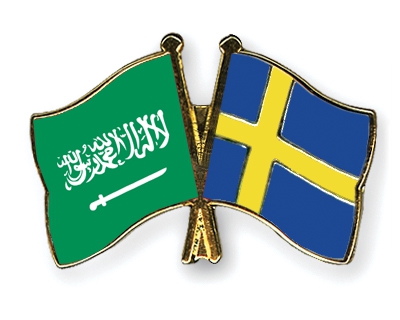
Swedish Prime Minister to Saudi Arabia to mend fences ( but does not take Foreign Minister Wallström with him)

October 20, 2016

saudi-arabia-sweden

The Swedish Prime Minister, Stefan Löfven is visiting Saudi Arabia over the weekend with a couple of business leaders to try and recover some of ground lost by Swedish businesses in Saudi Arabia. Needless to say, the Swedish Foreign Minister Margot Wallström does not seem to be accompanying him.

She, of course, was the one who soured relations with Saudi Arabia to such an extent that Swedish industry is not happy. There are many stories of  business opportunities lost because of Wallströms “holier than thou” diplomacy. It was in early 2015 that Margot Wallström and the left green coalition made a great display of their moral superiority and caused some diplomatic consternation. They called Saudi Arabia nasty, very undiplomatic names (all true but not how a Foreign Minister is expected to behave), saw to it that a defence agreement was cancelled and recognised Palestine. The Saudis recalled their Ambassador, banned Margot Wallström from giving a speech to the Arab League, denied visas to Swedes and made life difficult for Swedish firms doing business in Saudi Arabia. Eventually the King of Sweden sent a letter carried by Björn von Sydow to Saudi in March 2015 apologising for Wallström and managed – monarch to monarch – to cool down some of the Saudi anger.

Left/Green sanctimony is causing a debacle for Swedish foreign policy

But the Greens and the left of the Social Democrats forgot that they were actually in government and were not just an irresponsible lobby group like Greenpeace or the WWF indulging in publicity pranks.  They were so mesmerised by the idea of showing off their moral credentials that the intention to terminate the defense agreement was announced in a great blaze of self-righteous publicity.  The Prime Minister Stefan Löfven (an old trade unionist with a good understanding of the importance of jobs) actually wanted to extend the agreement. But he was over-ruled by his far left and the Greens. His Foreign Minister, Margot Wallström (who, unlike the Greens, is old enough to know better), was more obsessed with demonstrating how Swedish foreign policy was feminist and green and occupied the moral high ground than in promoting Swedish interests and values. And so she forgot about her duties as a Foreign Minister and sharply criticised Saudi Arabia in most undiplomatic language. It verges on incompetence that the consequences of her statements were not analysed.

On this trip Löfven will be accompanied by Marcus Wallenberg of Investor, and Maria Rankka from the Swedish Chamber of Commerce.

I don’t expect that Löfven will bring up the funding emanating from Saudi sources for IS in particular or for Sunni extremists in other places.


Second European Mars lander (Schiaparelli) also lost (after Beagle 2 in 2003)

October 20, 2016

While the ExoMars Trace Gas Orbiter by the European/Russian space agencies (ESA/Roscosmos) seems to have successfully entered the correct orbit around Mars, ESA’s Mars lander, Schiaparelli seems to have been lost on its way down to the surface.

schiaparelli-descent image-esa

schiaparelli-descent image-esa

BBC: 

There are growing fears a European probe that attempted to land on Mars on Wednesday has been lost. Tracking of the Schiaparelli robot’s radio signals was dropped less than a minute before it was expected to touch down on the Red Planet’s surface.

Satellites at Mars have attempted to shed light on the probe’s status, so far without success. One American satellite even called out to Schiaparelli to try to get it to respond. The fear will be that the robot has crashed and been destroyed. The European Space Agency, however, is a long way from formally calling that outcome. Its engineers will be running through “fault trees” seeking to figure out why communication was lost and what they can do next to retrieve the situation.

This approach could well last several days. 

One key insight will come from Schiaparelli’s “mothership” – the Trace Gas Orbiter (TGO). As Schiaparelli was heading down to the surface, the TGO was putting itself in a parking ellipse around Mars. But it was also receiving telemetry from the descending robot.

If the lander is indeed lost, it will be the second failure of a European Mars lander after the failure of Beagle 2 in 2003.

Beagle 2 was a British landing spacecraft that formed part of the European Space Agency’s 2003 Mars Express mission. The craft lost contact with Earth during its final descent and its fate was unknown for over twelve years. Beagle 2 is named after HMS Beagle, the ship used by Charles Darwin.

The spacecraft was successfully deployed from the Mars Express on 19 December 2003 and was scheduled to land on the surface of Mars on 25 December; however, no contact was received at the expected time of landing on Mars, with the ESA declaring the mission lost in February 2004, after numerous attempts to contact the spacecraft were made.

Beagle 2‘s fate remained a mystery until January 2015, when it was located intact on the surface of Mars in a series of images from NASA’s Mars Reconnaissance Orbiter HiRISE camera. The images suggest that two of the spacecraft’s four solar panels failed to deploy, blocking the spacecraft’s communications antenna.

The ESA’s plans and budget for landing a six-wheeled roving vehicle on Mars in 2021 will face further critical scrutiny. The rover is expected “to use some of the same technology as Schiaparelli, including its doppler radar to sense the distance to the surface on descent, and its guidance, navigation and control algorithms”.

ESA has an annual budget of about €5.25 billion.

Of course the EU sees the ESA as a matter of prestige first (and science, only second) which does help to protect the budget.

Perhaps some “frugal engineering” (a la ISRO) is called for.


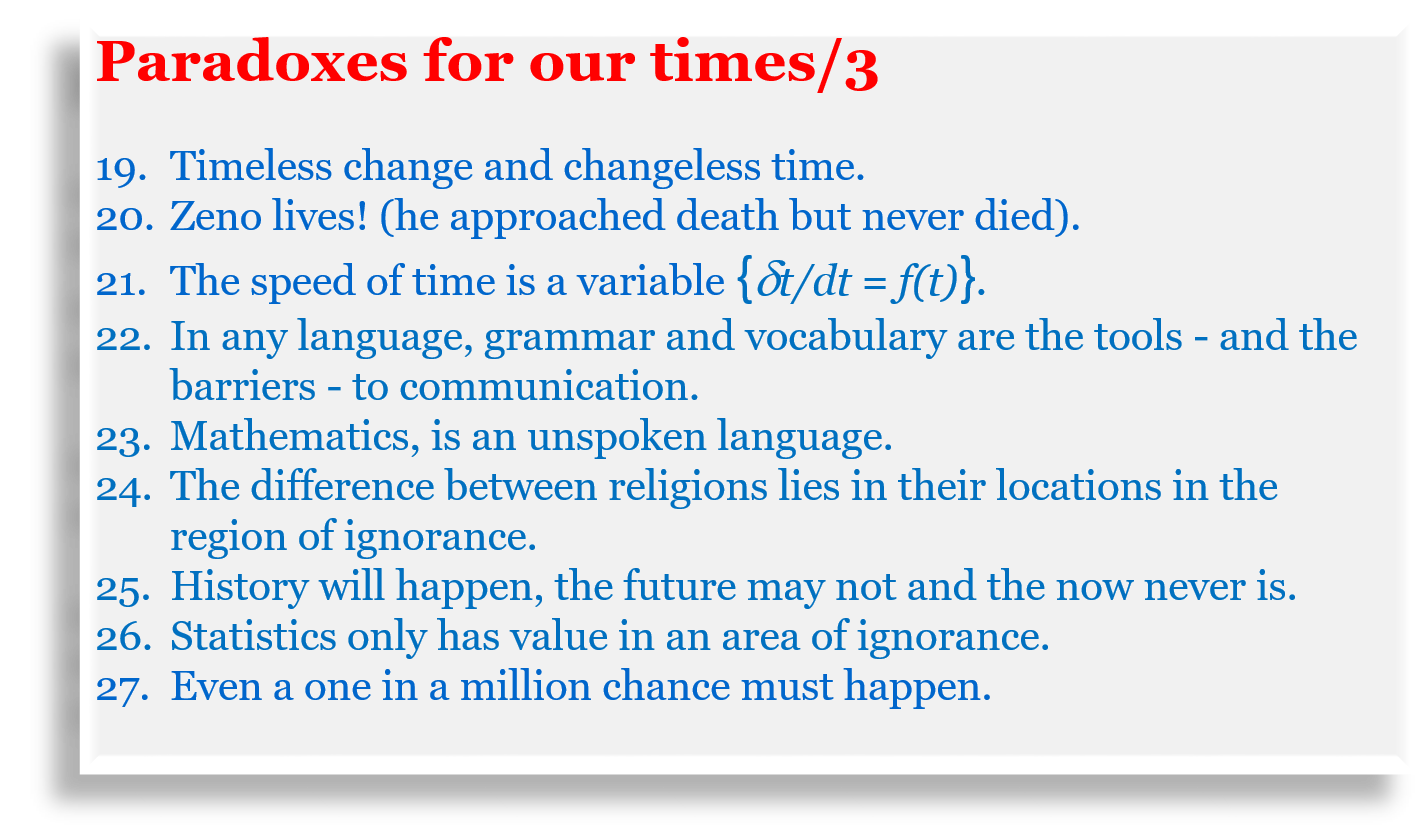
Paradoxes for our times/ 3

October 18, 2016

paradoxes-3


US media declares Clinton has won

October 17, 2016

Over the weekend the US media has declared victory in their battle against Donald Trump and that (therefore) Clinton has won the election. All their polls support their conclusion. The electoral college is said to have already decided in favour of Hillary Clinton.

The actual vote on November 8th now becomes a formality and the result – to a large extent – becomes irrelevant since

  1. the vote would include deplorable people (who shouldn’t really have a vote), and
  2. the electoral college decision has already been taken (unofficially).

The victory means the US media stands vindicated as the bastion of liberty and freedom after their 18-month long battle to stop Trump.

clinton-wins


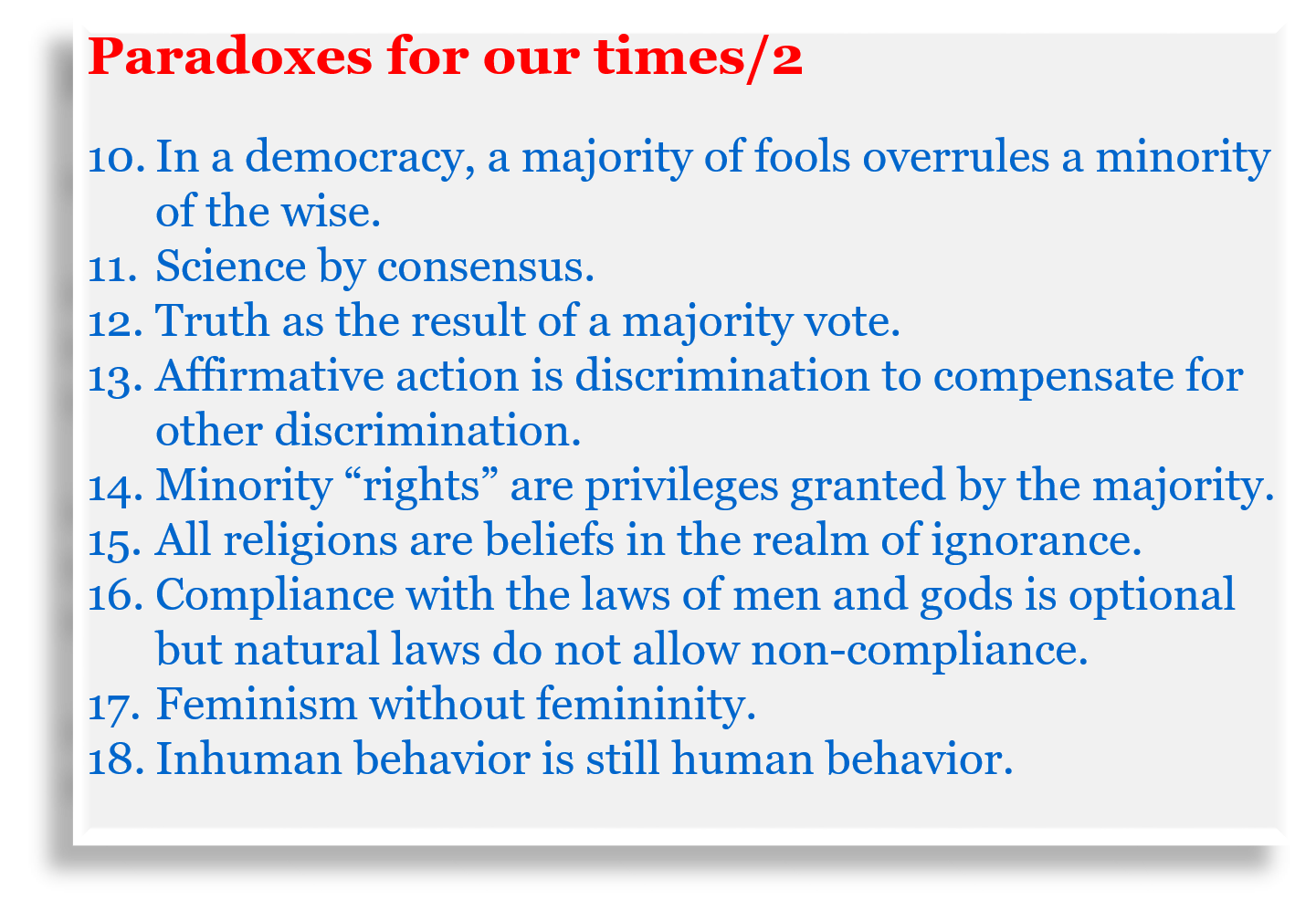
Paradoxes for our times / 2

October 15, 2016

paradoxes-2


Paradoxes for our times / 1

October 15, 2016

paradoxes-1


Quite unexpected: Dolly Parton at 33

October 15, 2016

I only saw this yesterday but this You Tube video was posted by Tom Berry in 2010, so it’s been around for a while.

The New Yorker:

Dolly Parton must be one of the only singers around whose voice could undergo such extreme manipulation and sound not sadly distorted but, rather, beautifully remade. Her baby-high soprano has always seemed slightly unreal anyway, a record played a little too fast. As it happens, one of her longtime stage stunts is mimicking a 45 r.p.m. record played at 78 r.p.m.: she goes into full Chipmunk mode, not missing a syllable or a wave of vibrato—an offhand joke at the expense of her own voice, as well as a flourishing exhibition of her impressive control of her instrument.

Parton, slowed to a speed at which most people would sound like gloopy, slothlike creatures, comes down to a reasonable alto range, sounding like a soulful male ballad singer.

Dolly Parton was born in 1946 so here’s an image of her at 33 in 1979.

Dolly Parton by Ed Caraeff-1979 (The Red List)

Dolly Parton by Ed Caraeff-1979 (The Red List)


How The Lancet creates, and the UN spreads, lies — Hans Rosling in The Lancet

October 14, 2016

The UN can only mirror its member countries. While the UN (and for example the EU) are supposed to try and “level up” they very often “level down”. When that happens they disseminate “worst practices” rather than spread “best practices”. The UN’s executive and officers and bureaucrats are not either immune to the corruptions of being in privileged and protected positions. They also disseminate lies when advocating for their pet projects or causes. The problem is that when lies are sanctioned by the UN they take on a sanctity which is downright harmful.

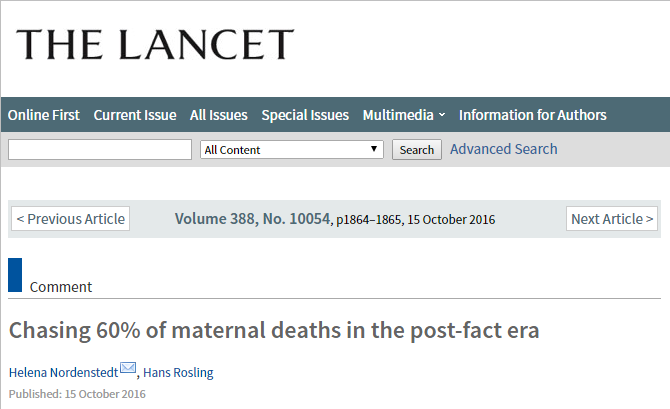
Professor Hans Rosling and Helena Nordenstedt take the UN to task for spreading lies in a new comment to The Lancet. But they also point out the lie was first created in The Lancet itself and suggest that The Lancet should not publish advocacy articles without peer review.

rosling-lancet

They write

In September, 2016, at the UN General Assembly, the Independent Accountability Panel (IAP) of the UN’s Global Strategy for Women’s, Children’s and Adolescents’ Health presented their first report. The IAP report states that 60% of maternal deaths today take place in humanitarian settings, specified as “conflict, displacement and natural disaster”The “60%” has been trending in development aid advocacy ever since late 2015 when UNFPA stated that 60% of maternal deaths happen in “humanitarian situations like refugee camps”. The 60% has even made its way into policy documents and discourse. The only health data mentioned in the proposed policy framework for Sweden’s future international development cooperation are: “60% of maternal deaths take place in humanitarian emergencies”. We chased the origin of this seemingly incorrect percentage. We found it to be a Comment published in The Lancet, referring to the published underlying data sources and to a grey publication describing the crude calculation that yielded the 60%.

……..

We conclude that the “60%” is a fourfold inaccuracy. It is surprising that, in just 1 year, the false percentage made its way to a highly qualified panel at the UN. Global health seems to have entered into a post-fact era, where the labelling of numerators is incorrectly tweaked for advocacy purposes. The reproductive health needs in humanitarian settings should be reported without hiding that most maternal deaths still occur in extreme poverty. As recently noted in The Lancet, Nigeria’s Minister of Health, Isaac Adewole, spoke the truth when stating that the real causes of maternal and child deaths are poverty, inequality, lack of financing, and poor governance.  The use of inaccurate numbers in global health advocacy can misguide where investments are most needed to achieve the Sustainable Development Goals. We, therefore, suggest The Lancet should only publish advocacy material after due referee procedures.


What is “statistically significant” is not necessarily significant

October 12, 2016

“Statistical significance” is “a mathematical machine for turning baloney into breakthroughs, and flukes into funding” – Robert Matthews.


Tests for statistical significance generating the p value are supposed to give the probability of the null hypothesis (that the observations are not a real effect and fall within the bounds of randomness). So a low p value only indicates that the null hypothesis has a low probability and therefore it is considered “statistically significant” that the observations do, in fact, describe a real effect. Quite arbitrarily it has become the custom to use 0.05 (5%) as the threshold p-value to distinguish between “statistically significant” or not. Why 5% has become the “holy number” which separates acceptance for publication and rejection, or success from failure is a little irrational. Actually what “statistically significant” means is that “the observations may or may not be a real effect but there is a low probability that they are entirely due to chance”.

Even when some observations are considered just “statistically significant” there is a 1:20 chance that they are not. Moreover it is conveniently forgotten that statistical significance is called for only when we don’t know. In a coin toss there is certainty (100% probability) that the outcome will be a heads or a tail or a “lands on its edge”. Thereafter to assign a probability to one of the only 3 outcomes possible can be helpful – but it is a probability constrained within the 100% certainty of the 3 outcomes. If a million people take part in a lottery, then the 1: 1,000,000 probability of a particular individual winning has significance because there is 100% certainty that one of them will win. But when conducting clinical tests for a new drug, it is often so that there is no certainty anywhere to provide a framework and a boundary within which to apply a probability.

A new article in Aeon by David Colquhoun, Professor of pharmacology at University College London and a Fellow of the Royal Society, addresses The Problem with p-values.

In 2005, the epidemiologist John Ioannidis at Stanford caused a storm when he wrote the paper ‘Why Most Published Research Findings Are False’,focusing on results in certain areas of biomedicine. He’s been vindicated by subsequent investigations. For example, a recent article found that repeating 100 different results in experimental psychology confirmed the original conclusions in only 38 per cent of cases. It’s probably at least as bad for brain-imaging studies and cognitive neuroscience. How can this happen?

The problem of how to distinguish a genuine observation from random chance is a very old one. It’s been debated for centuries by philosophers and, more fruitfully, by statisticians. It turns on the distinction between induction and deduction. Science is an exercise in inductive reasoning: we are making observations and trying to infer general rules from them. Induction can never be certain. In contrast, deductive reasoning is easier: you deduce what you would expect to observe if some general rule were true and then compare it with what you actually see. The problem is that, for a scientist, deductive arguments don’t directly answer the question that you want to ask.

What matters to a scientific observer is how often you’ll be wrong if you claim that an effect is real, rather than being merely random. That’s a question of induction, so it’s hard. In the early 20th century, it became the custom to avoid induction, by changing the question into one that used only deductive reasoning. In the 1920s, the statistician Ronald Fisher did this by advocating tests of statistical significance. These are wholly deductive and so sidestep the philosophical problems of induction.

Tests of statistical significance proceed by calculating the probability of making our observations (or the more extreme ones) if there were no real effect. This isn’t an assertion that there is no real effect, but rather a calculation of what wouldbe expected if there were no real effect. The postulate that there is no real effect is called the null hypothesis, and the probability is called the p-value. Clearly the smaller the p-value, the less plausible the null hypothesis, so the more likely it is that there is, in fact, a real effect. All you have to do is to decide how small the p-value must be before you declare that you’ve made a discovery. But that turns out to be very difficult.

The problem is that the p-value gives the right answer to the wrong question. What we really want to know is not the probability of the observations given a hypothesis about the existence of a real effect, but rather the probability that there is a real effect – that the hypothesis is true – given the observations. And that is a problem of induction.

Confusion between these two quite different probabilities lies at the heart of why p-values are so often misinterpreted. It’s called the error of the transposed conditional. Even quite respectable sources will tell you that the p-value is the probability that your observations occurred by chance. And that is plain wrong. …….

……. The problem of induction was solved, in principle, by the Reverend Thomas Bayes in the middle of the 18th century. He showed how to convert the probability of the observations given a hypothesis (the deductive problem) to what we actually want, the probability that the hypothesis is true given some observations (the inductive problem). But how to use his famous theorem in practice has been the subject of heated debate ever since. …….

……. For a start, it’s high time that we abandoned the well-worn term ‘statistically significant’. The cut-off of P < 0.05 that’s almost universal in biomedical sciences is entirely arbitrary – and, as we’ve seen, it’s quite inadequate as evidence for a real effect. Although it’s common to blame Fisher for the magic value of 0.05, in fact Fisher said, in 1926, that P= 0.05 was a ‘low standard of significance’ and that a scientific fact should be regarded as experimentally established only if repeating the experiment ‘rarely fails to give this level of significance’.

The ‘rarely fails’ bit, emphasised by Fisher 90 years ago, has been forgotten. A single experiment that gives P = 0.045 will get a ‘discovery’ published in the most glamorous journals. So it’s not fair to blame Fisher, but nonetheless there’s an uncomfortable amount of truth in what the physicist Robert Matthews at Aston University in Birmingham had to say in 1998: ‘The plain fact is that 70 years ago Ronald Fisher gave scientists a mathematical machine for turning baloney into breakthroughs, and flukes into funding. It is time to pull the plug.’ ………

Related: Demystifying the p-value