Airbnb discriminates against blacks in the US (and in Sweden as well)

October 3, 2016

airbnb

First a new paper to be published in the American Economic Journal:

Edelman et al, Racial Discrimination in the Sharing Economy: Evidence from a Field Experiment 

PDF airbnb-guest-discrimination-2016-09-16

In an experiment on Airbnb, we find that applications from guests with distinctively African-American names are 16% less likely to be accepted relative to identical guests with distinctively White names. Discrimination occurs among landlords of all sizes, including small landlords sharing the property and larger landlords with multiple properties. It is most pronounced among hosts who have never had an African-American guest, suggesting only a subset of hosts discriminate. While rental markets have achieved significant reductions in discrimination in recent decades, our results suggest that Airbnb’s current design choices facilitate discrimination and raise the possibility of erasing some of these civil rights gains.

The same story is repeated in Sweden.

Swedish Radio:

Rental service Airbnb – which provides private rooms and apartments for guests all over the world – has problems with discrimination.

Tim Davis from New York tried to book an apartment through the service in Stockholm last summer, but was denied by the 15 hosts. He believes that it has something to do with that he is black. “I sent out 15 different requests and they all said no, but I also noted that the dates were still on the site”, said Tim Davis from New York.

After having contacted 15 hosts on Airbnb in Stockholm but had been rejected by everyone, Tim Davis, who himself is an Airbnb host in New York, started to suspect that the reason that all the hosts denied him to hire his skin color. “I’ve never been in Sweden, so I began to investigate. Is it okay to go there? Will there be problems? Will there be a big problem for me to be there as the black man?”

In the US, this issue has received much attention this year, partly due to a scientific study by Harvard University showed that it is easier to get rental accommodations through Airbnb, if you have a name that is common among white Americans than if you have a name that is common among African Americans.

But we wanted to know if this is also a problem in Sweden and made our own small survey where we borrowed several black and white people’s Airbnb accounts. With the help of the black persons’ accounts, we asked 200 Airbnb hosts in Stockholm, Gothenburg and Malmö about their places were vacant on specific dates. More than half of the respondents said yes. But when we asked those who had said no again from an account that belongs to one of the white test subjects, nearly one in three hosts said instead that the apartment was vacant.

So here are what some of the hosts said when a black person asked:

“No sorry, friends are coming to visit”.

“Unfortunately, we will not be home on these dates”

“No, unfortunately,  the accommodation is not available, we had forgotten to change the dates. “

And this is how the hosts responded when we let a white person repeat the question:

“-You are more than welcome!”

“We will arrange that, what time are you coming on Friday?”

“Absolutely, it works well. Welcome!”

Process Manager Martin Dark at the Equality Ombudsman’s Office  said about the test: “It’s difficult to say something about the individual cases but as it looks there appears to be a problem. Typically, private behaviour is protected from discrimination legislation, but in this case when you have advertised on a commercial site with the purpose of making money, these people may be guilty of discrimination.”

– As anti-discrimination law stands today, it is values that are responsible for it. …….

……. Airbnb declined to participate in an interview …… but says that discrimination is unacceptable and that it will take action if guests report that they encountered discrimination.

Discriminate is what homo sapiens do. To discriminate is the automatic consequence of thought.

This kind of discrimination may be “deplorable” but I am not sure that forcing people – by legal coercion – to disregard or abandon their own values is not equally deplorable. You may not agree with someone’s values but to force them to adopt yours is either oppression of the individual or it is brainwashing.

Monsoon season is over but the rain continues as withdrawal lags

October 3, 2016

The monsoon season “officially” runs through June, July, August and September. This year it was about a week late in being established and now, at the end of the season, total rainfall has been about 3% lower than the long-term average and it counts as a normal monsoon (just).

Predictions of a better than average monsoon have been proven wrong . But have they?

The monsoon does not much care about calendar dates and the withdrawal of the monsoon is running about 2 weeks behind its “average” schedule.

graphic imd

graphic imd

It looks like monsoon rains will continue sporadically over the next 15 – 20 days. Currently the rains stretch across central India from Gujarat to Bihar. The total rainfall – though not conforming to the official calendar – may well be slightly above average.

Once it has finally withdrawn the verdict is likely to be that the 2016 monsoon was “good”.


To pay tax you don’t owe is just incompetence

October 2, 2016

I note that the NY Times is busy attacking Trump for offsetting tax on profits against past losses. Which of course is something the NY Times is itself very quick to do when it can. As Forbes reported in January this year:

New York Times Hypocrisy On Corporate Taxes Reaches Record High

……. More recently, for tax year 2014, The New York Times paid no taxes and got an income tax refund of $3.5 million even though they had a pre-tax profit of $29.9 million in 2014. In other words, their post-tax profit was higher than their pre-tax profit. The explanation in their 2014 annual report is, “The effective tax rate for 2014 was favorably affected by approximately $21.1 million for the reversal of reserves for uncertain tax positions due to the lapse of applicable statutes of limitations.” If you don’t think it took fancy accountants and tax lawyers to make that happen, read the statement again. …….

There is much hypocrisy about taxes and tax-paying. To pay more tax than the tax code demands is all about incompetence – not about ethics.

I wrote in December 2015;

Tax avoidance is a measure of the incompetence of the lawmaker and the competence of the taxpayer

…. As law-abiding individuals and companies, we calculate and pay our taxes according to the rules that prevail. We use all available rules of allowable deductions and off-sets and deferred taxes and tax-breaks to minimise the amount of personal assets that are to be confiscated by the State. We use accountants and experts to navigate the complexities and intricacies of tax legislation. No individual is ever expected to pay more than the prevailing rules require. Any individual who does pay more than required, and assuming his perfectly rational objective is to minimise the tax to be payed, is fundamentally incompetent. Any company which pays more tax than it should also demonstrates incompetence and is not demonstrating due care of its investors’ assets.

Individuals and corporations are not required or expected to pay more than what is due under the rules prevailing. The issue of ethics is in play when the rules are formulated and is also involved in the following of the rules. The act of payment is an ethical issue but minimisation of tax due is a matter of competence, not of ethics. Paying more taxes than are due demonstrates incompetence and gains no ethical credits. So when there is criticism of companies for “not paying enough tax”, the real failure is with the politicians who have made the deficient rules – not with the individuals or companies who have followed the prevailing rules to their own best advantage.

Back in January 2015 I was also exercised about the sanctimonious clap-trap that wealth inequality gives rise to:

Wealth inequality: The poor are not poor “because” the rich are rich

Most people on the left of the political divide want more to be taken from the rich to be “given” to the poor. The Robin Hood syndrome. Note that when the intention is to “give to the poor” and not for “making the poor greater creators of wealth”, the driving force is mainly envy. It is when the desire to deprive the rich is more important than any desire to improve the lot of the poor. Concern is over-ridden by envy. Sometimes it seems to me that the real difference between left and right is that the left wants to spread the consumption of existing wealth (and hope that total wealth increases), while the right want to focus on creating wealth (and hope that it trickles down and gets equitably distributed).

But there is a fundamental fallacy in the view that the poor are poor because the rich are rich. There may well be some of the rich who are exploiting some of the poor and where the poor are not getting a just opportunity to be creators of wealth. There may well be members of the rich who create no wealth but remain rich because of inherited wealth. But by far the greatest majority of the rich are rich because they created more wealth than others. The real question is whether each individual gets an equitable opportunity to create wealth and then gets to retain an equitable portion of the wealth he has created. (It is a different matter but I still do not understand why it is the creation and the retention of wealth that attracts more penalties in the form of taxation than the destruction or consumption of wealth).

I incline to the view that taxation as it is practiced today by most states is fundamentally immoral. It is in fact an act of confiscation. This I wrote in February 2015.

On the legitimacy and morality of taxation

I am persuaded that the concept of taxation as practised today is immoral. It is fundamentally a coercion of an individual by a larger (stronger) society. It is an enforced confiscation (by threat of legal action) of an individual’s property or wealth. It cannot be seen as a membership fee for being a member of the society because leaving (or being expelled from) the society is not an option. It is closer to the extortion of “protection money” than to the membership dues for a golf club. The use to which the funds are put is irrelevant. The key point is whether the payment is voluntary or coerced. When early Christians paid a “tithe” to the Church voluntarily it was not immoral. But when the payment was coerced and no longer voluntary, the system became immoral. Similarly Islam requires the payment of zakat on individual wealth over the minimum nisab and this also shifted from a quite unexceptionable and moral voluntary payment to become an obligatory and immoral coercive confiscation.

I don’t quarrel with the need for any society to generate “common funds” to improve the well being of that society. But the legitimacy of appropriating the funds lies only in that the society (state) is stronger than the individual. Might becomes right. I come to the conclusion that a tax code by which the amount a “good citizen”should contribute to society is calculated is quite moral as long as the payment is then voluntary. There would be no moral issue if all taxation was voluntary. The immorality lies in the use of threat or force to confiscate the payment. It is the oppression of the minority by the majority which is immoral. (I observe that all democracies use the very fact of being a “democracy” as being a justification for the oppression of minorities when that is the will of the majority. As if being in the majority – by and of itself – ensures proper behaviour). But, the good socialist will argue, compulsory payment of tax is necessary to ensure the funds for the common good. Without coercion society as a whole would suffer. The common good – as seen by the majority – is worth the oppression of the minority who do not pay their dues.

And so we come full circle. The end justifies the means. Oppression of the minority by a majority is acceptable for the good of the majority. A society must be able to use force and coercion against its own minorities for the greater good. Taxation is made legitimate only because the state is stronger than the individual.


The Obama legacy: Syrian chaos abroad and a failed Obamacare at home

October 2, 2016

History may remember Barack Hussein Obama mainly for being the first half-black President. The successes and failures of today which loom so large at the moment may not be of any great significance from the distance of another century or two. Just looking back over the last 8 years, the dominating story about the world would be the financial crisis which started in 2008 and which we have not yet recovered from. In that picture there is nothing that Obama has done which stands out. History will only record that Obama’s efforts to first stop and then recover from the crisis were not particularly noteworthy – neither catastrophic nor very successful. It will surely be recorded that this period was extremely violent in the middle east and saw heavy intervention by the US and Europe to try and effect regime change in a number of countries. History will also record that the interventions in Iraq, Syria and Libya, in particular, in support of rebel groups to the existing regimes caused the rise and explosive growth – and success – of the Islamic State terrorists. It will be recorded that the reluctance of the US to challenge Saudi Arabia allowed easy financing of Sunni terrorist groups. Syria and the Middle East will go down as a spectacular failure of US foreign policy under Barack Obama (aided and abetted by Hillary Clinton and John Kerry). Right now it is the visible face of inept US foreign policy. Depending on what happens in the next year or two, this failure may become something that history will recall and connect with Obama. Or it may just get lost in the continuing maelstrom of the middle east’s bloody and barbarous politics.

When Obama was elected there was an expectation that he would improve the lot of US blacks. That has not happened. If anything it has become somewhat worse. There was a huge expectation of job creation but that has dawdled along in the wake of the financial crisis. During his term the introduction of “health care for all” and the Affordable Care Act was hyped to an extraordinary degree. Obamacare was going to revolutionise health care and make it affordable and available to all. This was going to be his primary domestic legacy.

But it seems that Obamacare has already failed. It does not seem that it could be the kind of success that would be remembered by history. For now it seems to be the most important domestic failure of Obama’s term in office. Whether the failure will be big enough to be remembered by history remains to be seen – but probably not.

obama-7-years-on-image-time

obama-7-years-on-image-time

Chicago Tribune:

  1. Obamacare failed because it flunked Economics 101 and Human Nature 101. It straitjacketed insurers into providing overly expensive, soup-to-nuts policies. It wasn’t flexible enough so that people could buy as much coverage as they wanted and could afford — not what the government dictated. Many healthy people primarily want catastrophic coverage. Obamacare couldn’t lure them in, couldn’t persuade them to buy on the chance they’d get sick. 
  2. Obamacare failed because the penalties for going uncovered are too low when stacked against its skyrocketing premium costs. Next year, the penalty for staying uninsured is $695 per adult, or perhaps 2.5 percent of a family’s taxable household income. That’s far less than many Americans would pay for coverage. Financial incentive: Skip Obamacare.
  3. Obamacare failed because insurance is based on risk pools — that is, the lucky subsidize the unlucky. The unlucky who have big health problems (and big medical bills) reap much greater benefits than those who remain healthy and out of the doctors’ office. But Obamacare’s rules hamstring insurers. They can’t exclude people for pre-existing conditions, and can’t charge older customers more than three times as much as the young. Those are good goals, but they skew the market in ways Obamacare didn’t figure out how to offset. Result: Young and healthy consumers pay far more in premiums than their claims (probably) would justify in order to subsidize the unexpectedly large influx of older, sicker customers who require expensive care. Too many unlucky people, too few lucky people: That will collapse any insurance scheme. 
  4. Obamacare failed because it allowed Americans to sign up after they got sick and needed help paying all those medical bills. Insurance should be structured so that, although you don’t know if you’ll need it, you pay for it anyway, just in case; your alternative is financial doom. But if you can game the system and, for example, buy auto coverage after you crash into your garage, then you have no incentive to buy insurance beforehand. 
  5. Obamacare failed because it hasn’t tamed U.S. medical costs. Health care is about supply and demand: People who get coverage use it, especially if the law mandates free preventive care. Iron law of economics: Nothing is free; someone pays. To pretend otherwise was folly. Those forces combined to spike the costs of care, and thus insurance costs. 
  6. Obamacare failed because too many carriers simply can’t cover expenses, let alone turn a profit, in this rigidly controlled system. Take Blue Cross and Blue Shield of Illinois, the state’s dominant Obamacare insurer. Last year, for every dollar the carrier collected, it spent $1.32 buying care and providing services for customers, according to BCBS President Maurice Smith. No wonder BCBS is proposing rate increases from 23 percent to 45 percent for its individual plans.

So while the failures of Syria and Obamacare will be the immediately remembered heritage of Obama’s presidency, neither may be of great significance in historical terms.

And then all that remains is that Barack Hussein Obama was the first half-black president of the United States.


Man smart – woman smarter

October 1, 2016

i was 34 when my son was born. My father was 37 when I was born and his father was 41 when he was born. However my mother was 22 when I was born and her mother was 25 when she was born. My great grandmother was 19 when my grandmother was born.

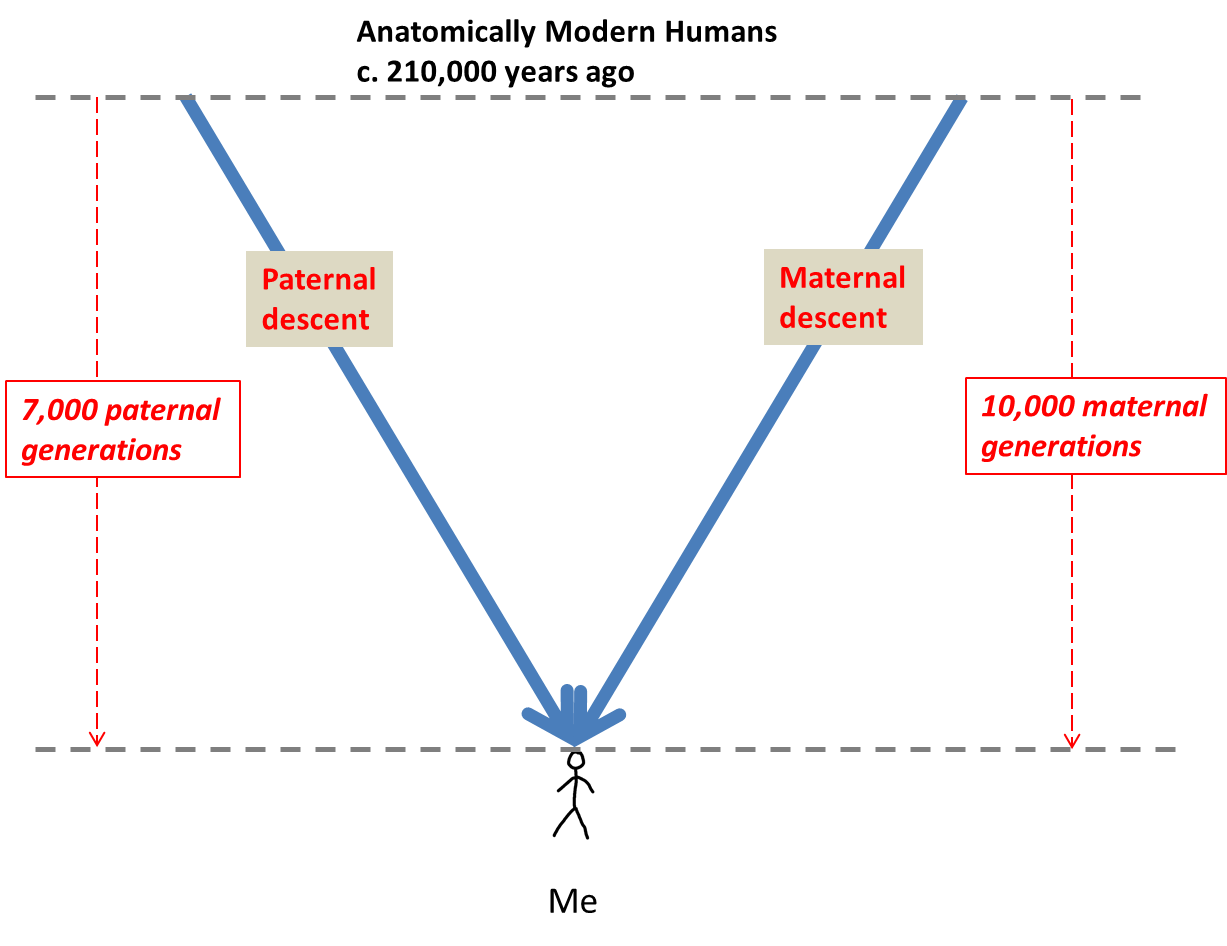
So my grandfather’s grandfather was born at about the same time as my grandmother’s, grandmother’s grandmother. From just about 1860, I am the product of 4 generations on my paternal line but of 6 generations on my maternal line. The same pattern is reproduced all the way back to when Anatomically Modern Humans began some 210,000 years ago and possibly even before that. But that means that everybody living today, for any given time period going back, has a maternal line of descent containing around 40% more generations than the paternal line of descent.

The conclusion is simply that the maternal line, generationally (and therefore also in evolutionary terms), is almost half as long again and therefore, that much more advanced than the paternal line.

Woman smarter (by 3,000 generations)

Woman smarter (by 3,000 generations)

Since the “start” of modern humans we have 3,000 more generations on the line of all our mothers than the line of all our fathers (7,000 fathers of fathers and 10,000 mothers of mothers).

Much is explained.

Remember the Harry Belafonte song, “Man smart – women smarter”.

I say let us put man and a woman together
To find out which one is smarter
Some say man but I say no
The woman got the man de day should know

And not me but the people they say
That de man are leading de women astray
But I say, that the women of today
Smarter than the man in every way

………..

Garden of Eden was very nice
Adam never work in Paradise
Eve meet snake, Paradise gone
She make Adam work from that day on

Methusaleh spent all his life in tears
Lived without a woman for 900 years
One day he decided to have some fun
The poor man never lived to see 900 and one

……


EU farm subsidies to a Saudi billionaire for breeding racehorses

September 29, 2016

The EU is replete with examples of how a bureaucratic process is made into a god and they lose sight of the objectives intended to be achieved by that process. Process keepers in Brussels have become more important than process objectives.

The latest example is of subsidies paid to a Saudi billionaire for a farm he owns in the UK where he breeds racehorses.

BBC:

Taxpayers are paying more than £400,000 a year to subsidise a farm where a billionaire Saudi prince breeds racehorses.

The Newmarket farm of Khalid Abdullah al Saud – owner of the legendary horse Frankel – is among the top 100 recipients of EU farm grants in the UK.

The system’s critics say Brexit will let the UK redirect £3bn in subsidies towards protecting the environment.

A spokesman for the prince declined to comment.

Farm subsidies swallow a huge chunk of the EU’s budget. They were started after World War Two to stimulate production, but led to food mountains that had to be dumped.

A compromised reform process – the so-called “greening” of the Common Agricultural Policy – resulted in farmers mostly being paid depending on how much land they own.

Frankel (horse).jpg

Frankel owned by Khalid Abdullah al Saud


Is Saudi Arabia giving up on its oil wars?

September 29, 2016

There is a faint whiff of realism entering into Saudi Arabian government policy. They have started to curb public expenditure, they have flagged salary cuts for public employees (not just now but in 2 years), they are desperately trying to diversify their economy. Much of the change has been forced due to self-inflicted collateral damage to their various “oil wars” against shale oil, against Iranian oil and against Russian oil. They have tried to use low oil price as a weapon in their political and ideological battles. But Saudi Arabia has not yet developed the capabilities (and competence) among its indigenous work force to cope without the fat cushion of oil revenues. Without foreign competence and labour, Saudi would collapse and the only thing keeping the foreign competence and labour there is oil money.

It may be a faint hint of an increasing pragmatism that for the first time in 8 years the Saudis and OPEC have agreed to a modest cut in oil production.

It is not the end of the  oil wars but it may be the beginning of the end.

Reuters: 

OPEC agreed on Wednesday modest oil output cuts in the first such deal since 2008, with the group’s leader Saudi Arabia softening its stance on arch-rival Iran amid mounting pressure from low oil prices.

“OPEC made an exceptional decision today … After two and a half years, OPEC reached consensus to manage the market,” said Iranian Oil Minister Bijan Zanganeh, who had repeatedly clashed with Saudi Arabia during previous meetings.

He and other ministers said the Organization of the Petroleum Exporting Countries would reduce output to a range of 32.5-33.0 million barrels per day. OPEC estimates its current output at 33.24 million bpd.

“We have decided to decrease the production around 700,000 bpd,” Zanganeh said.

The move would effectively re-establish OPEC production ceilings abandoned a year ago.

However, how much each country will produce is to be decided at the next formal OPEC meeting in November, when an invitation to join cuts could also be extended to non-OPEC countries such as Russia.

Oil prices jumped more than 5 percent to trade above $48 per barrel as of 2015 GMT. Many traders said they were impressed OPEC had managed to reach a compromise after years of wrangling but others said they wanted to see the details.

“This is the first OPEC deal in eight years! The cartel proved that it still matters even in the age of shale! This is the end of the ‘production war’ and OPEC claims victory,” said Phil Flynn, senior energy analyst at Price Futures Group. 

Jeff Quigley, director of energy markets at Houston-based Stratas Advisors, said the market had yet to discover who would produce what: “I want to hear from the mouth of the Iranian oil minister that he’s not going to go back to pre-sanction levels. For the Saudis, it just goes against the conventional wisdom of what they’ve been saying.”.

Saudi Energy Minister Khalid al-Falih said on Tuesday that Iran, Nigeria and Libya would be allowed to produce “at maximum levels that make sense” as part of any output limits.

That represents a strategy shift for Riyadh, which had said it would reduce output to ease a global glut only if every other OPEC and non-OPEC producer followed suit. Iran has argued it should be exempt from such limits as its production recovers after the lifting of EU sanctions earlier this year.

…….. Saudi Arabia is by far the largest OPEC producer with output of more than 10.7 million bpd, on par with Russia and the United States. Together, the three largest global producers extract a third of the world’s oil.

Iran’s production has been stagnant at 3.6 million bpd in the past three months, close to pre-sanctions levels although Tehran says it wants to ramp up output to more than 4 million bpd when foreign investments in its fields kick in. … Saudi oil revenue has halved over the past two years, forcing Riyadh to liquidate billions of dollars of overseas assets every month to pay bills and cut domestic fuel and utility subsidies last year.

It may even be that the Iranians and the Saudis are actually talking to each other.

Opec Countries (image pinterest.com)

Opec Countries (image pinterest.com)


Social class is necessary for any society and does not have to be unjust

September 28, 2016

One of the great “politically correct” myths is that people are born equal. A fundamental strength of the human race is that we are all unique individuals and not identical copies rolling off a production line. Our genes fix the envelope of our potential capabilities, and our upbringing determines to what extent we fulfill our potentials. The fundamental fallacy in Marxist theory is in the assumption that a classless society is desirable. In fact it is not even possible. Forcing or coercing unequal people to be “equal” is always unjust.

Some have considered class a “necessary evil” and most social theories assume that having classes is, in itself, unfair and a “bad thing”. But there is no example of a successful (sustainable and growing) society which has not had social classes of some kind. Ruling and ruled, rich or poor, aristocracy and peasants, masters and slaves, the political class and the great unwashed, workers and bosses, union members and others, employers and employees, producers and consumers, Brahmins and the Dalits. The Guilds were about capability and competence to begin with but later became contaminated when they became “closed”. Secret societies grew to try and create new classes which cut across other class boundaries. My hypothesis is that in any society, the inherent variations in human capabilities and competences make social classes both inevitable and necessary. Human diversity (genetic and epigenetic) is (I assume) a fundamental component for the success of the human race (again defined as being sustainable and growing). That diversity is what makes people unequal. The inequality is not, in itself, unjust. It just is. We are not clones  – thank goodness.

Since the French revolution, “egalite” has been made into a fashionable – but false god. A search for “equality” is not just incompatible with, it is also opposed, to a search for justice. It is just for a sick person to receive more care than a healthy person but it is unequal. Affirmative action may be one way of approaching fairness – but it is unequal. The “better man wins” in the Olympics is a celebration of the inherent inequality among humans. If we wanted equality of result, Usain Bolt would have to be handicapped (about 10 m would do). The capitalist goal of “to each as he deserves” and the socialist objective of “to each as he needs” are both expressions which inherently acknowledge the reality of inequality. They both seek their definitions of what is just – not what is equal.

The real issue is not, I think, to seek a classless condition which would cause society to break down, but to achieve classes which are not unjust. Classes will appear as a natural consequence of humans being gregarious. The real solution, which may well have to be a dynamic solution to fit the times, is to design the class system to be used, rather than let it appear by default. Most of the perceived injustices of class are connected to either the classes being hereditary or because movement between the classes is forbidden. The Indian caste system is grossly unjust because it is both hereditary and it forbids movement between castes. Having a class system does not necessitate oppression or injustice. At any given time, even the much vaunted “open” Swedish society also has its functioning classes, but to its credit – and even though there is a not an insignificant hereditary component – movement of individuals across class lines is possible, regular and continuous.

The real question is what attributes to use in defining classes which help a society to function and which are not unjust. It cannot be along just hereditary lines and it cannot be just based on wealth. However any class system must be able to accommodate the realities of ancestry and wealth. Parents will always seek to give their children an advantage  and wealth will always be able to purchase more. Whatever classes we invent must be capable of juxtaposing different levels of wealth within each class and must allow membership from any parentage. It should be possible to move from one class to another.

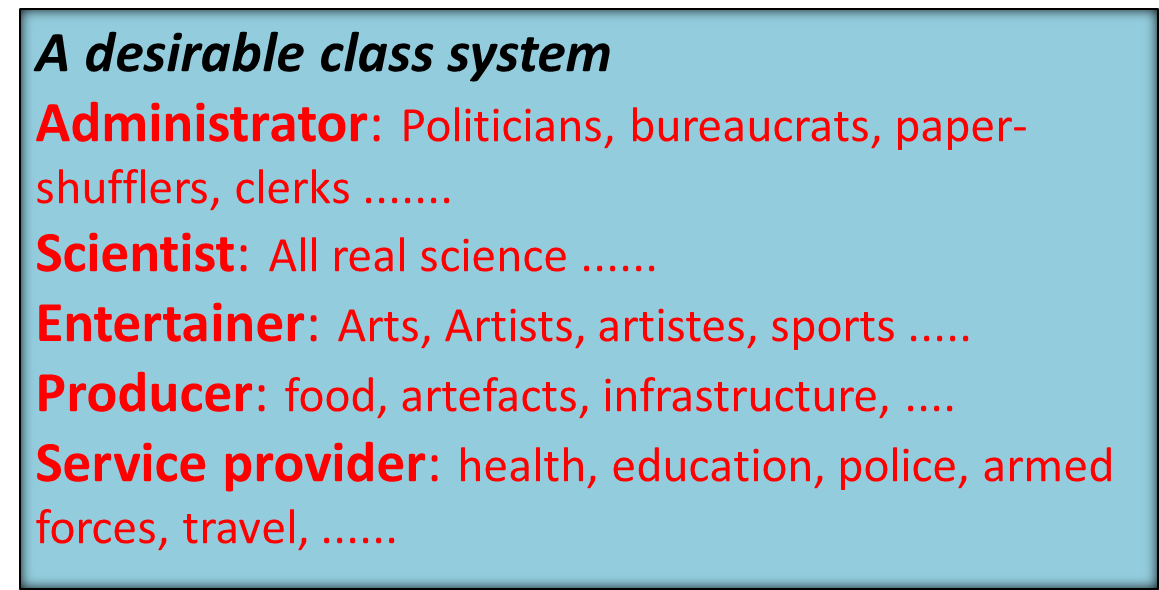
My choice of class system would then be one where the classes themselves did not create a hierarchy and where the main classification criterion would be based on the predominant, gainful occupation of the individual.  Each class would have its share of rich and poor, idiots and geniuses, and its share of parasites. Classification would not be until the prefrontal cortex was fully developed (at 25). Everybody under 25 would be a non-adult and classless. Marriage across class lines would be permitted. Voting would then be restricted to adults.

I think 5 classes will do.

5-classes


US shale gas arrives in Scotland today

September 27, 2016

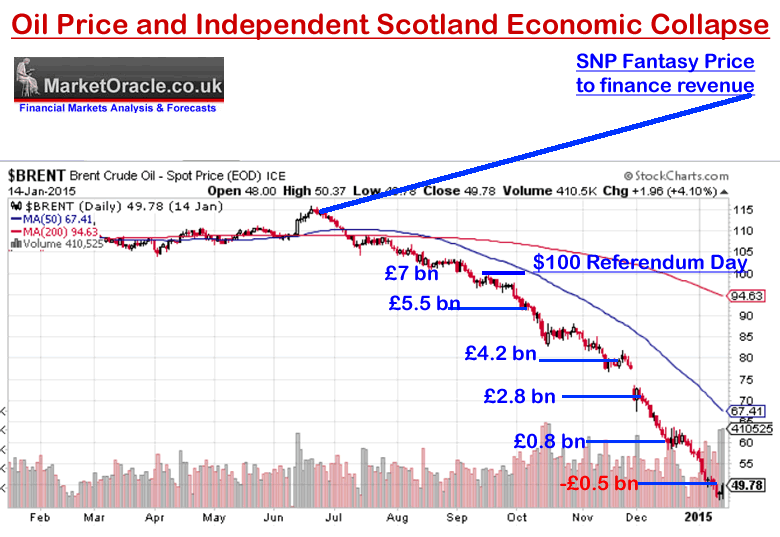
The SNP’s idiotic environmental policies means that Scotland has to import shale gas from the US even though there is plenty available locally. North Sea revenues for Scotland have collapsed and Scottish energy policy is a self-inflicted wound. In Europe generally, it is misguided, meaningless, environmental constraints on energy policies which have been a major contributor to holding back the economic recovery.

The low oil price in 2016 has effectively postponed any new independence referendum for a few years to come. Without North Sea revenues Scotland – if it wants to be an independent EU country – would be the “poor man of Europe” for 2 decades.

Image result for Scotland north sea revenue collapse

graphic: market oracle

BBC: 

The first shipment of US shale gas is arriving in Scotland amid a fierce debate about the future of fracking in the UK.

A tanker carrying 27,500m3 of ethane from US shale fields is due to dock at Grangemouth, the refinery and petrochemicals plant owned by Ineos.

The company said the gas would replace dwindling North Sea supplies and secure the future of the plant’s workforce.


When “star” athletes are permitted to dope and get a dispensation to cheat

September 25, 2016

UPDATE: Guardian article (see below).


Following on from my previous post, the BBC had this today. It reduces even further the very little confidence I have in WADA and the way in which the “sporting establishment” have permitted “stars” to cheat.

Of course these doped up athletes could do nothing wrong because they were officially permitted to “do wrong”.

Legal but unfair.

Compliant but unethical.

BBC: 

Sir Bradley Wiggins has insisted he was not trying to gain an “unfair advantage” from being allowed to use a banned steroid before major races. 

The Olympic cyclist told the BBC’s Andrew Marr Show he took the powerful anti-inflammatory drug triamcinolone for allergies and respiratory problems.

Sir Bradley said he sought therapeutic use exemptions (TUEs) to “put himself back on a level playing field”.

TUEs allow the use of banned substances if athletes have genuine medical need.

Sir Bradley’s TUEs were approved by British authorities and cycling’s world governing body, the UCI.

What is worse is the manner in which the licence to dope is justified:

Sir Hugh Robertson, vice-chairman of the British Olympic Association, told BBC Radio 5 live’s Sportsweek: “Whatever you think about whether he should have been allowed to do this, the fact is the anti-doping rules at the time allowed him to do so”.

If Bradley Wiggins had not been a star, and from a “sporting power”, I wonder if he would have got dispensation to cheat.


Epilog: 26th September

The article in today’s Guardian is more of the same but it seems pretty clear that Bradley Wiggins was given official sanction to “cheat” by the UK cycling authorities.

Guardian: …… which invited more questions than it answered in dealing with the trio of therapeutic use exemptions granted to Wiggins in 2011, 2012 and 2013 to allow him to take the powerful corticosteroid triamcinolone, for legitimate medical reasons before his biggest races of the season. …….

…….. “This was to cure a medical condition. This wasn’t about trying to find a way to gain an unfair advantage; this was about putting myself back on a level playing field in order to compete at the highest level,” Wiggins said, explaining why he had received an injection for 40mg of triamcinolone just before his triumphant 2012 Tour.

He said he had “really struggled” with respiratory problems in the run-up to the 2012 Tour one of the high points even among so many in that golden summer for British sport. But he did not really explain how that tallied with the account he gave in 2012 in his autobiography.

Then, Wiggins said: “I’d done all the work, I was fine-tuned. I was ready to go. My body was in good shape. I’m in the form of my life. I was only ill once or twice with minor colds, and I barely lost a day’s training from it.” 

Nor did he really manage to explain the contradiction between the “no needles” rhetoric espoused in the same book and the fact he received injections of a powerful drug just before the biggest races of his life; nor the fact that he has never discussed the TUEs in any of his books or since. His contention that he believed questions on needles to refer exclusively to doping is similarly hard to countenance.

It is time for WADA to be open about all athletes who have TUE’s. It’s difficult not to be cynical.