Posts Tagged ‘climate change’

“Global warming is the opiate of the upper middle class”

April 9, 2013

That “global warming” is a religion I have no doubt. But we could be going through a Martin Luther or perhaps a Galileo Galilei  moment for this religion as its foundations crumble. “Heretics” are gaining ground steadily as the high priests of the global warming religion continue to roar and bluster and threaten hell-fire and damnation.

The “religion” theme is succinctly put by Henry Payne in The Detroit News. Considering the soporific and addictive nature of the religion and its ability to induce a feeling of being superior I thought that being “an opiate of the upper middle class” was particularly apt.

Paris, France – From Anglicanism to Catholicism, Europe’s history is full of state-based religion. In secular 21st century Europe, the unofficial state religion is the GreenChurch. Environmentalism inspires a devout, pro-Kyoto devotion here quite different than the more skeptical American outlook.

But France’s strident green political and media voices are curiously silent this year. Perhaps it’s the bone-chilling spring.

Parisians used to leafy April vistas shiver past leafless trees on Paris’s beautiful, tree-lined parks. Temperatures are in the mid-40s, well below the 60s-normal. Average temperatures across the continent are, on average, 4-8 degrees below normal with March registering colder average temperatures than January. Snow fell in England, France, and Germany this spring- an unusual occurrence. The cold snap follows the frigid London Olympics last summer and over a decade of flat temperatures worldwide. Hardly the stuff of global warming. But the GreenChurch is firm in its doctrine – and the global warming high priests must be obeyed.

If Christianity was the opiate of the masses in centuries gone by, then global warming is the opiate of the upper middle class.

As such, politicians here have imposed draconian laws on their masses, from high gas taxes to high utility costs – a situation so extreme in Germany that the term “electric poverty” has become a common term. Unable to afford high energy costs imposed by government censor of sinful coal power, thousands have had their power shut off.

Here in Paris, French citizens suffer under $7.50 a gallon gas even as hey huddle at the pumps in winter overcoats. They pay their sin taxes, but, they may ask, to what end?

Climate sensitivity – 10 years on and Pat Michaels et al get their due

April 5, 2013

Back in 2002 a paper in Climate Research by Pat Michaels and his colleagues seriously questioned the sensitivities assumed in the exaggerated IPCC projections for global temperature but the paper was considered heretical and its authors were castigated by the global warming orthodoxy. So Pat Michaels and his colleagues would be more than entitled to an “I told you so” and even some more derisory nose-thumbing at the IPCC.

As Michaels and Knappenberger write at Cato:

Getting Our Due

In the Diary feature of this week’s The Spectatorrational optimist Matt Ridley has a collection of rather random observations from his daily life that have him thinking about (or maybe wishing for since Old Man Winter has been slow to loose his grip in the U.K. and Western Europe, much like he has across the Eastern U.S.) anthropogenic global warming.

What has his attention is that global warming just doesn’t seem to be going according to plan. And for those who have bought into that plan, their plan-driven actions are starting to make them look foolish.

But it’s not as if we haven’t “told you so”—a fact that Ridley draws attention to in the closing segment of his article. ……. 

What we determined in our 2002 study was that the amount of global warming projected by the end of this century was most likely being overestimated.  When we adjusted the climate model projections to take into account and better match the actual observations, our best estimate of the amount of warming we expected from 1990 to 2100 was about 1.8°C (3.2°F), which was in the lower end of the IPCC projected range, and which Ridley correctly noted, we termed as “modest.”

Further, we anticipated the slowdown in the warming rate. ….. 

…… Now, more than 10 years later, more and more evidence is piling in that we were right, including several recent papers that apply a technique not all that dissimilar in theory than our own (e.g. Gillett et al., 2012; Stott et al., 2013).

So even though we still are largely ostracized, at least we rest assured that we were pretty much on target—and some people are starting to take notice.

Revised 21st century temperature projectionsPatrick J. Michaels, Paul C. Knappenberger, Oliver W. Frauenfeld and Robert E. Davis, Climate Research, Vol. 23: 1–9, 2002

Abstract: Temperature projections for the 21st century made in the Third Assessment Report (TAR) of the United Nations Intergovernmental Panel on Climate Change (IPCC) indicate a rise of 1.4 to 5.8°C for 1990–2100. However, several independent lines of evidence suggest that the projections at the upper end of this range are not well supported. Since the publication of the TAR, several findings have appeared in the scientific literature that challenge many of the assumptions that generated the TAR temperature range. Incorporating new findings on the radiative forcing of black carbon (BC) aerosols, the magnitude of the climate sensitivity, and the strength of the climate/carbon cycle feedbacks into a simple upwelling diffusion/energy balance model similar to the one that was used in the TAR, we find that the range of projected warming for the 1990–2100 period is reduced to 1.1–2.8°C. When we adjust the TAR emissions scenarios to include an atmospheric CO2 pathway that is based upon observed CO2 increases during the past 25 yr, we find a warming range of 1.5–2.6°C prior to the adjustments for the new findings. Factoring in these findings along with the adjusted CO2 pathway reduces the range to 1.0–1.6°C. And thirdly, a simple empirical adjustment to the average of a large family of models, based upon observed changes in temperature, yields a warming range of 1.3–3.0°C, with a central value of 1.9°C. The constancy of these somewhat independent results encourages us to conclude that 21st century warming will be modest and near the low and of the IPCC TAR projections.

Climate studies a “science” is not

April 4, 2013

That climate is a subject for study is obvious. That it can be called a “discipline” is questionable but allowable. But any claim that it is settled and understood, let alone fanciful claims that we can control it, are just arrogant nonsense. When the study of climate might  get to be a “science” lies some few centuries in the future – if ever. Climate studies may be a discipline but a “science” it is not.

As with many articles in RealClearPolitics this by Robert Tracinski is trenchant, concise, precise and extremely well written. But RCP has not often been known to break with the global warming orthodoxy and I was surprised to find this there.

Very well worth reading.

The End of an Illusion

Many years ago, I remember thinking that it would take many years to refute the panicked claims about global warming. Unlike most political movements, which content themselves with making promises about, say, what the unemployment rate will be in two years if we pass a giant stimulus bill—claims that are proven wrong (and how!) relatively quickly—the environmentalists had successfully managed to put their claims so far off into the future that it would take decades to test them against reality.

But guess what? The decades are finally here.

…….. So basically, all that the global warming advocates really have, as the evidentiary basis for their theory, is that global temperatures were a little higher than usual in the late 1990s. That’s it. Which proves nothing. The climate varies, just as weather varies, and as far as we can tell, this is all well within the normal range. …..

……

So here’s the state of play of climate science a third of a century into the global warming hysteria. They don’t have a reliable baseline of global temperature measurements that would allow them to say what is normal and natural and what isn’t. Their projections about future warming are demonstrably failing to predict the actual data. And now they have been caught, yet again, fudging the numbers and manipulating the graphs to show a rapid 20th-century warming that they want to be true but which they can’t back up with actual evidence.

A theory with this many holes in it would be have been thrown out long ago, if not for the fact that it conveniently serves the political function of indicting fossil fuels as a planet-destroying evil and allowing radical environmentalists to put a modern, scientific face on their primitivist crusade to shut down industrial civilization.

But can’t we all just stop calling this “science” now? 

Full article here

Boston marathon winning times fail as a proxy for global warming temperature rise

March 31, 2013

I am not sure whether to call this “bad science” or to be generous and call it “trivial science”.

There is a new paper in PLOS ONE (open access) from “researchers” at Boston University:

Effects of Warming Temperatures on Winning Times in the Boston Marathon by Abraham J. Miller-Rushing, Richard B. Primack, Nathan Phillips and Robert K. Kaufmann, PLoS ONE 7(9): e43579. doi:10.1371/journal.pone.0043579

The only conclusions of any little value in this paper are that

  • Boston marathon winning times fail – so far – as a proxy for global warming temperature rise, and
  • if global warming increases Boston temperatures by about 5.8°C there is a 95% chance that the effect on winning time may be detectable!

Of course they could simply have reported that the variability of temperatures on race day drowned out the effects – if any – of any global temperature change. But that would have been too simple, too truthful and would not have helped towards publication.

The findings of this so-called “research” are:

  1. Higher temperatures and higher headwinds on the day of the race increase winning times for the marathon. Who would think otherwise? I would not have thought that weather conditions on any other day than race day would have much impact. Collecting this data is mildly useful but it is all readily available. Trivial.
  2. If temperatures do not increase relative to temperature variability on race days, the effects of warming on marathon times may not be detectable. However, at some point temperature increases may be large enough to affect marathon times. Amazing! So what exactly was the point of this work? Trivial.
  3. In summary, despite the well-known effect of temperature on marathon performance, we found that warming trends in Boston have not caused winning times to slow over time because of high variability in temperatures on race day. So race day temperature overrides any effects – due to global warming or anything else – on average annual temperatures. Obvious and Trivial.
  4. …. our models indicate that if race starting times had not changed and average race day temperatures continue to warm by 0.058°C/yr, a high-end estimate, we would have had a 95% chance of detecting a consistent slowing of winning marathon times by 2100. If average race day temperatures warm by 0.028°C/yr, a mid-range estimate, we would have had a 64% chance of detecting a consistent slowing of winning times by 2100. So your model says that if global warming increases race day temperatures above and beyond the natural daily variability then you have some chance of detecting this effect in the winning times! By modelling high rates of global warming  (5.8°C per century) you can force the race day temperatures to show an underlying increase such that there is a 95% chance that the effect on winning times could be detected.  The Boston marathon itself provides no evidence of global warming so far. Wow!! This is not just trivial but borders on “idiot science”.

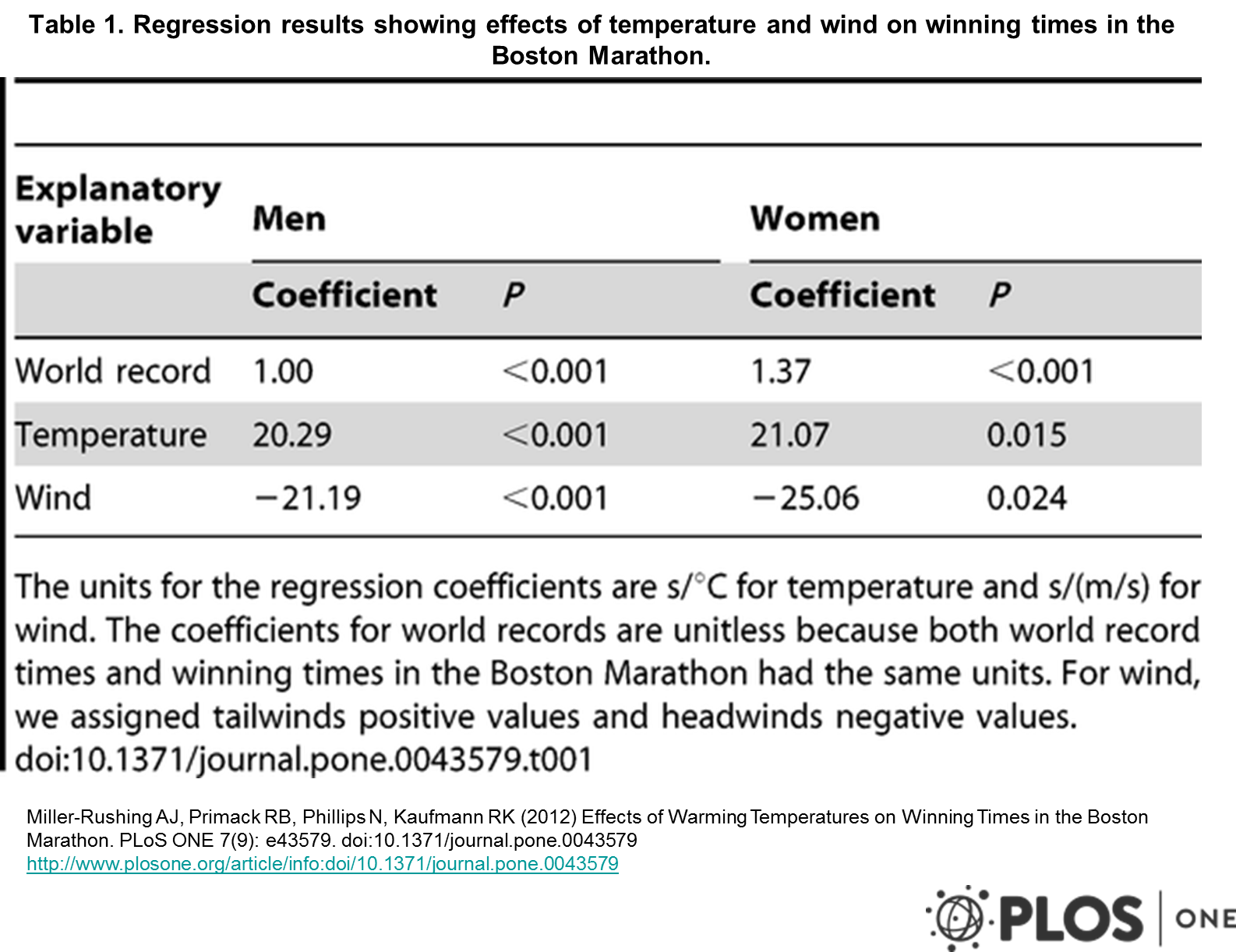
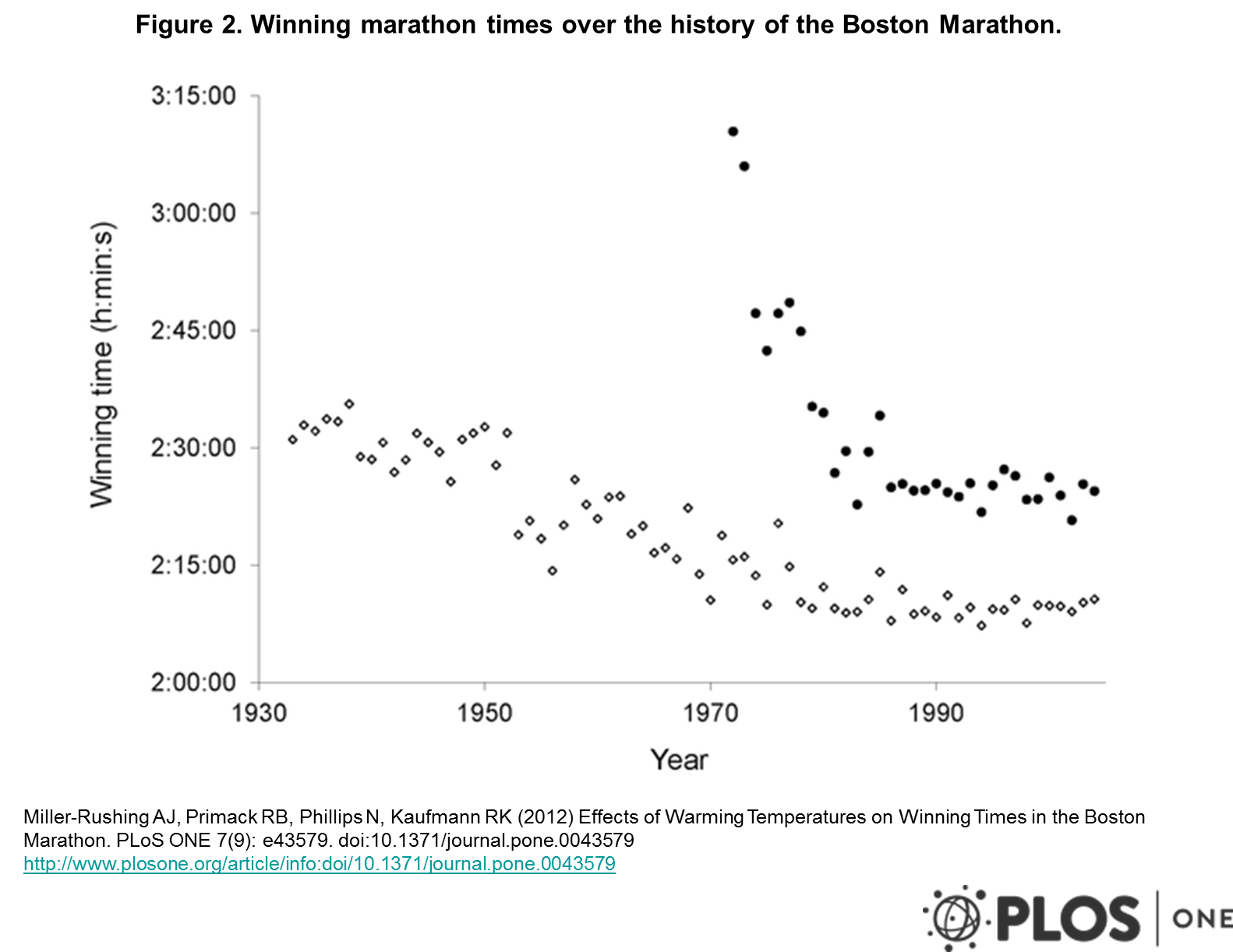
The effects of global warming clearly cannot be detected in the results of the Boston marathon. In the paper their Figure 2 and Table 1 are fairly trivial but of passing interest. The rest of their modelling efforts (input and output) are just garbage.

Miller-Rushing et al Figure 2

Open diamonds represent men’s times from 1933–2004. Closed circles represent women’s times from 1972–2004. Women’s running times improved rapidly in the first 14 yr of women’s participation in the marathon. From 1983 to 2004, the differences between men and women’s winning times held relatively constant at an average of 15 min 47 s.

Table 1. Regression results showing effects of temperature and wind on winning times in the Boston Marathon.

Table 1. Regression results showing effects of temperature and wind on winning times in the Boston Marathon.

AbstractIt is not known whether global warming will affect winning times in endurance events, and counterbalance improvements in race performances that have occurred over the past century. We examined a time series (1933–2004) from the Boston Marathon to test for an effect of warming on winning times by men and women. We found that warmer temperatures and headwinds on the day of the race slow winning times. However, 1.6°C warming in annual temperatures in Boston between 1933 and 2004 did not consistently slow winning times because of high variability in temperatures on race day. Starting times for the race changed to earlier in the day beginning in 2006, making it difficult to anticipate effects of future warming on winning times. However, our models indicate that if race starting times had not changed and average race day temperatures had warmed by 0.058°C/yr, a high-end estimate, we would have had a 95% chance of detecting a consistent slowing of winning marathon times by 2100. If average race day temperatures had warmed by 0.028°C/yr, a mid-range estimate, we would have had a 64% chance of detecting a consistent slowing of winning times by 2100.

On balance I shall just classify this as Trivial Science bordering on Bad Science

Summer time and it’s -12° C outside

March 31, 2013

Sweden -58N

We changed to summer time last night. And when I rose at 0600 today –  Easter Sunday –  (5 am according to my body clock) it was all of -12°C outside!

SMHI defines spring in Sweden as the first day – after 15th February – of 7 continuous days with temperatures between 0 and 10 °C. The “normal” onset of Spring is as below:

  • Malmö: 22nd February
  • Stockholm: 16th March
  • Östersund: 11th April
  • Kiruna: 1st May

Admittedly I am at a latitude of 58.7057° N.

At 58.7 °N spring should have come around 12th March and we are going to be around 3 weeks late (at least).

There is much clearing and spring cleaning to be done but I am not the most enthusiastic gardener in the world. The sun is warm and we should get up to an air temperature of +5°C today. But I have no intention of digging through the remaining frozen snow or risk frostbite while clipping the bushes. I shall have another cup of coffee and wait for time and natural variation to do their work.

I could do with a bit of real global warming – and not that which comes from a mathematical model.

Climate science on “negative watch”

March 30, 2013

Graphic: The Economist

The almost 20 year pause in global warming while emissions of carbon dioxide have continued to increase can no longer be ignored. Following The Economist’s article earlier this week, more of the main steam media are beginning to question if climate science is as “settled” as some would like us to believe. I would go a little further than The Australian and say that “climate science” and not just “climate sensitivity”  is now on “negative watch” if not as yet “downgraded”. While it is encouraging that some sanity may be returning to the debate as evidenced by the greater interest from the main stream media to question global warming orthodoxy (Die Welt, Jyllands Posten, Der Spiegel, The Telegraph, Daily Mail), they are already a little late. “Climate Science” has actually been at “junk” levels since Copenhagen and Climategate and is only just beginning to creep up from there!

The Australian:

DEBATE about the reality of a two-decade pause in global warming and what it means has made its way from the sceptical fringe to the mainstream.

In a lengthy article this week, The Economist magazine said if climate scientists were credit-rating agencies, then climate sensitivity – the way climate reacts to changes in carbon-dioxide levels – would be on negative watch but not yet downgraded.

Another paper published by leading climate scientist James Hansen, the head of NASA’s Goddard Institute for Space Studies, says the lower than expected temperature rise between 2000 and the present could be explained by increased emissions from burning coal.

For Hansen the pause is a fact, but it’s good news that probably won’t last.

International Panel on Climate Change chairman Rajendra Pachauri recently told The Weekend Australian the hiatus would have to last 30 to 40 years “at least” to break the long-term warming trend. 

But the fact that global surface temperatures have not followed the expected global warming pattern is now widely accepted.

Research by Ed Hawkins of University of Reading shows surface temperatures since 2005 are already at the low end of the range projections derived from 20 climate models and if they remain flat, they will fall outside the models’ range within a few years.

“The global temperature standstill shows that climate models are diverging from observations,” says David Whitehouse of the Global Warming Policy Foundation.

“If we have not passed it already, we are on the threshold of global observations becoming incompatible with the consensus theory of climate change,” he says.

Whitehouse argues that whatever has happened to make temperatures remain constant requires an explanation because the pause in temperature rise has occurred despite a sharp increase in global carbon emissions. ….. 


Upto130 years of global warming — but March is immune!

March 29, 2013

No comment!

Der Spiegel

Germany Faces Coldest March Since 1883

Complaining about the weather has reached epidemic proportions in northern Germany this “spring.” And with good reason. With Easter just around the corner, meteorologists are telling us this could end up being the coldest March in Berlin and its surroundings since records began in the 1880s. …… Meteorologists are keeping close tabs on thermometers to determine whether this March will go down as the coldest ever — since records began in the 1880s. And wiseacres on the streets of Berlin have not yet tired of noting that Easter promises to be colder than last Christmas.

The Guardian: 

Britain set for coldest March since 1962

This weekend’s great Easter getaway will be accompanied by some of the coldest March weather in decades, with temperatures in the UK set to drop to their lowest levels since 1962.

Met Office figures show that from 1 March to 26 March the UK mean temperature was 2.5C (36.5F) – three degrees below the long-term average.

This makes it the joint fourth coldest in the UK, in records going back to 1910. The coldest March in the UK was in 1962, at 1.9C (35.4F).

Real Science:

US Second Coldest March Since 1969 (So Far)

US temperatures are forecast to be far below normal for the rest of the month, so it is difficult to determine where March 2012 will end in the rankings. Possibly the coldest in 44 years.


We learn about climate only when the models are wrong!

March 29, 2013

When a forecast based on a mathematical model is correct, we learn nothing.

A mathematical model is merely a theory, a simplification of reality or an approximation to the real world. By definition a mathematical model is a hypothesis.  When forecasts are incorrect, we can return to our model and improve it and make a new hypothesis. A forecast is then a test of the model but in just one particular set of circumstances. Being correct does not prove the theory behind the model. It does of course add to the body of evidence that the model may be a satisfactory representation of reality and it does allow further forecasts to be made without tweaking the model. For learning to take place the mathematical model must be the falsifiable hypothesis of the scientific method.

It seems to me that Solar Science has a much healthier (scientifically) attitude to models and forecasts than “Climate Science”. When observations don’t match a climate forecast, the observations are impugned rather than the models being improved. This is, I think, because the forecast climate results have been used to establish huge revenue flows in the political arena (whether as taxes or carbon credits or just as research funding). There has been a vested interest in denying the observations and calling the science “settled”. Once the science is “settled”  the climate forecast and its underlying model become sacrosanct and take on the certainty of prophecy. Instead of being falsifiable hypotheses, climate model forecasts have taken on the character of unfalsifiable prophecies!

No scientist would presume to claim that we know or understand all solar effects. Or that we know and understand the role of the oceans or of the water vapour and dust and aerosols in the atmosphere. “Climate” is contained in the thin, chaotic layer of atmosphere which surrounds us. Yet “Climate Science” makes the arrogant assumption that the effect of trace amounts of carbon dioxide on climate is known definitively. Filling a real greenhouse with higher concentrations of carbon dioxide does not make that greenhouse any warmer than one filled with normal air – but the plants do grow faster with access to the additional CO2!! But – claim the climate priesthood –  in the real atmosphere, carbon dioxide causes other forcings (clouds? aerosols? precipitation effects?) which maximise warming which means that our model is still valid. Why not just admit that we don’t know what we don’t know?

The behavioural issue of course is whether it is worth trying to control something as poorly understood as climate rather than ensuring that we have the wherewithal to adapt to whatever changes may come. Another ice age will surely come whether in 10 years or a 100 years or 2,000. It will then be our ability to harness all available energy sources around us which will determine our capacity to adapt.

Learning from forecasts when they are wrong – not just in science but also in business and project management and technology development – has long been a hobby-horse of mine and is why forecasts need to be wrong.

When there is no difference there is no learning.

  • I take prophecies to be a promise about the future  based primarily on faith and made by prophets , witchdoctors, soothsayers and politicians such as ”You will be doomed to eternal damnation if you don’t do as I say”,
  • I take “forecasts” to be an estimate of future conditions based on known data with the use of calculations, logic, judgement, some intuition and even some faith. They are extrapolations of historical conditions to anticipate – and thereby plan for -future conditions.

……. Over the last 30 years I have spent of a lot of time conducting and participating in reviews. Reviews of research projects, of construction projects, of organisations and processes, of designs, of strategies and action plans, of businesses and of companies. The common features  in all these different reviews, that I have found the most penetrating, have been the comparisons not only between forecast values  and actual values, (which may be any values indicating performance and capable of being extrapolated), but also between past forecasts and current forecasts.

Whether considering construction progress or costs or sales figures or cash flow or profit or number of patents applied for, it is the differences between forecast and actual values, or values forecast before and values forecast later which have led to learning. In all these fields we are in the area of the behaviour of complex systems; and where people and their behaviour is involved any system is inevitably a complex system.

When a forecast is fulfilled there is usually an air of congratulation, satisfaction and self-adulation and this leads to a deadly complacency that everything is “settled science” and well understood. In any enterprise of any kind, that kind of complacency is the kiss of death. It is the differences which lead to questioning, to proper scientific scepticism, to further investigation and ultimately to an increase of understanding and – perhaps – a better forecast. (Of course, ignoring all such differences  and to merely “continue as before” can be equally fatal).

Which brings me to climate (which is not a science by any stretch of the imagination) and solar cycles. They are both in the realm not only of where “what we know is a great deal less than what we don’t know” but they are also both in the region where “we don’t even know what we don’t know”. We do not even know all the questions to be asked. They are both complex systems where – by definition – the complexity lies in the multitude of the processes involved and their interactions.

When climate – which is contained in the 100 m of ocean and 20 or so km thick, turbulent and chaotic atmospheric layer (and which is dimensionally miniscule in relation to the 140 million km of the earth-to-sun system) – is so complacently considered to be “settled science” then we have shifted into the area of faith and soothsaying and prophecies. When climate modellers are smug enough to believe they have understood the climate system and believe that their models are complete, then the models produce outputs which are not forecasts but prophecies. (No doubt soothsayers and shamans have sometimes made accurate prophecies but I still would not buy a used car from one of them)! Weather is in the realm of forecast (though you could argue that the most accurate forecast is still that “the weather tomorrow will be like today”) but climate is not yet there.

This kind of “arrogance” which pervades some of the climate “scientists” is not so prevalent when it comes to the study of Solar Cycles. There is a clear understanding that “we don’t know what we don’t know”. In addition to the 11 year and 22 year cycles, other cycles are hypothesised for 87 years, 210 years, 2300 years (or maybe 2241 or 2500 years) and 6000 years. We have no idea what causes these cycles. Even the 11 year cycle which has been most studied produces  surprises every day but is properly in the area of “forecast” (and hopefully never again will be in the area of prophecy). ….

…… We seem to be in a solar minimum. We may be seeing a 210 year cycle – or maybe not. There are changes to the forecasts not only regarding the maximum level of sunspot activity but also about when it will occur and what the length of cycle 24 might be. There is speculation as to what effect the length of the solar cycle may have on climate – but we haven’t a clue as to what mechanisms may be involved.  This is not to say that there isn’t much speculation and hypothesising. There is a great deal of comment about the effect these changing forecasts may have on global warming or cooling or climate disruption.  In some quarters there is much glee that the forecasts have been “wrong”. Some comments question the intelligence of the forecasters.

But of course the forecasts themselves say nothing about how the behaviour of the sun may impact our climate. They do not pretend to be prophecies or to be statements of inevitable outcomes. All they do say is that we don’t know very much – yet – about the sun. But we do know enough to make some tentative forecasts.

But I am very glad that people continue to be brave enough to make forecasts and I am quite relieved that the forecasts are not spot on. That at least ensures we will continue learning.
Climate sensitivities are not what they have been made out to be

March 27, 2013

A far from settled science! In fact – Climate Science may well be a discipline but it is a long, long way from being a science.

But the bottom line is that when “the observed trends are pushing down, whereas the models are pushing up” and “the mismatch between rising greenhouse-gas emissions and not-rising temperatures is among the biggest puzzles in climate science just now. it is time to stop fudging the models and to start examining the assumptions in the models again.

An important article and a “Must Read” even if I would take exception to their uncritical and naive acceptance of the effect of  carbon dioxide in the atmosphere.

The Economist:

OVER the past 15 years air temperatures at the Earth’s surface have been flat while greenhouse-gas emissions have continued to soar. The world added roughly 100 billion tonnes of carbon to the atmosphere between 2000 and 2010. That is about a quarter of all the CO₂ put there by humanity since 1750. And yet, as James Hansen, the head of NASA’s Goddard Institute for Space Studies, observes, “the five-year mean global temperature has been flat for a decade.”

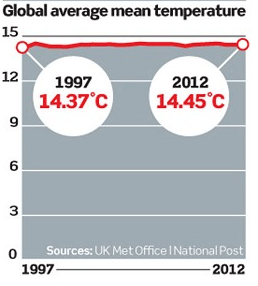
Temperatures fluctuate over short periods, but this lack of new warming is a surprise. Ed Hawkins, of the University of Reading, in Britain, points out that surface temperatures since 2005 are already at the low end of the range of projections derived from 20 climate models (see chart 1). If they remain flat, they will fall outside the models’ range within a few years.

The mismatch between rising greenhouse-gas emissions and not-rising temperatures is among the biggest puzzles in climate science just now. It does not mean global warming is a delusion. Flat though they are, temperatures in the first decade of the 21st century remain almost 1°C above their level in the first decade of the 20th. But the puzzle does need explaining.

The mismatch might mean that—for some unexplained reason—there has been a temporary lag between more carbon dioxide and higher temperatures in 2000-10. Or it might be that the 1990s, when temperatures were rising fast, was the anomalous period. Or, as an increasing body of research is suggesting, it may be that the climate is responding to higher concentrations of carbon dioxide in ways that had not been properly understood before. This possibility, if true, could have profound significance both for climate science and for environmental and social policy. ……..

………… So what does all this amount to? The scientists are cautious about interpreting their findings. As Dr Knutti puts it, “the bottom line is that there are several lines of evidence, where the observed trends are pushing down, whereas the models are pushing up, so my personal view is that the overall assessment hasn’t changed much.”

Economist article

Reality Check – Climate does not much care for Acts of Parliament

March 24, 2013

Two interesting articles today and perhaps they presage the return of some sanity to the ludicrous, Canute-like attempts to try and control climate. The first is in Die Welt (which is usually a most politically correct adherent of global warming dogma) about the nonsense that the Greens have wrought in German policy (by Sebastian Lüning and Fritz Vahrenholt reported by P. Gosselin). The second is a leader in the Telegraph calling for the repeal of the Climate Change Act in the UK.

NoTricksZone: Germany’s Energiewende [energy transition over to renewables] is being watched closely in foreign countries. Already bets are being made on whether the expensive experiment is going to work. Meanwhile increasing numbers of international experts are expressing serious doubts. In the March 20th print edition of German national daily Die Welt, Daniel Wetzel reports on a survey by the World Energy Council in an article titled “The Energiewende is an international flop”. An online version of the report is now available and bears the watered down title: “Other countries disdaining the Energiewende”:

Worldwide doubt about the success of the German Energiewende is growing. International experts are sure that the German economy is weakening. This is the finding of a survey from the World Energy Council. […] A rapid short-term shutdown of nuclear power plants along with unlimited subsidies for renewable energies: In Germany this has been viewed as the silver bullet for energy policy since the Fukushima accident. However in Europe and globally, there’s hardly a nation that views the German ‘Energiewende”’ as worth copying. These are the findings of the German section of the World Energy Council in 23 member countries, made exclusively available to Die Welt. […] The rising doubt is possibly related to the unexpectedly rapidly rising electricity prices in Germany, which are having a dissuasive effect. Stotz believes: ‘Obviously one has to be able to afford an energy transition.’ (Read more at Welt Online).

In a commentary appearing at Die Welt titled, “Germany, the odd one out”, Daniel Wetzel pleads for more prudence, and rejects climate alarmism as the most important argument for an Energiewende:

Also the necessity to rapidly end the use of fossil fuels no longer appears as urgent as it was just a few years ago. Indeed, in the meantime, fear of climate change appears to have evaporated worldwide. Global warming has been taking a break for over 10 years, and politicians in many countries appear as if they would rather await a good explanation for this phenomenon before again making the fight against climate change a high priority. Quite apart from this: one other large industrial country has just succeeded in reducing its per capita CO2 emissions to levels of the early 1960s. The best in the class when it comes to climate politics is the USA. Thanks to fracking technology in natural gas drilling, they have been able to switch off dirty coal power plants.”

“The Tory part of the Coalition is beginning to recognise some painful truths, but it is time for the Coalition to tear up its energy policy before the lights go out” says The Telegraph:

……  Because of a misguided faith in green energy, we have left ourselves far too dependent on foreign gas supplies, largely provided by Russian and Middle Eastern producers. Only 45 per cent of our gas consumption comes from domestic sources. All it takes is a spell of bad weather, and the closure of a gas pipeline from Belgium, to leave us dangerously exposed, and to send gas prices soaring. Talk of rationing may be exaggerated, but our energy policy is failing to deal with Britain’s fundamental incapacity to produce our own power.

…… It is time for the Coalition to tear up its energy policy before the lights really do go out. The first priority must be to repeal the Climate Change Act of 2008, with its brutal, punishing targets: ………  But green technology – in its current incarnation, anyway – is just too inefficient and expensive to meet our energy needs. In some of the worst weather for more than 30 years, green power still only provides a tiny fraction of our energy needs. Solar power is of limited use in our cold, dark, northern climate. And wind power isn’t much better – cold weather doesn’t necessarily mean windy weather. 

…….. He will know that American gas prices have plummeted, thanks to the US embracing the shale gas revolution. ………. Our energy problems have been deepened by the greener-than-green Liberal Democrats, with their seeming stranglehold on the Cabinet post of Energy Secretary. ………….

There is some good news, however. As we report today, government sources have said that wind power subsidies are to be cut again. This is a move in the right direction and we very much welcome it. It is to be hoped that there will be more such announcements, and concrete actions, from a government that has neglected a fundamental duty – to keep the lights on, energy affordable and our houses warm.