Posts Tagged ‘climate change’

Climate control – no less!! “A world you like – with the climate you like”

October 9, 2012

Even if anthropogenic effects on climate were significant – which they are not – the arrogance  of politicians and bureaucrats is astounding when they believe they can

  1. control the climate, and
  2. achieve this control by a “rebranding exercise”

The sun will continue on its merry way and our climate will perforce follow willy-nilly, even if our politicians and bureaucrats and so-called climate scientists think that modern day “rain dances” will give them climate control.

Perhaps they truly believe that man can control climate – and then it would not be arrogance – just gullibility or just plain stupidity! The modern-day King Canute syndrome.

Tornadoes and forest fires drastically down – It must be global warming

September 27, 2012

The orthodoxy of the Temple of Climate Science have been busy this summer trying to link every “unusual” weather event to global warming. But every time I see a headline that some weather event has been the worst for 30 or 40 or 100 years, it only serves to  illustrate that the same weather events also occurred 30 or 40 or 100 years ago. And when weather events today are similar to events before 1950 then they can only be further indicators that they are not linked to carbon dioxide emissions.

Even the IPCC realises that weather is not climate.

(more…)

New paper – “Warming since 1850 is mainly the result of natural climatic variations”

September 13, 2012

A new paper in Global and Planetary Change byNorwegian researchers has identified persistent cyclic variations in temperature records from Svalbard and Greenland. They find that some of the identified cycles correspond to variations in the Moons’ orbit around Earth and some correspond to solar variations. They find that warming since 1850 is mainly the result of natural climatic variations and conclude that the persistence of cycles makes climate forecasting feasible for limited time ranges.

And if  “warming since 1850 is mainly the result of natural climatic variations” then it just confirms that the theory that anthropogenic carbon dioxide emissions are responsible for global warming remains in the realm of speculation.

Identifying natural contributions to late Holocene climate change

by Ole Humlum, Jan-Erik Solheim and Kjell Stordahl

http://dx.doi.org/10.1016/j.gloplacha.2011.09.005

(more…)

Global temperature dependence on CO2 concentration goes missing

September 12, 2012

That climate changes and will continue to change is obvious. That this is primarily due to solar effects via the oceans also seems obvious to me. It seems the height of arrogance when – like Canute attempting to hold back the tides – climate-politicians attempt to hold back the sun and its effects. The sun cannot be carbon-taxed into submission.

That CO2 concentration in the atmosphere has little impact on climate is the reality that climate-politicians continue to deny. That the effects of man-made carbon dioxide emissions are of even less significance is becoming increasingly obvious.

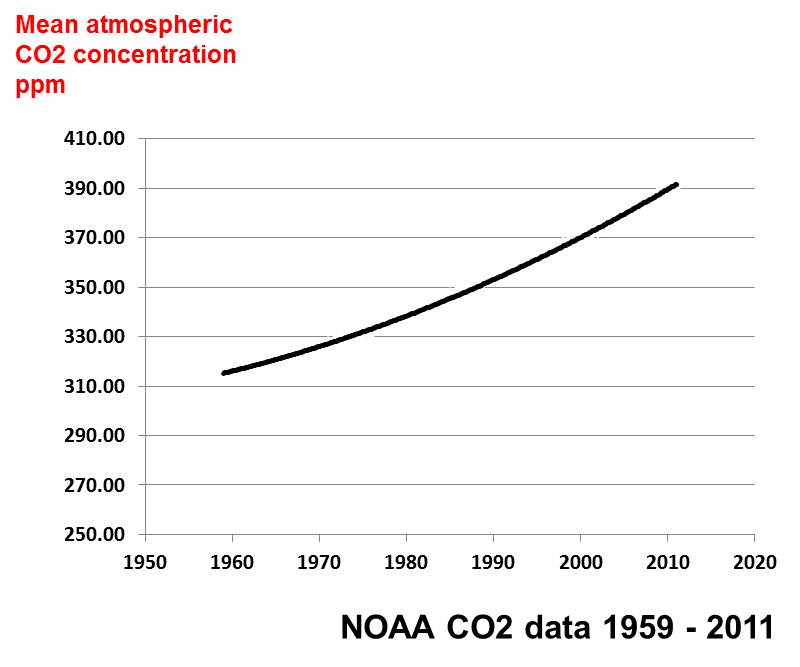
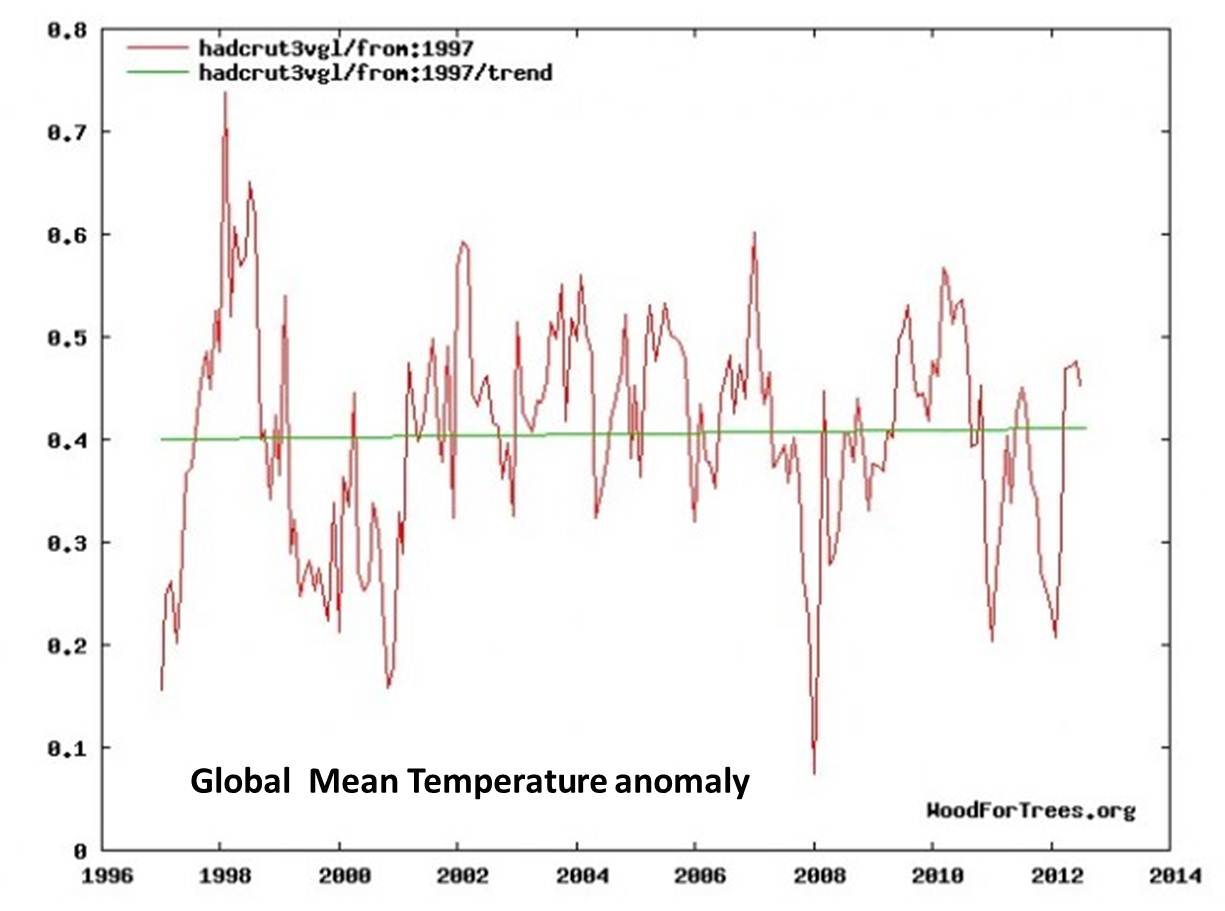
Over the last 16 years global temperatures have been pretty flat (actually the trend is very slightly downwards). During this same time  the atmospheric mean CO2 concentration has continued its increasing trend of between 1.5 and 2.5 ppm /year.

The data show no causality between CO2 concentration  and global mean temperature. How much or how little man-made emissions of CO2 contribute to the global mean concentration is still open to much question.

Global mean temperatures from woodfortrees.org

Global temperature anomaly hardcrut3vgl (via http://www.woodfortrees.org)

The following plot of mean annual atmospheric CO2 concentrations is from NOAA data 

(ftp://ftp.cmdl.noaa.gov/ccg/co2/trends/co2_annmean_mlo.txt)

NOAA ESRL data

Apocalypse Not!

August 18, 2012

I have a theory that within a hundred years we will be bemoaning the lack of world population. The collapse of society will be forecast as an impending catastrophe as the total world population stabilises at less than 10 billion with the proportion of the young working population decreasing relative to the increasing numbers of the “leisured” population.  And that apocalypse too shall not come to pass.

Matt Ridley has a new essay in Wired which needs to be read. Just some excerpts below:

Apocalypse Not: Here’s Why You Shouldn’t Worry About End Times

When the sun rises on December 22, as it surely will, do not expect apologies or even a rethink. No matter how often apocalyptic predictions fail to come true, another one soon arrives. And the prophets of apocalypse always draw a following—from the 100,000 Millerites who took to the hills in 1843, awaiting the end of the world, to the thousands who believed in Harold Camping, the Christian radio broadcaster who forecast the final rapture in both 1994 and 2011. ………

(more…)

Further confirmation that carbon dioxide lags temperature by hundreds of years

July 24, 2012

I find the blithe assumption – based on supposition and without any evidence – that carbon dioxide has any significant impact on climate, perhaps the most irritating part of the politically correct global warming dogma. I have no objection to it being a hypothesis but it is not rational to take such an hypothesis as fact just  “because there is no other explanation”. In fact, solar effects provide most of the “missing” explanation but since solar effects cannot be put down to man and clearly this is politically incorrect!!

Historical data of ice ages shows that carbon dioxide changes lag temperature changes and previously it seemed that the lag might be as long as 700 – 1000 years. Researchers from the University of Copenhagen have published a new paper. The paper suggests that the lag was more likely a few hundred years and less than 400 years. But lag it was. I draw two main conclusions:

  1. That carbon dioxide variations in the past were primarily caused by temperature changes and not the other way around, and
  2. That the degassing of the oceans following a temperature rise caused an increase in carbon dioxide  in just a few hundred years.

Of course this does not prove that increasing carbon dioxide emissions cannot influence temperature. But what it does show is that the primary link between temperature and CO2  is that temperature leads CO2 concentration.

Given that

  1. there have been no “temperature runaways” in the past where the subsequent increase of  CO2 concentration has provided a positive feedback to the initial temperature rise and
  2. given that in any system which tends to an equilibrium the effect tends to neutralise the cause,

I find it more plausible that increasing CO2 concentration may well have contributed to neutralising the temperature increase which caused the CO2 emission in the first place.

The greatest climate change the world has seen in the last 100,000 years was the transition from the ice age to the warm interglacial period. New research from the Niels Bohr Institute at the University of Copenhagen indicates that, contrary to previous opinion, the rise in temperature and the rise in the atmospheric COfollow each other closely in terms of time. The results have been published in the scientific journal, Climate of the Past. …

It had previously been thought that as the temperature began to rise at the end of the ice age approximately 19,000 years ago, an increase in the amount of CO2 in the atmosphere followed with a delay of up to 1,000 years.

“Our analyses of ice cores from the ice sheet in Antarctica shows that the concentration of CO2 in the atmosphere follows the rise in Antarctic temperatures very closely and is staggered by a few hundred years at most,” explains Sune Olander Rasmussen, Associate Professor and centre coordinator at the Centre for Ice and Climate at the Niels Bohr Institute at the University of Copenhagen.

Tightened constraints on the time-lag between Antarctic temperature and CO2during the last deglaciation by J. B. Pedro, S. O. Rasmussen, and T. D. van Ommen Clim. Past, 8, 1213-1221, 2012

Breaking weather records from a century ago only shows that it was hotter before CO2 emissions began

July 14, 2012

I am off again on an assignment for a few days and blogging will be light.

It’s summer and where I’m going torrential rain or blistering sunshine with temperatures over 45 °C  are quite normal for this time of year. If it is raining the temperature may be down to 25°C. So I’m prepared for a possible variation of some 20 deg C. It’s just weather.

I note the usual summer stories from around the world of heat waves in some places and “coldest” Junes in a 100 years in others. Some farmers are complaining about droughts and others are complaining about floods. Where societies have ignored repairs or have not built up their infrastructure to match the changing concentrations of urban populations – disasters occur. But I also note that when parts of the US declares that they have just had the hottest period for 50 years or 100 years or whatever and that this is “proof” of global warming they conveniently forget that 50 years ago or 100 years ago or whenever, man-made emissions of carbon dioxide were orders of magnitude lower. When weather records from a hundred years ago are broken it only proves that it was hotter/colder/stormier/wetter/drier or whatever long before the modern industrial age and before any significant man man-made carbon dioxide emissions.  Breaking an old record only shows cyclic behaviour – not “runaway” behaviour!

It’s summer and people are on vacation and journalists are looking for stories and the silly season has begun!

Solar influence confirmed by new high-res reconstruction of 2000 years of climate in northern Europe

July 10, 2012

It’s the sun of course and it cannot be ignored – even by the IPCC.

A new paper in Nature Climate Change shows that

Solar insolation changes, resulting from long-term oscillations of orbital configurations, are an important driver of Holocene climate.

The forcing is substantial over the past 2,000 years, up to four times as large as the 1.6 W m−2 net anthropogenic forcing since 1750, but the trend varies considerably over time, space and with season. Using numerous high-latitude proxy records, slow orbital changes have recently been shown to gradually force boreal summer temperature cooling over the common era. Here, we present new evidence based on maximum latewood density data from northern Scandinavia, indicating that this cooling trend was stronger (−0.31 °C per 1,000 years, ±0.03 °C) than previously reported, and demonstrate that this signature is missing in published tree-ring proxy records. The long-term trend now revealed in maximum latewood density data is in line with coupled general circulation models indicating albedo-driven feedback mechanisms and substantial summer cooling over the past two millennia in northern boreal and Arctic latitudes. These findings, together with the missing orbital signature in published dendrochronological records, suggest that large-scale near-surface air-temperature reconstructions relying on tree-ring data may underestimate pre-instrumental temperatures including warmth during Medieval and Roman times.

Orbital forcing of tree-ring data by Jan Esper, David C. Frank, Mauri Timonen, Eduardo Zorita, Rob J. S. Wilson, Jürg Luterbacher, Steffen Holzkämper, Nils Fischer, Sebastian Wagner, Daniel Nievergelt, Anne Verstege & Ulf Büntgen Nature Climate Change (2012) doi:10.1038/nclimate1589 

Received 27 March 2012  Accepted 15 May 2012  Published online 08 July 2012

image Johannes Gutenberg University Mainz (JGU)

(more…)
Reuters gets it wrong again: If Chinese emissions have been higher than assumed then emissions have even less effect on climate than thought!

June 11, 2012

Reuters reports that Chinese carbon dioxide emissions may be some 20% higher than previously thought. But then the Reuters reporters (David Fogarty and David Stanway) and their editor Jonathan Thatcher get their knickers properly in a twist and conclude that this suggests that “the pace of global climate change could be even faster than currently predicted”.

Perhaps some bright schoolboy could point out to our intrepid reporters that if the change in B is supposed to be dependent upon the change in A and if the change in A is actually higher than assumed, then the change in B is less dependent upon the change in A than assumed.

(more…)

Snowfall in Sweden and the coldest June day in Stockholm for 84 years

June 3, 2012

It’s weather not climate of course.

But is it Global warming?  or is it Global cooling? or just normal changes of climate which no so-called “climate scientist” understands or is capable of predicting.

http://www.scancomark.se

Friday, 01 June 2012
On the calendar, today is the first of June which is supposed to be a real summer day. This means that we were supposed to have great sunshine and would be outside in our gardens basking – if not at work though.

But such is not the reality if you live in the Swedish town of Långsjöby a couple miles from Storuman in Västerbotten. Here it has been snowing enough that a few centimetres of snow is visibly gathering  on the ground now. Visitors to the town from places such as Stockholm were surprised to find snow and some thought that they had been travelling in a time machine. 

image SvT

And yesterday on 2nd June the participants in the Stockholm marathon were met by a rainy, windy and cold day – the coldest in 84 years.

A 84-year cold record has been beaten in Stockholm. The temperature  on Saturday reached no higher than 6 degrees.

Stockholm marathon runners braving the coldest June day in 84 years image SvT