Posts Tagged ‘climate’

We learn about climate only when the models are wrong!

March 29, 2013

When a forecast based on a mathematical model is correct, we learn nothing.

A mathematical model is merely a theory, a simplification of reality or an approximation to the real world. By definition a mathematical model is a hypothesis.  When forecasts are incorrect, we can return to our model and improve it and make a new hypothesis. A forecast is then a test of the model but in just one particular set of circumstances. Being correct does not prove the theory behind the model. It does of course add to the body of evidence that the model may be a satisfactory representation of reality and it does allow further forecasts to be made without tweaking the model. For learning to take place the mathematical model must be the falsifiable hypothesis of the scientific method.

It seems to me that Solar Science has a much healthier (scientifically) attitude to models and forecasts than “Climate Science”. When observations don’t match a climate forecast, the observations are impugned rather than the models being improved. This is, I think, because the forecast climate results have been used to establish huge revenue flows in the political arena (whether as taxes or carbon credits or just as research funding). There has been a vested interest in denying the observations and calling the science “settled”. Once the science is “settled”  the climate forecast and its underlying model become sacrosanct and take on the certainty of prophecy. Instead of being falsifiable hypotheses, climate model forecasts have taken on the character of unfalsifiable prophecies!

No scientist would presume to claim that we know or understand all solar effects. Or that we know and understand the role of the oceans or of the water vapour and dust and aerosols in the atmosphere. “Climate” is contained in the thin, chaotic layer of atmosphere which surrounds us. Yet “Climate Science” makes the arrogant assumption that the effect of trace amounts of carbon dioxide on climate is known definitively. Filling a real greenhouse with higher concentrations of carbon dioxide does not make that greenhouse any warmer than one filled with normal air – but the plants do grow faster with access to the additional CO2!! But – claim the climate priesthood –  in the real atmosphere, carbon dioxide causes other forcings (clouds? aerosols? precipitation effects?) which maximise warming which means that our model is still valid. Why not just admit that we don’t know what we don’t know?

The behavioural issue of course is whether it is worth trying to control something as poorly understood as climate rather than ensuring that we have the wherewithal to adapt to whatever changes may come. Another ice age will surely come whether in 10 years or a 100 years or 2,000. It will then be our ability to harness all available energy sources around us which will determine our capacity to adapt.

Learning from forecasts when they are wrong – not just in science but also in business and project management and technology development – has long been a hobby-horse of mine and is why forecasts need to be wrong.

When there is no difference there is no learning.

  • I take prophecies to be a promise about the future  based primarily on faith and made by prophets , witchdoctors, soothsayers and politicians such as ”You will be doomed to eternal damnation if you don’t do as I say”,
  • I take “forecasts” to be an estimate of future conditions based on known data with the use of calculations, logic, judgement, some intuition and even some faith. They are extrapolations of historical conditions to anticipate – and thereby plan for -future conditions.

……. Over the last 30 years I have spent of a lot of time conducting and participating in reviews. Reviews of research projects, of construction projects, of organisations and processes, of designs, of strategies and action plans, of businesses and of companies. The common features  in all these different reviews, that I have found the most penetrating, have been the comparisons not only between forecast values  and actual values, (which may be any values indicating performance and capable of being extrapolated), but also between past forecasts and current forecasts.

Whether considering construction progress or costs or sales figures or cash flow or profit or number of patents applied for, it is the differences between forecast and actual values, or values forecast before and values forecast later which have led to learning. In all these fields we are in the area of the behaviour of complex systems; and where people and their behaviour is involved any system is inevitably a complex system.

When a forecast is fulfilled there is usually an air of congratulation, satisfaction and self-adulation and this leads to a deadly complacency that everything is “settled science” and well understood. In any enterprise of any kind, that kind of complacency is the kiss of death. It is the differences which lead to questioning, to proper scientific scepticism, to further investigation and ultimately to an increase of understanding and – perhaps – a better forecast. (Of course, ignoring all such differences  and to merely “continue as before” can be equally fatal).

Which brings me to climate (which is not a science by any stretch of the imagination) and solar cycles. They are both in the realm not only of where “what we know is a great deal less than what we don’t know” but they are also both in the region where “we don’t even know what we don’t know”. We do not even know all the questions to be asked. They are both complex systems where – by definition – the complexity lies in the multitude of the processes involved and their interactions.

When climate – which is contained in the 100 m of ocean and 20 or so km thick, turbulent and chaotic atmospheric layer (and which is dimensionally miniscule in relation to the 140 million km of the earth-to-sun system) – is so complacently considered to be “settled science” then we have shifted into the area of faith and soothsaying and prophecies. When climate modellers are smug enough to believe they have understood the climate system and believe that their models are complete, then the models produce outputs which are not forecasts but prophecies. (No doubt soothsayers and shamans have sometimes made accurate prophecies but I still would not buy a used car from one of them)! Weather is in the realm of forecast (though you could argue that the most accurate forecast is still that “the weather tomorrow will be like today”) but climate is not yet there.

This kind of “arrogance” which pervades some of the climate “scientists” is not so prevalent when it comes to the study of Solar Cycles. There is a clear understanding that “we don’t know what we don’t know”. In addition to the 11 year and 22 year cycles, other cycles are hypothesised for 87 years, 210 years, 2300 years (or maybe 2241 or 2500 years) and 6000 years. We have no idea what causes these cycles. Even the 11 year cycle which has been most studied produces  surprises every day but is properly in the area of “forecast” (and hopefully never again will be in the area of prophecy). ….

…… We seem to be in a solar minimum. We may be seeing a 210 year cycle – or maybe not. There are changes to the forecasts not only regarding the maximum level of sunspot activity but also about when it will occur and what the length of cycle 24 might be. There is speculation as to what effect the length of the solar cycle may have on climate – but we haven’t a clue as to what mechanisms may be involved.  This is not to say that there isn’t much speculation and hypothesising. There is a great deal of comment about the effect these changing forecasts may have on global warming or cooling or climate disruption.  In some quarters there is much glee that the forecasts have been “wrong”. Some comments question the intelligence of the forecasters.

But of course the forecasts themselves say nothing about how the behaviour of the sun may impact our climate. They do not pretend to be prophecies or to be statements of inevitable outcomes. All they do say is that we don’t know very much – yet – about the sun. But we do know enough to make some tentative forecasts.

But I am very glad that people continue to be brave enough to make forecasts and I am quite relieved that the forecasts are not spot on. That at least ensures we will continue learning.
Climate sensitivities are not what they have been made out to be

March 27, 2013

A far from settled science! In fact – Climate Science may well be a discipline but it is a long, long way from being a science.

But the bottom line is that when “the observed trends are pushing down, whereas the models are pushing up” and “the mismatch between rising greenhouse-gas emissions and not-rising temperatures is among the biggest puzzles in climate science just now. it is time to stop fudging the models and to start examining the assumptions in the models again.

An important article and a “Must Read” even if I would take exception to their uncritical and naive acceptance of the effect of  carbon dioxide in the atmosphere.

The Economist:

OVER the past 15 years air temperatures at the Earth’s surface have been flat while greenhouse-gas emissions have continued to soar. The world added roughly 100 billion tonnes of carbon to the atmosphere between 2000 and 2010. That is about a quarter of all the CO₂ put there by humanity since 1750. And yet, as James Hansen, the head of NASA’s Goddard Institute for Space Studies, observes, “the five-year mean global temperature has been flat for a decade.”

Temperatures fluctuate over short periods, but this lack of new warming is a surprise. Ed Hawkins, of the University of Reading, in Britain, points out that surface temperatures since 2005 are already at the low end of the range of projections derived from 20 climate models (see chart 1). If they remain flat, they will fall outside the models’ range within a few years.

The mismatch between rising greenhouse-gas emissions and not-rising temperatures is among the biggest puzzles in climate science just now. It does not mean global warming is a delusion. Flat though they are, temperatures in the first decade of the 21st century remain almost 1°C above their level in the first decade of the 20th. But the puzzle does need explaining.

The mismatch might mean that—for some unexplained reason—there has been a temporary lag between more carbon dioxide and higher temperatures in 2000-10. Or it might be that the 1990s, when temperatures were rising fast, was the anomalous period. Or, as an increasing body of research is suggesting, it may be that the climate is responding to higher concentrations of carbon dioxide in ways that had not been properly understood before. This possibility, if true, could have profound significance both for climate science and for environmental and social policy. ……..

………… So what does all this amount to? The scientists are cautious about interpreting their findings. As Dr Knutti puts it, “the bottom line is that there are several lines of evidence, where the observed trends are pushing down, whereas the models are pushing up, so my personal view is that the overall assessment hasn’t changed much.”

Economist article

Carbon dioxide lags “global temperature” by 9 – 12 months

February 23, 2013

Just another case of an effect being taken as a cause and yet another nail in the coffin of the “CO2 causes global warming” fantasy.

A new paper in Global and Planetary Change Volume 100, January 2013, Pages 51–69

The phase relation between atmospheric carbon dioxide and global temperature 

by Ole HumlumKjell Stordahl and Jan-Erik Solheim

Highlights:

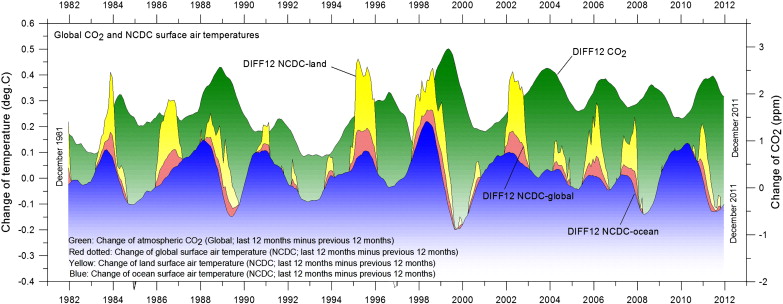
  1.  Changes in global atmospheric CO2 are lagging 11–12 months behind changes in global sea surface temperature. 
  2. Changes in global atmospheric CO2 are lagging 9.5–10 months behind changes in global air surface temperature.
  3. Changes in global atmospheric CO2 are lagging about 9 months behind changes in global lower troposphere temperature.
  4. Changes in ocean temperatures explain a substantial part of the observed changes in atmospheric CO2 since January 1980.
  5. Changes in atmospheric CO2 are not tracking changes in human emissions.
Figure 5 Humlum et al 2013

Fig. 5. 12-month change of global atmospheric CO2 concentration (NOAA; green), change in global surface air temperature (NCDC; blue), land surface air temperature (NCDC; yellow) and ocean surface air temperature (NCDC; red dotted). All graphs are showing monthly values of DIFF12, the difference between the average of the last 12 months and the average for the previous 12 months for each data series.

A week of new cold records in Delhi – must be punishment for man-made global warming

January 6, 2013

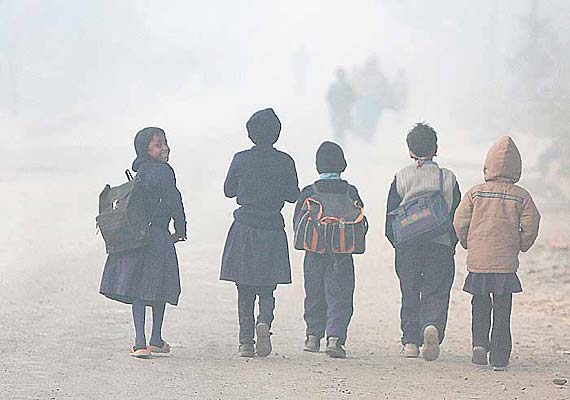
In spite of the urban heat effect and perhaps because of the religious fanaticism of the global warming pundits, every winter witnesses a significant death toll in Delhi and North India from bitterly cold weather conditions. Cold is the real killer not warmth. It is adaptation to cold which is more difficult and it is what is required.

Delhi schools to be closed till Jan 12 due to cold wave: indiatvnews.com

If instead of the Canute-like arrogance of following a pseudo-scientific religion in trying to arrest climate change, we focused on adapting and coping with the normal and real-life, variations of weather — where the magnitude of these variations  in real time dwarf those of long-term climate change — we would all be better served. It is successfully adapting to the on-going vagaries of weather (during both warming and cooling climate cycles) that has produced the greatest advances in human history. Futile attempts to control what are natural climate cycles is just plain stupid.

Cold records in Delhi: The minimum temperature in Delhi has been recorded at 1.9 degrees Celsius, which is five degrees below normal. The maximum temperature is 12.8 degrees, which is eight degrees below normal. This is the lowest minimum for January in the past five years.

…. On Saturday also, the capital had got no respite from the bitter cold as the minimum temperature settled at 2.9 degrees Celsius – four notches below average. … On Wednesday, the city witnessed the coldest day in 44 years when the maximum plummeted to 9.8 degress Celsius.

Cold wave in North India: The entire North India on Saturday continued to remain in the grip of severe cold, which claimed 11 more lives in Uttar Pradesh, taking the death toll this winter to 140.

The Nobel prize that wasn’t: A self proclaimed scientist with a self proclaimed Nobel prize

October 28, 2012

Michael Mann is no scientist – but he likes to claim he is one.

Michael Mann is no Nobel laureate – but he likes to claim he is one.

Climate “science” is no science – but Michael Mann likes to claim it is.

Time for the so-called “climate scientists” to be held accountable for their alarmism and waste.

Climate control – no less!! “A world you like – with the climate you like”

October 9, 2012

Even if anthropogenic effects on climate were significant – which they are not – the arrogance  of politicians and bureaucrats is astounding when they believe they can

  1. control the climate, and
  2. achieve this control by a “rebranding exercise”

The sun will continue on its merry way and our climate will perforce follow willy-nilly, even if our politicians and bureaucrats and so-called climate scientists think that modern day “rain dances” will give them climate control.

Perhaps they truly believe that man can control climate – and then it would not be arrogance – just gullibility or just plain stupidity! The modern-day King Canute syndrome.

New paper – “Warming since 1850 is mainly the result of natural climatic variations”

September 13, 2012

A new paper in Global and Planetary Change byNorwegian researchers has identified persistent cyclic variations in temperature records from Svalbard and Greenland. They find that some of the identified cycles correspond to variations in the Moons’ orbit around Earth and some correspond to solar variations. They find that warming since 1850 is mainly the result of natural climatic variations and conclude that the persistence of cycles makes climate forecasting feasible for limited time ranges.

And if  “warming since 1850 is mainly the result of natural climatic variations” then it just confirms that the theory that anthropogenic carbon dioxide emissions are responsible for global warming remains in the realm of speculation.

Identifying natural contributions to late Holocene climate change

by Ole Humlum, Jan-Erik Solheim and Kjell Stordahl

http://dx.doi.org/10.1016/j.gloplacha.2011.09.005

(more…)

Global temperature dependence on CO2 concentration goes missing

September 12, 2012

That climate changes and will continue to change is obvious. That this is primarily due to solar effects via the oceans also seems obvious to me. It seems the height of arrogance when – like Canute attempting to hold back the tides – climate-politicians attempt to hold back the sun and its effects. The sun cannot be carbon-taxed into submission.

That CO2 concentration in the atmosphere has little impact on climate is the reality that climate-politicians continue to deny. That the effects of man-made carbon dioxide emissions are of even less significance is becoming increasingly obvious.

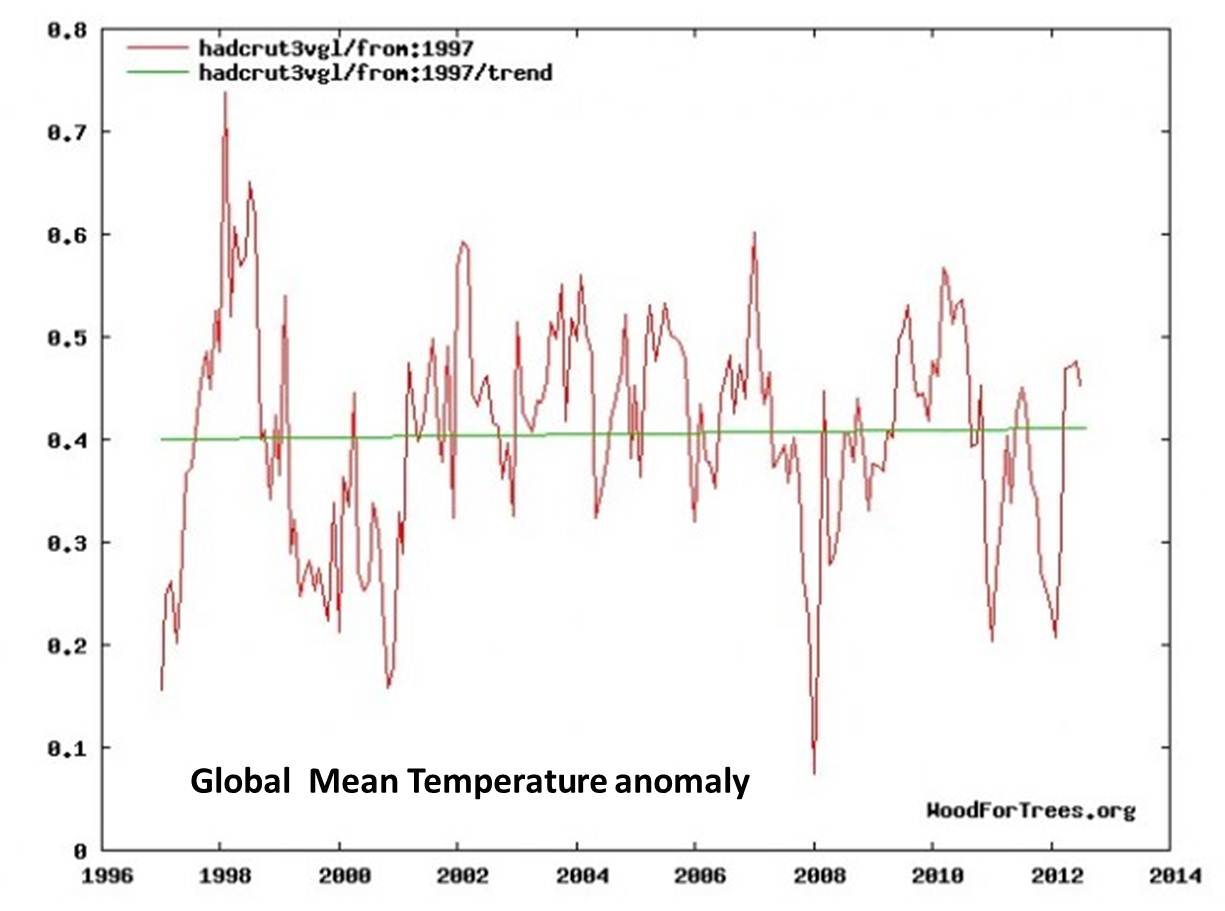
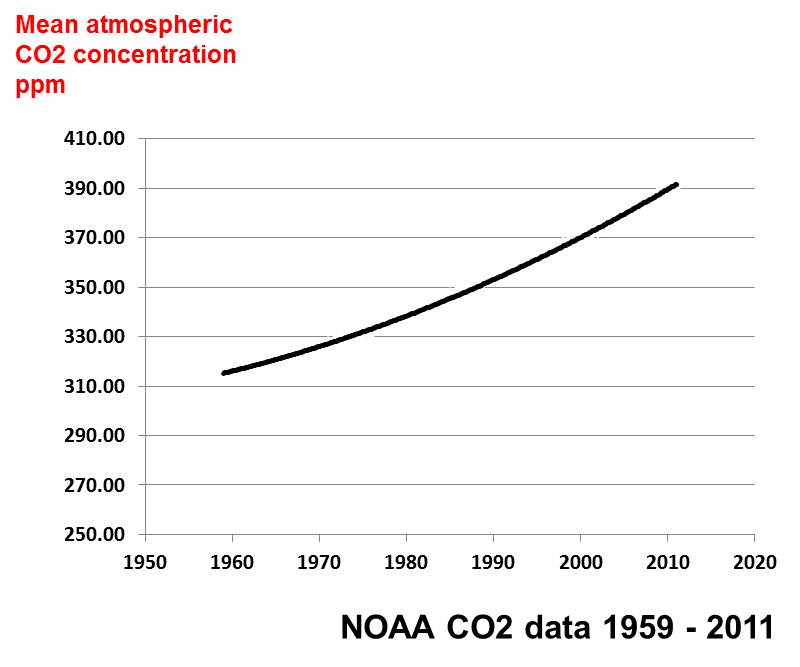
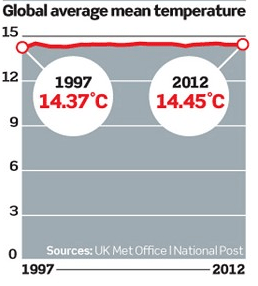
Over the last 16 years global temperatures have been pretty flat (actually the trend is very slightly downwards). During this same time  the atmospheric mean CO2 concentration has continued its increasing trend of between 1.5 and 2.5 ppm /year.

The data show no causality between CO2 concentration  and global mean temperature. How much or how little man-made emissions of CO2 contribute to the global mean concentration is still open to much question.

Global mean temperatures from woodfortrees.org

Global temperature anomaly hardcrut3vgl (via http://www.woodfortrees.org)

The following plot of mean annual atmospheric CO2 concentrations is from NOAA data 

(ftp://ftp.cmdl.noaa.gov/ccg/co2/trends/co2_annmean_mlo.txt)

NOAA ESRL data

The year when “hot air avoided Sweden with uncanny precision.”

September 5, 2012

One summer (or one winter) does not a climate make – but ……..

The Swedish Meteorological and Hydrological Institute (SMHI) has posted its summary of the 2102 summer.

In summary, one can say that the summer of 2012 was the year when “hot air avoided Sweden with uncanny precision.”

The summer of 2012 was not one of the wettest and coldest, but was probably still a disappointment for most vacationers. There was not a single extended period of warmth, sunshine and clear blue skies throughout the summer. It is twelve years since it happened last. Previously, this type of summer occurred more frequently. 1987, 1993, 1998 and 2000 are examples.

Otherwise, there was absolutely no shortage of hot air over the Northern Hemisphere. But it avoided Sweden with uncanny precision.

(more…)

Carbon dioxide lags temperature

September 3, 2012

A new paper again confirming that the theory that carbon dioxide leads global temperature is misconceived.

” Changes in global atmospheric CO2 are lagging 9.5-10 months behind changes in global air surface temperature. CO2 released from use of fossil fuels have little influence on the observed changes in the amount of atmospheric CO2.” 

The phase relation between atmospheric carbon dioxide and global temperature

by Ole HumlumKjell StordahlJan-Erik Solheim, Global and Planetary Change

Abstract

Using data series on atmospheric carbon dioxide and global temperatures we investigate the phase relation (leads/lags) between these for the period January 1980 to December 2011. Ice cores show atmospheric CO2variations to lag behind atmospheric temperature changes on a century to millennium scale, but modern temperature is expected to lag changes in atmospheric CO2, as the atmospheric temperature increase since about 1975 generally is assumed to be caused by the modern increase in CO2. In our analysis we use eight well-known datasets; 1) globally averaged well-mixed marine boundary layer CO2 data, 2) HadCRUT3 surface air temperature data, 3) GISS surface air temperature data, 4) NCDC surface air temperature data, 5) HadSST2 sea surface data, 6) UAH lower troposphere temperature data series, 7) CDIAC data on release of anthropogene CO2, and 8) GWP data on volcanic eruptions. Annual cycles are present in all datasets except 7) and 8), and to remove the influence of these we analyze 12-month averaged data. We find a high degree of co-variation between all data series except 7) and 8), but with changes in CO2 always lagging changes in temperature. The maximum positive correlation between CO2 and temperature is found for CO2 lagging 11–12 months in relation to global sea surface temperature, 9.5-10 months to global surface air temperature, and about 9 months to global lower troposphere temperature. The correlation between changes in ocean temperatures and atmospheric CO2 is high, but do not explain all observed changes.

Highlights

► The overall global temperature change sequence of events appears to be from 1) the ocean surface to 2) the land surface to 3) the lower troposphere.

►Changes in global atmospheric CO2 are lagging about 11–12 months behind changes in global sea surface temperature.

► Changes in global atmospheric CO2 are lagging 9.5-10 months behind changes in global air surface temperature. Changes in global atmospheric CO2 are lagging about 9 months behind changes in global lower troposphere temperature.

► Changes in ocean temperatures appear to explain a substantial part of the observed changes in atmospheric CO2 since January 1980.

► CO2 released from use of fossil fuels have little influence on the observed changes in the amount of atmospheric CO2, and changes in atmospheric CO2 are not tracking changes in human emissions.