Posts Tagged ‘global cooling’

Early snowfall across the Alps, Rockies and Himalayas

September 18, 2010
A panoramic view of distant Himalayan peaks fr...

View from Rohtang Pass

Snow has been falling across the world’s mountain ranges almost a month early. It could portend another long hard winter in the Northern Hemisphere.

  1. 23rd August: It’s winter in The Alps: Hard to belive it’s August, but it has been snowing across the Alps; in some place down to around 2,000m.
  2. 3rd September: A remarkable series of heavy snowfalls has brought up to two feet (60cm) of new snow to the higher slopes of the Alps, raising expectations for the coming winter. Indeed at some glacier ski areas, the 2010-11 season will begin in just a few weeks! The heavy snowfall was particularly intense over Austrian glaciers, several of which are currently open for summer skiing. The Tux glacier near Mayrhofen received more than a foot of new snow causing snow reporting agency http://www.skiinfo.co.uk to issue powder alarms to surprised subscribers to its snow alert email network earlier this week. The alarms are triggered every time there’s a snowfall of 20cm or more in 24 hours. In Switzerland Saas Fee and Zermatt are open for summer skiing too. In Saas Fee’s case it will remain open through to next May while Zermatt’s glacier is open for snow sports all year round. In Italy Cervinia is open this week but closes at the weekend, however Val Senales is currently open and was one of those reporting more than 50cm of new snow.
  3. 15th September: Nearly a month ahead of schedule, the higher reaches of Garhwal Himalayas today received snowfall, sending the mercury plummeting in Chamoli and Rudraprayag districts.  The hills around Badrinath and Kedarnath temples have received snowfall while lower areas received rainfall forcing the people to take out their woollens. Usually, the Garhwal Himalayas experience snowfall during October.
  4. 14th September: Higher reaches of this Himachal Pradesh’s picturesque tourist town experienced season’s first snowfall, on Tuesday. “Hills overlooking Manali received mild spells of snowfall Monday night,” Manmohan Singh, director of the meteorological office in Shimla said.  He said higher hills in Lahaul and Spiti, Chamba, Kinnaur and Kullu districts also experienced mild snowfall. Rohtang Pass, located at an altitude of 13,050 feet, some 50 km from here, was clad in two to three inches of snow. Meanwhile, the minimum temperature in most parts of the state came down due to rains and fresh spell of snow. While Shimla saw a low of 15.6 degrees Celsius Tuesday, it was 8.4 degrees in Keylong – the district headquarter of Lahaul and Spiti district and 11 degrees Celsius in Kalpa village of Kinnaur district.
  5. 17th September: Snow began falling in some areas of north central Montana and along the Rocky Mountain Front early on Friday , leaving some people checking their calendar to see if it is still, in fact, summer. A rain-snow mix in and around Great Falls turned to all snow around 10 am in some areas. Up to an inch of accumulation may be possible throughout Friday, and temperatures will remain in the upper 30s to low 40s. While snow in September is not unusual at higher elevations and in Glacier National Park, many lower elevations also received a dusting, with some areas reporting several inches of snow by mid-day on Friday.
  6. 17th September, Summer snow.  Summer doesn’t officially turn to fall until next week but northcentral Montana skipped right to winter on Friday, with enough snowfall in many areas to stick to the ground until late afternoon.

A whiff of common sense

September 14, 2010

Perhaps a return to some common sense instead of the religious fervour of the global warming terrorists.

  • Climate change is inevitable and warming and cooling will continue till the earth dies a “heat death” in about 4 to 5 billion years

  • The little (relative to the distance from the centre of the earth to the sun) turbulent layer of crust and atmosphere within which we live is a “chaotic” system dominated by the sun’s radiation and with the oceans as the primary vehicle for heat transport in this layer. The next largest “heat transporter” is the volcanic activity around the world and its transient effects. The atmosphere comes next and effects of its composition are dominated first by clouds and only then by the trace gases, sub-micron particulates and aerosols such as carbon dioxide and soot.
  • Climate science (which is a hotchpotch of disciplines and still a long way from being a science) can only  speculate as to the causes of and directions of climate change – from coming ice ages in the 1970’s to global warming and the melting of the ice caps in the 1990’s and to the prospects of a new little ice-age now.
  • Resorting to alarmism and the nonsensical “precautionary principle” in an attempt to control climate while still not understanding the causes of change is more than futile – it is plain stupid.

The new UK  Environment Secretary, Caroline Spelman seems to have changed tack – ever so slightly but still significantly – to focusing on adaptation rather than on trying to control or brake climate changes.

Perhaps a whiff of common sense returning. And high time for that.

The Telegraph reports that she will express this shift in her first speech on climate change. For the past few years Government policy has concentrated on trying to make people turn off lights and grow their own vegetables in an effort to bring down carbon emissions. But as global greenhouse gases continue to increase, with the growth of developing countries like China and India, and the public purse tightens, the focus will increasingly be on adapting to climate change. Temperatures are expected to rise further because of greenhouse gases that are already “locked in” but will take decades to warm the atmosphere.

http://i.telegraph.co.uk/telegraph/multimedia/archive/01408/carolinespelmanabb_1408348c.jpg

Climate change is inevitable, says Caroline Spelman

Bitter cold wave in S. America — blamed on global warming!!

August 29, 2010

The bitter cold wave being experienced in S. America does not conform to the Global Warming Religion’s creeds. Facts cannot be suppressed forever and Nature has finally acknowledged one cold event in Bolivia but even here finds a way to contort itself to claim this ” as an example of a sudden climatic change wreaking havoc on wildlife”.

Antarctic cold snap kills millions of aquatic animals in the Amazon. Cold empties Bolivian rivers of fish

dead fish

With high Andean peaks and a humid tropical forest, Bolivia is a country of ecological extremes. But during the Southern Hemisphere’s recent winter, unusually low temperatures in part of the country’s tropical region hit freshwater species hard, killing an estimated 6 million fish and thousands of alligators, turtles and river dolphins.

But the cold wave is not an isolated incident and appears to be widespread over a large part of the southern hemisphere. Der Spiegel (translation in Politically Incorrect) reports today that:

Cold wave in South America: The continent is experiencing one of the harshest winters in many years. Altogether 175 people have died as a result of the bitter cold, according to official statements. Especially affected are the more impoverished population groups who are often poorly protected from the cold by precarious housing that has no heating and are poorly cared for.

In Argentina, such low temperatures haven’t been recorded for ten years. There, 16 people froze to death, another eleven died from Carbon Monoxide poisoning because of faulty stoves. It was also unusually cold in the bordering countries: In Bolivia, 18 people fell victim to the cold, in Paraguay it was five, in Chile and Uruguay there were two each, and in southern Brazil nine people.

In addition, thousands of cattle froze to death in the pastures of Paraguay and Brazil. There aren’t stalls because normally it doesn’t get very cold, even in the winter.

In some regions of Bolivia and Peru, children had school-free days until the end of the week. In the larger cities of the region emergency shelters were opened for people who live on the street. The system for supplying electricity and natural gas were working to capacity in many communties. In Argentina there were even shortages in some provinces.

With La Niña already established the Northern Hemisphere may also be in for another harsh winter.

Further contortions are likely by the religious fanatics to show that it is just further evidence of  global warming !

How can we – if we should – prepare for a new Little Ice Age?

August 22, 2010

It seems that we are in a Solar Cycle Minimum – a Landscheidt Minimum which will perhaps be comparable to the Maunder Minimum.

The last decade has seen flat or declining global temperatures.

The Ocean temperature oscillations could indicate 20 or 30 years cooling ahead of us.

If these are all indicators of a coming Little Ice Age, then it may be time to take some preparatory actions to help humans adapt. I think adaptation to Climate Change when it happens is the key not some mis-guided and futile attempt to prevent the Climate Change from happening (as being proposed by the IPCC and other global warming fanatics).

image: http://t2.gstatic.com/images?q=tbn:TtpOoja-ueuOLM:http://www.wilsonsalmanac.com/images3/frost_fair_C18.jpg

The question which is more for engineers rather than for scientists is “What are the actions that could be taken to prepare and help for such an adaptation?”

Arctic melt season seems to be over for 2010

August 13, 2010

From the DMI mean temperatures above 80 degrees North it would seem that the Arctic melt season is over. Temperatures are now clearly below zero. This year it has been about 8 days shorter than the average melt season (green line below) of about 67 days.

Arctic tempereatures

IPCC / GISS: This is fraud !

August 12, 2010

Post by Willis Eschenbach in WUWT

There seems to be no end to the fraud-based advocacy being touted as science and propagated by the IPCC.

Temperatures in Nepal seem to have been particularly crudely “homogenised” by GISS.

IPCC Table 10.2 says: Nepal:  0.09°C per year in Himalayas and 0.04°C in Terai region, more in winter

The black line below is unadjusted temperatures and the red is temperatures after homogenisation. The yellow represents the level of “fudging” that was introduced to convert a cooling trend (in spite of the explosive urbanisation of Kathmandu and the consequent UHI effect) into a “warming” trend.

As Willis Eschenbach puts it

GISS has made a straight-line adjustment of 1.1°C in twenty years, or 5.5°C per century. They have changed a cooling trend to a strong warming trend … I’m sorry, but I see absolutely no scientific basis for that massive adjustment. I don’t care if it was done by a human using their best judgement, done by a computer algorithm utilizing comparison temperatures in India and China, or done by monkeys with typewriters. I don’t buy that adjustment, it is without scientific foundation or credible physical explanation.

This is not just shameless – it is simple fraud.

Antarctic sea ice growing fast

August 10, 2010

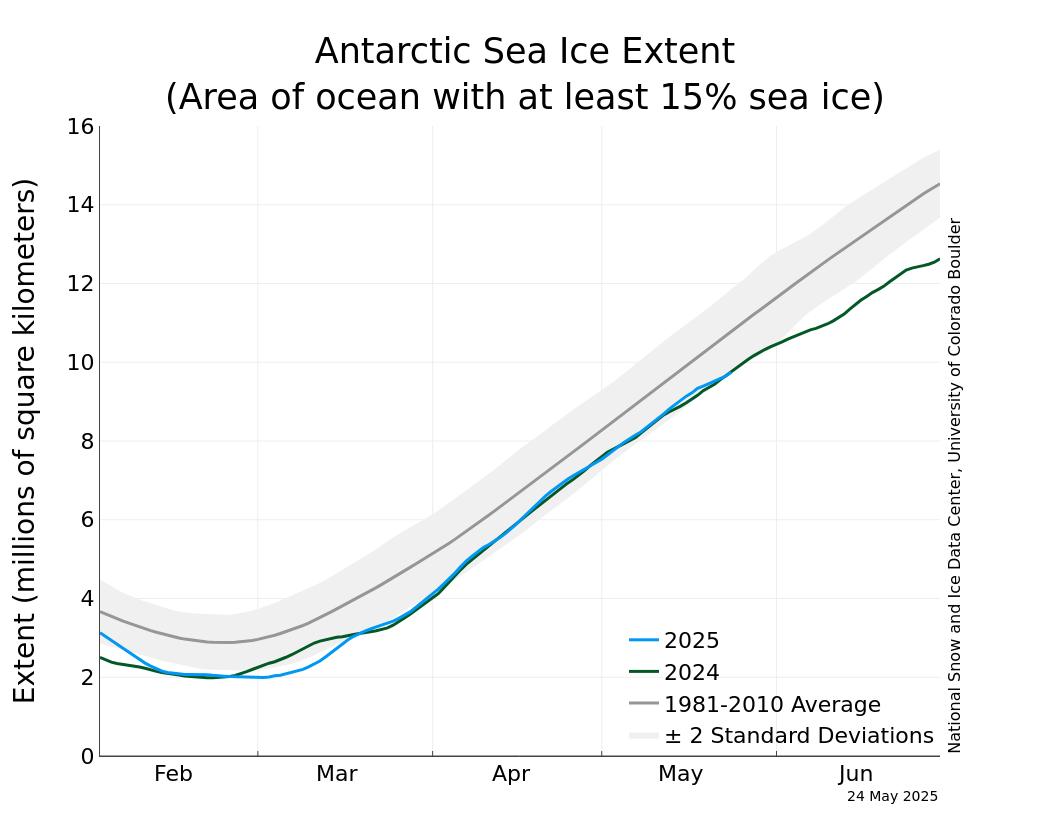
The sea ice extent in the Antarctic continues to be well above the 2009 level and more than 2 SD’s higher than the 1979-2000 average. Sea ice extent peaks at the end of September and, if anything, the growth is accelerating rather than slowing down when we are now in the middle of August.

http://nsidc.org/data/seaice_index/images/daily_images/S_stddev_timeseries.png

In the Northern Hemisphere, temperatures above the 80th parallel have dipped below freezing and are also clearly lower than the 1958 -2002 average.

http://ocean.dmi.dk/arctic/meant80n.uk.php

Looks like we are in for another long and cold winter.

La Niña conditions now established?

August 9, 2010

It would seem that La Niña conditions are no longer just a probability.  La Niña conditions are expected to strengthen towards the end of the year and through the first quarter of 2011.

In the latest bulletin issued by the NOAA (Update prepared by Climate Prediction Center / NCEP 9 August 2010) we see that

  • La Niña conditions are present across the equatorial Pacific. Negative sea surface temperature anomalies continue to strengthen across much of the Pacific Ocean.  La Niña conditions are likely to continue through early 2011
  • Since March 2010, positive SST anomalies have decreased across much of the equatorial Pacific. Since the beginning of May 2010, SST anomalies have become increasingly negative in the eastern half of the Pacific.
  • During the last four weeks, equatorial SST anomalies have been negative in the eastern half of the Pacific. During the last 30 days, negative SST anomalies increased in magnitude in the central equatorial Pacific
  • Since mid-June 2010, negative subsurface temperature anomalies have dominated the central and eastern equatorial Pacific, with only slight variations in the magnitude of the anomalies.

The formal designation of a La Niña is keyed to a 3 month mean of the Oceanic Niño Index (ONI) in Region 3.4 and is likely to happen in the first two weeks of September.


We are already in the Landscheidt minimum !!

July 27, 2010

A Massive Winter Heading for the Northern Hemisphere?

Geoff Sharp’s recent article suggests that the Landscheidt minimum is already upon us.

The winters of the past two years have been noticeably colder. The northern hemisphere in particular has experienced record cold, record snow and a rebuilding of the Arctic sea ice extent. The southern hemisphere this winter has also seen record low temperatures in South America which is resulting in many hundreds of deaths (human and livestock). There are a number of players involved which can be attributed to this cooling trend and when they come together they are capable of dropping the world’s temperatures by a significant amount.

Perhaps the most important player is the Pacific Decadal Oscillation (PDO) which is a hot and cold ocean temperature cycle in the Pacific of about 30 years. The world’s temperature trend very closely matches this cycle which has the potential to override solar activity of the day. The last major PDO cooling event was between 1946 and 1976 which experienced the highest solar cycle on record (SC19) followed by a low cycle (SC20). The deepest cold of this era was recorded when both the PDO and low solar activity teamed up, which is right where we are again today with perhaps a greater influence from the solar side with my predicted imminent grand minimum.

Aside from other ocean oscillations the ENSO pattern has a large short term effect on our climate/weather system. We are just coming out of a rather warm El Nino cycle and current observations are showing the possible impact of a very strong La Nina cooling pattern taking shape.

The La Nina phase is now official with the Australian BOM records showing all the major indicators heading into continued La Nina conditions. Of particular interest is the sub surface temperatures in the Pacific showing a large area 4 deg under normal.

Another oscillation called the Antarctic Oscillation (AAO)  is showing its highest readings since records began in 1979, during the strong 1999 and 2008 La Ninas the AAO was also high.

The cooling phase of the PDO is just beginning and should reduce the strength and frequency of future El Ninos and add extra punch and frequency to upcoming La Ninas.

So the stage is set for one of the most interesting natural experiments, nearly all the cool players are in place with the exception of the Atlantic Oscillation still not in its cool phase. I predict the extra boost from my predicted solar grand minimum along with the  current oceanic conditions the next northern winter will experience conditions similar to the Little Ice Age (1250-1850).

Adolfo Giurfa points to this map showing the cooling oceans.

The winter of 2010 / 2011 could remove many uncertainties and provide a fatal blow to global warming alarmism – though doom-day scenarios will never ever die.

Current Sea Surface Temperature Anomaly Plot

The big global ice melt is not happening

July 26, 2010

Global ice quantities are not decreasing. There is no polar meltdown at either pole.

It would seem that temperatures in the Arctic are running lower than average and the ice extent in the Antarctic continues to be higher than normal.

Perhaps the predictions of global cooling for the next 20 – 30 years are getting more probable. Moreover the sun continues to be far less active than predicted.

I cannot help feeling that global climate can only be consequent to the sun and that the primary vehicle for heat transport is the oceans. Within the atmosphere – where the heat content is puny compared to the oceans – the primary constituent of any significance is water in all its forms and the effect they have on solar radiation and the earth’s re-radiation.

The effects of man or CO2 and woefully inadequate climate models remain in the realms of the fly on the chariot wheel saying “Wow! Look at the all the dust I am raising”.