Posts Tagged ‘global warming’

Carbon dioxide warming effect is just a “marketing trick”

April 11, 2013

P Gosselin of NoTricksZone reports on this Article in the Voice of Russia a month ago – but which got little attention from the global warming orthodoxy and the politically correct media. Not that everything from Russia makes sense but in this case I think they are far closer to reality than most others. I think they pay sufficient attention to solar effects and the oceans and are not easily diverted by the fanciful demonisation of carbon dioxide:

The world facing an ice age (in German)

Gosselin writes: The article writes that Russian scientists are predicting that “a little ice age will begin in 2014“. The article adds:

“They reject the claim of global warming and call it a marketing trick.”

When it comes to warming and the man-made CO2 greenhouse gas effect, the Voice of Russia writes that “Russian scientist Vladimir Bashkin is categorically in disagreement. He claims that the climatic changes are characterized by cycles and have nothing to do in any way with the activities of man.”

Together with his colleague Rauf Galiullin from the Institute for Fundamental Problems of Biology of the Russian Academy Of Science, he demonstrates that the current warming is a reverberation of the planet coming out of the ‘Little Ice Age’ and that in the near future, of course measured on geological timescales, we are at the threshold of an ice age.”

The Voice of Russia quotes Bashkin:

“The periods of a cooling and a warming follow each other at 30-40 year intervals. In Russia for example there was a warming in the 1930s, a time when seafaring at the Northern Sea Route was possible, then a cooling followed during the wartime years, and then warming followed in the 1970s, etc.. The current warming period ended at the end of the millennium.“

Note here that the Russian scientists confirm that the Arctic sea ice extent was also low in the 1930s. This tells us that nothing is really so unusual in the Arctic today.

The Voice of Russia then explains that the cooling is related to ”a change in solar activity” and that this “also has an impact on our climate“. Bashkin adds:

“The scientific research of the climate of the past geological epoch causes us to doubt the motives behind the demands of the IPCC. […] The greenhouse effect that is connected with the anthropogenic factor is about 4 or 5 percent of that from natural emissions. The eruption of a volcano produces more. A real contribution to the greenhouse effect is made by normal water vapor. Thank God nobody has gotten the idea that this too needs to be regulated.“

The Voice of Russia continues: “The world’s oceans contain 60 times more carbon dioxide than the atmosphere. When the temperature of the planet rises, it begins to be quickly released. This leads to an increase in atmospheric CO2 concentration, and not vice versa. A global warming that so many are talking about is not so much a scientific problem, rather it is much more a marketing trick. […] We do not have global warming ahead of us, rather we have global cooling, the Russian scientist claims. However, we do not need to fear the cooling because it will take place gradually and won’t be noticeable until the middle of the 21st century.”

The scientists add that part of the motive behind the “marketing trick” is to manipulate the market for fossil fuels.
“Global warming is the opiate of the upper middle class”

April 9, 2013

That “global warming” is a religion I have no doubt. But we could be going through a Martin Luther or perhaps a Galileo Galilei  moment for this religion as its foundations crumble. “Heretics” are gaining ground steadily as the high priests of the global warming religion continue to roar and bluster and threaten hell-fire and damnation.

The “religion” theme is succinctly put by Henry Payne in The Detroit News. Considering the soporific and addictive nature of the religion and its ability to induce a feeling of being superior I thought that being “an opiate of the upper middle class” was particularly apt.

Paris, France – From Anglicanism to Catholicism, Europe’s history is full of state-based religion. In secular 21st century Europe, the unofficial state religion is the GreenChurch. Environmentalism inspires a devout, pro-Kyoto devotion here quite different than the more skeptical American outlook.

But France’s strident green political and media voices are curiously silent this year. Perhaps it’s the bone-chilling spring.

Parisians used to leafy April vistas shiver past leafless trees on Paris’s beautiful, tree-lined parks. Temperatures are in the mid-40s, well below the 60s-normal. Average temperatures across the continent are, on average, 4-8 degrees below normal with March registering colder average temperatures than January. Snow fell in England, France, and Germany this spring- an unusual occurrence. The cold snap follows the frigid London Olympics last summer and over a decade of flat temperatures worldwide. Hardly the stuff of global warming. But the GreenChurch is firm in its doctrine – and the global warming high priests must be obeyed.

If Christianity was the opiate of the masses in centuries gone by, then global warming is the opiate of the upper middle class.

As such, politicians here have imposed draconian laws on their masses, from high gas taxes to high utility costs – a situation so extreme in Germany that the term “electric poverty” has become a common term. Unable to afford high energy costs imposed by government censor of sinful coal power, thousands have had their power shut off.

Here in Paris, French citizens suffer under $7.50 a gallon gas even as hey huddle at the pumps in winter overcoats. They pay their sin taxes, but, they may ask, to what end?

Climate sensitivity – 10 years on and Pat Michaels et al get their due

April 5, 2013

Back in 2002 a paper in Climate Research by Pat Michaels and his colleagues seriously questioned the sensitivities assumed in the exaggerated IPCC projections for global temperature but the paper was considered heretical and its authors were castigated by the global warming orthodoxy. So Pat Michaels and his colleagues would be more than entitled to an “I told you so” and even some more derisory nose-thumbing at the IPCC.

As Michaels and Knappenberger write at Cato:

Getting Our Due

In the Diary feature of this week’s The Spectatorrational optimist Matt Ridley has a collection of rather random observations from his daily life that have him thinking about (or maybe wishing for since Old Man Winter has been slow to loose his grip in the U.K. and Western Europe, much like he has across the Eastern U.S.) anthropogenic global warming.

What has his attention is that global warming just doesn’t seem to be going according to plan. And for those who have bought into that plan, their plan-driven actions are starting to make them look foolish.

But it’s not as if we haven’t “told you so”—a fact that Ridley draws attention to in the closing segment of his article. ……. 

What we determined in our 2002 study was that the amount of global warming projected by the end of this century was most likely being overestimated.  When we adjusted the climate model projections to take into account and better match the actual observations, our best estimate of the amount of warming we expected from 1990 to 2100 was about 1.8°C (3.2°F), which was in the lower end of the IPCC projected range, and which Ridley correctly noted, we termed as “modest.”

Further, we anticipated the slowdown in the warming rate. ….. 

…… Now, more than 10 years later, more and more evidence is piling in that we were right, including several recent papers that apply a technique not all that dissimilar in theory than our own (e.g. Gillett et al., 2012; Stott et al., 2013).

So even though we still are largely ostracized, at least we rest assured that we were pretty much on target—and some people are starting to take notice.

Revised 21st century temperature projectionsPatrick J. Michaels, Paul C. Knappenberger, Oliver W. Frauenfeld and Robert E. Davis, Climate Research, Vol. 23: 1–9, 2002

Abstract: Temperature projections for the 21st century made in the Third Assessment Report (TAR) of the United Nations Intergovernmental Panel on Climate Change (IPCC) indicate a rise of 1.4 to 5.8°C for 1990–2100. However, several independent lines of evidence suggest that the projections at the upper end of this range are not well supported. Since the publication of the TAR, several findings have appeared in the scientific literature that challenge many of the assumptions that generated the TAR temperature range. Incorporating new findings on the radiative forcing of black carbon (BC) aerosols, the magnitude of the climate sensitivity, and the strength of the climate/carbon cycle feedbacks into a simple upwelling diffusion/energy balance model similar to the one that was used in the TAR, we find that the range of projected warming for the 1990–2100 period is reduced to 1.1–2.8°C. When we adjust the TAR emissions scenarios to include an atmospheric CO2 pathway that is based upon observed CO2 increases during the past 25 yr, we find a warming range of 1.5–2.6°C prior to the adjustments for the new findings. Factoring in these findings along with the adjusted CO2 pathway reduces the range to 1.0–1.6°C. And thirdly, a simple empirical adjustment to the average of a large family of models, based upon observed changes in temperature, yields a warming range of 1.3–3.0°C, with a central value of 1.9°C. The constancy of these somewhat independent results encourages us to conclude that 21st century warming will be modest and near the low and of the IPCC TAR projections.

Climate studies a “science” is not

April 4, 2013

That climate is a subject for study is obvious. That it can be called a “discipline” is questionable but allowable. But any claim that it is settled and understood, let alone fanciful claims that we can control it, are just arrogant nonsense. When the study of climate might  get to be a “science” lies some few centuries in the future – if ever. Climate studies may be a discipline but a “science” it is not.

As with many articles in RealClearPolitics this by Robert Tracinski is trenchant, concise, precise and extremely well written. But RCP has not often been known to break with the global warming orthodoxy and I was surprised to find this there.

Very well worth reading.

The End of an Illusion

Many years ago, I remember thinking that it would take many years to refute the panicked claims about global warming. Unlike most political movements, which content themselves with making promises about, say, what the unemployment rate will be in two years if we pass a giant stimulus bill—claims that are proven wrong (and how!) relatively quickly—the environmentalists had successfully managed to put their claims so far off into the future that it would take decades to test them against reality.

But guess what? The decades are finally here.

…….. So basically, all that the global warming advocates really have, as the evidentiary basis for their theory, is that global temperatures were a little higher than usual in the late 1990s. That’s it. Which proves nothing. The climate varies, just as weather varies, and as far as we can tell, this is all well within the normal range. …..

……

So here’s the state of play of climate science a third of a century into the global warming hysteria. They don’t have a reliable baseline of global temperature measurements that would allow them to say what is normal and natural and what isn’t. Their projections about future warming are demonstrably failing to predict the actual data. And now they have been caught, yet again, fudging the numbers and manipulating the graphs to show a rapid 20th-century warming that they want to be true but which they can’t back up with actual evidence.

A theory with this many holes in it would be have been thrown out long ago, if not for the fact that it conveniently serves the political function of indicting fossil fuels as a planet-destroying evil and allowing radical environmentalists to put a modern, scientific face on their primitivist crusade to shut down industrial civilization.

But can’t we all just stop calling this “science” now? 

Full article here

James Hansen’s exit strategy unfolding as he retires from NASA

April 2, 2013

It was just last week that I asked “Are global warmists preparing exit strategies?”, about warmists in general and about James Hansen in particular.

And today the New York Times reports that Hansen is to retire from NASA – ostensibly to free his hands as an activist. But it has been his association with NASA which has given him the pondus he has had in the global warming priesthood. He has been an embarrassment to NASA for some time but he is 72 and is surely ripe for retirement. I suspect he actually did resign (rather than being required to resign) and his “exit strategy” is playing out. It will allow him to fade quietly out of the alarmist picture he helped create before it is erased completely.

New York Times: James E. Hansen, the climate scientist who issued the clearest warning of the 20th century about the dangers of global warming, will retire from NASA this week, giving himself more freedom to pursue political and legal efforts to limit greenhouse gases.

….. At the same time, retirement will allow Dr. Hansen to press his cause in court. He plans to take a more active role in lawsuits challenging the federal and state governments over their failure to limit emissions, for instance, as well as in fighting the development in Canada of a particularly dirty form of oil extracted from tar sands.

“As a government employee, you can’t testify against the government,” he said in an interview.

Dr. Hansen had already become an activist in recent years, taking vacation time from NASA to appear at climate protests and allowing himself to be arrested or cited a half-dozen times.

But those activities, going well beyond the usual role of government scientists, had raised eyebrows at NASA headquarters in Washington. “It was becoming clear that there were people in NASA who would be much happier if the ‘sideshow’ would exit,” Dr. Hansen said in an e-mail.

When hockey sticks are not robust …

April 1, 2013

I had almost got the 1st of April out of my system but I could not resist noting that when things are not “robust” they break and the broken pieces don’t stay put.

This gets classified as misconduct.

The Marcott Filibuster

Marcott et al:  ” … 20th century portion of our paleotemperature stack is not statistically robust, cannot be considered representative of global temperature changes, and therefore is not the basis of any of our conclusions”.

Not robust

Not robust

Global warming will contaminate signals and cut internet speeds

April 1, 2013

Over the coming years we can all expect to spend more time staring at our download dialog boxes, waiting for our music or our videos to buffer and clicking away impatiently as we wait for our web pages to reload.

And it will not be the OS or our internet service providers who are to blame. It will be the effects of global warming.

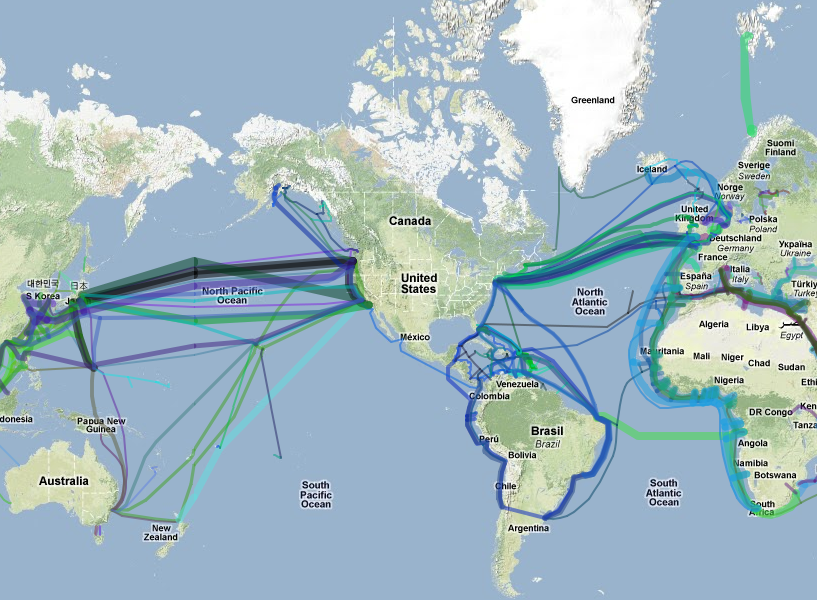
As global warming sets in and the seas warm the performance of all the undersea cables that are a critical part of global connections will be affected. A significant part of voice and data signals are transmitted through these cables and many communications services companies are entirely dependent on them. As the seas warm they will absorb increasing amounts of carbon dioxide from the atmosphere and turn acidic. While fish and all marine life have evolution to fall back upon and will adapt to the changing conditions, undersea cables being inanimate and unable to reproduce will suffer. Firstly the increasing temperature itself will cause the component fibres in the undersea cable to expand; both in length and in diameter. Secondly the acidic environment will cause them to corrode and distort.

Undersea Cable Map – The Big Picture (www.ritholtz.com)

These cables, which connect land-based transmission terminal stations across continents, are laid for tens of thousands of kilometres along the seabed. It is well known that these thick optic fibre cables can be disrupted due to many natural phenomena, such as temperature, earthquakes, extreme turbidity, current, or by coming in contact with fishing vessels or being attacked by marine life ranging from plankton to sharks.

It has now been shown conclusively by research at the International Marine Cable Research Centre (IMCRC) that increasing global temperatures will lead not only to the slowing down of signals as the marine cables expand in length, but that the integrity of signals being carried will suffer as the cable distortions lead to intertwined parallel signals getting mixed up with each other.

Just having cables in parallel cannot solve this problem. Global warming will affect all the cables. Longer cables will be affected most. Scientists at the IMCRC have modelled the performance under deteriorating conditions and calculate that these cables could become completely unusable as quickly as within 1,000 years. “We are working on an innovative solution”, said Dr. Peter Sellers, Director of the IMCRC. The International project to find a solution is being led by Dr. Martin Strangelove of the University of Pennsylvania who says, A drastic problem requires a drastic solution. We are now working on ways in which we can trigger a new ice age as a comprehensive global solution. Not only will undersea temperatures reduce but in many places alternative cables could be placed on the surface of the newly created ice sheets”.

(XPI – 1st April 2013)

Boston marathon winning times fail as a proxy for global warming temperature rise

March 31, 2013

I am not sure whether to call this “bad science” or to be generous and call it “trivial science”.

There is a new paper in PLOS ONE (open access) from “researchers” at Boston University:

Effects of Warming Temperatures on Winning Times in the Boston Marathon by Abraham J. Miller-Rushing, Richard B. Primack, Nathan Phillips and Robert K. Kaufmann, PLoS ONE 7(9): e43579. doi:10.1371/journal.pone.0043579

The only conclusions of any little value in this paper are that

  • Boston marathon winning times fail – so far – as a proxy for global warming temperature rise, and
  • if global warming increases Boston temperatures by about 5.8°C there is a 95% chance that the effect on winning time may be detectable!

Of course they could simply have reported that the variability of temperatures on race day drowned out the effects – if any – of any global temperature change. But that would have been too simple, too truthful and would not have helped towards publication.

The findings of this so-called “research” are:

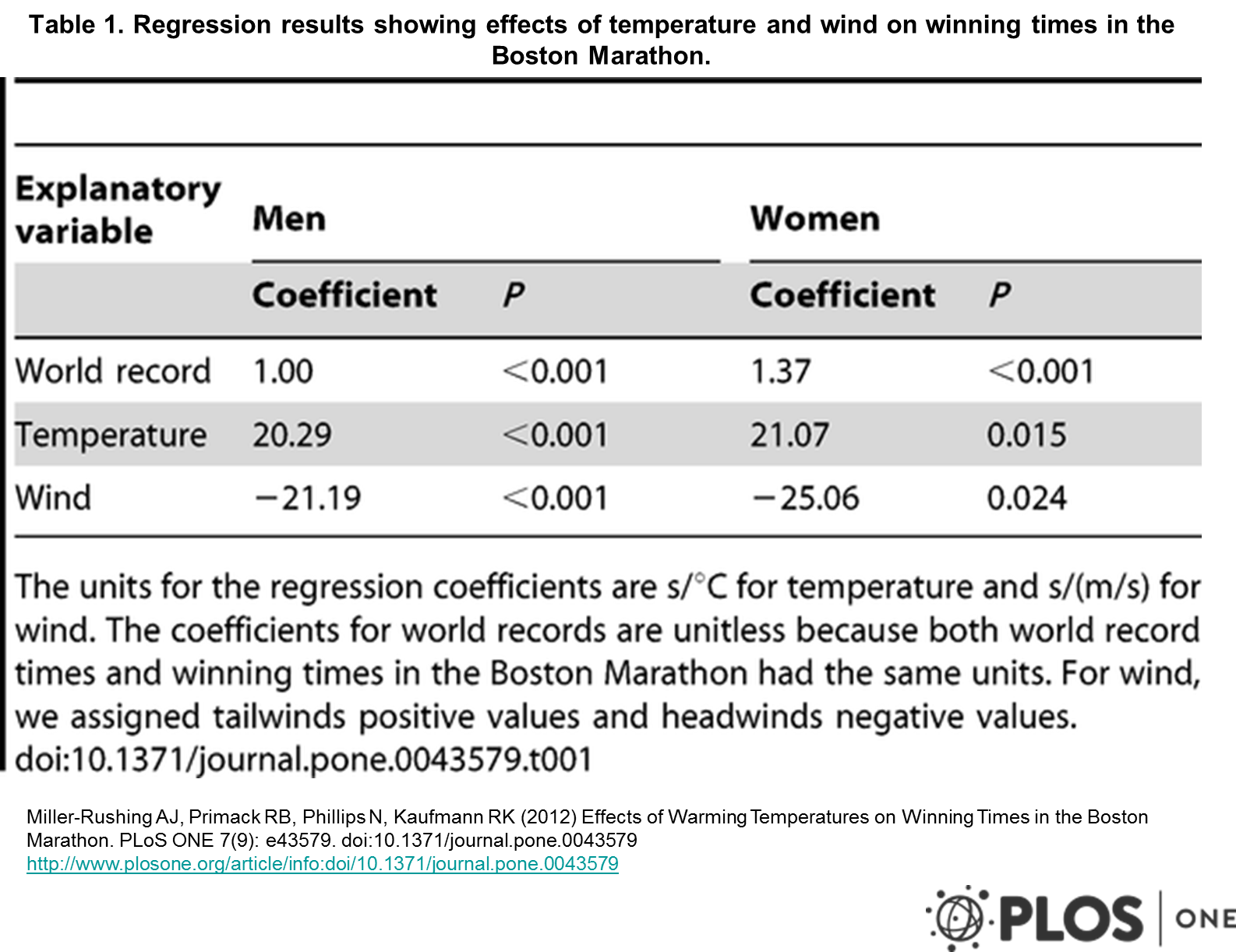
  1. Higher temperatures and higher headwinds on the day of the race increase winning times for the marathon. Who would think otherwise? I would not have thought that weather conditions on any other day than race day would have much impact. Collecting this data is mildly useful but it is all readily available. Trivial.
  2. If temperatures do not increase relative to temperature variability on race days, the effects of warming on marathon times may not be detectable. However, at some point temperature increases may be large enough to affect marathon times. Amazing! So what exactly was the point of this work? Trivial.
  3. In summary, despite the well-known effect of temperature on marathon performance, we found that warming trends in Boston have not caused winning times to slow over time because of high variability in temperatures on race day. So race day temperature overrides any effects – due to global warming or anything else – on average annual temperatures. Obvious and Trivial.
  4. …. our models indicate that if race starting times had not changed and average race day temperatures continue to warm by 0.058°C/yr, a high-end estimate, we would have had a 95% chance of detecting a consistent slowing of winning marathon times by 2100. If average race day temperatures warm by 0.028°C/yr, a mid-range estimate, we would have had a 64% chance of detecting a consistent slowing of winning times by 2100. So your model says that if global warming increases race day temperatures above and beyond the natural daily variability then you have some chance of detecting this effect in the winning times! By modelling high rates of global warming  (5.8°C per century) you can force the race day temperatures to show an underlying increase such that there is a 95% chance that the effect on winning times could be detected.  The Boston marathon itself provides no evidence of global warming so far. Wow!! This is not just trivial but borders on “idiot science”.

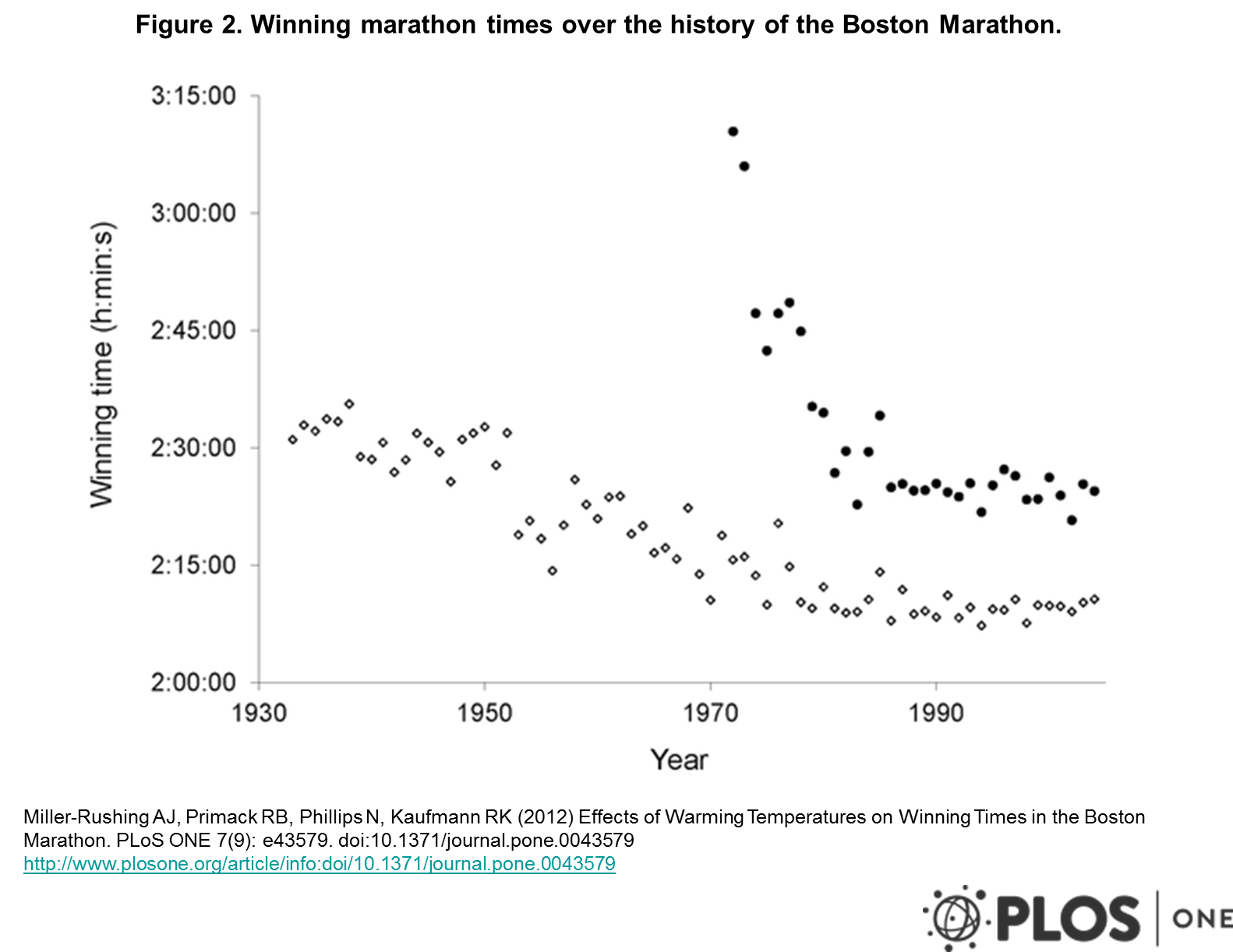
The effects of global warming clearly cannot be detected in the results of the Boston marathon. In the paper their Figure 2 and Table 1 are fairly trivial but of passing interest. The rest of their modelling efforts (input and output) are just garbage.

Miller-Rushing et al Figure 2

Open diamonds represent men’s times from 1933–2004. Closed circles represent women’s times from 1972–2004. Women’s running times improved rapidly in the first 14 yr of women’s participation in the marathon. From 1983 to 2004, the differences between men and women’s winning times held relatively constant at an average of 15 min 47 s.

Table 1. Regression results showing effects of temperature and wind on winning times in the Boston Marathon.

Table 1. Regression results showing effects of temperature and wind on winning times in the Boston Marathon.

AbstractIt is not known whether global warming will affect winning times in endurance events, and counterbalance improvements in race performances that have occurred over the past century. We examined a time series (1933–2004) from the Boston Marathon to test for an effect of warming on winning times by men and women. We found that warmer temperatures and headwinds on the day of the race slow winning times. However, 1.6°C warming in annual temperatures in Boston between 1933 and 2004 did not consistently slow winning times because of high variability in temperatures on race day. Starting times for the race changed to earlier in the day beginning in 2006, making it difficult to anticipate effects of future warming on winning times. However, our models indicate that if race starting times had not changed and average race day temperatures had warmed by 0.058°C/yr, a high-end estimate, we would have had a 95% chance of detecting a consistent slowing of winning marathon times by 2100. If average race day temperatures had warmed by 0.028°C/yr, a mid-range estimate, we would have had a 64% chance of detecting a consistent slowing of winning times by 2100.

On balance I shall just classify this as Trivial Science bordering on Bad Science

Summer time and it’s -12° C outside

March 31, 2013

Sweden -58N

We changed to summer time last night. And when I rose at 0600 today –  Easter Sunday –  (5 am according to my body clock) it was all of -12°C outside!

SMHI defines spring in Sweden as the first day – after 15th February – of 7 continuous days with temperatures between 0 and 10 °C. The “normal” onset of Spring is as below:

  • Malmö: 22nd February
  • Stockholm: 16th March
  • Östersund: 11th April
  • Kiruna: 1st May

Admittedly I am at a latitude of 58.7057° N.

At 58.7 °N spring should have come around 12th March and we are going to be around 3 weeks late (at least).

There is much clearing and spring cleaning to be done but I am not the most enthusiastic gardener in the world. The sun is warm and we should get up to an air temperature of +5°C today. But I have no intention of digging through the remaining frozen snow or risk frostbite while clipping the bushes. I shall have another cup of coffee and wait for time and natural variation to do their work.

I could do with a bit of real global warming – and not that which comes from a mathematical model.

Climate science on “negative watch”

March 30, 2013

Graphic: The Economist

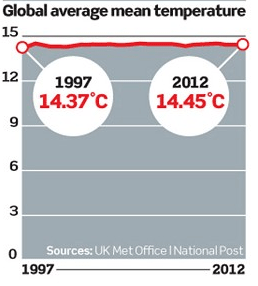
The almost 20 year pause in global warming while emissions of carbon dioxide have continued to increase can no longer be ignored. Following The Economist’s article earlier this week, more of the main steam media are beginning to question if climate science is as “settled” as some would like us to believe. I would go a little further than The Australian and say that “climate science” and not just “climate sensitivity”  is now on “negative watch” if not as yet “downgraded”. While it is encouraging that some sanity may be returning to the debate as evidenced by the greater interest from the main stream media to question global warming orthodoxy (Die Welt, Jyllands Posten, Der Spiegel, The Telegraph, Daily Mail), they are already a little late. “Climate Science” has actually been at “junk” levels since Copenhagen and Climategate and is only just beginning to creep up from there!

The Australian:

DEBATE about the reality of a two-decade pause in global warming and what it means has made its way from the sceptical fringe to the mainstream.

In a lengthy article this week, The Economist magazine said if climate scientists were credit-rating agencies, then climate sensitivity – the way climate reacts to changes in carbon-dioxide levels – would be on negative watch but not yet downgraded.

Another paper published by leading climate scientist James Hansen, the head of NASA’s Goddard Institute for Space Studies, says the lower than expected temperature rise between 2000 and the present could be explained by increased emissions from burning coal.

For Hansen the pause is a fact, but it’s good news that probably won’t last.

International Panel on Climate Change chairman Rajendra Pachauri recently told The Weekend Australian the hiatus would have to last 30 to 40 years “at least” to break the long-term warming trend. 

But the fact that global surface temperatures have not followed the expected global warming pattern is now widely accepted.

Research by Ed Hawkins of University of Reading shows surface temperatures since 2005 are already at the low end of the range projections derived from 20 climate models and if they remain flat, they will fall outside the models’ range within a few years.

“The global temperature standstill shows that climate models are diverging from observations,” says David Whitehouse of the Global Warming Policy Foundation.

“If we have not passed it already, we are on the threshold of global observations becoming incompatible with the consensus theory of climate change,” he says.

Whitehouse argues that whatever has happened to make temperatures remain constant requires an explanation because the pause in temperature rise has occurred despite a sharp increase in global carbon emissions. …..