Posts Tagged ‘Maunder Minimum’

Solar Cycle 24 is unusually quiet but not unprecedented

December 29, 2010

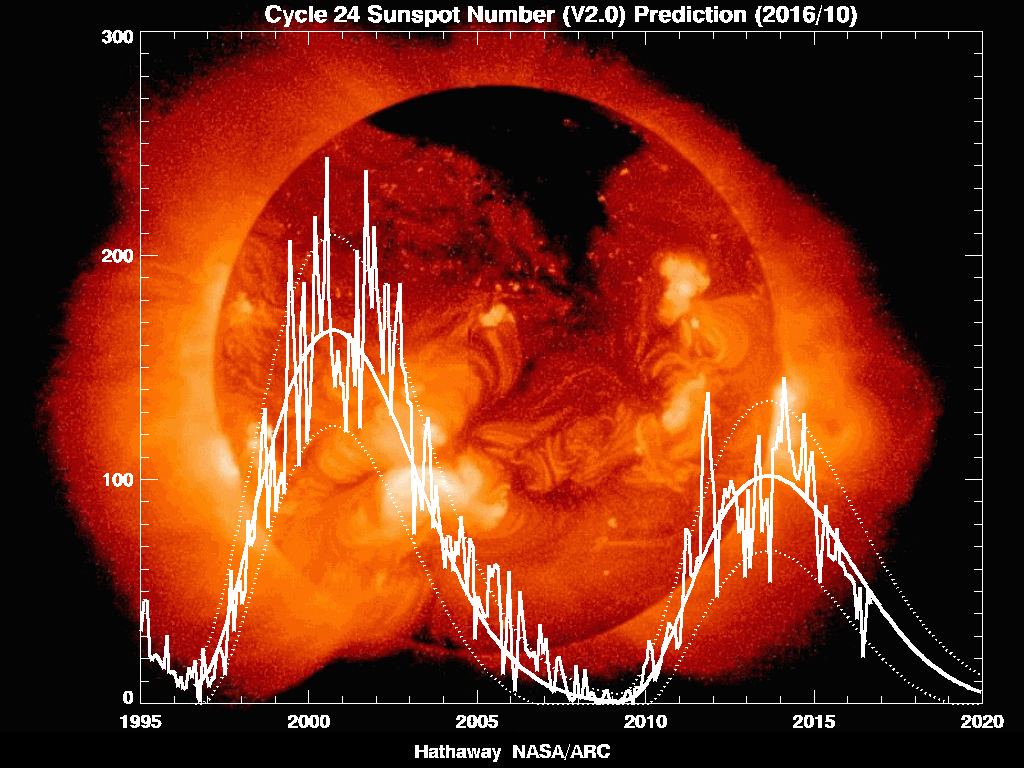
NASA has made a new reduced forecast for the peak sunspot number and the time of occurrence of the peak of Solar Cycle 24. The peak number has been reduced from 90 to 64 and the time of the peak is unchanged at June 2013.

I have superimposed the development of the forecast peak and time of the peak on the base forecast. This is not any criticism of the forecast. It only emphasises that the forecasts are about something which is not very well understood. So far the forecast development is only in the direction of reducing sunspot numbers and delays in the time of attaining the peak. As the peak actually approaches the forecasts should stabilise but there is still some room for further reduction. It is not inconceivable that the SC24 will not peak till early 2014 and will only achieve peak sunspot numbers around 55. Solar cycle 24 could well have a length of 150+ months instead of the nominal 132 months.


SC24 forecast development superimposed on NASA forecast (http://solarscience.msfc.nasa.gov/images/ssn_predict_l.gif)

That SC24 represents a very quiet sun and that taken together with SC23 this Landscheidt minimum represents a behaviour similar to the period leading up to the Dalton minimum is quite clear insofar as sunspot number is concerned. But the length of Solar Cycle 23 and its extended quiet period also has precedence.

Further similarities to SC4 and 5 were reported in

Agee, Ernest M., Emily Cornett, Kandace Gleason, 2010: An Extended Solar Cycle 23 with Deep Minimum Transition to Cycle 24: Assessments and Climatic Ramifications. J. Climate, 23, 6110–6114.
doi: 10.1175/2010JCLI3831.1

The extended length of solar cycle 23 and the associated deep quiet period (QP) between cycles 23 and 24 have been examined using the international sunspot record from 1755 to 2010. This study has also introduced a QP definition based on a (beginning and ending) mean monthly threshold value of less than 10 for the sunspot number. Features addressed are the length and intensity of cycle 23, the length of the QP and the associated number of spotless days, and the respective relationships between cycle intensity, length, and QP. The length of cycle 23 (153 months) is second only to cycle 4 (164 months), with an average of 132.5 months for the 11-yr cycle. The length of the QP between cycles 23 and 24 ranks eighth, extending from October 2005 through November 2009 (but subject to continued weakness in cycle 24). The number of spotless days achieved within this QP was 751 (and for all days within the transition from cycle 23 to cycle24, a record number of 801 spotless days had been observed through May 2010). Shortcomings of solar-convection-model predictions of sunspot activity and intensity are also noted, including the failure in the initial predictions of cycle-24 onset.

It would not be too surprising if SC24 only reached levels which were  lower than the Dalton minimum and perhaps even approaching the lows of the Maunder minimum.


Beware the Icarus syndrome

September 16, 2010

Like Icarus the global warming believers pay little attention to the sun and its moods. But like the wings of Icarus the demonisation of carbon dioxide is likely to be demolished by the sun. We are now in Solar Cycle  24 and magnetic flux and sunspots continue to be lower than the already low forecasts for this cycle. The Landscheidt minimum approaches and the sun is entirely oblivious of fanciful theories about coming ice ages or the melting of the polar ice caps. The sun will not be denied. The earth will merely adapt to whatever the sun deigns to produce and it might be best if we focused on adapting to whatever the sun does and waste less time on trying to control the climate.

Say Goodbye to Sunspots?

Science reports a new paper submitted to the International Astronomical Union Symposium No. 273, an online colloquium showing that the dearth of sunspots is at an unprecedented low level.

The sun goes through an 11-year cycle, in which the number of sunspots spikes during a period called the solar maximum and drops—sometimes to zero—during a time of inactivity called the solar minimum.The last solar minimum should have ended last year, but something peculiar has been happening. Although solar minimums normally last about 16 months, the current one has stretched over 26 months—the longest in a century. One reason, according to the paper is that the magnetic field strength of sunspots appears to be waning.

After studying sunspots for the past 2 decades the authors have concluded that the magnetic field that triggers their formation has been steadily declining. If the current trend continues, by 2016 the sun’s face may become spotless and remain that way for decades—a phenomenon that in the 17th century coincided with a prolonged period of cooling on Earth. Sunspots disappeared almost entirely between 1645 and 1715 during a period called the Maunder Minimum, which coincided with decades of lower-than-normal temperatures in Europe nicknamed the Little Ice Age. But Livingston cautions that the zero-sunspot prediction could be premature. “It may not happen,” he says. “Only the passage of time will tell whether the solar cycle will pick up.” Still, he adds, there’s no doubt that sunspots “are not very healthy right now.” Instead of the robust spots surrounded by halolike zones called penumbrae, as seen during the last solar maximum (photo), most of the current crop looks “rather peaked,” with few or no penumbrae.

Over a year ago Henrik Svensmark, Professor, Technical University of Denmark, Copenhagen warned “In fact global warming has stopped and a cooling is beginning. No climate model has predicted a cooling of the Earth – quite the contrary. And this means that the projections of future climate are unreliable.”

It’s important to realise that the Little Ice Age was a global event. It ended in the late 19th Century and was followed by increasing solar activity. Over the past 50 years solar activity has been at its highest since the medieval warmth of 1000 years ago. But now it appears that the Sun has changed again, and is returning towards what solar scientists call a “grand minimum” such as we saw in the Little Ice Age.

The match between solar activity and climate through the ages is sometimes explained away as coincidence. Yet it turns out that, almost no matter when you look and not just in the last 1000 years, there is a link. Solar activity has repeatedly fluctuated between high and low during the past 10,000 years. In fact the Sun spent about 17 per cent of those 10,000 years in a sleeping mode, with a cooling Earth the result.

image: http://solarcycle24.com/sunspots.htm