Posts Tagged ‘NASA’

Space shuttle Discovery sets of on her last mission

February 25, 2011

Shuttle Discovery sets out on last voyage

Space shuttle Discovery

Space shuttle Discovery lifts off from the Cape Canaveral. Photograph: Chris O'Meara/AP

The US shuttle Discovery has launched from the Kennedy Space Center for the last time. The orbiter roared into a bright blue Florida sky, leaving the pad at 1653 local time (2153 GMT).

Its 11-day mission will see it deliver a new store room and a sophisticated humanoid robot to the International Space Station (ISS). Only two further flights remain by Endeavour and Atlantis, which Nasa is trying to see concluded this year.

The orbiter fleet is then expected to retire to museums.

….. First launched in 1984, this is its 39th outing. When it lands back on Earth in nearly two weeks’ time it will have covered a cumulative career distance of 230 million km (143 million miles). That’s further than the distance from the Earth to the Sun (149 million km).

Once the shuttles are retired, the plan is for US astronauts to fly to the space station on Russian Soyuz rockets until perhaps the middle of the decade.

Related:

Space shuttle Discovery prepares for final mission

Rivers in the sky

February 12, 2011

Weather (and climate) which are contained within the thin chaotic layer around the earth’s surface are very far away from being “settled science” in spite of what Al Gore and those of his ilk like to pretend.

Unmanned aircraft are now being used in a new programme to study the “atmospheric rivers” which transport vast quantities of rain around the globe.

They’re called atmospheric rivers – narrow regions in Earth’s atmosphere that transport enormous amounts of water vapor across the Pacific or other regions. Aptly nicknamed “rivers in the sky,” they can transport enough water vapor in one day, on average, to flood an area the size of Maryland 0.3 meters (1 foot) deep, or about seven times the average daily flow of water from the Mississippi River into the Gulf of Mexico. The phenomenon was the subject of a recent major emergency preparedness scenario led by the U.S. Geological Survey, “ARkStorm,” which focused on the possibility of a series of strong atmospheric rivers striking California – a scenario of flooding, wind and mudslides the USGS said could cause damages exceeding those of Hurricane Katrina in 2005.

JPL airborne sensor to study 'Rivers in the Sky'

NASA's Global Hawk soars aloft from Edwards Air Force Base, Calif., on a functional check flight of the WISPAR aircraft payload system and science instruments. Credit: NASA Dryden Flight Research Center

While atmospheric rivers are responsible for great quantities of rain that can produce flooding, they also contribute to beneficial increases in snowpack. A series of atmospheric rivers fueled the strong winter storms that battered the U.S. West Coast from western Washington to Southern California from Dec. 10 to 22, 2010, producing 28 to 64 centimeters (11 to 25 inches) of rain in certain areas. The atmospheric rivers also contributed to the snowpack in the Sierras, which received 75 percent of its annual snow by Dec. 22, the first full day of winter.

To improve our understanding of how atmospheric rivers form and behave and evaluate the operational use of unmanned aircraft for investigating these phenomena, NASA scientists, aircraft and sensors will participate in a National Oceanic and Atmospheric Administration-led airborne field campaign slated to begin Feb. 11.

Called Winter Storms and Pacific Atmospheric Rivers, or WISPAR, the field campaign, which continues through the end of February, is designed to demonstrate new technology, contribute to our understanding of atmospheric rivers and assist NOAA in potentially conducting offshore monitoring of atmospheric rivers to aid in future weather predictions.

Read original article.

Solar Cycle 24 forecast reduced yet again

February 10, 2011

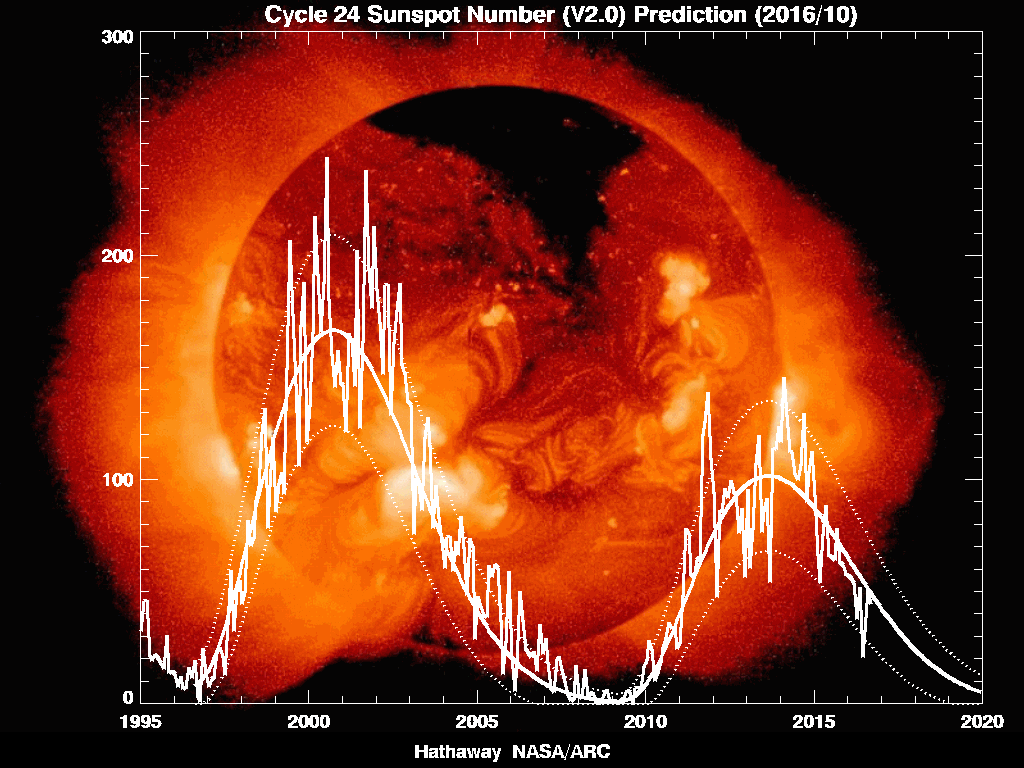
We had a reduced forecast from NASA just a month ago and it has reduced yet again.

The peak is now expected in July 2013 but this could well slip a month or two. This Landscheidt Minimum continues to look like a Dalton Minimum.

December 2010 forecast smoothed sunspot number maximum of 64 in June 2013

January 2011 forecast smoothed sunspot number maximum of 59 in June/July 2013

February 2011

Current prediction for the next sunspot cycle maximum gives a smoothed sunspot number maximum of about 58 in July of 2013. We are currently two years into Cycle 24 and the predicted size continues to fall.

The latest forecasts for sunspot number and 10.7 Radio flux and Ap progression are here: http://www.swpc.noaa.gov/SolarCycle/

Related:

https://ktwop.wordpress.com/2010/12/23/is-the-landscheidt-minimum-a-precursor-for-a-grand-minimum/

Space shuttle Discovery prepares for final mission

February 1, 2011

Only 3 more flights – money permitting – for an iconic series of space craft before they are retired.

BBC:

The US shuttle Discovery has rolled out for what should be its final mission. The orbiter completed its slow journey to the Kennedy Space Center’s Launch Pad 39A overnight, Monday into Tuesday.

Discovery’s flight to the space station is scheduled to begin on 24 February. With its crew of six astronauts, the ship will deliver a storeroom to be attached to the 350km-high platform, along with further supplies and spares.

NASA last tried to launch the vehicle in November but technical hitches, including cracks on its giant external fuel tank, kept the ship on the ground. The agency said engineers had now fixed those defects and carried out further work to strengthen the tank.

President Barack Obama and the US Congress have determined that the shuttle fleet should be retired this year. Discovery is the oldest of the three surviving orbiters. First launched in 1984, it has since completed 38 missions, travelling some 230 million km in the process. Endeavour is expected to fly to the station in April. Atlantis will go no earlier than June, if Nasa has sufficient money left in its shuttle programme budget.

Following the fleet’s retirement, the plan is for US astronauts to fly to the space station on Russian Soyuz rockets until perhaps the middle of the decade.

Discovery

Space shuttle Discovery : image NASA


NASA reduces forecast for Solar Cycle 24 again

January 19, 2011

In December NASA had reduced its forecasts for SC24 to a peak sunspot number of 64 being reached in June 2013. Now less than two months later, the latest forecast has been reduced again to a peak sunspot number of 59 to be reached in June / July 2013.

We find a starting time of May 2008 with minimum occurring in December 2008 and maximum of about 59 in June/July of 2013.

NASA SC24 forecast - January 2011: image NASA

At these levels the current Landscheidt minimum is comparable to SC5 and SC6 – the Dalton Minimum of 1790 to 1830 – where peak sunspot numbers were just over 50. (The earlier Maunder Minimum – 1645 to 1715- was before the modern period of sunspot number measurement and nominally was a period with no significant sunspots – presumably at sunspot numbers of less than 20 in today’s measurement values).

From my previous post:

It is not inconceivable that the SC24 will not peak till early 2014 and will only achieve peak sunspot numbers around 55. Solar cycle 24 could well have a length of 150+ months instead of the nominal 132 months.

The development of the NASA predictions are in the table below:

NASA Forecasts for SC24

Date of

forecast

Expected date

of peak

Expected peak

sunspot number

March 2006 June 2010 168
October 2008 March 2012 137
January 2009 June 2012 104
January 2010 June 2013 90
December 2010 June 2013 64
January 2011 June / July 2013 59


Related:

https://ktwop.wordpress.com/2010/12/23/is-the-landscheidt-minimum-a-precursor-for-a-grand-minimum/

Tenacious life: Microbe swaps phosphorous for arsenic

December 2, 2010
Lakeside of the Mono Lake with Tufa columns in...

Mono Lake: Image via Wikipedia

The New York Times has the story that has been buzzing all day:

Scientists said Thursday that they had trained a bacterium to eat and grow on a diet of arsenic, in place of phosphorus — one of six elements considered essential for life — opening up the possibility that organisms could exist elsewhere in the universe or even here on Earth using biochemical powers we have not yet dared to dream about.

The bacterium, scraped from the bottom of Mono Lake in California and grown for months in a lab mixture containing arsenic, gradually swapped out atoms of phosphorus in its little body for atoms of arsenic.

Scientists said the results, if confirmed, would expand the notion of what life could be and where it could be. “There is basic mystery, when you look at life,” said Dimitar Sasselov, an astronomer at the Harvard-Smithsonian Center for Astrophysics and director of an institute on the origins of life there, who was not involved in the work. “Nature only uses a restrictive set of molecules and chemical reactions out of many thousands available. This is our first glimmer that maybe there are other options.”

Felisa Wolfe-Simon, a NASA astrobiology fellow at the United States Geological Survey in Menlo Park, Calif., who led the experiment, said, “This is a microbe that has solved the problem of how to live in a different way.”

This story is not about Mono Lake or arsenic, she said, but about “cracking open the door and finding that what we think are fixed constants of life are not.”

Dr. Wolfe-Simon and her colleagues publish their findings Friday in Science.

Gerald Joyce, a chemist and molecular biologist at the Scripps Research Institute in La Jolla, Calif., said the work “shows in principle that you could have a different form of life,” but noted that even these bacteria are affixed to the same tree of life as the rest of us, like the extremophiles that exist in ocean vents.

“It’s a really nice story about adaptability of our life form,” he said. “It gives food for thought about what might be possible in another world.

Phosphorus is one of six chemical elements that have long been thought to be essential for all Life As We Know It. The others are carbon, oxygen, nitrogen, hydrogen and sulfur.

While nature has been able to engineer substitutes for some of the other elements that exist in trace amounts for specialized purposes — like iron to carry oxygen — until now there has been no substitute for the basic six elements. Now, scientists say, these results will stimulate a lot of work on what other chemical replacements might be possible. The most fabled, much loved by science fiction authors but not ever established, is the substitution of silicon for carbon.

Phosphorus chains form the backbone of DNA and its chemical bonds, particularly in a molecule known as adenosine triphosphate, the principal means by which biological creatures store energy. “It’s like a little battery that carries chemical energy within cells,” said Dr. Scharf. So important are these “batteries,” Dr. Scharf said, that the temperature at which they dissolve, about 160 Celsius (320 Fahrenheit), is considered the high-temperature limit for life.

Arsenic sits right beneath phosphorus in the periodic table of the elements and shares many of its chemical properties. Indeed, that chemical closeness is what makes it toxic, Dr. Wolfe-Simon said, allowing it to slip easily into a cell’s machinery where it then gums things up, like bad oil in a car engine.

A bacterium known as strain GFAJ-1 of the Halomonadaceae family of Gammaproteobacteria, proved to grow the best of the microbes from the lake, although not without changes from their normal development. The cells grown in the arsenic came out about 60 percent larger than cells grown with phosphorus, but with large, empty internal spaces.

By labeling the arsenic with radioactivity, the researchers were able to conclude that arsenic atoms had taken up position in the microbe’s DNA as well as in other molecules within it. Dr. Joyce, however, said that the experimenters had yet to provide a “smoking gun” that there was arsenic in the backbone of working DNA.

Despite this taste for arsenic, the authors also reported, the GFAJ-1 strain grew considerably better when provided with phosphorus, so in some ways they still prefer a phosphorus diet.

http://www.nytimes.com/2010/12/03/science/03arsenic.html?pagewanted=1&_r=1&partner=rss&emc=rss

Another form of life based on Arsenic?

December 2, 2010
The Arecibo message as sent 1974 from the Arec...

The Arecibo message as sent 1974: image via Wikipedia

The Telegraph  has an eye-catching headline (naturally):

‘Life as we don’t know it’ discovery could prove existence of aliens

But even without the exaggerations and the splash headlines, the possible existence of a form of life intimately connected with Arsenic would have enormous consequences on the definition and abundance of life in the universe and on how to go about searching for extra-terrestrial life.

NASA has sent the internet into a frenzy after it announced an “astrobiology finding” that could suggest alien life exists – even on earth.

The discovery could prove the theory of “shadow” creatures which exist in tandem with our own and in hostile environments previously thought uninhabitable. The “life as we don’t know it” could even survive on hostile planets and develop into intelligent creatures such as humans if and when conditions improve. In a press conference scheduled for tomorrow evening, researchers will unveil the discovery of a microbe that can live in an environment previously thought too poisonous for any life-form to survive.

The bacteria has been found at the bottom of Mono Lake in California’s Yosemite National Park which is rich in arsenic – usually poisonous to life.

Somehow the creature uses the arsenic as a way of surviving and this ability raises the prospect that similar life could exist on other planets, which do not have our benevolent atmosphere. Dr Lewis Dartnell, an astrobiologist at the Centre for Planetary Sciences in London, said: “If these organisms use arsenic in their metabolism, it demonstrates that there are other forms of life to those we knew of. “They’re aliens, but aliens that share the same home as us.”

The Brisbane Times reports:

The US space agency has created a buzz with its announcement of a press conference early tomorrow morning (Australian time) to discuss a scientific finding that relates to the hunt for life beyond the planet Earth.

“NASA will hold a news conference at 2pm EST (6am AEDT) to discuss an astrobiology finding that will impact the search for evidence of extraterrestrial life,” it said on its website.

But Nasa has declined to elaborate further on the topic, other than to say astrobiology is the ”study of life in the universe, including its origin and evolution, where it is located and how it might survive in the future”. The vague announcement has sent the blogosphere in a flurry of speculation about its potential meaning.

Blogger Jason Kottke tipped NASA would announce the discovery of arsenic on Titan, or possibly chemical evidence of bacteria utilising it for photosynthesis.

That speculation was quickly picked up and repeated by a number of other bloggers and internet sites. However Kottke theory has been rebuffed by Alexis Madrigal, senior science writer for The Atlantic, who tweeted that he had read the Science article relating to the Nasa announcement. ”I’m sad to quell some of the @kottke-induced excitement about possible extraterrestrial life. I’ve seen the Science paper. It’s not that,” he tweeted.

The American Association for the Advancement of Science, which publishes the journal in which the research will appear, told ABC News in the US that it had received numerous inquiries about the “mostly erroneous online and/or tabloid speculation about the forthcoming research”.

For NASA TV streaming video and downlink information, visit: http://www.nasa.gov/ntv at 2pm EST today (2nd December).

Nasa/University of Colorado establish Sun-Climate Research Center

November 30, 2010

The “settled science” of climate change seems to be opening up to real science  – at last. Nasa and the University of Colorado are establishing a new research centre dedicated to studying the effect of the sun on climate.

And about time too.

Perhaps they could let the 15,000 gathered in Cancun know about the importance the Sun may have!

Today the University of Colorado Laboratory for Atmospheric and Space Physics (LASP) and NASA’s Goddard Space Flight Center announced the formation of a new collaborative research center dedicated to the study of the Sun’s effect on Earth’s climate. The Press release goes on to say:

Solar Image

The newly announced Sun-Climate Research Center, a collaboration between LASP and Goddard, will focus on research areas such as how solar variations shape Earth’s atmosphere and climate. This image of the sun is from the LASP-built NSF Precision Solar Photometric Telescope (PSPT). (Courtesy NASA/GSFC Scientific Visualization Studio; source data courtesy of HAO and LASP PSPT project team)

The center, called the Sun-Climate Research Center (SCRC), will be directed by Peter Pilewskie, a LASP research scientist and CU professor, Robert Cahalan, Head of Goddard’s Climate and Radiation Branch, and Douglas Rabin, Head of Goddard’s Solar Physics Laboratory.

Pilewskie said, “The exciting thing about this collaboration is that we believe it will promote studies to help answer a key question about the climate system: how does Earth’s atmosphere respond to the sun’s variability, and how does that affect climate? This question is particularly important now, as we seek to quantify the human-induced impact on Earth’s climate.”

The SCRC, which has been made possible by a Federal Space Act Agreement, will foster collaboration between Earth-atmosphere and solar sciences at the two institutions. Opportunities will include a scientist exchange program between the organizations, the ability for post-doctoral scientists and graduate students in science, engineering, and mission operations to move between LASP and Goddard, annual international Sun-Climate research symposia, and the ability for the two institutions to collaborate more fluidly on future research opportunities.

Robert Cahalan, SCRC co-director and Goddard scientist, said, “In recent years Goddard and LASP have worked together on several Earth and Sun missions. Now we look forward to continuing to drive growth in this key interdisciplinary field of Sun-Earth research, bringing new focus to the study of multiyear changes in the Sun and their influence on Earth’s climate.”

With a limited number of such agreements between U.S. universities and any of NASA’s ten field centers, the SCRC represents a rare and innovative step, underscoring LASP’s ability to develop high-caliber research and programmatic opportunities with Goddard.

Daniel Baker, LASP Director, said, “LASP has developed some remarkable areas of expertise that are key to studying the sun and its effect on climate and on human activities. By working with our colleagues at Goddard, we can leverage our skills—and help take an important step toward greater cooperation between NASA centers and leading university research teams.”

Oxygen – carbon dioxide atmosphere found on Saturn’s moon Rhea

November 27, 2010

From The New Scientist:

On its journey around Saturn and its moons, the Cassini mission – jointly run by NASA and the European Space Agency – has made another breathtaking discovery. The findings, published in Science (DOI: 10.1126/science.1198366), show that Rhea, the second biggest moon of the giant planet, has an atmosphere that is 70 per cent oxygen and 30 per cent carbon dioxide. This adds to the picture of Rhea that Cassini has already provided by imaging its craters anddiscovering its rings.

“This really is the first time that we’ve seen oxygen directly in the atmosphere of another world”, Andrew Coates, from University College London’s Mullard Space Science Laboratory, told The Guardian. Layers containing oxygen had already been detected around the Jovian moons Europa and Ganymede in the 1990s, but only from a distance using NASA’s Hubble Space Telescope.

This time, Cassini’s instrument had the chance to “smell” that oxygen, as it flew through it over Rhea’s north pole, just 97 kilometres above the surface, according to the details given on Space.com. This layer – with an oxygen density probably about 5 trillion times less than on Earth – was “too thin to be remotely detected”, said Ben Teolis of the Southwest Research Institute in San Antonio.

These three views of Saturn's moon Rhea from NASA's Cassini spacecraft are enhanced to show colorful splotches and bands on the icy moon's surface. New observations have shown Rhea has an oxygen-rich atmosphere. Credit: NASA/JPL/SSI/LPI

Cassini Finds an Oxygen–Carbon Dioxide Atmosphere at Saturn’s Icy Moon Rhea B. D. Teolis, G. H. Jones, P. F. Miles, R. L. Tokar, B. A. Magee, J. H. Waite, E. Roussos, D. T. Young, F. J. Crary, A. J. Coates, R. E. Johnson, W.-L. Tseng and R. A. Baragiola

Science DOI: 10.1126/science.1198366, Published Online 25 November 2010

Abstract: The flyby measurements of the Cassini spacecraft at Saturn’s moon Rhea reveal a tenuous oxygen–carbon dioxide atmosphere. The atmosphere appears to be sustained by chemical decomposition of the surface water ice under irradiation from Saturn’s magnetospheric plasma. This in situ detection of an oxidizing atmosphere is consistent with remote observations of other icy bodies such as Jupiter’s moons Europa and Ganymede, and suggestive of a reservoir of radiolytic O2 locked within Rhea’s ice. The presence of CO2suggests radiolysis reactions between surface oxidants and organics, or sputtering and/or outgassing of CO2endogenic to Rhea’s ice. Observations of outflowing positive and negative ions give evidence for pickup ionization as a major atmospheric loss mechanism.

Son of Hubble may not launch till after 2015

November 11, 2010

Earlier this year it became clear the the son of Hubble the James Webb Space Telescope, was late and over budget. Costs had ballooned to 5 billion dollars (from the earlier 3.5 billion dollars) and launch was expected in 2014. It has now been acknowledged that costs will be not less than 6.5 billion dollars and launch even in 2015 is optimistic. The management is now being changed and reorganised.

The BBC has the story:

The scale of the delay and cost overrun blighting Nasa’s James Webb Space Telescope has been laid bare by a panel called in to review the project. The successor to Hubble will probably cost at least $6.5bn to launch and operate, and may get into orbit by September 2015.

But even that assessment is optimistic, say the panel members. The head of the US space agency has accepted that “cost performance and coordination have been lacking”. Charles Bolden has ordered a reorganising of the project and has changed the management at its top. Estimates for JWST’s total cost to build, launch and operate have steadily increased over the years from $3.5bn to $5bn. Along with the cost growth, the schedule has also eroded.

The most recent projected launch of 2014 has looked under pressure for some time. The independent panel chaired by John Casani of Nasa’s Jet Propulsion Laboratory (JPL) in Pasadena, California, believes it to be unrealistic. The group was convened to examine the root causes of JWST’s problems. It found the original budget for the project to be insufficient and poorly phased, and blamed the management for failing to pick up and deal with the issue.

“This is a very large complex project and to estimate something with any real degree of precision that’s never been done before is a tough job,” John Casani told reporters. “But the bottom line is that there was never enough money in the budget to execute the work that was required. The panel did however commend the technical success of the project. Mr Casani said the technology on JWST was in “very good shape”. The telescope was always regarded as major undertaking. Its primary mirror is 6.5m (21ft) across – close to three times wider than Hubble’s. The huge reflector will sit behind an even more expansive sun shield, the area of a tennis court. This structure will protect the observatory from radiation from the Sun and the Earth. Whereas Hubble sees the Universe mostly in visible light, JWST will observe the cosmos at longer wavelengths, in the infrared. It will see deeper into space and further back in time, to the very first population of stars.

When it is finally built, it will be launched on Europe’s Ariane 5 rocket and sent to an observing position 1.5 million km from Earth. It is expected to have a 10-year lifespan. Its distance from Earth means the telescope cannot be serviced by astronauts, as was the case with Hubble.

Herschel (BBC)