Posts Tagged ‘Plagiarism’
April 4, 2011
It was a only matter of time before the survival reflex started to kick in and start the propagation of cracks within the façade surrounding the Gaddafi family and clan. But replacing him with one of his sons would be a case of one step forward and two back.
As the NYT reports:

Saif al-Islam el-Gaddafi
At least two sons of Col. Muammar el-Qaddafi are proposing a resolution to the Libyan conflict that would entail pushing their father aside to make way for a transition to a constitutional democracy under the direction of his son Seif al-Islam el-Qaddafi, a diplomat and a Libyan official briefed on the plan said Sunday.
…. The proposal offers a new window into the dynamics of the Qaddafi family at a time when the colonel, who has seven sons, is relying heavily on them. Stripped of one of his closest confidantes by the defection of Foreign Minister Moussa Koussa and isolated by decades of attempted coups and internal purges, he is leaning on his sons as trusted aides and military commanders.
The idea also touches on longstanding differences among his sons. While Seif and Saadi have leaned toward Western-style economic and political openings, Colonel Qaddafi’s sons Khamis and Mutuassim are considered hard-liners. Khamis leads a fearsome militia focused on repressing internal unrest.
Saif al-Islam el-Gaddafi is thought to have plagiarised his PhD thesis at the LSE but considering the former German Defence Minister’s plagiarism perhaps this is an acceptable level of ethics for European politicians!
Related: Gaddafi’s children are a motley – but dangerous – lot
Tags:Gaddafi end-game, Muammar al-Gaddafi, Plagiarism, Saif al-Islam Muammar Al-Gaddafi
Posted in Ethics, Libya, Politics | Comments Off on Cracks appear in the Gaddafi façade
March 6, 2011
The entrepreneurial spirit is strong and growing at British universities. A survey of 84 universities has revealed a depressing picture of the extent to which plagiarism, impersonation and bribery has entered the mainstream of university life. The Telegraph reports:

image:soniceclectic.com
A cheating epidemic is sweeping universities with thousands of students caught plagiarising, trying to bribe lecturers and buying essays from the internet.
A survey of more than 80 universities has revealed that academic misconduct is soaring at institutions across the country.
More than 17,000 incidents of cheating were recorded by universities in the 2009-10 academic year – up at least 50 per cent in four years. But the true figure will be far higher because many were only able to provide details of the most serious cases and let lecturers deal with less serious offences. Only a handful of students were expelled for their misdemeanours among those universities which disclosed how cheats were punished.
Most of the incidents were plagiarism in essays and other coursework, but others examples include:
- Three cases categorised as “impersonation” by Derby University and three at Coventry, along with 10 “uses of unauthorised technology”
- Kent University reported at least one case where a student attempted to “influence a teacher or examiner improperly”.
- At the University of East Anglia students submitted pieces of work which contained identical errors, while others completed reports which were “almost identical to that of another student”, a spokesman said, while one was caught copying sections from the Wikipedia website.
- A student sitting an exam at the University of the West of Scotland was caught with notes stored in an MP3 player.
- * A Bradford University undergraduate completed work at home, smuggled it into an examination then claimed it had been written during the test.
- The University of Central Lancashire, at Preston, reported students had been caught using a “listening and/or communications device” during examinations.
- Keele undergraduates sitting exams were found to have concealed notes in the lavatory, stored on a mobile telephone and written on tissues while two students were found guilty of “falsifying a mentor’s signature on practice assessment documents to gain academic benefit”. …
…. The survey exposed for the first time a huge leap in the number of incidents compared with just four years earlier, with a 53 per cent jump from 9,100 to 14,200 among the 70 institutions able to provide comparable data.
Cheating was reported widely among undergraduates but there were also significant numbers reported among postgraduates. For example, Loughborough reported 151 incidents last year of which 43 were committed by postgraduates. …
Tags:Bribery, ethics in education, impersonation, Plagiarism, UK universities, University cheating
Posted in Behaviour, Corruption, Education, Ethics | 1 Comment »
March 4, 2011

Sir Howard Davies: Image via Wikipedia
Not only did the UK government provide Gaddafi with absolution for all his sins for the sake of weapons deals and oil contracts, they also orchestrated the release of the Lockerbie bomber.
And the LSE was part of the process of providing legitimacy to a bunch of thugs and murderers – of course in return for a suitable remuneration. The LSE Director has now resigned.
BBC:
The director of the London School of Economics has resigned over its links to Libyan leader Col Muammar Gaddafi. Sir Howard Davies said he recognised the university’s reputation had “suffered” and he had to quit. He said the decision to accept £300,000 for research from a foundation run by Col Gaddafi’s son, Saif, “backfired”.
The LSE council has commissioned an independent inquiry into the university’s relationship with Libya and Saif Gaddafi. It will seek to clarify the extent of the LSE’s links with Libya and establish guidelines for future donations.
Lord Woolf, former Lord Chief Justice of England and Wales and former chairman of the Council of University College London, has been appointed to carry it out. Sir Howard said he regretted visiting Libya to advise its regime about financial reforms, calling it a “personal error of judgement”. …..
The LSE has already announced it is investigating claims that Saif Gaddafi plagiarised his PhD thesis, which was awarded in 2008. The Libyan leader’s son had studied at the LSE, gaining both an MSc and PhD.
The Guardian:
A leaked US diplomatic cable indicates that the British government was also party to the deal to bring 400 Libyans to Britain for leadership training. The cable, published by WikiLeaks, suggests that other UK universities were involved in similar schemes, though there is no independent confirmation of this.
The university’s reputation has taken a battering over links with the Libyan regime, which include a donation of £1.5m from a charitable foundation run by Saif, who studied at the LSE. On Tuesday, the LSE agreed to put £300,000, equivalent to the cash it has received from the foundation, into a scholarship for north African students. …..
Ashok Kumar, the education officer of the LSE students’ union said : “The recent revelations have shone a light on one part of the relationship between the upper echelons of the LSE and the Gaddafi family, which is deeper and more perverse than we would have ever imagined.
“This issue is damaging the reputation of the school – it should be a place of learning – not at the centre of unscrupulous dealings with Libyan regime.”
Tags:corruption, Libya, London School of Economics, LSE, Muammar al-Gaddafi, Plagiarism, Saif al-Islam Gaddafi plagiarism, Saif al-Islam Muammar Al-Gaddafi
Posted in Corruption, Education, Libya, Politics, UK | Comments Off on LSE head quits over suspect ties to Gaddafi & son
February 27, 2011
Guttenberg has given up his PhD and the University of Bayreuth has now rescinded it after the Googleberg affaire. But it seems that for Guttenberg plagiarism is a long standing and regular habit and not just an opportunistic effort for his PhD and certainly not the unwitting mistake he claims it was.

"zu Googleberg" the Copycat Minister: photo DPA
Der Spiegel carries an article about the moral bankruptcy in Germany and reports on the discovery by the Gutenplag Wiki that he had plagiarised also in 2004.
The GuttenPlag Wiki website also found a 29-page analysis from 2004 that Guttenberg, then a representative in the German parliament, wrote for the Hanns Seidel Foundation. According to the site, the document contains passages that have been taken from other sources with minimal changes and not attributed. A spokesperson from Guttenberg’s legislative office told SPIEGEL ONLINE that the case involved an “editorial text” and not an academic one, and pointed out that the sources were all listed in an attached literature review.
Meanwhile, Bild published a survey Thursday in which 87 percent of the respondents said they believed Guttenberg should stay in office. More than 260,000 people called and faxed in to the toll line. The headline on the newspaper’s front page Thursday was “Yes, we stand behind Guttenberg!” However, on Friday, an ongoing online poll on the newspaper’s website found that 57 percent of the more than 680,000 surveyed wanted Guttenberg to step down.
Jürgen Trittin, floor leader of the Green Party, on Thursday spoke of a “dirty deal” between Guttenberg and Axel Springer AG, which owns Bild. It was announced this week that the newspaper will be a major recipient of new advertising that the government is planning to help with recruitment for the German military, the Bundeswehr, which is soon to become a volunteer army. A spokesman for the media company told SPIEGEL ONLINE this week that the editorial offices only learned of the advertising campaign from the media on Thursday, after the telephone poll.
Critics also pointed out that the tabloid in the past also defended Guttenberg’s controversial trip to Afghanistan in December with his wife Stephanie, which was decried as a publicity stunt by his opponents.
Ther are other writings by Guttenberg that are being criticised. Even Angela Merkel may have to back away from the support she has been giving to her Defence Minister to exploit his popularity before the impending local elections.
Guttenberg’s star with Merkel could more likely be tarnished by what a report said she regarded as an “only very rudimentary and poorly-considered basis for decisions about reform of the Bundeswehr.”
Der Spiegel reported at the weekend that criticism of his work at the Defence Ministry from the Chancellery was much harsher than previously thought.
Tags:Angela Merkel, corruption, ethics, Guttenberg, Plagiarism, Scientific misconduct, zu Googleberg
Posted in Corruption, Ethics, Germany, Politics, scientific misconduct | 2 Comments »
February 24, 2011
After the success of the on-line analysis of Guttenberg’s PhD thesis from Bayreuth University which proved that more than two-thirds of the pages had plagiarised content, the suspect thesis of Gadaffi Jr. from the LSE is also being examined on line here.
It would probably be a good idea for LSE to apply some plagiarism software and get ahead of the curve.
From Wikipedia:
Saif Al-Islam Gaddafi received his Ph.D. from the London School of Economics in 2008. Through the Gaddafi International Charity and Development Foundation, Saif subsequently pledged a donation of £1.5 million to support the work of the LSE’s Centre for the Study of Global Governance on civil society organizations in North Africa. Following the political uprising in Libya in February 2011, the LSE has issued a statement indicating that it will cut all financial ties with the country and will accept no further money from the Foundation, having already received and spent the first £300,000 installment of the donation.
Saif’s Ph.D. thesis has been made available online and commentators have already identified several passages which appear to have been copied from other sources without attribution. There is speculation that the thesis was plagiarized and/or ghostwritten by another individual.

Saif Al-Islam Gaddafi
Analysis of Saif Al-Islam Gaddafi’s LSE Thesis:
“THE ROLE OF CIVIL SOCIETY IN THE DEMOCRATISATION OF GLOBAL GOVERNANCE INSTITUTIONS”
(PDF)
In the Guttenberg case, Bayreuth University has now rescinded his PhD in an investigation which lasted less than a week. As Professor Debora Weber-Wulff points out this must be the fastest ever decision by a German University in over 400 years!!
Well, this has to be a record. I believe this is the shortest university decision process in the last 400 years or so. Last Tuesday evening the story broke, just over a week later the university commission for good scientific work at the University of Bayreuth reached a decision. They are rescinding his doctorate.
They didn’t go into details, and most important, didn’t decide if he plagiarized on purpose. He says he didn’t, the documentation found on the GuttenPlagWiki screams a different story. Since he has announced that he wanted to withdraw his doctorate anyway, he won’t contest it, so they don’t have to do the normal detailed analysis.
Tags:Bayreuth University, Libya, LSE, Plagiarism, Saif Al-Islam Gaddafi, Scientific misconduct, zu Googleberg, zu Guttenberg
Posted in Corruption, Education, Fraud, Germany, Libya, scientific misconduct | 1 Comment »
February 22, 2011

University of Bayreuth’s President Rüdiger Bormann sees “zu Googleberg’s” letter to the University requesting that his doctorate be withdrawn as an admission of guilt says Welt Online. Whether the plagiarist could retain his academic title or not, was not his decision, but solely the responsibility of the Examination Board. “The request to withdraw his doctorate, does not relieve the Commission from making an assessment of the incident.”
In addition to the thousands of jokes now circulating about Guttenberg, the University of Bayreuth is also getting its share of criticism and ridicule. “The University with a special mailbox where inadvertently or unfairly acquired doctorates can be resubmitted anonymously. “
Bayreuth’s commission of self-regulation for science currently consists of Professors Stephan Rixen, Nuri Aksel, Wiebke Putz-Osterloh and Paul Rösch. “Cases like this have never happened”. Never during his term of office has the examination committee had to meet, protested President Bormann. Bormann was only appointed in 2009 but the Dean of the Faculty of Law and Economics, Markus Möstl also asserted “In Bayreuth university circles, no one can recall the denial of a doctoral degree”.
However, Borman admits that in the Law School theses have not always been checked for plagiarism. Computer programs to detect plagiarism would be used only for “suspicious” cases.
But there are many students at the University who are irritated and depressed. They are now questioning how such a set piece of work could have been awarded a “Summa cum laude” stamp. Students were concerned about the reputation of their degrees, accuses the student chairman Benjamin Horn. They fear, that as Bayreuth students they will be disadvantaged in their search for jobs.
And the University is obviously very sensitive to being accused of giving undue favours. They declared that the management had immediately checked and that the University had not received any donations from the Guttenberg family.
The University cannot escape some ridicule and loss of reputation. But as with all such cases where the actual award is less rigorous than the process to be proposed for an award of a degree, his supervisor for his doctorate bears a large part of the blame and cannot be immune to criticism.
Tags:Bayreuth University, Guttenberg fraud, loss of reputation, Plagiarism, zu Googleberg
Posted in Corruption, Education, Ethics, Germany, scientific misconduct | Comments Off on Googleberg affaire: Loss of reputation could hit Bayreuth students
February 20, 2011
Update!
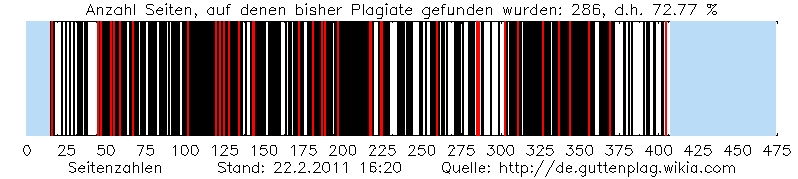
The GuttenPlag Wiki is expanding . Over 68% of the pages in his thesis contain plagiarised material.
http://de.guttenplag.wikia.com/wiki/GuttenPlag_Wiki

Pages where plagiarism were found (black). The Table of Contents (pages 1-14) and Annexes, page 408 (blue) were not included in calculating the percentages. Pages with imitations of various sources are shown in red. Plagiat graphic.jpg
Professor DEBORA WEBER-WULFF writes
I’m wondering if KTzG thought that this crazy quilt is how we do science. Or if he is perhaps suffering from an advanced version of cryptomnesia. Wikipedia quotes Macrae, C.N., Bodenhasen, G. V. & Calvini, G. (1999). Contexts of cryptomnesia: May the source be with you. Social Cognition, 17, 273–297:
Cryptomnesia is more likely to occur when the ability to properly monitor sources is impaired. For example, people are more likely to falsely claim ideas as their own when they were under high cognitive load at the time they first considered the idea.
Sounds fitting. The saga continues.
Perhaps the rumour that zu Guttenberg (aka “zu Googleberg”) actually used ghost writers for his thesis is more than just rumour.

Baron zu Googleberg image: emperorswithoutclothes.com
Der Spiegel reveals:
In May 2004, when Guttenberg was a member of parliament for the conservative Christian Social Union party, Ulrich Tammler, a civil servant in the department with two PhDs of his own, wrote an analysis for Guttenberg headlined “The Question of the Link to Faith in the US Constitution and Supreme Court Rulings on the Separation of the Church and State.”
Tammler completed the 10-page document on May 13, 2004 and passed it on to Guttenberg’s parliamentary office under the reference number WF III – 100/04, according to an article due to be published in SPIEGEL on Monday.Even though members of Bundestag, or lower house of parliament, are only supposed to use of the department for work relating to their parliamentary mandate, Guttenberg included almost the entire article in his dissertation, with only minor word changes.
Tammler himself isn’t cited in any of Guttenberg’s footnotes. Only the parliamentary research department itself is mentioned, a footnote 83. The 60 staff of the department are meant to help lawmakers fulfil their duties as members of parliament. The department’s guidelines state: “The German Bundestag reserves all rights to the work of the Research Department. Publication and distribution require the approval of the departmental management.”
A man of no shame!

Gockel-guttenberg.jpg
And the question becomes whether his thesis contains anything original at all.
On Friday Angela Merkel was still giving her Defence Minister her public support but it is going to be difficult for her to continue with this line. Associating with him is now a burden that few will be able to bear. The Süddeutsche Zeitung reported that the defense minister had plagiarised at least 19 authors. According to the Berliner Zeitung he also copied the work of first-year students at the Free University of Berlin.
Tags:Copycat Minister, Defence minister, Guttenberg plagiarism, Karl-Theodor zu Guttenberg, PhD fraud, Plagiarism, zu Googleberg
Posted in Corruption, Ethics, Fraud, Germany, scientific misconduct | 1 Comment »
February 18, 2011
Misconduct in the scientific world takes months if not years to be investigated and sanctions – if any – are light. But for those riding high in the poltical world the consequences can be swift. It seems unlikely that Googleberg can continue as the German Defence Minister for very long.
Just 4 days ago he was
Baron Dr. Karl-Theodor Maria Nikolaus Johann Jacob Philipp Franz Joseph Sylvester Freiherr von und zu Guttenberg, Defence Minister of the Federal Republic of Germany.

Baron Dr. Karl-Theodor Maria Nikolaus Johann Jakob Philipp Franz Joseph Sylvester Freiherr von und zu Guttenberg (focus.de)
Then his plagiarism was revealed by the Süddeutsche Zeitung earlier this week, and his copying of some 24 passages for his PhD thesis has grown to be the copying of at least 78 passages. Even the first two paragraphs of his introduction appear to have been copied from a 1997 article in the center-right dailyFrankfurter Allgemeine Zeitung.
Der Spiegel dubbed him Merkel’s Minister of Scandals.
Deutsche Welle decided that Googleberg was more appropriate than Guttenberg. Two criminal complaints have now been filed against him, claiming infringement of copyrights and lying in the sworn statement that accompanied the thesis. Others are claiming that he can’t be guilty of plagiarism – it must have been the fault of his ghost writer!
In a desperate damage control exercise after being read the riot act by Angela Merkel, Googleberg said on Friday that he would temporarily renounce his doctorate and relinquish his “doctor” title amid allegations that he plagiarized significant sections of his dissertation.
And now Der Spiegel has baptised him Merkel’s Copycat minister.
In the space of just 3 days,
Herr. Dr. Karl Theodor Maria Nikolaus Johann Jacob Philipp Franz Joseph Sylvester Freiherr von und zu Guttenberg, Defence Minister of the Federal Republic of Germany
has morphed to
Herr Theodor Googleberg, Merkel’s copycat minister.
But at least Googleberg has upheld the reputation of German politicians in the misconduct stakes and managed to reduce the lead that was being being taken by Bunga Bunga Berlusconi in Italy and by the “free loading” ministers of the French Republic.
Tags:fraud, Guttenberg plagiarism, Karl-Theodor zu Guttenberg, Plagiarism, Scientific misconduct, zu Googleberg
Posted in Corruption, Education, Ethics, Fraud, Germany, Uncategorized | 3 Comments »
February 18, 2011
Update 2!
Breaking –
That’s easily done but guilt cannot be as easily renounced!!
Karl-Theodor zu Guttenberg (aka “zu Googleberg”) is in hot water. Without the ability to “cut and paste” he is apparently at a loss for words! Clearly Google is the corrupting influence.
The German MSM are having a field day.
Deutsche Welle: Guttenberg is back from Afghanistan and
Chancellor Merkel called Defense Minister Karl-Theodor zu Guttenberg to her office in Berlin to explain severe allegations of plagiarism in his doctoral thesis. Opposition politicians, meanwhile, want Guttenberg to go.
After returning from Afghanistan on a short visit with German troops, Defense Minister Karl-Theodor zu Guttenberg had to let down excited guests at a campaign fundraiser in Saxony-Anhalt on Thursday because he was “unavailable and engaged in Berlin.”
Public broadcaster ZDF reported that the popular politician had been called in by Chancellor Angela Merkel for a question-and-answer session regarding allegations that he plagiarized complete – and numerous – passages of his doctoral dissertation.
“Karl-Theodor zu Guttenberg did not credit me as the author of excerpts that came from an article I once wrote,” Barbara Zehnpfennig, a professor at Passau University, told news channel N24. “This breaks all academic rules.”
Zehnpfennig is not the only source not “properly cited” in Guttenberg’s text; several German law professors have accused him of blatant plagiarism, citing up to 70 dubious passages.
Newsmagazine Spiegel said Guttenberg even passed off US Embassy material as his own text – translated directly into German – in a string of allegations that has prompted German media to turn the posh Franconian surname “zu Guttenberg” into a far less noble “zu Googleberg.” …….
…… The university has given the minister 14 days to issue a written explanation of the allegations.
Der Spiegel’s headline calls him the Minister of Scandals
Tags:Germany, Karl-Theodor zu Guttenberg, Minister of Scandals, Plagiarism, zu Googleberg
Posted in Behaviour, Corruption, Fraud, Germany, Media, scientific misconduct | 2 Comments »
February 14, 2011
From Xinhua News:

Li Liansheng: photo China Daily
BEIJING, Feb. 10 (Xinhua) — The recent revocation of a national scientific award due to academic fraud was the first of its kind in China, National Office for Science and Technology Awards told Xinhua Thursday.
China’s Ministry of Science and Technology, on Feb. 1, issued a statement revoking the State Scientific and Technological Progress Award (SSTPA) given to Li Liansheng, former professor of Xi’an Jiaotong University.
According to the statement, the investigation found Li had plagiarized others’ works and fabricated data in his winning project, and his prize will be canceled and money awarded retrieved.
Zhao Baojing, senior officer with the National Office for S&T Award, told Xinhua that it was the first time China had withdrawn a national scientific honor.
Li Liansheng, former professor and doctoral tutor of Xi’an Jiaotong University, received the second-place prize of the SSTPA in 2005 for his research on key technologies for designing and manufacturing scroll compressors.
In 2008, he was accused of plagiarism and providing false data in the winning project by six professors of Xi’an Jiaotong University. An investigation was later carried out.
Xi’an Jiaotong University suspended Li from working at the university and rescinded his employment contract in March, 2010.
AsiaOne.com writes:
News that the ministry is stripping him of his award for scientific and technological progress comes three years after six colleagues first claimed that the energy and power studies expert had plagiarized the work of others.
Wan Gang, the minister of science and technology, had earlier vowed that there would be a “zero tolerance” policy toward research frauds and academic plagiarism amid growing criticism about the country’s academic integrity.
“We will dig up the past of those researchers who fake their works and punish them,” he told China Daily in November 2010.
The country has more than 2.3 million workers in the science and technology field and the number of research papers published on the subject has topped the world.
The intense competition to get work published has led some researchers to exaggerate their achievements, said critics.
“In China, we care whether a paper is published in a magazine more than we care about the paper’s quality and academic influence,” Rao Yi, dean of the School of Life Sciences at Peking University, was quoted as saying in a report in China Youth Daily.
Universities and colleges are ranked according to the number of academic papers their staff can get published and the number of references they get in influential journals
Related:
https://ktwop.wordpress.com/2010/10/13/chinese-science-ministry-vindicates-academic-fraud-journalists/
Tags:Academic Dishonesty, China, Li Liansheng, Plagiarism, Scientific misconduct, Xi'an Jiaotong University
Posted in China, Ethics, Fraud | Comments Off on China retracts a national scientific award for plagiarism




 The k2p blog