Posts Tagged ‘Sea ice’

Self-correcting feedback mechanisms? When warming leads to cooling

February 28, 2012

An interesting paper from Curry et al. providing further evidence of a relationship between melting ice in the Arctic regions and widespread cold outbreaks in the Northern Hemisphere. Forcing mechanisms are all the rage where feedback loops lead to runaway effects. In general – in my experience with things technical – natural feedback loops are most often self-correcting. Sometimes they may appear in the short-term to amplify effects but in the long-term they drive back to an equilibrium condition. If feedback mechanisms are not known or if the true cycle-time of the feedback is unknown then short-term effects can be misleading.

Jiping Liu, Judith A. Curry, Huijun Wang, Mirong Song, and Radley M. Horton. Impact of declining Arctic sea ice on winter snowfallProceedings of the National Academy of Sciences, February 27, 2012 DOI:10.1073/pnas.1114910109

Newswise: 

Since the level of Arctic sea ice set a new record low in 2007, significantly above-normal winter snow cover has been seen in large parts of the northern United States, northwestern and central Europe, and northern and central China. During the winters of 2009-2010 and 2010-2011, the Northern Hemisphere measured its second and third largest snow cover levels on record.

“Our study demonstrates that the decrease in Arctic sea ice area is linked to changes in the winter Northern Hemisphere atmospheric circulation,” said Judith Curry, chair of the School of Earth and Atmospheric Sciences at Georgia Tech. “The circulation changes result in more frequent episodes of atmospheric blocking patterns, which lead to increased cold surges and snow over large parts of the northern continents.”

Arctic Ice: “Rapture” of an ice free Arctic now postponed till 2030

August 9, 2011

The ice free Arctic which was to have happened in 2008 according to Mark Serreze of the doomsday crowd has now been postponed till 2030 while scientists find that current concerns over a tipping point in the disappearance of Arctic sea ice may be misplaced.

From WUWT’s Quote of the week:

WUWT

We all cringed, then laughed when Dr. Mark Serreze of NSIDC first said it, then marveled about it as it got a life of its own, being the buzzphrase for every alarmist who wanted to shriek about declining Arctic sea ice.

In 2007 we heard him say:

“The Arctic is screaming,” said Mark Serreze, senior scientist at the government’s snow and ice data center in Boulder, Colorado.

So far, the “screaming” hasn’t kept anyone awake at night, and we have not returned to the low of 2007 in the last three melt seasons.

In 2008 Serreze made the  bold claim:

The ice is in a “death spiral” and may disappear in the summers within a couple of decades, according to Mark Serreze, an Arctic climate expert at the National Snow and Ice Data Center in Boulder, Colorado.

And in 2008 we had the forecast from NSIDC’s Dr. Mark Serreze of an “ice free north pole”.  As we know, that didn’t even come close to being true. Summer 2008 had more arctic ice than summer 2007, and summer 2007 was not “ice free” by any measure.

With those failed predictions behind him,  in an interview in The Age just a few weeks ago, Serreze pulled a Harold Camping, and changed his prediction date. Now he’s saying the new date for an ice free summer is 2030.

”There will be ups and downs, but we are on track to see an ice-free summer by 2030. It is an overall downward spiral.”

And in the meantime research reveals that ice levels in the Arctic were about half the present levels some 5000 years ago and had no problems in recovering.

Scientists say current concerns over a tipping point in the disappearance of Arctic sea ice may be misplaced. 


Antarctic sea ice is increasing and rate of increase is accelerating

August 4, 2011

An instance of actual measurements over the last 30 years rather than just model results. Overall, sea ice extent is increasing in the Antarctic, contrary to climate model predictions for the 21st century, and this increase is accelerating and has strong regional and seasonal signatures.

A new paper in Climate Dynamics, DOI: 10.1007/s00382-011-1143-9 

(H/T The Hockey Schtick)

Sea Ice Trends in the Antarctic and Their Relationship to Surface Air Temperature during 1979 to 2009 by Qi Shu, Fangli Qiao, Zhenya Song and Chunzai Wang

Sea ice trends in the Antarctic and their relationship to surface air temperature during 1979–2009

Abstract: 

Surface air temperature (SAT) from four reanalysis/analysis datasets are analyzed and compared with the observed SAT from 11 stations in the Antarctic. It is found that the SAT variation from Goddard Institute for Space Studies (GISS) is the best to represent the observed SAT. Then we use the sea ice concentration (SIC) data from satellite measurements, the SAT data from the GISS dataset and station observations to examine the trends and variations of sea ice and SAT in the Antarctic during 1979–2009. The Antarctic sea ice extent (SIE) shows an increased trend during 1979–2009, with a trend rate of 1.36 ± 0.43% per decade. Ensemble empirical mode decomposition analysis shows that the rate of the increased trend has been accelerating in the past decade. Antarctic SIE trend depends on the season, with the maximum increase occurring in autumn. If the relationship between SIC and GISS SAT trends is examined regionally, Antarctic SIC trends agree well with the local SAT trends in the most Antarctic regions. That is, Antarctic SIC and SAT show an inverse relationship: a cooling (warming) SAT trend is associated with an upward (downward) SIC trend. It is also concluded that the relationship between sea ice and SAT trends in the Antarctic should be examined regionally rather than integrally.

As put by Skeptical Science – “The most common misconception regarding Antarctic sea ice is that sea ice is increasing because it’s cooling around Antarctica. The reality is the Southern Ocean surrounding Antarctica has shown strong warming over the same period that sea ice has been increasing. Globally from 1955 to 1995, oceans have been warming at 0.1°C per decade. In contrast, the Southern Ocean (specifically the region where Antarctic sea ice forms) has been warming at 0.17°C per decade. Not only is the Southern Ocean warming, it’s warming faster than the global trend. This warming trend is apparent in satellite measurements of temperature trends over Antarctica”.

Antarctic Climate and Sea Ice Variability – a Brief Review by Marilyn Raphael, UCLA Geography, WRCP Workshop on Seasonal to MultiDecadal Predictability of Polar Climate, October 2010

ABSTRACT

Antarctica’s remoteness, the difficulty of conducting research there and the paucity of observations, are some reasons why the Antarctic climate and sea ice variability are not as well understood as in the Arctic. However, research has shown that the climate of Antarctica including its sea ice is dictated by numerous influences with origins ranging from the Tropics to local atmosphere/surface interactions. Over the period of record indications are that much of Antarctica is warming, led by the Antarctic Peninsula. Regional changes in atmospheric circulation, sea surface temperatures and sea ice may explain this warming. Overall, sea ice extent is increasing, contrary to climate model predictions for the 21st century, and this increase has strong regional and seasonal signatures. Sea ice variability is strongly influenced by ENSO, Southern Hemisphere Annular Mode (SAM) and by zonal wave three (ZW3) among other large scale atmospheric circulation mechanisms. The Antarctic climate and sea ice variability are reviewed with respect to the atmospheric and oceanic mechanisms that influence them.

 

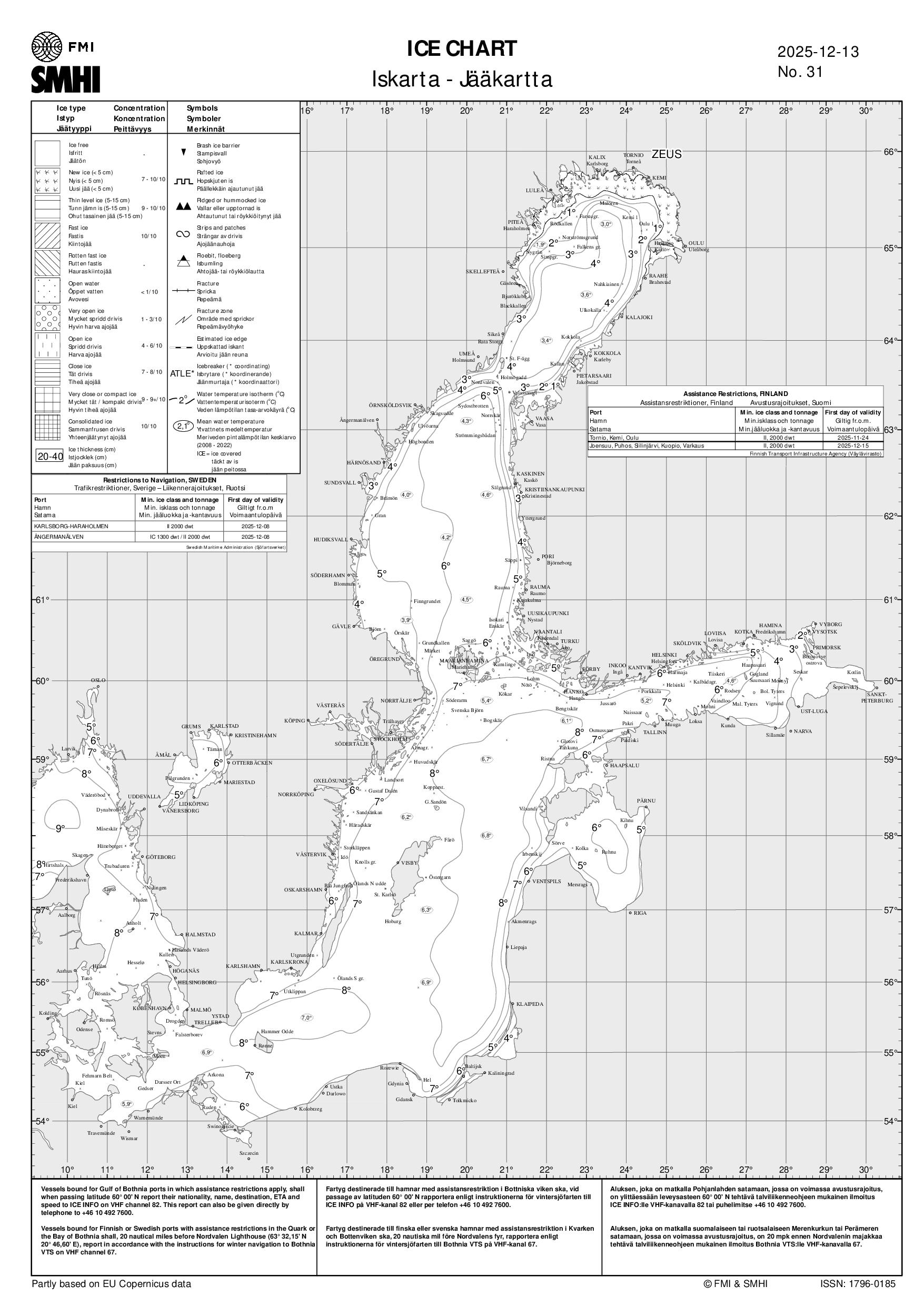
Baltic sea ice highest in 25 years

February 26, 2011

From The Local:

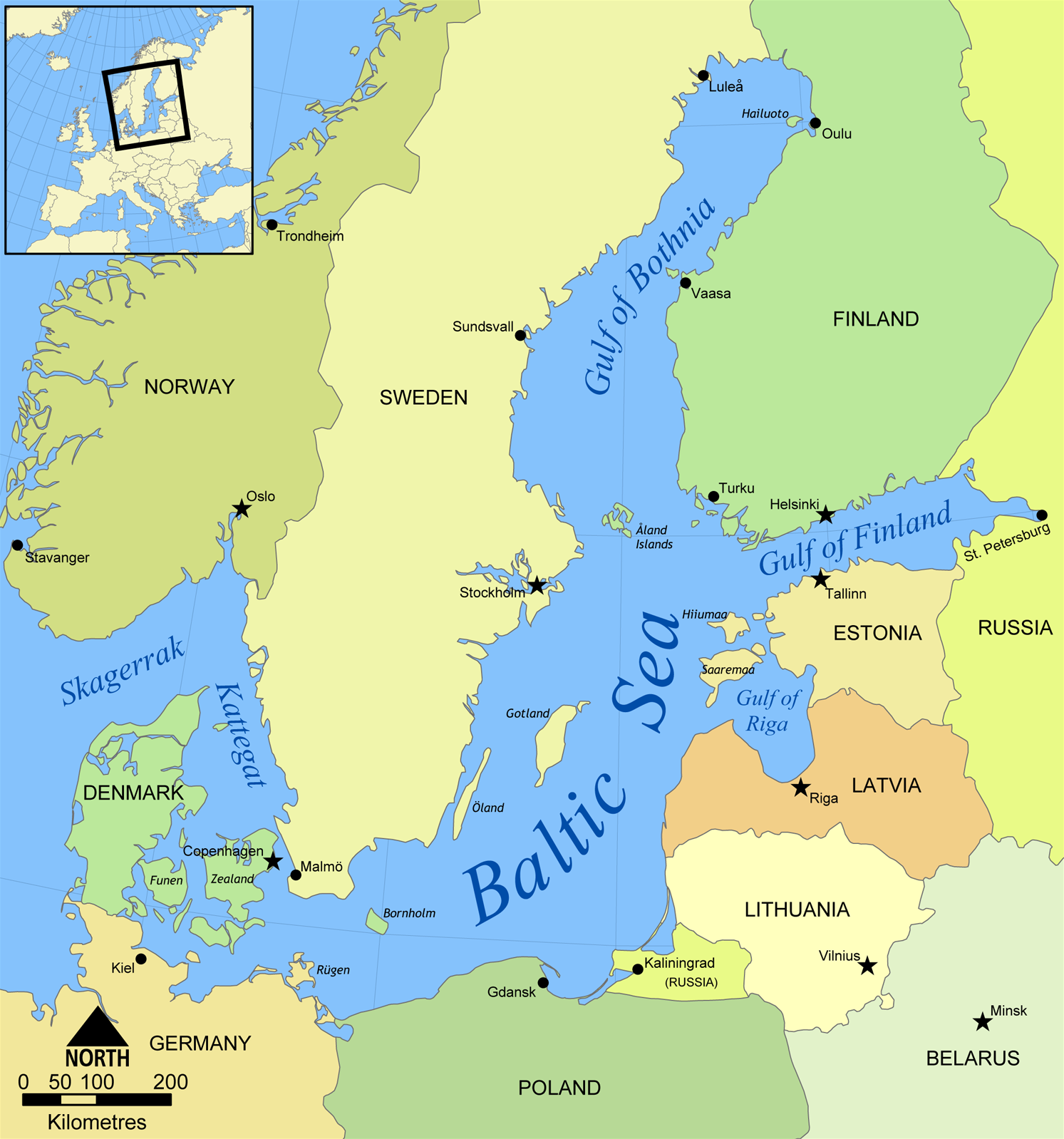
Baltic Sea: image Wikipedia

Deep freeze puts Baltic on track for record ice

Following another extended stretch of sub-zero temperatures, ice coverage on the Baltic Sea is greater than it’s been in nearly a quarter century, Sweden’s meteorological agency reports. About 250,000 square kilometres of the Baltic Sea are now covered in ice according to the Swedish Meteorological and Hydrological Institute (SMHI).

The last time so much of the Baltic was frozen was the winter of 1986-87, when ice covered nearly 400,000 square kilometres of the sea’s surface.

SMHI warns that ice coverage on the Baltic could expand further in the coming days, possibly setting a new record. “The surface water is cold and if winter-like temperatures continue in the region a few more weeks, we’ll probably get an icy winter on par with 1984-85, one of the toughest winters in the 1980s,” SMHI oceanographer Amund E. B. Lindberg said in a statement.

According to SMHI’s estimates, ice may eventually connect the Swedish mainland all the way out to the Baltic island of Gotland, which lies about 90 kilometres off of Sweden’s eastern coast.

Baltic ice cover is not only unusually wide this winter, but also unusually thick, especially in Gulf of Bothnia off Sweden’s northeastern coast, where air temperatures have consistently hovered around -30 degrees Celsius in recent months.

In some areas far out at sea, ice is more than 60 centimetres thick in the northern parts of the gulf. Recent cold temperatures near the southern areas of the Gulf of Bothnia have resulted in ice thickness growing by 30 centimetres in just two weeks.

Icebreakers from the Swedish Maritime Administration (Sjöfartsverket) have been working round the clock to ensure that sea routes on the Baltic remain open, but strong winds expected at the weekend may complicate their work.

SMHI’s daily ice report says:

During the next two days  heavy ice drifting and ridge forming is expected in all waters of the Baltic Sea north of N58 °.

A detailed sea ice map is available here:

Baltic Sea ice levels 20110225: image smhi