Reuters reports that Chinese carbon dioxide emissions may be some 20% higher than previously thought. But then the Reuters reporters (David Fogarty and David Stanway) and their editor Jonathan Thatcher get their knickers properly in a twist and conclude that this suggests that “the pace of global climate change could be even faster than currently predicted”.
Perhaps some bright schoolboy could point out to our intrepid reporters that if the change in B is supposed to be dependent upon the change in A and if the change in A is actually higher than assumed, then the change in B is less dependent upon the change in A than assumed.
When science leads to activism great things can be accomplished but when activism leads to “biased science” to justify the activism, we plumb the depths.
The Gergis affaire has some way to run as her activism-led science is revealed. ACM has preserved some of her activist writings on her now-disappeared blog :
Success is transient. Just like profit or cash-flow – it is over once it has been recognised. The success counter is set to zero once the success is “booked”. Goodness lasts longer – it is like a balance sheet item. This financial analogy is sound. A success once booked – like profit or cash – gets transferred to the goodness in the balance sheet. It is available as a balance sheet item for future results but does not – in itself – ensure such future results. Past successes like previous profits provide a track record and an indication of things to come but do not, in themselves, ensure future success or profit. And just as a lack of profit or a shortage of cash can impair a balance sheet, a lack of success can impair a manager’s goodness.
Success and goodness are different.
Here I address the use of hypothetical scenarios in selection interviews to find the “good” manager.
that the peer review process at the AMS is either incompetent or corrupt (in that it is especially friendly to papers propounding the global warming orthodoxy), and
that the “tricks” revealed by Climategate are still being actively used by so-called climate scientists to support their beliefs
That one of the authors – probably responsible for this cock-up – a Joelle Gergis from the University of Melbourne, is more an “activist” than a “scientist” does not help matters . Going through the abstracts of her list of publications suggests that she often decides on her conclusions first and then selects data and writes her papers to fit the conclusions. Cherry picking data is bad enough but when it is done because of confirmation bias it is perhaps the most insidious form of scientific misconduct there is.
The AMS Journal “peers” who reviewed this paper don’t come out of this very well either. But of course they will receive no strictures for a job done badly.
A case well made though I would suggest that it is “dissemination” that is being hindered and that any hindrance of “scientific progress” is collateral damage. But I suspect that the role of journals in scientific dissemination is in transition and the scientific community has yet to exploit, come to terms with or understand the potential of open access. However I do not believe – as Dienekes does – that the solution lies in government coercion – we have enough of that already. The solution will – I think – come from the technology itself. The possibility to disseminate widely will lead to “open access” truly becoming open access. It is already noticeable that the more enlightened scientists – and I would suggest they are the better scientists – all run their own blogs and open themselves up to much wider scrutiny than that available through pay-walled journals. I also note in passing that “plagiarism” is a scientific crime only because copyright is “violated” or because an individual is trying to get undue credit. But plagiarism – unlike faking data or cherry-picking data – does not necessarily hinder scientific progress (which must necessarily build on the shoulders of those who went before – even if they were not giants and only unacknowledged pygmies).
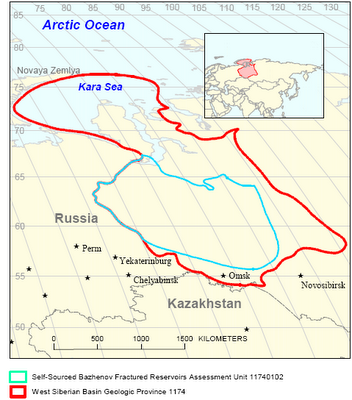
While oil from Siberia is nothing new the vast shale resources in the Bazhenov – containing oil and gas – have yet to be exploited. But fracking technology to extract these is now available. The West Siberian basin is the largest petroleum basin in the world.
Bazhenov basin Western Siberia
The shale in Western Siberia also contains large amounts of gas. Shale gas and oil are already flowing in the US, the shale gas potential in China and India is being explored and developed and now vast reserves of oil and gas are available from shale deposits in Russia. Europe also has large deposits of shale gas but are dithering under the influence of alarmist environmentalism. They will have little choice but to join the brave new world of shale – or be left far behind.
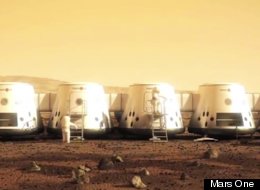
Perhaps it is commercial – and private – enterprises which will truly open up the new frontier. After SpaceX and its Dragon and Virgin Galactic yet to come, Mars One plans for the colonisation of Mars. In 2022, a crew of four will embark on a seven-month flight to the Red Planet–and stay there for the rest of their lives. A new team will make the trip every two years, enabling the colony to grow. Whether the concept of making it a media event to finance the adventure will work remains to be seen. I suspect the financing challenge rather than the technical challenges will be paramount.
Mars One plans to establish the first human settlement on Mars by April 2023. The first crew of four astronauts emigrate to their new planet from Earth, a journey that takes seven months. A new team will join the settlement every two years. By 2033 there will be over twenty people living, working and flourishing on Mars, their new home.
The vision of Mars One
A manned mission to Mars is one of the most exciting, inspiring and ambitious adventures that mankind can take on. We see this as a journey that belongs to us all, and it is for this reason that we will make every step one that we take together. This will also be our way to finance the mission: the mission to Mars will be the biggest media event ever! The entire world will be able to watch and help with decisions as the teams of settlers are selected, follow their extensive training and preparation for the mission and of course observe their settling on Mars once arrived. The emigrated astronauts will share their experiences with us as they build their new home, conduct experiments and explore Mars. The mission itself will provide us with invaluable scientific and social knowledge that will be accessible to everyone, not just an elite select few. Join us in this adventure. Put it on Facebook, Twitter, LinkedIn or whatever platforms are available to you, and spread the word!
A realistic plan
The Mars One team has worked on this plan since early 2011. That first year saw us research the feasibility of the idea extensively and exhaustively, scrutinizing every detail with countless specialists and expert organizations. In this analysis we not only included the technical elements, but also comprehensively discussed the financial, psychological and ethical aspects. We have met with several established, international aerospace companies who can design and deliver the essential hardware components for the Mars mission. These have written letters of interest that support our plan. We have an impressive list of people who support the mission to Mars, our ambassadors. One of them is professor dr. Gerard ‘t Hooft, Physics Nobel Prize winner of 1999. We were this thorough in our preparations for a reason. A project as ambitious as sending a manned mission to Mars can only be presented credibly when it can stand on its own two feet. We have a feasible plan and a way to finance it.
Direct viewing of the Sun with the naked eye or through open telescopes or binoculars should be avoided. Indirect observation of a projected image is advised.
Venus transit 5th-6th June 2012: image BBC
BBC:Venus transits occur four times in approximately 243 years; more precisely, they appear in pairs of events separated by about eight years and these pairs are separated by about 105 or 121 years. The reason for the long intervals lies in the fact that the orbits of Venus and Earth do not lie in the same plane and a transit can only occur if both planets and the Sun are situated exactly on one line.
This has happened only seven times in the telescopic age: in 1631, 1639, 1761, 1769, 1874, 1882 and 2004. Once the latest transit has passed, the next pair will not occur until 2117 and 2125. Most people alive today will probably be dead by then.
But is it Global warming? or is it Global cooling? or just normal changes of climate which no so-called “climate scientist” understands or is capable of predicting.
Friday, 01 June 2012 On the calendar, today is the first of June which is supposed to be a real summer day. This means that we were supposed to have great sunshine and would be outside in our gardens basking – if not at work though.
But such is not the reality if you live in the Swedish town of Långsjöby a couple miles from Storuman in Västerbotten. Here it has been snowing enough that a few centimetres of snow is visibly gathering on the ground now. Visitors to the town from places such as Stockholm were surprised to find snow and some thought that they had been travelling in a time machine.
image SvT
And yesterday on 2nd June the participants in the Stockholm marathon were met by a rainy, windy and cold day – the coldest in 84 years.



 The k2p blog