Archive for the ‘Alarmism’ Category

Indian monsoon rainfall recovering from deficit but strong El Niño no longer expected

July 18, 2014

Yesterday the monsoon covered the entire country but while this is only 2 days later than the “long term average”, the progress of the monsoon across south and central India has been around a week or 10 days late. Until last week the rainfall was in deficit by over 40%, but heavy rains this week are beginning to eat into this deficit. In the meantime the possibility of a strong El Niño  this year, which could have further depressed the monsoon rainfall, is receding.

With 2½ months of the monsoon season left, there is now a reasonable – and improving – probability that the shortfall will end up at less than 10% of the long term average and that the hit to the Indian GDP will not be too severe.

Climate alarmists (mainly the environmental mafia) have been hoping – and praying – for a strong El Niño, a disastrous monsoon, a strong blow to the agricultural sector and an increase in farmer suicides. They are increasingly likely to be disappointed. Fortunately the cost to consumers usually reduces and the good of society usually increases with the increasing disappointment of the loony green mafia.

The best thing to have happened for Australia in years is probably the recent repeal of the Carbon tax which has – surprise, surprise – caused great disappointment to the loony green mafia.

Monsoon covers entire country 17 July 2014 - IMD

Monsoon covers entire country 17 July 2014 – IMD

ET:The monsoon delivered this season’s heaviest showers on Tuesday, drenching southern and central India with 50 per cent more rainfall than normal, while international forecasters said the rain-disrupting El Nino phenomenon would be weaker than feared.

The northern and western parts of the country remained relatively dry, but for the country as a whole, Tuesday’s rainfall was 10 per cent above normal, reducing the season’s rain deficit to 40 per cent. The deficit is still abnormally high, but two days of heavy rainfall is expected to speed up crop planting, which was half of last year’s mid-July level. 

The weather office has forecast good rainfall in many parts of the country in the days ahead. Further, the latest forecast of Australia’s weather department could bring some relief to policy-makers as it has suggested that the El Nino weather phenomenon that curtails June-September rains is unlikely to be intense this year.

The Australian Bureau of Meteorology writes in its ENSO wrap-up:

Warming of the tropical Pacific Ocean over the past several months primed the climate system for an El Niño in 2014. However, a general lack of atmospheric response over the last month has resulted in some cooling of the tropical Pacific Ocean.

While the majority of climate models suggest El Niño remains likely for the spring of 2014, most have eased their predicted strength. If an El Niño were to occur, it is increasingly unlikely to be a strong event.

Changes are also occurring in the Indian Ocean. The Indian Ocean Dipole (IOD) index has been below −0.4 °C (the negative IOD threshold) since mid-June, but it would need to remain negative into August to be considered as an event. Negative values are rare when the central Pacific is warmer than average. Model outlooks suggest the IOD is likely to return to neutral by spring. Conditions in the Indian Ocean may have contributed to the above-average rainfall experienced in southeast Australia during June.
 

Chris Turney – lead Fool of the Ship of Fools – is selling tickets for a lecture at the Royal Institution

July 15, 2014

I don’t know who gets the proceeds from this lecture at the Royal Institution (Tickets: Standard £12, Concession £8, Associate £6, Free to Members, Faraday Members and Fellows) but one hopes that Chris Turney – he of the Ship of Fools – does not.

There is no little irony in the announcement that

“Chris Turney will present the initial findings of the Australasian Antarctic Expedition 2013-2014, and show how private funding brought the public and science together”.

Chris Turney made an utter fool of himself in the Antarctic, and yet the Royal Institution is  providing him with an opportunity to defend his idiocy on 17th July.

To make matters worse the Guardian, instead of bringing the chief fool on the Ship of Fools to bookwrites in its own inimitable, fawning style

 Professor Chris Turney from the University of New South Wales decided to follow in the footsteps of visionary geologist Douglas Mawson, who led one of the first scientific expeditions to the region 100 years ago. Turney and his team of geologists, biologists and geographers retraced Mawson’s steps, repeating the original expedition’s measurements as well as conducting new studies and surveys. …… 

Chairing proceedings is the Guardian’s former science correspondent, Alok Jha, who was also part of the expedition

Alok Jha’s reporting for the Guardian was particularly inane.

Why the Royal Institution is promoting this charlatan and his commercial interests is beyond me.

He helped set up a carbon refining company called Carbonscape which has developed technology to fix carbon from the atmosphere and make a host of green bi-products, helping reduce greenhouse gas levels.

Related: Turney’s tourists: the heroes who weren’t


US temperature data are not real but “adjusted”

June 29, 2014

It would now seem to be confirmed that US temperature data are being “adjusted” to meet the requirements of the adjusters.

This is more than confirmation bias. It is the fabrication of data. 

Real Science:

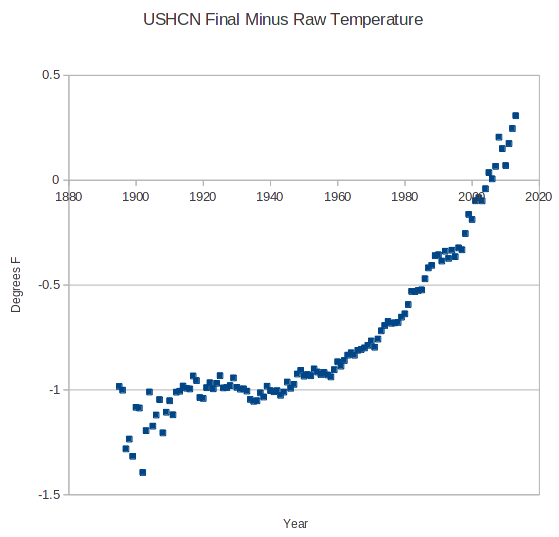
I have posted this graph dozens of times, and hopefully this time it will be clear to everyone. The graph shows the average final temperature for all USHCN stations minus the average raw temperature for all USHCN stations.  This is a very simple calculation which shows the average adjustment for all USHCN stations.

It shouldn’t be a surprise to NOAA or anybody else that an exponential increase in adjustments is occurring, as I have been showing the same graph (crying wolf) for many years.

USHCN adjustments - Real Science

USHCN adjustments – Real Science

While Real Science has been claiming this fabrication of data for some time it is only recently that it has started receiving serious attention. And it would seem that there are no real temperatures any more across the continental US. Where measuring stations no longer exist, temperatures are just  made up for the purpose of “continuity”.

Paul Homewood has been looking at these and he posted this about the temperature adjustments at Kansas stations

Following much recent discussion on USHCN temperature adjustments, I have had a chance to analyse what has been going across the state of Kansas.

Altogether there are 30 USHCN stations, currently listed as operational in Kansas, and I have compared the mean temperatures from the USHCN Final dataset for January 2013, with the actual station measurements as listed in the State Climatological Reports. (There is one station at Lawrence, which I have excluded as the file seems to be corrupted). …..

  • Nearly every station has had the actual temperatures adjusted upwards by about half a degree centigrade.
  • There are 8, out of the 29 stations, which have “Estimated” temperatures on USHCN. This is a ratio of 28%, which seems to tie in with Steve Goddard’s country-wide assessment.
  • Of these eight estimates, five are because of missing data, as listed at the bottom. Four of these are now shut.
  • There seems to be no obvious reason why the other three estimates have been made , at Ellsworth, Liberal and Ottawa. The adjustments at these though don’t appear to be significantly different to the non estimated ones.

 In addition to recent temperatures being adjusted upwards, we also find that historical ones have been adjusted down. So, for instance we find that the January 1934 mean temperature at Ashland has been adjusted from 3.78C to 3.10C, whilst at Columbus there is a reduction from 4.00C to 3.52C.

In total, therefore, there has been a warming trend of about 1C added since 1934. It has always been my understanding that the various adjustments made for TOBS, etc, have been made to the historic data, and that present temperatures were left unaltered. Certainly, the cooling adjustments of about half a degree in the 1930’s would seem to tally with what NOAA have been publishing.

But this leaves the question of just why there is a need to continually adjust current temperatures upwards.

WUWT is also on the case:

What is going on is that the USHCN code is that while the RAW data file has the actual measurements, for some reason the final data they publish doesn’t get the memo that good data is actually present for these stations, so it “infills” it with estimated data using data from surrounding stations. It’s a bug, a big one. And as Zeke did a cursory analysis Thursday night, he discovered it was systemic to the entire record, and up to 10% of stations have “estimated” data spanning over a century. ……… And here is the real kicker, “Zombie weather stations” exist in the USHCN final data set that are still generating data, even though they have been closed. ……

There are quite a few “zombie weather stations” in the USHCN final dataset, possibly up to 25% out of the 1218 that is the total number of stations. In my conversations with NCDC on Friday, I’m told these were kept in and “reporting” as a policy decision to provide a “continuity” of data for scientific purposes. While there “might” be some justification for that sort of thinking, few people know about it there’s no disclaimer or caveat in the USHCN FTP folder at NCDC or in the readme file that describes this, they “hint” at it saying:

“The composition of the network remains unchanged at 1218 stations”

But that really isn’t true, as some USHCN stations out of the 1218 have been closed and are no longer reporting real data, but instead are reporting estimated data.

This is the fabrication of data – institutionalised – to satisfy a pre-determined conclusion.

Fossil fuel combustion at an all time high (but global warming is absent)

June 18, 2014

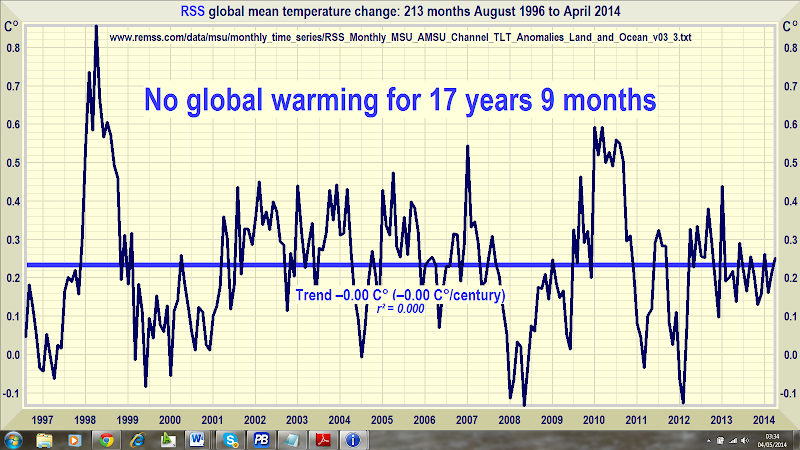
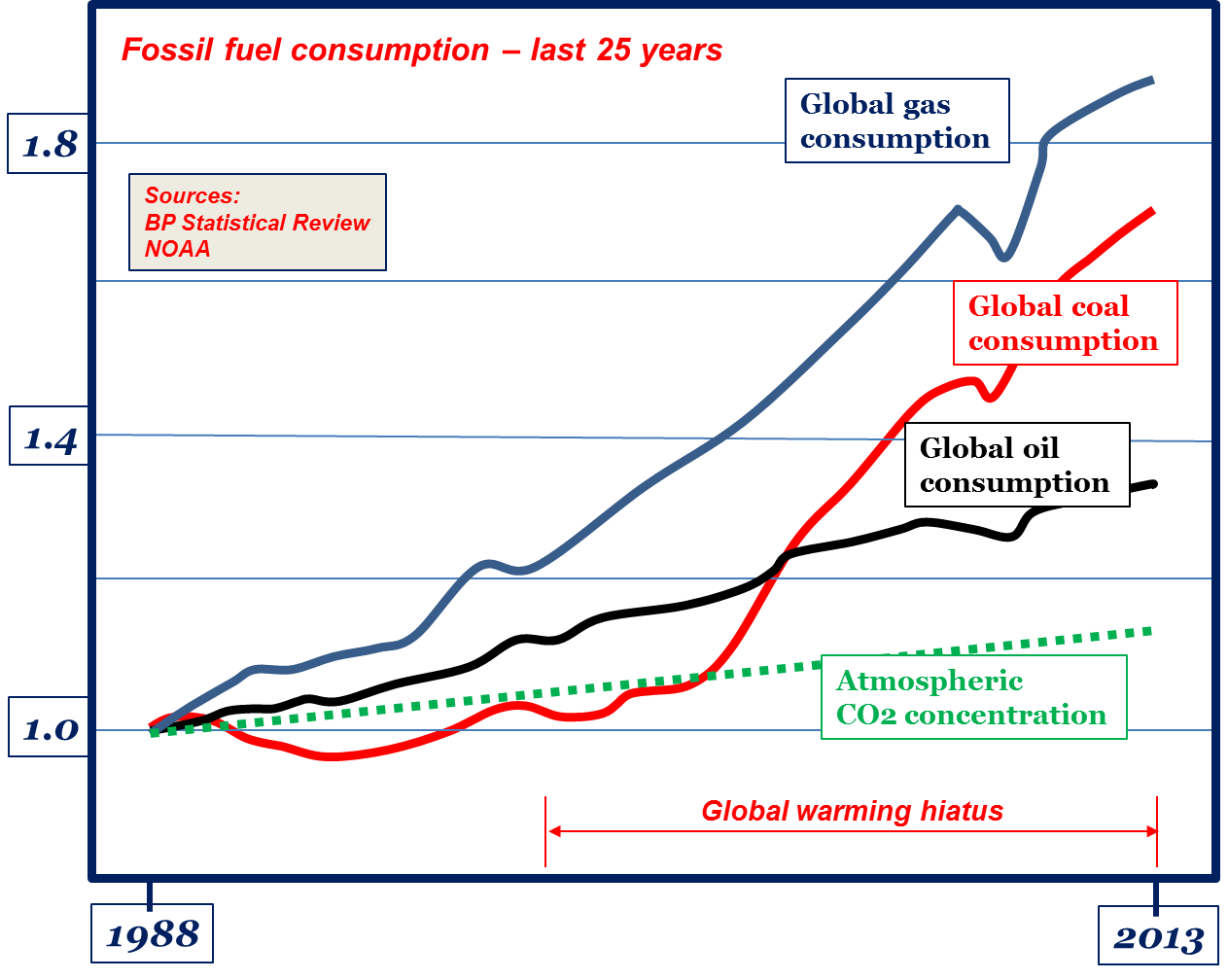
The BP Statistical Review of World Energy 2014 is now out and the consumption of all fossil fuels has never been higher. Coal and gas consumption are particularly strong. And – even though many are in a state of denial about it – global warming has come to a stop over the last 18 years. In the last 10 years global temperatures show a slight downward trend.

There seems to be no purpose to the demonisation of fossil fuels other than for pandering to the religion of global warming. Consider the last 25 years. (I use 1988 as a reference point not only because 25 years should be enough to see some trends but also because the BP data is readily available from that date). During this 25 year period gas consumption has increased by over 80%, coal consumption by 0ver 70% and oil consumption by over 30%. The increased global coal burn since about 1999 is particularly striking. In the same 25 year period the carbon dioxide concentration in the atmosphere has increased from about 355 ppm(v/v) to about 395 ppm(v/v) – a rise of about 11%. And global temperatures have not increased at all for almost 2 decades.

Climate policy is policy without any objectives and without any means of checking any achievements. What exactly could we achieve by not using fossil fuels?

There is not a single climate policy proposed by the IPCC or by any government in the world  which has a definable and measurable climate benefit.

25 years of fossil fuel consumption

25 years of fossil fuel consumption

The global warming hiatus now extends to at least 18 years.

Global warming has gone missing

  • The RSS satellite dataset shows no global warming at all for 213 months from August 1996 to April 2014. That is more than half the entire 423-month satellite record.
  • The fastest centennial warming rate was in Central England from 1663-1762, at 0.9 Cº per century – before the industrial revolution began. It cannot have been our fault.
  • The global warming trend since 1900 is equivalent to 0.8 Cº per century. This is well within natural variability and may not have much to do with us.

Polar bears neither threatened nor endangered

June 10, 2014

It has become increasingly clear that polar bear numbers have been grossly (and probably intentionally) underestimated and that reality is beginning to displace the alarmist myth of the species being under threat. Canada has declined to classify the polar bears as being “threatened or endangered”.

This has not pleased the environmental priesthood  at all. The Center for Biological Diversity has lobbied heavily in the US against the Canadian decision not to toe the politically correct lineThey appealed to an international NAFTA environmental panel to “investigate”  Canada’s failure to implement NAFTA rules by failing to classify the thriving polar bears as “threatened and endangered”.

This appeal has been rejected.

Polar bears remain unthreatened and unendangered in Canada.

An international trade panel has decided not to review whether Canada is enforcing its own environmental legislation to protect its polar bear population.

photo Geoff York/Reuters

cbcnews:

An international trade panel has decided not to review whether Canada is enforcing its own environmental legislation to protect its polar bear population.

The Commission for Environmental Co-operation voted 2-1 to reject a request for an investigation into why Canada has chosen not to designate the bears as threatened or endangered. A U.S. environmental group had filed a submission claiming that decision leaves the bears without protection, despite the ongoing loss of their sea-ice habitat and resulting projections of declining numbers.

Related:

Activists pressure tactics to force Canada to list polar bears as ‘threatened’ have failed June 7th, 2014

Canada under international pressure to list polar bears as threatened, so far holds out January 27, 2013

Canada again under international pressure to list polar bears as threatened November 24, 2013

Polar bear numbers systematically underestimated by 25-30%

May 31, 2014

The International Union for Conservation of Nature (IUCN) is a conservation lobby group. As with all advocacy groups (WWF, FoE, Greenpeace….) much of their “science” has to be taken with a large bushel of salt. Needless to say they have “observer” status at the UN. In any event they have a Polar Bear Specialist Group (PBSG) and much of the unfounded alarmism about the polar bear being a threatened species originates with them. As with other advocacy groups they systematically ignore data which does not advance their theses. They are not averse to data manipulation when it suits them.

In fact polar bears are thriving. The IUCN -PBSG now admits – in a little footnote – that their numbers in 5 large zones have just been ignored and set to zero for lack of data. Actual polar bear numbers are probably well in excess of 30,000. Since 2001, the PBSG has systematically ignored 5 large sub-populations of polar bears as Dr. Susan Crockford reports on her blog:

…. none of these ‘global population estimates’ (from 2001 onward) came anywhere close to being estimates of the actual world population size of polar bears (regardless of how scientifically inaccurate they might have been) — rather, they were estimates of only the subpopulations that Arctic biologists have tried to count.

For example, the PBSG’s  most recent global estimate (range 13,071-24,238) ignores five very large subpopulation regions which between them potentially contain 1/3 as many additional bears as the official estimate includes (see map below). The PBSG effectively gives them each an estimate of zero.

Based on previous PBSG estimates and other research reports, it appears there are probably at least another 6,000 or so bears living in these regions and perhaps as many as 9,000 (or more) that are not included in any PBSG “global population estimate”: Chukchi Sea ~2,000-3,000; East Greenland, ~ 2,000-3,000; the two Russian regions together (Laptev Sea and Kara Sea), another ~2,000-3,000 or so, plus 200 or so in the central Arctic Basin. These are guesses, to be sure, but they at least give a potential size.

I find the entire thrust of Conservationism to be fundamentally flawed. Threatened species are genetic and evolutionary failures in the sense that they do not have the genetic variability necessary to continue in a changing world. Trying to stop the change they cannot cope with is a futile exercise. If conservation of a species has to mean anything, then selected, threatened species have to be helped to adapt to the inevitable change – genetically if necessary.

Huge shale deposits confirmed in the South of England

May 23, 2014
Map of the Weald Basin

Shale deposits in South of England and Wales (BBC)

The British Geological Survey (BGS) has now confirmed the huge deposits of oil bearing shale in the South of England . Ironically this comes just days after the BBC also reported on the idiot report by the self-styled Global Sustainability Institute that the UK would run out of oil, coal and gas in 5 years!!!

BBC (23rd May)The BBC’s John Moylan said that although the BGS study will say that there are several billion barrels of oil in place, is not clear how much would be economically recoverable. ….. By way of comparison, the equivalent of around 45 billion barrels of oil has been extracted from the North Sea over the past 40 years.

Last year, a BGS study of the North of England suggested there could be as much as 1,300 trillion cubic feet of gas contained in shale rocks. ….

Andrew Austin, chief executive of the onshore energy IGAS, said it had long been known that southern England had extensive resources.

He told the BBC: “We’ve known that there’s a big potential for oil and gas explorations across the country but particularly in terms of oil in the Weald Basin which is the area that stretches roughly from Winchester across towards Gatwick, up to the M25 and down to the coast at Chichester.

“There’s been a long history of oil and gas exploration in this area. We as a company produce oil and gas from around 20 sites across that area. Around 40 million barrels have been recovered from that area to date.”

In the US, fracking for oil and gas has created an energy boom and led to speculation that the country could overtake Saudi Arabia as the world’s biggest producer by 2020, or even sooner.

Gas prices in the US have fallen sharply as a result, and other countries are now hoping that shale oil and gas could also lead to lower domestic energy prices.

And just a few days ago the BBC chose to present this nonsense.

BBC (16th May)In just over five years Britain will have run out of oil, coal and gas, researchers have warned. …… There should be a “Europe-wide drive” towards wind, tidal, solar and other sources of renewable power, the institute’s Prof Victor Anderson said. ….

……. Professor Anderson said: “Coal, oil and gas resources in Europe are running down and we need alternatives.

“The UK urgently needs to be part of a Europe-wide drive to expand renewable energy sources such as wave, wind, tidal, and solar power.”

However, Jim Skea, Research Councils fellow in UK Energy Strategy. cast doubt on the findings of the report.

He told BBC News: “This sounds very unlikely. What’s more, it’s irrelevant – the UK has a stable supply of imported energy, even if it is a good idea to increase our own supplies.”

The government recently announced it was cutting subsidies for large-scale solar energy and the Conservatives have said there will be no funding for new onshore wind farms if they win the next election.

Ministers are hoping that enough shale gas – extracted by fracking – will be obtained to make a difference, the BBC’s environment analyst Roger Harrabin says.

Professor Victor Anderson is an alarmist economist who used to work for the World Wildlife Fund. But to develop a catastrophe theory and predict that the UK will run out coal, oil and gas in 5 years is just stupidity.

Prior to taking up his current position Professor Anderson had worked as Senior Policy Officer for One Planet Economy at WWF-UK, a Lecturer at Goldsmith’s College, London University, an Economist at the Sustainable Development Commission, a Senior Parliamentary Researcher at Plaid Cymru Group of MPs, Board Member at London Development Agency and an elected Assembly Member at the Greater London Authority. He is also currently a Member of the Planetary Boundaries Initiative Advisory Group.

Carbon Cycle: Emissions from forest clearance underestimated, land absorption underestimated

May 23, 2014

Two new papers just published show that the carbon cycle is far from being certain. We still have large uncertainties regarding the sources of carbon dioxide emissions and their magnitude and the sinks where, and mechanisms by which, carbon dioxide is absorbed. One in Global Change Biology. shows that emissions due to forest clearance have been underestimated by some 40% while the second in Nature suggests that there are large land sinks for carbon dioxide in the Southern Hemisphere (paywalled but reported here) which have largely been ignored by climate models.

  1. The amount of carbon lost from tropical forests is being significantly underestimated, a new study reports. In addition to loss of trees, the degradation of tropical forests by selective logging and fires causes large amounts of “hidden” emissions. 
  2. they find that land sinks for CO2 are keeping up with the increase in CO2 emissions, thus modeled projections of exponential increases of CO2 in the future are likely exaggerated. 

The “settled science of climate” is a an edifice tottering on two unproven hypotheses:

  1. That carbon dioxide concentration in the atmosphere is a key driver of global temperature, and
  2. That man-made emissions of carbon dioxide (primarily fossil fuel combustion) are the key contributor to concentration in the atmosphere.

If either of these two assumptions are incorrect, the entire edifice of climate science and climate policy comes tumbling down.

The first now looks decidedly weak. For almost 20 years now global temperatures have stagnated (and show a slight negative trend) while carbon dioxide emissions from combustion have increased sharply. Carbon dioxide concentration has also continued to increase but at a much lower rate than the rate of man-made emissions. No doubt carbon concentration has some impact but it is clearly far from being a key driver of global temperature.

The second assumes that “natural emissions” and absorption are roughly in balance and therefore it must be fossil fuel combustion which is responsible for the increase of carbon dioxide concentration. But the Carbon balance of the earth is far from certain. Volcanic de-gassng of CO2 has been grossly underestimated. The mass of CO2 absorbing bio-mass in the oceans has also been underestimated and remains still highly uncertain.

The error bands surrounding “natural” emissions are of the same magnitude as man-made emissions. Absorption of Carbon dioxide by the oceans and the biological life (algae) in the oceans are, at best, relatively uncertain estimations.

ktwop: Even though the combustion of fossil fuels only contributes less than 4% of total carbon dioxide production (about 26Gt/year of 800+GT/year), it is usually assumed that the sinks available balance the natural sources and that the carbon dioxide concentration – without the effects of man – would be largely in equilibrium. 

…… Carbon dioxide emission sources (GT CO2/year)

  • Transpiration 440
  • Release from oceans 330
  • Fossil fuel combustion 26
  • Changing land use 6
  • Volcanoes and weathering 1

Carbon dioxide is accumulating in the atmosphere by about 15 GT CO2/ year. The accuracy of the amounts of carbon dioxide emitted by transpiration and by the oceans is no better than about 2 – 3% and that error band (+/- 20GT/year)  is itself almost as large as the total amount of emissions from fossil fuels. ….. 

The demonisation of fossil fuel combustion is based on belief and not on evidence. The carbon dioxide assumptions which are the foundations of the climate orthodoxy are unsound.

Alarmists wail – “Collapse” of Antarctic ice is nigh (but it could take 1000 years)

May 13, 2014

There is much wailing and gnashing of teeth.

The headlines would suggest an impending catastrophe. The Western Atlantic ice sheet is “collapsing”. Sea level could rise 1.2m.

The end of the world is nigh. And it is all due to global warming!!

Yes indeed – except that the melting has been going on for centuries. The so called “collapse” may take upto 1,000 years! Measurements over 9 years are projected over a millenium. Computer models have forecast that the loss of the glaciers is unstoppable and will occur sometime in the next 1,000 years.

The Guardian: Western Antarctic ice sheet collapse has already begun, scientists warn

BBC: ‘Nothing can stop retreat’ of West Antarctic glaciers

A collapse in very slow motion!

The alarmist headlines are are based on two papers. Note that one is based on 9 years of measurement and the other is a computer forecast about a “collapse” that is potentially underway.

1. E. Rignot, J. Mouginot, M. Morlighem, H. Seroussi and B. Scheuchl, Widespread, rapid grounding line retreat of Pine Island, Thwaites, Smith and Kohler glaciers, West Antarctica from 1992 to 2011, Geophysical Research LettersDOI: 10.1002/2014GL060140

AbstractWe measure the grounding line retreat of glaciers draining the Amundsen Sea Embayment of West Antarctica using Earth Remote Sensing (ERS-1/2) satellite radar interferometry from 1992 to 2011. Pine Island Glacier retreated 31 km at its center, with most retreat in 2005–2009 when the glacier un-grounded from its ice plain. Thwaites Glacier retreated 14 km along its fast-flow core and 1 to 9 km along the sides. Haynes Glacier retreated 10 km along its flanks. Smith/Kohler glaciers retreated the most, 35 km along its ice plain, and its ice shelf pinning points are vanishing. These rapid retreats proceed along regions of retrograde bed elevation mapped at a high spatial resolution using a mass conservation technique (MC) that removes residual ambiguities from prior mappings. Upstream of the 2011 grounding line positions, we find no major bed obstacle that would prevent the glaciers from further retreat and draw down the entire basin.

2. Ian Joughin, Benjamin E. Smith and Brooke Medley,  Marine Ice Sheet Collapse Potentially Underway for the Thwaites Glacier Basin, West AntarcticaScience,     DOI: 10.1126/science.1249055

Abstract: Resting atop a deep marine basin, the West Antarctic Ice Sheet has long been considered prone to instability. Using a numerical model, we investigate the sensitivity of Thwaites Glacier to ocean melt and whether unstable retreat is already underway. Our model reproduces observed losses when forced with ocean melt comparable to estimates. Simulated losses are moderate (<0.25 mm per year sea level) over the 21st Century, but generally increase thereafter. Except possibly for the lowest-melt scenario, the simulations indicate early-stage collapse has begun. Less certain is the timescale, with onset of rapid (> 1 mm per year of sea-level rise) collapse for the different simulations within the range of two to nine centuries.


The Antarctic glaciers may well be retreating (as glaciers are often wont to do), but Antarctic ice cover is at an all time high and the processes being forecast are being projected over millenia. And there is absolutely no evidence that these processes have anything whatever to do with any man-made effects. That connection is inferred  or assumed.

Related: The Guardian’s Suzanne Goldenberg jumps the shark again – gets called out by NYT


When it comes to climate change, “hot” = “cold”!

May 9, 2014

Why climate change is “bad” when nobody really knows what static climate is to be desired, and where climate stagnation would mean that the earth was dead, escapes me.

Taking pot shots at The Guardian on climate change is not very intellectually challenging, but sometimes the temptation cannot be resisted.

June 2011: Britain’s hot spring could be result of shrinking Arctic

March 2013: Scientists link frozen spring to dramatic Arctic sea ice loss

The first article was written by Robin Mckie, “Science Editor” and the second by John Vidal, “Environment Editor”. Which leads to the inevitable conclusion that for The Guardian, “hot” may be synonymous with “cold” but “environment” and “science” have entirely different values.

arctic ice guardian 2


arctic ice guardian 1


(h/t NOT A LOT OF PEOPLE KNOW THAT)