Archive for the ‘Alarmism’ Category

Japan to help Eastern Europe to shift from gas to coal

April 29, 2014

A return to coal as reality bites. It is now a “good thing” to help Eastern Europe to shift from Russian gas to their own coal.

Perhaps it is beginning to sink in that while carbon dioxide emissions have increased substantially in the last 20 years there has been no impact on global temperature. There is just no direct evidence that man-made carbon dioxide emissions have any significant impact on global temperature or on climate. The entire edifice of climate politics is built on this one unproven – and now broken – assumption. Take away this single assumption and all of climate politics collapses in a sorry heap.

Yomiuri Shimbun:

The government plans to support Ukraine and other Eastern European nations in the construction of next-generation coal-fired power plants that can generate power with less fuel, according to informed sources.

Under the initiative, Japan would stand behind the nations’ efforts to use coal—abundant in Eastern Europe—instead of natural gas, the supply of which makes them dependent on Russia. The government is expected to announce the initiative at the meeting of energy ministers from Japan and other Group of Seven industrialized nations to be held in Rome from May 5.

Japan’s support will involve the construction of coal-fired power plants using technologies known as supercritical steam pressure and ultra supercritical pressure to spin the turbines, enabling these nations to obtain electricity while using less fuel and emitting less carbon dioxide.

With a power generation efficiency of 40 percent to 43 percent, Japan has the world’s most advanced technologies in this field. About one-fourth of the coal-fired power plants in the nation use these technologies.

In comparison, Germany has a power generation efficiency of about 38 percent, while the corresponding figures for Ukraine and other Eastern European nations apparently remain at the 30 percent levels. 

If an agreement is reached with Ukraine, Japan will support a feasibility study to rebuild power plants during the current fiscal year. Under the initiative, Japan will provide yen loans to cover several tens of billions of yen in construction costs in addition to its energy-saving technologies, while Ukraine will provide emission quotas for greenhouse gases to Japan under their bilateral framework.

The G-7 meeting of energy ministers will discuss policies to raise the energy self-sufficiency rates of Ukraine and other European nations, as well as diversifying their energy supplies with one goal in mind: lowering their dependency on natural gas and oil from Russia.

 Ukraine imports 60 percent of the natural gas it uses from Russia, while the three Baltic nations and Eastern European nations buy from 60 percent to 100 percent of their natural gas from that country—a situation that makes it difficult to shift away from their reliance on Russia.

Though they have a dearth of natural gas, Eastern European nations have rich reserves of coal, with Ukraine being almost self-sufficient in that resource. Introduction of the next-generation coal-fired power plants is likely to improve their energy self-sufficiency rates, the sources said.

“Climate policy” has degenerated into ritualistic actions with no measurable objectives

April 5, 2014

I met some old friends yesterday and we were discussing development in SE Asia and  the diversion of resources from real actions with real objectives into “faith-based” actions where there were no objectives or where the objectives were not measurable.

There was no disagreement that any government policy to be characterised as policy needed proposed actions to be first tied to results and second to results which could be measured. There was no dissension from the proposition that any policy where the results could not be measured was a fundamental waste of resources.

The discussion got a little more heated when I challenged the gathering to name a single  “climate policy” action – whether proposed by any government or any environmental group or any UN organisation – which had a result on climate which was measurable. Carbon taxes, carbon footprint, renewable energy, shifting from fossil fuels and carbon emissions were all mentioned. But in not a single case could anybody find any measurable climate objective. The only measurements that were possible – and which were often quoted – were of the actions themselves – but never were any of the objectives measurable or even definable.

It soon became apparent that many governments set targets for how much energy would be generated by renewables, for example, and that this could be measured but in not a single case could a climatic effect to be achieved even defined – let alone measured.  It was the same in every case. The input could be measured but the output – the effect of the action on climate – could not be defined or measured. It was always taking actions for the sake of taking actions in the belief that there was a climate benefit. But the climate benefit was always undefinable and unmeasurable. Measuring inputs with no measurable objectives do not a policy make.

Every policy was based on the “faith”  that it would be good for climate but the benefit was unknowable and unmeasurable.

There is not a single climate policy proposed by the IPCC or by any government in the world  which has a definable and measurable climate benefit.

Hopes and faith are insufficient to convert religious rituals into rational policy.

IPCC is still living in its world of “IF” and is stuck in denial

March 31, 2014

Institutionalised alarmism is difficult to stop. It has a momentum of its own.

There has been no global warming for almost 20 years.

The link between carbon dioxide as a significant cause of the non existent global warming is broken.

Yet, the IPCC has come out with part 2 of its wildly alarmist report.

Everything is based on IF.

Lead authors have resigned because the report is too alarmist.

The wolf is dead and they are still crying “Wolf”.

IF global warming continues we COULD be in trouble sometime after 2050.

BUT Global Warming has stalled and the IPCC is in denial

I just have to keep my head when others are losing theirs and dealing in lies-

If you can keep your head when all about you   
    Are losing theirs and blaming it on you,   
If you can trust yourself when all men doubt you,
    But make allowance for their doubting too;   
If you can wait and not be tired by waiting,
    Or being lied about, don’t deal in lies,
Or being hated, don’t give way to hating,
    And yet don’t look too good, nor talk too wise:
(Rudyard Kipling – IF)

Another meaningless Earth hour to ignore today

March 29, 2014

For the same reasons as last year, and all previous years, I shall not be turning down the heat or switching off any lights today.

Earth hour is a morally bankrupt, self-indulgent, “feel-good” gesture. It is a “cheap” and mean action. It does a disservice to humanity. It diverts attention from the real issues of development that face the world’s poor. And the availability of electric power is fundamentally necessary to this development.

Switching off power during Earth hour manifests a self-righteous and a morally bankrupt arrogance. I shall not though respond in kind by the equally arrogant gesture of  turning on all the lights in my house.

The numbers tell the tale:

The world per capita consumption of energy(in tons of oil equivalent – toe)  is about 1.85 toe in 2013 and varying from about 7 toe in the US to 0.2 in the least developed parts of the world. In Europe it is about 3.5 toe with India at about 0.5 toe and China at 0.6 toe.

World population will increase from 7 billion now and stabilise at about 10 billion by 2100. Assuming that most of the world can reach an average level of development commensurate with a total per capita energy consumption of around 3 toe, then total energy production (all sources) has to increase by a factor of 2.3 between now and 2100. There is no shortage of energy availability. Shale gas has removed even the perceived – but false – threat of that. Peak oil and peak gas have disappeared over the horizon. If the developing world is to develop, then this energy has to be consumed and will be produced.

Global warming is a mirage and Earth hour is meaningless.

Older fathers becoming a threat to their children

March 27, 2014

Back in 2009 there was a rash of articles about the dangers to children of advanced paternal age.

Children born to fathers 40 or older have nearly a six-fold increase in the risk of autism as compared with kids whose fathers were younger than 30. Children of fathers older than 50 have a nine-fold risk of autism. And advanced paternal age, as it’s called, has also been linked to “an increased risk of birth defects, cleft lip and palate, water on the brain, dwarfism, miscarriage and ‘decreased intellectual capacity.'” 

And to an increased risk of schizophrenia. This risk rises for fathers with each passing year. The child of a 40-year-old father has a 2 percent chance of having schizophrenia-double the risk of a child whose father is younger than 30. And the kicker: A 40-year-old man’s risk of having a child with schizophrenia is the same as a 40-year-old woman’s risk of having a child with Down syndrome. More recent studies have linked fathers’ age to prostate and other cancers in their children. In September 2008, researchers linked older fathers to an increased risk of bipolar disorder in their children. Add to that the new finding, that the kids of older fathers score lower on IQ and other cognitive tests. 

Now 5 years later there is yet again a splurge of articles about the dangers of older fathers. These headlines are just in 2014.

  1. The Guardian: Children of older men at greater risk of mental illness
  2. Daily Mail: Children born to older fathers ‘are more likely to be ugly’… but may also live longer
  3. Daily Mail: Number of older fathers rises 58% in 14 years: 26 children every day are born to dads who are aged over 50

Of course it must also then follow that younger siblings (born inevitably to older fathers than their elder siblings) have a greater risk of autism, schizophrenia, prostate cancer, lower IQ, cleft palate, water on the brain, of being uglier and suffering from dwarfism!

Perhaps the EU should introduce some legislation to limit the age at which children can be fathered.

After all these aged (but usually richer) fathers are threatening the fundamental genetic structure of humans and perhaps threatening future evolution!!


Washington mud-slide tragedy – a catalogue of stupidities?

March 26, 2014

The landslide tragedy in Washington State has killed at least 16 and perhaps up to 24 people. I had first thought that it was another natural disaster to be compared to volcano eruptions or earthquakes or hurricanes. In fact it was a minor earthquake (magnitude 1.1) on 10th March which may have contributed to this landslide but which was probably not the trigger.

But then I came across this article yesterday in The Seattle Times. The area devastated has seen many landslides in the past. Just in modern times, landslides occurred in 1949, in 1951, in 1967 and most recently in 2006. Yet people continued living and building new homes on a hill known as “Slide Hill”.  How did such building get permitted? And I wonder why we so readily abandon common sense; on the one hand in ignoring real and present and immediate dangers as in this case; or on the other in wasting billions on theoretical and imagined dangers in the far distant future as with “global warming.

And if all that the Seattle Times reports is correct, then this was not a natural disaster but one caused by plain stupidity. It reads like a catalogue of stupidities – but that does not make the tragedy of lives lost any the less:

  • The hill that collapsed last weekend is referred to by geologists with different names, including Hazel Landslide and Steelhead Haven Landslide, a reference to the hillside’s constant movement. Some residents, according to a 1967 Seattle Times story, referred to it simply as “Slide Hill.” …….. the two creeks in the area are known as “Slide Creek” and “Mud Flow Creek.
  • Since the 1950s, geological reports on the hill that buckled during the weekend in Snohomish County have included pessimistic analyses and the occasional dire prediction. But no language seems more prescient than what appears in a 1999 report filed with the U.S. Army Corps of Engineers, warning of “the potential for a large catastrophic failure.”
  • Daniel Miller, a geomorph­ologist, also documented the hill’s landslide conditions in a report written in 1997 for the Washington Department of Ecology and the Tulalip Tribes. He knows the hill’s history, having collected reports and memos from the 1950s, 1960s, 1980s and 1990s. That’s why he could not believe what he saw in 2006, when he returned to the hill within weeks of a landslide that crashed into and plugged the North Fork of the Stillaguamish River, creating a new channel that threatened homes on a street called Steelhead Drive. Instead of seeing homes being vacated, he saw carpenters building new ones. “Frankly, I was shocked that the county permitted any building across from the river,” he said.
  • …. John Pennington, head of Snohomish County’s Department of Emergency Management, said at a news conference Monday. “It was considered very safe,” Pennington said. “This was a completely unforeseen slide. This came out of nowhere.”
  • At least five homes were built in 2006 on Steelhead Drive, according to Snohomish County records. The houses were granted “flood hazard permits” that required them to be jacked up 1 to 2 feet above “base flood elevation,” according to county building-permit records. Another home was built in the neighborhood in 2009. Snohomish County Executive John Lovick and Public Works Director Steve Thomsen said Monday night they were not aware of the 1999 report. 
  • In 1969, a geologist with the state Department of Natural Resources, Gerald Thorsen, submitted a memorandum after visiting the site of the slide. He explained that “aerial photographs taken as far back as 1932 show the river has cut at this clay bank for many years.”
  • In 1962, the state installed a “revetment” — a sort of rock barrier — to try to protect and support the riverbank. But oozing mud “overtopped” the barrier two years later. In 1967 the barrier was buried when a massive slide hit, damaging dozens of homes.
  • An investigation done in the 1980s said the landslide activity had expanded from 10 acres in 1942 to 35 acres in 1970.

It would seem to be a natural consequence of allowing alarmism to flourish unchecked that common sense is abandoned. Real dangers in the immediate future are ignored and imaginary ones in the far distant future are inflated.

Extra ice-breakers to the Great Lakes and the St. Lawrence Seaway

March 26, 2014

There is more ice cover in the Great Lakes than there has been for twenty years. For this week the ice cover is just under 80% compared to the long-term average of just under 20%. That hardly provides any evidence of “global warming”. It is nothing particularly extreme either — after all it happened twenty years ago. The only conclusion that is supported is that there has been little – if any – change in the climate over the Great Lakes over the last twenty years.

CTV News: 

19th March:The Canadian Coast Guard says it is sending more icebreakers to help clear shipping channels in the frozen Great Lakes and St. Lawrence Seaway.

“What we have committed to do given the extreme conditions is to bring two more assets (icebreakers), as well as a hovercraft, to facilitate the opening of the seaway,” Mario Pelletier, the coast guard’s assistant commissioner, said from Ottawa Wednesday.

Faced with the worst ice conditions in 20 years, Pelletier said it is too early to say when freighters filled with grain and other commodities will be able to move normally through the trade corridor. ….. A section of the seaway between Lake Ontario and Montreal is frozen but it set to open March 31. Shipping channels west of that area are choked with thick ice. 

“The conditions at Thunder Bay and the Sault Ste. Marie system is very extreme and the eastern portion of Lake Erie,” Pelletier said. There are already two coast guard icebreakers in the Great Lakes. One additional icebreaker is to be in the seaway system by Friday, Pelletier said. It is to be joined by another icebreaker and a hovercraft early next week. More coast guard ships could follow.

The Canadian Ice Service graph below shows the historical extent of ice cover on the Great Lakes for this week of the year – currently more than four times greater than “normal” at just under 80%.

Great lakes Ice Cover week of March 26th

Great lakes Ice Cover week of March 26th

Why insurance companies love alarmism

March 5, 2014

A fundamental for all insurance companies is that their profits are highest when perceived risk is higher than actual risk. There is a double benefit when the perceived risk can be hyped by alarmism  – whether about hurricanes or earthquakes or epidemics. The greater the alarmist meme, the higher the premiums that can be charged for the perceived risk. It is not surprising therefore that there is no insurance company which will publish a report – any report – about decreasing risks. It’s bad for business. But any alarmist report helps put up premiums for no increased risk. It is why many of them (and Munich Re comes easily to mind) employ many academics to produce alarmist reports. They find new risks to be alarmist about so that new insurance products can be invented.

And as Warren Buffet points out climate change alarmism has simply made hurricane insurance more profitable, driving up premiums without increasing risk”.

CNSNews: Any climate alarmist will tell you that climate change is increasing extreme weather events, but liberal billionaire Warren Buffett easily destroyed that argument.

Buffett told CNBC March 3, that extreme weather events haven’t increased due to climate change, saying that weather events are consistent with how they were 30-50 years ago. Buffett, who is heavily invested in various insurance markets, said that climate change alarmism has simply made hurricane insurance more profitable, driving up premiums without increasing risk

Buffett said the supposed increase in extreme weather “hasn’t been true so far, Joe. We always think it’s cold. We always think it’s cold in Omaha. But, it was cold in Omaha 50 years ago.”

CNBC’s Becky Quick asked Buffett on March 3’s “Squawk Box” if extreme weather events have increased, affecting insurance markets. Buffett responded that “the effects of climate change, if any, have not affected our – they have not affected the insurance market.”

Specifically, Buffett rejected claims that hurricanes have increased due to climate change, citing his experience in hurricane insurance. He said “we’ve been remarkably free of hurricanes in the United States in the last five years.” He added “If you are writing hurricane insurance, it has been all profit.”

Buffett compared the climate to previous decades, dismissing claims that weather events have been more unusual. He said “I think that the public has the impression that because there has been so much talk about climate, that events of the last 10 years, from an insured standpoint on climate, have been unusual. The answer is, they haven’t.”


Ice cover on the Great Lakes at an unprecedented (since 1980) high

March 4, 2014

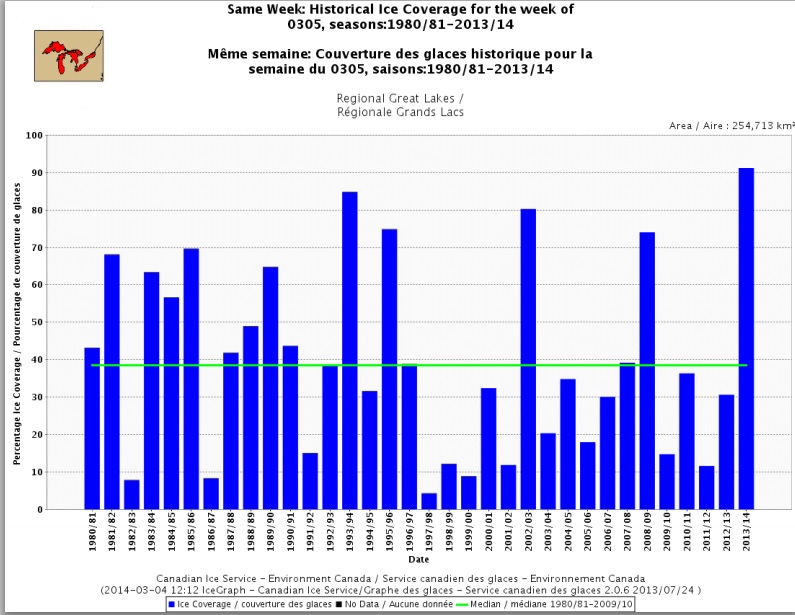
Ice cover on the Great lakes typically reaches maximum in the second week of March and the median since 1980 is at about 40%.

This week ice cover reached over 90%. Maximum in a “normal” year would be reached in the second week of March.

Both the diagrams below are from the Canadian Ice Service with the first showing ice cover historically for this week (since 1980) and the second showing the ice cover for this season (2013/2014) with the median for 1980-2010. This season ice cover is running at more than twice the median values.

Historical Great lakes Ice Cover  week of 0304 Canadian Ice Service

Historical Great lakes Ice Cover week of 0304
Canadian Ice Service

Great Lakes Ice Cover Season 2013 - 2014 Canadian Ice Service

Great Lakes Ice Cover Season 2013 – 2014 Canadian Ice Service

Global warming contortionists will no doubt find strange and convoluted explanations to show that this massive increase of ice cover is not inconsistent with global warming. The missing heat could be hiding in the deep waters around the world and Nessie is probably running a fever.

Of course this massive increase of ice cover is also not inconsistent with the start of another Little Ice Age.

The most parsimonious explanation is that the climate and weather are going through their “natural variations” (due directly or indirectly to the Sun) and that there is no missing heat. Which leads to the obvious – but politically incorrect – conclusion that man-made global warming is – at most – insignificant.

Where is the evidence that man-made CO2 is the dominant cause of global warming?

March 1, 2014

Political correctness is fond of stating that there is “overwhelming” evidence of man-made global warming. They have repeated it so often that many actually believe it. The reality however is that there is no evidence beyond assumptions in models that

  1. Carbon dioxide concentration in the atmosphere has a significant impact on global warming
  2. man-made carbon dioxide emissions (which accounts for about 5% of all carbon dioxide emissions) is incontrovertibly the cause of the observed increase in atmospheric carbon dioxide concentration

Assumptions of the impact of carbon dioxide in models tend to show the assumed impact, but assumptions do not evidence provide.

Patrick Moore (a co-founder of Greenpeace) has been testifying to a Senate Sub-Committee.

Full Statement of Patrick Moore, Ph.D.

Before the Senate Environment and Public Works Committee, Subcommittee on Oversight – “Natural Resource Adaptation: Protecting ecosystems and economies”

February 25, 2014

Chairman Whitehouse, Ranking Member Inhofe, and members of the Committee. Thank you for the opportunity to testify at today’s hearing.

In 1971, as a PhD student in ecology I joined an activist group in a church basement in Vancouver Canada and sailed on a small boat across the Pacific to protest US Hydrogen bomb testing in Alaska. We became Greenpeace.

After 15 years in the top committee I had to leave as Greenpeace took a sharp turn to the political left, and began to adopt policies that I could not accept from my scientific perspective. Climate change was not an issue when I abandoned Greenpeace, but it certainly is now.

There is no scientific proof that human emissions of carbon dioxide (CO2) are the dominant cause of the minor warming of the Earth’s atmosphere over the past 100 years. If there were such a proof it would be written down for all to see. No actual proof, as it is understood in science, exists.

The Intergovernmental Panel on Climate Change (IPCC) states: “It is extremely likely that human influence has been the dominant cause of the observed warming since the mid-20th century.” (My emphasis)

“Extremely likely” is not a scientific term but rather a judgment, as in a court of law. The IPCC defines “extremely likely” as a “95-100% probability”. But upon further examination it is clear that these numbers are not the result of any mathematical calculation or statistical analysis. They have been “invented” as a construct within the IPCC report to express “expert judgment”, as determined by the IPCC contributors.

These judgments are based, almost entirely, on the results of sophisticated computer models designed to predict the future of global climate. As noted by many observers, including Dr. Freeman Dyson of the Princeton Institute for Advanced Studies, a computer model is not a crystal ball. We may think it sophisticated, but we cannot predict the future with a computer model any more than we can make predictions with crystal balls, throwing bones, or by appealing to the Gods.

Perhaps the simplest way to expose the fallacy of “extreme certainty” is to look at the historical record. With the historical record, we do have some degree of certainty compared to predictions of the future. When modern life evolved over 500 million years ago, CO2 was more than 10 times higher than today, yet life flourished at this time. Then an Ice Age occurred 450 million years ago when CO2 was 10 times higher than today.

There is some correlation, but little evidence, to support a direct causal relationship between CO2 and global temperature through the millennia. The fact that we had both higher temperatures and an ice age at a time when CO2 emissions were 10 times higher than they are today fundamentally contradicts the certainty that human-caused CO2 emissions are the main cause of global warming.

Today we remain locked in what is essentially still the Pleistocene Ice Age, with an average global temperature of 14.5°C. This compares with a low of about 12°C during the periods of maximum glaciation in this Ice Age to an average of 22°C during the Greenhouse Ages, which occurred over longer time periods prior to the most recent Ice Age. During the Greenhouse Ages, there was no ice on either pole and all the land was tropical and sub-tropical, from pole to pole. As recently as 5 million years ago the Canadian Arctic islands were completely forested.

Today, we live in an unusually cold period in the history of life on earth and there is no reason to believe that a warmer climate would be anything but beneficial for humans and the majority of other species. There is ample reason to believe that a sharp cooling of the climate would bring disastrous results for human civilization.
Moving closer to the present day, it is instructive to study the record of average global temperature during the past 130 years. The IPCC states that humans are the dominant cause of warming “since the mid-20th century”, which is 1950.

From 1910 to 1940 there was an increase in global average temperature of 0.5°C over that 30-year period. Then there was a 30-year “pause” until 1970. This was followed by an increase of 0.57°C during the 30-year period from 1970 to 2000. Since then there has been no increase, perhaps a slight decrease, in average global temperature. This in itself tends to negate the validity of the computer models, as CO2 emissions have continued to accelerate during this time.

The increase in temperature between 1910-1940 was virtually identical to the increase between 1970-2000. Yet the IPCC does not attribute the increase from 1910-1940 to “human influence.” They are clear in their belief that human emissions impact only the increase “since the mid-20th century”. Why does the IPCC believe that a virtually identical increase in temperature after 1950 is caused mainly by “human influence”, when it has no explanation for the nearly identical increase from 1910-1940?

It is important to recognize, in the face of dire predictions about a 2°C rise in global average temperature, that humans are a tropical species. We evolved at the equator in a climate where freezing weather did not exist. The only reasons we can survive these cold climates are fire, clothing, and housing. It could be said that frost and ice are the enemies of life, except for those relatively few species that have evolved to adapt to freezing temperatures during this Pleistocene Ice Age. It is “extremely likely” that a warmer temperature than today’s would be far better than a cooler one.

I realize that my comments are contrary to much of the speculation about our climate that is bandied about today. However, I am confident that history will bear me out, both in terms of the futility of relying on computer models to predict the future, and the fact that warmer temperatures are better than colder temperatures for most species.

If we wish to preserve natural biodiversity, wildlife, and human well being, we should simultaneously plan for both warming and cooling, recognizing that cooling would be the most damaging of the two trends. We do not know whether the present pause in temperature will remain for some time, or whether it will go up or down at some time in the near future. What we do know with “extreme certainty” is that the climate is always changing, between pauses, and that we are not capable, with our limited knowledge, of predicting which way it will go next.

Thank you for the opportunity to present my views on this important subject.

Attached please find the chapter on climate change from my book, “Confessions of a Greenpeace Dropout: The Making of a Sensible Environmentalist”. I would request it be made part of the record.

Click here for Moore’s full chapter excerpt. (pdf)