Archive for the ‘Anthropology’ Category

On when speech may have originated

March 3, 2014

A new paper suggests that the Kebara 2 Neanderthals, some 60,000 years ago, not only had the capability but also used speech. The capability for speech itself has now been pushed back to the common ancestors of Anatomically Modern Humans, Neanderthals and Denisovans to about 500,000 years ago. The picture we have of Neanderthals is now of a fairly sophisticated and complex species:

  1. Neanderthals may have spoken in a similar way to modern humans.
  2. Neanderthals are our closest extinct human relatives.
  3. Neanderthal DNA is over 99% identical to modern human DNA.
  4. Several theories for Neanderthal extinction exist, including impacts of climate change, competition with human beings, and the possibility that Neanderthals and humans interbred and were ‘absorbed’ into the human species.
  5. Neanderthals lived in Eurasia 200,000 – 30,000 years ago in the Pleistocene Epoch
  6. Neanderthals and our human ancestors lived on Earth at the same time.
  7. Neanderthals lived in family groups and looked after their sick and infirm. 
  8. Neanderthals used tools made from bone, stone, antlers and other materials. 
  9. Neanderthals used fire, and even ate cooked vegetables. 

Moreover it is clear that all non-Africans carry some 3% of Neanderthal genes. And so – in my speculation – it would be perfectly consistent with not only the Neanderthals of the Kebara 2 study having speech, but also with all Neanderthals from about 200,000 years ago, having some form of – at least – rudimentary speech.

I have no doubt that speech originated from an intense need to communicate and developed in complexity and sophistication as the complex needs of the societies that developed required more nuanced communication. And if this happened 500,000 years ago then I find it not implausible that there are connections between the controlled use of fire, the growth of complex social interactions, the need for nuanced communications and the development of speech.

Visions arise of camp fires and a society with time for gatherings and then – inevitably – for story-telling! And for tall tales. Lying after all is a construct of language!

But speech was probably invented many times and only became language when some critical mass of people shared the same sounds for the same meanings. Within a single tribe or troop this critical mass for the beginnings of a rudimentary language was probably no more than a handful of individuals. What the first words ever spoken were can only be a matter of speculation. A case can be made for the “ma”, “ba” and “pa” sounds being the first to be repeated but also among the earliest ever words for communication would have been danger, here, there, up, down, you, me, stop, come and go.

Neanderthal genes are everywhere

January 30, 2014

Neanderthal genes are everywhere

We seek them here, we seek them there,

We met them often – but when? And where?

They are in our skins and in our hair,

Neanderthal genes are everywhere

From, Sriram Sankararaman et al, The genomic landscape of Neanderthal ancestry in present-day humansNature, 2014; DOI:10.1038/nature12961

Harvard Press ReleaseRemnants of Neanderthal DNA in modern humans are associated with genes affecting type 2 diabetes, Crohn’s disease, lupus, biliary cirrhosis and smoking behavior. They also concentrate in genes that influence skin and hair characteristics. At the same time, Neanderthal DNA is conspicuously low in regions of the X chromosome and testes-specific genes.

Dark-skinned, blue-eyed hunter gatherer

January 27, 2014

Light skin genes in Europe less than 7,000 years old

Genetic analysis of ancient skeletons is bringing pictures of our ancestors to light in vivid colours. What is particularly astounding to me is the mobility of our ancestors – and their genes – already in the pleistocene.

Less than 350 generations for the light skin gene to have spread all over Europe seems to be a very short time. But that is what is concluded from the genetic analysis of two hunter-gatherer skeletons discovered in a cave in the mountains of north-west Spain in 2006.

hunter gatherer from brana


Read the rest of this post

Without immigration OECD populations will be in decline and in crisis

January 17, 2014

In times of high unemployment the anti-immigration voices are raised very high everywhere and especially in many European countries. Much of the sentiment is rooted in racist views whether against those of Asian or African or East European origin. In Japan it is seen as threatening the homogeneity of the country. But what every politician well knows – but which some will not dare to admit for fear of losing their populist base – is that  without net immigration in, OECD countries will face an increasing crisis of declining populations, declining labour force and an increase in the  proportion of the aged. They are all very well aware that expanding the working population to at least match the increase in the “aged” proportion is critical to maintaining the standard of welfare and health care that they have become accustomed to. Increasing the retirement age – which is already on the table as trial balloons – is unavoidable because even with immigration the proportion of the working population relative to the “aged” is in decline.

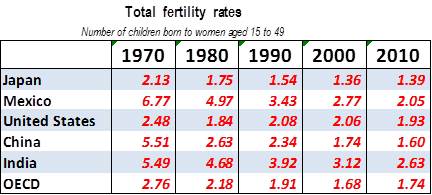
In OECD countries fertility rates are already well below the replacement level of 2.1 per woman. It is higher only in Israel, Iceland and New Zealand, and in India, South Africa and Indonesia. China is already down at 1.6 and India is down to 2.63 and declining fast.

The Local

France’s fertility rate has fallen below the symbolic level of two babies per woman and 2013 saw the slowest population growth in the country for well over a decade, new data revealed this week.

The 280,000 births in 2013 marked a 1.3 percent decline from 2012 with France’s fertility rate falling from 2.03 children per woman in 2010 to 1.99 children last year, according to the France’s national statistics agency INSEE. …… 

Despite the drop in the birth rate, France remains second only to Ireland when it comes to Europe’s most fertile nations. Women in Ireland, where the population is 4.6 million, had on average 2.01 children each in 2013.

These figures stand in stark contrast to Germany and Portugal, which had the lowest fertility rates on the continent. Germany recorded a rate of 1.38 per woman, followed by Portugal with 1.28 offspring per woman.

Korea, Hungary, Spain and Japan are the other countries where fertility rates are less than 1.4.

Fertility rates (2010 data) by country is here: OECD Total fertility rates 1970, 2010

Statistics are from the OECD Library:

Total fertility rates in OECD countries have declined dramatically over the past few decades, falling on average from 2.7 in 1970 to 1.7 children per woman of childbearing age in the 2000s. In all OECD countries, fertility rates declined for young women and increased at older ages. A modest recovery in total fertility rates started in the early 2000’s, to an average level of 1.7 in 2010. The total fertility rate is below its replacement level of 2.1 in most OECD countries except Israel, Iceland and New Zealand, and in India, South Africa and Indonesia.

The last few years have seen various trends emerge in fertility rates. A drop in fertility rates has occurred, for example in Australia, New Zealand, Spain and the United States, while rates have continued to rise in Iceland, Israel, Sweden, and Switzerland. The increase in fertility stopped in many other countries. The effect of the economic downturn is as yet unknown, but persistent economic uncertainties can impact downward the number of children women may have over their reproductive life.

OECD Fertility trends

OECD Fertility trends

OECD fertility table

The difference between the decline in fertility rates between India and China is of particular interest. While some of the difference is due to different rates of development, most of the difference can be attributed to the draconian one-child policy in China. But that is now being relaxed as the coming decline in the Chinese population becomes obvious..

The shortages of the proportion of working population – unless immigration is used to mitigate the shortfall – is inevitable and will really begin to bite over the next twenty years or so.

The first word(s) ever spoken

January 11, 2014

A recent conversation at a bar where – in the noise – I was served a whiskey instead of a beer led to a discussion of how sounds and/or gestures became words. Before the bar closed we came to the following conclusions:

  1. A sound becomes a  word only when at least two people use (both make and hear) the same sound for the same meaning.
  2. Probably many such words were “invented” by pairs of people but these never developed any further – either by spreading to others or becoming incorporated with other words to develop into language.
  3. Hand gestures are a consequence – indirectly – of human bipedalism.
  4. First came sounds. Then came sounds/gestures which became gestures/words.Words probably developed from sounds and hand gestures being used together with the words later coming to dominate.
  5. Fundamental hand gestures are almost universally understood today and probably have had similar meanings in antiquity and with the earliest humans.
  6. Fundamental gestures do not need sound for their basic meaning but cannot convey nuances and detail in themselves. Moreover the gestures were invisible in the dark or when out of sight but still within earshot.
  7. The sounds associated with these gestures were most likely among the earliest group of words. But we felt they must have been preceded by a sound – later a word – meaning “danger”. There may well have been a number of sounds describing different kinds of danger.
  8. These fundamental meanings that are readily communicated by gesture alone include: Here, there, up, down, you, me, stop, come and go.

So our considered opinion was that the earliest ever word was danger closely followed by here, there, up, down, you, me, stop, come and go.

But if man had not come down from the trees and freed his hands , sounds would not have become words and words would not have become language.

In Vino Veritas!

Human evolution as a braided stream rather than a branching tree

January 4, 2014
An interspecies love child? from Nature (Christoph P.E. Zollikofer)

An interspecies love child? from Nature (Christoph P.E. Zollikofer)

The genetic history of modern humans is creating a vast jigsaw puzzle. Genetic evidence is mounting that most people today carry some Neanderthal genes, that some carry what have been labelled “Denisovan” genes, that Denosivans and Neanderthals not only had a common ancestor but that there also was admixture between some Denisovans and some Neanderthals and that there was at least one other as yet unnamed archaic honim which interbred with the Denisovans. It now becomes clear that viewing all these various archaic humans as different species could be wrong. They could all well be the same species.

Chris Finlayson reviews the  paleoanthropology advances during 2013:

The conclusion of the Dmanisi study was that the variation in skull shape and morphology observed in this small sample, derived from a single population of Homo erectus, matched the entire variation observed among African fossils ascribed to three species – H. erectus, H. habilis and H. rudolfensis.

The five highly variable Dmanisi fossils belonged to a single population of H. erectus, so how could we argue any longer that similar variation among spatially and temporally widely distributed fossils in Africa reflected differences between species? They all had to be the same species. 

I have been advocating that the morphological differences observed within fossils typically ascribed to Homo sapiens (the so-called modern humans) and the Neanderthals fall within the variation observable in a single species.

It was not surprising to find that Neanderthals and modern humans interbred, a clear expectation of the biological species concept. …. If the fossils of 1.8 or so million years ago and those of the more recent Neanderthal-modern human era were all part of a single, morphologically diverse, species with a wide geographical range, what is there to suggest that it would have been any different in the intervening periods?

Probably not so different if we take the latest finds from the Altai Mountains in Siberia into account. Denisova Cave has produced yet another surprise, revealing that, not only was there gene flow between Neanderthals, Denisovans and modern humans, but that a fourth player was also involved in the gene-exchange game.

The identity of the fourth player remains unknown but it was an ancient lineage that had been separate for probably over a million years. H. erectus seems a likely candidate. Whatever the name we choose to give this mystery lineage, what these results show is that gene flow was possible not just among contemporaries but also between ancient and more modern lineages.

Just to show how little we really know of the human story, another genetic surprise has confounded palaeoanthropologists. Scientists succeeded in extracting the most ancient mitochondrial DNA so far, from the Sima de los Huesos site in Atapuerca, Spain.

The morphology of these well-known Middle Pleistocene (approximately 400,000 years old) fossils have long been thought to represent a lineage leading to the Neanderthals.

When the results came in they were actually closer to the 40,000 year-old Denisovans from Siberia. We can speculate on the result but others have offered enough alternatives for me to not to have to add to them. The conclusion that I derive takes me back to Dmanisi: We have built a picture of our evolution based on the morphology of fossils and it was wrong.

Some time ago we replaced a linear view of our evolution by one represented by a branching tree. It is now time to replace it with that of an interwoven plexus of genetic lineages that branch out and fuse once again with the passage of time

A braided stream rather than the branches of a tree is the better analogy where  – as John Hawkes describes it:

The “braided stream” analogy captures different information about human origins than the usual branching tree. The branches of a tree do not reconnect with each other above the point where they initially separate. A tree will never admit to exchanging sap between its branches, and there are no little xylem hyphae between branches to carry sap anyway. Our evolution was truly a network in which multiple populations existed and contributed to our process of adaptation.

But the braided stream is not quite satisfactory for the picture that is emerging:

promiscuity in the pleistocene

John Hawkes again:

I admit that the braided stream is not a perfect analogy. Diverging rivulets within a valley almost always come together again, forming a complicated network as they form sandbars and islets. None of them flow into a cul-de-sac. Some human populations of the past did become extinct, they did not inexorably flow back into the mainstream of our evolutionary history. Some of them may have flowed back into the mainstream only through very small channels of genetic exchange. When we go far enough back, some populations really did branch off into their own direction. It’s just not clear yet which populations those were. Maybe an evolutionary swamp would be a better analogy, full of algae-covered bayous.

I like the braided stream, and it’s clear that its time has come. Ancient DNA has begun to show the process of genetic exchange was not a minor player in our evolution. All human populations today evidence some mixture of ancient populations that existed well before the “origin of modern humans”. Genetic exchanges between different populations were dominant in the formation of some human adaptations. Some ancient populations can be understood only as the mixed descendants of other, yet more ancient ones. It’s mixing all the way back.

braided-stream-leone

A braided river from http://cloudman23.wordpress.com/ Image – Yann Arthus-Bertrand

The story will most likely become much more complex – as further pieces of the jigsaw are revealed – before the whole picture can be seen But it is already becoming apparent that the origin of modern humans includes genetic exchange with many “species” supposed to have predated AMH and this exchange was not insignificant.

Perhaps the concept of “Anatomically Modern Humans” has to be expanded and pushed back in time. Rather than an origin some 200,000 years ago the start of “modern humans” could need to be pushed back to about 500,000 years ago and has to somehow bring Neanderthals and Denisovans (and some others) back into the fold.

And maybe our ancestors of 20,000 generations ago were just as shocked at a Denisovan-Neanderthal marriage as some in India are today at an “inter-caste” marriage!

Giraffe and flamingo on the menu at Pompeii

January 3, 2014

The Romans were not averse to dining on the meat of exotic animals – when they could get hold of them. Mackinnon (2006) Supplying Exotic Animals for the Roman Amphitheatre Games, suggests that the exotic animals imported and killed in the Roman games were distributed for consumption.

From Mackinnon 2006

From Mackinnon 2006

Now evidence is emerging from Pompeii where it seems leg of giraffe could have been on the menu. Past Horizons has the story:

University of Cincinnati archaeologists are making discoveries in Pompeii that are changing traditional perceptions of how the inhabitants dined; the rich enjoying delicacies such as flamingos and the poor scrounging for soup or gruel.

UC teams of archaeologists have spent more than a decade at two city blocks within a non-elite district in the Roman city of Pompeii, which was buried under a volcano in 79 AD. The excavations are uncovering the earlier use of buildings that would have dated back to the 6th century BC. ….

… The area covers 10 separate building plots and a total of 20 shop fronts, most of which served food and drink. The waste that was examined included collections from drains as well as 10 latrines and cesspits, which yielded mineralized and charred food waste coming from kitchens and excrement. Ellis says among the discoveries in the drains was an abundance of the remains of fully-processed foods, especially grains.

The material from the drains revealed a range and quantity of materials to suggest a rather clear socio-economic distinction between the activities and consumption habits of each property, which were otherwise indistinguishable hospitality businesses,” says Ellis. Findings revealed foods that would have been inexpensive and widely available, such as grains, fruits, nuts, olives, lentils, local fish and chicken eggs, as well as minimal cuts of more expensive meat and salted fish from Spain. Waste from nearby drains would also turn up less of a variety of foods, revealing a socio-economic distinction between neighbours. …..

….. A drain from a central property revealed a richer variety of foods as well as imports from outside Italy, such as shellfish, sea urchin and even delicacies including the butchered leg joint of a giraffe. “That the bone represents the height of exotic food is underscored by the fact that this is thought to be the only giraffe bone ever recorded from an archaeological excavation in Roman Italy,” says Ellis. “How part of the animal, butchered, came to be a kitchen scrap in a seemingly standard Pompeian restaurant not only speaks to long-distance trade in exotic and wild animals, but also something of the richness, variety and range of a non-elite diet.”

Deposits also included exotic and imported spices, some from as far away as Indonesia.

Ellis adds that one of the deposits dates as far back as the 4th century BC which he says is a particularly valuable discovery, since few other ritual deposits survived from that early stage in the development of Pompeii. …… 

Steven Ellis will present these discoveries on Jan. 4, at the joint annual meeting of the Archaeological Institute of America (AIA) and American Philological Association (APA) in Chicago.

Promiscuity in the pleistocene

January 2, 2014

Svante Pääbo of the Max Planck Institute for Evolutionary Anthropology and his colleagues from various institutions are making stunning advances in the analysis of ancient DNA. The complete genome of a Neanderthal has now been reconstructed with a remarkable level of detail.

The complete genome sequence of a Neanderthal from the Altai MountainsKay Prüfer et al, Nature 505, 43–49 (02 January 2014),  doi:10.1038/nature12886

Editors Summary: Recent excavations in the Denisova Cave in the Altai Mountains of southern Siberia have yielded a wealth of hominin fossils from a site that has been occupied for perhaps 250,000 years or more. Now a high-quality genome sequence has been determined from a circa 50,000-year-old toe bone — a proximal toe phalanx — excavated from the east gallery of Denisova Cave in 2010. The sequence is that of a Neanderthal woman whose parents were closely related — perhaps half-siblings or uncle and niece. Such inbreeding was also common among her recent ancestors. Comparisons with other archaic and present-day human genomes reveal several gene-flow events among Neanderthals, the closely related Denisovans and early modern humans, possibly including gene flow into Denisovans from an unknown archaic group. The high-quality Neanderthal genome also helps to establish a definitive list of substitutions that became fixed in modern humans after their separation from the ancestors of Neanderthals and Denisovans.

promiscuity in the pleistocene

But what is also becoming clear is that there were more “species” of homo erectus who existed in parallel than has generally been assumed and also that sexual encounters and interbreeding between these cousin-species has been a regular occurrence over some 250,000 years. And so there have been times when Anatomically Modern Humans (AMH), Neanderthals, Denisovans and the “unknown” hominim have co-existed.

The AMH-Neanderthals split is thought to have occurred about 400,000 years ago. The split with the unknown hominims then must have been around 500,000 years ago. The Denisovans split off from the Neanderthals perhaps about 300,000 years ago. The Out-of-Africa split among AMH was around 100,000 years ago.

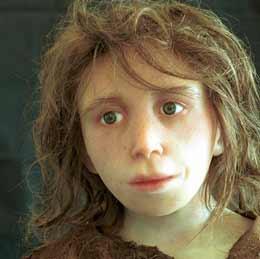
A Neanderthal in our time. (copyright Nenderthal Museum / H Neumann)

A Neanderthal in our time. (copyright Nenderthal Museum / H Neumann)

These ancient splits were all probably in and around Africa even if the Out-of-Africa event for AMH is now more likely to have been  many such events and an expansion out of Africarabia. But it also means that a wave of “unknown hominims” split off from the mainline after a mainline group had left Africa and then spread out to unknown areas. Neanderthals probably split from their parent line of descent also outside of Africa but there must first have come a migration from Africa. The Neanderthal-Denisovan split must also have taken place outside of Africa. Clearly there have been many migrations Out of Africa over the last 400,000 years.

Carl Zimmer writes, “Evolution is a mixture of flow–the cascade of genes from parents to offspring, and the criss-cross movement between populations and species”.

But this generates a myriad of new questions. How large were the troops or tribes or clans of these ancient hunter-gatherers that they could sustain such large migrations? For how long and in what proximity did these different species of man co-exist. These troops – it is thought – probably did not number more than about 50. Some critical population would have been required for sufficient interactions to have taken place between the species. At any one time the total human population – of all species – may have approached 10 million (for if this was – say – just 1 million the opportunities to interbreed would not have been many). They all had fire, but did they all have some form of speech?

But most fascinating of all is how the interbreeding took place. Was it just a product of normal rape and pillage? Did violent clashes lead to the victors impregnating the vanquished, or were there other scenarios for individuals to mate? At some point there must have been children who were 50% Neanderthal and 50% AMH. And some who were 50% Neanderthal and 50% Denisovan. How did they survive? What kind of society existed in these ancient times that would permit such offspring not only to survive but also to mate and produce offspring in their turn? But however it happened, our ancestors in the pleistocene were a promiscuous lot.

Could it be that it was only among AMH  – after they had been vanquished and raped and pillaged by Neanderthal raids – that such mixed children were allowed not only to survive but also to thrive?

DNA sequenced from a 400,000 year old hominin from Spain

December 4, 2013

After developing techniques for extracting and analysing DNA from ancient (c. 40,000 years ago) Neanderthal and Denisovan specimens the Max Planck team have now taken a giant leap backwards in time in extracting and analysing an almost complete mitochondrial genome sequence of a 400,000-year-hominin. The specimen is from  Sima de los Huesos, a unique cave site in Northern Spain. The results show that it is related to the mitochondrial genome of Denisovans, extinct relatives of Neandertals in Asia. DNA this old has until recently been retrieved only from the permafrost.

standard

The Sima de los Huesos hominins lived approximately 400,000 years ago during the Middle Pleistocene. © Kennis & Kennis, Madrid Scientific Films

The result itself is of great interest but it is the development of the techniques for extracting and analysing – without any contamination – and with sufficient confidence, the entire MtDNA sequence in such old specimens that is quite revolutionary. Archaeological evidence – and particularly of of such age – is subject to a great deal of subjective interpretation. But dating techniques and now DNA extraction techniques are removing much of this subjectivity and they are now providing the anchor points around which the evolutionary narrative must be built. And this narrative is now of a much more complex story of hominin expansions and admixture than has generally been thought. Ancient and presumed extinct hominin species are now showing themselves within us.

“Our results show that we can now study DNA from human ancestors that are hundreds of thousands of years old. This opens prospects to study the genes of the ancestors of Neandertals and Denisovans. It is tremendously exciting” says Svante Pääbo, director at the Max Planck Institute for Evolutionary Anthropology.

Matthias Meyer, Qiaomei Fu, Ayinuer Aximu-Petri, Isabelle Glocke, Birgit Nickel, Juan-Luis Arsuaga, Ignacio Martínez, Ana Gracia, José María Bermúdez de Castro, Eudald Carbonell, Svante PääboA mitochondrial genome sequence of a hominin from Sima de los HuesosNature, 2013; DOI: 10.1038/nature12788

Read the whole post in 6,000 Generations


Numeracy and language

December 2, 2013

I tend towards considering mathematics a language rather than a science. In fact mathematics is more like a family of languages each with a rigorous grammar. I like this quote:

R. L. E. SchwarzenbergerThe Language of Geometry, in A Mathematical Spectrum Miscellany, Applied Probability Trust, 2000, p. 112:

My own attitude, which I share with many of my colleagues, is simply that mathematics is a language. Like English, or Latin, or Chinese, there are certain concepts for which mathematics is particularly well suited: it would be as foolish to attempt to write a love poem in the language of mathematics as to prove the Fundamental Theorem of Algebra using the English language.

Just as conventional languages enable culture and provide a tool for social communication, the various languages of mathematics, I think, enable science and provide a tool for scientific discourse. I take “science” here to be analaogous to a “culture”. To follow that thought then, just as science is embedded within a “larger” culture, so is mathematics embedded within conventional languages. This embedding shows up as the ability of a language to deal with numeracy and numerical concepts.

And that means then the value judgement of what is “primitive” when applied to language can depend upon the extent to which mathematics and therefore numeracy is embedded within that language.

GeoCurrents examines numeracy embedded within languages:

According to a recent article by Mike Vuolo in Slate.com, Pirahã is among “only a few documented cases” of languages that almost completely lack of numbers. Dan Everett, a renowned expert in the Pirahã language, further claims that the lack of numeracy is just one of many linguistic deficiencies of this language, which he relates to gaps in the Pirahã culture. ….. 

The various types of number systems are considered in the WALS.info article on Numeral Bases, written by Bernard Comrie. Of the 196 languages in the sample, 88% can handle an infinite set of numerals. To do so, languages use some arithmetic base to construct numeral expressions. According to Comrie, “we live in a decimal world”: two thirds of the world’s languages use base 10 and such languages are spoken “in nearly every part of the world”. English, Russian, and Mandarin are three examples of such languages. ….. 

Around 20% of the world’s languages use either purely vigesimal (or base 20) or a hybrid vigesimal-decimal system. In a purely vigesimal system, the base is consistently 20, yielding the general formula for constructing numerals as x20 + y. For example, in Diola-Fogny, a Niger-Congo language spoken in Senegal, 51 is expressed as bukan ku-gaba di uɲɛn di b-əkɔn ‘two twenties and eleven’. Other languages with a purely vigesimal system include Arawak spoken in Suriname, Chukchi spoken in the Russian Far East, Yimas in Papua New Guinea, and Tamang in Nepal. In a hybrid vigesimal-decimal system, numbers up to 99 use base 20, but the system then shifts to being decimal for the expression of the hundreds, so that one ends up with expressions of the type x100 + y20 + z. A good example of such a system is Basque, where 256 is expressed as berr-eun eta berr-ogei-ta-hama-sei ‘two hundred and two-twenty-and-ten-six’. Other hybrid vigesimal-decimal systems are found in Abkhaz in the Caucasus, Burushaski in northern Pakistan, Fulfulde in West Africa, Jakaltek in Guatemala, and Greenlandic. In a few mostly decimal languages, moreover, a small proportion of the overall numerical system is vigesimal. In French, for example, numerals in the range 80-99 have a vigesimal structure: 97 is thus expressed as quatre-vingt-dix-sept ‘four-twenty-ten-seven’. Only five languages in the WALS sample use a base that is neither 10 nor 20. For instance, Ekari, a Trans-New Guinean language spoken in Indonesian Papua uses base of 60, as did the ancient Near Eastern language Sumerian, which has bequeathed to us our system of counting seconds and minutes. Besides Ekari, non-10-non-20-base languages include Embera Chami in Colombia, Ngiti in Democratic Republic of Congo, Supyire in Mali, and Tommo So in Mali. …… 

Going back to the various types of counting, some languages use a restricted system that does not effectively go above around 20, and some languages are even more limited, as is the case in Pirahã. The WALS sample contains 20 such languages, all but one of which are spoken in either Australia, highland New Guinea, or Amazonia. The one such language found outside these areas is !Xóõ, a Khoisan language spoken in Botswana. ……. 

Read the whole article. 

Counting monkey?

In some societies in the ancient past, numeracy did not contribute significantly to survival as probably with isolated tribes like the Pirahã. But in most human societies, numeracy was of significant benefit especially for cooperation between different bands of humans. I suspect that it was the need for social cooperation which fed the need for communication within a tribe and among tribes, which in turn was the spur to the development of language, perhaps over 100,000 years ago. What instigated the need to count is in the realm of speculation. The need for a calendar would only have developed with the development of agriculture. But the need for counting herds probably came earlier in a semi-nomadic phase. Even earlier than that would have come the need to trade with other hunter gatherer groups and that  probably gave rise to counting 50,000 years ago or even earlier. The tribes who learned to trade and developed the ability and concepts of trading were probably the tribes that had the best prospects of surviving while moving from one territory to another. It could be that the ability to trade was an indicator of how far a group could move.

And so I am inclined to think that numeracy in language became a critical factor which 30,000 to 50,000 years ago determined the groups which survived and prospered. It may well be that it is these tribes which developed numbers, and learned to count, and learned to trade that eventually populated most of the globe. It may be a little far-fetched but not impossible that numeracy in language may have been one of the features distinguishing Anatomically Modern Humans from Neanderthals. Even though the Neanderthals had larger brains and that we are all Neanderthals to some extent!