Archive for the ‘Anthropology’ Category

David Attenborough is my hero but humans are not “a plague on earth”

September 10, 2013

David Attenborough is reported in the Guardian as being rather pessimistic about the future of humans.

Sir David Attenborough warns things will only get worse

People should be persuaded against having large families, says the broadcaster and naturalist

Much of what he is reported to have said is perfectly sound but many of the conclusions then present a pessimistic and apocryphal – a very Guardianesque – view. In fact I suspect that the spin is entirely due to the Guardian’s reporter and the Guardian’s remarkable ability to see a looming catastrophe in every advance.

That with falling fertility rates, world population will continue to rise at a decreasing rate and stabilise by 2100 is just a matter of arithmetic. But a 100 years from now we will face the challenges of a slowly declining population. That natural selection is “defeated” when even weak individuals are cared for and are not allowed to die is not something to regret. We are in the process of artificial selection over-riding natural selection and at a quite different pace, but it is just another challenge for humans – not something to wring our hands over. In fact we are already practicing a sort of eugenics by default.

Sir David Attenborough has said that he is not optimistic about the future and that people should be persuaded against having large families.

The broadcaster and naturalist, who earlier this year described humans as a plague on Earth”, also said he believed humans have stopped evolving physically and genetically because of birth control and abortion, but that cultural evolution is proceeding “with extraordinary swiftness”.

“We stopped natural selection as soon as we started being able to rear 90-95% of our babies that are born. We are the only species to have put a halt to natural selection, of its own free will, as it were,” he tells this week’s Radio Times.

“Stopping natural selection is not as important, or depressing, as it might sound – because our evolution is now cultural … We can inherit a knowledge of computers or television, electronics, aeroplanes and so on.”

Attenborough said he was not optimistic about the future and “things are going to get worse”.

“I don’t think we are going to become extinct. We’re very clever and extremely resourceful – and we will find ways of preserving ourselves, of that I’m sure. But whether our lives will be as rich as they are now is another question.

“We may reduce in numbers; that would actually be a help, though the chances of it happening within the next century is very small. I should think it’s impossible, in fact.”

… he also appeared to express qualified support for the one-child policy in China.

He said: “It’s the degree to which it has been enforced which is terrible, and there’s no question it’s produced all kinds of personal tragedies. There’s no question about that. On the other hand, the Chinese themselves recognise that had they not done so there would be several million more mouths in the world today than there are now.”

He added: “If you were able to persuade people that it is irresponsible to have large families in this day and age, and if material wealth and material conditions are such that people value their materialistic life and don’t suffer as a consequence, then that’s all to the good. But I’m not particularly optimistic about the future. I think we’re lucky to be living when we are, because things are going to get worse.”

“Worse” is a matter of judgement.

We will feed and house more people than ever before. We will take care of more of the elderly than ever before. We will each have more and affordable energy available to us than ever before. We will educate and empower more people than ever before. More of us will see more of this world than ever before. We will face more challenges than ever before.  That’s not “worse”.

Faroe Islands were colonised 300-500 years before the Vikings

August 20, 2013

Somebody got there before the Vikings did – some 300 and 500 years earlier. Norse settlers reached Iceland in the 9th century and probably reached Greenland around the 11th century. But the archaeological evidence is that some unknown colonists had already reached the Faroes in the 4th- 6th century and again between the 6th -8th centuries. There is a theory that they could have been monks from Ireland (St. Brendan?) but I think it is still highly likely that these early explorers/colonists were sea-faring peoples out of Scandinavia.

Mike J. Church, Símun V. Arge, Kevin J. Edwards, Philippa L. AscoughJulie M. Bond, Gordon T. Cook, Steve J. Dockrill, Andrew J. DugmoreThomas H. McGovernClaire Nesbitt and Ian A. Simpson, The Vikings were not the first colonizers of the Faroe Islands, Quaternary Science Reviews (2013)

dx.doi.org/10.1016/j.quascirev.2013.06.011

Faroe Islands -Google Earth

Faroe Islands -Google Earth

Abstract

We report on the earliest archaeological evidence from the Faroe Islands, placing human colonization in the 4th–6th centuries AD, at least 300–500 years earlier than previously demonstrated archaeologically. The evidence consists of an extensive wind-blown sand deposit containing patches of burnt peat ash of anthropogenic origin. Samples of carbonised barley grains from two of these ash patches produced 14C dates of two pre-Viking phases within the 4th–6th and late 6th–8th centuries AD. A re-evaluation is required of the nature, scale and timing of the human colonization of the Faroes and the wider North Atlantic region.

Durham University Press Release:

The Faroe Islands were colonised much earlier than previously believed, and it wasn’t by the Vikings, according to new research.

New archaeological evidence places human colonisation in the 4th to 6th centuries AD, at least 300-500 years earlier than previously demonstrated. 

The research, directed by Dr Mike J Church from Durham University and Símun V Arge from the National Museum of the Faroe Islands as part of the multidisciplinary project “Heart of the Atlantic”, is published in the Quaternary Science Reviews.

The research challenges the nature, scale and timing of human settlement of the wider North Atlantic region and has implications for the colonisation of similar island groups across the world.

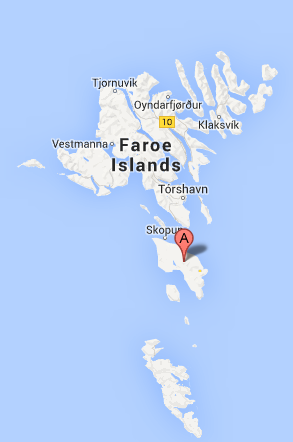
Sandoy, Faroes - Google Maps

Sandoy, Faroes – Google Maps

The Faroes were the first stepping stone beyond Shetland for the dispersal of European people across the North Atlantic that culminated on the shores of continental North America in the 11th century AD, about 500 years before Columbus made his famous voyage.

The research was carried out on an archaeological site at Á Sondum on the island of Sandoy. 

Analysis showed an extensive windblown sand deposit containing patches of burnt peat ash from human activity, dating human settlement to pre-Viking phases. These ash spreads contained barley grains which were accidentally burnt in domestic hearths and were then spread by humans onto the windblown sand surface during the 4th-6thcenturies and 6th-8th centuries, a common practice identified in the North Atlantic during this period to control wind erosion.

Lead author Dr Mike Church, from Durham University’s Department of Archaeology, said: “There is now firm archaeological evidence for the human colonisation of the Faroes by people some 300-500 years before the large scale Viking colonisation of the 9th century AD, although we don’t yet know who these people were or where they came from.

“The majority of archaeological evidence for this early colonisation is likely to have been destroyed by the major Viking invasion, explaining the lack of proof found in the Faroes for the earlier settlement. This also raises questions about the timing of human activity on other islands systems where similarly evidence may have been destroyed.”

Co-author, Símun V Arge from the National Museum of the Faroe Islands, said: “Although we don’t know who the people were that settled here and where they came from, it is clear that they did prepare peat for use, by cutting, drying and burning it which indicates they must have stayed here for some time.

The BANŪ SĀSĀN – a fraternity of medieval Islamic poets, rogues and charlatans

August 16, 2013

It could be a tale told by Scheherazade from the 1001 nights and set in the times of the Great Abbasid Caliph Haroun al-Rashid.  A tale of the Banu Sasan. A tale of poets and rogues, of vagabonds and bandits and of charlatans and disinherited second sons.

Fraternities of criminals and outlaws have probably existed from the earliest time when “laws” were first invented and “outlaws” were banished. Of course “laws” were established by whoever was strong enough to enforce them and the label of “criminality” applied to a group only as long as the group was not dominant. (Once a gang was strong enough it became legitimate and would now be called a “political party”). Organised crime and criminal fraternities that we might recognise as “gangs” therefore date back at least to the initial formation of cities and the exclusion of people outside those early city walls. The origin of gangs probably lies in the loose cooperation between such “outsiders” and “outlaws” and probably goes back some 5,000 years. In Ancient Greece, in the 7th and 8th centuries BCE, “criminal gangs” – for want of a better term – had to be put down when the city states were established.  There are suggestions of “criminal fraternities” / rebels in the Roman Empire, in Byzantium and even among the Aztecs.

The romanticism of Robin Hood and his ilk comes later but is still alive today. The success of The Godfather would suggest that even the Mafia can be seen through romanticised eyes. Certainly modern day gangs – whether in the Balkans or in Los Angeles or in Afghanistan or in the jungles of Chattisgarh – still succeed in recruiting young members who see themselves as “freedom fighters” or rebels against an unjust society. As Kings and Vagabonds.

The Smithsonian’s Past Imperfect Blog carries the story of the Banu-Sasan.

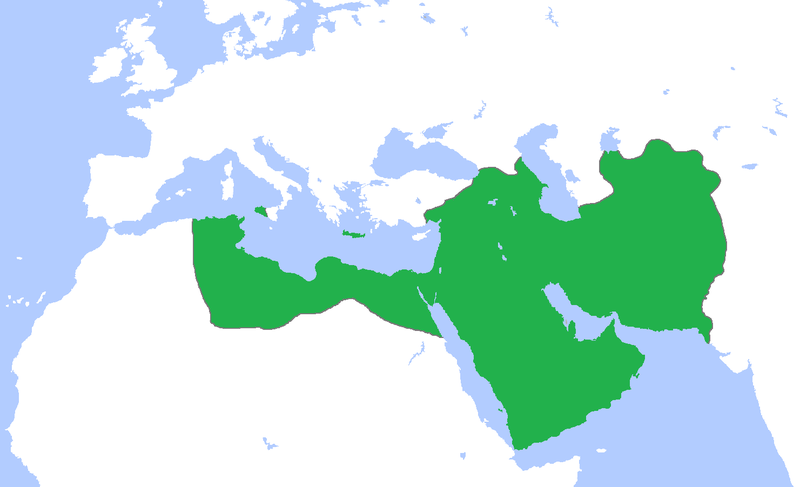
Abbasid Caliphate at its greatest extent, c. 850: Wikipedia

Islam’s Medieval Underworld

The year is—let us say—1170, and you are the leader of a city watch in medieval Persia. Patrolling the dangerous alleyways in the small hours of the morning, you and your men chance upon two or three shady-looking characters loitering outside the home of a wealthy merchant. Suspecting that you have stumbled across a gang of housebreakers, you order them searched. From various hidden pockets in the suspects’ robes, your men produce a candle, a crowbar, stale bread, an iron spike, a drill, a bag of sand—and a live tortoise.

The reptile is, of course, the clincher. There are a hundred and one reasons why an honest man might be carrying a crowbar and a drill at three in the morning, but only a gang of experienced burglars would be abroad at such an hour equipped with a tortoise. It was a vital tool in the Persian criminals’ armory, used—after the iron spike had made a breach in a victim’s dried-mud wall—to explore the property’s interior.

We know this improbable bit of information because burglars were members of a loose fraternity of rogues, vagabonds, wandering poets and outright criminals who made up Islam’s medieval underworld. This broad group was known collectively as the Banu Sasan, and for half a dozen centuries its members might be encountered anywhere from Umayyad Spain to the Chinese border. Possessing their own tactics, tricks and slang, the Banu Sasan comprised a hidden counterpoint to the surface glories of Islam’s golden age. They were also celebrated as the subjects of a scattering of little-known but fascinating manuscripts that chronicled their lives, morals and methods..

According to Clifford Bosworth, a British historian who has made a special study of the Banu Sasan, this motley collection of burglars’ tools had some very precise uses:

The thieves who work by tunneling into houses and by murderous assaults are much tougher eggs, quite ready to kill or be killed in the course of their criminal activities. They necessarily use quite complex equipment… [The iron spike and an iron hand with claws] are used for the work of breaking through walls, and the crowbar for forcing open doors; then, once a breach is made, the burglar pokes a stick with a cloth on the end into the hole, because if he pokes his own head through the gap, [it] might well be the target for the staff, club or sword of the houseowner lurking on the other side.    

The tortoise is employed thus. The burglar has with him a flint-stone and a candle about as big as a little finger. He lights the candle and sticks it on the tortoise’s back. The tortoise is then introduced through the breach into the house, and it crawls slowly around, thereby illuminating the house and its contents. The bag of sand is used by the burglar when he has made his breach in the wall. From this bag, he throws out handfuls of sand at intervals, and if no-one stirs within the house, he then enters it and steals from it; apparently the object of the sand is either to waken anyone within the house when it is thrown down, or else to make a tell-tale crushing noise  should any of the occupants stir within it.    

Also, the burglar may have with him some crusts of dry bread and beans. If he wishes to conceal his presence, or hide any noise he is making, he gnaws and munches at these crusts and beans, so that the occupants of the house think that it is merely the cat devouring a rat or mouse.

The Iranica informs us:

BANŪ SĀSĀN, a name frequently applied in medieval Islam to beggars, rogues, charlatans, and tricksters of all kinds, allegedly so called because they stemmed from a legendary Shaikh Sāsān. A story frequently found in the sources, from Ebn al-Moqaffaʿ onward, states that Sāsān was the son of the ancient Persian ruler Bahman b. Esfandīār, but, being displaced from the succession, took to a wandering life and gathered round him other vagabonds, thus forming the “sons of Sāsān.” 

The Smithsonian continues:

Who were they, then, these criminals of Islam’s golden age? The majority, Bosworth says, seem to have been tricksters of  one sort or another,

who used the Islamic religion as a cloak for their predatory ways, well aware that the purse-strings of the faithful could easily be loosed by the eloquence of the man who claims to be an ascetic or or mystic, or a worker of miracles and wonders, to be selling relics of the Muslim martyrs and holy men, or to have undergone a spectacular conversion from the purblindness of Christianity or Judaism to the clear light of the faith of Muhammad.

Amira Bennison identifies several adaptable rogues of this type, who could “tell Christian, Jewish or Muslim tales depending on their audience, often aided by an assistant in the audience who would ‘oh’ and ‘ah’ at the right moments and collect contributions in return for a share of the profits,” and who thought nothing of singing the praises of both Ali and Abu Bakr—men whose memories were sacred to the Shia and the Sunni sects, respectively. Some members of this group would eventually adopt more legitimate professions—representatives of the Banu Sasan were among the first and greatest promoters of printing in the Islamic world—but for most, their way of life was something they took pride in. One of the best-known examples of the maqamat (popular) literature that flourished from around 900 tells the tale of Abu Dulaf al-Khazraji, the self-proclaimed king of vagabonds, …

“I am of the company of beggar lords,” Abu Dulaf boasts in one account,

the cofraternity of the outstanding ones,

One of the Banu Sasan…

And the sweetest way of life we have experienced is one spent in sexual indulgence and wine drinking.

For we are the lads, the only lads who really matter, on land and sea.

Scheme of Indo-European migrations from ca. 4000 to 1000 BCE according to the Kurgan hypothesis.

Scheme of Indo-European migrations from ca. 4000 to 1000 BCE according to the Kurgan hypothesis. Wikipedia

The ethnic composition of the Banu Sasan is the subject of much speculation. The nomadic Banu Sasan are said by some to have been one of the drivers of the spread of “indo-European”peoples and languages. Perhaps the Banu Sasan may have had links with the ancient Tocharians. But it is more likely that the Banu Sasan was more a fraternity of occupation(s) and not of ethnicity. There are suggestions that there may be genetic connections between those of the Banu Sasan to present-day Roma (the Boyash or the Rudari) and to Parsis and even some Jews. That of course is quite possible for no doubt these vagabond poets and beggar-lords had their share of girl-friends at every caravanserai to be found.

Ancient Sarmatian burial tomb of noble descendant of the Amazon warrior-women found intact

August 8, 2013
Sarmatian (Amazon) warriior woman (image from RealmsofGold)

Sarmatian (Amazon) warriior woman (image from RealmsofGold)

It is thought that the predecessors of the ancient warrior-women of the Sauromatian culture of central Asia dating from the 6th to the 4th century B.C.  could have been the inspiration for the Amazons of Homer’s Iliad. The Iliad possibly dates from the 8th or the 7th century B.C and describes

a race of fierce women who mated with vanquished male foes and kept only the female children they bore, were believed to occupy the area around the Black Sea. Amazon women also crop up in Greek myths. One of the labors of Hercules, for example, required him to acquire the girdle of the Amazon queen, Hippolyte.

… The works of the Greek historian Herodotus, written around the 5th century B.C., describe a group of female warriors who lost to the Greeks at the battle of Thermodon. Herodotus’ Amazons were taken prisoner and put on ships, but overwhelmed and killed the Greek crew. Unable to sail themselves, the women drifted to the shores of the Black Sea, to the territory of the Scythians, a nomadic culture of Iranian descent. The women, Herodotus says, intermarried with the Scythian men, and convinced their new husbands to move northeast across the flat grassy plains, high mountains, and searing deserts of the Russian steppes, where the group eventually evolved into the Sauromatian culture.

The Sauromatians were succeeded by the Sarmatians from around the 4th century B.C. who were also nomadic and fierce warriors who held their warrior-women  – now evolving into “noble” women –  in high regard:

The culture, which had been expanding its territory, soon shifts its focus. “They become raiders and traders, with forays to the west to interface with the Romans, and they relocate to cities and to areas along large trade routes,” …… “Their wealth increases. We see that in their burial items. We see strong, powerful women, but their role changes. We find burials of women that still retain cultic artifacts, indicating that they were a priestess of some sort, but there is much more gold and more secular ornamentation — more golden cups, more golden jewelry, elaborate things — and less weaponry. This type of evolution is a normal manifestation of culture.” 

Filippovka "Tsar Tumulus" mounds (Google Maps)

Filippovka “Tsar Tumulus” mounds (Google Maps)

The Sarmatians held sway for about 900 years until about 400 AD when they were overrun by barbarians from the West. Now a completely intact tomb of a Sarmatian noble woman dating from about 2500 years ago has been found at the  “Tsar Tumulus” mounds near Filippovka in Southern Russia reports RiaNovosti.

MOSCOW, August 6 (RIA Novosti) – Archaeologists have found the intact burial chamber of a noble woman from a powerful tribe that roamed the Eurasian steppes 2,500 years ago in southern Russia, an official said Tuesday.

The Sarmatians were a group of Persian-speaking tribes that controlled what is now parts of southern Russia, Ukraine and Central Asia from around 500 BC until 400 AD. They were often mentioned by ancient Greek historians and left luxurious tombs with exquisite golden and bronze artifacts that were often looted by gravediggers.

sarmatian trasures (image from en.ria.ru)

sarmatian trasures (image from en.ria.ru)

But the burial site found near the the village of Filippovka in the Orenburg region has not been robbed – and contained a giant bronze kettle, jewelry, a silver mirror and what appears to be containers for cosmetics, said history professor Gulnara Obydennova who heads the Institute of History and Legal Education in the city of Ufa.

“The find is really sensational also because the burial vault was intact – the objects and jewelry in it were found the way they had been placed by the ancient nomads,” she told RIA Novosti.

The vault – located 4 meters (13 feet) underground – was found in the “Tsar Tumulus,” a group of two dozen mounds where hundreds of golden and silver figurines of deer, griffins and camels, vessels and weapons have been found since the 1980s.

The woman’s skeleton was still covered with jewelry and decorations, and her left hand held a silver mirror with an ornamented golden handle, Obydennova said.

The descendants of the Sarmatians include Ossetians, an ethnic group living in the Caucasus region, who speak a language related to Persian.

From Realmsof Gold:

Accomplished horse-breeders and horsemen, Sarmatians were nomadic Indo-European tribes closely related to the Scythians. The Roman historian Ammianus Marcellinus describes Sarmatian tribesmen as “tall and handsome, their hair inclines to blond; by the ferocity of their gaze they inspire dread. They delight in danger and warfare.” 

A fascinating feature of Sarmatian society was the high status accorded to women. Sarmatian warrior queens were renowned in antiquity. Herodotus affirmed that the Sarmatians were descendants of the Amazons and Scythians, whose women “frequently hunted on horseback with their husbands; in war taking the field; and wore the very same dress as the men.” The Sarmatian tradition had it that “no girl should wed till she had killed a man in battle.” In ancient kurgans, sumptuous female burials often included swords and arrowheads together with elegant jewelry inlaid with dazzling gems in the Hellenistic style. Eastern campaigns of Alexander the Great (356-323 BC) spread Greek influences throughout his huge empire and exposed local artisans to new styles. The composite style that emerged is known as Hellenistic. 

The Sarmatians were overrun by the invasions of the Goths and Huns in the 3rd and 4th centuries AD. – 

Coping with climate change drove innovation

June 18, 2013

When and how innovation occurs sometimes seems random and the corporate world has long pursued the creation of “environments” in which innovation can flourish. And while the very definition of what counts as innovation can be debated, it seems to me that it is a changing environment rather than a static environment which is a key ingredient. And it could well be that the greater the change to be handled then the very necessity of coping with that change could be the “mother of all innovation”.

I suspect that some of the most fundamental innovations have been driven by the need not just to survive but also to thrive in “rapidly” changing and threatening environments. And climate change where “rapid” would mean several hundred if not thousands of years would also have been a powerful driver. One advantage in the stone age would have been that humans would have focused on coping with the change as it unfolded and not wasted too much effort in trying to control the climate.

A new paper addresses how climate change could have driven innovation in the stone age centered around the discovery and establishment of new refuges.

Ziegler, M. et al. Development of Middle Stone Age innovation linked to rapid climate changeNature Communications 4, Article number: 1905.

Abstract: The development of modernity in early human populations has been linked to pulsed phases of technological and behavioural innovation within the Middle Stone Age of South Africa. However, the trigger for these intermittent pulses of technological innovation is an enigma. Here we show that, contrary to some previous studies, the occurrence of innovation was tightly linked to abrupt climate change. Major innovational pulses occurred at times when South African climate changed rapidly towards more humid conditions, while northern sub-Saharan Africa experienced widespread droughts, as the Northern Hemisphere entered phases of extreme cooling. These millennial-scale teleconnections resulted from the bipolar seesaw behaviour of the Atlantic Ocean related to changes in the ocean circulation. These conditions led to humid pulses in South Africa and potentially to the creation of favourable environmental conditions. This strongly implies that innovational pulses of early modern human behaviour were climatically influenced and linked to the adoption of refugia.

PhysOrg reviews the paper:

According to a study by the Universitat Autònoma de Barcelona, the University of Cardiff and the Natural History Museum in London, technological innovation during the Stone Age occurred in fits and starts and was climate-driven. Abrupt changes in rainfall in South Africa 40,000 to 80,000 years ago triggered the development of technologies for finding refuge and the behaviour of modern humans. This study was recently published in Nature Communications.

Archaeological and genetic evidence suggests that modern humans (the modern form of Homo sapiens, our species) originated in Africa during the Stone Age, between 30,000 and 280,000 years ago. The latest  in southern Africa have shown that technological innovation, linked to the emergence of culture and modern behaviour, took place abruptly: the beginnings of symbolic expression, the making of tools from stone and bone, jewellery or the first agricultural settlements.

An international team of researchers has linked these pulses of innovation to the climate that prevailed in sub-Saharan Africa in that period.

Over the last million years the  has varied between  (with great masses of ice covering the continents in the northern hemisphere) and interglacial periods, with changes approximately every 100,000 years. But within these long periods there have been abrupt climate changes, sometimes happening in the space of just a few decades, with variations of up to 10ºC in the average temperature in the polar regions caused by changes in the Atlantic . These changes affected rainfall in southern Africa.

The researchers have pieced together how  varied in southern Africa over the last 100,000 years, by analysing  deposits at the edge of the continent, where every millimetre of  corresponds to 25 years of sedimentation. The ratio of iron (dissolved from the rocks by the water during the rains) to potassium (present in arid soils) in each of the millimetre layers is a record of the sediment carried by rivers and therefore of the rainfall throughout the whole period.

The reconstruction of the rainfall over 100,000 years shows a series of spikes that occurred between 40,000 and 80,000 years ago. These spikes show rainfall levels rising sharply over just a few decades, and falling off again soon afterwards, in a matter of centuries. This research has shown that the climate changes coincided with increases in population, activity and production of technology on the part of our ancestors, as seen in the archaeological records. In turn, the end of certain stone tool industries of the period coincides with the onset of a new, drier climate.

The findings confirm one of the principal models of Palaeolithic cultural evolution, which correlates technological innovation with the adoption of new refuges and with a resulting increase in population and social networks. For these researchers, the bursts of demographic expansion caused by climate change in southern Africa were probably key factors in the origin of modern humans’ behaviour in Africa, and in the dispersal of Homo sapiens from his ancestral home.


We were lowly scavengers long before we became noble hunter-gatherers

May 10, 2013

There has always been an aura of romance about our ancient hunter-gatherer forbears. The term “noble savage” ( “bon sauvage”) only dates back to 1672 but the concept gained ground in the 18th and 19th centuries and the idea of “nature’s gentlemen” flourished in the sentimentality of that time. Jean M Auel’s hugely successful Earths Children series also paints a picture of rather noble hunter-gatherers. Hunters are of course intrinsically heroic and appending “gatherers” to their description does not take too much away. The heroic stature is only dissipated when we become fully settled agriculturists – mere farmers – in the Holocene. Farmer’s don’t conjure up images of nobility and heroism and of course when humans became traders they also get greed and deviousness added to their image.

But there is no perceived nobility or honor in scavenging. It is the image of the hyena versus that of the lion. But long before we became hunter-gatherers we were scroungers and scavengers. New archaeological findings indicates that we were hunter-scavengers some 2 million years ago. And we were scavengers before that and scroungers when we first split from the chimps.

Ferraro JV, Plummer TW, Pobiner BL, Oliver JS, Bishop LC, et al. (2013) Earliest Archaeological Evidence of Persistent Hominin Carnivory. PLoS ONE 8(4): e62174. doi:10.1371/journal.pone.0062174

My imagined time-line for the various phases of human development then becomes:

  • 8 million YBP           Human Chimpanzee divergence – Scroungers
  • 4 million YBP           Bipedalism – Scavengers
  • 2 million YBP           Stone tools – Hunter-scavengers
  • 600,000 YBP          Archaic Human – Neanderthal divergence
  • 200,000 YBP          Hunting teams, herd followers  Hunter-nomads
  • 60,000    YBP          Semi-permanent dwellings, Hunter-gatherers
  • 11,500     YBP          Settled agriculture Farmers
  • 5,000       YBP          Mercantile expansions Merchant-soldiers

180 million Neanderthals are among us

April 16, 2013

From John Hawks Weblog

Just got back proofs of a book chapter I have coming out soon with Zach Throckmorton. My favorite paragraph:

Nearly seven billion people inhabit our planet. At least six billion carry the genes of Neandertal ancestors. Inheritance from Neandertals makes up approximately 3% of the genomes of randomly chosen people outside sub-Saharan Africa today (Green et al., 2010; Reich et al., 2010). A back-of-the-envelope calculation shows if we took all of the Neandertal genes from today’s human population, we would have enough raw material to make up 180 million Neandertals.

I love that because it makes the Neandertals into the evolutionary success story they really were. They succeeded by becoming part of us.

The idea that all the various hominids who developed bipedalism have all disappeared except Anatomically Modern Humans does not appeal. I prefer to think that many of them – and not just the Neanderthals and Denisovans – live on; in us.

File:Homo-Stammbaum, Version Stringer.jpg

Possible archaic human admixture with modern Homo sapiens (Wikipedia)

Revisiting Heyerdahl’s Kon-Tiki 50 years on

April 6, 2013

Last night we saw the new Kon-Tiki movie at our local cinema. A full-fledged action/adventure film it relates the story of Thor Heyerdahl and his 1947 Kon-Tiki expedition. It is the most expensive film ever to have been made in Norway and was a nominee for Best Foreign Film at this year’s Oscars (which it did not win). The film is directed by Joachim Rønning and Espen Sandberg and the role of Thor Heyerdahl is played by Pål Sverre Valheim Hagen.

English: Kon-Tiki raft

Kon-Tiki raft (Photo credit: Wikipedia)

I enjoyed every minute of this 2 hour movie. Stunning visuals and a clear demonstration, I think , that understatement is far more effective than “sound and fury” in sustaining excitement. It took me back some 50 years to 1962 when I first saw Heyerdahl’s own documentary movie about his expedition (which did win an Oscar in 1951). Ever since then I have eagerly followed Heyerdahl’s various expeditions and theories of the migrations of ancient peoples (Ra and Tigris and The Search for Odin among others). And my current fascination with anthropology is in no small measure due to Heyerdahl’s injection of adventure and wonder and a kind of “romance” into the long-dead past of our ancestors. It does not matter that his theories were heavily criticised and may not have been correct. It does not matter either that our theories about the past may no longer be capable  of being “proven” conclusively. Imagining how our ancestors – just 100 or so generations ago – could have behaved and acted is what I find absolutely compelling. And Heyerdahl’s adherence to the materials and tools of the past adds credibility at least to imagining what our fore-fathers could have accomplished – if not necessarily to his own theories.

Back in 1962 when I first saw Heyerdahl’s documentary I had not fully appreciated the enormity of what Heyerdahl and his “glad amateurs” were trying to do. While he had an absolute belief in the migration of people from South America to Polynesia, his companions were only there either because he was or because they were seeking some intense adventure after the war. While the success of the Kon-Tiki could not prove that this migration had actually taken place it certainly proved that it could have. Heyerdahl’s theory received much criticism from the establishment view that Polynesia had been populated solely from Asia. But what all this “establishment criticism” sometimes forgets is their sense of wonder and that Heyerdahl does actually prove that it could have happened. This criticism continued well into the 1990’s but the latest genetic studies now show that Heyerdahl was in fact partly correct.

Heyerdahl’s theory of Polynesian origins never gained acceptance among anthropologists. Physical and cultural evidence had long suggested that Polynesia was settled from west to east, migration having begun from the Asian mainland, not South America. In the late 1990s, genetic testing found that the mitochondrial DNA of the Polynesians is more similar to people from southeast Asia than to people from South America, showing that their ancestors most likely came from Asia. Easter Islanders are of Polynesian descent. Anthropologist Robert Carl Suggs included a chapter titled “The Kon-Tiki Myth” in his book on Polynesia, concluding that “The Kon-Tiki theory is about as plausible as the tales of Atlantis, Mu, and ‘Children of the Sun.’ Like most such theories it makes exciting light reading, but as an example of scientific method it fares quite poorly.” Anthropologist and National Geographic Explorer-in-Residence Wade Davis also criticised Heyerdahl’s theory in his book The Wayfinders, which explores the history of Polynesia. Davis says that Heyerdahl “ignored the overwhelming body of linguistic, ethnographic, and ethnobotanical evidence, augmented today by genetic and archaeological data, indicating that he was patently wrong.”

But that is changing as advanced genetic studies show that there is some clear admixture from South America.

Now – 64 years later- new research has finally proved the adventurer was at least partly right after all. A team of scientists have tested the genetic make up of descendants of the original islanders and found it includes DNA that could have only come from native Americans.

That means that some time before the remote islands – including Easter Island – were colonised by Europeans the locals had interbred with people from South America. …. 

The established theory has always been that Polynesia was colonised via Asia around 5,500 years ago. This has been backed up by archaeology, linguistics and some genetic studies. But in 1947, Heyerdahl controversially claimed that Easter Island’s famous statues were similar to those at Lake Titicaca in Bolivia, and sailed a raft from Peru to French Polynesia to prove it could have been colonised from America.

Now Professor Erik Thorsby of the University of Oslo in Norway has found clear evidence to support elements of Heyerdahl’s hypothesis.

The Polynesian gene pool: an early contribution by Amerindians to Easter Island, Erik Thorsby, Published 6 February 2012, doi:10.1098/rstb.2011.0319, Phil. Trans. R. Soc. B 19 March 2012 vol. 367 no. 1590 812-819 (full text pdf)

AbstractIt is now generally accepted that Polynesia was first settled by peoples from southeast Asia. An alternative that eastern parts of Polynesia were first inhabited by Amerindians has found little support. There are, however, many indications of a ‘prehistoric’ (i.e. before Polynesia was discovered by Europeans) contact between Polynesia and the Americas, but genetic evidence of a prehistoric Amerindian contribution to the Polynesian gene pool has been lacking. We recently carried out genomic HLA (human leucocyte antigen) typing as well as typing for mitochondrial DNA (mtDNA) and Y chromosome markers of blood samples collected in 1971 and 2008 from reputedly non-admixed Easter Islanders. All individuals carried HLA alleles and mtDNA types previously found in Polynesia, and most of the males carried Y chromosome markers of Polynesian origin (a few had European Y chromosome markers), further supporting an initial Polynesian population on Easter Island. The HLA investigations revealed, however, that some individuals also carried HLA alleles which have previously almost only been found in Amerindians. We could trace the introduction of these Amerindian alleles to before the Peruvian slave trades, i.e. before the 1860s, and provide suggestive evidence that they were introduced already in prehistoric time. Our results demonstrate an early Amerindian contribution to the Polynesian gene pool on Easter Island, and illustrate the usefulness of typing for immunogenetic markers such as HLA to complement mtDNA and Y chromosome analyses in anthropological investigations.


Neanderthals died out because they could see better than humans

March 13, 2013

Hot on the heels of the theory that Neanderthals died out because they couldn’t adapt from hunting big game to hunting rabbits comes this new theory that they died out because they developed bigger eyes than humans’ in the cold dark Northern latitudes!  The theory goes like this:

Their large eyes led to too much of their brain capacity being used for processing visual information and since more of their brain capacity was also needed to handle the motion of their larger, heavier bodies, this  resulted in less brain capacity being available for cognitive reasoning. They therefore had less brain to deal with other functions like social networking” and had “fewer friends to help them out in times of need”Obviously they then remained culturally trapped in the Stone Age and could not develop written language or Facebook or Agriculture as competing humans eventually did. Apart from a few intrepid and promiscuous Neanderthals who managed to participate in contributing their genes to the human gene pool, all the rest died out.

A novel theory but a little far-fetched!

Eiluned Pearce

This is the theory of  Eiluned Pearce a DPhil student at Oxford and is published in  a paper published today in the Proceedings of the Royal Society B (but where it is beyond a pay wall). A press release has been issued by the University of Oxford.

The only data are measurements of eye sockets in 13 Neanderthal skulls compared to those in 32 human skulls from the same time. All the rest is just conjecture – and then further conjecture based on the original speculation.  It would seem to be a little light on data and a little heavy on conjecture. It is still an interesting conjecture nevertheless.

… Looking at data from 27,000–75,000-year-old fossils, mostly from Europe and the Near East, they compared the skulls of 32 anatomically modern humans and 13 Neanderthals to examine brain size and organisation. In a subset of these fossils, they found that Neanderthals had significantly larger eye sockets, and therefore eyes, than modern humans. 

The researchers calculated the standard size of fossil brains for body mass and visual processing requirements. Once the differences in body and visual system size are taken into account, the researchers were able to compare how much of the brain was left over for other cognitive functions.

Previous research by the Oxford scientists shows that modern humans living at higher latitudes evolved bigger vision areas in the brain to cope with the low light levels. This latest study builds on that research, suggesting that Neanderthals probably had larger eyes than contemporary humans because they evolved in Europe, whereas contemporary humans had only recently emerged from lower latitude Africa.

‘Since Neanderthals evolved at higher latitudes and also have bigger bodies than modern humans, more of the Neanderthal brain would have been dedicated to vision and body control, leaving less brain to deal with other functions like social networking,’ explains lead author Eiluned Pearce from the  Institute of Cognitive and Evolutionary Anthropology at the University of Oxford.

‘Smaller social groups might have made Neanderthals less able to cope with the difficulties of their harsh Eurasian environments because they would have had fewer friends to help them out in times of need. Overall, differences in brain organisation and social cognition may go a long way towards explaining why Neanderthals went extinct whereas modern humans survived.’

‘The large brains of Neanderthals have been a source of debate from the time of the first fossil discoveries of this group, but getting any real idea of the “quality” of their brains has been very problematic,’ says Professor Chris Stringer, Research Leader in Human Origins at the Natural History Museum and co-author on the paper. ‘Hence discussion has centred on their material culture and supposed way of life as indirect signs of the level of complexity of their brains in comparison with ours.

‘Our study provides a more direct approach by estimating how much of their brain was allocated to cognitive functions, including the regulation of social group size; a smaller size for the latter would have had implications for their level of social complexity and their ability to create, conserve and build on innovations.’

Professor Robin Dunbar observes: ‘Having less brain available to manage the social world has profound implications for the Neanderthals’ ability to maintain extended trading networks, and are likely also to have resulted in less well developed material culture – which, between them, may have left them more exposed than modern humans when facing the ecological challenges of the Ice Ages.’

The relationship between absolute brain size and higher cognitive abilities has long been controversial, and this new study could explain why Neanderthal culture appears less developed than that of early modern humans, for example in relation to symbolism, ornamentation and art.

The Smithsonian blog writes:

One of the easiest differences to quantify, they found, was the size of the visual cortex—the part of the brain responsible for interpreting visual information. In primates, the volume of this area is roughly proportional to the size of the animal’s eyes, so by measuring the Neanderthals’ eye sockets, they could get a decent approximation of their the visual cortex as well. The Neanderthals, it turns out, had much larger eyes than ancient humans. The researchers speculate that this could be because they evolved exclusively in Europe, which is of higher latitude (and thus has poorer light conditions) than Africa, where H. sapiens evolved.

Along with eyes, Neanderthals had significantly larger bodies than humans, with wider shoulders, thicker bones and a more robust build overall. To account for this difference, the researchers drew upon previous research into the estimated body masses of the skeletons found with these skulls and of other Neanderthals. In primates, the amount of brain capacity devoted to body control is also proportionate to body size, so the scientists were able to calculate roughly how much of the Neanderthals’ brains were assigned to this task.

After correcting for these differences, the research team found that the amount of brain volume left over for other tasks—in other words, the mental capacity not devoted to seeing the world or moving the body—was significantly smaller for Neanderthals than for ancient H. sapiens. Although the average raw brain volumes of the two groups studied were practically identical (1473.84 cubic centimeters for humans versus 1473.46 for Neanderthals), the average “corrected” Neanderthal brain volume was just 1133.98 cubic centimeters, compared to 1332.41 for the humans.

This divergence in mental capacity for higher cognition and social networking, the researcher argue, could have led to the wildly different fates of H. sapiens and Neanderthals. “Having less brain available to manage the social world has profound implications for the Neanderthals’ ability to maintain extended trading networks,” Robin Dunbar, one of the co-authors, said in a press statement. “[They] are likely also to have resulted in less well developed material culture—which, between them, may have left them more exposed than modern humans when facing the ecological challenges of the Ice Ages.”

New insights into differences in brain organization between Neanderthals and anatomically modern humans by Eiluned Pearce, Chris Stringer and R. I. M. Dunbar

Published online March 13, 2013 doi:10.1098/rspb.2013.0168 Proc. R. Soc. B 7 May 2013 vol. 280 no. 1758 20130168 

Related articles

Rabbits (or a lack thereof) killed off the Neanderthals!

March 4, 2013

A new paper in the Journal of Human Evolution claims that the diet of the Neanderthals contained far fewer rabbits than that of Modern Humans. The paper then suggests that this was because Neanderthals could not shift from hunting large prey to hunting small animals. The data may well be valid but the interpretations of the data and the conclusions drawn are so lacking in common sense that the entire paper may well qualify as “idiot science”.

Rabbits and hominin survival in Iberia

by John E. Fa, John R. Stewart, Lluís Lloveras and J. Mario Vargas

Abstract

High dependence on the hunting and consumption of large mammals by some hominins may have limited their survival once their preferred quarry became scarce or disappeared. Adaptation to smaller residual prey would have been essential after the many large-bodied species decreased in numbers. We focus on the use of a superabundant species, the rabbit, to demonstrate the importance of this taxon in Iberia as fundamental to predators. We show that the use of the rabbit over time has increased, and that there could have been differential consumption by Neanderthals and Anatomically Modern Humans (AMH). Analysis of bone remains from excavations throughout Iberia show that this lagomorph was a crucial part of the diet of AMH but was relatively unutilised during the Mousterian, when Neanderthals were present. We first present changes in mammalian biomass and mean body mass of mammals over 50,000 years, to illustrate the dramatic loss of large mammalian fauna and to show how the rabbit may have contributed a consistently high proportion of the available game biomass throughout that period. Unlike the Italian Peninsula and other parts of Europe, in Iberia the rabbit has provided a food resource of great importance for predators including hominins. We suggest that hunters that could shift focus to rabbits and other smaller residual fauna, once larger-bodied species decreased in numbers, would have been able to persist. From the evidence presented here, we postulate that Neanderthals may have been less capable of prey-shifting and hence use the high-biomass prey resource provided by the rabbit, to the extent AMH did.

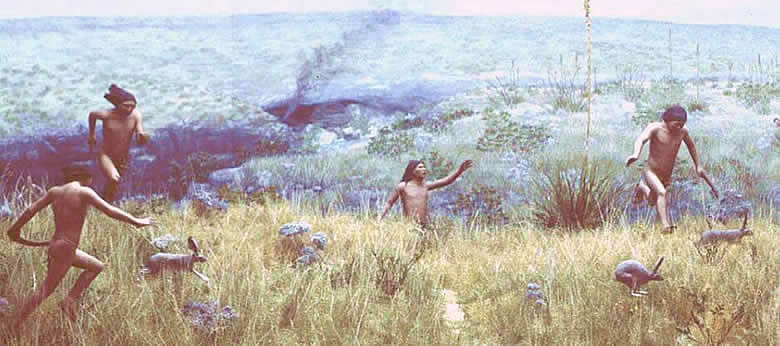
painting of prehistoric hunters

Prehistoric hunters prepare to unleash their throwing sticks at a group of jack rabbits on the run. Painting by Nola Davis, courtesy Texas Parks and Wildlife Department.

That Anatomically Modern Humans ate more rabbits than Neanderthals may well be true but to then leap to the amazing conclusion that Neanderthals were incapable of hunting small prey and then to the even more dubious suggestion that this may have something to do with the demise of Neanderthals as a species takes legitimate speculation into the fantasy worlds of the Land of Painted Caves. We could just as well assume that eating rabbits led to a virulent disease which AMH were immune to but which led to the eradication of the Neanderthal species (except of course for the offspring of those who had mated with AMH) !!