Archive for the ‘Archeology’ Category

Viking slaves were probably sacrificed and buried headless with their masters

November 7, 2013

Viking slaves were apparently decapitated and buried with their owners as grave gifts, new research shows. The slaves were buried headless. Moreover their diets differed. High status individuals who were accompanied by their – presumed – beheaded and sacrificed slaves, had much more meat in their diets. Their slaves along with other less exalted commoners had a predominantly marine diet.

Meat for the Viking Lords and fish for all the others but slaves had the dubious privilege of accompanying their masters, headless, into the after life!

Elise Naumann, Maja Krzewińska, Anders Götherström, Gunilla Eriksson Slaves as burial gifts in Viking Age Norway? Evidence from stable isotope and ancient DNA analyses  Journal of Archaeological Science, Volume 41, January 2014, Pages 533–540 http://dx.doi.org/10.1016/j.jas.2013.08.022

Full-size image (68 K)

The burial site of Flakstad is situated on Flakstad Island

PastHorizons reports:

Six Late Iron Age (AD 550–1030) graves were discovered in the northern Norwegian island of Flakstad and partially excavated in the period 1980–1983. There were ten individuals making up three single burials, two double and one triple and unusually for this region the bones were in a good state of preservation.

Although much of the contextual information had been lost due to farming activity, the double and triple burials contained one intact individual in each, along with the post-cranial bones of the other occupants. This situation has been interpreted as decapitated slaves buried with his/her master and the theory is supported by a number of double burials found within Norse societies indicating this practice.

Elise Naumann from the University of Oslo led a study to investigate stable isotope and ancient mitochondrial DNA fragments in order to better understand the social status, geographical and/or familial links within the Flakstad group

Graves with two or more individuals occur relatively frequently all over the Viking World. The choice to bury people together is not coincidental, but rather a deliberate action based on specific relationships between these individuals, which could either be:

  1. Family members or people with other close connections.
  2. Sacrifice, where one or more individuals are intended to accompany the “main” burial.

The research has revealed some intriguing results and indicates that the intact person in each grave had distinct isotope values from the other individuals with missing crania; the former having a predominately meat based diet, while the latter – in common with the single grave occupants – had consumed a much higher percentage of marine foodstuffs.

The research study noted that ” in a society where most of the daily activities were dedicated to the acquirement and preparation of food, where food shortage and harsh winters are assumed to have been a constant threat, it would seem likely that a different diet should be detectable in people of low social standing compared to the common population. However, isotopic data in this study show quite the contrary. Despite indications that the headless people in multiple graves might represent low-status members of the population, their diet was equivalent to those  in the single burials who are interpreted as representatives of the free population. ”

he ancient DNA results suggest that maternal relations between the individuals buried together are unlikely and backs up the isotope evidence. Therefore, the complete individuals from the multiple burials stand out as a distinct group and may be perceived as having a special social status. This is emphasised by a diet distinctly different from the slaves and the rest of the population and along with the lack of high status artefacts in the multiple burials could indicate that they were not necessarily wealthy, but special in another sense, who were  treated differently than others in death as well as in life.

Why the slaves were deprived of their heads is a little unclear. Perhaps it was to make sure that they stayed in the service of their owners in the after-life and didn’t just go wandering about on their own.

The authors conclude:

Results from stable isotope analyses show that individuals in multiple burials most likely were intentionally placed in the same burial, given the pattern in which the only person buried intact in each burial, had distinct isotope values. Thus, persons sharing a grave had distinctly different diets during their lifetime and were unlikely to share maternal kinship. A reasonable explanation for these observations could be that persons buried headless may have been slaves accompanying their masters in the grave. This interpretation corresponds well with other double burials from the Norse World with similar features, where decapitated and sometimes headless people were deposited as grave gifts. The resemblance in diet between headless persons and individuals buried in single burials was unexpected and calls for further investigation in the future. The present study indicates that also other double burials should be investigated using a bioarchaeological approach.

Neanderthal’s weren’t vegetarian – they just ate the stomachs of vegetarians

October 21, 2013

English: First reconstruction of Neanderthal m...

The view that calcified plaque found on Neanderthal teeth came from medicinal plants and vegetables, conjuring up visions of a smart, cultured, sensitive race of homo erectus is being challenged. Laura Buck and Chris Stringer believe these remains have a much more violent source. They came from eating the stomachs of prey which in turn were vegetarian. Neanderthals were only vegetarian by proxy.

Hah! We can now go back to the older vision of Neanderthals being brutal, brutish, insensitive, blood-thirsty carnivores!

(Just as an aside, my grandmother was not only a confirmed vegetarian but a devout Hindu for whom the very thought of eating beef was anathema. She couldn’t quite come to terms with the fact that her grandchildren were carnivorous and that they ate gentle things like chickens and goats. I once tried to convince her that I was more of a vegetarian – by proxy – by eating beef rather than chicken since cows were more vegetarian in their diet than chickens. Chickens after all were known to eat worms and other horrible stuff. She gave up any hopes that I would escape everlasting damnation at that point!).

Past Horizons carries this revisionist view of Neanderthals:

(This article titled “The stomach-turning truth about what the Neanderthals ate?” was written by Robin McKie, for The Observer on Saturday 19th October 2013)

It was the tell-tale tartar on the teeth that told the truth. Or at least, that is what it appeared to do. Researchers – after studying calcified plaque on Neanderthal fossil teeth found in El Sidrón cave in Spain – last year concluded that members of this extinct human species cooked vegetables and consumed bitter-tasting medicinal plants such as chamomile and yarrow.

These were not brainless carnivores, in other words. These were smart and sensitive people capable of providing themselves with balanced diets and of treating themselves with health-restoring herbs, concluded the researchers, led by Karen Hardy at the Catalan Institution for Research and Advanced Studies in Barcelona. Our vision of these long-extinct people needs adjusting, they argued.

But now this tale of ancient tartar has taken a new twist with two researchers at London’s Natural History Museum challenging the Barcelona group’s conclusions. Dental research does not prove that Neanderthals were self-medicating, vegetable-eating sophisticates, one told the Observer. There are other, equally valid but decidedly more grizzly explanations to account for those microscopic fragments of herbs and plants found in Neanderthal teeth.

In a paper by Laura Buck and Chris Stringer and published in the latest edition of Quaternary Science Reviews, Stringer argues that the tiny pieces of plant found in Neanderthal teeth could have come from a very different source. They may well have become embedded in the stomach contents of deer, bison and other herbivores that had then been hunted and eaten by Neanderthals.

“Many hunter-gatherers, including the Inuit, Cree and Blackfeet, eat the stomach contents of animals such as deer because they are good source of vitamin C and trace elements,” said Stringer. “For example, among the Inuit, the stomach contents of an animal are considered a special delicacy with a consistency and a flavour that is not unlike cream cheese. At least that is what I am told.” ……

…… Stringer and Buck stress that they are not arguing that Neanderthals definitely did not eat vegetables or could not have used certain herbs as medicines. “What we are saying is that the evidence of plant fragments in Neanderthal teeth is simply not strong enough to prove that they did so. There are other explanations, including the proposal that they ate these organs of the animals they killed. They had the stomach for it, if you want to put it that way.”

Ancient humans coped with massive climate change (without the IPCC)

October 1, 2013

Many people today seem to like to live in the fear of an impending catastrophe. The fears are all artificial and always include fanciful predictions of doom. Fears of uncontrollable population explosions, food shortages and starvation, of energy crises and depletion of all resources and of course of catastrophic global warming. And they give rise to such utterly useless bodies as the IPCC.

The period from before the last interglacial, the Eemian and through to the current interglacial in the Holocene has seen the rise of Anatomically Modern Humans and, starting from Africa, the peopling of the world. Anatomically modern humans make their appearance in Africa during an even earlier interglacial at around 250,000 years ago. They saw a descent into glacial conditions with global temperatures dropping about 6 °C and sea levels  dropping by some 150m. Then around 130,000 to 135,000 years ago a very rapid (relatively) climate change ocurred as the conditions of the Eemian were established.  Global temperatures increased by some 7 °C and sea levels rose by upto 170m. Temperatures were warmer than today and sea levels were higher.They didn’t just survive this change – they thrived. They made their way through the Sahara (perhaps through ancient green river corridors) and established themselves in the North and North-East of Africa. At this time sea-levels were high and crossing over into Europe or to Arabia would not have been possible. Both these crossings would have been made at earlier periods by the precursors of AMH and such groups would have given rise to the Neanderthals in Europe and the Denisovans in Asia. When sea levels allowed and perhaps driven by desertfication they crossed into Arabia. From Africarabia they moved across the globe – again perhaps driven by desertification of Arabia.

All these predecessors of ours – some ancestors and some distant cousins – not only survived but actually thrived. They had no IPCC to warn them of looming catastrophe if sea levels rose by 20 cm or temperatures rose by 1.5 °C. Not realising their dangers they still coped with changes of 7 °C and sea-levels of 170 m. Of course they were not without their resources. They had fire. They could probably speak but they had not been contaminated by the written word and were not corrupted by IPCC reports. They may have had some primitive form of rafts but they had no boats and the wheel was unknown. They had stone tools and their version of WMD consisted of many spears. They just coped with the weather and whatever it threw at them. They didn’t waste time predicting the climate and living in the fear of their own predictions. They had other more real fears to worry about.

Former interglacials

The period after the Eemian and upto the present day is particularly interesting.  For most of the time the world was in the grip of glacial conditions. Even as the climate changed and the world started warming up, there were sudden spikes of climate in the reverse direction as with the Younger Dryas. It was in this glacial period that AMH left Africa and then peopled the entire globe. It was not a period of stable climate and their expansion and growth took place in an environment of frequent and violent change. Real population increase started some time before the neolithic when we were still hunter-gatherers or semi-nomadic herders.

Age of Human Expansion

Age of Human Expansion

Of course in North Africa and the Middle East and Asia where much of the action took place for AMH there was little danger of advancing ice sheets. But there was the constant risk of sudden desertification, the drying up of fresh water resources and the sudden loss or appearance of new coastal land as sea levels increased or decreased. Rainfall patterns would have changed. Landscapes would have been transformed from forests to savannahs to deserts and back again. The only recourse available to humans of that time was to move to a more viable location whenever their survival was threatened.

And as they did that they populated the world and they prospered.

But they could have been stopped in their tracks if they had had the benefit of an IPCC.

Faroe Islands were colonised 300-500 years before the Vikings

August 20, 2013

Somebody got there before the Vikings did – some 300 and 500 years earlier. Norse settlers reached Iceland in the 9th century and probably reached Greenland around the 11th century. But the archaeological evidence is that some unknown colonists had already reached the Faroes in the 4th- 6th century and again between the 6th -8th centuries. There is a theory that they could have been monks from Ireland (St. Brendan?) but I think it is still highly likely that these early explorers/colonists were sea-faring peoples out of Scandinavia.

Mike J. Church, Símun V. Arge, Kevin J. Edwards, Philippa L. AscoughJulie M. Bond, Gordon T. Cook, Steve J. Dockrill, Andrew J. DugmoreThomas H. McGovernClaire Nesbitt and Ian A. Simpson, The Vikings were not the first colonizers of the Faroe Islands, Quaternary Science Reviews (2013)

dx.doi.org/10.1016/j.quascirev.2013.06.011

Faroe Islands -Google Earth

Faroe Islands -Google Earth

Abstract

We report on the earliest archaeological evidence from the Faroe Islands, placing human colonization in the 4th–6th centuries AD, at least 300–500 years earlier than previously demonstrated archaeologically. The evidence consists of an extensive wind-blown sand deposit containing patches of burnt peat ash of anthropogenic origin. Samples of carbonised barley grains from two of these ash patches produced 14C dates of two pre-Viking phases within the 4th–6th and late 6th–8th centuries AD. A re-evaluation is required of the nature, scale and timing of the human colonization of the Faroes and the wider North Atlantic region.

Durham University Press Release:

The Faroe Islands were colonised much earlier than previously believed, and it wasn’t by the Vikings, according to new research.

New archaeological evidence places human colonisation in the 4th to 6th centuries AD, at least 300-500 years earlier than previously demonstrated. 

The research, directed by Dr Mike J Church from Durham University and Símun V Arge from the National Museum of the Faroe Islands as part of the multidisciplinary project “Heart of the Atlantic”, is published in the Quaternary Science Reviews.

The research challenges the nature, scale and timing of human settlement of the wider North Atlantic region and has implications for the colonisation of similar island groups across the world.

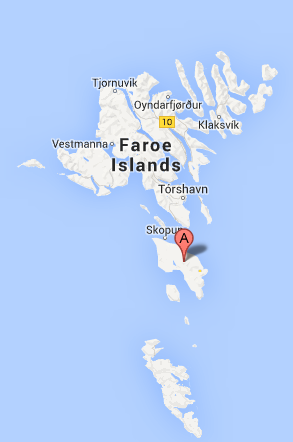
Sandoy, Faroes - Google Maps

Sandoy, Faroes – Google Maps

The Faroes were the first stepping stone beyond Shetland for the dispersal of European people across the North Atlantic that culminated on the shores of continental North America in the 11th century AD, about 500 years before Columbus made his famous voyage.

The research was carried out on an archaeological site at Á Sondum on the island of Sandoy. 

Analysis showed an extensive windblown sand deposit containing patches of burnt peat ash from human activity, dating human settlement to pre-Viking phases. These ash spreads contained barley grains which were accidentally burnt in domestic hearths and were then spread by humans onto the windblown sand surface during the 4th-6thcenturies and 6th-8th centuries, a common practice identified in the North Atlantic during this period to control wind erosion.

Lead author Dr Mike Church, from Durham University’s Department of Archaeology, said: “There is now firm archaeological evidence for the human colonisation of the Faroes by people some 300-500 years before the large scale Viking colonisation of the 9th century AD, although we don’t yet know who these people were or where they came from.

“The majority of archaeological evidence for this early colonisation is likely to have been destroyed by the major Viking invasion, explaining the lack of proof found in the Faroes for the earlier settlement. This also raises questions about the timing of human activity on other islands systems where similarly evidence may have been destroyed.”

Co-author, Símun V Arge from the National Museum of the Faroe Islands, said: “Although we don’t know who the people were that settled here and where they came from, it is clear that they did prepare peat for use, by cutting, drying and burning it which indicates they must have stayed here for some time.

Ancient Sarmatian burial tomb of noble descendant of the Amazon warrior-women found intact

August 8, 2013
Sarmatian (Amazon) warriior woman (image from RealmsofGold)

Sarmatian (Amazon) warriior woman (image from RealmsofGold)

It is thought that the predecessors of the ancient warrior-women of the Sauromatian culture of central Asia dating from the 6th to the 4th century B.C.  could have been the inspiration for the Amazons of Homer’s Iliad. The Iliad possibly dates from the 8th or the 7th century B.C and describes

a race of fierce women who mated with vanquished male foes and kept only the female children they bore, were believed to occupy the area around the Black Sea. Amazon women also crop up in Greek myths. One of the labors of Hercules, for example, required him to acquire the girdle of the Amazon queen, Hippolyte.

… The works of the Greek historian Herodotus, written around the 5th century B.C., describe a group of female warriors who lost to the Greeks at the battle of Thermodon. Herodotus’ Amazons were taken prisoner and put on ships, but overwhelmed and killed the Greek crew. Unable to sail themselves, the women drifted to the shores of the Black Sea, to the territory of the Scythians, a nomadic culture of Iranian descent. The women, Herodotus says, intermarried with the Scythian men, and convinced their new husbands to move northeast across the flat grassy plains, high mountains, and searing deserts of the Russian steppes, where the group eventually evolved into the Sauromatian culture.

The Sauromatians were succeeded by the Sarmatians from around the 4th century B.C. who were also nomadic and fierce warriors who held their warrior-women  – now evolving into “noble” women –  in high regard:

The culture, which had been expanding its territory, soon shifts its focus. “They become raiders and traders, with forays to the west to interface with the Romans, and they relocate to cities and to areas along large trade routes,” …… “Their wealth increases. We see that in their burial items. We see strong, powerful women, but their role changes. We find burials of women that still retain cultic artifacts, indicating that they were a priestess of some sort, but there is much more gold and more secular ornamentation — more golden cups, more golden jewelry, elaborate things — and less weaponry. This type of evolution is a normal manifestation of culture.” 

Filippovka "Tsar Tumulus" mounds (Google Maps)

Filippovka “Tsar Tumulus” mounds (Google Maps)

The Sarmatians held sway for about 900 years until about 400 AD when they were overrun by barbarians from the West. Now a completely intact tomb of a Sarmatian noble woman dating from about 2500 years ago has been found at the  “Tsar Tumulus” mounds near Filippovka in Southern Russia reports RiaNovosti.

MOSCOW, August 6 (RIA Novosti) – Archaeologists have found the intact burial chamber of a noble woman from a powerful tribe that roamed the Eurasian steppes 2,500 years ago in southern Russia, an official said Tuesday.

The Sarmatians were a group of Persian-speaking tribes that controlled what is now parts of southern Russia, Ukraine and Central Asia from around 500 BC until 400 AD. They were often mentioned by ancient Greek historians and left luxurious tombs with exquisite golden and bronze artifacts that were often looted by gravediggers.

sarmatian trasures (image from en.ria.ru)

sarmatian trasures (image from en.ria.ru)

But the burial site found near the the village of Filippovka in the Orenburg region has not been robbed – and contained a giant bronze kettle, jewelry, a silver mirror and what appears to be containers for cosmetics, said history professor Gulnara Obydennova who heads the Institute of History and Legal Education in the city of Ufa.

“The find is really sensational also because the burial vault was intact – the objects and jewelry in it were found the way they had been placed by the ancient nomads,” she told RIA Novosti.

The vault – located 4 meters (13 feet) underground – was found in the “Tsar Tumulus,” a group of two dozen mounds where hundreds of golden and silver figurines of deer, griffins and camels, vessels and weapons have been found since the 1980s.

The woman’s skeleton was still covered with jewelry and decorations, and her left hand held a silver mirror with an ornamented golden handle, Obydennova said.

The descendants of the Sarmatians include Ossetians, an ethnic group living in the Caucasus region, who speak a language related to Persian.

From Realmsof Gold:

Accomplished horse-breeders and horsemen, Sarmatians were nomadic Indo-European tribes closely related to the Scythians. The Roman historian Ammianus Marcellinus describes Sarmatian tribesmen as “tall and handsome, their hair inclines to blond; by the ferocity of their gaze they inspire dread. They delight in danger and warfare.” 

A fascinating feature of Sarmatian society was the high status accorded to women. Sarmatian warrior queens were renowned in antiquity. Herodotus affirmed that the Sarmatians were descendants of the Amazons and Scythians, whose women “frequently hunted on horseback with their husbands; in war taking the field; and wore the very same dress as the men.” The Sarmatian tradition had it that “no girl should wed till she had killed a man in battle.” In ancient kurgans, sumptuous female burials often included swords and arrowheads together with elegant jewelry inlaid with dazzling gems in the Hellenistic style. Eastern campaigns of Alexander the Great (356-323 BC) spread Greek influences throughout his huge empire and exposed local artisans to new styles. The composite style that emerged is known as Hellenistic. 

The Sarmatians were overrun by the invasions of the Goths and Huns in the 3rd and 4th centuries AD. – 

We were lowly scavengers long before we became noble hunter-gatherers

May 10, 2013

There has always been an aura of romance about our ancient hunter-gatherer forbears. The term “noble savage” ( “bon sauvage”) only dates back to 1672 but the concept gained ground in the 18th and 19th centuries and the idea of “nature’s gentlemen” flourished in the sentimentality of that time. Jean M Auel’s hugely successful Earths Children series also paints a picture of rather noble hunter-gatherers. Hunters are of course intrinsically heroic and appending “gatherers” to their description does not take too much away. The heroic stature is only dissipated when we become fully settled agriculturists – mere farmers – in the Holocene. Farmer’s don’t conjure up images of nobility and heroism and of course when humans became traders they also get greed and deviousness added to their image.

But there is no perceived nobility or honor in scavenging. It is the image of the hyena versus that of the lion. But long before we became hunter-gatherers we were scroungers and scavengers. New archaeological findings indicates that we were hunter-scavengers some 2 million years ago. And we were scavengers before that and scroungers when we first split from the chimps.

Ferraro JV, Plummer TW, Pobiner BL, Oliver JS, Bishop LC, et al. (2013) Earliest Archaeological Evidence of Persistent Hominin Carnivory. PLoS ONE 8(4): e62174. doi:10.1371/journal.pone.0062174

My imagined time-line for the various phases of human development then becomes:

  • 8 million YBP           Human Chimpanzee divergence – Scroungers
  • 4 million YBP           Bipedalism – Scavengers
  • 2 million YBP           Stone tools – Hunter-scavengers
  • 600,000 YBP          Archaic Human – Neanderthal divergence
  • 200,000 YBP          Hunting teams, herd followers  Hunter-nomads
  • 60,000    YBP          Semi-permanent dwellings, Hunter-gatherers
  • 11,500     YBP          Settled agriculture Farmers
  • 5,000       YBP          Mercantile expansions Merchant-soldiers

Indian “curry” dates back to 4,500 years ago

January 30, 2013

Curries have come a long way from the proto-curry of the Indus Valley civilization and I am sure our tastes have also evolved. And chillies probably came much later and only in the 16th century.

But I can attest to the fact that curry withdrawal syndrome is a real thing and hits hard if I go more than 3 or 4 days without a fix.

Slate:

The Mystery of Curry

By |Posted Tuesday, Jan. 29, 2013,

Indian chicken jalfrezi curry.

Indian chicken jalfrezi. Photograph by Joe Gough/iStockphoto/Thinkstock.

What is curry? Today, the word describes a bewildering number of spicy vegetable and meat stews from places as far-flung as the Indian subcontinent, the South Pacific, and the Caribbean Islands. There is little agreement about what actually constitutes a curry. And, until recently, how and when curry first appeared was a culinary mystery as well.

The term likely derives from kari, the word for sauce in Tamil, a South-Indian language. Perplexed by that region’s wide variety of savory dishes, 17th-century British traders lumped them all under the term curry.  A curry, as the Brits defined it, might be a mélange of onion, ginger, turmeric, garlic, pepper, chilies, coriander, cumin, and other spices cooked with shellfish, meat, or vegetables.

Those curries, like the curries we know today, were the byproduct of more than a millennium of trade between the Indian subcontinent and other parts of Asia, which provided new ingredients to spice up traditional Indian stews. After the year 1000, Muslims brought their own cooking traditions from the west, including heavy use of meat, while Indian traders carried home new and exotic spices like cloves from Southeast Asia. And when the Portuguese built up their trading centers on the west coast of India in the 16th century, they threw chilies from the New World into the pot. (Your spicy vindaloo may sound like Hindi, but actually the word derives from the Portuguese terms for its original central ingredients: wine and garlic.) 

But the original curry predates Europeans’ presence in India by about 4,000 years. Villagers living at the height of the Indus civilization used three key curry ingredients—ginger, garlic, and turmeric—in their cooking. This proto-curry, in fact, was eaten long before Arab, Chinese, Indian, and European traders plied the oceans in the past thousand years.

….. The Indus society began to flourish around the same time that the ancient Egyptians built their pyramids and Mesopotamians constructed the first great cities in today’s Iraq. Though less well known than its more famous cousins to the West, the Indus civilization boasted a half-dozen large and carefully planned urban centers with sophisticated water and sewage systems unmatched until Roman times. During its peak, between 2500 B.C. and 1800 B.C., the Indus dominated a land area larger than either ancient Egypt or Mesopotamia, covering much of today’s Pakistan and most of western India, as far west as the Iranian coast, as far north as Afghanistan, and as far east as the suburbs of New Delhi. But unlike the hieroglyphic and cuneiform writing of the Egyptian and Mesopotamian scribes, the strange symbols left behind by their Indus counterparts has not yet been deciphered by today’s scholars. Deciphering their food traditions has, until recently, been equally challenging.

Archaeologists have long known how to spot some ancient leftovers. The biggest breakthrough came in the 1960s, when excavators began to drop soil from their sites—particularly from places where food likely was prepared—onto mesh screens. The scientists then washed the earth away with water, leaving behind little bits of stone, animal bones, and tiny seeds of wheat, barley, millets, and beans. This flotation method allowed scientists to piece together a rough picture of an ancient diet. “But spices are absent in macro-botanical record,” says archaeologist Arunima Kashyap at Washington State University Vancouver, who, along with Steve Weber, made the recent proto-curry discovery.*

Working with other Indian and American archaeologists, the two applied new methods for pinpointing the elusive remains of spices that don’t show up in flotation tanks. Instead of analyzing dirt from Indus kitchens, they collected cooking pots from the ancient town of Farmana, a modest settlement that prospered in the late third millennium B.C. (Today, it’s a two-hour drive west of Delhi.) They also obtained human teeth from the nearby cemetery from the same era. …… 

…… Examining the human teeth and the residue from the cooking pots, Kashyap spotted the telltale signs of turmeric and ginger, two key ingredients, even today, of a typical curry. This marked the first time researchers had found unmistakable traces of the spices in the Indus civilization. Wanting to be sure, she and Weber took to their kitchens in Vancouver, Washington. “We got traditional recipes, cooked dishes, then examined the residues to see how the structures broke down,” Weber recalls. The results matched what they had unearthed in the field. “Then we knew we had the oldest record of ginger and turmeric.” Dated to between 2500 and 2200 B.C., the finds are the first time either spice has been identified in the Indus. They also found a carbonized clove of garlic, a plant that was used in this era by cooks from Egypt to China.

They found additional supporting evidence of ginger and turmeric use on ancient cow teeth unearthed in Harappa, one of the largest Indus cities, located in Pakistan west of the border with India. Why would cattle be eating curry-style dishes? Weber notes that in the region today, people often place leftovers outside their homes for wandering cows to munch on. There are numerous ancient Indus images of cattle on terra-cotta seals, suggesting that during Indus times, people may have regarded cows as sacred, as Hindus do today. The Harappan ruins also contain evidence of domesticated chickens, which were likely cooked in those tandoori-style ovens and eaten. …….

Migration from India brought genes, tools and dingoes to Australia 4,200 years ago

January 15, 2013

It is generally assumed that the expansion of AMH from Africa (or Africarabia) reached S-E Asia around 70,000 years ago and Australia some 40,000 – 50,000 years ago. The Australian population then remained virtually isolated until quite recently. But a new genome-wide study suggests that there was migration from India to Australia some 4,200 years ago during the Holocene and that they brought stone-tools and the ancestor of the dingo with them. The study suggests that after the first migrants originally arrived in Sahul, the Australian, New Guinea and Mamanwa populations split from each other some 36,000 years ago. But by – an as yet unknown route – migrants from India arrived in Australia between 4,000 and 5,000 years ago.

Though this coincides with the height of the Indus Valley civilization in 2600 BC, I think it is more likely that any ocean-based, island-hopping migration at this time would have started – at least geographically – from S-E India rather than from the Indus Valley civilization in N-W India. But coastal navigation around the Indian coastline of that time would have been well within the capabilities of the Indus valley inhabitants. This is also the period when proto-Dravidian was the language across most of India (including in the Indus valley civilization) and it would be interesting if there are any traces in language which match this genetic data.

Genome-wide data substantiate Holocene gene flow from India to Australia, by Irina Pugach, Frederick Delfin, Ellen Gunnarsdóttir, Manfred Kayser, and Mark Stoneking, Proceedings of the National Academy of Sciences, 

http://www.pnas.org/content/early/2013/01/09/1211927110

Abstract:The Australian continent holds some of the earliest archaeological evidence for the expansion of modern humans out of Africa, with initial occupation at least 40,000 y ago. It is commonly assumed that Australia remained largely isolated following initial colonization, but the genetic history of Australians has not been explored in detail to address this issue. Here, we analyze large-scale genotyping data from aboriginal Australians, New Guineans, island Southeast Asians and Indians. We find an ancient association between Australia, New Guinea, and the Mamanwa (a Negrito group from the Philippines), with divergence times for these groups estimated at 36,000 y ago, and supporting the view that these populations represent the descendants of an early “southern route” migration out of Africa, whereas other populations in the region arrived later by a separate dispersal. We also detect a signal indicative of substantial gene flow between the Indian populations and Australia well before European contact, contrary to the prevailing view that there was no contact between Australia and the rest of the world. We estimate this gene flow to have occurred during the Holocene, 4,230 y ago. This is also approximately when changes in tool technology, food processing, and the dingo appear in the Australian archaeological record, suggesting that these may be related to the migration from India.

BBC reports:

“For a long time, it has been commonly assumed that following the initial colonization, Australia was largely isolated as there wasn’t much evidence of further contact with the outside world,” explained Prof Mark Stoneking, from the Max Planck Institute for Evolutionary Anthropology in Leipzig, Germany.

“It is one of the first dispersals of modern humans – and it did seem a bit of a conundrum that people who got there this early would have been so isolated.”

To study the early origins of Australia’s population, the team compared genetic material from Aboriginal Australians with DNA from people in New Guinea, South East Asia and India.

By looking at specific locations, called genetic markers, within the DNA sequences, the researchers were able to track the genes to see who was most closely related to whom.

They found an ancient genetic association between New Guineans and Australians, which dates to about 35,000 to 45,000 years ago. At that time, Australia and New Guinea were a single land mass, called Sahul, and this tallies with the period when the first humans arrived.

But the researchers also found a substantial amount of gene flow between India and Australia.

Prof Stoneking said: “We have a pretty clear signal from looking at a large number of genetic markers from all across the genome that there was contact between India and Australia somewhere around 4,000 to 5,000 years ago.”

He said the genetic data could not establish the route the Indians would have taken to reach the continent, but it was evidence that Australia was not as cut off as had been assumed.

“Our results show that there were indeed people that made a genetic contribution to Australians from India,” Prof Stoneking explained.

The researchers also looked at fossils and other archaeological discoveries that date to this period.

They said changes in tool technology and new animals could possibly be attributed to the new migrants.

Prof Stoneking said: “We don’t have direct evidence of any connection, but it strongly suggestive that microliths, dingo and the movement of people were all connected.”

Humans may have started selective breeding 50-60,000 years ago

November 25, 2012

Humans probably started selective breeding – artificial selection – with the domestication of the dog. Dogs diverged from wolves about 100,000 years ago. The earliest skeletal association of wolves with humans is also from about 100,000 years ago. The earliest evidence of an ancestral dog  is from about 32,000 years ago.

It is not implausible that the first exercise of artificial selection is connected with the domestication of the dog and happened 50- 60,000 years ago.

Ancient dog domestication was the start of artificial selection by humans

Stone-tipped spears were being used for hunting 500,000 years ago

November 16, 2012

It is thought that wooden spears could have come into use as early as 5 million years ago since chimpanzees and orangutans have been observed using wooden spears and because the human – chimpanzee split is dated to around 8 million years ago.  Stone tipped spears however were thought to have come into use only around 300,000 years ago during the time of the Neanderthals. But a new paper in Science finds archaeological evidence from South Africa that stone spear tips were being used around 500,000 years ago.

(more…)