Archive for the ‘Behaviour’ Category

Post-election leadership battles provide the entertainment lacking in UK election campaign

May 16, 2015

The UK general election was just like the Eurovision song contest. No substance in the songs and great excitement during the vote. There was no substance either during the rather lacklustre campaign and then intense excitement during the vote count. The foregone conclusion of a hung parliament with a possible Labour/SNP “majority” first morphed into possibly another Conservative/Lib Dem majority and then – almost unthinkably – into an outright Conservative win. High drama on election night. I was switching between BBC (TV and radio) and Sky TV´and the BBC tried valiantly to be objective but could not quite hide their Labour bias. (For the education of the judges of the EU General Court, there was absolutely no confusion in my mind between Sky TV and Skype).

But now after the election, the contortions of the Labour party to elect a new leader and the non-election of a UKIP leader after Farage’s non-resignation are providing much of the entertainment that I had hoped for, but did not materialise, during the campaign. The Lib Dems are also choosing a leader after Nick Clegg but there is no excitement here and it is difficult to see that it is of any great relevance.

For the Labour party, battle lines are being drawn up between the New Blairites and the union supported left-wing. It is no longer politically correct to be considered a straight Blairite because Tony Blair has brought himself so much into disrepute with his money-grubbing ways. However, when he was leader, he held the centre ground with his New Labour which addressed all those with aspirations. The New Blairites see that it is necessary to attract more than just those who live on handouts. They have to appeal, they think, to the aspirational centre.  This makes for a rather clear distinction with the left wing who want to increase the number of people getting handouts and thereby increase the number of voters beholden to Labour. The New Blairites want to shift policy to address  the middle-ground, while the unionists want to increase the size of the “left”. If the unions succeed in getting one of their candidates elected as leader, we shall probably not see the Labour party governing in Britain for the next decade.

One of the main New Blairites, Chuka Umunna, threw his hat into the ring and then, 3 days later, withdrew from the fight saying that the pressure and stress of the increased scrutiny was too much. There are hints in some papers that actually there was a fear about the increased scrutiny revealing tax avoidance on the purchase of his house or that his “girl-friend” had been rolled out for PR purposes. Whatever the real reason, Umunna has effectively put paid to his chances of ever becoming the leader of the Labour party. If he could not withstand 3 days of pressure just as candidate for leader, it would be quite irresponsible of the party to ever actually make him leader. And if they made him leader he would never become a Prime Minister who was unable to withstand any pressure.

Within UKIP the entertainment has the character of pure farce. Nigel Farage said he would resign if he failed to win a seat. When he lost, he duly announced that he was going to resign. But he never actually did resign. (Which also emphasises my perception of noise without substance). So then when the UKIP executive committee met they had no decision to take since thay had no resignation to consider. This was then presented as being a unanimous call for Farage to remain leader. He then withdrew the resignation that he had never submitted. Clever Nigel! Tricky Nigel! Douglas Carswell who shifted from the Tories to join UKIP won his seat handily – but he was the only UKIP candidate to do so. His joining UKIP was entirely opportunistic and his decision to shift paid of – at least for himself. But his view of the UKIP is through his blue-tinted glasses and  what he sees – or would like to see – is not quite what UKIP actually is. As the only UKIP MP he “controls” the £650,000 the party is entitled to every year for the number of votes it won. This puts Farage in the frustrating position of not being able to sack Carswell from the party, but also gives Carswell the nuclear deterrent of threatening to leave. I suppose he could sit as an independent but I am not sure what would happen to the money if he did.

Labour and UKIP, at least, are now providing the light entertainment that was so lacking during the campaign.
3 UK relief helicopters not allowed into Nepal as retaliation for prosecution of Nepalese Army officer

May 16, 2015

The report today is that 3 RAF Chinook helicopters, which were sent by the UK as part of the earthquake relief effort, have now returned after spending a week grounded in Delhi and never having even entered Nepal. The undertone in all the British reports is that this was an inexplicable and callous act of an incompetent Nepalese government.

But of course, there is more to the story than that and the roots lie in the Nepalese Army and its efforts against the Maoist terrorists in late 1990s and early 2000s. During the height of the conflict the UK intelligence services assisted the government but some retired British Army officers are known to have advised and helped the Maoist terrorists. Then in 2013 a Nepalese Army officer, Colonel Kumar Lama, was charged by the UK in London for torture against Maoist prisoners under the UN’s conventions.

Why Colonel Lama was singled out by the UK for prosecution was partly due to the fact that he had settled in “St Leonard-on-Sea, East Sussex, with his family. He had been serving as a UN peacekeeper in South Sudan shortly before being detained”. But it was also because the British Army officers – all now retired – who had helped the Maoists and some so-called human rights groups were either instigating or assisting the prosecution. Some of the Maoist leaders are now within the normal political process.

The bottom line is that the Nepalese government declined to accept the 3 RAF Chinook helicopters because of the prosecution – perceived as being totally unjustified – of Colonel Lama and the history of British mercenaries in helping the Maoist rebels. The UK has also been accused of assisting the government of the time against the Maoists and to have been complicit in some of the torture – which no doubt took place. But making Colonel Lama the scapegoat by mounting a prosecution in London has irritated the Nepalese government intensely.

The two decades of conflict was marked by abuse by both sides:

S Singh et al, Nepal’s war on human rightsInt J Equity Health. 2005; 4: 9.

…, both the Maoist rebels and the Royal Nepalese Army are engaged in regular intimidation and extortion leading to a climate of intense fear in Nepal. The government forces have resorted to large-scale arbitrary arrests, detentions, “disappearances”, extra judicial executions and torture including rape. Human rights defenders, including lawyers; journalists and members of NGO’s have been arrested, tortured, killed or “disappeared” in Nepal. Nepal held the unique distinction for the highest number of “disappearances” of any country in 2003 and 2004. The Maoists have resorted to torture and deliberate and unlawful killings. According to INSEC (Informal Sector Service Centre), a human rights organisation, nearly 3000 people were killed and about 26,000 people were abducted in 2004 in Nepal. The Maoists have abducted civilians, including teachers and schoolchildren for the purpose of ‘political indoctrination’. 

Sources:

BBCThree RAF Chinook helicopters sent to Nepal to help the aid effort in the country are to return to the UK having not been used, the government has said. The CH47 Chinooks left the UK two weeks ago to help transport “life-saving aid supplies” and reach stranded victims “in desperate need” of help.

But the helicopters have been grounded in Delhi, in India, for the past week. The Ministry of Defence said it was “disappointed”, saying the decision had been made by the Nepalese government. An MoD spokesman said the Nepalese government, while thanking the UK for the offer, had said the helicopters will not take part in the relief effort.

The GuardianA Nepalese army officer has gone on trial at the Old Bailey accused of torturing two alleged Maoist rebels in his homeland 10 years ago. The prosecution of Lieutenant Colonel Kumar Lama, 47, was brought before a London court because of the UK’s obligations under the UN convention against torture to bring suspects to justice wherever they are detained. Torture, like war crimes, is subject to universal jurisdiction, allowing those who allegedly committed crimes abroad to be tried in Britain.

Lama was arrested in 2013 after settling in St Leonard-on-Sea, East Sussex, with his family. He had been had been serving as a UN peacekeeper in South Sudan shortly before being detained. Charged with presiding over the torture of two men – Janak Raut and Karam Hussain – while in charge of Gorusinghe barracks in Kapilvastu in 2005, Lama denies both counts of inflicting severe pain or suffering.

The prosecution has been brought under section 134 (sub-section 1) of the Criminal Justice Act 1988. The colonel has indefinite leave to remain in the UK. Opening the case, prosecutor Bobbie Cheema QC said: “The authorities in this country have an obligation in cases where torture is alleged to have been committed if the alleged perpetrators are found within England. “This commitment to prosecute alleged torturers even if the torture happened in an entirely different country and continent is sometimes called the principle of providing no safe haven for torturers.”

Southasia.comAnnapurna Dainik, a Nepali-language newspaper, has claimed the government took the ‘informal decision’ of not allowing the three Chinook helicopters to enter the Nepali airspace because of the arrest and prosecution of Nepalese Army’s Colonel Kumar Lama as well as for the relationship that existed between a senior British Army officer (now retired) and the Maoist guerrillas while they were still in war with the state. …

….. The Royal Air Force flew the helicopters in a transporter aircraft on April 30. It is understood they were originally planned to be flown straight to Kathmandu for reassembly but the aircraft carrying them was diverted to New Delhi when the Tribhuvan International Airport became clogged with relief flights due to the limited number of runways.

The GuardianBritish authorities have been accused of funding a four-year intelligence operation in Nepal that led to Maoist rebels being arrested, tortured and killed during the country’s civil war.

Thomas Bell, the author of a new book on the conflict, says MI6 funded safe houses and provided training in surveillance and counter-insurgency tactics to Nepal’s army and spy agency, the National Investigation Department (NID) under “Operation Mustang”, launched in 2002.

Nepal’s decade-long civil war left more than 16,000 dead, with rebels and security forces accused of serious human rights violations including killings, rapes, torture and disappearances.

“According to senior Nepalese intelligence and army officials involved in the operation, British aid greatly strengthened their performance and led to about 100 arrests,” said Bell, whose book Kathmandu is released in south Asia on Thursday. “It’s difficult to put an exact number on it, but certainly some of those who were arrested were tortured and disappeared,” he said.

EC looking for GE concessions to approve Alstom acquisition

May 12, 2015

UPDATE!

The New York Times also reports on the potential anti-trust issues and GE’s readiness to make some accommodations for EC concerns. However my take away from the NYT article is that GE is warning the EC that Alstom and the European Union have more to lose than GE has if the deal does not go through:

In now dealing with the European Commission’s antitrust office, Mr. Immelt has not forgotten the harsh experience of his predecessor, Jack Welch. In 2001, Mr. Welch failed to win approval for a proposed $42 billion takeover of Honeywell International after objections were raised by Mario Monti, the European antitrust commissioner at the time.

Mr. Immelt was worried enough last week that he met with Ms. Vestager in Brussels, where he also gave an address at the American Chamber of Commerce highlighting Europe’s economic potential. In that address, Mr. Immelt said young Europeans were “awesome” and “amazing,” but he emphasized that Europe needed investment to gain competitiveness and beat unemployment.

Speaking to reporters later, Mr. Immelt said his meeting with Ms. Vestager was “very constructive” and he described her as “a good leader.” G.E., he said, was engaged in “a process” with Brussels, and would “take the process where it goes.”

If G.E. is unable to convince Ms. Vestager of the merits of its case, the next step could be a so-called statement of objections, as soon as next month — formal charges that would outline the commission’s specific antitrust concerns. G.E. and Alstom could avoid that step by offering remedies sooner, perhaps proposing to sell parts of the gas turbine business in Europe.


My expectation was that the European Commision would look for some concessions from GE and would only grant a conditional approval for the acquisition of Alstom’s power and grid businesses.

The EC concerns seemed to be focused on Heavy Duty Gas Turbines (HDGT), and I wrote:

Will the EC approve GE’s acquisition of Alstom’s power business?

…. In any event,  I expect that the deal will go through, but I will not be surprised to see an approval conditional on some assurances from GE regarding R & D centres, R & D jobs and/or R & D budgets in Europe. I think it highly unlikely – and a little meaningless – if the EC were to ask for divestment of Alstom’s HDGT business to a third party (if any such exists). The bottom line is, I think, that Alstom’s HDGT technology has come to a dead-end and can not be developed any further in their own hands. While the business can continue in a diminishing way for some years, Alstom technology has no long-term value except to another party which has access to high temperature cooling technology. To have Alstom continue with the HDGT business as an unwilling and reluctant player does no one any service at all.

This Reuters report today suggests that my expectation may be close to the mark. However it also seems that if the EC demands too much in the way of concessions, GE might walk away. Clearly GE are already getting a little irritated at the protracted nature of the EC approval process. The failure of the deal is not something that Alstom or the EU would look forward to.

The EC decision may also be delayed somewhat beyond August 6th.

Reuters:

General Electric Co said on Monday for the first time it would be willing to consider concessions in order to win European approval to acquire the power equipment unit of France’s Alstom. “We are willing to explore remedies to get this deal done even though again we believe in the merits of the deal,” Steve Bolze, president and CEO of GE Power & Water, the conglomerate’s biggest industrial unit, told Reuters in an interview. Any concessions would have to “preserve the deal economics and our strategic value,” he said. …

… EU regulators typically prefer merging companies to sell overlapping assets or make it easy for rivals to enter the market. GE’s gas turbine competitors include Siemens AG and Mitsubishi Heavy Industries Ltd.

…GE already altered the deal to win the French government’s backing during last year’s two-month battle, in which it fended off Siemens and Mitsubishi. In the interview, Bolze acknowledged the “protracted process” for Alstom, and said GE was focused on “how to move … forward as it makes sense.”

In GE’s first-quarter conference call last month, Chief Executive Jeff Immelt backed the deal’s fit for GE, but said if it “ever would become unattractive, we wouldn’t do it.”

…. GE, which is undergoing an overhaul involving the exit of most of its finance assets, has said it expected synergies from the Alstom deal to add between 6 to 9 cents in earnings per share in 2016. But some analysts have told Reuters they doubt GE’s stock would take a big hit should the deal collapse, with the idea that GE could make up those earnings with stock buybacks or other deals. ……. 

…… EC spokesman Ricardo Cardoso said regulators are waiting for data from the companies before a setting a new deadline to act. The previous deadline was Aug. 6.

The EC will need to be very precise in demanding concessions from GE while ensuring that the deal does go through. Divesting parts of the HDGT business to unknown (and probably non-existent) buyers is probably a lose-lose solution. I expect that GE’s walk-away point will be reached if earnings from the service of Alstom’s fleet of gas turbines is removed from the mix. In fact any conditions set by the EC which dilute future revenues could prove fatal for the deal going through. Assurances about keeping R & D located in Europe and assurances about jobs and even about R & D budgets could be absorbed by a robust business plan. But no business plan can survive if something as fundamental as the revenue stream is adversely affected. And it is the volume of that revenue stream – and not just the margin from those revenues – which is crucial.

The value of a vote

May 10, 2015

In all democracies it is universally assumed that “one man, one vote” is sacrosanct. The “vote” is not earned in any way. Just being born and then being of the minimum age is sufficient to be bestowed with “one vote”. The value of a vote has no connection to merit.

In Scandinavia and most of Europe proportional representation means that one votes for political parties rather than for individuals as representatives of a constituency. The number of seats won by a party is then generally proportional to the total number of votes cast and this leads to an over-representation of minority parties but an under-representation of minorities defined in other ways (gender, ethnicity, age). But the party lists from which the “elected officials” are chosen are produced by the members of the party and the names on the list may or may not have been chosen democratically. The value of the vote of a member of a party is something more than one since that vote also has a say in choosing the party list.

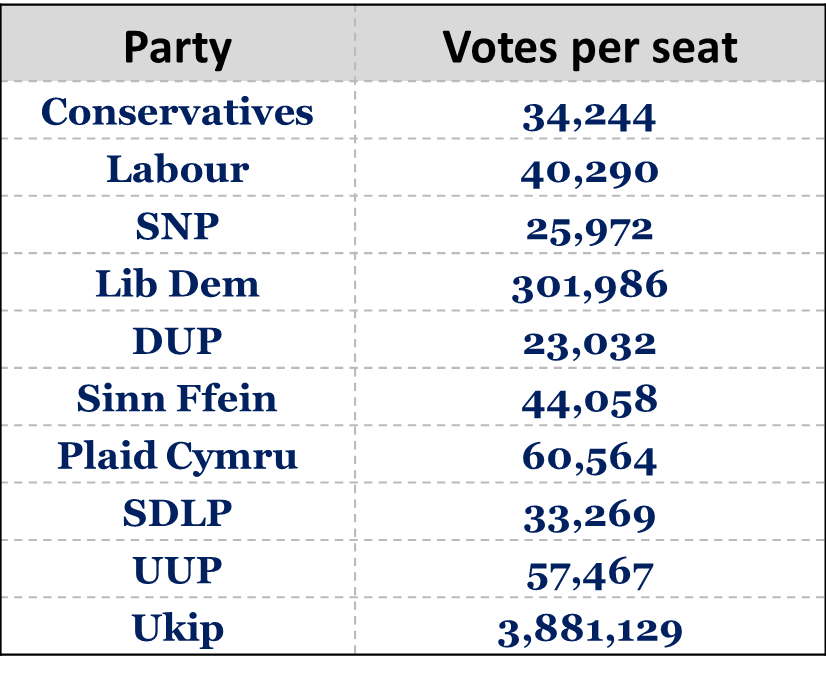
In “first past the post” systems as in the UK, every constituency has an identified representative. In spite of party affiliation, in theory, the elected member represents the entire constituency including its minorities. Of course the elected member then mostly behaves as his party dictates. In the recent UK election the number of votes needed to win a seat in parliament varied from just 25,000 for those supporting the SNP to almost 4 million for a UKIP voter. An SNP vote had a weight 160 times greater than than that of a Ukip voter and 12 times greater than that of a Lib Dem voter.

The Telegraph:

UK votes per seat

UK votes per seat

But it seems to me that in both systems (PR or first-past-the-post), it is irrational that the value of a vote is not graduated and somehow proportional to the value or the merit of the voter.  It seems illogical that a “vote bought” is equal to a “vote freely given” or that a “fool” has the same vote as a “wise man” (however those are defined).

(It is) mere existence as an individual that suffices to have an “equal vote”. And if everyone has the vote it is assumed that “democracy” has been attained – as if it were some sort of state of grace.  The only real criterion is that of age, even if some countries still have some other criteria in force. The merit of the individual is irrelevant. Votes can and are bought by promises or by free meals or by money or by a bus-ride. A “bought” or coerced vote weighs as heavy as one that is freely given. (There is nothing wrong in buying or selling votes – the flaw lies in that the seller has a vote equal to that of free elector). A fool has the same vote as a wise man. A large tax contributor is equated to a small tax contributor. Government servants paid for by taxes have the same weight of vote as the tax payers. Priests and politicians have the vote. The behaviour of an individual does not affect his vote. Experience, intelligence, wisdom, competence or criminality are all considered equally irrelevant. …..  One hundred and one idiots take precedence over one hundred wiser men. 

Of course, measuring “merit” is no easy thing and to get agreement would be extremely difficult – but not impossible.

There is no good reason why all votes should be equal. If there is such a thing as a “good” citizen, or if you accept – as I do – that individuals are not equal in ability and competence and their contribution to a society, then constraining everybody to the same value of vote is itself unjust. Votes must be given weight, I think, according to the “goodness” of the voter. It should not be beyond the wit of man to see to it that an individual had a way of “earning” extra value for his vote by those aspects of his performance or achievements which had value to society. We might then get closer to a “true democracy”. Of course that would also imply that other “anti-social” behaviour or lack of competence could get penalised by having some value of a vote taken away. I can imagine that a “good” citizen or an accomplished citizen could perhaps have a vote with a value enhanced from a base value of one to be – say – 1.5 or 1.8, while a “bad citizen” might have it reduced to – say – 0,5.  A murderer or a fraud serving time could perhaps have their vote value reduced to – say – 0.5. Instead of just being endowed with a vote on reaching the age of 18, an 18-year old could perhaps have 0.2 of a vote increasing to the base value of 1.0 on reaching 23 (when his brain is fully developed).

Such a system is not practical – for the moment. But I would prefer if the right to vote was “earned” in some way and that the value of an individual’s vote had some connection to merit.

Russel Brand and The Guardian have helped cement Cameron’s majority

May 8, 2015

On Tuesday last week (28th April) Ed Miliband met with Russel Brand with the goal of “making the election more interesting”.

On Monday this week (4th May) The Guardian (in the shape of columnist Owen Jones) published an article “Russel Brand has endorsed Labour and the Tories should be worried”. Now Owen Jones is a 4th generation socialist and a defender of and an apologist for the stereotyped “chav”. The Guardian has the Lib Dems as their primary favourites with Labour coming close behind.

In the event, The Guardian and Russel Brand have been almost classically, and doubly, counter-productive. Russel Brand’s self-admitted “big mouth and laptop” are not as persuasive as he and some others would like to think. Jones wrote:

He has nearly 10 million Twitter followers; his YouTube interview with Ed Miliband received well over a million hits and counting; he is listened to by hundreds of thousands of disillusioned Britons, particularly young people who have been repeatedly kicked over the last few years. Russell Brand matters.

And however much bluff and bluster the Tories now pull – maybe more playground abuse from David Cameron, who called Brand a “joke” – his endorsement of Labour in England and Wales will worry them. More people have registered to vote than ever before: between the middle of March and the deadline to register, nearly 2.3 million registered, over 700,000 of them 24 years old or younger.

The Brand effect has been compounded by The Guardian effect. Brand’s mouth and his laptop have certainly been irritating enough to have pushed some few – maybe the critical few – towards Cameron. The Guardian stridency has helped in the collapse of the Lib Dem vote and has sent more of them towards anybody rather than Labour. Brand and The Guardian have effectively provided the icing on Camron’s cake. Twenty four hours ago it was unthinkable that the Tories would have gained any seats and the expectation was for prolonged coalition negotiations. That the Tories could possibly have a majority was not even an outlier in the polls or for the political pundits. And now even the SNP must dampen some of their expectations of influence in Westminster since the Tories have a clear majority of 10 (which is in practice a majority of between 15 and 20 considering the Sinn Fein, the DUP and the Speaker).

As the Spectator writes:

Elsewhere, commentators hailed Brand as the man who has ‘access to voters politicians can’t reach’. Brand was treated as a celeb conduit, a connector of the political class with the plebs, someone who could actually turn things around. ‘The Tories should be worried.’ People seriously said that.

We can laugh at it all now, and we should – in fact, it’s important that we do. Because it turns out that Brand’s ability to get people lining up behind Miliband was pure bluster.

And Russel Brand has compromised his “Don’t Vote” stand for ever and has ensured a Tory majority into the bargain.


Bombay High Court restores the natural order of the universe

May 8, 2015

I am pleased to see that the Bombay High Court has seen fit to follow my exhortations to restore the natural order of the Universe where privilege is given its full due and where the high status of a Bollywood Star is honoured.

The natural order of the universe where respect must be accorded to those of higher status, and Bollywood Stars are indubitably the highest of the high, requires that Salman Khan be released immediately.

Hindustan Times reports:

The Bombay high court on Friday suspended actor Salman Khan’s jail term, handed by a lower court in the 2002 hit-and-run case, pending appeal.

The single-judge bench of justice Abhay Thipsay suspended the five-year jail term after hearing arguments from both sides.

“We can fix a date in June or July whether he is guilty or not.”

I note that the Bombay High Court had little to say about the unfortunate Noor Ullah Khan who was stupid enough to sleep outdoors just where a drunken driver without a licence was about to mount the pavement and crush him to death.

Even if the cowardly driver did run away from the scene, it is surely no reason to chastise him – especially as he is a Bollywood Star.

Why Salman Khan should not go to jail

May 7, 2015

It is inconceivable that Salman Khan be incarcerated in some “common” prison for causing the death of some “common” man. Privilege must be given its due.

  1. Salman Khan is a Bollywood Star – which is by an Act of God.
  2. He is not a “common man” to be subjected to the same laws used to control the riff-raff.
  3. That he is not “common” is amply demonstrated by the readiness of his driver, Ashok Singh, to sacrifice himself by assuming all guilt, if any, that is alleged against the said Salman Khan.
  4. Such a sacrifice is in the best traditions of Indian mythology and Ashok Singh needs to be honoured for his magnanimous offer and freely pardoned for any and all perjury he may have committed in a greater cause.
  5. Salman cannot therefore be treated as a “common man” and be subjected to the indignities and vagaries and delays of the “common” Indian justice system.
  6. (Ashok Singh should also not be penalised for the vagaries of a “common court” and denied any of the compensation that may have been promised to him by Salman Khan).
  7. The relatives of the homeless but “common” man who was killed when he was run over by a drunken Salman Khan – a certain Noor Ullah Khan – will now receive more in compensation than they could ever have received from the earnings of the dead man. (Thanks be to a merciful God!)
  8. The three other labourers injured  have confirmed that the compensation they receive is far more important than any conviction of Salman Khan. (Thanks be to a merciful God!)
  9. By any measure the life of an endangered black buck is worth much more than that of the unfortunate Noor Ullah Khan.
  10. For killing (poaching) the black buck Salman Khan has been convicted and sentenced to one year in prison – which is not being implemented since he is an uncommon man and the higher Indian courts are exhibiting the deference due.
  11. The natural order of the universe where respect must be accorded to those of higher status, and Bollywood Stars are indubitably the highest of the high, requires that Salman Khan be released immediately.

EU judges don’t have the discernment necessary to tell Sky from Skype

May 6, 2015

Any 5-year old today can tell you what Skype is. In a country where Sky operates the child will also tell you the channel number on cable.

But EU judges – by their own admission –  have not the discernment necessary to be able to tell the difference.  They seem terribly confused  but they try to blame the confusion on the “general public”. But I am afraid I find them (the EU judges) either blatantly partisan or unashamedly unintelligent.

BBC: Video chat software Skype’s name is so similar to the broadcaster Sky’s that the public is likely to be confused between the two, an EU court has ruled.

The judgement prevents Microsoft from registering a trademark for Skype’s name and bubble-design logo. The US company intends to appeal against the decision.

Judges at the General Court of the European Union said: “Conceptually, the figurative element conveys no concept, except perhaps that of a cloud.”

“[That] would further increase the likelihood of the element ‘Sky’ being recognised within the word element ‘Skype’, for clouds are to be found ‘in the sky’ and thus may readily be associated with the word ‘sky’.”

I don’t think that EU judges really lack the intelligence to tell the difference. But they do bend to what is considered to be politically correct in a bigoted EU world. And in that world, EU judges do not easily rule against an EU corporation if pitted against a US (or any non-European) corporation.

After all Skype is now owned by a US corporation

Skype was later acquired by Microsoft in May 2011 for $8.5 billion. Microsoft’s Skype division headquarters are in Luxembourg, but most of the development team and 44% of the overall employees of the division are still situated in Tallinn and Tartu, Estonia.

But Sky is European and the EU judges know what is politically correct.

Sky plc is a British-based pan-European satellite broadcasting, on-demand Internet streaming media, broadband and telephone services company headquartered in London, with operations in the United Kingdom, Ireland, Germany,Austria and Italy. Sky is Europe’s biggest and leading media company and the largest pay-TV broadcaster in Europe, with over 20 million subscribers.

I am afraid that for the EU General Court and its judges, whatever is “politically correct” comes first and any pretense to fairness or being equitable comes a distant second.

Another conundrum: Religion is more about ancestry than about any true faith

May 6, 2015

This news item caught my eye:

BBCWhat happened when an anti-Semite found he was Jewish?

Three years ago, a Hungarian far-right politician with a strong line in anti-Semitism discovered that he was Jewish. He left his party, and set out on a remarkable personal journey to learn and practise his Jewish faith. …. 

As deputy leader of the radical nationalist Jobbik party in Hungary, (Csanad) Szegedi co-founded the Hungarian Guard – a paramilitary formation which marched in uniform through Roma neighbourhoods.

And he blamed the Jews, as well as the Roma, for the ills of Hungarian society – until he found out that he himself was one. After several months of hesitation, during which the party leader even considered keeping him as the party’s “tame Jew” as a riposte to accusations of anti-Semitism, he walked out. ……

Not a man to do things in half-measures, he has now become an Orthodox Jew, has visited Israel, and the concentration camp at Auschwitz which his own grandmother survived.

He found out about his ancestry and then set out to “learn his faith”!

Is “faith” really something which can be learned?

“Faith” is necessary. It is necessary because there are questions which I cannot answer for lack of evidence or lack of knowledge and where I resort to “faith” to provide me with an answer. But they have to be my answers. By definition “faith” is then about matters which cannot be proven. Since “faith” or “belief” are required only when there is no knowledge or no evidence, I would think that “faith” cannot ever be “learned”. It can only be generated internally by the exercise of a mind or it must be imposed.

There is something very perplexing here. The vast majority of children, of course are brainwashed/indoctrinated by their parents into a religion. Any religion which did not permit the brainwashing of its members’ children could not survive. “Faith” is not contained within our genes. Religion is not naturally hereditary – except that we make it so. Children are not born with any “faith”, it is pounded into them. And most Christians, Muslims or Hindus are Christians, Muslims or Hindus only because their parents were. And what their parents have as “faith” was, in turn,  pounded into them. Most people therefore, who claim to follow some “faith” or “religion” do so because that faith or religion was imposed upon them by their ancestry – not because they used their minds to decide what they believed to be true.

For Csanad Szegedi at least “faith” clearly is dependent upon and follows ancestry.  (Of course some of his even more distant ancestors probably followed shamanism). His “learning” is now nothing more than getting others to tell him what his “faith” should be or figuring it out himself – but only consequent to his ancestry. He is learning what his “faith” should be according to others – not what it is. It may be more self-imposed than imposed, but it remains something external now being imprinted upon him. But a copy is a copy is a copy. It is never the original.

So what we loosely call the  “freedom of religion” is little more than the freedom to have a “faith” imposed upon us and to then impose our imported beliefs, in turn, onto our children. What we believe depends on who our parents are (or grandparents were in the case of Szegedi).

An imposed belief is not something which is generated by an individual by the exercise of his own mind. It seems to me intrinsically impossible for any imposed belief to be considered a “true faith”. Religions and faiths are propagated less by discussion and overwhelmingly by mere dissemination of the beliefs of authority (prophets, disciples, sages, authors and other “enlightened” folk) to the masses. To believe something only because someone else does, seems a poor qualification for a “true belief”.

And so my respect for any person’s “beliefs” evaporates when I learn that they are not their own true beliefs, but those of others which have been imposed upon them. And my opinion of Szegedi’s sudden conversion to Judaism based on his ancestry is not very high. I see damage control and I see opportunism but I see no “true faith”.


The conundrum of putting adolescents into positions of power

May 5, 2015

The prefrontal cortex of the brain, we are told,  mediates decision making, is selectively involved in the retrieval of remote long-term memory and is the seat of good judgement.

The prefrontal cortex (PFC) is located in the very front of the brain, just behind the forehead. In charge of abstract thinking and thought analysis, it is also responsible for regulating behavior. This includes mediating conflicting thoughts, making choices between right and wrong, and predicting the probable outcomes of actions or events. This brain area also governs social control, such as suppressing emotional or sexual urges. Since the prefrontal cortex is the brain center responsible for taking in data through the body’s senses and deciding on actions, it is most strongly implicated in human qualities like consciousness, general intelligence, and personality.

We are also told that the prefrontal cortex is not fully developed till the age of 25 years or even later. Until the prefrontal cortex is fully developed a human is “adolescent”.

BBCChild psychologists are being given a new directive which is that the age range they work with is increasing from 0-18 to 0-25.

There are three stages of adolescence – early adolescence from 12-14 years, middle adolescence from 15-17 years and late adolescence from 18 years and over.

Neuroscience has shown that a young person’s cognitive development continues into this later stage and that their emotional maturity, self-image and judgement will be affected until the prefrontal cortex of the brain has fully developed. Alongside brain development, hormonal activity is also continuing well into the early twenties.

Most countries allow voting at age 18. Some allow voting even earlier:

Those with a national minimum age of 17 include East Timor, Indonesia, North Korea, South Sudan and Sudan. The minimum age is 16 in Argentina, Austria, Brazil, Cuba, Ecuador, Nicaragua and the Isle of Man, Jersey and Guernsey (three self-governing British Crown Dependencies). People aged 16–18 can vote in Bosnia, Serbia and Montenegro if employed.

The mystery is why adolescents whose power of judgement is not yet fully developed are allowed to exercise this undeveloped judgement.

Even more perplexing is why adolescents with undeveloped judgement ability (those < 25 years old) are allowed not only to become armed soldiers and police but also politicians and even members of parliaments? We put them into positions of power where they must exercise their partially-developed judgement – even over others whose judgement is fully developed.

Why?

Statistics in Sweden are quite comprehensive and numbers for voters and politicians in the age group 18 – 29 are readily available. Conservatively, I take the age group 18 – 25 to be the majority (>50%) of the 18-29 age group.

Age group 18 – 25

  1. Proportion of electorate for parliament elections                           >10%
  2. Proportion of candidates                                                                       >6.5%
  3. Proportion of elected members of parliament                                  >5.5%

There is no getting away from the conclusion that over 5% of elected, Swedish members of parliament are adolescents whose brains are not fully developed and whose judgement is less than what it should be.

Interestingly, the proportion of the electorate older than 65 is 25% but the proportion of elected members of parliament over 65 is only 2.9%.

The only explanation I have is that in Sweden, “youth” has been made into a “politically correct” fetish with religious and mystical – if not electoral – significance.

It is not difficult to observe that many in the Swedish parliament today, and even some in government, are remarkably childish and quite clearly demonstrate that they are still adolescent.