Archive for the ‘Behaviour’ Category

“Peer review is a regression to the mean. ….. a completely corrupt system” – Sydney Brenner

March 2, 2014
Sydney Brenner

Sydney Brenner, CH FRS (born 13 January 1927) is a biologist and a 2002 Nobel prize laureate, shared with H. Robert Horvitz and John Sulston. Brenner made significant contributions to work on the genetic code, and other areas of molecular biology at the Medical Research Council Unit in Cambridge, England.

A fascinating interview with Professor Sydney Brenner by Elizabeth Dzeng in the Kings Review.

I find his comments on Academia and publishing and peer review  particularly apposite. Peer review – especially where cliques of “peers” determine “correct thinking” – can not provide sufficient room for the dissenting view, for the challenging of orthodoxy. Orthodox but incorrect views thus persist for much longer than they should. Completely new avenues are effectively blocked and ideas are still-born.

Some extracts here but the whole conversation is well worth a read.

How Academia and Publishing are Destroying Scientific Innovation: A Conversation with Sydney Brenner

by Elizabeth Dzeng, February 24th

I recently had the privilege of speaking with Professor Sydney Brenner, a professor of Genetic medicine at the University of Cambridge and Nobel Laureate in Physiology or Medicine in 2002. ….

SB: Today the Americans have developed a new culture in science based on the slavery of graduate students. Now graduate students of American institutions are afraid. He just performs. He’s got to perform. The post-doc is an indentured labourer. We now have labs that don’t work in the same way as the early labs where people were independent, where they could have their own ideas and could pursue them.

The most important thing today is for young people to take responsibility, to actually know how to formulate an idea and how to work on it. Not to buy into the so-called apprenticeship. I think you can only foster that by having sort of deviant studies. ……..

…… I think I’ve often divided people into two classes: Catholics and Methodists. Catholics are people who sit on committees and devise huge schemes in order to try to change things, but nothing’s happened. Nothing happens because the committee is a regression to the mean, and the mean is mediocre. Now what you’ve got to do is good works in your own parish. That’s a Methodist. 

ED: …….. It is alarming that so many Nobel Prize recipients have lamented that they would never have survived this current academic environment. What is the implication of this on the discovery of future scientific paradigm shifts and scientific inquiry in general? I asked Professor Brenner to elaborate.

SB: He wouldn’t have survived. It is just the fact that he wouldn’t get a grant today because somebody on the committee would say, oh those were very interesting experiments, but they’ve never been repeated. And then someone else would say, yes and he did it a long time ago, what’s he done recently?  And a third would say, to top it all, he published it all in an un-refereed journal.

So you know we now have these performance criteria, which I think are just ridiculous in many ways. But of course this money has to be apportioned, and our administrators love having numbers like impact factors or scores. ….

……. And of course all the academics say we’ve got to have peer review. But I don’t believe in peer review because I think it’s very distorted and as I’ve said, it’s simply a regression to the mean.

I think peer review is hindering science. In fact, I think it has become a completely corrupt system. It’s corrupt in many ways, in that scientists and academics have handed over to the editors of these journals the ability to make judgment on science and scientists. There are universities in America, and I’ve heard from many committees, that we won’t consider people’s publications in low impact factor journals.

Now I mean, people are trying to do something, but I think it’s not publish or perish, it’s publish in the okay places [or perish]. And this has assembled a most ridiculous group of people.

…….. I think there was a time, and I’m trying to trace the history when the rights to publish, the copyright, was owned jointly by the authors and the journal. Somehow that’s why the journals insist they will not publish your paper unless you sign that copyright over. It is never stated in the invitation, but that’s what you sell in order to publish. And everybody works for these journals for nothing. There’s no compensation. There’s nothing. They get everything free. They just have to employ a lot of failed scientists, editors who are just like the people at Homeland Security, little power grabbers in their own sphere.

If you send a PDF of your own paper to a friend, then you are committing an infringement. Of course they can’t police it, and many of my colleagues just slap all their papers online. I think you’re only allowed to make a few copies for your own purposes. It seems to me to be absolutely criminal. When I write for these papers, I don’t give them the copyright. I keep it myself. That’s another point of publishing, don’t sign any copyright agreement. That’s my advice. I think it’s now become such a giant operation. I think it is impossible to try to get control over it back again. …….. Recently there has been an open access movement and it’s beginning to change. I think that even NatureScience and Cell are going to have to begin to bow. I mean in America we’ve got old George Bush who made an executive order that everybody in America is entitled to read anything printed with federal funds, tax payers’ money, so they have to allow access to this. But they don’t allow you access to the published paper. They allow you I think what looks like a proof, which you can then display.

Elizabeth Dzeng is a PhD candidate conducting research at the intersection of medical sociology, clinical medicine and medical ethics at the University of Cambridge. She is also a practising doctor and a fellow in General Internal Medicine at the Johns Hopkins School of Medicine.

Has Psychiatry just become a marketing tool for pills?

March 2, 2014

I have always been uncomfortable with the readiness to “medicalise” all behavioural issues. Where parents or teachers or social workers and others charged with teaching behavioural skills can easily find an excuse for their failures. Because a behavioural problem has been classified as a medical problem. Nearly always leading to the use of medication.  There seems to be an unholy alliance between the psychiatry industry and the pharmaceutical industry.

The Psychiatry Bible (DSM 5) has seemed to me to be nothing but a Marketing Brochure for the pharmaceutical companies where

The drug companies pay eminent professors, university officials and teaching hospital chairmen millions ‘in personal income’ to concoct more and more abnormalities so that more and more pills can be dished out by GPs and specialists. 

They pocket consultancy fees to attend conferences, give marketing lectures and endorse useless tablets. They are bribed, in essence, not to openly criticise the pharmaceutical industry.

.. people are led to believe they have ‘a problem in their brain’ if they drink too much coffee (‘caffeine-related disorders’), stutter or swear (‘language disorders’), are shy or reserved (‘social phobias’), suffer period pains, are too fat or too thin, feel irritable, sexy, unsexy, sleepless, tired, or experience grief for more than two weeks after the death of a loved one. By these means, 26.2  per cent of all American adults suffer from a disorder of some sort, requiring that it be ‘pharmacologically treated’. Though psychiatric research is by all accounts ‘a hodgepodge, scattered, inconsistent and ambiguous’, one thing has definitely emerged – that anti-depressants don’t work. Extensive trials have shown that placebos induce as much of a degree of uplift as Prozac, Seroxet or any of the other wonder drugs, which simply make patients feel numb, glassy and emotionally disengaged.

Now it seems Dyslexia does not really exist

Now comes The Dyslexia Debate, published yesterday, a rigorous study of this alleged ailment by two distinguished academics – Professor Julian  Elliott of Durham University, and Professor Elena Grigorenko of Yale University.

Their book makes several points. There is no clear definition of what ‘dyslexia’ is. There is no objective diagnosis of it. Nobody can agree on how many people suffer from it. The widespread belief that it is linked with high intelligence does not stand up to analysis.

And, as Parliament’s Select Committee on Science and Technology said in 2009: ‘There is no convincing evidence  that if a child with dyslexia is not labelled as dyslexic, but receives full support for his or her reading difficulty, that the child will do any worse than a child who is labelled dyslexic and then receives special help.’

 This is because both are given exactly the same treatment. But as the book’s authors say: ‘Being labelled dyslexic can be perceived as desirable for many reasons.’ These include extra resources and extra time in exams. And then there’s the hope that it will ‘reduce the shame and embarrassment that are often the consequence of literacy difficulties. It may help exculpate the child, parents and teachers from any perceived sense of responsibility’.

I think that last point is the decisive one and the reason for the beetroot-faced fury that greets any critic of ‘dyslexia’ (and will probably greet this book and article). If it’s really a disease, it’s nobody’s fault. But it is somebody’s fault. For the book also describes the furious resistance, among teachers,  to proven methods of teaching children to read. Such methods have been advocated by  experts since Rudolf Flesch wrote his devastating book Why Johnny Can’t Read almost 60 years ago.

It was not so long ago that James Davies addressed the ills of Psychiatry in his book “Cracked: Why Psychiatry is Doing More Harm Than Good” and Richard Saul published his book “ADHD Does Not Exist” criticising the over-diagnosis of ADHD. Richard Saul writes in the New Republic:

The stimulants most often prescribed for ADHD represent several different types of agents that help control attention and behavior. These include methylphenidate (like Ritalin and Concerta) and mixed salt amphetamines (like Adderall and Vyvanse). Each of these has a specific effect on the body’s neurotransmitters, or the chemical compounds that help transmit signals within the nervous system. The exact mechanisms by which these chemicals interact are very complex, but essentially, if levels of these chemicals are too low or their activity is blocked, the transmission of messages within the nervous system decreases, corresponding to a state of inattention or impulsivity. Specific medications aimed at targeting attention-deficit and hyperactivity symptoms help increase levels of neurotransmitters and their activity. For example, methylphenidate-based medications like Ritalin increase the activity of the neurotransmitters dopamine and noradrenaline in the parts of the brain that help to control attention and behavior. Adderall also increases dopamine’s effects, but in a more gradual way than Ritalin and similar agents do.

So let’s back up a moment. If stimulants can increase one’s attention span and reduce impulsivity, why shouldn’t we use them? Furthermore, even if we’re masking another underlying condition, aren’t we at least solving the problems of inattention and impulsivity in the patient? The answer to both of these questions is a resounding NO. While stimulants can help people with a variety of symptoms in the short term, they have multiple damaging effects in the short- and long-term. The most common short-term side effects associated with stimulants involve overstimulation, such as loss of appetite and sleep disturbance, but perhaps more troubling are the longer-term effects of stimulant use, which include unhealthy weight loss, poor concentration and memory, and even reduced life expectancy in some cases. Long-term, patients also face the development of tolerance, which exacerbates these side-effects. After a while, the body adjusts its natural production of these same chemicals in the brain, and the temporary improvements in attention and behavior begin to disappear. This is why we see doctors prescribing higher and higher doses of the stimulant to achieve the same effect in the patient as time wears on—a dangerous pattern.

Medicalising behavioural issues or blaming genetic causes for behavioural lapses is a cop-out. Both for the offending individual and for those who ought to be helping the individual to modify his behaviour.

Obama’s “promotion of democracy” leads to de facto support for Al Qaida in Syria and Neo-Nazis in Ukraine

March 1, 2014

Obama will go down in history as a follower rather than a leader, let alone the “leader of the free world”.

I have a theory that Obama’s indecision, his dithering and his aversion to risk of any kind has led to his actually supporting Al Qaida in Syria and is now leading him to help Neo-Nazis in the Ukraine. All in the name of promoting “democracy”. A quick strike in Syria was never on the cards in spite of all Obama’s bluster. He is incapable of taking any actions with such associated risk. Instead he supported the arming of rebel groups which are now being dominated by Al Qaida. His best option now – paradoxically – is that Assad manages to keep Al Qaida at bay. Remarkably the best chances for a real  “democracy” – eventually –  is now with Assad in power such that Al Qaida does not prevail. (And the example of “democracy promotion” leading to the rise and fall of the Muslim Brotherhood in Egypt should not be so soon forgotten. The Egypt with Sissi is not so different from Mubarak’s Egypt).

After Helping Arm Al Qaeda In Syria, US Government Says Al Qaeda In Syria A Threat To US

….. The Syrian Civil War is the epitome of a conflict that has no US national interest involved – neither side is allied with the United States nor is likely to ever be nor is there any vital security or even economic interest at stake.

But despite this total lack of relevance to the American people and country, the Obama Administration tried to enter the war. First there was an attempt to pretend the Assad government was a threat to the United States because it had chemical weapons, but then Assad agreed to remove the weapons. So then President Obama bypassed an American law to prevent arming terrorists to arm the “moderate” rebels within Syria.

Not long after Obama dodged the anti-terrorist law, the Al Qaeda faction of the Syrian rebels was in possession of the weapons Obama sent to Syria. So yes, after refusing to follow a law that was supposed to prevent arming terrorists, Obama ended up arming terrorists. Abysmally stupid does not even begin to describe this policy.

Now the supposedly “democratic” movement in Ukraine is being taken over by the Neo-Nazis. Obama is blustering again against Russia and the inevitable Russian intervention in the Crimea. He threatens that any Russian intervention will have “costs” – whatever that means. It is in part the US meddling in the Ukraine – ostensibly to promote “democracy” which has advantaged the Neo-Nazis and brought the Ukraine to where it is.

The Neo-Nazis of Ukraine

Reality on the ground in Ukraine contradicts the incompetent and immoral Obama regime’s portrait of Ukrainian democracy on the march.

To the extent that government exists in post-coup Ukraine, it is laws dictated by gun and threat wielding thugs of the neo-Nazi, Russophobic, ultra-nationalist, right-wing parties. Watch the video of the armed thug, Aleksandr Muzychko, who boosts of killing Russian soldiers in  Chechnya, dictating to the Rovno regional parliament a grant of apartments to families of protesters.

Read about the neo-nazis intimidating the Central Election Commission in order to secure rule and personnel changes in order to favor the ultra-right in the forthcoming elections.  Thug Aleksandr Shevchenko informed the CEC that armed activists will remain in CEC offices in order to make certain that the election is not rigged against the neo-nazis.  What he means, of course, is the armed thugs will make sure the neo-nazis win.  If the neo-nazis don’t win, the chances are high that they will take power regardless.

The Russians are already talking about another battle against the Nazis. It seems inevitable that Russia will now ensure its own influence in the Crimea with troops on the ground (even if they bear no Russian insignia). With 60% of the Crimean population being Russian (with 24% being Ukrainian and 12% being Tartars) there is little doubt that Russia will “respond” to calls for help from the Russian population and are already doing so. And once again – paradoxically – it could be Russian intervention in the Crimea which turns out to be the best defense against Neo-nazis exploting the US and Obama’s “promotion of democracy”.

NewsInfo: The newly-chosen prime minister of the Ukrainian southern region of Crimea on Saturday called on Russian President Vladimir Putin to help restore “peace and calm” to the Black Sea peninsula, amid a standoff with the new authorities in Kiev.

Crimea (Google Maps)

Crimea (Google Maps)

China issues report on US Human Rights record

February 28, 2014

Pots calling kettles black and the kettles claiming the pots are even blacker!!

For the sake of balance…..

From Xinhua News:

BEIJING, Feb. 28 (Xinhua) — China published a report on the United States’ human rights record on Friday, in response to U.S. criticism and “irresponsible remarks” about China.

“The Human Rights Record of the United States in 2013” was released by the Information Office of the State Council, China’s cabinet, in response to “Country Reports on Human Rights Practices for 2013” made public by the U.S. State department on Thursday.

  • The U.S. government spies on its own citizens to a “massive and unrestrained” degree, the report says. The report calls the U.S. PRISM surveillance program, a vast, long-term mechanism for spying on private citizens both at home and abroad, “a blatant violation of international law” and says it “seriously infringes human rights.” The U.S. intelligence services, by virtue of data provided by Internet and telecom companies — including Microsoft, Google, Apple, Facebook, and Yahoo — “recklessly” track citizens’ private contacts and social activities. 
  • Since 2004, the U.S. has carried out 376 drone strikes killing 926 civilians. 
  • The U.S. has not ratified, or participated in, a series of core UN conventions on human rights, such as the International Covenant on Economic, Social and Cultural Rights, the Convention on the Elimination of All Forms of Discrimination against Women, the Convention on the Rights of the Child, and the Convention on the Rights of Persons with Disabilities. 
  • Solitary confinement is prevalent in the U.S., the report says. In U.S. prisons, inmates in solitary confinement are enclosed in cramped cells with poor ventilation and little or no natural light, isolated from other prisoners; a situation that takes it toll on inmates’ physical and mental health. About 80,000 U.S. prisoners are in solitary confinement. Some have been held in solitary confinement for over 40 years. 
  • Rampant U.S. gun culture breeds violence that results in the death of 11,000 Americans every year. 
  • Firearms were used in 69.3 percent of the nation’s murders, 41 percent of robberies, and 21.8 percent of aggravated assaults. 
  • In 2013, 137 people were killed in 30 mass murder events (four or more deaths each). A rampage in the headquarters of the Naval Sea Systems Command in Washington D.C. left 12 people dead. 
  • Unemployment for low-income families has topped 21 percent. 
  • The homeless population in the U.S. has climbed 16 percent from 2011 to 2013. 
  • There are also many child laborers in the agricultural sector in the U.S. and their physical and mental health is seriously compromised.

Idiot paper of the day: “Math Anxiety and Exposure to Statistics in Messages About Genetically Modified Foods”

February 28, 2014

Roxanne L. Parrott is the Distinguished Professor of Communication Arts and Sciences at Penn State. Reading about this paper is not going to get me to read the whole paper anytime soon. The study the paper is based on – to my mind – is to the discredit of both PennState and the state of being “Distinguished”.

I am not sure what it is but it is not Science.

Kami J. Silk, Roxanne L. Parrott. Math Anxiety and Exposure to Statistics in Messages About Genetically Modified Foods: Effects of Numeracy, Math Self-Efficacy, and Form of PresentationJournal of Health Communication, 2014; 1 DOI: 10.1080/10810730.2013.837549

From the Abstract:

… To advance theoretical and applied understanding regarding health message processing, the authors consider the role of math anxiety, including the effects of math self-efficacy, numeracy, and form of presenting statistics on math anxiety, and the potential effects for comprehension, yielding, and behavioral intentions. The authors also examine math anxiety in a health risk context through an evaluation of the effects of exposure to a message about genetically modified foods on levels of math anxiety. Participants (N = 323) were randomly assigned to read a message that varied the presentation of statistical evidence about potential risks associated with genetically modified foods. Findings reveal that exposure increased levels of math anxiety, with increases in math anxiety limiting yielding. Moreover, math anxiety impaired comprehension but was mediated by perceivers’ math confidence and skills. Last, math anxiety facilitated behavioral intentions. Participants who received a text-based message with percentages were more likely to yield than participants who received either a bar graph with percentages or a combined form. … 

PennState has put out a Press Release:

The researchers, who reported their findings in the online issue of the Journal of Health Communication, recruited 323 university students for the study. The participants were randomly assigned a message that was altered to contain one of three different ways of presenting the statistics: a text with percentages, bar graph and both text and graphs. The statistics were related to three different messages on genetically modified foods, including the results of an animal study, a Brazil nut study and a food recall announcement.

Wow! The effort involved in getting all of 323 students to participate boggles. And taking Math Anxiety as a critical behavioural factor stretches the bounds of rational thought. Could they find nothing better to do? This study is at the edges of academic misconduct.

“This is the first study that we know of to take math anxiety to a health and risk setting,” said Parrott.

It ought also to be the last such idiot study – but I have no great hopes.

Older Dads have sicker children

February 27, 2014

There is – it seems – an optimal child bearing age for fathers as well as mothers. Older fathers may be richer and more able to support a child but there is an increased risk to the health of their children.

A study by Indiana University, in the US, and Sweden’s Karolinska Institute is the largest and one of the best designed studies on the issue and suggests that mutated sperm with older fathers are the cause.

Seems very plausible.

Brian M. D’Onofrio, Martin E. Rickert, Emma Frans, Ralf Kuja-Halkola, Catarina Almqvist, Arvid Sjölander, Henrik Larsson and Paul Lichtenstein Paternal Age at Childbearing and Offspring Psychiatric and Academic Morbidity, JAMA Psychiatry, doi:10.1001/jamapsychiatry.2013.4525

BBC reports: 

A wide range of disorders and problems in school-age children have been linked to delayed fatherhood in a major study involving millions of people.

Increased rates of autism, attention deficit hyperactivity disorder (ADHD), bipolar disorder, schizophrenia, suicide attempts and substance abuse problems were all reported. …….

…. The researchers looked at 2.6 million people and at the difference between siblings born to the same father as it accounts for differences in upbringing between families.

Comparing children of a 45-year-old dad to those of a 24-year-old father it indicated:

  • autism was more than three times as likely
  • a 13-fold increased risk of ADHD
  • double the risk of a psychotic disorder
  • 25 times more likely to have bipolar disorder
  • 2.5 times more likely to have suicidal behaviour or problems with drugs
  • lower scores at school

There was no starting point after which the risk started to increase, rather any increase in age had an associated increase in risk.

….. One of the researchers, Dr Brian D’Onofrio, said he was shocked by the findings, which suggested a higher risk than previously estimated. He told the BBC: “The implications of the study is that delaying childbearing is also associated with increased risk for psychiatric and academic problems in the offspring. The study adds to a growing body of research, that suggests families, doctors, and society as a whole must consider both the pros and cons of delaying childbearing.”

The social trend for both parents to have children later in life thus seems to have repercussions for the children. Though the risk may be small it could be said that this a social trend which weakens the health and reduces the well-being of succeeding generations. The demographic effect is that the incidence of psychoses will increase. While having children later may allow a maximisation of the economic contributions of the parents to society, it could also lead to increased medical costs for the affected children in the following generations. Genetic screening and abortion could of course mitigate some of the long term consequences for the evolution of humans.

It could be that we are moving towards greater promiscuity during the “best” child-bearing years but without the production of children due to the availability of contraception. Child bearing itself is then postponed to a more economically suitable time of life for the parents, but a less than optimal time for the health of the children so conceived. Apart from genetic screening of foetuses and abortion of some there does not seem to be a “natural” self-correcting mechanism for this social trend.

An existentialist problem for virtual Bitcoins

February 26, 2014

“Virtual” has no connotations of having any virtues. As long as things “virtual” remain in the abstract world they work.

Virtual books can be read. Virtual commerce is fine for recording transactions. But virtual foods are indigestible and unsatisfying. A virtual house doesn’t keep out the rain. And virtual currencies are useless if they cannot be translated into the real world.

I am not convinced that virtual currency offers me anything more than I get with electronic transactions with real money. At least the real currency has a value which is somewhat connected to things happening on the ground (even if speculation does occur). The Bitcoin however has an exchange value solely dependent upon somebody’s imagination.

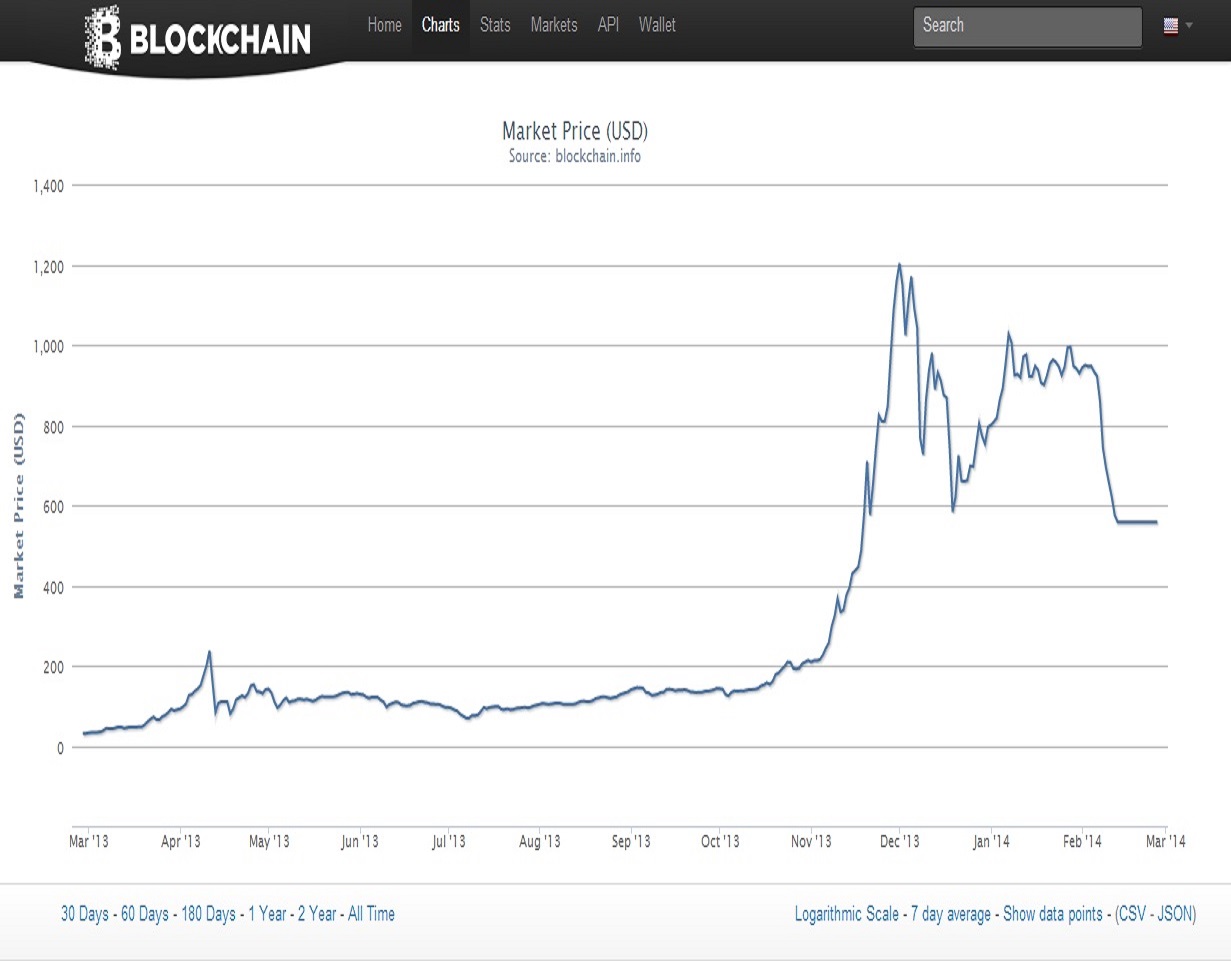
(Reuters)Mt. Gox, once the world’s biggest bitcoin exchange, abruptly stopped trading on Tuesday and its chief executive said the business was at “a turning point,” sparking concerns about the future of the unregulated virtual currency. ……. The website of Mt. Gox suddenly went dark on Tuesday with no explanation, and the company’s Tokyo office was empty – the only activity was outside, where a handful of protesters said they had lost money investing in the virtual currency. …

…. Investors deposit their bitcoins in digital wallets at specific exchanges, so the Mt. Gox shutdown is similar to a bank closing its doors – people cannot retrieve their funds.

A document circulating on the Internet purporting to be a crisis plan for Mt. Gox, said more than 744,000 bitcoins were “missing due to malleability-related theft”, and noted Mt. Gox had $174 million in liabilities against $32.75 million in assets. It was not possible to verify the document or the exchange’s financial situation. If accurate, that would mean approximately 6 percent of the 12.4 million bitcoins minted would be considered missing. ……. The digital currency has caught the eye of regulators concerned with consumer protections and bitcoin’s use in money laundering. ….

…… Mt. Gox halted withdrawals earlier this month after it said it detected “unusual activity on its bitcoin wallets and performed investigations during the past weeks.” The move pushed bitcoin prices down to their lowest level in nearly two months.

Even with the halt on February 7, Mt. Gox still handled more transactions than any other in the past month. Over the last 30 days, Mt. Gox has handled more than one million bitcoin transactions denominated in dollars, or about 34 percent of activity, according to Bitcoincharts, which provides data and charts for the bitcoin network.

Critics of the exchange, from rivals to burned investors, said the digital marketplace operator had long been lax over its security. Investors in bitcoin, who have endured a volatile ride in the value of the unregulated cyber-tender, said they still had faith in the currency despite the problems at Mt. Gox.

“Mt. Gox is one of several exchanges, and their exit, while unfortunate, opens a door of opportunity,” The Bitcoin Foundation, the digital currency’s trade group, said in a statement. “This incident demonstrates the need for responsible individuals and members of the bitcoin community to lead in providing reliable services.” …….

Bitcoin value Feb 2014

Bitcoin value Feb 2014

The exchange rate applying is entirely speculative and – it seems to me – purely a result of manipulation. It is not anchored to anything real  – but why would it be?

After all it is only virtual.

Airport security and the monetisation of distrust

February 25, 2014

I am just back after a trip of 10 days and have suffered the travails of airport security at 5 airports.

It occurs to me that the behaviour of the security personnel (by definition composed of people required to follow a particular protocol and required NOT TO THINK) is primarily a measure of distrust.

  1. The “security” industry is just too large and too lucrative to disappear.
  2. Whether or not airport security achieves its purpose is not measurable and it is to the industry’s benefit that it not be measurable.
  3. The greater the inconvenience and hassle generated, the greater the perception that something useful is being achieved. (Hassle free security checks – which could be done – is not beneficial to the industry).
  4. The security checks are the single most disruptive and stressful part of the journey.
  5. Idiot security staff (chosen so since they are not required to think) are vested with a power to ruin your travel experience and doing so is one of the little pleasures they have in their jobs. They are more formidable than any immigration control officer.

Distrust has been monetised and some industries are making a killing. It is the monetisation of the precautionary principle where it pays handsomely to be alarmist.

I will not see a return in my lifetime to the days when the travel itself was a pleasurable experience. Those days are long since gone and will probably never return.

Fortunately it is still exciting to arrive.

Denmark continues its campaign to exterminate giraffes named Marius

February 14, 2014

Denmark is a dangerous place to be a giraffe especially if your name is Marius.

I suspect that Jyllands Park Zoo is desperate for a little publicity. Though just killing giraffes named Marius as a publicity stunt seems a little drastic. They might have been better off starting a campaign to keep their Marius alive.

The Telegraph:The Danish Jyllands Park Zoo said on Wednesday it may put down one of its giraffes, which by coincidence has the same name, Marius, as the giraffe Copenhagen Zoo slaughtered on Sunday to the disgust of animal lovers around the world, according to Danish news agency Ritzau. …

Jyllands Park Zoo in western Denmark might put down its seven-year-old Marius if the zoo manages to acquire a female giraffe, which is most likely, zoo keeper Janni Lojtved Poulsen told Ritzau. The zoo also has a younger male called Elmer.

“We can’t have two males and one female. Then there will be fights,” Poulsen said.

Related:

Petition

Copenhagen Zoo’s justifications for killing Marius if applied to humans

I hope visitors to Copenhagen Zoo dry up….

Copenhagen Zoo’s justifications for killing Marius if applied to humans

February 12, 2014

Copenhagen Zoo has been marshalling support on the scientific and the ethical plane to try and justify their decision to kill Marius the healthy giraffe. They protest too much and it is a revealing exercise to apply their argumentation to humans.

Their basic theme is that He died so that others could live

Capital punishment could be applied for all humans convicted of murder or  causing a fatal accident or whose genes are defective in any way so that others may live. In current Danish politics, the wrong skin colour in a human is indicative of defective genes.

Culling is for the greater good of the giraffes

The man who pulled the trigger, the zoo’s own veterinarian Mads Frost Bertelsen, says that a very positive situation lies behind the Zoo’s action. 

”Up until now, we have not had to cull the giraffes. But now we have reached the point where the population is doing so well that a giraffe like Marius could not be relocated. Then the best solution is to put him down,” says Mads Frost Bertelsen.

The vet explains that a central European coordinator keeps track of pedigrees, and which genes are represented by individual giraffes in European zoos. The coordinator estimated from these data that Marius’ genes were already well represented and recommended that Marius was killed to protect the population best suited to the gene pool.

But now we have reached the point where the human population is doing so well in so many countries. Many individuals cannot be relocated. From East Europe or Africa to Europe for example. Then the best solution is to put them down, especially if their genes are already well represented. Something like the policy China had. Enforced abortion for all children after the first. 

The right time for Marius to die

Marius was allowed to live for one and a half years, then that was it. At that age he can, according to Bertelsen, be described as a ‘teenager’. It was an age when his father had also started roughing him up.

“In the wild he would leave the herd. If he were lucky, he would meet and join up with other young male giraffes. If he were  unlucky, he would be killed by lions,” says Mads Frost Bertelsen, explaining that it was not unnatural for Marius to die young.

In fact, the young male giraffes are most at risk of being killed and eaten on the savannah, because they do not have the protection of the herd when they are looking for females to mate.

If contraception or abortion are not permitted then the individual can be allowed to live for a while and put down just before it reaches child-bearing age. Lions and other carnivores could soon develop a liking for human flesh.

How to lead a natural life in the zoo

The Copenhagen Zoo lets the animals breed because one of the biggest challenges of keeping animals in captivity is that they are bored. …… a great activity for the captive animals is to find a partner, nest, have offspring, feed an raise their offspring, and finally spend energy on throwing the kids out.

“The side effect is that we have a surplus of animals. It is in fact fortunate that we can use them as food. Instead of killing 20 goats or a cow, we can use the giraffe,” says Mads Frost Bertelsen. ….. 

“Our function is not to keep the individual animal alive, but to keep the species alive,” says the Jens Sigsgaard and continues:

“We have decided that even if an animal is over-represented in the gene pool, we will let it breed and have as normal a life as possible. We prefer to kill ‘surplus animals’ rather than send them to zoos we cannot approve.”

For defective humans or humans of low intelligence, breeding could be encouraged as an antidote to boredom. Surplus individuals produced by such breeding can always then be culled and used as food. They should be killed rather than being sent to countries unwilling to accept them or to countries which cannot be approved.

The adult animals breed – the young must die

Aalborg Zoo has several arguments for allowing animals to breed, even if it may result in too many babies. …. “The animals are allowed to breed because it is an important part of their natural behavior to have offspring and experience the process of taking care of the them. Looking after the young is one of the best and most natural ways to occupy animals in captivity, In the wild there comes a time when the baby is old enough to break away from the mother and maybe become part of another group. That is the time when we try to find another well-suited zoo for it. If that is not possible, the young animal must be put down,” ”says Jens Sigsgaard. 

The animals can also be adversely affected if they are not allowed to breed and have offspring. They may find it difficult ever to start breeding again. And if there are no kids in the flock, the younger animals will not get the experience of what it is like to care for babies. 

The humans with the defective genes are allowed to breed as part of their natural behaviour. But when any young individual is old enough to break away from the mother we can try and find a new location for the individual. If that is not possible then it must be put down.

It is not the killing of an animal that is the problem; it is allowing the individual to be bred with the intention of killing it (and where the feeding of the carcass to lions is only incidental). And there is a difference in the breeding of mice for the purpose of being fed to snakes.

Animals are kept captive and alive in zoos just for gawking at. Once upon a time we did that with human “freaks”. I would like to think that we are more “civilised” now where I take “civilised” to be elegance in behaviour. The behaviour of Copenhagen Zoo with Marius was particularly inelegant.

The fundamental issue is that Copenhagen Zoo – like all zoos – are places for human entertainment.  They fool themselves – and others – into thinking that they are performing a scientific or conservation function – but that is just twaddle. (That is also the fundamental flaw in the conservation of species in zoos where – instead of trying to get the species to adapt genetically – the zoos try to “freeze” the animals genetically in a frozen and artificially maintained habitat).

There is something lacking in the ethics of Copenhagen Zoo – and all zoos for that matter.