Archive for the ‘Behaviour’ Category

Global Big Maconomics

February 11, 2014

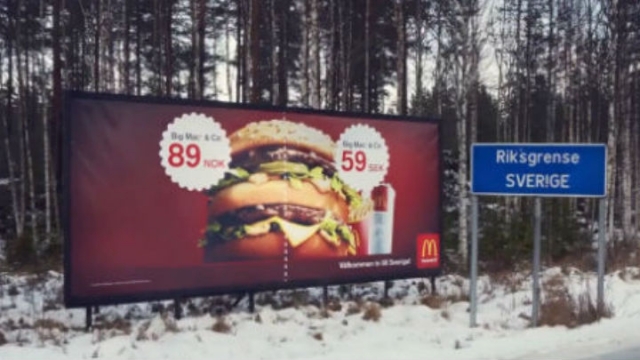
Norway is a lot more expensive than Sweden. This is not lost on McDonald’s advertising agency DDB in Stockholm and they have installed this billboard straddling the border to persuade Norwegians to cross over for their burgers. Many Norwegians cross the border in any case to shop and most road borders have retail outlets and supermarkets on the Swedish side to cash in on this. Food alcohol and, it seems, Big Macs offer significant savings.
Norway - Sweden Big Mac

Norway – Sweden Big Mac

Eighty nine Norwegian kronor is about 93 Swedish kronor and so the Big Mac meal (including a drink and fries) is about 30% cheaper in Sweden. McDonalds have not revealed how effective this has been in attracting Norwegians.

TheLocal: Norway once again boasts the world’s most expensive Big Mac, the UK’s Economist magazine has reported, with the ubiquitous double-decker burger now costing 48 kroner, or $7.80. 

Venezuela slips into second place with a $7.15 burger. Switzerland, which briefly stole the top spot last year on the back of a burgeoning Swiss franc, is now in third place with its $7.14 burger, followed by Sweden ($6.29) in fourth. 
 
The burger in Norway is on average 68.8 percent more expensive than it would be in a McDonald’s in the US. 

The cheapest Big Mac in the world is in India at $1.54. China at $2.74 and Japan at $2.97 are surprisingly close. Of course the current currency exchange rates also have an impact.

The Economist invented the global Big Mac Index in 1986. The 2014 Big Mac index was released a few days ago with January 2014 exchange rates.

THE Big Mac index was invented by The Economist in 1986 as a lighthearted guide to whether currencies are at their “correct” level. It is based on the theory of purchasing-power parity (PPP), the notion that in the long run exchange rates should move towards the rate that would equalise the prices of an identical basket of goods and services (in this case, a burger) in any two countries. For example, the average price of a Big Mac in America in January 2014 was $4.62; in China it was only $2.74 at market exchange rates. So the “raw” Big Mac index says that the yuan was undervalued by 41% at that time. 
 
Burgernomics was never intended as a precise gauge of currency misalignment, merely a tool to make exchange-rate theory more digestible. Yet the Big Mac index has become a global standard, included in several economic textbooks and the subject of at least 20 academic studies. For those who take their fast food more seriously, we have also calculated a gourmet version of the index.

This adjusted index addresses the criticism that you would expect average burger prices to be cheaper in poor countries than in rich ones because labour costs are lower. PPP signals where exchange rates should be heading in the long run, as a country like China gets richer, but it says little about today’s equilibrium rate. The relationship between prices and GDP per person may be a better guide to the current fair value of a currency. The adjusted index uses the “line of best fit” between Big Mac prices and GDP per person for 48 countries (plus the euro area). The difference between the price predicted by the red line for each country, given its income per person, and its actual price gives a supersized measure of currency under- and over-valuation.

Click here for the interactive map.

big mac index - the economist

big mac index – the economist

Number of citations and excellence in science

February 10, 2014

Scientific excellence can only truly be judged by history. But history has eyes only for impact and if excellent science causes no great change to science orthodoxy, it is soon forgotten. For a scientist the judgements of history long after he performs his science are of no real significance. Even where academic freedom is the main motivator for the scientist,  the degrees of freedom available are related to academic success. An academic or scientific career depends increasingly on contemporaneus judgements – and here social networking, peer review and bibliometric factors are decisive. There may well be some correlation between academic success and the “goodness” of the scientist but it is not the success or the bibliometrics which are causative.

As Lars Walloe puts it: Walloe-on-Exellence

In the evaluation process many scientists and nearly all university and research council administrators love all kind of bibliometric tools. This has of course a simple explanation. The “bureaucracy” likes to have a simple quantitative tool, which can be used with the aid of a computer and the internet to give an “objective” measure of excellence. However, excellence is not directly related either to the impact factor of the journal in which the work is published, or to the number of citations, or to the number of papers published, or even to some other more sophisticated bibliometric indices. Of course there is some correlation, but it is in my judgement weaker than what many would like to believe, and uncritical use of these tools easily leads to wrong conclusions. For instance the impact factor of a journal is mainly determined by the very best papers published in it and not so much by the many ordinary papers published. We know well that even in high impact factor journals like Science and Nature or high impact journals in more specialized fields, from time to time not so excellent papers are being published. 

…..  I often meet scientists for whom to obtain high bibliometric factors serve as a prime guidance in their work. Too many of them are really not that good, but were just lucky or work in a field where it was easier to get many citations. …..If you are working with established methods in a popular field you can be fairly sure to get your papers published. I can mention in details some medical fields were I know that this has happened or is happening today. The scientists in such fields get a high number of publications and citations, but the research is not necessarily excellent. 

And getting your paper published has now become so important in the advancement of an academic career that journals are proliferating. Many of the new journals have now shifted their business models to be based on author’s fees and not on volume of readership. This is a very “safe” business model since profits are ensured before the journal has even been published and if the journal is an on-line journal then costs are minimal. It is virtually the “self-publishing” of papers. You pay your money and get your paper published.

The reality today is that more papers are being published by more authors in more journals than ever before. But fewer are being actually read. Papers are cited without having been read – let alone understood.

Skeptical Scalpel:

Another reason could be that publishers, particularly those who charge authors fees for publishing, are in the business of making money.

Authoring journal articles is not only enhancing to one’s CV (the old “publish or perish” cliché), it is required by Residency Review Committees as evidence of “scholarly activity” in training programs. Maybe it’s good for attracting referrals too.

The publish or perish ethos has led to a proliferation of the number of authors per paper!

First noted in 1993 by a paper in Acta Radiologica and a letter in the BMJ, the number of authors per paper has risen dramatically over the years. 
A study of 12 radiology journals found the number of authors per paper doubled from 2.2 in 1966 to 4.4 in 1991.  A review of Neurosurgery and the Journal of Neurosurgery spanned 50 years. the average went from 1.8 authors per article in 1945 to 4.6 authors in 1995. 
Of note, the above two articles were each written by a single author. 
Three psychiatrists from Dartmouth analyzed original scientific articles in four of the most prestigious journals in the United States—Archives of Internal Medicine, Annals of Internal Medicine, Journal of the American Medical Association, and the New England Journal of Medicine—from 1980 to 2000. They found that the mean number of authors per paper increased from 4.5 to 6.9. The same is true for two plastic surgery journals, which saw the average number of authors go from 1.4 to 4.0 and 1.7 to 4.2 in the 50 years from 1955 to 2005. The number of single-author papers went from 78% to 3% in one journal and 51% to 8% another.
In orthopedics, a 
review of the American and British versions of the Journal of Bone and Joint Surgery for 60 years from 1949 to 2009 showed an increase of authors per paper from 1.6 to 5.1.
An impressive  rise in the number of authors took place in two leading thoracic surgery
 journals. For the Journal of Thoracic and Cardiovascular Surgery the increase was 1.4  in 1936 to 7.5 2006 and for Annals of Thoracic Surgery it was 3.1 in 1966 to 6.8 in 2006. 

And the winner is a paper with 3171 authors! Needles to say it comes from Big Science and the Large Hadron Collider:

the paper with the most authors is “Observation of a new particle in the search for the Standard Model Higgs boson with the ATLAS detector at the LHC” in a journal called “Physics Letters B” with 3171. The list of authors takes up 9 full pages.

Too many journals, too many papers, too many authors and too many citations. But that does not mean there is more excellence in science.

I hope visitors to Copenhagen Zoo dry up….

February 9, 2014

One wonders what the purpose of the Copenhagen Zoo is? First they breed them. Then if they don’t like them or find them surplus to requirements they kill them. They invite zoo visitors to the autopsy. Why not to the executions? A healthy, 18 month old giraffe bred by the Copenhagen Zoo was killed off for being surplus to requirements (genetically)! Why breed it in the first place? And apparently this is standard practice.

If it had been culled in the wild because of an excess population it might have felt different. And the zoo had been offered alternatives.

Marius the giraffe bred to be killed by Copenhagen Zoo

I hope visitors to the Copenhagen Zoo dry up.

From the Copenhagen Post:

An online petition to save the life of a young giraffe at Copenhagen Zoo is currently accumulating close to 2,000 votes an hour. But all the votes are in vain because the unfortunate animal was destroyed this morning in accordance with the zoo’s policy on in-breeding. 

The zoo said it has taken the decision to kill the 18-month-old male giraffe Marius and feed him to some of his fellow animals at the zoo in order to keep the giraffe population “genetically sound”.

“Giraffes today breed very well, and when they do you have to choose and make sure the ones you keep are the ones with the best genes,” Bengt Holst, the scientific director at the zoo, explained to the BBC.

Between 20 and 30 animals are put down in a similar fashion every year, added Holst. According to Ekstra Bladet tabloid, this has included bears, tigers and zebras.

…. Marius was killed by a bolt gun instead of a lethal injection, which would have contaminated the meat.

While most of him will be fed to the carnivores at the zoo, part of his carcass will be used for scientific research. Visitors to the zoo on Sunday were invited to attend the autopsy.

Ottawa Citizen: Copenhagen Zoo turned down offers from other zoos and 500,000 euros ($680,000) from a private individual to save the life of a healthy giraffe before killing and slaughtering it Sunday to follow inbreeding recommendations made by a European association.

The 2-year-old male giraffe, named Marius, was put down using a bolt pistol and its meat will be fed to carnivores at the zoo, spokesman Tobias Stenbaek Bro said. Visitors, including children, were invited to watch while the giraffe was dissected.

Marius’ plight triggered a wave of online protests and renewed debate about the conditions of zoo animals. Before the giraffe was killed, an online petition to save it had received more than 20,000 signatures.

Stenbaek Bro said the zoo, which now has seven giraffes left, was recommended to put down Marius by the European Association of Zoos and Aquaria because there were already a lot of giraffes with similar genes in the organization’s breeding program.

The Amsterdam-based EAZA has 347 members, including many large zoos in European capitals, and works to conserve global biodiversity and to achieve the highest standards of care and breeding for animals.

Bengt Holst is the scientific director of Copenhagen Zoo who has implemented this policy of the EAZA.

Zoos are of course just places of entertainment for humans and I don’t really think they perform any other useful function. And I don’t much believe that their much vaunted  “conservation” which consists of freezing an unsuccessful species in an artificial habitat does that species any service at all.

Meanwhile in the UK: lioness and cubs who were the pride of Longleat are put down

Graphic pictures of Marius being cut up and fed to the lions.

Bjørndalen – and the “sense of Wow”!

February 9, 2014

Ole Einar Bjørndalen, 40 years old, 6th consecutive Olympic Games, 20 years of competition at the highest level, 12 Olympic medals, 7 Olympic Golds  (so far), all in the biathlon. Wow! On only the second day of the Sochi games and my “sense of Wow” has been well and truly engaged.

I watched the 10km biathlon sprint yesterday at Sochi and Bjørndalen, in spite of missing one target in the shooting, was strong enough in the skiing sections to win. He was not the favorite since his results this season have not been spectacular and he has generally been considered the veteran in the twilight of his competitive career. Wow!

His Olympics career has been both long and spectacular:

Bjoerndalen Olympics medals (2014-02-09) Wikipedia

Bjoerndalen Olympics medals (2014-02-09) Wikipedia

He still has the chance of winning a few more medals.

BBC: Norway’s Ole Einar Bjoerndalen equalled the record for most medals won at the Winter Olympics as the 22nd Games got under way in Sochi, Russia. Bjoerndalen, 40, won the biathlon 10km sprint to take his tally to 12 medals, matching compatriot Bjoern Daehlie. 

Bjoerndalen finished ahead of Austria’s Dominik Landertinger and Czech biathlete Jaroslav Soukup to claim the seventh Olympic gold medal of his career.

“This victory has been a four-year job and it has been many years since I won (an individual gold medal), but life is too short to give up,” said Bjoerndalen. “I think this is one of my most important victories.” The Norwegian will get the chance to break Daehlie’s record in the men’s pursuit on Monday, but he played down comparisons between the pair. “It’s difficult to compare us at this time because Bjorn was some years ago and now we have a lot more disciplines,” he said.

The only faint shadow I perceive is that the achievements at Sochi not be later spoilt by revelations about doping. Whether or not Lasse Viren ever indulged in blood doping, some other Finnish athletes of his day did but it was not illegal at the time (1970’s). The Norwegian ski team in the 1990’s have also been accused of dirty tricks. The intense Alpine skiing events have had their share of rumours. Marit Bjoergen also won a gold yesterday in the skiathlon. She takes asthma medicine and has had dispensation to do so when it contained a banned substance (which is no longer banned upto certain quantities). In any event she has also faced accusations from her peers that her asthma inhaler was performance enhancing. I suppose being able to breathe is performance enhancing. But I thought that Pistorius being allowed to use blades to run in the summer Olympics was ridiculous. Why not allow a javelin thrower with a weak arm to use a “spear-thrower” attachment to his arm?

Usain Bolt generates a sense of Wow and there are no indications that he is anything but “clean”. But so did Ben Johnson generate the same sense of Wow when he won. And even Lance Armstrong. More often than not rumours of dirty tricks have – much later – been found to be true and sometimes banned.

I have a feeling that athletic team directors and doctors are continuously looking for legal performance enhancing methods and it takes a little time before any new methods discovered become widely known, spread and are then banned (like blood doping).  For an armchair spectator like me it is “the sense of Wow” which attracts and captures my imagination. I just hope that my  “sense of Wow” – not just at Bjørndalen’s fantastic achievements– are not deflated and destroyed by later revelations of dirty tricks – even if they are not illegal for now. 

Nuland rant indicates heavy US advice to (or direction of) Ukraine opposition

February 7, 2014

For once it was not the NSA bugging some European leader. Presumably it was the Russians bugging US diplomats. Victoria Nuland the US diplomat for European and Eurasian affairs reportedly said ‘Fuck the EU’ while speaking of the Ukraine crisis with the US ambassador to Ukraine Geoffrey Pyatt. 

Марионетки Майдана

I will not be surprised if this recording disappears from You Tube if the US applies pressure – through the horse has bolted.

The US like many others may be frustrated with the EU but what is fairly clear is that the US is very actively advising – if not directing – the Ukraine opposition.The modern version of the Great Game being played out in Syria and Ukraine.

BBC: A voice resembling that of Assistant Secretary of State Victoria Nuland refers to the EU using a graphic swear word, in a conversation apparently with to the US ambassador to Ukraine. The US said Ms Nuland had “apologised for these reported comments”.

The EU and US are involved in talks to end months of unrest in Ukraine. …. 

Russia has been widely accused of intervening in Ukraine, using its economic clout to persuade Mr Yanukovych to abandon closer ties with Brussels. Russia has itself accused Washington and the EU of meddling in Ukraine. 

The 4min 10sec video was entitled “Maidan’s puppets” in Russian – a reference to the square in the Ukrainian capital, Kiev, where pro-EU protests have been held for months. A transcription of the whole conversation was also posted in Russian.

At one point, the female speaker mentions the UN and its possible role in trying to find a solution to the Ukraine stand-off.

She says: “So that would be great, I think, to help glue this thing and have the UN help glue it and you know…” she then uses the graphic swear word about the EU.

The male replies: “We’ve got to do something to make it stick together, because you can be pretty sure that if it does start to gain altitude the Russians will be working behind the scenes to try to torpedo it.”

The two officials also discuss frankly the merits of the three main Ukrainian opposition leaders – Vitaly Klitschko, Arseniy Yatseniuk and Oleh Tyahnybok.

Intrusive ads are counter-productive – at least with me

February 6, 2014

I must be representative of some consumers since I do buy stuff.

I even buy quite a lot of stuff on-line. Tickets of any kind (theatre, airline, museum, train, football, hockey bus ……), books, music, electrical and electronic gadgets and a host of small articles capable of being delivered by post. We book hotels on-line and sometimes pay on-line as well. We generally don’t buy food or clothes on-line but we do sometimes (at least my wife does) respond to the flyers dropped into our letter box by local retailers. Nearly all automotive products or materials for house repairs are bought physically and not on-line though we may have searched on-line.

But what I observe is that when I buy-on line it is from sites that I know or for which I have searched on-line. Never by clicking on an ad at another site. Even when I search I always hop over the paid ads which show up at the top of the search results. For a store to show up in a search result is much more important in getting my custom than in their advertising having been seen on another site. I cannot recall a single instance in the last year of buying something in response to an on-line ad. But what I also observe is that there is some threshold level of intrusiveness which leads me to remove sites from my bookmarks. If a site directs me first to full-page ads which I have to click away – and especially if they make it difficult to find the “close” button – then those sites get removed from my bookmark lists. I don’t watch videos on-line if their ads don’t disappear within 5 seconds. If my mouse, when hovering over text, brings up too many intrusive ads then the entire site gets onto my “black-list”. I don’t mind registering for some services at some sites but if that process takes longer than about 30 seconds (perhaps a minute) then that site never gets visited again.  Of course it could be that some of the on-line ads are having a subliminal effect and reinforce my perceptions when I search for on-line stores – but it is not very likely.

Even on TV and especially since the break for commercials is so long (in Sweden a commercial break lasts 6 minutes and there are not many ads of high quality), the commercial break either leads me to surf other channels or to go do something else. In the last year or two I notice that there are more TV programmes that I watch only up to the first commercial break because I then go and do something else and never get back in time to watch the rest of the programme. If it is a sporting or political event, then I may well return to the programme – after the commercial break. In any event the people paying vast sums for making and airing the commercials do not capture my attention. If anything they create a resentment in me since I am either a “captive audience” or am being coerced to view their “nonsense”. And it is the resentment which leads to the content being classified in my mind as “nonsense”. I never watch TV shopping channels but they clearly don’t have me as their target audience. The very existence of the commercials is leading me to strategies to avoid them!

My behaviour is surely influenced by the presence of ads on-line and commercials on TV. However, the behaviour engendered in me is nearly always counter-productive from the viewpoint of the advertiser. Maybe I am an untypical consumer – but I doubt it.  Which makes me wonder how effective some of this advertising is?

Certainly advertising agencies and the industry in general will never admit that there can be too much advertising. They get paid for exposure (or apparent exposure) and not for sales achieved. They don’t suffer any penalty for resentment caused or customers driven away. But I would suggest that there is a threshold – very low in my case – at which on-line advertising and commercials on TV become counter-productive.

I get virtually no text ads on my phone. I stopped using Facebook and Twitter some months ago so at least I am not harassed by their ads. But from what I hear, the intrusiveness of the ads on the social media are now leading to some people reducing their use and, in some cases, ending their use of social media. Social media and their business models are still evolving but the assumption that advertising revenues can keep increasing forever is fundamentally flawed.

BBC: Twitter reports $645m loss for 2013

Microblogging site Twitter has reported a net loss of $645m (£396m) for 2013, just three months after its flotation on the New York Stock Exchange. The loss was expected by analysts, who highlighted Twitter’s revenues, which rose 110% last year to reach $665m.

But a reported slow growth in user numbers was a bigger concern for investors. Twitter averaged 241 million monthly users in the last quarter of the year, up just 3.8% on the previous quarter. That represents a slowdown compared with a growth rate of 10% seen at the beginning of 2013. Timeline views were down nearly 7%, suggesting users were refreshing their feeds less often.

“What this report will do is it will question how mainstream is Twitter as a platform,” said Arvind Bhatia, an analyst at Sterne, Agee & Leach.

Shares fell as much as 12% in after-hours trading on Wednesday.

Putin’s Sochi is “ready” but journalists are missing their basic luxuries!

February 5, 2014

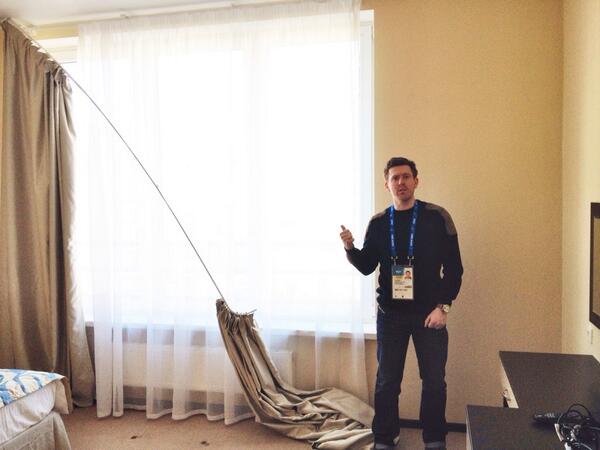
Putin’s winter games open in Sochi on Friday and journalists have started arriving. But Putin is probably a little indignant that they are nowhere near as hardy as he is and expect all manner of luxuries ranging from

View image on Twitter

Twitter image Harry Reekie @CNN

  • one room per person (Putinities can manage with 11/room)
  • curtains
  • toilet paper
  • heating
  • internet
  • elevators that work
  • running water
  • hotel lobbies
  • reception desk
  • water safe to wash in
  • water safe to drink
  • flooring
View image on Twitter

Twitter image @wyshynski

Reuters: Russian officials have declared Sochi ready for the Games, on which President Vladimir Putin has staked his and his country’s reputation. But days before they open on Friday, the organizers acknowledge that not all the new hotels are ready, despite the Games’ $50-billion price tag. ……. 

macho putin

Although no athletes are affected, officials from two countries said they were turned away when they arrived at night in Krasnaya Polyana because their hotels were not ready. They too have been temporarily moved elsewhere.

The International Olympic Committee (IOC) has urged the Russian organizers to sort out the problems quickly and says only about three percent of the newly built accommodation – around 700 rooms – are not ready for guests.

Macho Putin is not impressed by these namby-pamby types. 

Related posts:

Sochi Winter Olympics: Champions of Corruption

Economic model predicts Olympic medals at 2014 Sochi winter games

Give all your students an A+ and lose your job

February 4, 2014
Denis Rancourt

Denis Rancourt

Denis Rancourt is a recognised researcher and he may even be an excellent physics teacher for all I know. But he either suffers from wanting to be a “martyr” for the cause of “no competition in education” or is just plain lazy and couldn’t be bothered to go to the trouble of grading his students.

I am inclined to believe it is the latter together with a desire for the limelight.

Ottawa citizen:

Denis Rancourt has lost his bid to reclaim his job as a professor at the University of Ottawa. ….  arbitrator Claude Foisy concluded he had no reason to intervene in the university’s 2009 decision to fire Rancourt, then a tenured physics professor, for defying its orders to grade his students objectively.

The university dismissed Rancourt after he awarded A+ marks to all 23 students who completed an advanced physics course he taught in the winter of 2008. The university had earlier issued him a letter of reprimand for awarding A+ marks to virtually everyone in a first-year physics course he gave in 2007. As well, Rancourt’s dean, the late André Lalonde, gave him “clear and unequivocal direction” in March 2008 that he must not grant every student in his courses a grade of A+ based only on their attendance at class.

Rancourt, ……  testified that he’d come to believe that traditional methods of teaching and evaluating physics students were ineffective. Learning physics, he said, must be anchored in self-motivation. Key to his “student-centred” pedagogical method, he testified, was allowing students to learn free of the stress produced by the traditional method of grading and ranking.

…… Foisy noted that the university had opposed Rancourt’s evaluation method “every step of the way.” Lalonde testified that it would undermine the university’s reputation, causing it to be seen as a “Mickey Mouse university,” and was prejudicial to students graded in the traditional manner.

Foisy agreed, even accepting Lalonde’s characterization of Rancourt’s failure to objectively evaluate his students as “a form of academic fraud. This, in my opinion, is a very serious breach of his obligations as a university professor.”

Even though Rancourt was “well aware” of the university’s opposition to his method of evaluation, “he continued to defy the administration,” Foisy said. “Is the dismissal the appropriate remedy in the circumstances? The short answer is yes.”

The arbitrator rejected arguments that Rancourt’s teaching methods were protected by academic freedom, freedom of expression and his tenure status.

“Academic freedom is not so wide as to shield a professor from actions or behaviour that cannot be construed as a reasonable exercise of his responsibilities,” he said.

Foisy did uphold one of Rancourt’s grievances, ordering the university to remove any mention of a disciplinary letter dated Nov. 20, 2007, from Rancourt’s record. The letter blamed Rancourt for not having taught the content of an approved course.

But he rejected Rancourt’s demands for a written apology, monetary reparations and help in partially recovering lost time and career advancement.

joanne st lewis

joanne st lewis

Rancourt is not a stranger to controversy.  He claims that he was fired for political reasons rather than for his teaching methods, but that does not seem to have cut much ice with the arbitrator. His own blog is here and there does seem to be a touch of paranoia. In fact reading his blog suggests he is more interested in publicity through controversy than actually in teaching. He is also being sued for libel by Joanne St. Lewis a Law Professor at the University of Ottawa, after Rancourt referred to her as university president Allan Rock’s “House Negro” on his blog.

From my own experience – though not in a classroom – it was always very difficult to get my managers to objectively grade the performance of their subordinates. Poor performance ratings in a department reflected also on the manager’s own competence. And in my experience it was the goodness of the manager which determined whether he got the balance right in the application of stress to improve the performance of his subordinates or if he went over the top and caused a burn-out. But I have no doubt that performance ratings – done right – improved performance in the work place.

And I am quite sure that much of the poor performance of students reflects on the teacher’s ability to teach. An element of competition and stress is – in my experience – necessary for learning.

Which leaves me without much sympathy for Denis Rancourt.

Japanese right-wingers continue to try and rewrite history

February 4, 2014

Victors write history.

But almost 70 years after the end of the Second World War the militaristic faction of the Japanese right-wing are still in a state of denial about the result. Their attempts to rewrite history – especially the actions and behaviour of the Japanese military in China – have never ceased but have never before had much impact or much support even within Japan. The Nanjing massacre and the use of “comfort women“ by the military in occupied territories are often downplayed or even denied by the revisionists. But now there is a rightist party in government which is in tacit agreement with many of these extreme views.The most potent symbol for the militaristic and nationalistic heritage in Japan is the Yasakuni shrine. As Mark Selden writes

Japan’s Yasukuni problem is inseparable from the fact that nationalism is the dominant ideology of our era. …… In the postwar, with Japan at peace and occupied by US forces, the shrine has played a role in structuring how the war is remembered and presented to the Japanese people. It did so within a framework crafted by the occupation authorities who exonerated the emperor of all responsibility for initiating or waging war. ….. Not only would the emperor not be deposed or tried as a war criminal, he would be shielded even from testifying at the Tokyo Trial. The verdict at Tokyo, sentencing Tojo and a small number of prominent military and government officials to death, as well as the convictions of thousands of soldiers and police officials tried in B and C class tribunals, in leaving untouched Japan’s supreme wartime leader, essentially absolved the Japanese people of the responsibility to examine their own behavior in the era of colonialism and war. For these reasons, the US as well as Japan ultimately shares responsibility for resolving issues of war responsibility that it helped to create, including those associated with the emperor and with Yasukuni Shrine. 

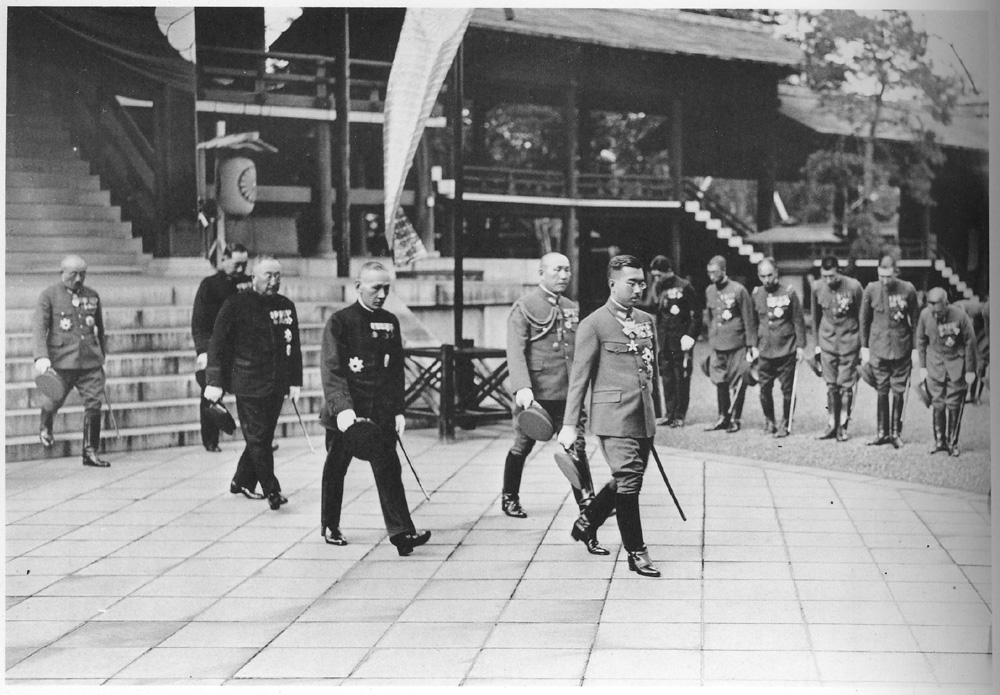
Emperor Hirohito at the Yasakuni shrine 1935

Emperor Hirohito at the Yasakuni shrine 1935

Just a month ago the Prime Minister Shinzo Abe visited the Yasakuni Shrine to honour the convicted war criminals enshrined there.

BBC: Whatever Shinzo Abe says, any visit to the Yasakuni shrine by a Japanese prime minister is deeply political and sure to cause offence. In the 1960s and 70s, the spirits of scores of convicted Japanese war criminals were “enshrined” there. The most controversial were the 14 “Class A” war criminals, including wartime leader Hideki Tojo, who were “enshrined” in the late 1970s. These men were the ones who ordered and oversaw Japan’s brutal war in China and South East Asia. …..

…… Close observers of the Japanese prime minister say he is at heart a nationalist and a historical revisionist. He believes the trials that convicted Japan’s wartime leaders were “victors’ justice”. His own grandfather Nobusuke Kishi served in the war cabinet and was arrested by the Americans on suspicion of being a Class A war criminal. He was later released without charge.

School text books are now beginning to downplay or remain silent about Japanese atrocities (not that they have ever been fully accepting of their occurrence or of Japanese responsibility). Now this revisionism is spreading to the national broadcaster NHK and again with some support from the government.

JapanDailyPress: The Japanese public broadcasting firm NHK is under fire again as another senior manager sparked controversy over his comments denying any massacre from happening in the Nanjing province of China in 1930s. Naoki Hyakuta, member of the 12-man management committee for programming policy and budget-setting, denied reports of rape and murder by Japanese troops in China during 1937-38, shrugging it off as “propaganda.” …… 

…. Chief Cabinet Secretary Yoshihide Suga justified the right-wing novelist’s statements, saying that he is entitled to his opinions. Speaking to the press, he said that he is aware of the reports “but has learnt (expressing personal views) doesn’t violate the Broadcast Law.” Fears of the broadcasting firm molding into PM Abe’s nationalist policy are starting to circulate with Hyakuta’s comments following new chief Katsuto Momii’s statements last month about the use of “comfort women,” or sexual slaves, being a normal practice during wartime, with many other nations doing the same.

Jan 31, 2014:The already embattled new chief of NHK is set to face a Diet committee today on claims that his comments about the “comfort women” system of World War II can be considered “political interferance.”  ……. Katsuto Momii will be grilled by the Parliament over his statement during his first press conference as the new chairman. He said that the use of sexual slaves, or comfort women, during times of war was also being practiced by other countries like France, Germany, and the United States, among others. While he has already apologized for his comments, saying they were his personal beliefs and not that of NHK, the international furor over it has not abated. ….

Certainly there is a growing concern about growing Chinese might in South East Asia and this concern is partially shared in the US. So the US, while disapproving of the revisionist trends in Japanese government circles, has been fairly mild in its criticism as long as the Japanese target is China. In the territorial disputes between Japan and China for example the US generally supports the Japanese positions.

I perceive a risk that as the Japanese commercial predominance weakens there could be an upsurge in the militaristic ambitions of the nationalistic right. It is only my perception of course but having lived in Japan and in Germany, I sense a greater risk of sudden chaos with the Japanese militaristic nationalists than with the German neo-Nazis. The manner is which the rest of Europe acts as a check and balance against extremism is something missing in Japan.

The cons (“assholes”) of Paris – as seen from Marseille

February 2, 2014

The rivalry between Paris and Marseille is legendary though Marseille can boast human settlements starting from 30,000 years ago  while settlements in Paris can only go back about 7,000 years. Today Paris has a population about 3 times as large as Marseille’s (at about 2.3 million in the city and 12 million in the metropolitan area). The current pre-eminence of Paris does give Marseille a bit of an inferiority complex and there is usually an air of defensiveness evident from the Marseillais. They don’t like being perceived as the crime capital of France and the defence is then to take pride in the toughness of their criminals! Of course the rivalry manifests itself these days through football and an Olympique de Marseille versus Paris Saint-Germain match is something very special.

But even the New York Times magazine asks the question if Marseille is the secret capital of France.

Marseille remains a patchwork sprawl of rich and poor neighborhoods, a melancholy, compelling mess of corruption and sun — the anti-Paris and secret capital of a France that doesn’t pretend the country is race-blind.

GeoCurrents addresses some of the satirical maps of France at Carte de France.

I like these two particularly.

1. France as seen from Marseille:

France - seen from Marseilles image carte-de-france

France – seen from Marseilles image carte-de-france

The reported perception of France from the perspective of Marseille is particularly simplistic: amusingly, the map features two latitudinal lines and one oval to create a total of four regions: “North Pole” for the far North of France, “North” for everything poleward of the region the French call “Sud” (which itself usually corresponds to the regions of Provence-Alpes Côte d’Azur, Languedoc-Roussillon, Midi Pyrennées and Aquitaine, but is here even more constrained) and, finally, the shining label “cons,” (“assholes”), assigned to the oval encompassing Paris. Of notice, too, is the ironic “Capitale” label on top of Marseille. The map perfectly showcases the deep-seated rivalry between Paris and Marseille…..

2.France as seen from Paris

France seen from Paris image carte-de-france

France seen from Paris image carte-de-france

The map of France as seen by the Parisians seems more complex at first glance, though this does not mean that the Parisians are more discriminating than the Marseillais. The labels for the different regions here could be taken as offhanded proofs from inside the minds of Parisians, justifying France’s centralized political model. Alsace is perceived as the home of the “dépressifs” (depressed), the Bretagne region (Brittany), summed up for most Parisians by crepes and hard cider, are “alcooliques,”(alcoholics), and the Northerners are “pauvres” (poor).  The wildly successful 2008 French movie “Bienvenue Chez Les Chtis” (‘Welcome to the Sticks’) captured these dichotomies and prejudices perfectly. It is centered around a postal manager from the region of Lyon who is sent to the Northern region (Nord-Pas-de-Calais) as a punishment for having faked a disability in the hope of being sent to an office … on the Mediterranean. The movie was seen by a third of the French population in 23 weeks, thus showing the extent to which the regional question remains a running joke in France. ….. The labels “branleurs” (‘wankers’) and “menteurs” (‘liars’) for the southern regions show the extent to which Paris sees itself as pulling the country on its own—whether that is a role it has given to itself or the product of actual laziness from the other regions. The “terrorist” label both for the Basque Country and Corsica humorously point out the existence of occasionally violent separatist groups in both regions, though both places are also extremely popular vacation destinations for the Parisians, who seldom let geopolitics in the way of their summer migration.  Finally, the map reveals the idea that Parisians tend to see many regions of France as their playground. The “plages” (beaches) label along the Western and the Mediterranean coasts and the “ski” label along the Pyrenees and the Alps may seem amusing and reductive, but they are in fact indicative of the huge ebb and flow that occurs in the winter and summer (with all those weeks off work!), when a massive exodus heads out of Paris and into these regions.

Source: http://www.geocurrents.info/cultural-geography/seek-thou-shall-fiend-french-satirical-maps#ixzz2sBdyIUno