Archive for the ‘Business’ Category
February 27, 2012
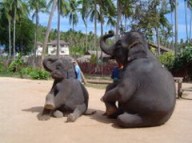
Thai show elephants
The Thai Government relies heavily on the $2 billion tourist industry which in turn uses elephants as a focus for attracting tourists. But most of these “show” elephants (estimated to be 100- 200 per year) are captured as young calves by poachers who kill their mothers when trying to protect their calves. But the Thai Government which makes all the politically correct noises about protecting elephants is reluctant to disturb the poachers and the tourist industry. So when poachers are threatened the Thai Government (ironically through its National Parks, Wildlife and Plant Conservation Department) rushes to their defence.
The Age: A partly Australian-funded wildlife rescue foundation whose chief spoke out about the illegal poaching of baby elephants in Thailand has been raided and had 103 animals taken away by Thai parks officials. … witnesses say many of the animals, including endangered species, were injured during the raids on the Wildlife Friends Foundation Thailand centre by up to 100 armed men, some of whom wore balaclavas to hide their identities.
The raids over four days followed claims by the organisation’s founder and director, Edwin Wiek, that more than half the elephants in tourist camps across Thailand had been illegally caught in the wild when they were young, sometimes by poachers who shot their mothers or other members of their herd that tried to protect them. …….
Thailand’s National Parks, Wildlife and Plant Conservation Department said the animals were seized because the foundation failed to produce paperwork showing they were being kept legally. “We need to enforce Thai laws that have been issued to protect those animals,” said the department’s director-general, Damrong Pidech.
Ironically many of the animals seized were originally rescued from government centres and will now find themselves back in these centres.
Tags:elephant poaching, Poaching, Thailand, Tourism
Posted in Business, Corruption, Environment, Thailand | Comments Off on Thai Government rushes in to protect elephant poachers
February 24, 2012
Insurance companies are in the business of making perceived risks seem much larger than actual risk. Their profits are directly impacted by increasing the risk perceptions of the party seeking insurance. It is not surprising that they exaggerate the dangers of whatever is being insured against. To be “alarmist” for an insurance company is just good marketing. However much of their marketing and publicity is presented under the cloak of “scientific research”. Any report from an insurance company about future risks and purporting to be an “objective” or “scientific” study needs to be discounted and taken with a very large shovel of salt. Yet, the media often swallow such publicity and merely reproduce their reports with little effort to see through the conflicts of interest.
I have posted earlier about Munich Re and their attempts to suggest that global warming will increase the frequency of natural disasters. Anything to increase the perceptions of risk.
Now JunkScience reports on the case of Kerry Emanuel and his alarmist positions and his connections to Insurance companies:
Based on a request for investigation from JunkScience.com, Nature has forced MIT’s Kerry Emanuel to disclose his employment with insurance companies as a conflict of interest.
In the Feb. 14 Nature Climate Change study “Physically based assessment of hurricane surge threat under climate change,” of which Emanuel is a co-author, the “Additional Interests” section disclosed:
The authors declare no competing financial interests. However, in the interests of transparency we confirm that one of us, Kerry Emanuel, is on the boards of two property and casualty companies: Homesite and Bunker Hill, and also on the board of the AlphaCat Fund, an investment fund dealing with re-insurance transactions. In all three cases, Dr Emanuel receives fixed fees but owns no stocks or shares. Dr Emanuel does not stand to make any personal financial gain through these directorships as a consequence of the reported findings.
There was obvious reluctance in the disclosure from the wording (“no competing financial interests” even though insurance companies are gaming global warming alarmism) to the fact that, despite our asking, we had to find out about the disclosure on our own initiative — i.e., after our initial exchange with Nature, the journal editors stopped communicating with us.
JunkScience also reported that the Consumer Federation of America says in a new report:
…. Although insurers have become adept at shifting the cost of catastrophe losses to others, they still use catastrophic weather events to advocate for measures that would shift risk even more, such as higher rates, or putting more policyholders in pools or created taxpayer-supported entities. Thus, many consumers exposed to catastrophe weather risk are also vulnerable to insurer attempts to unjustifiably increase rates or hollow out coverage…
Tags:climate change, Consumer Federation of America, Insurance, Insurance and alarmism, JunkScience, Kerry Emanuel, Massachusetts Institute of Technology, Nature
Posted in Alarmism, Business | Comments Off on Insurance Companies and alarmism
February 14, 2012
China has reserves of shale gas at least 50% greater than in the US and is the latest country hopping onto the fracking band-wagon. The Chinese are looking to acquire minority interests in technology companies owning fracking technology in the US and are pushing ahead with their plans for production of shale gas. It seems quite clear now that whenever the global economic recovery finally gets going, the availability of shale gas will be one of the contributing factors. I expect we shall see a boom in exploration for shale gas reserves, in increasing production of shale gas and a boom in gas-fired power generation. There may well be a boom in the sales of gas turbines for power generation within the next 2 -3 years.
“Peak” gas is nowhere in sight. And the fracking technology developments seem to have application even for the recovery of large amounts of gas from methane gas hydrates which are found under deep sea-beds (>500m deep) and even under thick layers of permafrost. While this may take another 10+ years to develop, it makes it even more unlikely that any “peak” gas scenario can develop.

Shale gas reserves: Reuters graphic
Forbes reports:
(more…)
Tags:"Peak" gas, China, fracking, Hydraulic fracturing, Natural gas, Shale gas
Posted in Business, China, Energy, Gas | 1 Comment »
February 13, 2012
Dassault’s success in being selected as the lowest bidder for the Indian MMRCA competition with the Rafale aircraft seems to be having a significant impact in other deals. The Rafale is now the most likely winner of the Brazilian contract for 36 aircraft. The
aggressive pricing by Dassault and the active (and very effective) lobbying by the French government is a potent combination. The Rafale has not yet been sold outside France and the Indian and Brazilian deals are critical for the future export life of the Rafale.
In Brazil the Rafale is competing against Boeing’s F-18 and Saab’s Gripen. Though Saab is also desperately looking for export orders for the Gripen, it is unlikely that it can afford to drop its prices by the levels that Dassault obviously can. Boeing on the other hand is not so dependent on the Brazilian orders and is unlikely to drop its price by very much – especially since they will not wish to disturb the already very high price levels they enjoy for exports to the Middle-East. And that probably leaves the Rafale sitting very pretty.
Svenska Dagbladet reports (freely translated):
(more…)
Tags:Boeing, Brazil, Dassault Rafale, India, MMRCA, Rafale, SAAB, Saab Gripen
Posted in Aviation, Brazil, Business, Defense, India | Comments Off on Following Indian MMRCA success, Dassaut’s Rafale also tipped for Brazil
January 11, 2012

SAS – which used to be one of my favourite airlines – needs new owners with access to larger markets and with financial muscle.
Lufthansa was – and still is – the most likely buyer. But in the last 2 days the rumors of interest from Qatar have been driving up the SAS share price. Of course the rumors have been denied.
 But SAS is unsustainable as it is and something is due to happen with SAS ownership this year. And my guess would be that the clear fit and benefits would point to Lufthansa rather than Quatar.

Tags:Business and Economy, Lufthansa, Qatar, SAS
Posted in Aviation, Business | Comments Off on Will SAS be acquired by Qatar or Lufthansa?
January 2, 2012
A case of squirrelling away your losses to avoid taxes when times are good!!
Allowing for deferred taxes to average out the ups and downs of a business cycle makes good sense. But of course such provisions are exploited to the full – especially by the financial “industry”.
Barclays stockpiles ‘losses’ to soften tax obligations
Barclays has amassed a war chest of “losses” to offset against future tax payments that can almost rival those at the crippled state-backed banks, despite remaining strongly profitable.
Tags:Barclays, Deferred tax, ethics
Posted in Business, Ethics | Comments Off on Saving your losses for a sunny day!
December 19, 2011
North Korea’s Dear Leader Kim Jong-il passed away yesterday at the age of 69.
He will be succeeded (probably) by Kim Jong-Un but exactly who he is is a matter of some speculation.
My crystal ball tells me that the reunification of Korea will be a reality within 5 years. The scenario I see is that after much noise and threats the North will ask for help – mainly for food. S Korean industrialists will get heavily involved in these “compassionate” projects and will develop the North Korean market in the interests of their own conglomerates. And then the changes will escalate and will be irreversible.
Nearly all countries and even China publicly support the reunification of the Koreas. But this will be a much more traumatic process than the German reunification – which was not cheap and is not complete even after 20 years. With a population of about 50 million in the South and about 25 million in the North it will inevitably seem like an “acquisition” of the North by the South. While the 25 million is a mouth-watering additional (and captive) market for the industrial conglomerates of the South, the social pressures of what should be seen to be a “merger” appearing to be an acquisition would place an unprecedented and formidable challenge for the politicians of the South. The politicians themselves have a reputation for being in the pockets of the various chaebols and whether they will have the vision and skill to manage the social upheaval remains to be seen.
Though the process may well start within the next 5 years, it will likely take much longer to complete than the German experience.

Kim Jong-Un
Tags:Kim Jong-il, Kim Jong-un, Korea, Korea reunification, North Korea
Posted in Business, Korea, Politics | Comments Off on Kim Jong-Who and the reunification of Korea
November 23, 2011
The Carbon Trading scams around the world are coming undone (though Australia in it’s wisdom and its noble efforts to single-handedly save the world has just introduced a carbon tax). The Swiss Bank, UBS has produced a report for its investors with a devastating indictment about carbon trading “waste” in Europe and its bleak future.
The Australian:
SWISS banking giant UBS says the European Union’s emissions trading scheme has cost the continent’s consumers $287 billion for “almost zero impact” on cutting carbon emissions, and has warned that the EU’s carbon pricing market is on the verge of a crash next year.
(more…)
Tags:carbon trading scams, carbon trading waste, Emissions trading, European Union, UBS, UBS Investment Research
Posted in Alarmism, Business, Climate, European Union, Fraud | Comments Off on Europe has “wasted” €210 billion on carbon trading for almost zero impact
November 17, 2011
Most subsidies for the introduction of uneconomic technologies are in an effort to make them commercially viable. But after 30+ years in the power generation industry I have yet to see a case where this has happened. Instead, subsidies have nearly always been counter-productive. In virtually every case I have seen, subsidies have always been used first to maintain margins rather than to reduce costs. If costs are not reduced then the “indirect” costs for every taxpayer which a subsidy represents eventually end up becoming direct costs for the consumer when the subsidies end.
This is happening to an increasing extent with solar and wind power as subsidies are reduced or withdrawn in the current financial crisis. The costs have then to be borne directly by the consumers and it is not surprising that virtually all countries which have introduced wind power to any extent have seen electricity prices to the consumer increase.
Now it is the turn of the Dutch government to reduce subsidies and pass on the costs directly to consumers.
Reuters reports:
Dutch fall out of love with windmills
(more…)
Tags:Electricity generation, Netherlands, off-shore wind power, Subsidy, wind power
Posted in Business, Energy, Environment, Renewable Energy | Comments Off on Now Holland cannot afford to subsidise off-shore wind power
November 15, 2011
Many supposedly unbiased, objective BBC documentary programs have been sponsored by vested interests.
Programs about development were sponsored by the Malaysian government to the tune of £17 million. During the Arab spring a program was sponsored by Mubarak’s government. Another program about climate change was sponsored by Envirotrade – a carbon trading company based safely for taxes in Mauritius. The BBC’s alarmist bias about climate change is notorious but sponsorship by organisations making millions from carbon trading goes a long way to explaining their “objectivity”. The broadcasting regulator, Ofcom, is to investigate.
One media company which made partisan programs for the BBC, FBC Media (UK), has gone into administration. “FBC, incorporated in 1998, was a vehicle for high-profile figures led by founder and chairman Alan Friedman.”
The Independent:
The BBC has owned up to a “nominal fee” programming scandal in which viewers of 15 editorial programmes were hoodwinked by “serious” conflicts of interest of programme makers and a failure to declare that documentaries had outside sponsors.
(more…)
Tags:Alan Friedman, BBC, BBC Trust, biased BBC programs, conflict of interest., FBC, sponsored programs
Posted in Alarmism, Business, Ethics, Media | Comments Off on Supposedly unbiased programs at the BBC were sponsored for millions by vested interests!


 The k2p blog