Archive for the ‘Climate’ Category

Coral reef not so sensitive to global warming after all (if it ever was)

April 5, 2013

Another “climate sensitivity” to join the long list of global warming exaggerations. A coral reef has recovered from a severe “bleaching” event in just 12 years to a level that was thought to require many decades. In fact the assumption that the cause of the severe disturbance in in 1998 was due to global warming is itself looking very shaky. After all, if it was due to global warming (rather than some local temperature or other event) then why on earth did it reverse in 1998? Or is it just a coincidence that no global warming has been observed since that time?

Polar bear numbers are increasing, clouds may “cool” more than they “heat”, the earth’s green cover is increasing, the Antarctic has more ice than it ever had and the Arctic ice variability is not unprecedented and glaciers are not melting at any greater rate than the pre-industrial rate. It is becoming increasingly clear that the “sensitivity” of the global climate to carbon dioxide has been grossly exaggerated.

Location of Reef building corals

Location of Reef building corals (Photo credit: Wikipedia)

“Recovery of an isolated coral reef system following severe disturbance”, by J. P. Gilmour, L. D. Smith, A. J. Heyward, A. H. Baird and M. S. Pratchett  published online at Science on Friday, 5th April, 2013.

Abstract: Coral reef recovery from major disturbance is hypothesized to depend on the arrival of propagules from nearby undisturbed reefs. Therefore, reefs isolated by distance or current patterns are thought to be highly vulnerable to catastrophic disturbance. We found that on an isolated reef system in north Western Australia, coral cover increased from 9% to 44% within 12 years of a coral bleaching event, despite a 94% reduction in larval supply for 6 years after the bleaching. The initial increase in coral cover was the result of high rates of growth and survival of remnant colonies, followed by a rapid increase in juvenile recruitment as colonies matured. We show that isolated reefs can recover from major disturbance, and that the benefits of their isolation from chronic anthropogenic pressures can outweigh the costs of limited connectivity.

PhysOrg writes: Scott Reef, a remote coral system in the Indian Ocean, has largely recovered from a catastrophic mass bleaching event in 1998, according to the study published in Science today. The study challenges conventional wisdom that suggested isolated reefs were more vulnerable to disturbance, because they were thought to depend on recolonisation from other reefs. Instead, the scientists found that the isolation of reefs allowed surviving corals to rapidly grow and propagate in the absence of human interference. Australia’s largest oceanic reef system, Scott Reef, is relatively isolated, sitting out in the Indian Ocean some 250 km from the remote coastline of north Western Australia (WA). Prospects for the reef looked gloomy when in 1998 it suffered catastrophic mass bleaching, losing around 80% of its coral cover. The study shows that it took just 12 years to recover. Spanning 15 years, data collected and analysed by the researchers shows how after the 1998 mass bleaching the few remaining corals provided low numbers of recruits (new corals) for Scott Reef. On that basis recovery was projected to take decades, yet within 12 years the cover and diversity of corals had recovered to levels similar to those seen pre-bleaching.

Climate studies a “science” is not

April 4, 2013

That climate is a subject for study is obvious. That it can be called a “discipline” is questionable but allowable. But any claim that it is settled and understood, let alone fanciful claims that we can control it, are just arrogant nonsense. When the study of climate might  get to be a “science” lies some few centuries in the future – if ever. Climate studies may be a discipline but a “science” it is not.

As with many articles in RealClearPolitics this by Robert Tracinski is trenchant, concise, precise and extremely well written. But RCP has not often been known to break with the global warming orthodoxy and I was surprised to find this there.

Very well worth reading.

The End of an Illusion

Many years ago, I remember thinking that it would take many years to refute the panicked claims about global warming. Unlike most political movements, which content themselves with making promises about, say, what the unemployment rate will be in two years if we pass a giant stimulus bill—claims that are proven wrong (and how!) relatively quickly—the environmentalists had successfully managed to put their claims so far off into the future that it would take decades to test them against reality.

But guess what? The decades are finally here.

…….. So basically, all that the global warming advocates really have, as the evidentiary basis for their theory, is that global temperatures were a little higher than usual in the late 1990s. That’s it. Which proves nothing. The climate varies, just as weather varies, and as far as we can tell, this is all well within the normal range. …..

……

So here’s the state of play of climate science a third of a century into the global warming hysteria. They don’t have a reliable baseline of global temperature measurements that would allow them to say what is normal and natural and what isn’t. Their projections about future warming are demonstrably failing to predict the actual data. And now they have been caught, yet again, fudging the numbers and manipulating the graphs to show a rapid 20th-century warming that they want to be true but which they can’t back up with actual evidence.

A theory with this many holes in it would be have been thrown out long ago, if not for the fact that it conveniently serves the political function of indicting fossil fuels as a planet-destroying evil and allowing radical environmentalists to put a modern, scientific face on their primitivist crusade to shut down industrial civilization.

But can’t we all just stop calling this “science” now? 

Full article here

James Hansen’s exit strategy unfolding as he retires from NASA

April 2, 2013

It was just last week that I asked “Are global warmists preparing exit strategies?”, about warmists in general and about James Hansen in particular.

And today the New York Times reports that Hansen is to retire from NASA – ostensibly to free his hands as an activist. But it has been his association with NASA which has given him the pondus he has had in the global warming priesthood. He has been an embarrassment to NASA for some time but he is 72 and is surely ripe for retirement. I suspect he actually did resign (rather than being required to resign) and his “exit strategy” is playing out. It will allow him to fade quietly out of the alarmist picture he helped create before it is erased completely.

New York Times: James E. Hansen, the climate scientist who issued the clearest warning of the 20th century about the dangers of global warming, will retire from NASA this week, giving himself more freedom to pursue political and legal efforts to limit greenhouse gases.

….. At the same time, retirement will allow Dr. Hansen to press his cause in court. He plans to take a more active role in lawsuits challenging the federal and state governments over their failure to limit emissions, for instance, as well as in fighting the development in Canada of a particularly dirty form of oil extracted from tar sands.

“As a government employee, you can’t testify against the government,” he said in an interview.

Dr. Hansen had already become an activist in recent years, taking vacation time from NASA to appear at climate protests and allowing himself to be arrested or cited a half-dozen times.

But those activities, going well beyond the usual role of government scientists, had raised eyebrows at NASA headquarters in Washington. “It was becoming clear that there were people in NASA who would be much happier if the ‘sideshow’ would exit,” Dr. Hansen said in an e-mail.

When hockey sticks are not robust …

April 1, 2013

I had almost got the 1st of April out of my system but I could not resist noting that when things are not “robust” they break and the broken pieces don’t stay put.

This gets classified as misconduct.

The Marcott Filibuster

Marcott et al:  ” … 20th century portion of our paleotemperature stack is not statistically robust, cannot be considered representative of global temperature changes, and therefore is not the basis of any of our conclusions”.

Not robust

Not robust

Global warming will contaminate signals and cut internet speeds

April 1, 2013

Over the coming years we can all expect to spend more time staring at our download dialog boxes, waiting for our music or our videos to buffer and clicking away impatiently as we wait for our web pages to reload.

And it will not be the OS or our internet service providers who are to blame. It will be the effects of global warming.

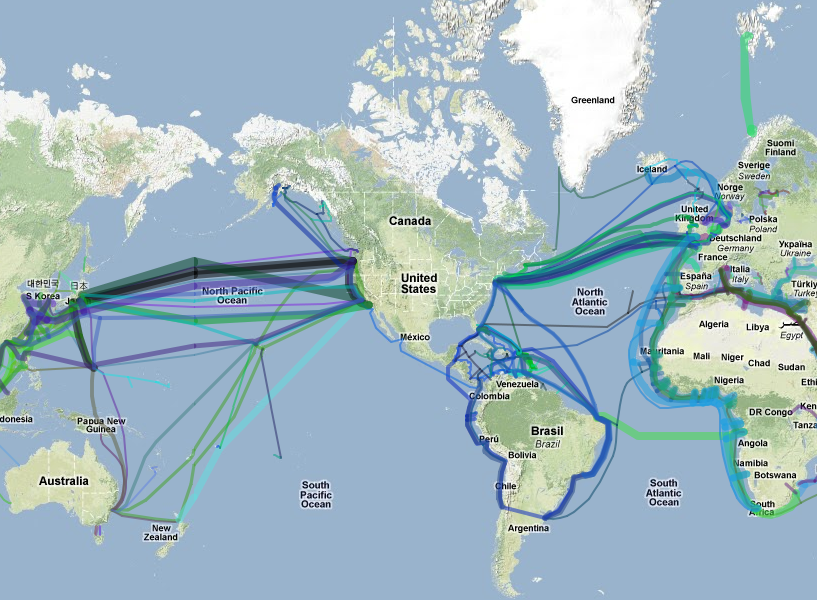
As global warming sets in and the seas warm the performance of all the undersea cables that are a critical part of global connections will be affected. A significant part of voice and data signals are transmitted through these cables and many communications services companies are entirely dependent on them. As the seas warm they will absorb increasing amounts of carbon dioxide from the atmosphere and turn acidic. While fish and all marine life have evolution to fall back upon and will adapt to the changing conditions, undersea cables being inanimate and unable to reproduce will suffer. Firstly the increasing temperature itself will cause the component fibres in the undersea cable to expand; both in length and in diameter. Secondly the acidic environment will cause them to corrode and distort.

Undersea Cable Map – The Big Picture (www.ritholtz.com)

These cables, which connect land-based transmission terminal stations across continents, are laid for tens of thousands of kilometres along the seabed. It is well known that these thick optic fibre cables can be disrupted due to many natural phenomena, such as temperature, earthquakes, extreme turbidity, current, or by coming in contact with fishing vessels or being attacked by marine life ranging from plankton to sharks.

It has now been shown conclusively by research at the International Marine Cable Research Centre (IMCRC) that increasing global temperatures will lead not only to the slowing down of signals as the marine cables expand in length, but that the integrity of signals being carried will suffer as the cable distortions lead to intertwined parallel signals getting mixed up with each other.

Just having cables in parallel cannot solve this problem. Global warming will affect all the cables. Longer cables will be affected most. Scientists at the IMCRC have modelled the performance under deteriorating conditions and calculate that these cables could become completely unusable as quickly as within 1,000 years. “We are working on an innovative solution”, said Dr. Peter Sellers, Director of the IMCRC. The International project to find a solution is being led by Dr. Martin Strangelove of the University of Pennsylvania who says, A drastic problem requires a drastic solution. We are now working on ways in which we can trigger a new ice age as a comprehensive global solution. Not only will undersea temperatures reduce but in many places alternative cables could be placed on the surface of the newly created ice sheets”.

(XPI – 1st April 2013)

Boston marathon winning times fail as a proxy for global warming temperature rise

March 31, 2013

I am not sure whether to call this “bad science” or to be generous and call it “trivial science”.

There is a new paper in PLOS ONE (open access) from “researchers” at Boston University:

Effects of Warming Temperatures on Winning Times in the Boston Marathon by Abraham J. Miller-Rushing, Richard B. Primack, Nathan Phillips and Robert K. Kaufmann, PLoS ONE 7(9): e43579. doi:10.1371/journal.pone.0043579

The only conclusions of any little value in this paper are that

  • Boston marathon winning times fail – so far – as a proxy for global warming temperature rise, and
  • if global warming increases Boston temperatures by about 5.8°C there is a 95% chance that the effect on winning time may be detectable!

Of course they could simply have reported that the variability of temperatures on race day drowned out the effects – if any – of any global temperature change. But that would have been too simple, too truthful and would not have helped towards publication.

The findings of this so-called “research” are:

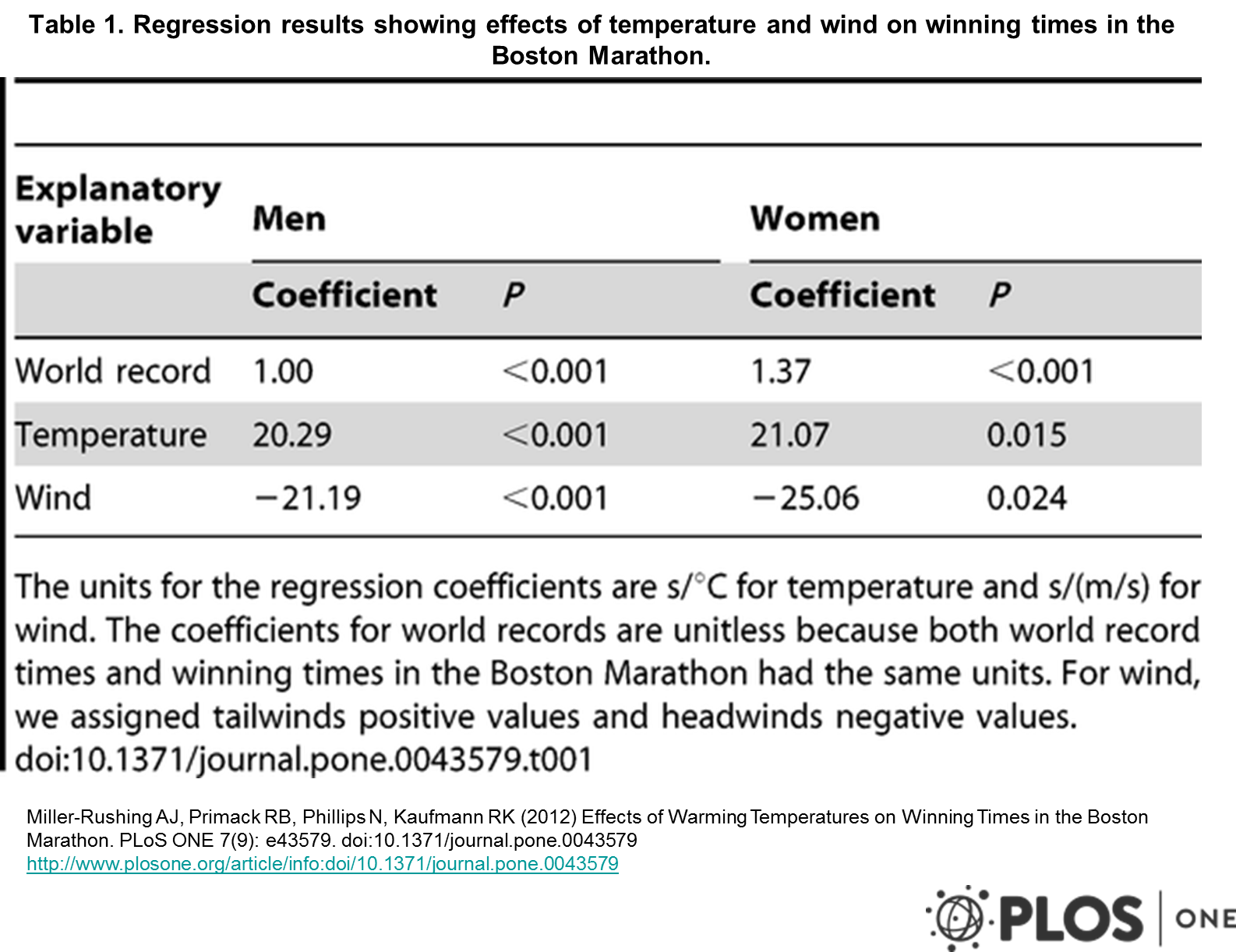
  1. Higher temperatures and higher headwinds on the day of the race increase winning times for the marathon. Who would think otherwise? I would not have thought that weather conditions on any other day than race day would have much impact. Collecting this data is mildly useful but it is all readily available. Trivial.
  2. If temperatures do not increase relative to temperature variability on race days, the effects of warming on marathon times may not be detectable. However, at some point temperature increases may be large enough to affect marathon times. Amazing! So what exactly was the point of this work? Trivial.
  3. In summary, despite the well-known effect of temperature on marathon performance, we found that warming trends in Boston have not caused winning times to slow over time because of high variability in temperatures on race day. So race day temperature overrides any effects – due to global warming or anything else – on average annual temperatures. Obvious and Trivial.
  4. …. our models indicate that if race starting times had not changed and average race day temperatures continue to warm by 0.058°C/yr, a high-end estimate, we would have had a 95% chance of detecting a consistent slowing of winning marathon times by 2100. If average race day temperatures warm by 0.028°C/yr, a mid-range estimate, we would have had a 64% chance of detecting a consistent slowing of winning times by 2100. So your model says that if global warming increases race day temperatures above and beyond the natural daily variability then you have some chance of detecting this effect in the winning times! By modelling high rates of global warming  (5.8°C per century) you can force the race day temperatures to show an underlying increase such that there is a 95% chance that the effect on winning times could be detected.  The Boston marathon itself provides no evidence of global warming so far. Wow!! This is not just trivial but borders on “idiot science”.

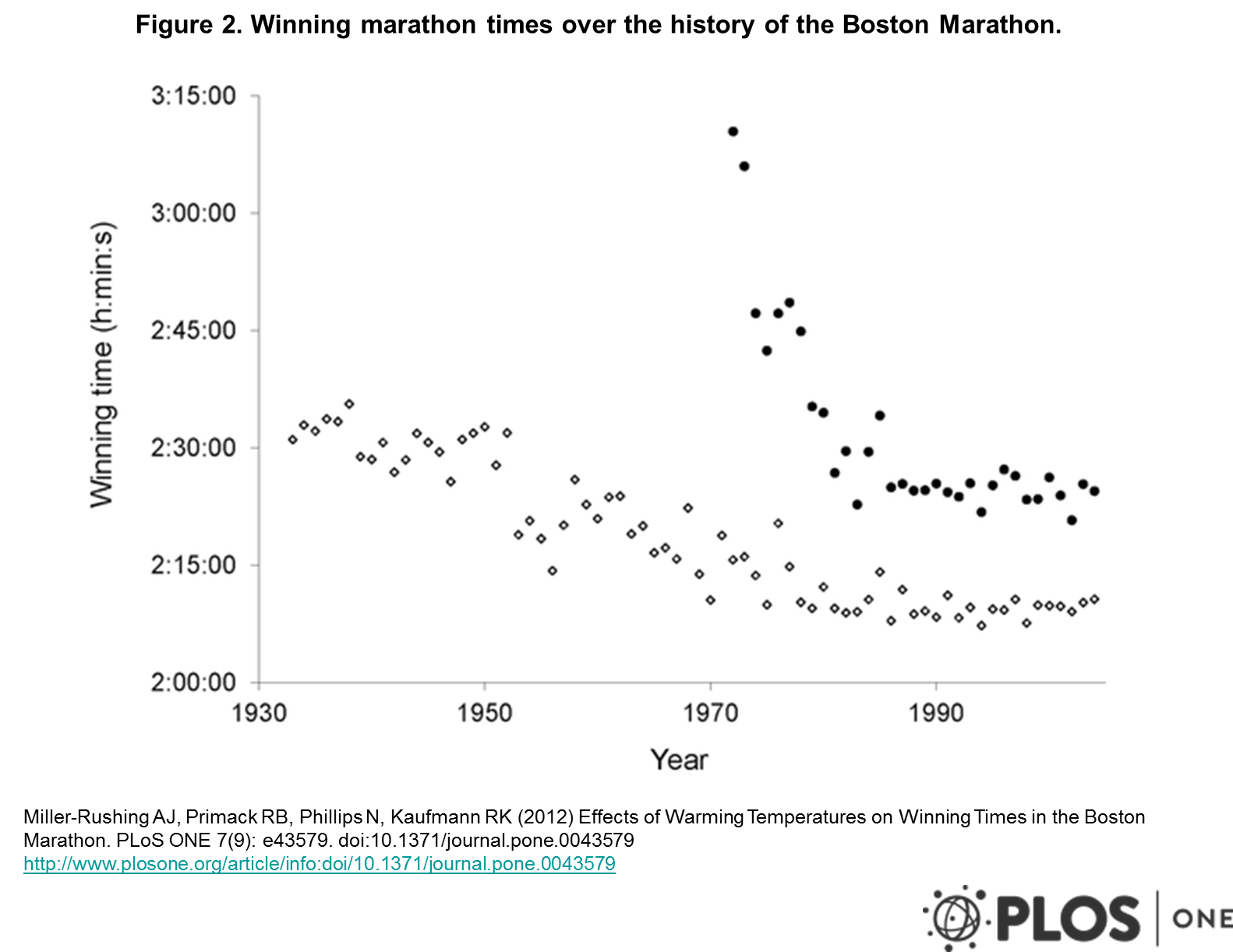
The effects of global warming clearly cannot be detected in the results of the Boston marathon. In the paper their Figure 2 and Table 1 are fairly trivial but of passing interest. The rest of their modelling efforts (input and output) are just garbage.

Miller-Rushing et al Figure 2

Open diamonds represent men’s times from 1933–2004. Closed circles represent women’s times from 1972–2004. Women’s running times improved rapidly in the first 14 yr of women’s participation in the marathon. From 1983 to 2004, the differences between men and women’s winning times held relatively constant at an average of 15 min 47 s.

Table 1. Regression results showing effects of temperature and wind on winning times in the Boston Marathon.

Table 1. Regression results showing effects of temperature and wind on winning times in the Boston Marathon.

AbstractIt is not known whether global warming will affect winning times in endurance events, and counterbalance improvements in race performances that have occurred over the past century. We examined a time series (1933–2004) from the Boston Marathon to test for an effect of warming on winning times by men and women. We found that warmer temperatures and headwinds on the day of the race slow winning times. However, 1.6°C warming in annual temperatures in Boston between 1933 and 2004 did not consistently slow winning times because of high variability in temperatures on race day. Starting times for the race changed to earlier in the day beginning in 2006, making it difficult to anticipate effects of future warming on winning times. However, our models indicate that if race starting times had not changed and average race day temperatures had warmed by 0.058°C/yr, a high-end estimate, we would have had a 95% chance of detecting a consistent slowing of winning marathon times by 2100. If average race day temperatures had warmed by 0.028°C/yr, a mid-range estimate, we would have had a 64% chance of detecting a consistent slowing of winning times by 2100.

On balance I shall just classify this as Trivial Science bordering on Bad Science

Climate science on “negative watch”

March 30, 2013

Graphic: The Economist

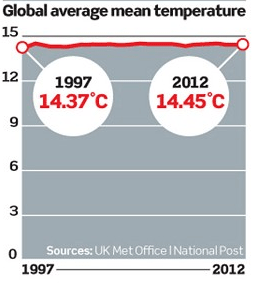
The almost 20 year pause in global warming while emissions of carbon dioxide have continued to increase can no longer be ignored. Following The Economist’s article earlier this week, more of the main steam media are beginning to question if climate science is as “settled” as some would like us to believe. I would go a little further than The Australian and say that “climate science” and not just “climate sensitivity”  is now on “negative watch” if not as yet “downgraded”. While it is encouraging that some sanity may be returning to the debate as evidenced by the greater interest from the main stream media to question global warming orthodoxy (Die Welt, Jyllands Posten, Der Spiegel, The Telegraph, Daily Mail), they are already a little late. “Climate Science” has actually been at “junk” levels since Copenhagen and Climategate and is only just beginning to creep up from there!

The Australian:

DEBATE about the reality of a two-decade pause in global warming and what it means has made its way from the sceptical fringe to the mainstream.

In a lengthy article this week, The Economist magazine said if climate scientists were credit-rating agencies, then climate sensitivity – the way climate reacts to changes in carbon-dioxide levels – would be on negative watch but not yet downgraded.

Another paper published by leading climate scientist James Hansen, the head of NASA’s Goddard Institute for Space Studies, says the lower than expected temperature rise between 2000 and the present could be explained by increased emissions from burning coal.

For Hansen the pause is a fact, but it’s good news that probably won’t last.

International Panel on Climate Change chairman Rajendra Pachauri recently told The Weekend Australian the hiatus would have to last 30 to 40 years “at least” to break the long-term warming trend. 

But the fact that global surface temperatures have not followed the expected global warming pattern is now widely accepted.

Research by Ed Hawkins of University of Reading shows surface temperatures since 2005 are already at the low end of the range projections derived from 20 climate models and if they remain flat, they will fall outside the models’ range within a few years.

“The global temperature standstill shows that climate models are diverging from observations,” says David Whitehouse of the Global Warming Policy Foundation.

“If we have not passed it already, we are on the threshold of global observations becoming incompatible with the consensus theory of climate change,” he says.

Whitehouse argues that whatever has happened to make temperatures remain constant requires an explanation because the pause in temperature rise has occurred despite a sharp increase in global carbon emissions. ….. 


Upto130 years of global warming — but March is immune!

March 29, 2013

No comment!

Der Spiegel

Germany Faces Coldest March Since 1883

Complaining about the weather has reached epidemic proportions in northern Germany this “spring.” And with good reason. With Easter just around the corner, meteorologists are telling us this could end up being the coldest March in Berlin and its surroundings since records began in the 1880s. …… Meteorologists are keeping close tabs on thermometers to determine whether this March will go down as the coldest ever — since records began in the 1880s. And wiseacres on the streets of Berlin have not yet tired of noting that Easter promises to be colder than last Christmas.

The Guardian: 

Britain set for coldest March since 1962

This weekend’s great Easter getaway will be accompanied by some of the coldest March weather in decades, with temperatures in the UK set to drop to their lowest levels since 1962.

Met Office figures show that from 1 March to 26 March the UK mean temperature was 2.5C (36.5F) – three degrees below the long-term average.

This makes it the joint fourth coldest in the UK, in records going back to 1910. The coldest March in the UK was in 1962, at 1.9C (35.4F).

Real Science:

US Second Coldest March Since 1969 (So Far)

US temperatures are forecast to be far below normal for the rest of the month, so it is difficult to determine where March 2012 will end in the rankings. Possibly the coldest in 44 years.


We learn about climate only when the models are wrong!

March 29, 2013

When a forecast based on a mathematical model is correct, we learn nothing.

A mathematical model is merely a theory, a simplification of reality or an approximation to the real world. By definition a mathematical model is a hypothesis.  When forecasts are incorrect, we can return to our model and improve it and make a new hypothesis. A forecast is then a test of the model but in just one particular set of circumstances. Being correct does not prove the theory behind the model. It does of course add to the body of evidence that the model may be a satisfactory representation of reality and it does allow further forecasts to be made without tweaking the model. For learning to take place the mathematical model must be the falsifiable hypothesis of the scientific method.

It seems to me that Solar Science has a much healthier (scientifically) attitude to models and forecasts than “Climate Science”. When observations don’t match a climate forecast, the observations are impugned rather than the models being improved. This is, I think, because the forecast climate results have been used to establish huge revenue flows in the political arena (whether as taxes or carbon credits or just as research funding). There has been a vested interest in denying the observations and calling the science “settled”. Once the science is “settled”  the climate forecast and its underlying model become sacrosanct and take on the certainty of prophecy. Instead of being falsifiable hypotheses, climate model forecasts have taken on the character of unfalsifiable prophecies!

No scientist would presume to claim that we know or understand all solar effects. Or that we know and understand the role of the oceans or of the water vapour and dust and aerosols in the atmosphere. “Climate” is contained in the thin, chaotic layer of atmosphere which surrounds us. Yet “Climate Science” makes the arrogant assumption that the effect of trace amounts of carbon dioxide on climate is known definitively. Filling a real greenhouse with higher concentrations of carbon dioxide does not make that greenhouse any warmer than one filled with normal air – but the plants do grow faster with access to the additional CO2!! But – claim the climate priesthood –  in the real atmosphere, carbon dioxide causes other forcings (clouds? aerosols? precipitation effects?) which maximise warming which means that our model is still valid. Why not just admit that we don’t know what we don’t know?

The behavioural issue of course is whether it is worth trying to control something as poorly understood as climate rather than ensuring that we have the wherewithal to adapt to whatever changes may come. Another ice age will surely come whether in 10 years or a 100 years or 2,000. It will then be our ability to harness all available energy sources around us which will determine our capacity to adapt.

Learning from forecasts when they are wrong – not just in science but also in business and project management and technology development – has long been a hobby-horse of mine and is why forecasts need to be wrong.

When there is no difference there is no learning.

  • I take prophecies to be a promise about the future  based primarily on faith and made by prophets , witchdoctors, soothsayers and politicians such as ”You will be doomed to eternal damnation if you don’t do as I say”,
  • I take “forecasts” to be an estimate of future conditions based on known data with the use of calculations, logic, judgement, some intuition and even some faith. They are extrapolations of historical conditions to anticipate – and thereby plan for -future conditions.

……. Over the last 30 years I have spent of a lot of time conducting and participating in reviews. Reviews of research projects, of construction projects, of organisations and processes, of designs, of strategies and action plans, of businesses and of companies. The common features  in all these different reviews, that I have found the most penetrating, have been the comparisons not only between forecast values  and actual values, (which may be any values indicating performance and capable of being extrapolated), but also between past forecasts and current forecasts.

Whether considering construction progress or costs or sales figures or cash flow or profit or number of patents applied for, it is the differences between forecast and actual values, or values forecast before and values forecast later which have led to learning. In all these fields we are in the area of the behaviour of complex systems; and where people and their behaviour is involved any system is inevitably a complex system.

When a forecast is fulfilled there is usually an air of congratulation, satisfaction and self-adulation and this leads to a deadly complacency that everything is “settled science” and well understood. In any enterprise of any kind, that kind of complacency is the kiss of death. It is the differences which lead to questioning, to proper scientific scepticism, to further investigation and ultimately to an increase of understanding and – perhaps – a better forecast. (Of course, ignoring all such differences  and to merely “continue as before” can be equally fatal).

Which brings me to climate (which is not a science by any stretch of the imagination) and solar cycles. They are both in the realm not only of where “what we know is a great deal less than what we don’t know” but they are also both in the region where “we don’t even know what we don’t know”. We do not even know all the questions to be asked. They are both complex systems where – by definition – the complexity lies in the multitude of the processes involved and their interactions.

When climate – which is contained in the 100 m of ocean and 20 or so km thick, turbulent and chaotic atmospheric layer (and which is dimensionally miniscule in relation to the 140 million km of the earth-to-sun system) – is so complacently considered to be “settled science” then we have shifted into the area of faith and soothsaying and prophecies. When climate modellers are smug enough to believe they have understood the climate system and believe that their models are complete, then the models produce outputs which are not forecasts but prophecies. (No doubt soothsayers and shamans have sometimes made accurate prophecies but I still would not buy a used car from one of them)! Weather is in the realm of forecast (though you could argue that the most accurate forecast is still that “the weather tomorrow will be like today”) but climate is not yet there.

This kind of “arrogance” which pervades some of the climate “scientists” is not so prevalent when it comes to the study of Solar Cycles. There is a clear understanding that “we don’t know what we don’t know”. In addition to the 11 year and 22 year cycles, other cycles are hypothesised for 87 years, 210 years, 2300 years (or maybe 2241 or 2500 years) and 6000 years. We have no idea what causes these cycles. Even the 11 year cycle which has been most studied produces  surprises every day but is properly in the area of “forecast” (and hopefully never again will be in the area of prophecy). ….

…… We seem to be in a solar minimum. We may be seeing a 210 year cycle – or maybe not. There are changes to the forecasts not only regarding the maximum level of sunspot activity but also about when it will occur and what the length of cycle 24 might be. There is speculation as to what effect the length of the solar cycle may have on climate – but we haven’t a clue as to what mechanisms may be involved.  This is not to say that there isn’t much speculation and hypothesising. There is a great deal of comment about the effect these changing forecasts may have on global warming or cooling or climate disruption.  In some quarters there is much glee that the forecasts have been “wrong”. Some comments question the intelligence of the forecasters.

But of course the forecasts themselves say nothing about how the behaviour of the sun may impact our climate. They do not pretend to be prophecies or to be statements of inevitable outcomes. All they do say is that we don’t know very much – yet – about the sun. But we do know enough to make some tentative forecasts.

But I am very glad that people continue to be brave enough to make forecasts and I am quite relieved that the forecasts are not spot on. That at least ensures we will continue learning.

Are global warmists preparing exit strategies?

March 28, 2013

Are global warmists preparing their arguments so that they can have exit strategies ready for when they have to abandon the global warming religion?

The purpose of an exit strategy is – as a minimum – to save face and minimise losses. In the best case it ends an engagement while realising potential benefits and protecting past gains. This is common enough in – and a necessary part of  – business and military planning. Politicians – at least the skilled ones – always have exit strategies in place when they choose to follow a particular “path of principle”. It is less likely that ideologues or religious leaders have prepared exits from dogmatic positions. However even they do have to change their colours from time to time. (Fanatics of course are not permitted exit strategies. They are expected to fall on their swords and die for their cause).

To escape from a discredited or outdated or bankrupt “faith-based” dogma usually requires some strong, visible reason for leaving a dogmatic position. A divine “revelation” is best though “new data” or  just “seeing the light” are also acceptable. This provides both a new faith as a destination and a reason for leaving the current position. A good exit strategy will also include a high profile “conversion” from one faith to another such that much credit can accrue, first for an”honourable” mea culpa for having followed the wrong path and then for the “principled and difficult” shift to the new path! Damage control may also require that the new converts repudiate their former “brothers of the faith”. In fact it is often “converts” who become the most fanatical about their new “religion”. The success of an exit strategy can be judged by how much baggage or stigma the ideologue or politician can avoid after the conversion.

James Hansen has been one of the most vocal and active proponents of the global warming hypothesis that it is caused by man-made emissions of carbon dioxide. He has been seen as one of the high priests of the global warming religion and qualifies as an ideologue:

Hansen is best known for his research in the field of climatology, his testimony on climate change to congressional committees in 1988 that helped raise broad awareness of global warming, and his advocacy of action to avoid dangerous climate change. In recent years, Hansen has become an activist for action to mitigate the effects of climate change, which on a few occasions has led to his arrest.

But he has a new (open access)  paper which makes me wonder whether he is preparing a position for the execution of an exit strategy when it becomes necessary.  He now admits that less of human made CO2 is entering the atmosphere than it should but that it is due to the increased use of coal which has increased aerosol particulates. He argues that this short term masking by aerosols of global warming will eventually have to appear and his doomsday messages have not changed. But he is adjusting his arguments quite fundamentally to account for the real life observations which he can no longer ignore. The “fertlisation of the biosphere” to account for man-made carbon dioxide not entering the atmosphere sounds a lot like back-pedalling to me. That the biosphere feeds on and relishes carbon dioxide is obvious. It does not much care  where it comes from.

James Hansen et al 2013 Environ. Res. Lett. 8 011006 doi:10.1088/1748-9326/8/1/011006

Climate forcing growth rates: doubling down on our Faustian bargain

As The Hockey Schtick reports some of the contents are startling – coming from Hansen:

  • the effect [forcing] of man-made greenhouse gas emissions has fallen below IPCC projections, despite an increase in man-made CO2 emissions exceeding IPCC projections
  • the growth rate of the greenhouse gas forcing has “remained below the peak values reached in the 1970s and early 1980s, has been relatively stable for about 20 years, and is falling below IPCC (2001) scenarios (figure 5).”
  • the airborne fraction of CO2 [the ratio of observed atmospheric CO2 increase to fossil fuel CO2 emissions] has decreased over the past 50 years [figure 3], especially after the year 2000
  • Hansen believes the explanation for this conundrum is CO2 fertilization of the biosphere from “the surge of fossil fuel use, mainly coal.”
  • “the surge of fossil fuel emissions, especially from coal burning, along with the increasing atmospheric CO2 level is ‘fertilizing’ the biosphere, and thus limiting the growth of atmospheric CO2.”
  • “the rate of global warming seems to be less this decade than it has been during the prior quarter century”

From the paper:

The simple Keeling airborne fraction, clearly, is not increasing (figure 3). Thus the net ocean plus terrestrial sink for carbon emissions has increased by a factor of 3–4 since 1958, accommodating the emissions increase by that factor.

Figure 3.

Figure 3. Fossil fuel CO2 emissions (left scale) and airborne fraction, i.e., the ratio of observed atmospheric CO2 increase to fossil fuel CO2 emissions. Final three points are 5-, 3- and 1-year means.

Remarkably, and we will argue importantly, the airborne fraction has declined since 2000 (figure 3) during a period without any large volcanic eruptions. The 7-year running mean of the airborne fraction had remained close to 60% up to 2000, except for the period affected by Pinatubo. The airborne fraction is affected by factors other than the efficiency of carbon sinks, most notably by changes in the rate of fossil fuel emissions (Gloor et al 2010). However, it is the dependence of the airborne fraction on fossil fuel emission rate that makes the post-2000 downturn of the airborne fraction particularly striking. The change of emission rate in 2000 from 1.5% yr-1 to 3.1% yr-1 (figure 1), other things being equal, would have caused a sharp increase of the airborne fraction (the simple reason being that a rapid source increase provides less time for carbon to be moved downward out of the ocean’s upper layers). ……

…… We suggest that the surge of fossil fuel use, mainly coal, since 2000 is a basic cause of the large increase of carbon uptake by the combined terrestrial and ocean carbon sinks. One mechanism by which fossil fuel emissions increase carbon uptake is by fertilizing the biosphere via provision of nutrients essential for tissue building, especially nitrogen, which plays a critical role in controlling net primary productivity and is limited in many ecosystems (Gruber and Galloway 2008). Modeling (e.g., Thornton et al 2009) and field studies (Magnani et al 2007) confirm a major role of nitrogen deposition, working in concert with CO2 fertilization, in causing a large increase in net primary productivity of temperate and boreal forests. Sulfate aerosols from coal burning also might increase carbon uptake by increasing the proportion of diffuse insolation, as noted above for Pinatubo aerosols, even though the total solar radiation reaching the surface is reduced.

The paper concludes

The principal implication of our present analysis probably relates to the Faustian bargain. Increased short-term masking of greenhouse gas warming by fossil fuel particulate and nitrogen pollution represents a ‘doubling down’ of the Faustian bargain, an increase in the stakes. The more we allow the Faustian debt to build, the more unmanageable the eventual consequences will be. Yet globally there are plans to build more than 1000 coal-fired power plants (Yang and Cui 2012) and plans to develop some of the dirtiest oil sources on the planet (EIA 2011). These plans should be vigorously resisted. We are already in a deep hole—it is time to stop digging.