Archive for the ‘Demographics’ Category

Rosling’s health, wealth and statistics

January 31, 2014

Hans Rosling’s tour de force: 200 countries, 200 years, 4 minutes.

This is not new and I think I first saw it about 3 years ago.

But it is worth looking at not just for the content but also for the power of the presentation.

Just a reminder that the world is feeding more people than ever before, we are living longer than ever before, and things are not as black as some alarmists would have us think. And by 2100 total population will be declining.

The glass is more than half-full.

A much longer (20 minutes) presentation is also well worth watching.

Without immigration OECD populations will be in decline and in crisis

January 17, 2014

In times of high unemployment the anti-immigration voices are raised very high everywhere and especially in many European countries. Much of the sentiment is rooted in racist views whether against those of Asian or African or East European origin. In Japan it is seen as threatening the homogeneity of the country. But what every politician well knows – but which some will not dare to admit for fear of losing their populist base – is that  without net immigration in, OECD countries will face an increasing crisis of declining populations, declining labour force and an increase in the  proportion of the aged. They are all very well aware that expanding the working population to at least match the increase in the “aged” proportion is critical to maintaining the standard of welfare and health care that they have become accustomed to. Increasing the retirement age – which is already on the table as trial balloons – is unavoidable because even with immigration the proportion of the working population relative to the “aged” is in decline.

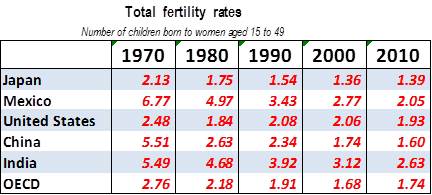
In OECD countries fertility rates are already well below the replacement level of 2.1 per woman. It is higher only in Israel, Iceland and New Zealand, and in India, South Africa and Indonesia. China is already down at 1.6 and India is down to 2.63 and declining fast.

The Local

France’s fertility rate has fallen below the symbolic level of two babies per woman and 2013 saw the slowest population growth in the country for well over a decade, new data revealed this week.

The 280,000 births in 2013 marked a 1.3 percent decline from 2012 with France’s fertility rate falling from 2.03 children per woman in 2010 to 1.99 children last year, according to the France’s national statistics agency INSEE. …… 

Despite the drop in the birth rate, France remains second only to Ireland when it comes to Europe’s most fertile nations. Women in Ireland, where the population is 4.6 million, had on average 2.01 children each in 2013.

These figures stand in stark contrast to Germany and Portugal, which had the lowest fertility rates on the continent. Germany recorded a rate of 1.38 per woman, followed by Portugal with 1.28 offspring per woman.

Korea, Hungary, Spain and Japan are the other countries where fertility rates are less than 1.4.

Fertility rates (2010 data) by country is here: OECD Total fertility rates 1970, 2010

Statistics are from the OECD Library:

Total fertility rates in OECD countries have declined dramatically over the past few decades, falling on average from 2.7 in 1970 to 1.7 children per woman of childbearing age in the 2000s. In all OECD countries, fertility rates declined for young women and increased at older ages. A modest recovery in total fertility rates started in the early 2000’s, to an average level of 1.7 in 2010. The total fertility rate is below its replacement level of 2.1 in most OECD countries except Israel, Iceland and New Zealand, and in India, South Africa and Indonesia.

The last few years have seen various trends emerge in fertility rates. A drop in fertility rates has occurred, for example in Australia, New Zealand, Spain and the United States, while rates have continued to rise in Iceland, Israel, Sweden, and Switzerland. The increase in fertility stopped in many other countries. The effect of the economic downturn is as yet unknown, but persistent economic uncertainties can impact downward the number of children women may have over their reproductive life.

OECD Fertility trends

OECD Fertility trends

OECD fertility table

The difference between the decline in fertility rates between India and China is of particular interest. While some of the difference is due to different rates of development, most of the difference can be attributed to the draconian one-child policy in China. But that is now being relaxed as the coming decline in the Chinese population becomes obvious..

The shortages of the proportion of working population – unless immigration is used to mitigate the shortfall – is inevitable and will really begin to bite over the next twenty years or so.

Waves of aging

December 15, 2013

The aging of the world is not news, but visualising the change is done very well here:

Population By Age, Japan

Population By Age, Japan

Population By Age, U.S.

Population By Age, U.S.

Not all countries are getting older. Many developing countries still have high fertility rates, and children account for a huge share of the people in those countries. (Typically, fertility rates don’t start falling until countries hit a certain stage of economic development.)

When you look at the whole world, you see a blend of these two trends — the population of the globe is aging, on average, but there are still far more children than old people.

World Population Breakdown By Age

World Population Breakdown By Age


The inexorable numbers – 10:10:10:100 is inevitable around 2100

December 4, 2013

10:10:10:100 by 2100

The “success” of a species is generally taken to be indicated by its population though it is of course possible to have quantity without much quality of life. In general however, an increasing population of any species does indicate the sufficiency of food, the ability of the species to withstand competition from other species and the ability to breed successfully in the prevailing conditions. And so it is for humans. Based on population, modern humans have never been as successful as they currently are. And in spite of all the doom-sayers and the alarmists, the fact remains that more humans are being fed and housed and are achieving some large part of their aspirations than ever before. They are living longer than ever before  and their life expectancy is still increasing – currently by about 2 -3 months every year.

However  just looking at the crude birth rate (number of births per 1000 of population) might lead one to a conclusion that there was a catastrophic decline in the human species.

Crude Birth Rate / 1000 of population

Crude Birth Rate / 1000 of population

Birth rates have declined from about 37/1000 in 1950 to less than 15/1000 now and are projected to be around 10/1000 by 2100. For any other species that would be a catastrophic decline. But of course that conclusion would be quite wrong when applied to humans. The mortality rate of humans has also declined drastically as medical and public health advances have been made. And human ingenuity has maintained food and material supplies such that life expectancy has increased in spite of a booming population.

Birth and mortality rates

Birth and mortality rates

The fact that population and life expectancy have increased simultaneously is a clear indicator that the quality of life has not deteriorated. There may be problems of equitable distribution but there is no shortage of food or other resources – and no prospect of any catastrophic shortages occurring. All other indicators tell the same story. Infant mortality, poverty and malnourishment are all at all-time lows and declining even if these can be lower still. The real GDP per capita is increasing. Leisure time (time not spent on the requirements for survival) is increasing and for more people than ever before. The age of space exploration and the potential for access to new sources of raw materials and even real estate has already begun.

There are many who rail against the consumer society and materialism but generally do so from a position of some comfort. There are others who moan the loss of spirituality and yearn for a return to a simpler life but they too are not quite ready to return to the trees. There is no shortage of doom-mongers and alarmists who merely keep pushing their doomsdays into the future where they cannot be disproved.

It is a question of attitude. There are those who would prefer to be governed by fear (the precautionary principle) and there are others who would move forward in spite of their fears.

But the reality is that the human species – with all its warts and threats and self-inflicted problems – is thriving.

Population and life expectancy WPP2012

Population and life expectancy WPP2012

It is not a forecast or an objective but merely the inexorable arithmetic of demographics which leads to the inevitability of 10:10:10:100 around the year 2100.

10 billion population, 10 births per 1000 of population, 10 deaths per 1000 of population and a life expectancy at birth of 100 years.

I prefer to see the glass half-full rather than the glass half-empty.

China relaxes highly successful one-child policy

November 15, 2013

It was no doubt authoritarian and draconian and there may well be many unforeseen emotional and psychological side-effects to come for many generations, but the bottom line is that the Chinese one-child policy has done the trick insofar as population numbers is concerned. The Chinese population will reach its peak of just under 1.4 billion around 2020 and will then decline dropping to less than 1 billion by 2100. Around 2020, India’s population will exceed the Chinese population and will continue to increase until about 2060 reaching a peak of about 1.7 billion. Then by 2100 the India population will have declined to about 1.5 billion.

ReutersChina unwrapped its boldest set of economic and social reforms in nearly three decades on Friday, relaxing its one-child policy and further freeing up markets in order to put the world’s second-largest economy on a more stable footing.

The sweeping changes helped dispel doubts about the leadership’s zest for the reforms needed to give the economy fresh momentum as three decades of breakneck expansion shows signs of faltering.

The chart below is based on an analysis of the World Population Prospects 2010 and not on the latest 2012 projections. However the numbers and trends are largely the same.

WPP2010 Population projections till 2100

WPP2010 Population projections till 2100

Even if fertility rates now increase much more than predicted, the Chinese government now has a tried and tested – if disliked – population control method to fall back on. An increased fertility rate is now absolutely necessary to avoid a major aging challenge after about 2050 when the ratio of the working population to the supported population could reach crisis levels.

By 2100, 8 million could be over 100 years old

November 13, 2013

The 2012 review of the UN’s World Population Prospects was released in August this year.

World Population Prospects 2012 (pdf – 3.53Mb)

Charts are still – presumably – being prepared since the interactive charts from the 2010 review are no longer available on the UN site and have not yet been replaced by new charts.

The basic picture is still of fertility rates decreasing steadily with the medium scenario giving a world population stabilising at about 10.8 billion around 2100. Chinese population is just about at its peak and will now be reducing till 2100. Indian population will reach its peak around 2060 and then start declining. African population will reach its peak only around 2100.

WPP12 Fertlity

WPP12 Fertlity

There is a massive amount of data and projections, and the interesting thing about demographic forecasts done on this scale is that the “inertia” is high. Consequently much of the “forecast” is inevitable and the key parameter is the fertility rate. In 1953, 99.9% of the world population exhibited a fertility rate greater than 2.1 children per woman (the static population replenishment rate). Now in 2013, 49% of the world’s population have a fertility rate lower than 2.1. Half the world’s population is already shrinking. By 2100 this will be 81% and the world population as a whole will be shrinking.

A significant proportion of those under ten years old today will still be around in 2100. Today about 20% of the world population is under 10 years old ( approximately 1,400 million). In 2100 around 8% of 10.8 billion will be over 80 years old. Assuming that say 3% are older than 87 years, it would mean that 320 million (or 23% of those under 10 or about 5% of everybody) living today will still be around in 2100. Today about 14% of the world’s population is over 60 and about 2% are over 80. By 2100, 35% will be over 60 and about 8% over 80 years old. The 950 million over 60 today will become 3,800 million by 2100.

More than 800 million people will be over 80 and I would estimate that around 1% of these  – or 8 million – could be over 100 years old!

Bloomberg (2012)Unicharm Corp.’s sales of adult diapers in Japan exceeded those for babies for the first time last year.

Just the demographics is changing the make up of the world and its genetic mix.

WPP12 population mix

WPP12 population mix

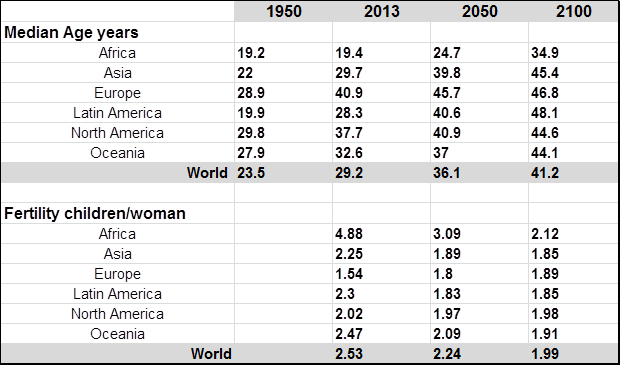
The human genetic pool in 2100 will be geographically placed 40% in Africa, 40% in Asia with the remaining 20% spread between The Americas, Oceania and Europe. And while there will be some migration and genetic mixing, this basic distribution will be maintained. Moreover, fertility rates will be stable and close to (even if just under) 2.1 in all regions. Median age is also on the way up world-wide.

WPP12 median age

WPP12 median age

Life expectancy is rising across the world:

The twentieth century witnessed the most rapid decline in mortality in human history. In 1950-1955, life expectancy at the world level was 47 years and it had reached 69 years by 2005-2010. Over the next 40 years, life expectancy at birth at the global level is expected to reach 76 years in 2045-2050 and 82 years in 2095-2100 (table III.1 and figure III.1). The more developed regions already had a high expectation of life in 1950-1955 (64.7 years) and have since experienced further gains in longevity. By 2005-2010 their life expectancy stood at 76.9 years, 10 years higher than in the less developed regions where the expectation of life at birth was 67.0 years. Although the gap between the two groups is expected to narrow between 2005 and mid-century, in 2045-2050 the more developed regions are still expected to have considerably higher life expectancy at birth than the less developed regions (82.8 years versus 74.8 years). Throughout 2010-2100, systematic progress against mortality is further expected to increase life expectancy at birth up to 88.9 years in the more developed regions and 80.8 years in the less developed regions thereby further reducing the gap in mortality between the two groups.

What occurs to me also is that famine, disease, war and the effects of natural catastrophes are becoming less and less relevant demographically. But I shall return to that subject in another post.

Chinese woman said to be 127 years old was born in 1886

October 17, 2013

It has been calculated that there is a high probability that somebody already born will live to see 200 years. That is just a probability of course but if in 2213 it turns out to be true it is likely to be a woman.

There are 54,000 Chinese who are over 100 years old and about 80% of them are women. And the oldest one is Alimihan Seyiti, an Uygur who is 127 years old and was born on June 25, 1886. She is said to have 56 descendants. The claim is still being verified and there are many so called “experts” who doubt the claim.

A Chinese government news portal has claimed that a woman in China's remote far west is 127 years old, making her the oldest person ever to have lived – but experts raised questions over the supposed record.

Alimihan Seyiti sitting in her home in Shule county of Kashgar, northwest China’s Xinjiang region Photo: AFP/Getty Images

Alimihan Seyiti from Kashgar, near the border with Kyrgyzstan, was born on June 25, 1886, said ts.cn, a government website in Xinjiang – when Grover Cleveland was president of the United States and William Gladstone the British prime minister. …. 

At the time of Seyiti’s supposed birth much of Xinjiang was ruled by Yakub Beg, a Tajik warlord, while Russia held other parts of the region.

Xinhua reports

About four-fifths of the more than 54,000 living Chinese centenarians are women, and a 127-year-old woman from northwest China is the oldest of them all, according to figures released on Wednesday.

The Geriatric Society of China (GSC) claimed the oldest person in China is Alimihan Seyiti, a Uygur who was born on June 25, 1886. She lives in Shule County in Xinjiang Uygur Autonomous Region.

If verified, Seyiti could be the oldest person in the world, beating by five years the Guinness World Record of 122 set by Jeanne Calment from France. Seyiti was honored by the GSC in June as the oldest person in China after the death of Luo Meizhen in Guangxi Zhuang Autonomous Region, who was born in 1885.

Xinjiang, Hunan, Yunnan, Shandong, Guangxi and Sichuan are home to China’s 10 oldest supercentenarians (those who have attained the age of at least 110), and their average age is 119.2 years.

According to GSC figures, rural centenarians outnumber their urban counterparts. Among the 54,166 Chinese centenarians, about three-quarters, or more than 74 percent, are from the countryside.

The GSC also published a list of the 10 oldest couples in China, who are now living in the provinces of Hainan, Henan, Liaoning, Fujian and Shanghai Municipality.

According to the GSC, the oldest living couple are Ping Muhu and his wife Zhang Xinniu from Yuzhou City in central China’s Henan Province, whose combined age stands at 213 years. The average combined age of the 10 oldest couples in China is 207.7 years.

The Mediterranean is the graveyard of the Château d’EU

October 12, 2013

Washington PostDozens were feared dead after a boat filled with migrants capsized in the Mediterranean Sea about 70 miles south of the Italian island of Lampedusa, just a week after more than 300 migrants died when their boat sank near the same island south of Sicily.

At least 50 are known to have died yesterday including at least 3 small children.

Map of migrants routes

Europe’s Graveyard

The EU – we should not forget –  won the Nobel Peace Prize last year.

Which only goes to show how ridiculous the Nobel Peace Prize and the Norwegian Nobel Committee has become. And while the EU rests on its laurels, the Mediterranean is fast becoming the graveyard of the Château d’EU (with apologies to Alexandre Dumas).

lampedusa-map.jpg

A ship carrying migrants capsized Friday near the Italian island of Lampedusa. (GoogleMaps)

It is not that I am advocating open borders for the EU (though there will be a time in the distant future when nation states and national boundaries will become obsolete). But nearly all the countries of the EU need – in the long-term – to improve the ratio of their working population to their supported populations (notwithstanding the short-term high unemployment that currently reigns in some countries). It was the EU which supported the overthrow of the old regime in Tunisia. It was the EU itself which was so keen to bomb Libya and cannot now escape from the consequences. It is the EU which is supporting Al Qaida in Syria by supporting the “rebels” and that too will have long term consequences. When Assad’s regime prevails – as it seems to be doing – where will all the “rebel” Syrians turn? The EU was all too quick to support the overthrow of Mubarak without realising what the Muslim Brotherhood would bring.

It is in the EU’s long-term self interest to develop a pro-active – and therefore orderly –  immigration policy in the countries outside its borders. It is politicians in the ruling parties across Europe who have to stop pandering to nationalistic, short-term populism and have the courage to lead their countries to face up to the long term demographic challenges. And that cannot happen with a Fortress Europe policy.

With a Château d’EU surrounded by watery graveyards.

BBC: 

Maltese PM Joseph Muscat has said European waters close to Africa are turning into a cemetery, after another boat laden with migrants capsized. Mr Muscat said Malta felt “abandoned” by the rest of Europe and insisted that the EU had to take action.

Malta and Italy launched a rescue operation after a boat capsized on Friday, leaving up to 50 people dead. It happened 120km (70 miles) off Lampedusa, the Italian island where at least 300 migrants drowned last week.

The loss of life has renewed the debate within EU member states on migration rules.

In the latest incident, the vessel carrying more than 200 migrants is believed to have encountered difficulties in Maltese waters just before sunset on Friday. The migrants used a satellite phone to raise the alarm but the boat capsized when passengers crowded to one side as they tried to get the attention of a passing aircraft, the Maltese navy said.

…. Also on Friday, a separate boat accident off the Egyptian port of Alexandria claimed the lives of at least 12 migrants.

The ancient melting pots of Europe

October 11, 2013

Stone Age settlers migrated across Europe in multiple waves that replaced older hunter-gatherer cultures with the genes from each wave blending into the population of the day. Ancient mtDNA studies are revealing that cultures spread to a great extent by the physical migrations of peoples and possibly faster and more effectively than by cultural diffusion alone. And the many different gene-melts continue today. Whereas in the Stone Age much of the action was in Central Europe, in the jet-age the melting-pots have shifted westwards and are mainly now in Western and Northern Europe. The peopling of Europe is an ongoing thing.

Guido Brandt, Wolfgang Haak, Christina J. Adler, Christina Roth, Anna Szécsényi-Nagy, Sarah Karimnia, Sabine Möller-Rieker, Harald Meller, Robert Ganslmeier, Susanne Friederich, Nicole Nicklisch, Joseph K. Pickrell, Frank Sirocko, David Reich, Alan Cooper, Kurt W. Alt and The Genographic Consortium, “DNA reveals key stages in the formation of Central European mitochondrial genetic diversity,” Science doi: 10.1126/science.1241844

National Geographic:

… the people who lived in Central Europe 7,000 years ago had different DNA lineages than those that lived there 5,000 years ago, and again different to those that lived 3,500 years ago. Central Europe was dynamic place during the Bronze age, and the genetic composition of the people that lived there demonstrates that there was nothing static about European prehistory.

Genographic Project Director and National Geographic Explorer-in-Residence, Spencer Wells expounds: “spanning a period from the dawn of farming during the Neolithic period through to the Bronze Age, the [genetic] data from the archaeological remains reveals successive waves of migration and population replacement- genetic ‘revolutions’ that combined to create the genetic patterns we see today.”

What we see in Europeans today is a kind of mixture of what was present there at different times in our past. So, just like parts of Europe today are melting pots from different living cultures across the world, Europe is also a melting pot of genetic lineages from different prehistoric cultures that lived there at different periods of time.

timeline peopling of europe Brandt et al, DOI: 10.1126/science.1241844 fig.3


Dienekes: “Central Europe, once populated exclusively by hunter-gatherers, experienced a virtual disappearance of their matrilineages for almost two thousand years after the advent of farming.  Then, between the Middle to Late Neolithic, around five thousand year ago, the hunter-gatherers make their re-appearance before their lineages converge to their modern (minority) frequency”

David Attenborough is my hero but humans are not “a plague on earth”

September 10, 2013

David Attenborough is reported in the Guardian as being rather pessimistic about the future of humans.

Sir David Attenborough warns things will only get worse

People should be persuaded against having large families, says the broadcaster and naturalist

Much of what he is reported to have said is perfectly sound but many of the conclusions then present a pessimistic and apocryphal – a very Guardianesque – view. In fact I suspect that the spin is entirely due to the Guardian’s reporter and the Guardian’s remarkable ability to see a looming catastrophe in every advance.

That with falling fertility rates, world population will continue to rise at a decreasing rate and stabilise by 2100 is just a matter of arithmetic. But a 100 years from now we will face the challenges of a slowly declining population. That natural selection is “defeated” when even weak individuals are cared for and are not allowed to die is not something to regret. We are in the process of artificial selection over-riding natural selection and at a quite different pace, but it is just another challenge for humans – not something to wring our hands over. In fact we are already practicing a sort of eugenics by default.

Sir David Attenborough has said that he is not optimistic about the future and that people should be persuaded against having large families.

The broadcaster and naturalist, who earlier this year described humans as a plague on Earth”, also said he believed humans have stopped evolving physically and genetically because of birth control and abortion, but that cultural evolution is proceeding “with extraordinary swiftness”.

“We stopped natural selection as soon as we started being able to rear 90-95% of our babies that are born. We are the only species to have put a halt to natural selection, of its own free will, as it were,” he tells this week’s Radio Times.

“Stopping natural selection is not as important, or depressing, as it might sound – because our evolution is now cultural … We can inherit a knowledge of computers or television, electronics, aeroplanes and so on.”

Attenborough said he was not optimistic about the future and “things are going to get worse”.

“I don’t think we are going to become extinct. We’re very clever and extremely resourceful – and we will find ways of preserving ourselves, of that I’m sure. But whether our lives will be as rich as they are now is another question.

“We may reduce in numbers; that would actually be a help, though the chances of it happening within the next century is very small. I should think it’s impossible, in fact.”

… he also appeared to express qualified support for the one-child policy in China.

He said: “It’s the degree to which it has been enforced which is terrible, and there’s no question it’s produced all kinds of personal tragedies. There’s no question about that. On the other hand, the Chinese themselves recognise that had they not done so there would be several million more mouths in the world today than there are now.”

He added: “If you were able to persuade people that it is irresponsible to have large families in this day and age, and if material wealth and material conditions are such that people value their materialistic life and don’t suffer as a consequence, then that’s all to the good. But I’m not particularly optimistic about the future. I think we’re lucky to be living when we are, because things are going to get worse.”

“Worse” is a matter of judgement.

We will feed and house more people than ever before. We will take care of more of the elderly than ever before. We will each have more and affordable energy available to us than ever before. We will educate and empower more people than ever before. More of us will see more of this world than ever before. We will face more challenges than ever before.  That’s not “worse”.