Archive for the ‘Demographics’ Category

On birth rates, abortions and “eugenics by default”

July 20, 2013

Selective breeding works.

Humans have applied it – and very successfully – for plants and animals since antiquity.

There is nothing “wrong” conceptually with eugenics for the selective breeding of humans. But the Nazis – and not only the Nazis – brought all of eugenics into disrepute by the manner in which they tried to apply the concept.  Because of the Nazis and the coercive treatment of some minorities in Europe and of the Aborigines in Australia where forced sterilisation, forced abortions, genocide, euthanasia and mass murder were used to try and control the traits of future generations, eugenics has come to be inextricably associated with the methods used. Even in more recent times genocide, mass rapes and mass murder have been evident even if not openly for the purpose of controlling the genetic characteristics of the survivors.

I note that evolution by “natural selection” does not intentionally select for any particular traits. Surviving traits are due to the deselection of individuals who have not the wherewithal to survive until reproduction. Natural Selection in that sense is not pro-active and evolution is merely the result of changing environments which causes individuals of a species who cannot cope with the change to perish. Evolution has no direction of its own and is just the result of who survives an environmental change. It is not not some great force which “selects” or  leads a species into a desired future. Species fail when the available spread of traits and characteristics among the existing individuals of that species is not sufficient to generate some individuals who can survive the environmental change. Natural Selection is therefore not an intentional selection process but represents the survivors of change. Of course, not all traits have a direct influence on survival. All “collateral” traits are carried along – coincidentally and unintentionally –  with those traits which do actually help survival in any particular environment. But as conditions change what was once a collateral trait may become one which assists in survival.

As breeding techniques go, “Natural Selection” relies on a wide variation of traits throwing up viable individuals able to cope no matter how the environment changes, while “Artificial Selection” chooses particular traits to promote but runs the risk of unwanted collateral traits showing up (as with some bulldogs unable to breathe or with the development of killer bees). Natural selection is the shot-gun to the rifle of artificial selection. The shot gun usually succeeds to hit the target but may not provide a “kill”. But the rifle usually kills but it could easily miss or even kill the wrong target!

Of all the babies conceived today about 1% are conceived by “artificial” means (IVF or surrogacy) and include a measure of genetic selection. Even the other 99% include a measure of partner selection and – though very indirectly – a small measure of genetic selection. A significant portion (perhaps around 20%?) are through “arranged” marriages where some due diligence accompanies the “arrangement”. Such due diligence tends to focus on economic and social checks but does inherently contain some “genetic selection” (for example by excluding partners with histories of mental or other illnesses in their families). If eugenics was only about deliberate breeding programs seeking particular traits then we would not be very far down the eugenics road. But more importantly around 20-25% of babies conceived are aborted and represent a genetic deselection. As a result, a form of “eugenics by default” is already being applied today.

(The rights and wrongs of abortion is another discussion which – in my opinion – is both needless and tainted. Abortion, I think, is entirely a matter for the pregnant female and her medical advisors. I cannot see how anybody else – male or female – can presume to impose the having or not having of an abortion on any pregnant person. Even the male sperm donor does not, I think,  warrant any decisive role in what another person should or should not do. No society requires that a female should get its approval for conceiving or having a child (with the exception of China’s one-child policy). Why then should not having a child require such approval? While society may justifiably seek to impose rules about infanticide, abortion – by any definition – is not the same as infanticide. Until the umbilical is severed, a foetus is essentially parasitic, totally dependent upon its host- mother and not – in my way of thinking – an independent entity. I cannot and do not have much respect for the Pope or other religious mullahs who would determine if I should shave or not or if a woman may or may not have an abortion).

Consider our species as we breed today.

In general the parents of children being conceived today share a geographical habitat. Apart from the necessity – so far – of the parents having to meet physically, it is geographical proximity which I think has dominated throughout history. Victors of war, conquerors, immigrants, emigres and wanderers have all succumbed to the lures of the local population within a few generations. In consequence, partners often share similar social and religious and ethnic backgrounds. But the geographical proximity takes precedence. Apart from isolated instances (Ancient Greece, the Egypt of the Pharaohs, the persecution of the Roma, European Royalty, Nazi Germany and the caste-system on the Indian sub-continent), selective breeding solely for promoting or destroying specific genetic traits has never been the primary goal of child-bearing. Even restrictive tribes where marrying outside the “community” (some Jews and Parsis for example) is discouraged have been and still are more concerned about not diluting inherited wealth than any desire to promote specific genetic traits.

But it is my contention that we are in fact – directly and indirectly –  exercising an increasing amount of genetic control in the selection and deselection of our offspring . So much so that we already have “eugenics by default” being applied to a significant degree in the children being born today.

Currently the global birth rate is around 20 per 1000 of population (2%), having been around 37 in 1950 and projected to reduce to around 14 (1.4%) by 2050.
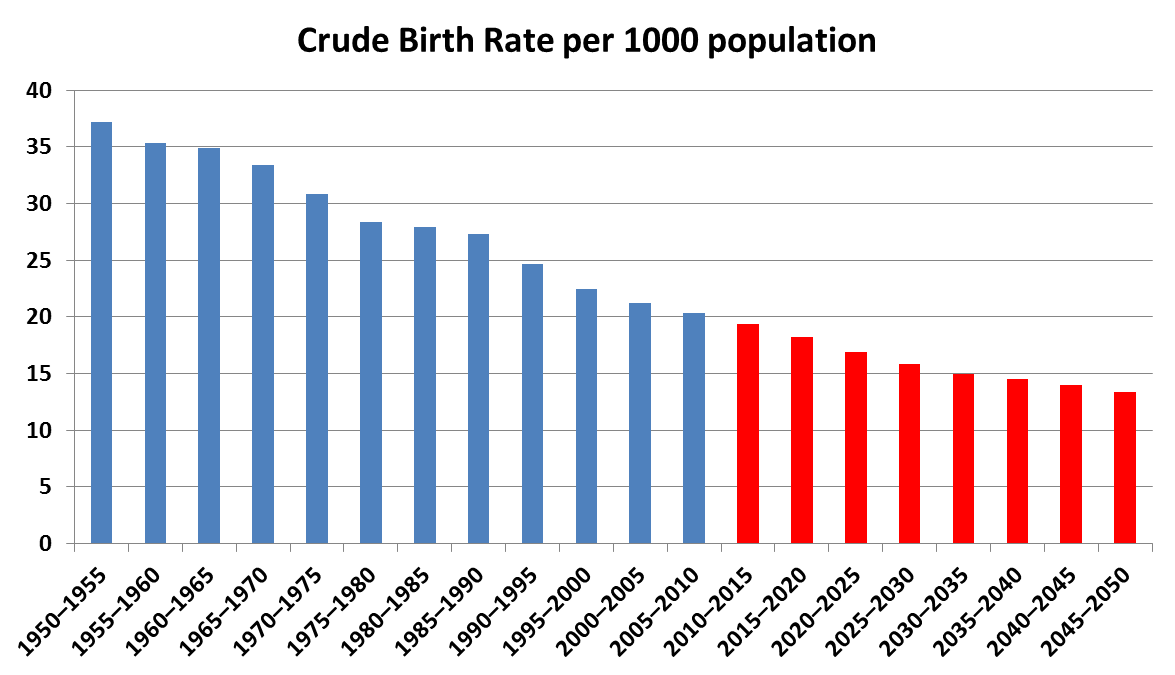
Crude birth rate actual and forecast UN data

Crude birth rate actual and forecast: UN data

Of these the number conceived by artificial means (IVF and surrogacy) is probably around 1% (around 0.2 births per 1000 of population). For example for around 2% of live births in the UK in 2010 , conception was by IVF. In Europe this is probably around 1.5% and worldwide it is still less than 1%. But this number is increasing and could more than double by 2050 as IVF spreads into Asia and Africa. By 2050 it could well be that for around 3% of all live births, conception has been by “artificial” means and that there will be a much greater degree of genetic screening applied.

Abortion rates increased sharply after the 1950’s as the medical procedures developed to make this a routine procedure. Done properly it is a relatively risk-free procedure though there are still many “unsafe” abortions in the developing and religiously repressive countries. Since 1995 abortion rates worldwide have actually decreased from about 35 per 1000 women of child-bearing age to about 28 today.  These numbers would indicate that the number of abortions taking place today is around 20-25% of the number of live births.

http://www.economist.com/blogs/graphicdetail/2012/01/daily-chart-7

Global abortion rates: graphic Economist

Global abortion rates: graphic Economist

So of every 100 babies conceived around 25% are deselected by abortion and 75 proceed to birth. Only 1 of these 75 would have been conceived by “artificial” means. The genetic deselection by abortion is both direct and indirect. The detection of genetic defects in the foetus often leads to abortion and this proportion can be expected to increase as techniques for the early identification of defects or the propensity for developing a debilitating disease are perfected. In many cases abortion is to safeguard the health of the mother and does not – at least directly – involve any deselection for genetic reasons. In many countries – especially India – abortions are often carried out to avoid a girl child and this is a direct genetic deselection. It seems to apply particularly for a first child. The majority of abortions today are probably for convenience. But if the “maternal instinct” is in any way a genetic charateristic, then even such abortions would tend to be deselection in favour of those who do have the instinct.

The trends I think are fairly clear. The proportion of “artificial births” is increasing and the element of genetic selection by screening for desired charateristics in such cases is on the increase. The number of abortions after conception would seem to be on its way to some “stable” level of perhaps 25% of all conceptions. The genetic content of the decision to abort however is also increasing and it is likely that the frequency of births where genetic disorders exist or where the propensity for debilitating disease is high will decrease sharply as genetic screening techniques develop further.

It is still a long way off to humans breeding for specific charateristics but even what is being practised now is the start of eugenics in all but name. And it is not difficult to imagine that eugenics – without any hint of coercion – but where parents or the mothers-to-be select for certain characteristics or deselect (by abortion) to avoid others in their children-to-be will be de rigueur.

 

What food crisis?

July 16, 2013

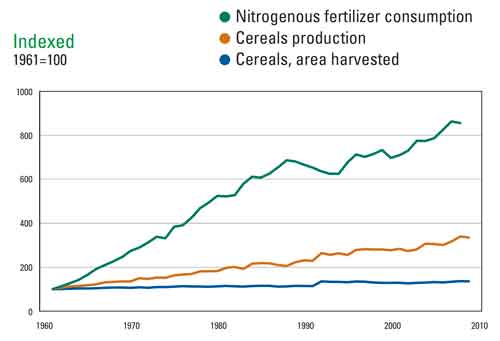
In 1961 the world population was just over 3 billion. Now it is 7 billion. The UN Food and Agriculture Organisation’s 2013 Statistical Year Book is now out and shows that during this period:

Agricultural production has increased  

  • Global crop production has expanded threefold over the past 50 years, largely through higher yields per unit of land and crop intensification.
  • Global per capita food supply rose from about 2 200 kcal/day in the early 1960s to over 2 800 kcal/day by 2009
  • Buoyed by high commodity prices, agriculture has demonstrated astonishing resilience during global economic turmoil. In 2010, agricultural value-added at the world level rose by 4 percent, in contrast to a 1 percent increase in overall GDP.

image UNEP/GEAS

So while population has increased by a factor of 2.3, the food available per person has increased by about 30%. Of course there are many millions who still suffer from malnutrition but this is primarily due to poverty and a failing of distribution systems. It is not the availability of food which has failed. The proportion of the population which is under-nourished continues to steadily decline.

(more…)

The youth of the world in 2100

June 8, 2013

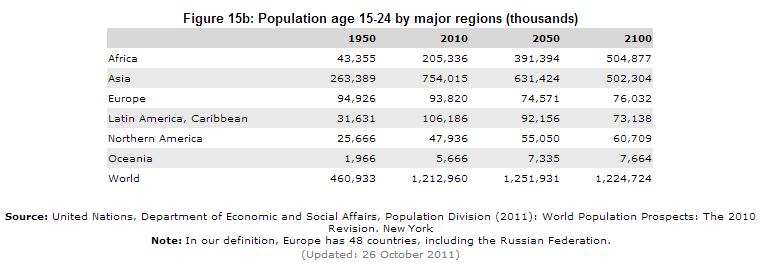
In China the youth (age 15 – 24) population is already declining. In India it will keep increasing till about 2050 and then decline. In Africa it will be growing until about 2100. Most of the youth of today will not be around in 2100 but the youth of that time who will see the world through to 2200 will be 500 million each in Africa and Asia and less than 300 million in the rest of the world – subject of course to any geographical population shifts that might take place. In the period till 2100 such migrations will probably not be so significant.

From the UN’s World Population Prospects (2012 Revision):

Population age 15-24

youth of the world 2100

India’s plummeting birth rates illustrate the coming population decline

May 9, 2013

Fertility rates are dropping sharply across the world and simple arithmetic tells us that by 2100 world population will be steady or declining slightly. In fact, rather than facing a population explosion and food shortages we will be facing the demographic challenges of a stable or declining population together with an increase in longevity. A new flexibility in the patterns of working will be needed as the populations in work reduce in proportion to those beyond retirement age. Retirement age itself will have to increase.

Yet it seems to me that the utterly alarmist, Malthusian, catastrophe scenarios for world population put forward in the 1970’s and 80’s by the Club of Rome, Ehrlich and other doom-mongers still prevail as “conventional wisdom” – even though it has long been established that their basic assumptions were plain wrong. For some reason environmentalists are the most ardent deniers of what the arithmetic says. They are the first to proclaim the dangers of population explosions yet are extremely loth to abandon catastrophe scenarios they have espoused when they are shown to be exaggerated or false.

I was therefore glad to see the subject getting attention in GeoCurrents where Martin W Lewis addresses and presents the sharply falling fertility rates around the world and in the various States in India. His maps are particularly well put together. The average fertlity rate in India is now down to 2.5 but many of the States fall well below the “replacement rate” of 2.2. The variation of fertility rates is impacted by the “usual suspects”; GDP, female literacy, proportion of urban dwellers, life expectancy, the Human Development Index (HDI) and the availability of electricity. But as Lewis shows there is also a striking correlation between fertility and TV ownership (seems plausible) and between fertility rates and the exposure of women to the media (also very plausible).

India’s Plummeting Birthrate: A Television-Induced Transformation?

…. It can be deceptive, however, to view India as an undivided whole. As shown on the map posted here, fertility figures for half of India are actually below replacement level. Were it not for the Hindi-speaking heartland, India would already be looking at population stabilization and even decline. All the states of southern India post TFR figures below 1.9. A number of states in the far north and the northeast boast similarly low fertility levels, including West Bengal, noted for its swarming metropolis of Calcutta (Kolkata).

(from GeoCurrents)

India’s geographical birthrate disparities, coupled with the country’s admirable ability to collect socio-economic data, allow us to carefully examine ideas about fertility decline. The remainder of this post will do so through cartography, comparing the Indian fertility-rate map with maps of other social and economic indicators. ……. 

……

Some scholars have argued that recent fertility decreases in India and elsewhere in the Third World are more specifically linked to one technological innovation: television. The TV hypothesis is well-known in the field, discussed, for example, in the LiveScience article on the African population explosion mentioned above. In regard to India, Robert Jensen and Emily Oster argue persuasively that television works this magic mostly by enhancing the social position of women. As they state in their abstract:

This paper explores the effect of the introduction of cable television on women’s status in rural India. Using a three-year, individual-level panel dataset, we find that the introduction of cable television is associated with significant decreases in the reported acceptability of domestic violence towards women and son preference, as well as increases in women’s autonomy and decreases in fertility. We also find suggestive evidence that exposure to cable increases school enrollment for younger children, perhaps through increased participation of women in household decision-making. We argue that the results are not driven by pre-existing differential trends.

As it turns out, the map of television ownership in India does bear a particularly close resemblance to the fertility map. Two anomalously low-fertility states with low levels of female education, Andhra Pradesh and Jammu and Kashmir, score relatively high on TV penetration, as does West Bengal, which lags on several other important socio-economic indicators. The correlation is far from perfect: Mizoram ranks higher on the TV chart than its fertility figures would indicate, whereas Odisha and Assam rank lower. Odisha and Assam turn out to be a bit less exceptional in a related but broader and more gender-focused metric, that of “female exposure to media.” These figures, which include a television component, seem to provide the best overall correlation with the spatial patterns of Indian fertility.

(from GeoCurrents)

“Bearing children has largely become the province of the lower classes”

May 2, 2013

The Daily Mail runs an article today about why the middle class are not breeding any more. It is not difficult to get a faint whiff of eugenics. But I can’t help feeling that some level of eugenics is not necessarily all bad as we move from natural selection to a world where artificial selection (IVF, surrogacy, sperm banks etc.) is increasing. And of course, even the availability of abortion on demand is in itself a form of selection.

  • Educated women deferring motherhood for so long they’re no longer fertile
  • Bearing children ‘has largely become the province of the lower classes’ 
  • TV historian Dr Lucy Worsley is poster girl for intentionally childless women

…. as author and demographic expert Jonathan Last observes in his controversial book What to Expect When No One’s Expecting:

‘The bearing and raising of children has largely become the province of the lower classes. It’s a kind of reverse Darwinism where the traditional markers of success make one less likely to reproduce.’

If “lower class” were a genetic trait then the middle and higher classes should fear extinction in due course. Fortunately “class” is just relative and subjective so no matter what the demographics are, distinctions of class will be introduced into any population that exists. But what is more interesting to consider is the fact that women with a higher level of education (which says nothing about native intelligence) have fewer children. This seems to be a global phenomenon. Data from 2010 in the extract below.

The full table is here. Primary School Enrollment and Total Fertility Rates, Latest Year (2000-2010)

Primary School Enrollment and Total Fertility Rates for Selected Countries, Latest Year 2000 – 2010

Rank Country

Primary School Enrollment

Total Fertility Rate

Percent

Number of children
per woman

1 Japan

100.0

1.3

2 Spain

99.8

1.5

3 Iran

99.7

1.8

4 Georgia

99.6

1.6

5 United Kingdom

99.6

1.9

181 Equitorial Guinea

53.5

5.3

182 Guinea-Bissau

52.1

5.7

183 Djibouti

40.1

3.9

184 Sudan

39.2

4.2

185 Eritrea

35.7

4.6

Note: Rankings are based on a list of 185 countries for which primary enrollment data are available.
Source: EPI from UNESCO

Fertility rates tend to be highest in the world’s least developed countries. When mortality rates decline quickly but fertility rates fail to follow, countries can find it harder to reduce poverty. Poverty, in turn, increases the likelihood of having many children, trapping families and countries in a vicious cycle. Conversely, countries that quickly slow population growth can receive a “demographic bonus”: the economic and social rewards that come from a smaller number of young dependents relative to the number of working adults.

For longer term population stability the goal is to reach replacement-level fertility, which is close to 2 children per woman in places where mortality rates are low. Industrial countries as a group have moved below this level. Some developing countries have made progress in reducing fertility, but fertility rates in the least developed countries as a group remain above 4 children per woman.

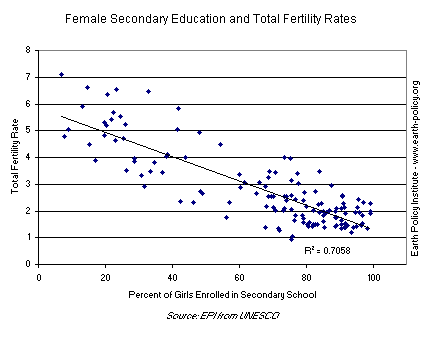
The trends with secondary education are also very clear:
Female Secondary Education and Total Fertility Rates

Of course the level of development in a country dominates and fertility rates around the world are reducing and converging. Whether this trend will continue even when all female children enjoy secondary education remains to be seen. The UK case where nearly all children do get secondary education would suggest that those with higher (university) education continue to show a declining fertility. But the real test of this hypothesis will only come when education levels around the world have equalised and fertility rates all lie around the same level.

So is the human population “dumbing down”? Not really. Education level is not intelligence. To what extent intelligence is a hereditary trait is uncertain. While it would seem that evolution should favour increasing intelligence, even this is not crystal clear. It is certainly a perception I have that “successful” people tend to be more intelligent but high intelligence does not ensure success. And success in life correlates with wealth but not so well with number of offspring.  “Success”, however we define it,  is not a genetic trait. There have been some suggestions that there may be some optimum level of intelligence for the genetic success of the species and that hunter-gatherers were actually somewhat more intelligent than we are now. Perhaps humans can be “too clever by half”!

But for some time to come, as the developing world catches up with the developed world, we can surely conclude that less-educated parents will have the higher fertility. Whatever that may mean for the long term evolution of humans, and that will be the result of the level to which we intentionally apply genetic selection.

Related: “Selection” lies in the begetting and evolution is just a result

Population decline is looming

April 6, 2013

I have posted earlier regarding the population decline that is inevitable if the fertility rates around the world continue to decline as they are doing. The declining fertility combined with the increase in longevity and the problems of aging pose new challenges of maintaining the growth and maintenance of the infrastructure that we would have become used to. In a hundred years from now the challenge could be a real shortage of labour.

The challenge in 2100 will be to maintain the balance between those “producing” to those “supported” in a declining and aging population. Perhaps immigration or population migrations or  productivity increases by the use of robots and an increase in the age one joins the “supported” population will be parts of the solution. I have no doubt that solutions will be found, but the “overpopulation problem” would have left the stage. ….

The majority of children being born today in the developed world will live to be over 100 years old.

Now as Science 2.0 reports another model simulation shows that  The Looming Population Implosion is inevitable and just a mathematical consequence of falling fertility rates.

Total fertility by major regions, 1950-2100 (children per woman) (UN)

A model based on global population data spanning the years from 1900 to 2010 has caused a research team to predict the opposite of what Doomsday Prophets of the 1960s and beyond insisted would happen –  the number of people on Earth will stabilize around the middle of the century and perhaps even start to decline. 

The results coincide with the United Nation’s downward estimates, which claim that by 2100 Earth’s population will be 6.2 billion, if low fertility and birth rate continues on its current path, below the 7 billion we are at now. 

The numerical model developed by a team from the Autonomous University of Madrid (UAM) and the CEU-San Pablo University seems to confirm the lower estimate, in addition to a standstill and even a slight drop in the number of people on Earth by the mid-21st century. The population prospects between 1950 and 2100 provided by the UN were used to conduct the analysis published in the journal Simulation. 

“This is a model that describes the evolution of a two-level system in which there is a probability of passing from one level to another,” as explained to SINC by Félix F. Muñoz, UAM researcher and co-author of the project. …… 

……. The team considered the Earth as a closed and finite system where the migration of people within the system has no impact and where the fundamental principle of the conservation of mass –biomass in this case– and energy is fulfilled.

“Within this general principle, the variables that limit the upper and lower zone of the system’s two levels are the birth and mortality rates,” Muñoz pointed out and recalled the change that occurred in the ratio between the two variables throughout the last century.

“We started with a general situation where both the birth rate and mortality rate were high, with slow growth favouring the former,” he added, “but the mortality rate fell sharply in the second half of the 20th century as a result of advances in healthcare and increased life expectancy and it seemed that the population would grow a lot.

However, the past three decades have also seen a steep drop-off in the number of children being born worldwide.”

Apartheid is still alive and well – in Sweden

March 25, 2013

The days of segregating bus passengers by skin colour and their appearance are not just something from the bad old days of the American South or from the days of apartheid in S. Africa. It would seem to be alive and well and practised in Sweden even today. For some it brings back memories of  Bosnia where those with the “wrong” names were selected to be put on the “death-buses”.

Sweden has a population of 9.55 million and around 19.6% or 1.858.000 inhabitants who have a foreign background, defined as being born abroad or being born in Sweden of two parents born abroad. Many sectors of industry and public services are totally dependent upon the “immigrants” as in the rest of Europe. The welfare states of Europe are more and more dependent upon the immigrants of working age who help support the ageing demographics. Overt discrimination in Sweden is probably much less than in many other parts of Europe but it would be quite wring to think that it is absent. The latent dislike of “others” will always be present under the surface but it is the political “respectability” provided by the new fascist or neo-Nazi parties which encourages this “latent” behaviour to openly manifest itself .

Another Kristallnacht somewhere in Europe within the next decade is not unthinkable. And if it happens it may well be in Greece or Germany or Austria but it could also happen further North.

Dagens Nyheter reports (my free translation):

The segregation of people having a different appearance which DN revealed on Saturday is not unique. When Viking Line buses would depart from Örebro, bus drivers  used name-lists to place the “immigrants” on one  bus and “Swedes” on another. “There was absolutely no way that this was random,” said Faruk Smailhodzic.

DN’s articles on how Eckerö Line buses, run by the People Travel Group owned by Veolia, on at least two occasions segregated passengers  according to their skin colour has aroused strong reactions. And now it turns out that Wednesday’s and Thursday’s events are not unique.

On two occasions in December Viking Line drivers had been provided with lists of passengers in order to divide them onto different buses. One list contained the names that appeared to be “Swedish” and other names that appeared to be “foreign”. ….

For one couple it brought back memories of Bosnia. Memories of how some people were selected  while others escaped. “We have experienced of when people are separated and put on a bus and it is not a good feeling. And there was always a feeling that maybe we were not going on any cruise, but maybe somewhere else”, says Faruk Smailhodzic.

Calculating Doomsday – An interesting but ultimately meaningless probability game

March 21, 2013

A new paper playing probabilistic games – this time about the Doomsday Argument.

Universal Doomsday: Analyzing Our Prospects for Survival, by Austin Gerig, Ken D. Olum, Alexander Vilenkin,  arxiv.org/abs/1303.4676 , Cosmology and Extragalactic Astrophysics (astro-ph.CO)

The full version of the paper (pdf) is here

Doomsday argument Gerig et al

Doomsday argument Gerig et al

The Doomsday Argument is the idea that we can estimate the total number of humans that will ever exist, given the number that have lived so far. The argument goes that since around 100 billion is the number of humans that have ever lived and assuming that there is a 95% probability that we are among the last 95% of humans who will ever live then there is a 95% probability that the number of humans who will ever live will lie between 1.4 and 2.0 trillion. A fairly trivial conclusion since any probability greater than 0 and less than 100% would be valid for the exercise.

In this paper the authors try to formalise the probability calculations and introduce the effect of known existential threats. Just like in Drake’s equation for the number of extra-terrestrial civilisations that may exist in the Milky Way, all the probabilities are unknown and could be assumed to be anything you like. The Doomsday Argument like Drake’s equation is really no more than a probability game, based on nothing at all. But it is fascinating to consider which terms are relevant and necessary in any such game.  And that is what makes these games interesting.

The author’s conclusions could be considered a trifle obvious and almost cliched – but none the less they are perfectly true!! The Earth will surely experience catastrophic events in the future which threaten human existence – whether by earthquake or volcanos or meteors and even if we survive all of these, eventually by the inevitable death of our sun.  In fact you could play another – and equally valid – probability game and calculate how many humans will have lived if humanity continues to survive till the death of our sun. And this probability is surely not zero.

To avoid Doomsday, humanity needs to make sure that asteroids don’t crash into earth and that catastrophic earthquakes, volcano eruptions or the like don’t occur until  such time as humanity has spread into space and  developed colonies on other planets.

From the Conclusions:

With the priors that we considered, the fraction of civilizations that last long enough to become large is not likely to exceed a few percent. If there is a message here for our own civilization, it is that it would be wise to devote considerable resources (i) for developing methods of diverting known existential threats and (ii) for space exploration and colonization. Civilizations that adopt this policy are more likely to be among the lucky few that beat the odds. Somewhat encouragingly, our results indicate that the odds are not as overwhelmingly low as suggested by earlier work. 

Abstract (Submitted on 19 Mar 2013)

Given a sufficiently large universe, numerous civilizations almost surely exist. Some of these civilizations will be short-lived and die out relatively early in their development, i.e., before having the chance to spread to other planets. Others will be long-lived, potentially colonizing their galaxy and becoming enormous in size. What fraction of civilizations in the universe are long-lived? The “universal doomsday” argument states that long-lived civilizations must be rare because if they were not, we should find ourselves living in one. Furthermore, because long-lived civilizations are rare, our civilization’s prospects for long-term survival are poor. Here, we develop the formalism required for universal doomsday calculations and show that while the argument has some force, our future is not as gloomy as the traditional doomsday argument would suggest, at least when the number of early existential threats is small.

Japanese demographics are alarming as Finance Minister tells elderly to “Hurry up and die”

January 27, 2013

The demographic strains in Japan are beginning to tell. They face a shrinking population and an increasing proportion of the elderly and without measures to increase the productive proportion of the population the situation is not sustainable. That the problems are not in some long distant future but are already exercising the minds of the current administration shows in the outburst from the new Finance Minister and Deputy Prime Minister, Taro Aso, when he exhorted the elderly to “Hurry up and Die”

The Japanese deputy prime minister Taro Aso kicked up a storm of controversy Monday with his comments on the financial burden the elderly place on society. 

The 72-year old finance minister said elderly should be allowed to “hurry up and die” at a meeting of the National Council on Social Security reforms, hoping to ease the financial strain caused by an aging population where fertility rates are low and the economy is struggling. Heaven forbid if you are forced to live on when you want to die,” Aso said. “You cannot sleep well when you think it’s all being paid for by the government.” 

“This won’t be solved unless you let them hurry up and die.” …. Aso is no stranger to controversy: the former prime minister once said he wanted to make Japan the kind of country where “the richest Jews would want to live,” and compared the opposition to the Nazis.

But the fact is that he is the first politician who has dared to defy political correctness – his subsequent apology notwithstanding – and address what is likely to be Japan’s most serious challenge within the next decade. It is a challenge that is going to come to dominate the realities in Europe as well. In the US – and in some countries in Europe –  it is the continuing immigration into the ranks of the productive population which helps to keep this challenge a little further away in the future. In any event it will be population decline that is the global issue within one hundred years. Globally the proportion of productive population to elderly population will not be so wrong – but it will be too low where population is declining unless active measures to keep this in balance are taken.

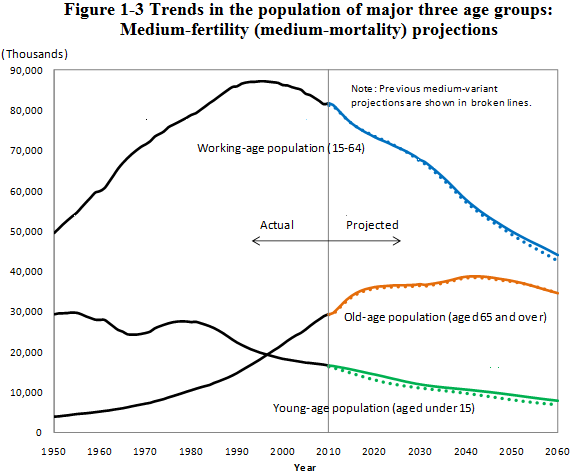
The latest data from the Japanese National Institute of Population show why Aso is so alarmed. The projections for the next few years of the rate at which the productive population is declining are alarming.

Aso’s outburst is not palatable or feasible but there are only 4 basic ways to address this issue:

  1. reduce the proportion of elderly requiring support 
  2. increase the birth rate,
  3. allow immigration to bolster the productive part of the population , and
  4. increase the age at which the elderly get support from the state

Increasing the birth rate is a long term measure and that assuming that birth rate can be increased. In the short term it has to be immigration into the productive portion of the population which can have an effect (assuming of course that they can contribute to growth).

But before the demographic challenge can be addressed it has to be acknowledged and maybe Aso’s outburst – unpleasant as it is – will bring the issue to the table.

A retirement age of 78 will be needed in Norway for children born today

January 23, 2013

Increasing lifespans are real and the period during which we can be productive is increasing and what follows is inevitable. At the present rate of longevity increasing by about 3 months every year, by 2500 most people will live to be 200. Considering that world population is likely to be falling slowly after 2100 it seems not unconnected that any consequent decrease in human economic activity will be (will have to be) compensated for by people having a longer productive life.

A year ago a trial balloon was sent up by the Swedish Prime Minister when he imagined a retirement age of 70 rather than the current 65. Now a suggestion that retirement age will have to be increased to 78 has been floated in Norway. The necessary debate is starting but the result is not in doubt – only the timing is.

But before not too long the  human condition of “study for 20 work for 40 and live to 80”  which probably applies to me will change to “study for 25, work for 50 and live to 100” and will apply to my children. And probably within another 200 years it would have become “study for 40, work for 80 and live to 160”.

Svenska Dagbladet:

Work until you’re 78. It could become necessary for Norwegians born today if the financial burden on the productive section of the population is not to become too large. The calculation and the challenge is from the Norwegian business newspaper Dagens Industry and has created a heated debate in Norway.

Life expectancy is on the rise in both Sweden and Norway. It will force today’s young people to work longer than today. But to retire at 78 years of age is not what many are convinced about.  Sweden had a similar debate when Prime Minister Fredrik Reinfeldt spoke of 75 years as an appropriate retirement age.

In Norway, the suggestion is that 78 years is the appropriate age but Professor Hilde Björnland has doubts: “ The calculation is interesting because it shows the increased pension obligations we face. It is not enough to work up to age 67 if we are to cope with the coming demographic challenges”. But, she says, there is a difference between a long life and increasing mental and physical health. It is uncertain whether we can work much longer than 65-70 years even though we live longer. It depends on how the jobs look like in the future, it depends on how the tasks are suited to us as we get older. Today, only 2.3 percent of the Norwegian population work between 67 and 74 years. After 74 years, it is so small that it is not measurable by the Norwegian Central Statistical Office.

Those who want to raise the retirement age to 78 years at Den Norske Bank believe in any case that today’s young people must be prepared to work much longer than their parents’ generation did. But to get people to work more years in a country that has huge oil revenues and would like to convert income to more leisure time will not be easy. …