Archive for the ‘Economics’ Category

Global Big Maconomics

February 11, 2014

Norway is a lot more expensive than Sweden. This is not lost on McDonald’s advertising agency DDB in Stockholm and they have installed this billboard straddling the border to persuade Norwegians to cross over for their burgers. Many Norwegians cross the border in any case to shop and most road borders have retail outlets and supermarkets on the Swedish side to cash in on this. Food alcohol and, it seems, Big Macs offer significant savings.

Norway - Sweden Big Mac

Norway – Sweden Big Mac

Eighty nine Norwegian kronor is about 93 Swedish kronor and so the Big Mac meal (including a drink and fries) is about 30% cheaper in Sweden. McDonalds have not revealed how effective this has been in attracting Norwegians.

TheLocalNorway once again boasts the world’s most expensive Big Mac, the UK’s Economist magazine has reported, with the ubiquitous double-decker burger now costing 48 kroner, or $7.80. 

Venezuela slips into second place with a $7.15 burger. Switzerland, which briefly stole the top spot last year on the back of a burgeoning Swiss franc, is now in third place with its $7.14 burger, followed by Sweden ($6.29) in fourth. 
 
The burger in Norway is on average 68.8 percent more expensive than it would be in a McDonald’s in the US. 

The cheapest Big Mac in the world is in India at $1.54. China at $2.74 and Japan at $2.97 are surprisingly close. Of course the current currency exchange rates also have an impact.

The Economist invented the global Big Mac Index in 1986. The 2014 Big Mac index was released a few days ago with January 2014 exchange rates.

THE Big Mac index was invented by The Economist in 1986 as a lighthearted guide to whether currencies are at their “correct” level. It is based on the theory of purchasing-power parity (PPP), the notion that in the long run exchange rates should move towards the rate that would equalise the prices of an identical basket of goods and services (in this case, a burger) in any two countries. For example, the average price of a Big Mac in America in January 2014 was $4.62; in China it was only $2.74 at market exchange rates. So the “raw” Big Mac index says that the yuan was undervalued by 41% at that time. 
 
Burgernomics was never intended as a precise gauge of currency misalignment, merely a tool to make exchange-rate theory more digestible. Yet the Big Mac index has become a global standard, included in several economic textbooks and the subject of at least 20 academic studies. For those who take their fast food more seriously, we have also calculated a gourmet version of the index.

This adjusted index addresses the criticism that you would expect average burger prices to be cheaper in poor countries than in rich ones because labour costs are lower. PPP signals where exchange rates should be heading in the long run, as a country like China gets richer, but it says little about today’s equilibrium rate. The relationship between prices and GDP per person may be a better guide to the current fair value of a currency. The adjusted index uses the “line of best fit” between Big Mac prices and GDP per person for 48 countries (plus the euro area). The difference between the price predicted by the red line for each country, given its income per person, and its actual price gives a supersized measure of currency under- and over-valuation.

Click here for the interactive map.

big mac index - the economist

big mac index – the economist

Economic model predicts Olympic medals at 2014 Sochi winter games

November 29, 2013

Update! See post of 7th February 2014 about PwC’s predictions.

==============================================

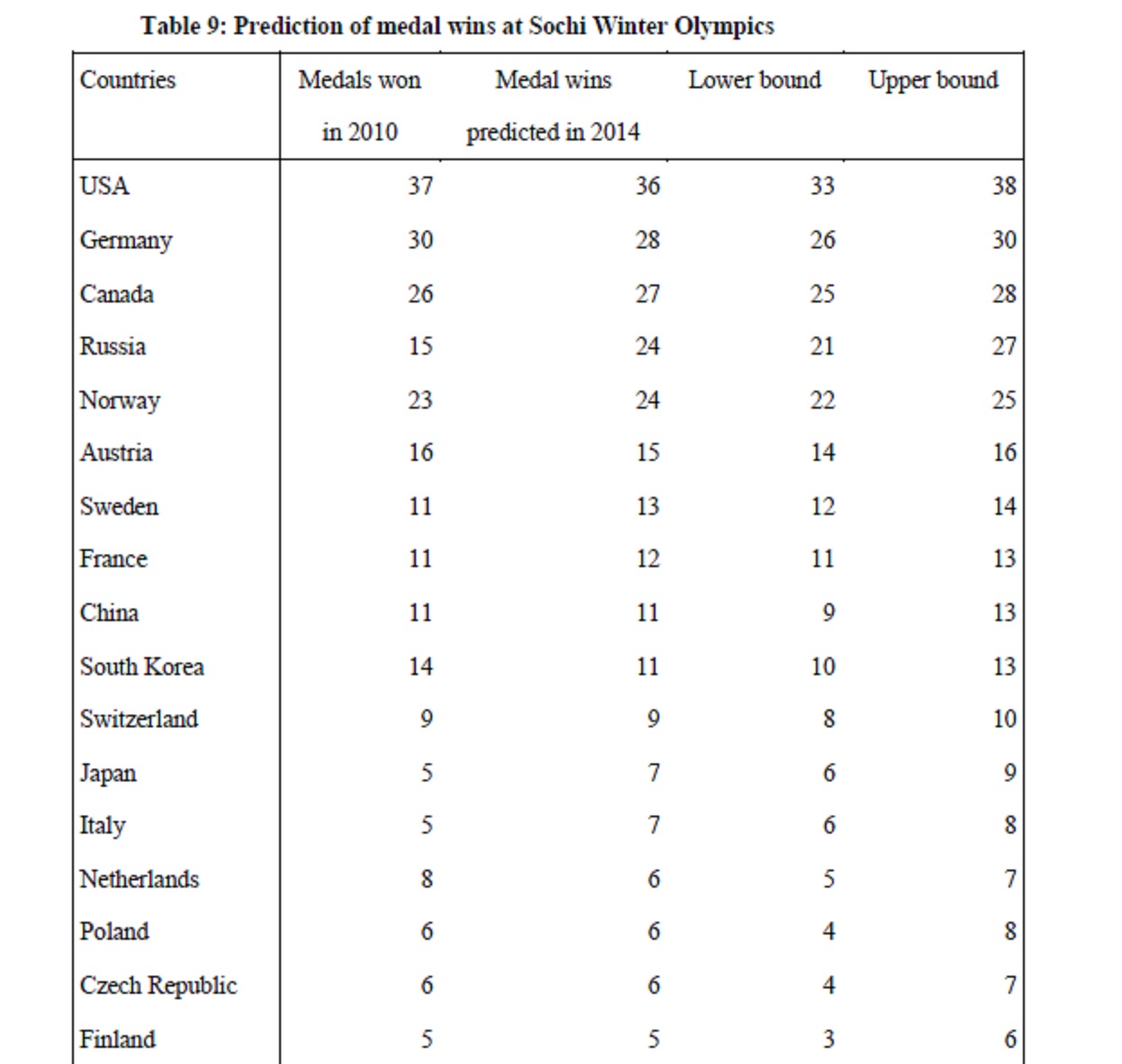
Two economists believe that the number of medals that will be won by any country at the 2014 Winter Olympic games in Sochi will be determined primarily by GDP. They have developed an economic model, tested it against previous Olympic results from 1964 to 2010 and have found that other factors have only a minor effect. They have used their model to make predictions for the 2014,  XXII Olympic Winter Games at Sochi in Russia!

Medal predictions Sochi 2014 - M Andreff

Medal predictions Sochi 2014 – M Andreff

Economic Prediction of Medal Wins at the 2014 Winter Olympics, Madeleine Andreff and  Wladimir Andreff  (pdf: Andreff Sochi)

There is also a published version of the paper: W Andreff, Economic development as major determinant of Olympic medal wins: predicting performances of Russian and Chinese teams at Sochi Games, in Int. J. Economic Policy in Emerging Economies, 2013, 6, 314-340.

Abstract: Starting from an econometric model successfully used to explain and then predict the distribution of medal wins across nations at the Beijing Summer Olympics, a similar model is elaborated on with some different explanatory variables for estimating the determinants of medals won per nation at Winter Games. A Tobit estimation of the model based on data from 1964 to 2010 shows that GDP per capita, population, the endowment in ski and winter sports resorts, and a host country dummy are significant determinants of medal wins at Winter Olympics. Then the estimated model is used for predicting the sporting outcomes at the 2014 Sochi Games with a focus on Russia and China. The Russian team is expected to perform better than in Vancouver 2010 and to be ranked fourth behind the USA, Germany and Canada while the Chinese team would be ranked ninth, a performance doomed to improve in the future given China’s swift economic development.

In their base study the authors do warn that a pinch of salt would be called for and conclude:

Conclusion
All the above predictions must be taken with a pinch of salt. This is namely due to a number of surprising sporting outcomes. Indeed, there are many unexpected sporting outcomes observed ex post ( i.e. achieved outcomes markedly different from the forecast – even though it happens more with the FIFA World Cup than with Summer Olympics (M. & W. Andreff, 2010). Unexpected or surprising outcomes of a sport game or contest have not really been analysed so far. This happens when opponents in a game (contest) have clearly uneven sporting forces, and the underdog wins the favourite. Elaborating on a metrics to quantify surprising sporting outcomes should be a promising avenue for further research. It will be possible to check after Sochi 2014 whether Winter Olympics are characterised with many or few surprising sport outcomes.
For the time being our recommendation is: do not bet that Russia will win 24 medals at Sochi Winter Olympics! But, if Russia makes it with more than 27 medals you would be allowed to conclude that she performed very well, better than expected with an economic model, and that this must be due to exceptional efforts of Russian athletes and coaches before and during Sochi Games. If Russia would win less than 21 medals, you could join Prime Minister Putin and President Medvedev in complaining that the Russian winter sports squad should really have done better – or that it was unexpectedly bad lucky.

The Russians are expecting to be the leading nation on the total medals table and they will not be pleased if they win less than 21 medals. Heads will roll!

If GDP really is the determining factor it should not be too difficult to devise a handicapping system to level the field of competition.

I am inclined to take this with a bucket rather than a pinch of salt.

Hollande’s France is dragging down the Eurozone and the world

November 15, 2013
Photo - AFP

Photo – AFP

Francois Hollande is a socialist of the old school and about a century behind the times. Fundamentally he has few new ideas beyond tax the rich and create more public sector jobs. He is not even very popular at home just now – but the French have only themselves and Sarkozy’s excesses to blame for having him there. Dominique Strauss-Kahn’s sexual excesses also helped. He makes impossible promises with a straight face. He promises to cut state spending without reducing public sector jobs. He will improve competitiveness without  reducing state subsidies. And he has promised to reduce unemployment by the end of this year. Nonsense promises are not doing much for his credibility.

France’s credit rating is falling and even The Guardian has little good to say about his administration:

The GuardianFrance’s second credit-rating downgrade by Standard & Poor’s in less than two years is as damaging politically for the socialist François Hollande as it was for his rightwing predecessor Nicolas Sarkozy, who lost the election shortly after France lost its AAA rating in January 2012.

S&P directly attacked Hollande’s economic policy, questioning the socialist government’s capacity to repair Paris’s stuttering economic motor. It said the problem with France was that the government’s tentative reforms were not enough to lift growth in the eurozone’s second largest economy.

Hollande, recently found to be the most unpopular French president on record in a poll by BVA, was already struggling to sell his economic measures to the nation. “The recovery is here,” Hollande declared in August after a small rebound in growth following months of stagnation. But real, sustained growth is expected to be slow in returning. …… 

And now the economy of France, along with that of Italy, is actually shrinking. The global recovery needs Europe  – and not just Germany – to do its bit. Instead, Hollande’s schoolboy economics are not just threatening the Eurozone recovery but actually threatening to postpone the recovery.

ReutersThe euro zone economy all but stagnated in the third quarter of the year with France’s recovery fizzling out and growth in Germany slowing. The 9.5 trillion euro economy pulled out of its longest recession in the previous quarter but record unemployment, lack of consumer confidence and anaemic bank lending continue to prevent a more solid rebound.

In the three months to September, the combined economy of the 17 countries sharing the euro grew by a slower than expected 0.1 percent. In the previous quarter it rose 0.3 percent – the first expansion in 18 months. The euro fell to a session low in response.

The French economy contracted by 0.1 percent, snuffing out signs of revival in the previous three months. It had been expected to post quarterly growth of 0.1 percent and has now shrunk in three of the last four quarters. ……. 

Unemployment is still increasing even though the number of French seeking jobs outside the country is also increasing. The rich have been fleeing Hollande’s swingeing taxes in droves.

The Telegraph: 

France’s economy has buckled once again amid official warnings of an explosive political mood across the nation that threatens to spin out of control.

French output fell by 0.1pc in the third quarter and Italy remained trapped in recession, dashing hopes of a sustained recovery in Europe. “It is no longer a question of whether the eurozone can achieve ‘escape velocity’, but whether it can grow at all,” said sovereign bond strategist Nicholas Spiro.

The latest data show a continued erosion of France’s industrial base and export share. It risks shattering the credibility of President François Hollande, who has been talking up recovery for months. A YouGov poll showed his approval ratings have dropped to 15pc, the lowest recorded for a French leader in modern times.

While the risk of a eurozone bond crisis has greatly receded since the European Central Bank agreed to act as a lender of last resort in July 2012, this has been replaced by slow economic attrition. It resembles the mid-1930s slump under the Gold Standard and is fuelling political crises in a string of countries.

Le Figaro said loss of confidence in the French government is turning dangerous, citing a confidential report based on surveys by “prefects” in each of the 101 departments. “All across the country, the prefects described the same picture of a society that is angry, exasperated and on edge. A mix of latent discontent and resignation is being expressed through sudden eruptions of fury, almost spontaneously,” said the document. The report warned that people were no longer venting their feelings within normal social structures. Increasing numbers are questioning the “legitimacy” of taxes. …… 

But there is no sign that Hollande will change from his classic policies of more taxes to support a profligate state sector and a bloated welfare system. Regulated austerity is called for but Hollande’s approach will only lead to an unregulated, painful and enforced austerity as in Greece and Spain.

I still believe in Europe and in many French firms but I have taken the precaution of shifting some of my (small) savings out of French stocks. France has not reached its bottom yet!

Economists are – by and large – religious or political advocates

August 1, 2013

A recent article by March Buchanan in Bloomberg got me to wondering why “Economists” and “Economics” – in spite of their gross and sometimes spectacular failures – have the high status they do. I come to the conclusion that “Economists” are – by and large – just religious or political advocates and “Economics” is no more than a study of social behaviour.

Is Economics a Science or a Religion?

The idea of economics as religion harks back to at least 2001, when economist Robert Nelson published a book on the subject. Nelson argued that the policy advice economists draw from their theories is never “value-neutral” but foists their values, dressed up to look like objective science, on the rest of us.

Take, for example, free trade. In judging its desirability, economists weigh projected costs and benefits, an approach that superficially seems objective. Yet economists decide what enters the analysis and what gets ignored. Such things as savings in wages or transport lend themselves easily to measurement in monetary terms, while others, such as the social disruption of a community, do not. The mathematical calculations give the analysis a scientific wrapping, even when the content is just an expression of values.

Similar biases influence policy considerations on everything from labor laws to climate change. As Nelson put it, “the priesthood of a modern secular religion of economic progress” has pushed a narrow vision of economic “efficiency,” wholly undeterred by a history of disastrous outcomes.

The practice of the black-magic that is considered economics – for it is certainly no science in the Popper sense – gets much of its cloak of respectability from the fact that the Nobel Prize exists (more correctly the Sveriges Riksbank Prize in Economic Sciences in Memory of Alfred Nobel).  

The Nobel prize in Economics should never have been created. In fact Nobel never wanted one and he is probably spinning in his grave as prize winners, one after another, prove – at best – to be mere historians and – at worst – religious or political zealots.  The prize adds more stature to the discipline of economics than it deserves. Almost every economic theorist has developed wonderful hindcasts but few – if any – have produced theories which can consistently make correct forecasts.

WikipediaThe Prize in Economics is not one of the original Nobel Prizes created by the will of Alfred Nobel. ……. In his speech at the 1974 Nobel Banquet Friedrich Hayek stated that if he had been consulted whether to establish a Nobel Prize in economics he would “have decidedly advised against it” primarily because “the Nobel Prize confers on an individual an authority which in economics no man ought to possess… This does not matter in the natural sciences. Here the influence exercised by an individual is chiefly an influence on his fellow experts; and they will soon cut him down to size if he exceeds his competence. But the influence of the economist that mainly matters is an influence over laymen: politicians, journalists, civil servants and the public generally.”

The Nobel family are among the harshest critics of the Economics Prize being associated with Alfred Nobel:

“The Economics Prize has nestled itself in and is awarded as if it were a Nobel Prize. But it’s a PR coup by economists to improve their reputation,” Nobel’s great great nephew Peter Nobel  told AFP in 2005, adding that “It’s most often awarded to stock market speculators …. There is nothing to indicate that [Alfred Nobel] would have wanted such a prize.”

Members of the Nobel family are among the harshest, most persistent critics of the economics prize, and members of the family have repeatedly called for the prize to be abolished or renamed. In 2001, on the 100th anniversery of the Nobel Prizes, four family members published a letter in the Swedish paper  Svenska Dagbladet, arguing that the economics prize degrades and cheapens the real Nobel Prizes. They aren’t the only ones.

To make it worse the Prize  is now “available to researchers in such topics as political science, psychology, and sociology”.

The political advocacy which is inherent in the theses promoted by Nobel Economics laureates have led to spectacular failures. Milton Friedman and his rabid monetarism gave rise to many of the crises today, Muhammad Yunus and the Grameen bank with their concept and practice of microcredit have exacerbated the risks of the debt trap into which so many small farmers have fallen. Krugman’s politics are essentially of the left and usually encourage profligacy. His analyses are more destructive than constructive and he has fault to find with almost every other theorist cutting across all political boundaries. He himself has yet to advocate any consistently successful theories. Amartya Sen focuses on analysing the “economics of poverty” but has nothing real to offer for its alleviation beyond platitudes representing his own political values from his ivory tower.

The world’s economies lurch from one crisis to the next but rarely are the crises foreseen. The only constant that can be observed is that growth – when it happens – leads to the improvement of the human condition but no “economic theory” has been able to deliver sustained growth. Growth – when it happens – achieves more for poverty alleviation than any social welfare program. Real wealth creation achieves more in achieving full employment or achieving social equality than merely redistributing a static pot of wealth.

As Mark Buchanan writes:

There’s a real danger in seeing economics as an objective science from which all values have been stripped.

It may be that “economics” will always be subject to the vagaries of human attitudes and behaviour and – since these are never constant or rational – that economics theory applied to political reality can never be more than a very short-term action plan.

Czechs jump off the renewables train to nowhere

July 30, 2013

From Power Engineering:

The Czech Republic’s government has voted to end support for renewable power generation in a bid to reduce rising consumer electricity bills.

The law proposes to stop subsidies for new projects and goes in to effect from 2014.

Subsidies for renewable-power sources have raised prices for Czech energy users in the past three years as the cost is passed on through customer bills.

Prime Minister Jiri Rusnok said in the statement, that rising electricity prices “threatens the competitiveness of our industry and raises consumers’ uncertainty about power prices.”

Only hydro, wind and biomass power plants that got construction permits in 2013 will be eligible for support if they’re completed before the end of 2014, the statement said.

Could Russian money from Cyprus be fuelling the Bitcoin?

April 7, 2013

In the last 6 months the value of the “virtual” currency the Bitcoin has jumped from $9.7 to $149. It started increasing significantly in February and really  took off in the middle of March this year. It seems too much of a coincidence that the worries (and the rumours) about the Cyprus banks followed the same time-table.

Bitcoin value in US Dollars

Bitcoin value in US Dollars

It is thought that much of the Russian money stashed away in Cyprus – especially the “black” money – left Cyprus before all the restrictions came into effect. That money must have gone somewhere and that somewhere would need not only to be “remote” but which also could provide the possibility of some “laundering” when the money was moved again. The Bitcoin perhaps could provide such a haven. If the bubble bursts in the next few months it could well indicate that the Russian money has moved again, well “laundered” and probably at a profit.

The bitcoin logo

At current values the Bitcoin “hoard” – restricted to be 21 million Bitcoins – represents a little over $3 billion.

The Telegraph reports that

Russia is the country most interested in Bitcoin, internet searches show, after a week in which the controversial electronic currency reached a record high and led to talk of a bubble.

The virtual currency, which allows users to circumvent the banks, burst into the mainstream as the price of a Bitcoin rose to $147 (£96) against the dollar, from under $20 at the start of this year.

Russia is the country now performing the most internet searches for the term “Bitcoin”, according to Google figures, followed by Estonia, the United States and Finland. The UK is not in the top 10.

The data gave weight to the belief that the recent price spike was driven by the crisis in Cyprus, as cuts to depositors’ savings planned under its bail-out further undermined faith in the global banking system.

Russian businesses were thought to account for €19bn of deposits held in Cypriot banks as of September last year, due to tax advantages, cultural links and, in some cases, for reasons of tax evasion. …….

……….. Created by a developer using a psuedonym in 2009, Bitcoin was intended to offer a means of payment that cuts out the banks through a “purely peer-to-peer version of electronic cash [that] would allow online payments to be sent directly from one party to another without going through a financial institution”.

The coins are “mined” by computer processing, with the system capping the number that can be produced at 21m. The process is technically difficult, meaning it has a cost in terms of equipment and electricity.

Does the solar cycle impact the global economic cycle?

April 2, 2013

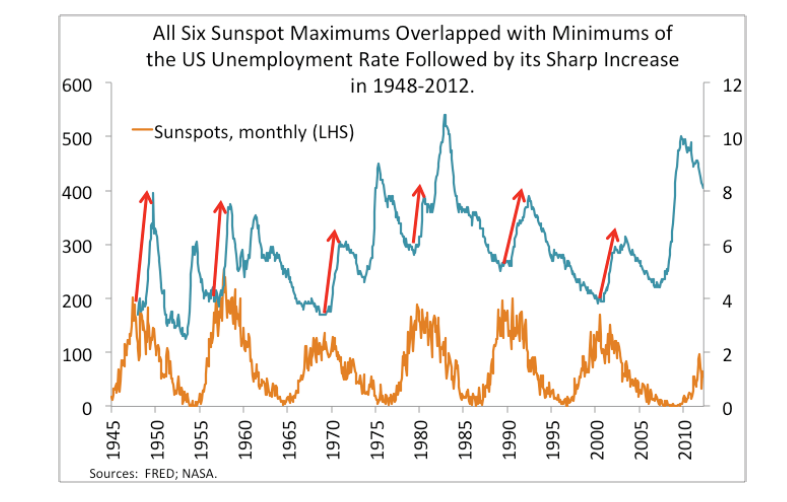
That weather and climate are affected by solar cycles is highly likely even if it is not part of the mainstream climate theories (though I think it is patently obvious). That climate and weather affect food production is clear and that this must impact the economic cycle is not so far fetched. Yet it has never been part of mainstream economic thinking that there will be a connection from the solar cycle to global economic cycles. Back in 1801 William Herschel observed the apparent connection between the sunspot cycles and the price of wheat. Since then many economists have returned at regular intervals to studying the link between the 11 year sunspot cycle and the behaviour of the global economic cycle. It is becoming increasingly clear that the economic cycle is not unconnected with solar cycles but the mechanisms are far from clear.

Mikhail Gorbanev an economist at the IMF has a fascinating new paper that became available last month at the University of Munich. He does add this Caution though!

Caution: This research is not in the “mainstream” of the economic thought. Read at your own risk!

Sunspots, unemployment, and recessions, or Can the solar activity cycle shape the business cycle?,” MPRA Paper 40271, University Library of Munich, Germany. (pdf Gorbanev Business Cycle and solar cycles MPRA_paper_40271)

Gorbanev shows some interesting correlations and  goes on to predict that “For other advanced economies, the upcoming solar maximum also suggests higher chances of recessions. The 3-year period when the recessions are most likely to occur in the G7 countries would run from early 2013 till end-2015”.

Whether there will be a sharp increase in US unemployment after the solar maximum remains to be seen. But it is not so unlikely that the world economy has another 2 – 3 tough years ahead!


Sunspot cycles and US unemployment (Gorbanev 2012)

Sunspot cycles and US unemployment (Gorbanev 2012)

Abstract 

 Over the last 77 years (from 1935), all 7 cyclical maximums of the solar activity overlapped closely with the US recessions, thus predicting (or triggering?) 8 out of 13 recessions officially identified by NBER (including one “double-deep” recession). Over the last 64 years (from 1948), all 6 maximums of the solar activity were preceded by minimums of the US unemployment rate, and the spikes in the unemployment rate followed with lags of 2-3 years. On the world scale, over the last 44 years (for which the data is available), all 4 maximums of the solar activity overlapped with minimums of the unemployment rate in the G7 countries, followed by its spikes within 2-3 years. From 1965, when consistent recession dating is available for all G7 countries, nearly 3/5 of the recessions started in the 3 years around and after the sunspot maximums. Was it a mere coincidence or a part of a broader pattern? This paper explores the correlation between the solar activity cycles (as measured by the number of sunspots on the sun surface) and the timing of recessions in the US and other economies. It finds out that the probability of recessions in G7 countries greatly increased around and after the solar maximums, suggesting that they can cause deterioration in business conditions and trigger recessions. This opens new approach for projecting recessions, which can be applied and tested with regard to the next solar maximum in 2013.

Climate change costs are not that critical compared to economic development of poor countries – Prof. Per Krussel

January 11, 2013

Swedish Radio is one of the more rabid and unthinking supporters of global warming orthodoxy (as are all the main stream media in Sweden). So I was rather surprised to see them giving prominence today to Per Krussel, Professor of Economics at Stockholm University. Normally Swedish Radio is so biased and bigoted on this subject that they would have made no mention of this if Krussel had not been a Swedish Professor. Of course – for balance – they then also interviewed a Professor on Environmental Economy who just happens to be a member of the IPCC and clearly backed the alarmist line — what else? He was less than impressive. For representing the IPCC they might just as well have interviewed someone from Greenpeace!

Krussel skewers the Stern Report on fundamental methodology but this itself is nothing new. The Stern Report from 2006 is another one where the content has been massaged to come to a pre-determined conclusion and is almost embarrassingly bad. In my view any document today which cites the Stern Report as support is itself discredited.

Swedish Radio: (free translation from the Swedish)

Many researchers believe that the threat from climate change is the critical issue of our time. But Per Krusell, professor of economics at Stockholm University, and leading a major international effort to calculate the economic costs of climate change, believes that the threat is not that critical in financial terms

“Climate change is a threat, it’s pretty big, but it’s not that huge when translated  into dollars and cents”  says Per Krusell.

Per Krusell leads an international research project to develop an economic model, which the world’s countries can use to figure out their future costs of climate change. The model should be finished in about a year and will be the world’s most advanced tools in this context, according to Per Krusell. So far, they have concluded that GDP in the worst case will only drop by a few percent in most countries, such as Sweden. This differs from the widely publicized Stern Report in 2006 pointing to significantly higher costs.

……..  above all, Krusell is critical of Stern for putting  together all anticipated costs, without discounting these costs  properly in the way economists usually do for future costs. … 

(The Stern report used a discounting factor of 0.1% – but it is normal to use a discount rate of 1%, which therefore lowers the cost of future generations substantially.) …. Economist Per Krusell agrees that climate change is a big problem, but thinks it’s more important to focus on the economic development of the poor countries rather than combating climate change.

“When we consider the effects of climate change, we expect also that there will be a cost especially in poor countries, but it sums up to no great critical issue for the world. It is more important to get the poor countries to develop. I’m a little worried that “environmental thinking” leads to more important issues being ignored.”

US going over the fiscal cliff is probably best for world economy

December 26, 2012

No doubt I have a simplistic view but the best thing in the long-term for the world economy would be for the US to start reducing its budget deficit and its burgeoning  public debt. Public debt has to be set to whatever level is sustainable. An economy in transition from one level to another can permit a changing level of public debt, but the current level of deficits (7 -9% of GDP) and ever-increasing debt is not sustainable. The problem is that even if the US did not avoid the fiscal cliff the US public debt would continue to grow – if a little more slowly than as at present. The cliff may in reality be more like a hill but it is still along the way to the wrong place.

US Public Debt

US Public Debt

Budget discipline and a stable level of public debt must – I think – come first. It is public profligacy – whether in Greece or Spain or the US – which is unsustainable and rampant profligacy will not end without some short-term pain. It is probably time for the US to bite the bullet.

I see that the US press is now beginning to expect that some kind of fall – whether over a cliff or a hill – is inevitable but that perhaps the fall can be cushioned by attaching a bungee rope or by aiming for a ledge part-way down!

NY Times: Until late last week, most observers had expected the president and Congressional Republicans to come up with at least a short-term compromise before the year-end deadline. But thefailure of Speaker John A. Boehner to win support for tax increases on the wealthiest Americans from fellow House Republicans has forced many economic observers to reconsider what might happen if political leaders remain deadlocked into 2013.

MSNBC: On the Sunday news shows, no one signaled a change of position that could form the basis for a short-term fix, despite a suggestion from Obama on Friday that he would favor one. The focus was shifting instead to the days following January 1 when the lowered tax rates dating back to the George W. Bush administration will have expired, presenting Congress with a redefined and more welcome task that involves only cutting taxes, not raising them.

“I believe we are,” going over the cliff, said Republican Senator John Barrasso of Wyoming. “I think the president is eager to go over the cliff for political purposes. I think he sees a political victory at the bottom of the cliff,” Barrasso said on Fox News Sunday.

Some Republicans have said Obama would welcome the fiscal cliff’s tax increases and defense cuts, as well as the chance to blame Republicans for rejecting deal. Obama has rejected that assertion.

WSJ: Lawmakers returning to town this week will see whether they can agree on a plan to avoid the full brunt of the fiscal cliff, the combined $500 billion in tax increases and spending cuts set to begin next week. Little if any progress was made in the talks before Congress and President Barack Obama left town last Friday for Christmas. The president plans to leave his vacation in Hawaii late Wednesday night, returning to Washington on Thursday, the White House said.

CNBC: Despite the $600 billion of tax hikes and spending cuts due to come into force at the end of this month unless U.S. lawmakers reach a deal, the S&P 500 index is not displaying signs of stress, says independent chartist Daryl Guppy.

The stock index is in fact trading upwards as investors increasingly take in the possibility that the U.S. economy might fall over the “fiscal cliff,” he told CNBC Asia’s “Squawk Box” on Thursday. “The fiscal cliff is a bungee jump. It used to be exciting. Now it’s just a tourist attraction. The market is absorbing that,” he said. 

While the S&P 500 index has dipped back towards the 1,380 to 1,400 range seen in August and mostly recently in November, stocks appear to be on their way up again, he added. The index closed at about 1,419 on Wednesday.


Subsidies for electricity production in the US show that renewables are far from commercialisation

November 23, 2011

Data for 2010 is now available from the US Energy Information Administration.  Solar and Wind power are still a long way from being commercial with just direct subsidies being equivalent to 7.8 and 5.6 cents/kWh respectively. Indirect subsidies and increased costs for alternate capacity are not included.

My view of subsidies in power generation is that they are usually counter productive and provide windfalls for developers and constructors but rarely lead to benefits for the consumers of electricity.

Factors Affecting Electricity Prices:

The average retail price of electricity in the United States in 2010 was 9.88 cents per kilowatt-hour (kWh). The average prices by type of utility customer were:

  • Residential: 11.6¢ per kWh
  • Transportation: 11.0¢ per kWh
  • Commercial: 10.3¢ per kWh
  • Industrial: 6.8¢ per kWh

(more…)