Archive for the ‘Engineering’ Category

Human pylons across Iceland

September 1, 2010

Human Engineering !

From The Beautiful Brain

“Like the statues of Easter Island, it is envisioned that these one hundred and fifty foot tall, modern caryatids will take on a quiet authority, belonging to their landscape yet serving the people, silently transporting electricity across all terrain, day and night, sunshine or snow.”

From http://www.wired.co.uk/news/archive/2010-08/16/human-pylons

An architecture and design firm called Choi+Shine has submitted a design for the Icelandic High-Voltage Electrical Pylon International Design Competitionwhich proposes giant human-shaped pylons carrying electricity cables across the country’s landscape.

The enormous figures would only require slight alterations to existing pylon designs, says the firm, which was awarded an honourable mention for its design by the competition’s judging board. It also won an award from the Boston Society of Architects Unbuilt Architecture competition.

http://cdni.wired.co.uk/674×281/o_r/pylons.png

Human pylons carry electricity across Iceland

http://img.wired.co.uk.s3.amazonaws.com/659×425/o_r/pylons2.png

Pylons

http://www.choishine.com/port_projects/landsnet/landsnet.html

Despite the large number of possible forms, each pylon-figure is made from the same major assembled parts (torso, fore arm, upper leg, hand etc.) and uses a library of pre-assembled joints between these parts to create the pylon-figures’ appearance. This design allows for many variations in form and height while the pylon-figures’ cost is kept low through identical production, simple assembly and construction.

Wind Turbine blades a security threat?

August 31, 2010

Wind turbines are not without their problems –they are expensive, have to be shut down for strong winds, don’t like freezing weather, need back-up, weaken the grid they are connected in to, are dangerous to transport, can be very noisy and can be dangerous for large birds.

In addition it seems they pose a threat to the military.

The New York Times reports that Dr. Dorothy Robyn, deputy under secretary of defense, has declared that wind turbines pose an unacceptable risk to national security and military training in some areas–because  moving turbine blades can cause “blackout zones” where planes disappear from radar. And in certain cases,  turbine blades are indistinguishable from approaching planes.

http://graphics8.nytimes.com/images/2008/08/19/timestopics/windpower_395.jpg

Moving turbine blades can be indistinguishable from airplanes on many radar systems, and they can even cause blackout zones in which planes disappear from radar entirely. Clusters of wind turbines, which can reach as high as 400 feet, look very similar to storm activity on weather radar, making it harder for air traffic controllers to give accurate weather information to pilots.

Although the military says no serious incidents have yet occurred because of the interference, the wind turbines pose an unacceptable risk to training, testing and national security in certain regions, Dr. Dorothy Robyn, deputy under secretary of defense, recently told a House Armed Services subcommittee.

In 2009, about 9,000 megawatts of proposed wind projects were abandoned or delayed because of radar concerns raised by the military and the Federal Aviation Administration, according to a member survey by the American Wind Energy Association. That is nearly as much as the amount of wind capacity that was actually built in the same year, the trade group says.

As a result of the military’s opposition, Horizon Wind Energy recently withdrew three project applications in the area. AES Wind Generation said it found out in May, after nine years of planning, that the military had objections to its proposal to build a 82.5-megawatt, 33-turbine wind farm.

Wind Power apart from its cost and technical issues is not as benign as it might seem.


“Thank god for BP”:Louisiana fishermen net more cash working for BP

August 24, 2010

There is always a silver lining – for some.

The FT reports:

The white shrimp season officially began this week in Louisiana, and at this time of year 46-year-old Mr Foret, a hardened Cajun shrimper from Houma in the Mississippi delta, would normally be out on the water plying the trade that has kept him and his family since he was 13. But now that he is a BP contractor through the oil company’s Vessels of Opportunity programme, designed to employ local fishermen in the oil spill clean-up operations, he earns more consistent money, and works a lot less than he used to. “BP is a very nice fella, and this is a guaranteed cheque,” he says, pointing to a huge yellow skin or “bladder” on his boat that is used to collect skimmed oil. “I’m sticking with this for as long as I can.”

Captain Michael Owen, better known as the big “O”, has been doing pretty well out of BP. For the past three months, he and his 24-foot fishing boat have been ferrying clean-up workers to parts of the Gulf affected by the oil spill. As a BP contractor, he does not have to worry about securing charter fishing contracts for small parties of tourists visiting the Mississippi delta, the business he ran until the oil spill. Nor does he have to stress over the pressure to find fish – redfish and speckled trout – for his demanding clients. “I’m super happy with BP,” he says. “And I’m not taking a cut [in pay].”

“It takes you three days to make that charter fishing,” says a charter fisherman from Port Sulphur about 30 miles up the road. “Thank god for BP.”

http://www.huffingtonpost.com/2010/08/23/former-gulf-fishermenturn_n_691451.html

Gulf Coast Fisherman

How can we – if we should – prepare for a new Little Ice Age?

August 22, 2010

It seems that we are in a Solar Cycle Minimum – a Landscheidt Minimum which will perhaps be comparable to the Maunder Minimum.

The last decade has seen flat or declining global temperatures.

The Ocean temperature oscillations could indicate 20 or 30 years cooling ahead of us.

If these are all indicators of a coming Little Ice Age, then it may be time to take some preparatory actions to help humans adapt. I think adaptation to Climate Change when it happens is the key not some mis-guided and futile attempt to prevent the Climate Change from happening (as being proposed by the IPCC and other global warming fanatics).

image: http://t2.gstatic.com/images?q=tbn:TtpOoja-ueuOLM:http://www.wilsonsalmanac.com/images3/frost_fair_C18.jpg

The question which is more for engineers rather than for scientists is “What are the actions that could be taken to prepare and help for such an adaptation?”

Applying Asimov’s Laws of Robotics

August 21, 2010

Isaac Asimov published his first short story about robotics in 1942 and his I Robot in 1950. The three laws of robotics he developed have now become the de facto basis for most science fiction dealing with robots and even in engineering:

First Law: A robot may not injure a human being, or, through inaction, allow a human being to come to harm, unless this would violate a higher order law.
Second Law: A robot must obey orders given it by human beings, except where such orders would conflict with a higher order law.
Third Law: A robot must protect its own existence as long as such protection does not conflict with a higher order law.
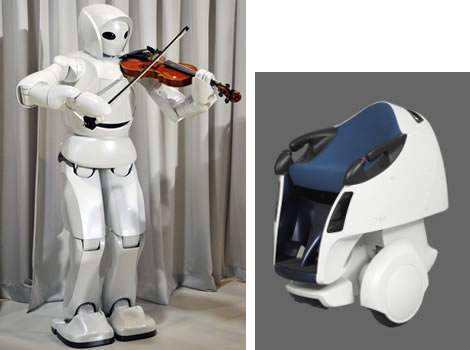
image: http://www.geekalerts.com/u/toyota-robots.jpg

Later as Asimov integrated his Robot series with his Foundation series he added a Zeroth Law:

Zeroth Law: A robot may not injure humanity, or, through inaction, allow humanity to come to harm.

A modern counterpart to Asimov’s fictional character is Eliza. Eliza was created in 1966 by Professor Joseph Weizenbaum of Massachusetts Institute of Technology who wrote Eliza — a computer program for the study of natural language communication between man and machine. She was initially programmed with 240 lines of code to simulate a psychotherapist by answering questions with questions.

Robotics and robot design has now advanced to the stage that engineers are now having to re-look at Asimov’s laws for practical implementation. David Woods, professor of integrated systems engineering at Ohio State University says “The philosophy has been, ‘sure, people make mistakes, but robots will be better — a perfect version of ourselves.’ We wanted to write three new laws to get people thinking about the human-robot relationship in more realistic, grounded ways.” He addresses the practical issues in his article: Beyond Asimov: The Three Laws of Responsible Robotics in IEEE Intelligent Systems by Robin Murphy , David D. Woods, July 2009, pp. 14-20. “Go back to the original context of the stories,” Woods says, referring to Asimov’s I Robot among others. “He’s using the three laws as a literary device. The plot is driven by the gaps in the laws — the situations in which the laws break down. For those laws to be meaningful, robots have to possess a degree of social intelligence and moral intelligence, and Asimov examines what would happen when that intelligence isn’t there.”

“His stories are so compelling because they focus on the gap between our aspirations about robots and our actual capabilities. And that’s the irony, isn’t it? When we envision our future with robots, we focus on our hopes and desires and aspirations about robots — not reality.”

In reality, engineers are still struggling to give robots basic vision and language skills. These efforts are hindered in part by our lack of understanding of how these skills are managed in the human brain. We are far from a time when humans can agree on a universal ethical or moral code and even further away from imbuing such a code into robots.

Woods and his coauthor, Robin Murphy of Texas A&M University, composed three laws that tries to put the responsibility back on humans.

The three new laws that Woods and Murphy propose are:

  • A human may not deploy a robot without the human-robot work system meeting the highest legal and professional standards of safety and ethics.
  • A robot must respond to humans as appropriate for their roles.
  • A robot must be endowed with sufficient situated autonomy to protect its own existence as long as such protection provides smooth transfer of control which does not conflict with the First and Second Laws.

Woods admits that one thing is missing from the new laws: the romance of Asimov’s fiction — the idea of a perfect, moral robot that sets engineers’ hearts fluttering.