Archive for the ‘Engineering’ Category

EC looking for GE concessions to approve Alstom acquisition

May 12, 2015

UPDATE!

The New York Times also reports on the potential anti-trust issues and GE’s readiness to make some accommodations for EC concerns. However my take away from the NYT article is that GE is warning the EC that Alstom and the European Union have more to lose than GE has if the deal does not go through:

In now dealing with the European Commission’s antitrust office, Mr. Immelt has not forgotten the harsh experience of his predecessor, Jack Welch. In 2001, Mr. Welch failed to win approval for a proposed $42 billion takeover of Honeywell International after objections were raised by Mario Monti, the European antitrust commissioner at the time.

Mr. Immelt was worried enough last week that he met with Ms. Vestager in Brussels, where he also gave an address at the American Chamber of Commerce highlighting Europe’s economic potential. In that address, Mr. Immelt said young Europeans were “awesome” and “amazing,” but he emphasized that Europe needed investment to gain competitiveness and beat unemployment.

Speaking to reporters later, Mr. Immelt said his meeting with Ms. Vestager was “very constructive” and he described her as “a good leader.” G.E., he said, was engaged in “a process” with Brussels, and would “take the process where it goes.”

If G.E. is unable to convince Ms. Vestager of the merits of its case, the next step could be a so-called statement of objections, as soon as next month — formal charges that would outline the commission’s specific antitrust concerns. G.E. and Alstom could avoid that step by offering remedies sooner, perhaps proposing to sell parts of the gas turbine business in Europe.


My expectation was that the European Commision would look for some concessions from GE and would only grant a conditional approval for the acquisition of Alstom’s power and grid businesses.

The EC concerns seemed to be focused on Heavy Duty Gas Turbines (HDGT), and I wrote:

Will the EC approve GE’s acquisition of Alstom’s power business?

…. In any event,  I expect that the deal will go through, but I will not be surprised to see an approval conditional on some assurances from GE regarding R & D centres, R & D jobs and/or R & D budgets in Europe. I think it highly unlikely – and a little meaningless – if the EC were to ask for divestment of Alstom’s HDGT business to a third party (if any such exists). The bottom line is, I think, that Alstom’s HDGT technology has come to a dead-end and can not be developed any further in their own hands. While the business can continue in a diminishing way for some years, Alstom technology has no long-term value except to another party which has access to high temperature cooling technology. To have Alstom continue with the HDGT business as an unwilling and reluctant player does no one any service at all.

This Reuters report today suggests that my expectation may be close to the mark. However it also seems that if the EC demands too much in the way of concessions, GE might walk away. Clearly GE are already getting a little irritated at the protracted nature of the EC approval process. The failure of the deal is not something that Alstom or the EU would look forward to.

The EC decision may also be delayed somewhat beyond August 6th.

Reuters:

General Electric Co said on Monday for the first time it would be willing to consider concessions in order to win European approval to acquire the power equipment unit of France’s Alstom. “We are willing to explore remedies to get this deal done even though again we believe in the merits of the deal,” Steve Bolze, president and CEO of GE Power & Water, the conglomerate’s biggest industrial unit, told Reuters in an interview. Any concessions would have to “preserve the deal economics and our strategic value,” he said. …

… EU regulators typically prefer merging companies to sell overlapping assets or make it easy for rivals to enter the market. GE’s gas turbine competitors include Siemens AG and Mitsubishi Heavy Industries Ltd.

…GE already altered the deal to win the French government’s backing during last year’s two-month battle, in which it fended off Siemens and Mitsubishi. In the interview, Bolze acknowledged the “protracted process” for Alstom, and said GE was focused on “how to move … forward as it makes sense.”

In GE’s first-quarter conference call last month, Chief Executive Jeff Immelt backed the deal’s fit for GE, but said if it “ever would become unattractive, we wouldn’t do it.”

…. GE, which is undergoing an overhaul involving the exit of most of its finance assets, has said it expected synergies from the Alstom deal to add between 6 to 9 cents in earnings per share in 2016. But some analysts have told Reuters they doubt GE’s stock would take a big hit should the deal collapse, with the idea that GE could make up those earnings with stock buybacks or other deals. ……. 

…… EC spokesman Ricardo Cardoso said regulators are waiting for data from the companies before a setting a new deadline to act. The previous deadline was Aug. 6.

The EC will need to be very precise in demanding concessions from GE while ensuring that the deal does go through. Divesting parts of the HDGT business to unknown (and probably non-existent) buyers is probably a lose-lose solution. I expect that GE’s walk-away point will be reached if earnings from the service of Alstom’s fleet of gas turbines is removed from the mix. In fact any conditions set by the EC which dilute future revenues could prove fatal for the deal going through. Assurances about keeping R & D located in Europe and assurances about jobs and even about R & D budgets could be absorbed by a robust business plan. But no business plan can survive if something as fundamental as the revenue stream is adversely affected. And it is the volume of that revenue stream – and not just the margin from those revenues – which is crucial.

Will the EC approve GE’s acquisition of Alstom’s power business?

May 3, 2015

UPDATE! 

Bloomberg: General Electric Co.’s Jeffrey Immelt is set to meet with the European Union’s antitrust chief Tuesday as the U.S. company seeks approval for its acquisition of Alstom SA’s energy business.

The session in Brussels between GE’s chief executive officer and Margrethe Vestager is part of regulators’ “ongoing merger review,” Lucia Caudet, a European Commission spokeswoman, said in an e-mail.


On February 23rd this year the European Commission announced that its preliminary investigation into the proposed acquisition of Alstom’s power businesses by GE had highlighted Heavy Duty Gas Turbines (HDGTs) as a potential area of concern. Therefore an in-depth investigation would be carried out. This investigation was due to have been completed by 8th July but has been extended – apparently at GE’s request – till August 6th.

The European Commission has opened an in-depth investigation to assess whether General Electric’s (GE) proposed acquisition of the Thermal Power, Renewable Power & Grid businesses of Alstom is in line with the EU Merger Regulation. The Commission’s preliminary investigation indicates potential competition concerns in the market for heavy-duty gas turbines which are mainly used in gas-fired power plants.

Since GE already has HDGTs  in direct competition with Alstom’s GT24 and GT26 engines and even with Alstom’s GT11N2 and GT13E2 engines, I expect that the Alstom range of machines will have to be discontinued. (It would be quite irrational for GE to continue to offer Alstom’s portfolio except for a very restricted time period or for some very particular application. It is not much appreciated by a buyer either when a supplier appears so confused as to offer different machines for the same purpose). The discontinuation of some engines is “no big deal”. But, as I have written previously, it would be a shame if the line of technology for HDGTs within Alstom – which carried forward the lines of technology emanating from BBC, GEC, Asea and ABB (including sequential combustion technology) – were to be entirely lost.

I would summarise the EC’s potential areas of concern as being:

  1. If the European HDGT market can be said to be distinct from the global market, then the number of HDGT suppliers would effectively reduce in Europe from three to two.
  2. Reduced competition in Europe could lead to supplier(s) having greater than 40% market share and could lead to an increase in prices.
  3. GE together with Alstom could have greater than 50% market share and not only in Europe.
  4. In Europe, fundamental R & D on combustion, emissions and materials and innovation regarding HDGTs would be hurt, and
  5. Competition in the HDGT service business would be impacted since Alstom currently is an alternate supplier of service to older GE HDGTs (since Alstom was a GE licencee prior to 1999).

The market for HDGTs is characterised by high technological and financial barriers to entry, leading to a concentrated market with only four globally active competitors: GE, Alstom, Siemens and Mitsubishi Hitachi Power Systems (MHPS). The fifth player, Ansaldo, appears to be a niche player with a more limited geographic reach. The margins in the market for HDGTs appear to be higher than those of neighbouring markets for power generation equipment such as steam turbines. 

The HDGTs market worldwide is divided into two frequency regions, namely those operating at 50 Hz and those at 60 Hz. All thecountries in the European Economic Area (EEA) operate at 50 Hz frequency.

Since MHPS seems to be less active in the EEA than in the rest of the world, the transaction would bring together the activities of two of the three main competitors in the EEA.The transaction would eliminate Alstom from the market, leaving European customers without an important competitor of GE and Siemens. Indeed, in the market for the sale of new 50 Hz frequency HDGTs, the merged entity would reach high market shares in the range of around 50 %, both in the EEA and at worldwide level excluding China.

Furthermore, the transaction might significantly reduce R&D and customer choice in the HDGT industry. After the merger there is a risk that GE would discontinue the production of certain Alstom HDGT models and that advanced HDGT technology developed by Alstom would not be brought to the market.

Finally, in the market for the servicing of General Electric’s mature technology HDGT frames, the transaction eliminates competition by Alstom’s subsidiary Power System Manufacturing.

Overall, the Commission is at this stage concerned that the transaction may lead to an increase in prices, a reduction in customer choice and a reduction of R&D in the HDGT industry, leading to less innovation.

I note that GE have taken on a very-high powered lawyer to help in dealing with anti-trust issues,

Sharis Pozen, a former acting assistant U.S. attorney general for antitrust who joined Skadden, Arps, Slate, Meagher & Flom in July 2012, left the firm this month to become vice president for global competition and antitrust at General Electric. Pozen is the latest high-profile Am Law 100 partner to join the in-house legal ranks of the Fairfield, Conn.-based conglomerate, which has tapped Skadden to advise on its pending $17 billion buy of the energy unit of French engineering giant Alstom.

However, my own opinion is that these potential EC concerns are not sufficient to disallow the proposed acquisition. I believe the market concerns are more theoretical than real.

1. While the EC tends to look at market share rather than market size, the EU market currently (before the advent of shale gas in Europe) is so small that it cannot be considered a market distinct from the global market. No HDGT manufacturer could survive on the strength of the European market alone. A simple test question is very revealing. Could Alstom’s HDGT business be sold as an independent stand-alone business to anybody else with only Europe as the designated market? The answer is a resounding NO and, I think, should eliminate any consideration of the European market as being distinct from the global market.

In fact, even with a global market available, the Alstom HDGT business is of little value to any manufacturer who does not already have high temperature cooling technology and who does not already have a heavy rotating machinery manufacturing background. And I don’t see any such parties around.

2. It should be remembered also that Mitsubishi (formerly MHI now Mitsubishi Hitachi Power Systems – MHPS) is absent from Europe as a matter of their own choice – not because they cannot. It is part of the remains of the old “unofficial” arrangement where the Japanese didn’t come into Europe and the Europeans didn’t enter Japan. This “arrangement” for steam turbines, gas turbines, boilers and generators held quite well through till the 1980s but broke down in the 1990s. Note that the Japanese gas turbine market had a special relationship with the US manufacturers with TEPCO providing GE with a protected “home” market for 60 Hz gas turbines. The Westinghouse relationship with MHI for gas turbines was effectively taken over by MHI. The Siemens equity engagement with Furukawa to create Fuji Electric (Fu- for Furukawa and Ji for Siemens in japanese, jiimensu) was ended after WW 2. The ABB (later Alstom) JV for gas turbines with Kawasaki which I headed for a time was only set up in the 1990s and was eventually discontinued.

To enter a new market for HDGTs, it must either be a growing market or it must have a large fleet of existing machines which can be served. Europe provides neither for MHPS at the present time. If shale gas takes off in Europe and the gas turbine market starts to grow (which I predict will happen), it will not take very long for MHPS to enter.  For MHPS the market size and growth for new equipment must be sufficient to justify the cost of setting up the necessary service network. There is no guarantee either that Alstom – without GE – could continue with a product range rapidly becoming uncompetitive against the “J” class machines, without access to high temperature cooling technology. The Ansaldo/Shanghai Electric tie-up is still in its infancy and – in the event of market growth in Europe – would surely become a significant 4th player. (Even a 5th global player could emerge as a consequence of a particularly strong market growth and my guess would be that it could be Doosan or BHEL, Harbin or from Russia). But as far as the EC is concerned, the key point should be that if the market grows there will be certainly three, probably four and eventually five players. And if the market does not grow then the objection is moot.

3. The risk of one player having 50% (or greater than 40%) market share is not to be trivialised but, in my opinion, is not a real threat. When the market (in Europe) has been as low as it has been and only one or two machines are sold in a year it is a quirk of arithmetic that one player may have a 100% market share in one year or that two may have 50% each. Customers are very well aware of the dangers of having only 2 suppliers. The fact is that if the market were large enough, MHPS and Ansaldo and others would be strongly encouraged to quote by the European buyers. We would probably then have a global market share split of GE/Alstom – 30%, Siemens – 30%, MHPS -20, other (Ansaldo, BHEL, Russians, new players ….) – 20%. When a market is small, market share is misleading and meaningless. In a strong market some of the manufacturers of small gas turbines would also try and follow their customers into larger sizes – a “Honda” strategy.

4. R & D is where I began my career and safeguarding innovation is rather special for me. There is a valid point regarding R&D and innovation and I think it would be perfectly justified for the EC to give approval conditional on some kind of assurance from GE that R &D centres (and possibly R & D jobs and budgets) in Europe would be maintained for some period of time. I don’t believe that innovation can be mandated, but I do see a potential benefit for GE – in time – in absorbing and – even adopting – some sequential combustion elements in their mid-range (rather than their largest) engines (see diagrams below). But that is a call for GE to take in about a decade from now. (It is probably just wishful thinking on my part).

Alstom (as BBC) developed the sequential combustion cycle in 1948 and (as ABB) the GT24 and GT26 engines in the 1990s, when GE moved beyond the “F” class machines to their “FA” machines. The choice was a forced one for ABB, and they had to follow the sequential combustion path because they did not have access to the high temperature blade cooling technology which was available to their competitors. All their attempts to acquire such technology from Russia failed. A technology agreement with Rolls Royce gave no technology ownership and had very strict limitations. Sequential combustion eventually converted a weakness into a virtue and allowed ABB (later Alstom) to maintain efficiency and compete with “G” class machines even though they were effectively limited to an “F” class inlet temperature as a maximum. If ABB had not developed the GT24 and the GT26 – in spite of all their early challenges – Alstom would not have acquired ABB’s power generation business after their GE licence was terminated. (In fact the challenges were so large that ABB had to compensate Alstom through the acquisition price for the power business for all the problems that had to be fixed by Alstom in the field).

Taking a very cynical view, ABB had reached the end of their road with GT development when they divested to Alstom. Alstom in their turn made devlopments that ABB could not but have also reached the end of their road for development of sequential combustion technology – again because of a lack of high temperature cooling technology – and wish now to divest to GE.
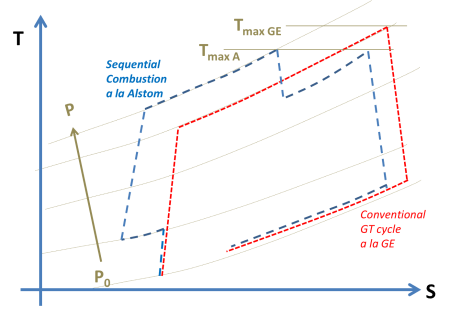
GT cycles - conventional and sequential combustion

GT cycles – conventional and sequential combustion

Now as GE, Siemens and Mitsubishi have moved on to even higher inlet temperatures, the “G” class has gone on to become the “J” class. (The “H” class was Mitsubishi attempting to use steam cooling for the turbine blades which didn’t really catch on and “I” has been passed over for the designation of turbine class). Alstom, with its limitations on temperature have successfully squeezed the sequential combustion technology to approach a “G+” performance with temperatures slightly lower than a “G” class from the others. But Alstom now also has reached its temperature limits and, I suspect, it was the lack of a way forward for their machines to compete with “J” class machines which has been part of their decision to get out of power generation.

But I like the concept of sequential combustion which is elegant and fundamentally sound and I look forward to the day when maybe it can be applied together with the high temperatures that GE knows how to handle. Then maybe we will someday see an “M” class gas turbine with 1600ºC and sequential combustion?
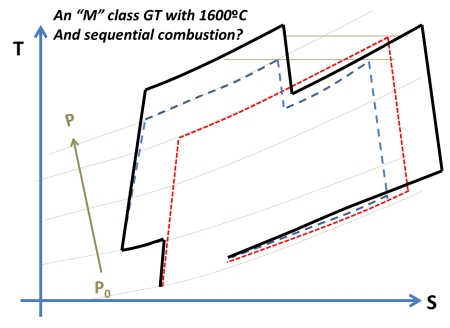
M Class GT?

M Class GT?

It can be argued therefore that the acquisition is what may actually keep R & D alive instead of it coming to a stop in the cul-de-sac in which it is stuck with Alstom.

And without R & D and high temperatures and new competitive “J” class products, Alstom’s days as a cutting-edge HDGT supplier would have been limited anyway.

5. The older GE machines  are still serviced by GE licencees and former licencees around the world – including in this case by Alstom (for GE machines prior to 1999). This Alstom does by means of a special subsidiary set up for the purpose. This unit – Power Systems Manufacturing – specialises in formerly licenced GE machines and also acts as a “pirate” for Siemens and Mitsubishi machines.

PSM’s product line includes … parts for GE Frame 6B, 7E/EA, 9E and 7FA machines, the Siemens/Westinghouse 501F (SGT6-5000F) engine and the Mitsubishi 501F engine.

Siemens also has such a subsidiary unit – Turbo Care – to service – where they can – the machines of competitors. This used to be a separate Siemens entity but has now been approved by the EC as a JV with the Wood Group. The “pirate” service business is important to each manufacturer – for intelligence and competition purposes – but the volume is quite small. No customer would select a “pirate” rather than the OEM, except for older machines past their prime or perhaps to teach the OEM “a lesson”. The “pirate” business is just not possible on relatively new machines and really only applies to machines installed more than about 10 years previously – when all liabilities and potential liabilities of the OEM have fallen away. No GT owner would take the risk of resorting to a “pirate” for a relatively new machine. A customer would usually resort to “pirates” only when all investment costs have been fully written off and he is no longer looking for – or particularly needs – any performance or availability guarantees. Even design and manufacturing warranties to be provided are strictly limited since the “pirate” has to rely on reverse engineering.  “Pirates” only come into the picture when the perceived risk levels are low.

The EC concern that if PSM is merged into GE, that some competition for the older GE machines will disappear is not correct I think, because for these older machines the competition for service business is far more with other “pirates” than with the OEM. And there are plenty of “pirates” around.

In the long run I judge that this acquisition is good for the customer, may even be good for R & D and even good for Siemens (and also for Mitsubishi). I imagine that any objections from Siemens are more for the sake of form (and because there is no love lost between Patrick Kron and Siemens).

In any event,  I expect that the deal will go through, but I will not be surprised to see an approval conditional on some assurances from GE regarding R & D centres, R & D jobs and/or R & D budgets in Europe. I think it highly unlikely – and a little meaningless – if the EC were to ask for divestment of Alstom’s HDGT business to a third party (if any such exists). The bottom line is, I think, that Alstom’s HDGT technology has come to a dead-end and can not be developed any further in their own hands. While the business can continue in a diminishing way for some years, Alstom technology has no long-term value except to another party which has access to high temperature cooling technology. To have Alstom continue with the HDGT business as an unwilling and reluctant player does no one any service at all.

ISRO successfully launches 3rd of the 7-satellite IRNSS

October 16, 2014

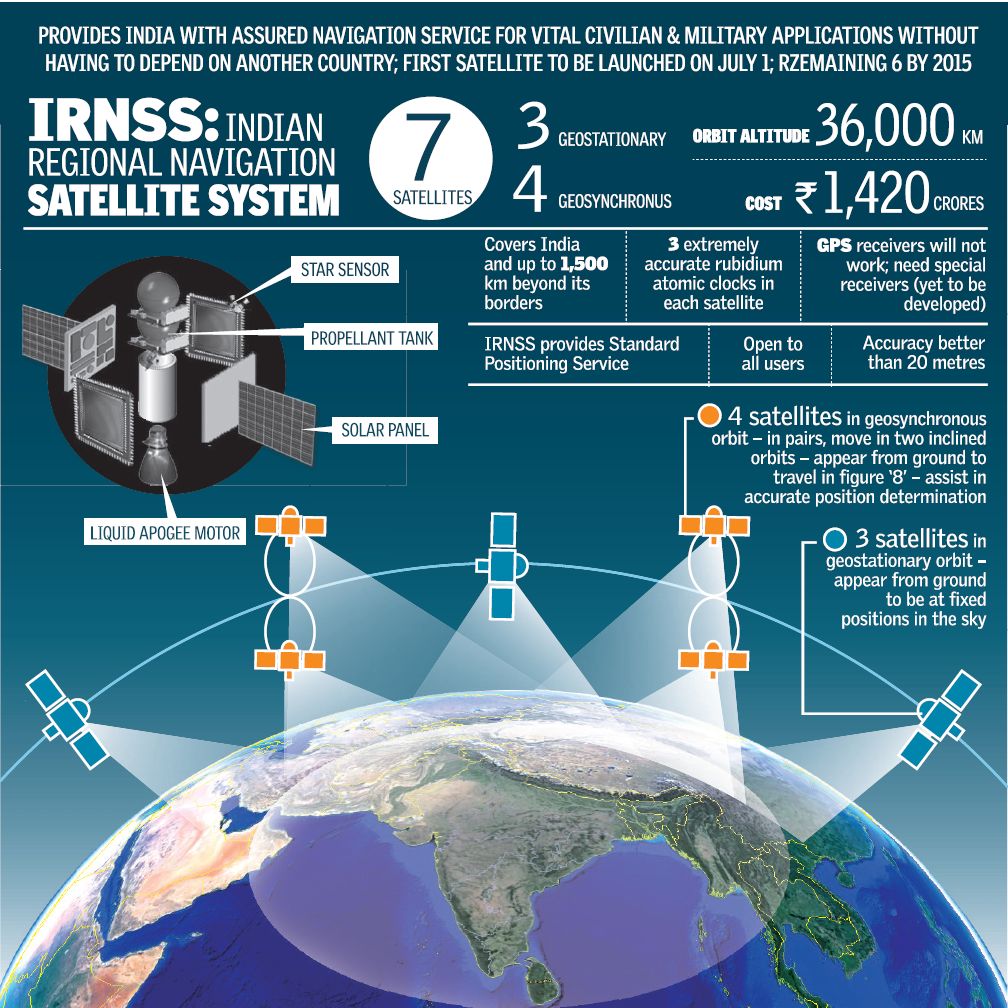
After the successful arrival of the MOM in Mars Orbit, ISRO has taken the more mundane step of putting the 3rd of 7 satellites for India’s satellite navigation system into place.

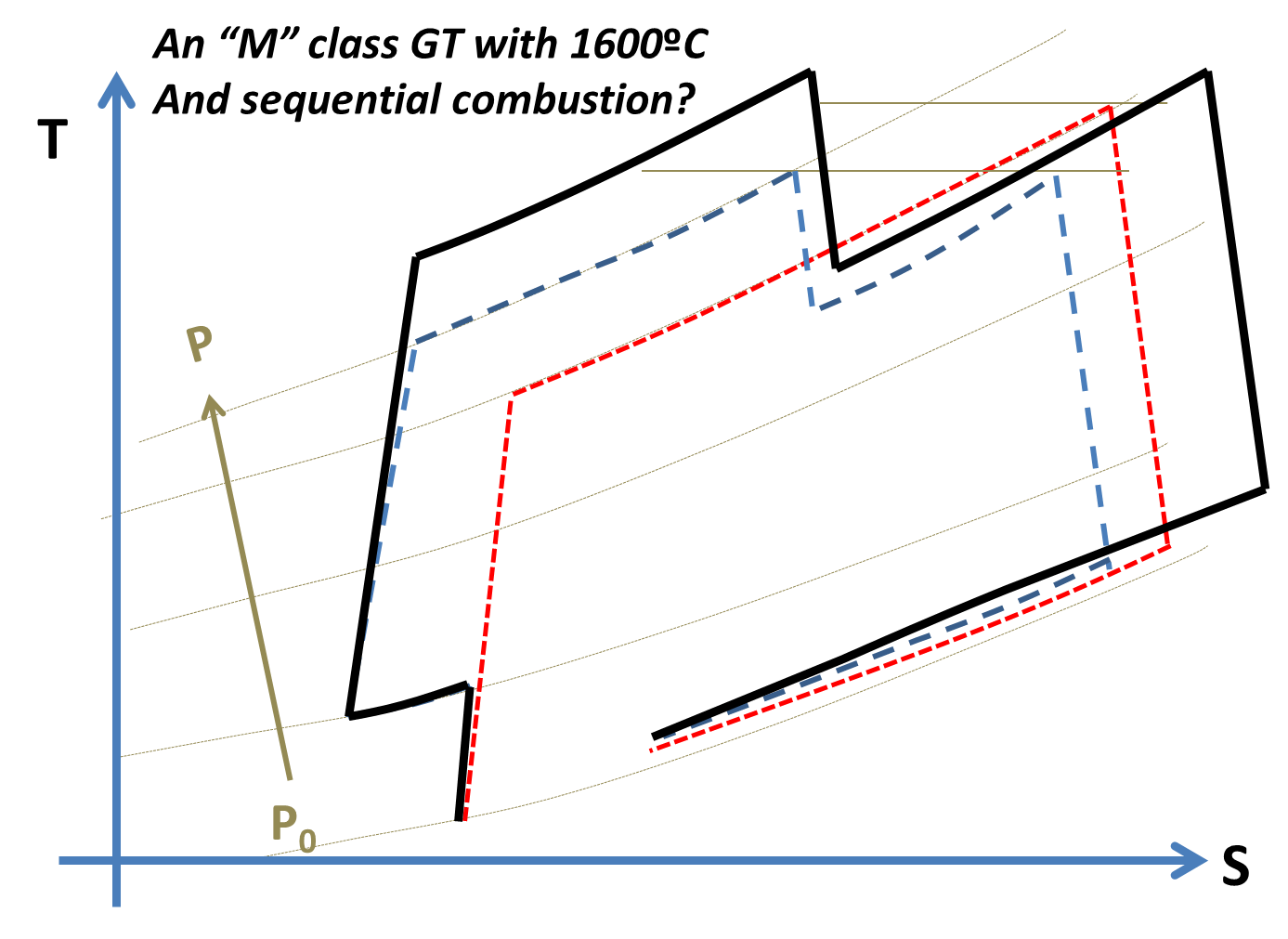
ISRO’s Polar Satellite Launch Vehicle, PSLV-C26, successfully launched IRNSS-1C, the third satellite in the Indian Regional Navigation Satellite System (IRNSS), in the early morning hours of today (October 16, 2014) at 0132 hours IST from Satish Dhawan Space Centre, Sriharikota. This is the twenty seventh consecutively successful mission of PSLV. The ‘XL’ configuration of PSLV was used for this mission. Previously, the same configuration of the vehicle was successfully used six times.

The Indian Regional Navigation Satellite System (IRNSS) is India’s 7-satellite global positioning system. It is similar to the GPS of the US, Russia’s Glonass , Europe’s Galileo  China’s Beidou and the Japanese Quasi Zenith Satellite System. The IRNSS is autonomous and under the control of the Indian Government. In addition to providing civilian navigation services (Standard Positioning Service – SPS) in a region extending 1500 km beyond the country’s borders, the IRNSS will also provide encrypted military and strategic services (Restricted Services – RS) independent of foreign governments. The positioning accuracy is designed to be 20 m in the primary service area. Each satellite is designed for a life of 10 years.

The IRNSS program received government approval in 2006 and is planned to be fully deployed by the end of 2015. The budgeted cost is 14.2 billion INR (about $240 million) and must count as another example of ISRO’s “frugal engineering”. The cost includes for two stand-by satellites on the ground making nine included in the budget. As a comparison Europe’s Galileo navigational system comprises 27 satellites and is expected to cost about 50 times more at about €10 billion ($13 billion).

IRNSS - ISRO

IRNSS – ISRO

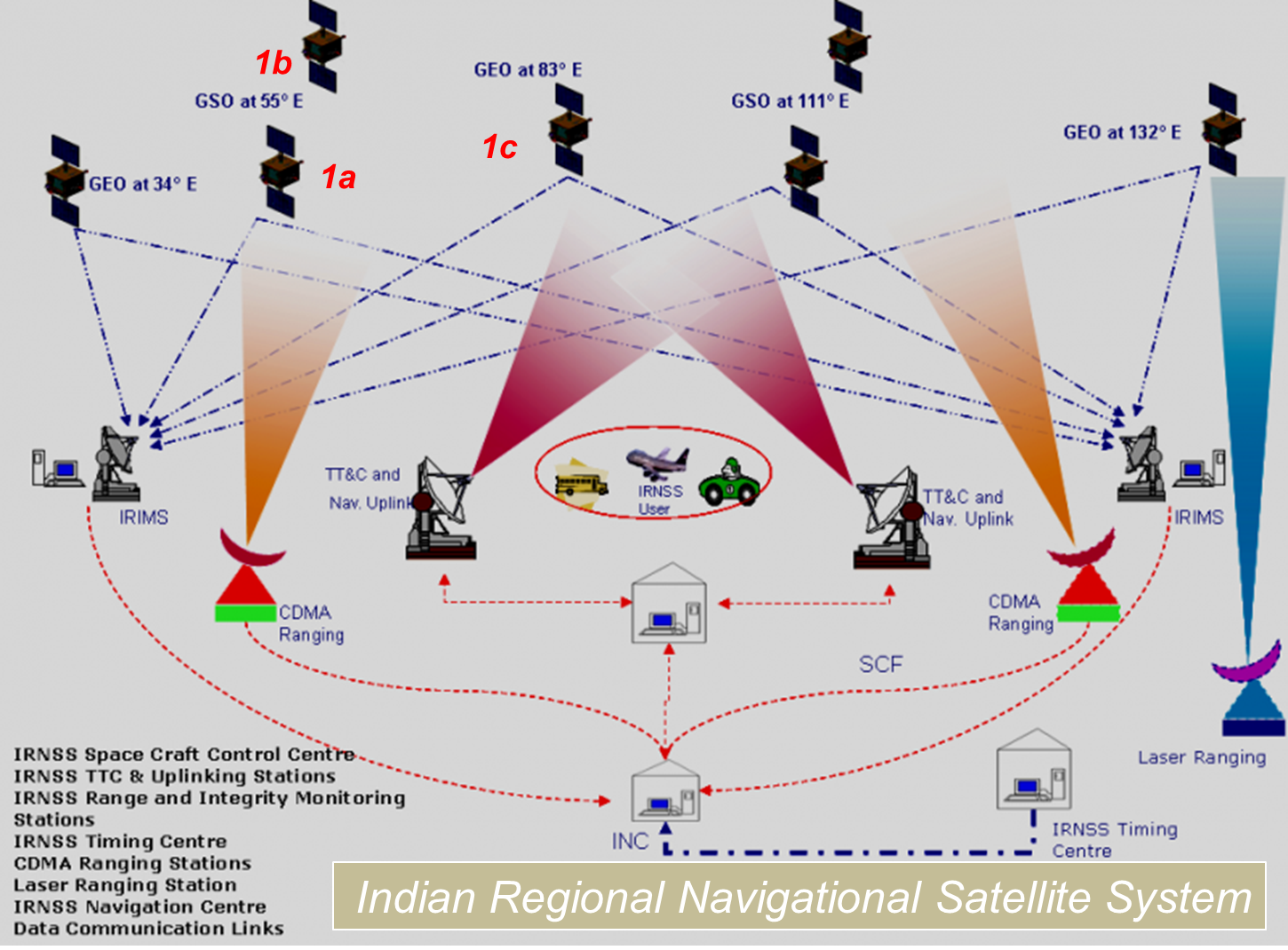
The 7 satellite system consists of 4 satellites as two pairs of geosynchronous satellites and 3 in geostationary orbit. The first two satellites in the series, IRNSS 1a and IRNSS 1b formed the first geosynchronous pair and were launched from Sriharikota on July 1st, 2013 and April 4th this year. respectively. The IRNSS-1c launched this morning is the first geostationary satellite and carries two payloads, one for transmitting navigation service signals to users and another consisting of a C-band transponder to facilitate Cube Retro Reflectors for laser ranging. It is the central satellite of the seven satellite configuration. The satellites launched so far are individually operational but the system will become operational only with the next launch of a geostationary satellite. (The system needs one geosynchronous pair, the central satellite and one more geostationary satellite to reach the threshold conditions to become operational). All seven satellites are planned to be in place and operational by the end of 2015.

IRNSS Architecture - ISRO

IRNSS Architecture – ISRO

NasaSpaceflight:

Based on ISRO’s I-1K satellite bus, each IRNSS satellite has a mass at launch of 1,425 kilograms (3,142 lb). Unfuelled, the spacecraft has a mass of only 600 kilograms (1,323 lb), with the remaining 825 kilograms (1,819 lb) being taken up by propellant for their apogee motors and manoeuvring engines.

The spacecraft are designed for ten years’ operational service. Generating 1.6 kilowatts of power through twin solar arrays, the satellites broadcast L5 and S band navigation signals. C-band transponders and retroreflectors are used for range calibration.

Each satellite is fitted with a single liquid apogee motor producing 440 newtons (99 pounds-force) of thrust. Three-axis control is provided by reaction wheels, magnetorquers and twelve reaction control thrusters.

The apogee motor is tasked with propelling the satellite from its initial deployment orbit into the final geostationary orbit, while the remaining thrusters will be used to manoeuvre and orient the spacecraft once it is in orbit.

IRNSS-1C is the first geostationary satellite in the IRNSS system. Planned for operation at a longitude of 83 degrees East, it will operate at the middle station of the constellation.

Two more geostationary satellites will be added; at longitudes of 34 and 132 degrees, while the remaining four spacecraft will operate in inclined geosynchronous orbits to increase the angle of separation between signals. Two of the inclined satellites are already in orbit; IRNSS-1A and 1B operate at a longitude of 55 degrees East. A second pair will be located at 111 degrees East next year.

The two satellites already in orbit were deployed in July 2013 and April 2014, both riding PSLV rockets to orbit from the Satish Dhawan Space Centre

The PSLV launch vehicle was introduced in 1993 and this is its 28th successful use (27th consecutive successful use). Today’s launch used the PSLV-XL configuration – the most powerful version of the PSLV currently flying – which makes use of six PS0M-XL boosters containing S-12 solid rocket motors. Four of these motors are lit when the rocket leaves its launch pad, with the remaining two lit during the early stages of its ascent.


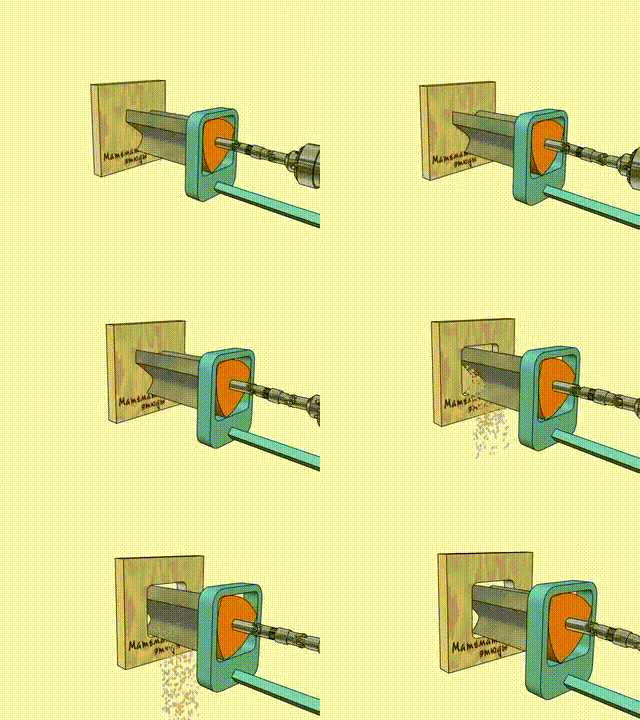
How to drill a square hole

August 26, 2014
how to drill a square hole (via imgur)

how to drill a square hole (via imgur)

gif image from here

MOM and MAVEN approach Mars

August 12, 2014

Both the Indian Mars Orbiter Mission (MOM – Mangalyaan, budget $70 million) and NASA’s MAVEN (budget $672 million) are now approaching Mars. Both are doing well according to their latest status updates.

MOM was launched on 5th November last year and MAVEN on 18th November, 2013. Whereas MAVEN on its Atlas 5 rocket could directly enter into a  Hohmann Transfer Orbit with periapsis at Earth’s orbit and apoapsis at the distance of the orbit of Mars, MOM had to take the low-cost, scenic route. Because of the relatively low payload capability of the PSLV launch rocket, MOM had to spend 26 days in ever-increasing earth orbits. MOM had to fire its Liquid Motor six times to work its way up to departing Earth orbit using a standard Hohmann Transfer Orbit on 1st December.

Alternate paths to Mars: NASA’s MAVEN compared to India’s MOM

MAVEN - MOM trajectories

MAVEN – MOM trajectories


When they were launched MAVEN was expected to reach Mars on 22nd September 2014 and MOM 2 days later on 24th September 2014. The time lines have shifted slightly subsequent to the mid-course corrections carried out and MOM is now expected to reach Mars orbit about a week ahead of MAVEN. I suspect that the time of Mars Orbit Insertion is still a little fluid, but both are about 1 month away. MOM is currently about 6 minutes away in radio signal distance.

Discovery News:

India’s Mars Orbiter Mission (MOM) is more than 80 percent of the way to Mars and performing well, according to a Facebook update posted July 21 by the Indian Space Research Organization. MOM is expected to enter orbit on Sept. 14.

The second craft, NASA’s Mars Atmosphere and Volatile EvolutioN (MAVEN), is also performing well. MAVEN is scheduled to embark on its final approach to the Red Planet on Sept. 21, one week after MOM’s arrival, principal investigator Bruce Jakosky said. After months of checkouts and tests, the spacecraft will now be left quiet until close to the big day.

NASA’s MAVEN has now gone into a “pre-Mars Orbit Insertion moratorium.” All systems required for a safe Mars Orbit Insertion remain powered on. But other systems like the instruments are shut down until late September because they are not needed for a successful MOI. We want the spacecraft system to be as “quiet” as possible and in the safest condition during the critical event on September 21st”.

Related: Frugal engineering for India’s Mars mission

The end of the road for the large Alstom gas turbines?

July 7, 2014

(corrected February 2015)

The large (>50MW) Alstom gas turbines (GT11N2, GT13E2, GT24 and GT26) represent a line of technology which derives mainly from the BBC range of products (developed further as ABB) and acquired by Alstom in 1999. At that time Alstom’s licence with GE came to an end. But as GEC-Alsthom, Alstom had also inherited the gas turbine technology which came out of GEC in the UK. In the current Alstom range not much remains of the GEC tradition. At the smaller end Alstom also once had the gas turbine technology of the Ruston engines from Lincoln and acquired the ABB range of small machines (which themselves carried forward the developments as ASEA and some of the Sulzer range). But the entire range of industrial (<50MW) gas turbines was divested to Siemens in 2003 (and they are doing very well there).

Now as GE takes over Alstom’s power business (which has still to get final regulatory approval but looks to be a done deal), the days of the Alstom range of large gas turbines are strictly numbered. GE (and Siemens) have their own machines competing directly with the GT24 (60Hz) and GT26 (50Hz) and I do not expect that any more of these machines will ever be sold again. The sequential combustion design concept that these machines employ is so far from the GE approach that it seems impossible for any versions of these machines to continue. Alstom (as ABB) had adopted sequential combustion in the late 1990’s firstly to differentiate themselves from GE and Siemens and to get over their lack of access to advanced, high-temperature materials coming out of military jet engine programmes. Sequential combustion was first used/tested by BBC in the 1960’s 1948* though at much lower temperatures and ABB was trying to create a virtue out of a disadvantage – which the GT24 and GT26 did eventually do, but not without great problems and great cost.

GE may well have some benefit from some of the component solutions that Alstom has been forced to develop – at great expense – to get over the challenges posed by sequential combustion. Similarly some of the low-NOx solutions developed by Alstom could possibly be of use for GE. There may be some tricks for GE to pick-up regarding compressors. Certainly GE will continue with the very lucrative service market in maintaining the Alstom fleet and this will continue for perhaps 10 or 12 years at most. So while GE will benefit from the service revenue and by the reach of Alstom’s global sales organisation, the GT24 and GT26 – as products – have very little benefit to offer. It will not be possible for GE to absorb all the manpower currently employed with Alstom’s gas turbines. Not all those currently involved with the design and manufacture of the GT24 and GT26 will be needed for – or be able to switch over to – the design and manufacture of the GE range. GE’s global procurement network and its qualification of sub-suppliers is probably much more advanced than Alstom’s. I don’t expect that GE’s global sourcing will be much enhanced by the acquisition of Alstom’s Power business. Some job losses at Alstom locations are inevitable and I suspect these will be mainly in Switzerland while jobs in France will be somewhat protected by GE’s promises to the French government. At Belfort, Alstom produced GE machines under licence till 1999 and no doubt this will become GE’s centre for large gas turbines in Europe.

The GT11N2 gas turbine will probably die a natural death. It has not been a really competitive machine for over a decade and even though it has gone through many upgrades and cost reduction exercises, It has some unique advantages with low-Btu fuels but I do not think it offers GE any great advantages and they already have competing machines. The GT11N2 may have survived a little longer within the more restricted Siemens stable but even here it would have eventually withered.

The GT13E2 is possibly the only machine that may survive for a while under GE. It has some unique advantages with low-Btu fuels and could have a geographical market niche in Russia and the former CIS countries. But if it does survive it will do so only as a niche product. Again it would probably have had a longer life under Siemens but my guess is that it will not be sold for more than another 2 or 3 years.

The next market boom for large gas turbines – by my analysis – will come in the second half of 2015. This will be due partly to the 7-8 year “normal” business cycle and partly due to, and reinforced by, the advent of shale gas. And when that boom comes, the Alstom machines will be absent and there will be one less gas turbine technology available in the world. GE, Siemens and MHI will be the only three technologies left and they will be the main beneficiaries. But just three technologies are not enough. A growing market together with a dearth of technology suppliers will probably ensure the entry of another player into the field of large gas turbines.

(Actually Siemens and MHI get the best return at the lowest cost. They gain increased market space as Alstom’s machines disappear at no cost to themselves. GE gains no new products, gets the same increased market space and gets increased service revenue for Alstom machines. But GE has a large cost of acquisition and a great deal of hassle – and cost – to come as they restructure and integrate the Alstom business).

I would guess that this fourth player could well be Shanghai Electric with their newly acquired 40% stake in Ansaldo Energia. This has been something of a coup for Shanghai Electric. Doosan were also eyeing Ansaldo as a way of entering the gas turbine playing field (the entry barriers are too high for a scratch player). Both Doosan and Siemens had made bids for Ansaldo Energia but Siemens’ bid was essentially a defensive and a spoiling bid and they eventually withdrew. Doosan were the sole remaining bidder but it seems that Shanghai have pipped them at the post for this strategic acquisition.

* Correction – Sequential combustion was first used by BBC at Beznau in 1948, operating on distillate and with a TIT of 575ºC.

100 days to Mars for ISRO’s Mangalyaan

June 16, 2014

Four days ago

  • The second Trajectory Correction Manoeuvre (TCM-2) of India’s Mars Orbiter Spacecraft was successfully performed on June 11, 2014 at 1630 hrs IST. TCM-2 was performed by firing the spacecraft’s 22 Newton thrusters for a duration of 16 seconds.
  • At present, the radio distance between the Spacecraft and the Earth is 102 million km. A radio signal from the Earth to the Spacecraft now takes about 340 seconds. The spacecraft so far has traveled a distance of 466 million km as part of its total Journey of 680 million km.
  • ISRO is continuously monitoring Mars Orbiter Spacecraft using Indian Deep Space Network (IDSN). The spacecraft and its five scientific instruments are in good health.

And 100 days from today on 24th September, ISRO’s frugally engineered  Mars Orbiter Mission (called Mangalyaan meaning Mars craft) should be inserted into Mars orbit. The highly over-rated movie “Gravity” had a larger budget at $100 million than ISRO’s $75 million for its Mars mission.

God is an hypothesis and a mathematician is a linguist

May 6, 2014

Science discovers, engineering invents.

Eyes are to vision as language is to discovery.

To be discovered it must first be imaginable.

To describe and communicate what can be imagined needs language.

To be “discovered” requires that something imagined in a language be “sensed” (observed or measured or calculated or inferred).

Something imagined to exist but not yet discovered is a faith – an hypothesis.

Without the attribute of hearing, there is no sound.

Discoveries need a suitable language to first describe them before they can be found (Mathematics, Chemistry, Algebra, Logic….).

Language is an invention and can not be discovered.

The application of discovered science to the manufacturing of artefacts is engineering.

Mathematics is a language and a mathematician is a linguist (an engineer).

Logic is a language and a logician is a philosopher.

Philosophers imagine and describe but neither discover nor invent.

Music is a science and a musician is a scientist.

Painting (or sculpture) is engineering and the artist is an engineer.

Medicine is a science but a practising physician is an engineer.

The symbol for a thing is not the thing.

God is an hypothesis and a mathematician is a linguist.


Boeing 787 Dreamliner still not out of the woods

March 9, 2014

The Dreamliner woes continue with cracks in the wings found during manufacture and another emergency landing for a JAL Dreamliner. And in the meantime Norwegian Airlines is in rough seas as a consequence of their Dreamliner problems but have still ordered another four aircraft. Their eggs are all in the Dreamliner basket now but Boeing must have provided a great many sweeteners. The Dreamliners are proving not to be as fuel efficient as it was claimed they would be when they were being sold. Air India which has taken delivery of 13 Dreamliners and has a total of 27 on order is also reported to be seeking compensation from Boeing.

JAL Dreamliner makes emergency landing in Honolulu

Japan Airlines said Sunday its Dreamliner flight from Tokyo to San Francisco made an emergency landing in Honolulu, reportedly due to a possible problem with its hydraulic system.

The pilot of flight JL002, carrying 171 passengers and crew, decided to divert to Hawaii after a warning message about falling pressure of lubricant oil in its right engine, according to Japanese national broadcaster NHK.

Boeing Has a New 787 Dreamliner Headache With Wing Cracks

Boeing’s 787 is the airplane program that keeps on giving—problems. The company will inspect about 40 airplanes and delay some 787 deliveries after Mitsubishi Heavy Industries, which makes the plane’s carbon fiber wing, discovered small cracks in newly built wings following a change in its manufacturing process, Boeing said Friday.

The cracked area is very small and will require repairs that will take a week or two per airplane, Boeing spokesman Marc Birtel said. “We are confident that the condition does not exist in the in-service fleet,” the company said in an e-mailed statement. “We understand the issue, what must be done to correct it, and are completing inspections of potentially affected airplanes.”

Mitsubishi Heavy crafts the wings in Nagoya, Japan, and Boeing flies them to its 787 assembly plants in Everett, Wash., and North Charleston, S.C. About 17 of the 787s being inspected are fully completed, and seven have been undergoing predelivery flight tests, according to the Wall Street Journal, which first reported news of the cracks.

Profits down after Dreamliner dramas

Norwegian Air reported a profit in 2013 for the seventh year running on Thursday, but takings were significantly down on previous years. Major problems setting up its new long-haul routes with trouble-plagued Boeing 787 Dreamliners led to a huge amount of customer complaints, and the budget carrier angered unions and other airlines over pay conditions and its use of cheaper Asian crews. Norwegian reported its pre-tax profits for 2013 were NOK 437 million (USD 71.5 million), down from NOK 623 million in 2012. The airline lost NOK 283 million in the fourth quarter.

Norwegian orders four more Dreamliners and reports Q4 losses

Norwegian Air Shuttle announced on Thursday the lease of four more Boeing 787 Dreamliner aircraft, despite a series of technical hitches with the planes. The contract, which brings Norwegian’s planned Dreamliner fleet to 14, was signed with the US aircraft leasing company International Lease Finance Corporation (ILFC) but no financial details were released.

Boeing Says Air India Unhappy With 787 Dreamliner’s Performance

Boeing Co. said Air India Ltd. is dissatisfied with the performance of its 787 Dreamliner, joining other carriers including Norwegian Air Shuttle ASA in slamming the manufacturer for repeated faults on its marquee jet. “Yes, they are not happy with the reliability portion, neither are we,” Dinesh Keskar, a senior vice president at the Chicago-based planemaker, said in an interview at the Singapore Air Show today. “Over the last few months, we understood which are the components that were causing issues, which software needs to be upgraded.”

…. Air India diverted one of its 787s to Kuala Lumpur this month as a precaution after a software fault on a flight to New Delhi from Melbourne. Boeing is upgrading software and changing some components on Air India 787s whenever the planes can be taken out of service, Keskar said, adding that a 13th Dreamliner will be delivered to the carrier this month. …… Air India, which has ordered 27 Dreamliners, will seek compensation from Boeing after the carrier found that its 787s aren’t as fuel efficient as the planemaker had claimed while selling them ……. Fuel efficiency of the Dreamliner is improving after earlier models didn’t “quite make the mark” on this count, Keskar said.

Going nuclear for a nanowatt battery life of 20+ years

February 28, 2014

Tritium batteries are now available commercially and can have a life exceeding 20 years (Tritium has a half-life of 12.3 years). These thumb-size batteries can produce enough nanowatt (1 nW = 10−9 watt) power to keep micro-electronics going. An 8-bit PIC microcontroller chip when in “sleep” mode consumes around 10 nW. The cost is still in thousands of Dollars but should come down fast. It appears that they could be scaled up to the microwatt (1 µW = 10−6 watt) range which would be enough to power a wristwatch.

Commercial nanoTritium battery by City Labs

Commercial nanoTritium battery by City Labs

Tritium (symbol T or 3H, also known as hydrogen-3) is a radioactive isotope of hydrogen. The nucleusof tritium (sometimes called a triton) contains one proton and two neutrons, whereas the nucleus of protium (by far the most abundant hydrogen isotope) contains one proton and no neutrons. Naturally occurring tritium is extremely rare on Earth, where trace amounts are formed by the interaction of the atmosphere with cosmic rays. The name of this isotope is formed from the Greek word “tritos” meaning “third”.

Tritium is produced in nuclear reactors by neutron activation of lithium-6. This is possible with neutrons of any energy, and is an exothermic reaction yielding 4.8 MeV. In comparison, the fusion of deuterium with tritium releases about 17.6 MeV of energy. High-energy neutrons can also produce tritium from lithium-7 in an endothermic reaction, consuming 2.466 MeV. This was discovered when the 1954 Castle Bravo nuclear test produced an unexpectedly high yield.

Gizmag reports:

(Tritium) although occurring naturally in the upper atmosphere, it’s also produced commercially in nuclear reactors and used in such self-luminescent products as aircraft dials, gauges, luminous paints, exit signs in buildings and wristwatches. It’s also considered a relatively benign betavoltaic, providing a continuous flow of low-powered electrons for a good many years.

According to the Environmental Protection Agency, tritium has a half-life of 12.3 years and the Model P100a NanoTritium betavoltaic power source from Toronto’s City Labs is claimed to be capable of providing juice to low-power micro-electronic and sensor applications for over 20 years. It’s described as robust and hermetically sealed, and the tritium is incorporated in solid form.

Independent testing undertaken by Lockheed Martin during an industry-wide survey also found the technology to be resistant to broad temperature extremes (-50° C to 150° C/-58° F to 302° F), as well as extreme vibration and altitude.

Examples of possible applications for the technology offered by City Labs include environmental pressure/temperature sensors, intelligence sensors, medical implants, trickle charging lithium batteries, semi-passive and active RFID tags, deep space probes, silicon clocks, SRAM memory backup, deep-sea oil well electronics, and lower power processors.

It is still a long way from microwatts to the kilowatts needed to power a home or to drive electric vehicles and the Megawatts needed for small scale power generation. Central power generation requires Gigawatts.

It is easier to convert nuclear radiation into heat and only some materials are betavoltaics which generate current. If only all low-grade radioactive waste from nuclear plants could be converted into batteries! Perhaps nuclear batteries are the breakthrough that electric cars are waiting for!! With current battery technology they are not going anywhere very fast.