Archive for the ‘Environment’ Category

Purple coloured wind turbines might save some bats

October 15, 2010

Reported by the BBC:


purple windmill


A study has revealed that a wind turbine’s colour affects how many insects it attracts, shedding more light on why the turbines occasionally kill bats and birds. Scientists say that turbines, most commonly painted white or grey, draw in insects. These then lure bats and birds – as they pursue their prey – into the path of the turbine blades. Support for the idea comes from another study showing that bats are most often killed by turbines at night and in summer, when insects are most abundant.

Bats are more likely to be killed by wind turbines at night and during the summer, researchers have discovered. The reason is thought to be because the turbines attract migrating insects. At some sites, 20 to 40 bats are killed each year per turbine, although rates of one to three bats are more typical.

Now scientists have ascertained that 90% of bat mortality occurs in northern Europe between late July and early October. A similar pattern occurs in North America. Observations from both continents also show that most bats are killed on relatively warm nights with low wind speed.

While the review by scientists does not provide all the answers, it suggests wind turbines are tall enough to attract insects migrating at night, which typically fly at heights of over 60m. Bats and birds are then killed by turbine blades as they feed on this insect bonanza.

PhD student Chloe Long of Loughborough University, UK. and her Loughborough colleagues, Dr James Flint and Dr Paul Lepper, conducted the first empirical study of insect attraction to wind turbines, the results of which are published in the European Journal of Wildlife Research.

In particular, they measured how a turbine’s colour alters how many insects gather around it. Most turbines are painted pure white or light grey, in a bid to make them as visually unobtrusive as possible. But insects, it seems, are unlikely to ignore these muted tones. The researchers measured how many insects were attracted to a range of paint colours, including pure white, light and dark grey, sky blue, red and purple.

Turbines painted pure white and light grey drew the most insects bar just one other colour; yellow. The colour they found least attractive was purple.


EUROPEAN JOURNAL OF WILDLIFE RESEARCH


The researchers also found that the ultraviolet and infrared components of paint colour, which humans cannot see but insects can, also had a significant impact, with higher levels of both attracting more insects.

Insect attraction to wind turbines: does colour play a role? by C. V. Long, J. A. Flint and P. A. Lepper

Mortality of bats at wind turbines links to nocturnal insect migration? by Jens Rydell, Lothar Bach, Marie-Jo Dubourg-Savage, Martin Green, Luísa Rodrigues and Anders Hedenström


Tenacious life – a new species of snail fish found at depth of 7000m

October 14, 2010


The new type of snailfish was found living at a depth of 22,966ft (7,000m) in the Peru-Chile trench of the South East Pacific Ocean.

Snailfish found living at a depth of 22,966ft Peru-Chile trench of the South East Pacific Ocean. Photo: Oceanlab, University of Aberdeen


Hot on the heels of discovering a biological oasis of life in hot, inky-black waters at the bottom of Yellowstone Lake in the midst of hundreds of geothermal vents comes news of  a new type of snailfish found living at a depth of 22,966ft (7,000m) in the Peru-Chile trench of the South East Pacific Ocean.

The Telegraph reports:

The 10 inch long tadpole-shaped creature with a large head, tiny eyes and pelvic fins has adapted to living in an icy cold, pitch black environment under constant, crushing pressure. Mass groupings of cusk-eels and large crustacean scavengers were also found living in the narrow abyss despite the inhospitable conditions.

The findings, in one of the deepest places on the planet, were made by a team of marine biologists from the University of Aberdeen and experts from Japan and New Zealand. The team took part in a three-week expedition, during which they used deep-sea imaging technology to take 6,000 pictures at depths between 14,764ft (4,500m) and 26,247ft (8,000m) within the trench.

The Peru-Chile Trench

The Peru-Chile Trench: Image via Wikipedia

The mission was the seventh to take place as part of HADEEP, a collaborative research project between the University of Aberdeen’s Oceanlab and the University of Tokyo’s Ocean Research Institute, supported by New Zealand’s National Institute of Water and Atmospheric research (NIWA).

Oceanlab’s Dr Alan Jamieson, who led the expedition said these latest discoveries helped shed new light on life in the depths of the Earth. “Our findings, which revealed diverse and abundant species at depths previously thought to be void of fish, will prompt a rethink into marine populations at extreme depths,” he said.

“This expedition was prompted by our findings in 2008 and 2009 off Japan and New Zealand where we discovered new species of snailfish known as Liparids inhabiting trenches … at depths of approximately 7,000 metres – with each trench hosting its own unique species of the fish.

“To test whether these species would be found in all trenches, we repeated our experiments on the other side of the Pacific Ocean off Peru and Chile, some 6,000 miles (9,656km) from our last observations.

“What we found was that indeed there was another unique species of snailfish living at 7,000 metres – entirely new to science – which had never been caught or seen before.”

The new snailfish will not be named until it is officially confirmed as a new species.

The estimates of the number of unknown marine species may be at the top end of the range estimated between 1 million and 10 million species. However, plant and animal diversity looks insignificant compared to the sea’s micro-organisms, which may number 1 billion. Their diversity is “spectacular”.

IPCC Meeting opens in Busan. Pachauri to go?

October 11, 2010

It is time for Pachauri to call it a day. Even though the Indian Government is forced to support the discredited Chairman, the recommendation that the Chairman not serve more than one term will probably be followed.

(400 delegates! And the UN meeting has just been held in Beijing. Cancun in November. A gravy train, hot air and not just a few ounces of carbon dioxide!!)

KBS World reports that

The 32nd general assembly of the Intergovernmental Panel on Climate Change (IPCC) opened in Busan today.
Attending the four-day meeting are IPCC Chairman Rajendra Pachauri, the heads of the World Meteorological Organization and the U.N. Environment Program, and some 400 other delegates from 194 countries. The participants will discuss 14 issues, including the publication of the IPCC’s fifth assessment report that will be announced in 2014.

The Times of India believes the Busan meet will decide Pachauri’s fate as IPCC head.

Though the Council had recommended that the “the term of the IPCC Chair should be limited to the timeframe of one assessment”, and Pachauri has already headed one such assessment report, which was released in 2007, the Indian government plans to back the director of The Energy Research Institute (TERI) at the meeting.
But, the Indian representatives at the meeting will ask for immediate implementation of all the other reforms of the committee set up after the Himalayan glacier scandal that had dented the IPCC’s reputation earlier this year.


THIRTY-SECOND SESSION OF THE IPCC

Busan, 11-14 October 2010

IPCC-XXXII/Doc. 1

(4.VIII.2010)

Agenda Item: 1

ENGLISH ONLY


PROVISIONAL AGENDA

1. OPENING OF THE SESSION

2. APPROVAL OF THE DRAFT REPORT OF THE 31st SESSION

3. IPCC PROGRAMME AND BUDGET FOR 2010-2014

4. THE IPCC 5TH ASSESSMENT REPORT (AR5)

4.1. Scope, content and process for the preparation of the AR5 Synthesis Report

4.2 Progress reports and schedule of AR5 related activities

5. REVIEW OF THE IPCC PROCESSES AND PROCEDURES:

REPORT BY THE INTER ACADEMY COUNCIL

6. ADMISSION OF OBSERVER ORGANIZATIONS

7. RULES OF PROCEDURES FOR THE ELECTION OF THE IPCC BUREAU AND ANY

TASK FORCE BUREAU

8. REPLACEMENT OF MEMBERS OF THE IPCC BUREAU

9. COMMUNCATIONS STRATEGY

10. MATTERS RELATED TO UNFCCC

11. OTHER PROGRESS REPORTS

11.1 Special Report on Renewable Energy Sources and Climate Change Mitigation

11.2 Special Report on Managing the Risks of Extreme Events and Disasters to Advance

Climate Change Adaptation

11.3 Task Force on National Greenhouse Gas Inventories

11.4 Task Group on Data and Scenario Support for Impact and Climate Analysis

(TGICA)

11.5 Development of new scenarios

11.6 IPCC Scholarship Programme

11.7 Implementation of decisions taken at the 30th Session

11.8 Any other progress reports

12. OTHER BUSINESS

13. TIME AND PLACE OF THE NEXT SESSION

14. CLOSING OF THE SESSION


Evaporation from land increased from 1982 to 1998 and then stopped

October 10, 2010

Interesting paper but the headlines it generates are even more interesting.

A new Letter to  Nature:

Recent decline in the global land evapotranspiration trend due to limited moisture supply

Martin Jung et al, NatureDOI:10.1038/nature09396

The authors write:

Our results suggest that global annual evapotranspiration increased on average by 7.1 ± 1.0 millimetres per year per decade from 1982 to 1997. After that, coincident with the last major El Niño event in 1998, the global evapotranspiration increase seems to have ceased until 2008. This change was driven primarily by moisture limitation in the Southern Hemisphere, particularly Africa and Australia.

But the New Scientist in its wisdom reports this under the headline:

Water cycle goes bust as the world gets warmer

That evapotranspiration should decrease if the moisture is not there in the first place seems perfectly reasonable.  That we will have to use technology to get ground water levels back up as water usage increases is also fairly obvious.

It occurs to me that global temperatures have been stable if not declining over the last decade which also fits the period when they measured the stable evapotranspiration.

I note – in passing – that evaporation from ocean surfaces is some 7 times greater than the evaporation from land surfaces while precipitation over the oceans is about 4 times greater than that over land.

But the NS headline is a little bizarre.


The Sun moves to its own music

October 6, 2010

Totally impervious to vulgar 10:10 videos, biodiversity 10.10 campaigns, 0% interest rates and other goings-on on Earth, the Sun moves to its own music.

It was spotless again.

Spotless Sun 5th October 2010: NASA image

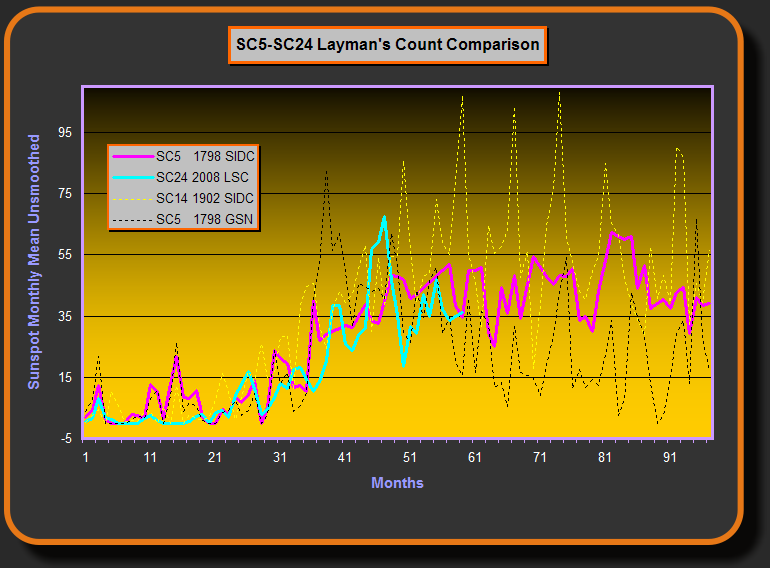
Sunspot numbers and 10.7 flux continue to be significantly lower than forecast (and the forecast for Cycle 24 were pretty low to begin with).

2010/10/05 08:00 Today was spotless although Locarno managed to see two groups. The specks were tiny and would be on the fringe of visibility on the original Wolf 64x telescope on a perfect day. What could be old area 1106 may be returning in the next two days.

Yesterday’s adjusted F10.7 flux figures recorded a high of 76.6 (81.4) and a low of 74.7 (78.8), unbelievably low.

F10.7 Radio Flux (including September 2010)

That we are in a solar minimum (the Landscheidt minimum) seems clear but whether it will be a grand minimum remains to be seen.

sc5 sc24 comparison

sc5,sc14 comparison with sc24

And the sun will surely impact our climate — but how?

And in any case the sun gets no feedback and it does not much care.


How exactly is biodiversity a problem?

October 5, 2010

Yesterday The Guardian reported that

While some 230,000 marine species have been recorded there are thought to be at least 1 million species in the sea. Ian Poiner, chair of the Census of Marine Life (COML) steering committee, said: “All surface life depends on life inside and beneath the oceans. Sea life provides half of our oxygen and a lot of our food and regulates climate. We are all citizens of the sea”. To mark the end of the COML project, scientists at the British Antarctic Survey (BAS) showed off the results of the Census of Antarctic Marine Life, an inventory of more than 16,000 marine species and the culmination of more than 19 trips into Antarctic waters.

In fact the total is unknown and may be as many as 10 million. The New Scientist points out:

A newly discovered copepod (Image: Jan Michels)

A newly discovered copepod (Image: Jan Michels)

“There are three to four unknown species for every known,” says Paul Snelgrove of Memorial University of Newfoundland in St John’s, Canada.

The Census has so far added 1200 new species to the tally, though that is likely to rise as over 5000 more organisms that were collected have yet to be studied or named. The new species include several that were thought to have disappeared, such as the “Jurassic shrimp”, which was believed to have died out 50 million years ago.

The Census was also able to identify those regions that are richest in diversity, which include the Gulf of Mexico and the Australian coastline. The Galapagos Islands, meanwhile, turned out to have less biodiversity than the chilly South Orkney Islands, in the Southern Ocean near Antarctica.

However, plant and animal diversity looks insignificant compared to the sea’s micro-organisms, which may number 1 billion. Their diversity is “spectacular”, Snelgrove says.

Just a few days ago Science reported that

Diana Fisher and Simon Blomberg of the University of Queensland in Australia carried out a comprehensive analysis of missing and extinct mammalian species. They created a database of all 187 mammal species that have been identified as extinct or possibly extinct, then combed through the literature to find out which ones had been rediscovered. They also included what threats the species had been facing, such as habitat destruction or hunting.

(more…)

Sony disassociate themselves from 10:10

October 4, 2010

I just received the following email from Nick Sharples, Sony Europe’s Director of Communications:

Dear Mr. Pillai,

Thank you for your email concerning the video released by the 10:10 climate change campaign group. Sony has supported the 10:10 climate change campaign because we share its objective to reduce carbon emissions. However, we strongly condemn the “No Pressure” video which was conceived, produced and released by 10:10 entirely without the knowledge or involvement of Sony. The company considers the video to be ill-conceived and in extremely bad taste. We also believe the video risks undermining the work of the many thousands of members of the public, schools and universities, local authorities and many businesses, of which Sony is one, who support the long-term aims of the 10:10 movement and who are actively working towards the reduction of carbon emissions.

As a result we have taken the decision to disassociate ourselves from 10:10 at this time.

In our press statement we will be posting tomorrow morning we reaffirm our ongoing commitment to the reduction of global carbon emissions as part of our ‘Road to Zero’ environmental plan.

Yours sincerely,

Nick

Nick Sharples

Director of Corporate Communications

Sony Europe

The Heights, Weybridge

Surrey, KT13 0XW

nick.sharples@eu.sony.com

+44 (0)7786 114 870 (Mobile)

+44(0)1932 816 828 (Office)

Biodiversity 100 – another 10.10 crisis?

October 4, 2010

The Guardian today (and they have yet to distance themselves from their support for their 10: 10 partners):

Talk has not halted biodiversity loss – now it’s time for action

Guillaume Chapron and George Monbiot: “Help us compile a list of 100 tasks (that’s 10.10 to the rest of us) that G20 governments should undertake to prove their commitment to tackling the biodiversity crisis”.

Lurching from one crisis to the next

This comes a day after such headlines  as:

Oceans could contain 750,000 undiscovered species

The world’s oceans are teeming with far greater diversity of life than was previously thought, according to the first Census of Marine Life.

This plethora of manufactured crises is becoming farcical.

Mr. Monbiot has been silent regarding the 10:10 fiasco.

The Guardian is busy positioning itself for the next crisis when biodiversity becomes less fashionable.

The water footprint


Onwards and upwards.

Three Gorges Dam to reach full water level this month

October 4, 2010

The Three Gorges Dam is a hydroelectric dam that spans the Yangtze River by the town ofSandouping, located in the Yiling District of Yichang, in Hubei province, China.

Map of the location of the Three Gorges Dam, Sandouping, Yichang, Hubei Province, China and major cities along the Yangtze River

Three Gorges Dam location: Wikipedia image

The dam body was completed in 2006. Except for a ship lift, the originally planned components of theproject were completed on October 30, 2008, when the 26th generator in the shore plant began commercial operation. Each generator has a capacity of 700 MW. Six additional generators in the underground power plant are not expected to become fully operational until 2011. Coupling the dam’s 32 main generators with 2 smaller generators (50 MW each) to power the plant itself, the total electric generating capacity of the dam will eventually reach 22,500 MW.

Xinhua reports  from Yichang, Hubei that the water level at the Three Gorges Dam, the world’s largest water control project, reached 164.59 meters on Sunday, only 10 meters short of its full capacity of 175-meters. The dam in central China started to hold back water this September by discharging less to the lower reaches of the Yangtze River, the country’s longest river.

When the water level is at its maximum of 175 metres over sea level (110 metres above the river level downstream), the dam reservoir is about 660 kilometres  in length and 1.12 kilometres  in width on average, and contains 39.3 km3 of water. The total surface area of the reservoir is 1,045 km². The reservoir flooded a total area of 632 km² of land, compared to the 1,350 km² of reservoir created by the Itaipu Dam on the border of Brazil and Paraguay (which has a  generating capacity of 14,000 MW).

File:Yangtze longitudinal profile upstream.JPG

Yangtze longitudinal profile: Wikipedia image

Reaching the 175-meter water level would enable the Three Gorges Dam to fulfill its functions of flood control and generating electricity to the fullest extent, symbolizing the total success of the massive water project. This is the reservoir’s third attempt to reach full capacity since 2008. However, water levels stopped at 172.8 meters in 2008 and 171.43 meters in 2009 due to droughts on the lower reaches.

However, this time officials believe the dam will reach full capacity by the end of October.

Changed Landscape of the Three Gorges Dam region. (NASA/Goddard Space Flight Center Scientific Visualization Studio).

Life flows back into the Murray-Darling Basin

October 1, 2010

From the Sydney Morning Herald:

An aerial view of the Choke (north and south lagoon) of the Coorong. Photo: David Mariuz

The long wait is almost over at the mouth of Australia’s greatest river. A decade after it last spilt into the sea, the Murray River will reconnect with the Southern Ocean in a matter of days.

The Murray-Darling Basin is having its fourth wettest year (to date) on record, the Bureau of Meteorology said yesterday. The Murray’s famous Lower Lakes – surviving on environmental ”death row” last year – have swollen close to 150 centimetres higher than the nadir of 2009, thanks mostly to summer downpours in northern Australia and the September floods in Victoria.

Chief executive of South Australia’s environment and water department Allan Holmes is bullish about the future, saying the region was already ”an entirely different environment” to the one he was managing six months ago. ”These systems, provided you don’t tip them over the edge, are enormously resilient and they come back with a vengeance,” he said.

Just a month ago The plight of Australia’s Murray-Darling Basin was being attributed to climate change:

“Australian climate scientists see the country as ‘extremely vulnerable’ to climate change and the Murray-Darling Basin as a ground zero for global warming. Climate change advisors to Australia’s government have warned that agricultural production in the basin could fall by up to 92% by 2100”.

“Global warming will trigger more frequent and severe droughts, as well as more devastating bushfires, cyclones and floods”–Kathy Marks.