Now a real image actually taken of South Asia on Diwali night (November 12th/13th) this year has been released by NASA and they write: “In reality, any extra light produced during Diwali is so subtle that it is likely imperceptible when observed from space”.
Every fall, Hindus around the world light lamps, candles, and firecrackers as part of a five-day festival known asDiwali. The celebration, which has roots as a harvest festival, usually falls between mid-October and mid-November. In 2012, it began on November 11.
On November 12, 2012, the Visible Infrared Imaging Radiometer Suite(VIIRS) on theSuomi NPP satellite captured this nighttime view of southern Asia. The image is based on data collected by the VIIRS “day-night band,” which detects light in a range of wavelengths from green to near-infrared. The image has been brightened to make the city lights easier to distinguish.
Most of the bright areas are cities and towns in India, the country with the world’s largest Hindu population. India is home to more than 1.2 billion people and has 30 cities with populations over 1 million. (For comparison, China has 62 cities with more than 1 million residents and the United States has 9). Cities in Bangladesh, Nepal, and Pakistan are also visible near the edges of the image.
An image that claims to show the region lit for Diwali has been circulating on social media websites and the Internet in recent years. In fact, it does not show what it claims. That image, based on data from the Operational Linescan System flown on U.S. Defense Meteorological Satellite Program (DMSP) satellites, is a color-composite created in 2003 by NOAA scientist Chris Elvidge to highlight population growth over time. In that image, white areas show city lights that were visible prior to 1992, while blue, green, and red shades indicate city lights that became visible in 1992, 1998, and 2003 respectively.
In reality, any extra light produced during Diwali is so subtle that it is likely imperceptible when observed from space.
While the Indian origin of the European Roma populations is linguistically and genetically well-established, accurate identification of their South Asian source has remained a matter of debate. A new open access paper PLoS ONE 7(11): e48477. doi:10.1371/journal.pone.0048477now pinpoints the ancestry of today’s Roma to the ancestors of the Adivasi (“original people) tribes of North West India.
The picture purports to be from NASA of Diwali night as seen from space. (This year Diwali was on 13th November).
It is indeed from NASA, it is from space and it is at night. But it is not on a Diwali night and is actually a composite picture of night illumination over many years to try and show population increase. Even the colours are not real. It was circulated widely at this time last year as well. But as Robert Johnson of Business Insider points out:
The photo is an overlay of shots highlighting India’s burgeoning population over several years. The white lights were the only illumination visible before 1992. The blue lights appeared in 1992. The green lights in 1998. And the red lights appeared in 2003.
Current speculation suggests the lights are a result of the Hindu celebration Diwali, or the celebration of lights, held from mid-October to mid-November, but NASA was unable to confirm what time of year the shots were taken.
…. NASA says there are no more recent versions available.
Large public contracts in India are often plagued by claims of favouritism, rigged specifications to suit a particular bidder, rigged evaluations, bid cancellations, vicious publicity campaigns by the protagonists and innumerable rebids. It is not uncommon for high profile complaints by a bidder after losing a bid to lead to a reversal of an award decision. The more high profile the complaint is and the closer in time a complaint is to an election, the more likely it is that a reversal of a decision can be achieved. The sales process in India does not end when a contract is awarded and any self-respecting sales manager does not stop until he has tried all available avenues to reverse an award decision which has gone against his bid. The primary avenues available are through approaches to politicians and the bureaucrats involved in the evaluation and award (and these approaches are not always without the appropriate lubricating flows of money). For politicians, the bureaucrats are both the potential scapegoats and the potential justification for reversals of decisions. For good and bad, the Indian Civil Service is modeled on the British Civil Service and the interactions between politicians and bureaucrats in India today have their roots in the methods of the British Raj. Bidding flaws and reversals of contract awards are usually a good indicator for the presence of corruption.
Phases of approval reversals
This story in the UK where high profile complaints from Richard Branson and Virgin Rail has led to the reversal of a decision to award a contract to a competitor could be a story lifted directly from an Indian newspaper. I note that in this case the politicians who have reversed their decision are using bureaucrats as their scapegoat. Who else? And when they make a new award they will surely justify their new decision on the pronouncements of other, more senior bureaucrats. It would seem that the methods of UK politicians and bureaucrats even today are not so different from those of their Indian counterparts. In India though, the opportunities afforded to bureaucrats and politicians by the bidding process have been raised to a much higher level.
Government cancels West Coast Mainline contract due to ‘flaws’ in bidding process
FirstGroup’s contract to run the West Coast Mainline has been cancelled by the Government due to “significant technical flaws” in the bidding process, which will be re-run. Transport Secretary Patrick McLoughlin said that the flaws “stem from the way the level of risk in the bids was evaluated”.
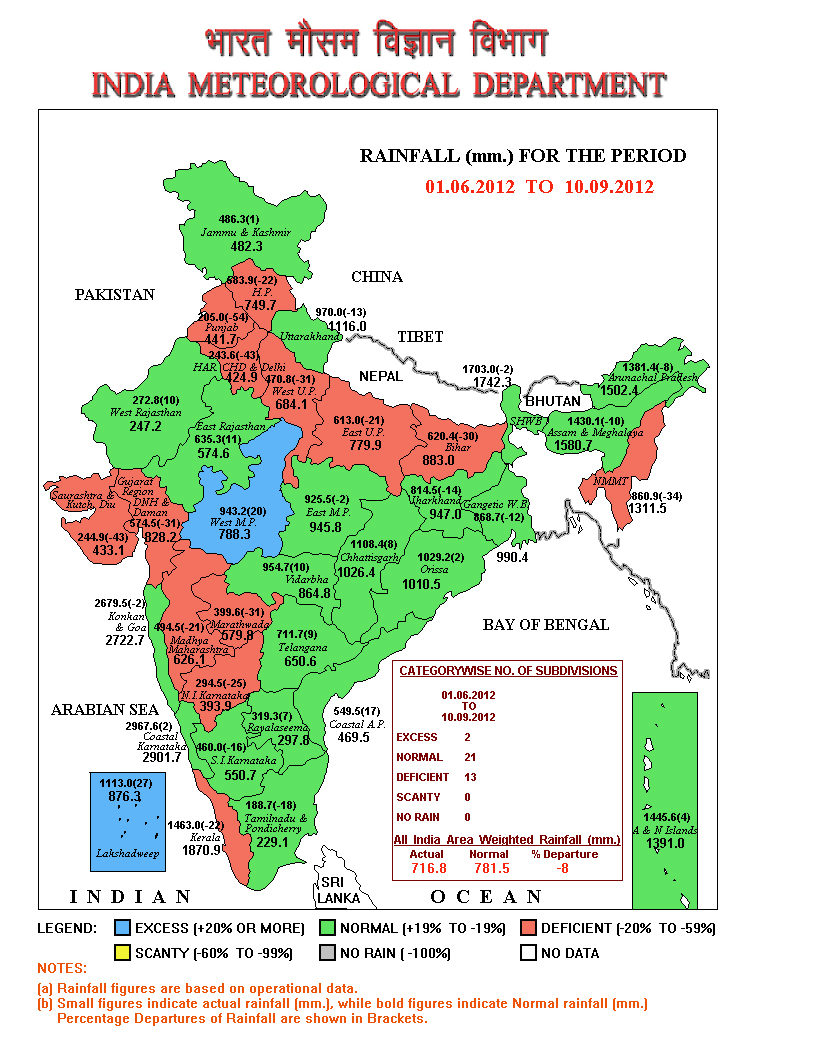
Rainfall was lower than normal in the first two months (-22% at the end of July) and surged somewhat in the final two. The monsoon takes the shape of a skewed “U” and advances N-W and withdraws to the S-E. The withdrawal of the South-West monsoon is underway but it is slightly delayed and this late withdrawal also helps in bringing additional rainfall especially at the ends of the “U” in the North-West and the North-East (with flooding recently in Pakistan and Assam).
Withdrawal of 2012 monsoon: IMD
Until September 26th, total rainfall was running about 7% less than the long-term average and within “normal” limits.
2012 Monsoon – Cumulative rainfall till 26th September : IMD
Though total rainfall will be almost “normal”, agricultural production will be slightly disturbed because of the uneven rainfall during the 4 months.
The Indian monsoon season officially covers the 4 months from June to September. Rainfall after the first 2 months was running some 25% less than “normal” and there were fears of severe effects not only directly on agricultural output but also for the knock-on effects on agriculture-related industry. But with 3 weeks left to go the rains seem to have recovered partially such that the total rainfall is running only 8% less than”normal”.
2012 monsoon rainfall till 10th September / image IMD
At the end of July the rainfall map was dominated by “pink” deficient states and with even a couple of “yellow” scanty states. The situation has improved considerably though the late rains will not be as beneficial as they could have been a few weeks ago. Nevertheless, 2012 will probably be considered – statistically – a pretty average year and this monsoon will not be a “bad” one. Since the difference between a “good” monsoon (about +10 -15%) and a bad one (-15%) is thought to about 2% for the annual GDP, this partial recovery will come as a relief to many.
The Indian space programme started 50 years ago and the Indian Space Research Organisation (ISRO) has now achieved its 100th mission. Of course there is a debate on whether this is money is well spent considering the many needs in the country. My own view is that it is. The long term development of technology, I think, takes precedence over some short term benefits if the money was spent elsewhere.
Daily Mail:The Indian space programme reached yet another milestone with the successful launch of the Polar Satellite Launch Vehicle (PSLV) carrying two foreign satellites from the Satish Dhawan spaceport, Sriharikota, in Andhra Pradesh on Sunday morning.
This is the Indian Space Research Organisation’s (ISRO) 100th mission, which began with an experimental satellite called Aryabhata launched by a Russian rocket in April 1975.
Incidentally, 2012 also marks 50 years of the start of the programme beginning with sounding rockets launched from Thumba in Kerala. ……
The launch was delayed by two minutes – from 9.51 am to 9.53 am – after a safety analysis of data relating to space debris and asteroids.
ISRO officials said this was a normal precaution taken to ensure safe journey for satellites to avoid any collision with space objects.
Both satellites have been placed into their orbits precisely.
The count of 100 space missions includes 63 Indian satellites, 36 launch vehicle missions and one reusable space recovery mission.
Prime Minister Manmohan Singh on Sunday congratulated scientists of the Indian Space Research Organisation (ISRO) for the successful launch of the Polar Satellite Launch Vehicle C-21 from Sriharikota.
Expressing happiness at witnessing the launch, Dr. Singh complimented the Department of Space and the ISRO fraternity on this “spectacular success.”
“As ISRO’s 100th space mission, today’s [Sunday’s] launch is a milestone in our nation’s space capabilities,” he told a gathering of scientists that included the former ISRO chiefs.
Dr. Singh also congratulated EADS Astrium of France and the Osaka Institute of Technology of Japan on the successful launch of their satellites. This achievement was a testimony to the commercial competitiveness of the Indian space industry and a tribute to Indian innovation and ingenuity.
He noted that the year also marked the 50th anniversary of the commencement of India’s space programme and acknowledged the presence of many stalwarts of the earlier space programmes, including Project Directors of space missions. “Given the string of successes since then, we often forget how challenging space technology is and what a relatively new field it continues to be.” …..
London 2012 has been a fantastic Olympics – the Bolt Games – notwithstanding a fairly pathetic closing ceremony.
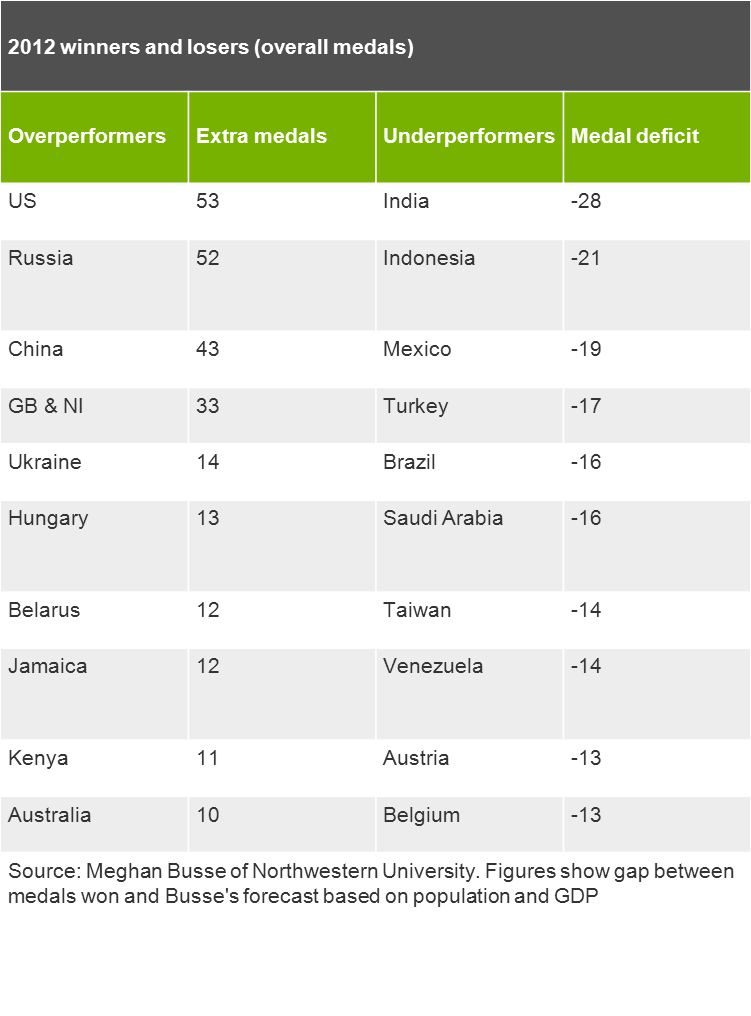
The BBC with the help of Meghan Busse from the Kellogg School of Management at Northwestern University in the US has produced a table of the underachieving and overachieving nations (based on population and GDP).
The top-10 list of countries that won most Olympic medals barely changed between 2008 and 2012. The top four – US, China, Russia, UK – were identical. Just one country dropped out – Ukraine – which was replaced by Japan. But which countries did better or worse than we should have expected?
“If you use those predictions as a kind of benchmark, then you can ask the question, who’s done well and not so well relative to that prediction – who won more medals than they should have, and who won fewer,” says Meghan Busse from the Kellogg School of Management at Northwestern University in the US, who helped with the sums.
India test fired its Agni-V ICBM today. Initial reports are of a successful launch though details of the 20 minute flight will take some time to be analysed.
The Hindu:India demonstrated its Inter-Continental Ballistic Missile (ICBM) capability on Thursday by successfully launching its most powerful and longest range missile, Agni-V, from the Wheeler Island off the Odisha coast.
The 17-metre-long surface-to-surface ballistic missile lifted off majestically from a rail mobile launcher at 8.04 a.m. After a flight time of 20 minutes, the missile re-entry vehicle impacted the pre-designated target point more than 5,000 kms away in the Indian Ocean with a high degree of accuracy.
Video of the launch ( from two different cameras) has already been posted on You-Tube. I can imagine that the most beautiful words for all those involved was the calm repetition of the phrase “Vehicle state is normal”.



 The k2p blog