Archive for the ‘India’ Category

Supreme Court rules against Bollywood union ban on women make-up artists

November 4, 2014

I posted recently about the challenge to the Bollywood union’s ban on women make up artists. The Supreme Court in India has now ruled that this ban is illegal (but in India labour laws are still among the most restrictive in the world though the new Modi government is beginning to address them). The court has given the union one week to delete their own rule restricting women and has assured the petitioners that if the union does not, the Court will.

Indian Express:

The 59-year-old practice in the Indian film industry that bars women from being classified as make-up artists is set to end with the Supreme Court stating on Monday that it would not allow this “constitutionally impermissible discrimination” to continue.

In the film industry, only men are allowed to become make-up artists while women are classified as hairdressers. The trade unions say this is to ensure that the men are not deprived of work.

“How can this discrimination continue? We will not permit this. It cannot be allowed under our Constitution. Why should only a male artist be allowed to put make-up? How can it be said that only men can be make-up artists and women can be hairdressers? We don’t see a reason to prohibit a woman from becoming a make-up artist if she is qualified,” said a bench of Justices Dipak Misra and U U Lalit.

“You better delete this clause on your own. Remove this immediately. We are in 2014, not in 1935. Such things cannot continue even for a day,” the court told the Cine Costume Make-up Artists and Hair Dressers Association (CCMAA). The court said the film industry, as a unit, could not be allowed to prolong this “gender bias”.

The court was hearing a petition by Charu Khurana and other women make-up artists, who were rebuffed by the CCMAA when they sought make-up artist cards. Khurana qualified from the Cinema Make-up School, California, but her application for membership was rejected by the CCMAA in 2009 because she is a woman.

The bench directed the body to come back with a “positive response” within a week. Khurana’s counsel, Jyotika Kalra, complained that Maharashtra’s union refused to delete the clause even after a state government order. “Don’t worry. If they don’t do it this time, we will order deletion,” assured the bench.

In the meantime the new Modi government has initiated moves to rationalise some of India’s archaic and restrictive labour laws:

India’s labour laws are restrictive in nature and hurt investments in the manufacturing sector. The Industrial Disputes Act (1947) has rigid provisions such as compulsory and prior government approval in the case of layoffs, retrenchment and closure of industrial establishments employing more than 100 workers. This clause applies even when there is a good reason to shut shop, or worker productivity is seriously low.

The Contract Labour (Regulation and Abolition) Act (1970) states that if the job content or nature of work of employees needs to be changed, 21 days’ notice must be given. The changes also require the consent of the employees, and this can be tricky.

While the right of workers to associate is important, the Trade Union Act (1926) provides for the creation of trade unions where even outsiders can be office-bearers. This hurts investor faith and restricts economic growth.

Rigid labour laws discourage firms from trying to introduce new technology, requiring some workers to be retrenched. This deters FDI because of the fear that it would not be possible to dismiss unproductive workers or to downsize during a downturn. Hence getting FDI into export-oriented labour-intensive sectors in India has not been fully achieved.

In contrast, China has succeeded in attracting FDI to export-oriented labour-intensive manufacturing, in part because of flexible labour laws such as the contract labour system implemented in 1995. Whereas in India, employers have taken to hiring workers on contract outside the institutional and legislative ambit, resulting in informalisation of the labour market. This hampers worker well-being. ……

To undo the malady in India’s labour market, some changes have recently been initiated in the three acts that largely govern India’s labour market: the Factories Act (1948), the Labour Laws Act (1988) and the Apprenticeship Act (1961). Amendments to some restrictive provisions of all these acts have been cleared by the Cabinet and are set to be tabled in Parliament. Key changes proposed include dropping the punitive clause that calls for the imprisonment of company directors who fail to implement the Apprenticeship Act of 1961.

The Government is also going to do away with a proposed amendment to the Act that would mandate employers to absorb at least half of its apprentices in regular jobs.

In order to provide flexibility to managers and employers, the amendment to the Factories Act includes doubling the provision of overtime from 50 hours a quarter to 100 hours in some cases and from 75 hours to 125 hours in others involving work of public interest. This is seen by some as being anti-labour as it imposes greater working hours without ensuring their security and welfare. …..

This is not a NASA image of India on Diwali night

October 23, 2014

It is doing the rounds again purporting to be a NASA image of India on Diwali night. It surfaces every year at Diwali time. It is a composite image and the coloured lights only represent different times between 1992 and 2003.

I just repeat what I wrote two years ago.

It is indeed from NASA, it is from space and it is at night. But it is not on a Diwali night and is actually a composite picture of night illumination over many years to try and show population increase. Even the colours are not real. It was circulated widely at this time last year as well. But as Robert Johnson of Business Insider points out:

The photo is an overlay of shots highlighting India’s burgeoning population over several years. The white lights were the only illumination visible before 1992. The blue lights appeared in 1992. The green lights in 1998. And the red lights appeared in 2003.

Current speculation suggests the lights are a result of the Hindu celebration Diwali, or the celebration of lights, held from mid-October to mid-November, but NASA was unable to confirm what time of year the shots were taken.

…. NASA says there are no more recent versions available.

Composite NASA image of India’s population development between 1992 and 2003. Blue is lights which appeared in 1992, green in 1998 and red in 2003. – image ngdc.noaa.gov


ISRO successfully launches 3rd of the 7-satellite IRNSS

October 16, 2014

After the successful arrival of the MOM in Mars Orbit, ISRO has taken the more mundane step of putting the 3rd of 7 satellites for India’s satellite navigation system into place.

ISRO’s Polar Satellite Launch Vehicle, PSLV-C26, successfully launched IRNSS-1C, the third satellite in the Indian Regional Navigation Satellite System (IRNSS), in the early morning hours of today (October 16, 2014) at 0132 hours IST from Satish Dhawan Space Centre, Sriharikota. This is the twenty seventh consecutively successful mission of PSLV. The ‘XL’ configuration of PSLV was used for this mission. Previously, the same configuration of the vehicle was successfully used six times.

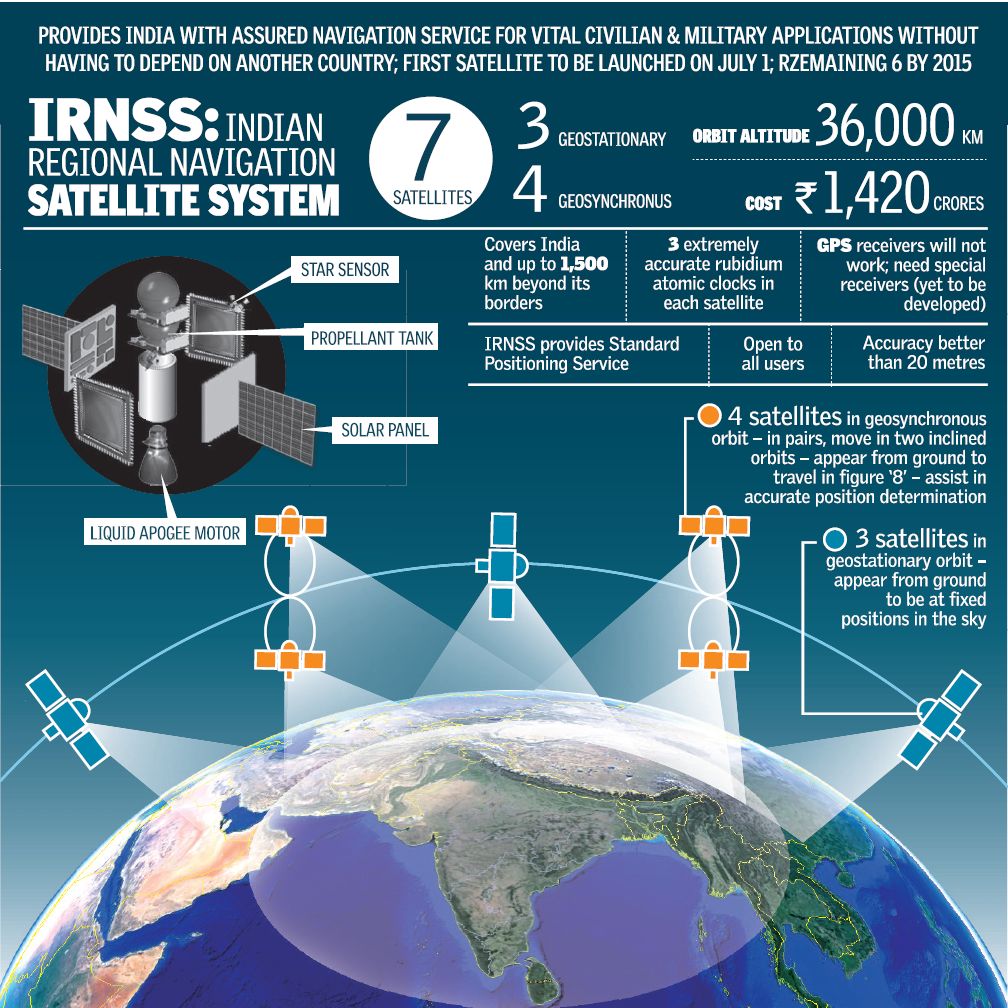
The Indian Regional Navigation Satellite System (IRNSS) is India’s 7-satellite global positioning system. It is similar to the GPS of the US, Russia’s Glonass , Europe’s Galileo  China’s Beidou and the Japanese Quasi Zenith Satellite System. The IRNSS is autonomous and under the control of the Indian Government. In addition to providing civilian navigation services (Standard Positioning Service – SPS) in a region extending 1500 km beyond the country’s borders, the IRNSS will also provide encrypted military and strategic services (Restricted Services – RS) independent of foreign governments. The positioning accuracy is designed to be 20 m in the primary service area. Each satellite is designed for a life of 10 years.

The IRNSS program received government approval in 2006 and is planned to be fully deployed by the end of 2015. The budgeted cost is 14.2 billion INR (about $240 million) and must count as another example of ISRO’s “frugal engineering”. The cost includes for two stand-by satellites on the ground making nine included in the budget. As a comparison Europe’s Galileo navigational system comprises 27 satellites and is expected to cost about 50 times more at about €10 billion ($13 billion).

IRNSS - ISRO

IRNSS – ISRO

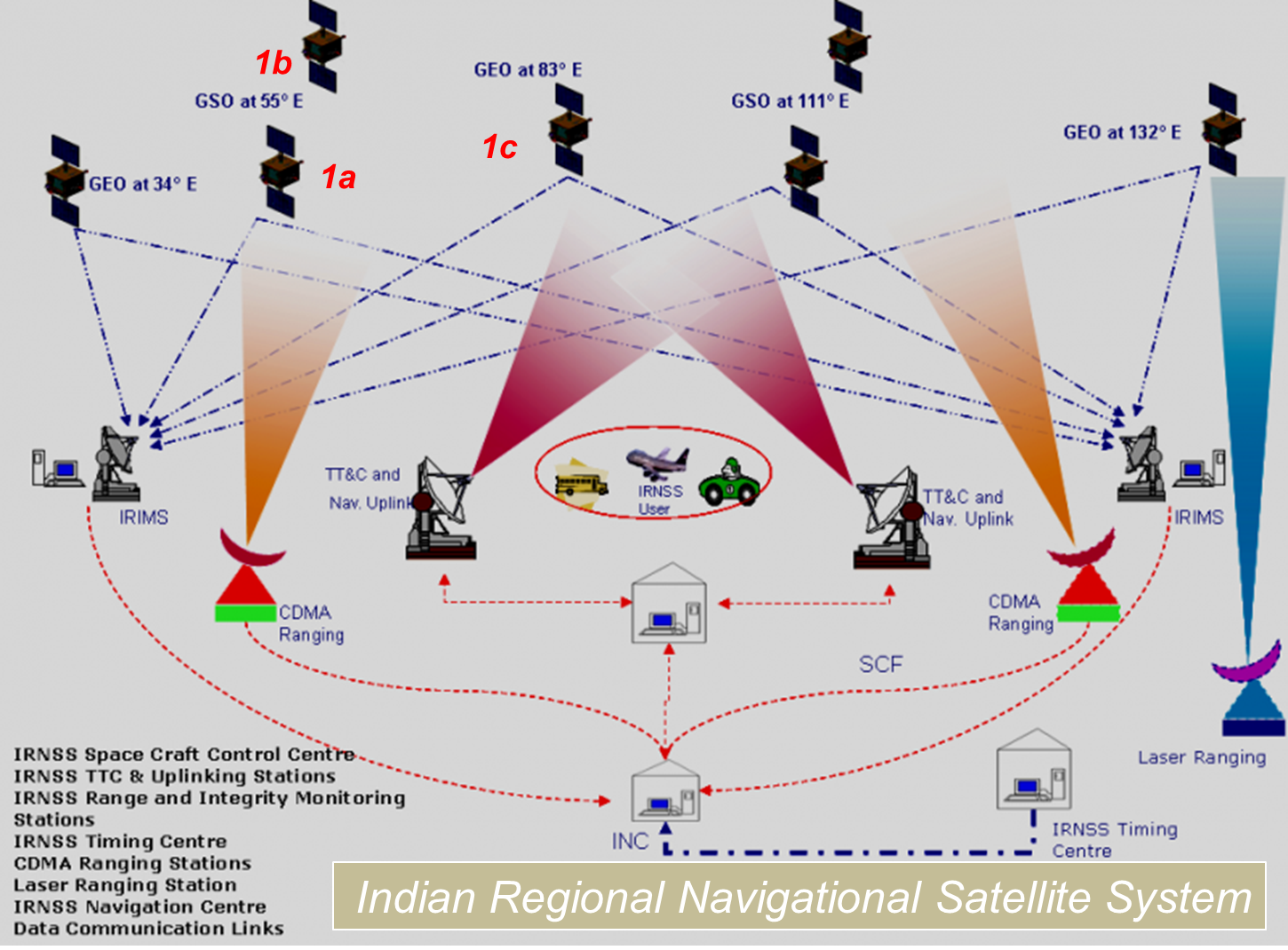
The 7 satellite system consists of 4 satellites as two pairs of geosynchronous satellites and 3 in geostationary orbit. The first two satellites in the series, IRNSS 1a and IRNSS 1b formed the first geosynchronous pair and were launched from Sriharikota on July 1st, 2013 and April 4th this year. respectively. The IRNSS-1c launched this morning is the first geostationary satellite and carries two payloads, one for transmitting navigation service signals to users and another consisting of a C-band transponder to facilitate Cube Retro Reflectors for laser ranging. It is the central satellite of the seven satellite configuration. The satellites launched so far are individually operational but the system will become operational only with the next launch of a geostationary satellite. (The system needs one geosynchronous pair, the central satellite and one more geostationary satellite to reach the threshold conditions to become operational). All seven satellites are planned to be in place and operational by the end of 2015.

IRNSS Architecture - ISRO

IRNSS Architecture – ISRO

NasaSpaceflight:

Based on ISRO’s I-1K satellite bus, each IRNSS satellite has a mass at launch of 1,425 kilograms (3,142 lb). Unfuelled, the spacecraft has a mass of only 600 kilograms (1,323 lb), with the remaining 825 kilograms (1,819 lb) being taken up by propellant for their apogee motors and manoeuvring engines.

The spacecraft are designed for ten years’ operational service. Generating 1.6 kilowatts of power through twin solar arrays, the satellites broadcast L5 and S band navigation signals. C-band transponders and retroreflectors are used for range calibration.

Each satellite is fitted with a single liquid apogee motor producing 440 newtons (99 pounds-force) of thrust. Three-axis control is provided by reaction wheels, magnetorquers and twelve reaction control thrusters.

The apogee motor is tasked with propelling the satellite from its initial deployment orbit into the final geostationary orbit, while the remaining thrusters will be used to manoeuvre and orient the spacecraft once it is in orbit.

IRNSS-1C is the first geostationary satellite in the IRNSS system. Planned for operation at a longitude of 83 degrees East, it will operate at the middle station of the constellation.

Two more geostationary satellites will be added; at longitudes of 34 and 132 degrees, while the remaining four spacecraft will operate in inclined geosynchronous orbits to increase the angle of separation between signals. Two of the inclined satellites are already in orbit; IRNSS-1A and 1B operate at a longitude of 55 degrees East. A second pair will be located at 111 degrees East next year.

The two satellites already in orbit were deployed in July 2013 and April 2014, both riding PSLV rockets to orbit from the Satish Dhawan Space Centre

The PSLV launch vehicle was introduced in 1993 and this is its 28th successful use (27th consecutive successful use). Today’s launch used the PSLV-XL configuration – the most powerful version of the PSLV currently flying – which makes use of six PS0M-XL boosters containing S-12 solid rocket motors. Four of these motors are lit when the rocket leaves its launch pad, with the remaining two lit during the early stages of its ascent.


BJP dumps Shiv Sena. As expected?

September 25, 2014

The 25 year old alliance between the BJP and Shiv Sena is finally over. Of course it was actually an alliance between Bal Thackeray and the BJP and without him the Shiv Sena is just a shadow of what it once was (and some might say that it was always a blight on Indian politics with Bal Thackeray – and being a shadow of a blight without him was a welcome shift to the light!). But the simple reality is that the BJP – at national level – does not need the Shiv Sena. In fact they are a liability.

ToIThe 25-year-old BJP-Shiv Sena alliance split on Thursday amid continued deadlock over seat-sharing for the October 15 Maharashtra assembly polls.

After several rounds of talks over the last few days, senior state BJP leaders announced on Thursday evening severing of the ties between the two parties, blaming Shiv Sena’s “inflexibility” for it.

“We have conveyed our decision to snap ties to Shiv Sena. The decision was taken with a heavy heart,” Maharashtra BJP chief Devendra Fadnavis told reporters after a meeting of the state party’s core committee.

While this split is just for the Maharashtra elections, it is effectively a national split since the Shiv Sena is a zero without or outside of Maharashtra.

After the Modi wave at the general elections it was only a matter of time. Back in July I speculated

The biggest credibility challenge that Narendra Modi faces is to convince Indians – and the outside world – that he represents something much larger, secular and inclusive than the narrow, religiously-bigoted  and exclusive position espoused by the RSS and some even more extreme Hindu nationalist groups. But he has to do this equitably but without giving the perception of appeasing the Muslim fanatics.

And he has to clean his own house first. His ally in Maharashtra, the Shiv Sena, is now an embarrassment and a liability. Within his own party also there is no dearth of intellectually retarded loud-mouths. They are all now a burden and unless he cuts them down to size they have the potential to negate all his efforts to be  inclusive.

The Shiv Sena is a special case and I think Modi can afford to dump them. They have just made utter fools of themselves  ……..

……. The Shiv Sena remains a force – if only in Maharashtra – but they are in a declining spiral and my reading is that it would be least damaging for Modi to dump them now – early on in his term – and cap his losses.


MOM’s first image from Mars

September 25, 2014

ISRO has released the first image taken by MOM on Mars.

Taken from a height of 7300 km; with 376 m spatial resolution.

Shades of pink and brown, but I am not sure why the lighter shades around each crater reminds me of gas bubbling through sand. The “streaks” in the bottom right quadrant are suggestive of “wind effects” in a sea of sand.


MOM orbit exactly as planned with a flawless MOI

September 24, 2014

ISRO can feel very satisfied. The MOI was flawless. The tracking indicates that the MOM has achieved an orbit of 421.7 km / 76993.6 km compared to the planned 423 km / 80,000 km. Not bad after a 10 month journey of some 680 million km. The inclination of orbit with respect to the equatorial plane of Mars is 150º and exactly as planned. 

The first colour pictures of Mars from MOM are expected within a day or two.

Now for a manned, fast, free-return, fly-by of Mars in 2018?

ISRO: India’s Mars Orbiter Spacecraft successfully entered into an orbit around planet Mars today morning (September 24, 2014) by firing its 440 Newton Liquid Apogee Motor (LAM) along with eight smaller liquid engines. This Liquid Engines firing operation which began at 07:17:32 Hrs IST lasted for 1388.67 seconds which changed the velocity of the spacecraft by 1099 metre/sec. With this operation, the spacecraft entered into an elliptical orbit around Mars. 

The events related to Mars Orbit Insertion progressed satisfactorily and the spacecraft performance was normal. The Spacecraft is now circling Mars in an orbit whose nearest point to Mars (periapsis) is at 421.7 km and farthest point (apoapsis) at 76,993.6 km. The inclination of orbit with respect to the equatorial plane of Mars is 150 degree, as intended. In this orbit, the spacecraft takes 72 hours 51 minutes 51 seconds to go round the Mars once.

Spaceflight101Launched back on November 5, 2013 atop a Polar Satellite Launch Vehicle, the Mars Orbiter was constrained by the performance of India’s workhorse launcher that required the spacecraft to take the scenic route – first entering an elliptical Earth orbit that the spacecraft raised by making six engine burns before firing its main engine, the Liquid Apogee Motor, a seventh time to depart Earth and enter a path to Mars on November 30. ….. 

The Mars Orbit Insertion Burn had a planned change in velocity of 1,098.7 meters per second with an anticipated burn time of 24 minutes and 14 seconds. However, engine shutdown was triggered by the navigation system when accelerometers sensed that the proper delta-v was achieved, dynamically adjusting for actual engine performance by extending of shortening the burn slightly. 

For MOM, the sun came up 19.5 minutes into its burn, but Earth was not coming into view until three minutes after the scheduled end of the Mars Orbit Insertion burn. The spacecraft was programmed to start the re-orientation back to its comm attitude one minute after shutdown, followed five minutes later by the re-activation of the communications system when MOM was visible from Earth again.
The Mars Orbit Insertion Burn had a planned change in velocity of 1,098.7 meters per second with an anticipated burn time of 24 minutes and 14 seconds. However, engine shutdown was triggered by the navigation system when accelerometers sensed that the proper delta-v was achieved, dynamically adjusting for actual engine performance by extending of shortening the burn slightly. 
For MOM, the sun came up 19.5 minutes into its burn, but Earth was not coming into view until three minutes after the scheduled end of the Mars Orbit Insertion burn. The spacecraft was programmed to start the re-orientation back to its comm attitude one minute after shutdown, followed five minutes later by the re-activation of the communications system when MOM was visible from Earth again.

MOM successfully enters Mars orbit – first time ever on a maiden Mars mission

September 24, 2014

In what appears to have been a remarkably flawless and precise operation ISRO’s MOM has entered Mars orbit. It is the first time that a country has succeeded to get a spacecraft to enter Martian orbit on its maiden attempt.

“We have the signal.

1099 m/s.

Expected – 1098.7 m/s”

(The Mars Orbit Insertion burn had a planned duration of 24 minutes and 14 seconds, slowing the spacecraft down by 1,098.7 meters per second to be captured in an elliptical orbit around Mars.)

The operations took place while the spacecraft was behind Mars. It seemed an endless wait for it to reappear. It was then a seemingly endless 12.5 minutes from when telemetry was reactivated and the signals were received confirming that the maneuvers had been successful.

The precise orbit achieved now awaits further tracking information.

Foto

Prime Minister Narendra Modi arrived at ISRO in time to witness the critical and historical phases of the orbit insertion procedures (and he is to be highly commended for preferring real things to the meaningless, pointless and futile climate change talkshop at the UN).

He was more than a little pleased.

Narendra Modi at ISRO after MOM achieved orbit — screen grab by The Hindu

A major step not just for India’s confidence in its technological capabilities but also for its geopolitical positioning against China.

BBC: If all goes well and the satellite orbits the Red Planet, India’s space agency will become the fourth in the world after those of the United States, Russia and Europe to undertake a successful Mars mission. …..

…… After India’s successful unmanned Chandrayaan mission to the Moon in 2008 that brought back the first clinching evidence of the presence of water there, the Mars mission, according to K Radhakrishnan, chairman of the Indian Space Research Organisation (Isro), is a “natural progression”. …….

India sees the Mars mission as an opportunity to beat its regional rival China in reaching the planet, especially after a Russian mission carrying the first Chinese satellite to Mars failed in November 2011. Japan also failed in a similar effort in 1998.

China has beaten India in space in almost every aspect so far: it has rockets that can lift four times more weight than India’s, and in 2003, successfully launched its first human space flight which India has not yet embarked on. China launched its maiden mission to the Moon in 2007, ahead of India.

So if India’s mission succeeds, it will have something to feel proud about.

Culmination nears for India’s Mars Orbiter Mission

September 23, 2014

In 8 hours – if everything goes as planned – the MOM would have been inserted into Mars orbit of 423 km at periareion and 80,000 Kilometers at apoareion  at an inclination of 150 degrees and with an orbital period of a little more than three days. Though a number of experiments are planned, the most important objectives of the mission – to demonstrate technology and capability – will largely have been accomplished on getting into orbit.

Frugal engineering and with a cost of about 10% of that of NASA’s MAVEN will have taken ISRO’s MOM into Mars orbit – and at the first attempt.

But the next few hours will be tense and nervous not only for ISRO mission staff but for the many millions of Indians who will be following the live webcast at http://webcast.isro.gov.in/. The critical operations will take place while the MOM spacecraft is occluded on the far side of Mars and when signals will be taking over 12 minutes to reach earth.

Spaceflight101: 

The critical Mars Orbit Insertion Burn Sequence will begin three hours ahead of the planned maneuver time when the spacecraft automatically switches over to its Medium Gain Antenna for communications since the High Gain Antenna will be pointing away from Earth during the retrograde burn.
21 minutes ahead of ignition, the spacecraft will begin the re-orientation to the proper attitude for the burn, pointing LAM to the direction of travel. The re-orientation is accomplished using the vehicle’s Reaction Wheels. Five minutes and 13 seconds ahead of the burn, the spacecraft passes into darkness – for the first time since leaving Earth last year. In advance, MOM will fully charge its battery to be in a safe configuration for the eclipse.
Three minutes ahead of the burn, the vehicle’s eight 22-Newton thrusters are enabled to start providing attitude control which they will continue to do throughout the main engine burn, keeping MOM pointing forward. Ignition of the Liquid Apogee Motor is planned at 1:47:32 UTC on Wednesday, September 24, 7:17 Indian Standard Time. The Mars Orbit Insertion burn has a planned duration of 24 minutes and 14 seconds, slowing the spacecraft down by 1,098.7 meters per second to be captured in an elliptical orbit around Mars. During the burn, the engines will consume 249.5 Kilograms of propellant leaving only about 40 Kilograms of propellant for the rest of the mission.
Should something go wrong during the burn, MOM is programmed to react appropriately in order to achieve a stable orbit around Mars – even if that means to spend all the vehicle’s propellant to do so. In the event the Liquid Apogee Motor is not ignited or its burn is cut short, MOM would automatically switch to the 22-Newton thrusters to supply as much delta-v as possible. Due to their lower thrust, the 22N thrusters would need to fire much longer than LAM along a greater stretch around the periapsis pass which will increase propellant consumption and leave MOM in a higher orbit.
MOI timeline

Graphic ISRO (via spaceflight101)

MOM test fires liquid motor for orbit insertion on Wednesday

September 22, 2014

A sigh of relief today as the liquid fueled motor was successfully test fired for 4 seconds after having last been used 9 months ago.

The 440 Newton Liquid Apogee Motor (LAM) of India’s Mars Orbiter Spacecraft, last fired on December 01, 2013, was successfully fired for a duration of 3.968 seconds at 1430 hrs IST today (September 22, 2014). This operation of the spacecraft’s main liquid engine was also used for the spacecraft’s trajectory correction and changed its velocity by 2.18 metre/second. With this successful test firing, Mars Orbiter Insertion (MOI) operation of the spacecraft is scheduled to be performed on the morning of September 24, 2014 at 07:17:32 hrs IST by firing the LAM along with eight smaller liquid engines for a duration of about 24 minutes.

The MOM is now in (or just entering) Mars’ sphere of influence and is effectively falling freely towards Mars. The orbit insertion procedure is described here.

Mars Orbit Insertion for MAVEN and MOM

graphic: indiaspaceactivity

On 24th 0127 GMT, even as it is falling with speed of 4 kms/sec, the craft is reoriented so that the thrusters face forward  ( for the next orbit maneuver of retro thrust to reduce the speed and to direct it in the required orbit ). The re-orientation is completed @ 0147 GMT. MOM would by this time be falling with a speed of  4.48Km/sec.

After the disturbances due to reorientation have died, i.e. 5 seconds later,  the Retro action starts with the firing of  LAM using 8 thrusters ..  the fall speed by now is 4.68 km/s. Even as the thrusters start their effort to reduce the speed of MOM, the fallingspeed continues to increase due to the gathered momentum upto 5.89 km/s and thenspeed  starts falling. The LAM firing also directs the craft in the desired direction so that it achieves the required orbit around Mars. The LAM operation ends @0216GMT.

As shown in figure there the MOM speed would increase from 3.18 Kms/sec to 5.89Kms/sec @  0216GMT.

Now notice that MOM approached Mars parellel to  equator unlike MAVEN which approached over North pole.  The reason for these two approaches is that the final orbits of MAVEN and MOM are inclined @ 75 deg and @ 19 deg respectively. This is evident from the ‘ cross roads ‘ seen between MOM and MAVEN release in the combination diagram shown above.

In the above flow of sequence we did not have time to  mention a couple of more chilling facts: @ nearly the same time when LAM operation starts MOM would go behind Mars as seen from Earth. Secondly , even if it was visible, whatever happens at MOM will be known to Earth only after 12 minutes due to the distance between Earth and MOM. So all this (and next described operations ) are being done under the unsupervised pre-loaded command sequences. So the success indicates how well are we in anticipating the situation through modelling.

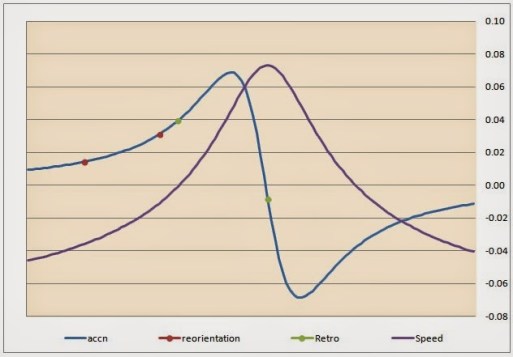
A detailed look at dynamics of acceleration during this critical operation is shown in this graphic. (numbers are in kms/sec/sec ) corrosponding to sky blue curve. (X axis is time axis from 0110GMT to 0310GMT of 24 Sep. )
Violet curve is the speed normalized to fit in this graph with that of acceleration. Actual speed variation shown corresponds to 3.88 km/sec at left to 5.89km/s at peak near center which falls to 4 km/s at lsft edge.

We have also marked the events of reorientation (between red dots) and retro rocket firing (between Green dots ) on acceleration curve.

Notice that the LAM retro action started at first green dot on left ( 0152 GMT ) ..  it has tried to reduce the speed but the fall is more powerful, so MOM speed continues to increase despite retro action. This continues and for sometime eventhough the acceleration has started reducing ( blue line coming down ), the gathered momentum  makes the craft to increase its speed for sometime. Finally however the thrusters succeed in reducing the speed ( reversal near center of violet line ) ..  the thrusters are also turned off at that moment.(green dot near the center of graph ). Now the total operation of MOI is over.

Incidentally, the point where speed reversal has taken space forms the lowest point near the surface of MOM prior to first perigee which would occur after the craft completes one revolution.

South East Asia vary of Chinese nationalism and a return of the Maritime Silk Road

September 22, 2014

The Chinese vision of a Maritime Silk Road is based on the seven great voyages of Admiral Zheng He in the time of the the Yongle Emperor (1360 – 1424), the third Emperor of the Ming dynasty.

The admiral of all seven fleets was Zheng He, the great-grandson of a Mongol warrior. His original name was Ma Ho, the Chinese version of Muhammad, for his father was a Muslim who had made the pilgrimage to Makkah. In 1404, the emperor conferred on him the honorific Zheng, and he was appointed Grand Eunuch, thenceforth to be known as Zheng He. ….

From the point of view of geographical discovery, the Ming voyages must rank as the earliest state-sponsored effort to seek out new lands, markets and spheres of political influence. That the same idea occurred to the rulers of both the Far East and the “Far West” almost simultaneously is intriguing, and it shows that—long before the emergence of a “global economy” in the late 20th century—East and West were responding to the same rhythms of political and economic change.

Zheng He 7 voyages - National Geographic

Zheng He 7 voyages – National Geographic

The reestablishment of the Chinese Maritime Silk Road is said to be a pet project of President Xi Jinping who is a scholar of Chinese maritime history and an admirer of Admiral Zheng He. Even before the Ming dynasty there was extensive maritime and cultural commerce between South India and China during the Song and Yuan dynasties. But the maritime routes withered after Zheng He and left the area open for the Potuguese in the 16th century and later for the French, Dutch and the British who followed. The Maritime Silk Road was among the items to be discussed by President Xi with Narendra Modi on his recent visit to India.

New Delhi is abuzz with speculation that President Xi Jinping could raise the issue of Maritime Silk Road (MSR) during his visit to India this week and explore business, investments and trade opportunities for China in India. At least three reasons can be identified to uphold the above assumption; first, the issue of MSR was raised during President Hamid Ansari’s visit to China in July this year and the Indian side had indicated that New Delhi would examine the idea. The Chinese would be keen for a response from the Indian side and India may push for the BCIM (Bangladesh, China, India and Myanmar) corridor to which it has offered wholehearted support and it serves the interests of all the partners.

The second reason is that the MSR is a pet project of the Chinese President and is believed to have been driven by his knowledge of ancient Chinese cultural and trade connections with the outside world. Apparently, between 1985 and 2002, Xi had personally taken interest in the Quanzhou Maritime Museum, and according to the curator, Xi had perused through the ancient historical records, artifacts and exhibits at the museum and may have ‘learnt a lot about China’s maritime history’ which could have been the driver for his interest in MSR. Xi even secured substantial government grants for the museum. Incidentally, Quanzhou is home to several ancient shrines and temples built by Tamil communities who had established trading contacts with the Chinese during the Song (960-1279) and Yuan (1279-1368) periods. Given his knowledge of ancient maritime trade and cultural connections between India and China, Xi may recall the cultural and Buddhist connections between the two countries. It is pertinent to mention that China has committed US $1 million for the Nalanda University.

While India is not averse to some parts of the Maritime Silk Road being reestablished, others – and especially Vietnam – are very suspicious of Chinese intentions.

Maritime Silk Route

Maritime Silk Route

Most countries have maritime disputes with China in the South China Sea, but also see a threat to liberty, security and maritime safety at sea.

The restoration of “Silk Road on the Sea” is both an ancient ambition of the leaders in Beijing, and a symbol of Chinese nationalism. So it hides a lot under what seems beneficial to the surrounding neighbors of China. The essence of Chinese intentions in the idea of ​​building “new silk road” at sea are:

Firstly , create a new order in which coastal neighbors follow a trajectory operated and dominated by the Chinese. The “Silk Road on the Sea” is part of the  “string of pearls” master plan to transform China into a maritime power and compete with American superpower.

Secondly , “Silk Road on the Sea” is a diplomatic tool to execute foreign policy with China’s neighbors. Through the use of “Silk Road on the Sea”, the Chinese are trying to create a soft image, useful for the rise and expansion of its influence.

Thirdly , “Silk Road on the Sea” provides an opportunity for China to promote its policy of “setting aside dispute and pursuing joint development” so as to exploit marine resources in the region, especially energy resources of oil and gas. 

Fourth , the initiative “Silk Road on the Sea” is to further the territorial claims on islands by China. Successful implementation of the initiative “Silk Road on the Sea” will create conditions favorable for the presence of the Chinese coast guard  especially the South China Sea, the Strait Malacca, Indian Ocean, and help to expand Chinese maritime influence and enhance the influence of its military on the sea. … As with ancient Zheng He’s voyage the objective is “to establish and enforce sovereignty “over the Paracels and Spratlys (of Vietnam). To justify its claims to sovereignty. China will continue to use the “Silk Road on the Sea” for aggressive actions in the South China Sea make the situation hotter and more physical.

Fifth , China will use initiative “Silk Road on the Sea” to implement a divide and rule policy of the neighboring countries. There may be the possibility that some countries will be attracted to the immediate economic benefits, are willing to overlook the problem rules and norms of international law to support the initiative “Silk Road of the Sea ​​”of China that will harm the interests of the country which has sovereignty disputes with China over some island. On the other hand, this does not exclude the possibility that China will increase the pressure and aggression with countries that do not support the initiative “Silk Road on the Sea”.

Sixth , the initiative “Silk Road on the Sea” also aims to push the United States and the Western countries out of the area. This initiative is important in order for the policy to “rebalancing strategy in Asia – Pacific region” of America. On the economic front, “Silk Road on the Sea” is to fight Agreement Trans-Pacific economy (TPP) of the United States. Thus, one can see “Silk Road on the Sea” China will make competition between the United States and China increasingly fierce.

Once the “Silk Road on the Sea” is formed China will set out new rules to force other countries to comply; China will act unilaterally ignore international law. The actual situation in the South China Sea has proven time over this. Seen from this perspective, the “Silk Road on the Sea” is not only a threat to the security and territorial sovereignty of neighboring countries, especially countries with maritime disputes with China in the South East, but also a threat to freedom, security and safety of navigation at sea.

China has officially put the materials to build the concept of “Silk Road on the sea at a meeting of Senior Officials (SOM) ASEAN – China. ASEAN countries have not yet responded. …..

For Vietnam, the initiative “Silk Road on the Sea” is a challenge to the sovereignty of the islands of Vietnam just as Zheng’s ships in ancient times were used as an argument concerning the sovereignty of archipelagos Sa and Truong Sa of Vietnam.

But Malaysia, while still vary, is tempted by the possibilities of development on the relatively under-developed East coast in Kuantan.

More than 600 years ago, the legendary Ming Dynasty diplomat Admiral Zheng He made seven epic journeys to the West via a route known as the maritime Silk Road.

First used in the Qin and Han Dynasties (AD 25-220), the nautical passageway connected the ports of south China to Southeast Asia, India, Arabia and Africa. Silk, china, tea and spices exchanged hands from Guangzhou, the starting point, to the countries around the Gulf. 

Now, China is proposing to rebuild this centuries-old seaway into a 21st century maritime Silk Road. Kuantan, on the east coast of Peninsular Malaysia, is hoping that modern day Chinese vessels will share Zheng’s assessment when he landed here in the 15th century: that this city facing the South China Sea is an ideal gateway to the region and beyond.

Located 250 kilometers from the capital city of Kuala Lumpur, Kuantan is the east coast’s economic hub and its most modern city; although by no means as cosmopolitan as its west coast sisters. The capital of the state of Pahang is being developed into an integrated logistics and industrial hub for the East Coast Economic Region (ECER), a major project by the Malaysian government to decentralize economic activities.

Crucially, it provides fast access to China through its namesake port. The multipurpose, deep-sea port serves the resource-rich hinterland of the east coast and is a leading petrochemical hub port and container terminal for that part of the peninsula.