Archive for the ‘Natural Disasters’ Category
September 28, 2013
A second earthquake (6.8 magnitude) rocked south-west Pakistan today, in a region where at least 400 people died in a 7.7 magnitude quake earlier this week. The earlier quake gave birth to a new island off the coast of Gwadar.

The epicentre of Tuesday’s quake, which hit close to the location of the latest seismic shock. BBC
From NASA’s Earth Observatory:
On September 24, 2013, a major strike-slip earthquake rattled western Pakistan, killing at least 350 people and leaving more than 100,000 homeless. The 7.7 magnitude quake struck the Baluchistan province of northwestern Pakistan. Amidst the destruction, a new island was created offshore in the Paddi Zirr (West Bay) near Gwadar, Pakistan.
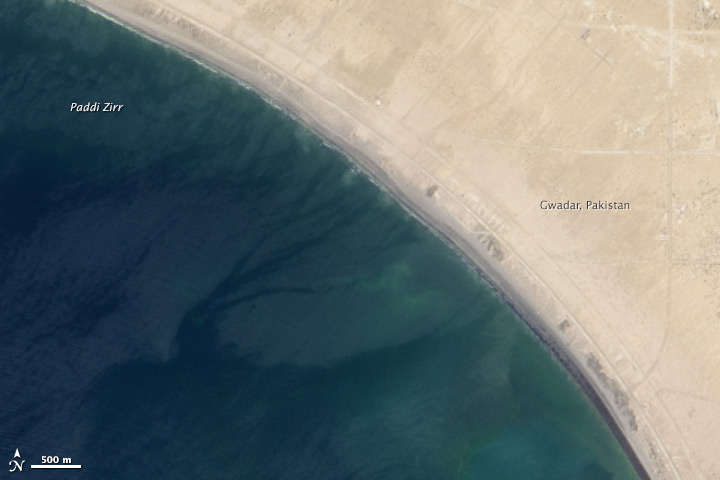
On September 26, 2013, the Advanced Land Imager (ALI) on NASA’s Earth Observing-1 (EO-1) satellite captured the top image of that new island, which sits roughly one kilometer (0.6 miles) offshore. Likely a “mud volcano,” the island rose from the seafloor near Gwadar on September 24, shortly after the earthquake struck about 380 kilometers (230 miles) inland. The lower image, acquired by the Operational Land Imager on the Landsat 8 satellite, shows the same area on April 17, 2013.

acquired September 26, 2013 – Earthquake Births New Island off Pakistan

Coast of Gwadar acquired April 17, 2013
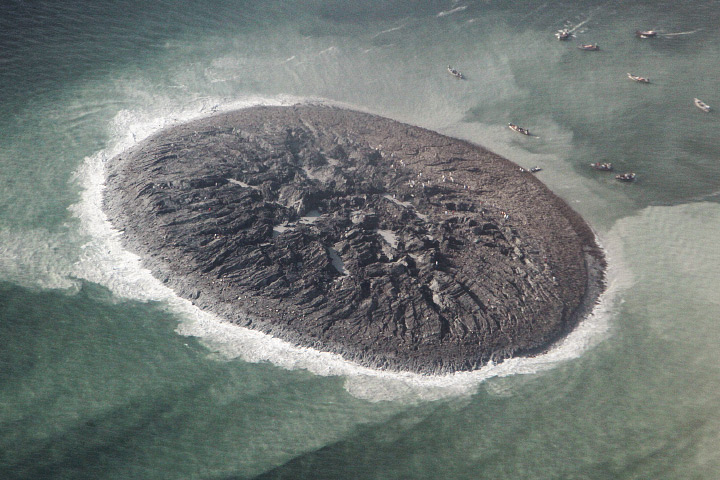
The aerial photograph below from the National Institute of Oceanography provides a close-up of the landform, estimated to stretch 75 to 90 meters (250 to 300 feet) across and standing 15 to 20 meters (60 to 70 feet) above the water line. The surface is a mixture of mud, fine sand, and solid rock.

Aerial view of new island acquired September 26, 2013
“The island is really just a big pile of mud from the seafloor that got pushed up,” said Bill Barnhart, a geologist at the U.S. Geological Survey who studies earthquakes in Pakistan and Iran. “This area of the world seems to see so many of these features because the geology is correct for their formation. You need a shallow, buried layer of pressurized gas—methane, carbon dioxide, or something else—and fluids. When that layer becomes disturbed by seismic waves (like an earthquake), the gases and fluids become buoyant and rush to the surface, bringing the rock and mud with them.”
Inam asserted that the underground pressure in this case came from expanding natural gas. “The main driving force for the emergence of islands in this part of the world is highly pressurized methane gas, or gas hydrate. On the new island, there is a continuous escape of the highly flammable methane gas through a number of vents.”
Several of these islands have appeared off the 700-kilometer-long Makran coast in the past century noted Eric Fielding, a tectonics scientist at NASA’s Jet Propulsion Laboratory. He explained that the Makran coast is where the Arabian tectonic plate is pushed northward and downward to go underneath the Eurasian continental plate. The thick layer of mud and rock on the Arabian Plate is scraped off and has formed the land in southwestern Pakistan, southeastern Iran, and the shallow underwater area offshore.
“The Makran coast is not very populated and any such event may easily go unnoticed, so satellite images are extremely important,” Inam said. “Mud volcanoes and islands are a natural hazard and threat to navigation.”
The life of this island is likely to be short. That underground pocket of gas will cool, compress, or escape over time, allowing the crust to collapse and settle back down. Waves, storms, and tidal action from the Arabian Sea will also wash away the loose sand, soft clay, and mud. Barnhart says such islands usually last a few months to a year before sinking back below the water line.
Tags:Earthquake, Gwadar, mud island, Mud volcano, new island, Pakistan
Posted in Natural Disasters, Natural Phenomena, Pakistan | Comments Off on Images of new island born after earthquake in Pakistan
August 13, 2013
“Seismic seiches are standing waves set up on rivers, reservoirs, ponds, and lakes when seismic waves from an earthquake pass through the area. They are in direct contrast to tsunamis which are giant sea waves created by the sudden uplift of the sea floor.”
A new paper describes how these seiches -standing waves – observed in the Norwegian fjords in 2011 – for the first time since the 1950’s – have been linked to the Great Tohoku Quake of 2011 half an hour earlier.
Stein Bondevik, Bjørn Gjevik and Mathilde B. Sørensen, Norwegian seiches from the giant 2011 Tohoku earthquake, Geophysical Research Letters, DOI: 10.1002/grl.50639, 2013
Abstract: Seismic waves of the giant 2011 Tohoku earthquake triggered seiches in western Norwegian fjords. The seiching began a half hour after the earthquake origin time. The oscillations were noted by eyewitnesses and recorded by surveillance and cell phone cameras. The observations show maximum trough-to-peak amplitudes of 1.0–1.5 m and periods of 67–100 s. The water waves were not triggered from the arrival of the surface waves, the timing inferred for other seiches. Instead, the seiching began during the passage of horizontal S waves. We reproduced the S wave trigger by means of a shallow-water wave model calibrated previously to Norwegian tides and storm surges. The simulations, which used the observed earthquake motion as forcing, show water waves with periods and amplitudes similar to those in the film clips. However, the strongest horizontal ground oscillations with shorter periods (20–30 s) did not contribute much to the formation of the seiches.
It is not the first time that such standing waves have been observed so far away. As the US Geological Service notes:
The term seismic seiche was first coined by Anders Kvale in 1955 to describe oscillation of lake levels in Norway and England caused by the Assam earthquake of August, 1950. But this was not the first time that seismic seiches had been observed. The first published mention was after the great earthquake of November 1755 at Lisbon, Portugal. An article in Scot’s Magazine in 1755 described seiches in Scotland in Loch Lomond, Loch Long, Loch Katrine and Loch Ness. They were also seen in English harbors and ponds and were originally described in the Proceedings of the Royal Society in 1755.
…….
Seismic waves from the Alaska earthquake of 28 March, 1964, were so powerful that they caused water bodies to oscillate at many places in North America. Seiches were recorded at hundreds of surface-water gaging stations – although they had rarely been reported following previous earthquakes. Indeed, four seiches were observed in Australia.
Some of the 1964 seiches were very large. Waves as high as 1.8 meters were reported on the Gulf Coast – probably because they were generated in resonance with the seismic surface waves.
In the case of the Norwegian fjords and the Great Tohoku quake, PhysOrg reports:
The scene was captured by security cameras and by people with cell phones, reported to local media, and investigated by a local newspaper. Drawing on this footage, and using a computational model and observations from a nearby seismic station, Bondevik et al. identify the cause of the waves—the powerful magnitude 9.0 Tohoku earthquake that hit off the coast of Japan half an hour earlier.
In closed or semi-enclosed bodies of water, seismic waves can trigger standing waves known as “seiches.” Seiching had not been recorded in Norway’s fjords since 1950. Scientists have traditionally thought that seiching is caused by seismic surface waves, but the authors find that the fjord seiching was initiated before the surface waves had arrived.
Using seismic observations and a model for local fjord behavior, they find that in this case the seiching was triggered by S waves, which travel through Earth’s body, and later was amplified by Love waves, which travel on Earth’s surface. There are a lot of open questions surrounding the connection between earthquakes and seiching, but the authors’ research supports the idea that not all earthquakes will cause seiching in all enclosed bodies of water. The occurrence of the Japanese earthquake?induced seiches depended on the period and orientation of the seismic waves aligning with the natural frequency and orientation of the body of water.
Tags:2011 Tōhoku earthquake and tsunami, fjords, Norway, Norwegian seiches, Seiche, Seismic wave, standing waves
Posted in Geosciences, Japan, Natural Disasters, Natural Phenomena, Norway | Comments Off on Great Tohoku quake in 2011 caused standing waves in Norwegian fjords 30 minutes later
April 17, 2013
Like primitive man I am overwhelmed by the power of the Sun and a firm believer that even minute solar effects can have a major effect on the Earth and its systems. (I also note that my deification of the Sun must be similar to that by our ancient ancestors and is probably not unconnected to my moving to Scandinavia). In any case I am convinced that for climate
“Solar effects are much more profound than many so-called climate scientists like to admit”,
but I am not sure how strong the link to earthquakes is.
The link between solar effects (radio flux, sunspots, magnetic reversals, proton events….) and volcano activity and earthquakes has been postulated and studied many times but if any such link does exist it is not something obvious and it is by unknown mechanisms. For some this search for such a link is not “science” and there is no link. For others it can be a lifetime’s quest. But “intuition” and “gut-feeling” keeps me believing that there must be a connection. It could well be that the build-up of stresses upto some “breaking point” within the earths crust are a result of ongoing geologic processes and do not need any external trigger like solar activity or the position of the planets to be unleashed. But even continental drift and the build-up of seismic or volcanic stresses are all – ultimately – driven by energy fluxes. And all energy fluxes on Earth can eventually be traced to the Sun (except perhaps if the energy is from any ongoing nuclear reactions in the Earth’s core).
There were two major earthquakes yesterday – USGS
- 6.6, 23km ESE of Aitape, Papua New Guinea, 2013-04-16 22:55:27 UTC, 13.0 km deep
- 7.8, 83km E of Khash, Iran, 2013-04-16 10:44:20 UTC, 82.0 km deep
And – I note in passing – on April 11th – 5 days ago there was a solar flare and a Coronal Mass Ejection (CME) event. Could be just a coincidence of course – but perhaps not …
Discovery News: APR 11, 2013 03:00 PM ET
The sun has unleashed the biggest solar flare of the year, quickly followed by an Earth-directed coronal mass ejection (CME). Both phenomena have the potential to impact communications and electronics on Earth and in orbit.
Although the sun is currently experiencing “solar maximum” — the culmination of its approximate 11-year cycle — scientists have noted that this particular maximum is a lot quieter than predicted. At this time, the sun should be bubbling with violent active regions, exhibiting sunspots, popping off flares and ejecting CMEs. But so far, the sun seems to be taking it relatively easy.
This morning (at 0716 UT), active region (AR) 1719 erupted with an M-class flare. With a rating of M6.5, this event is the most energetic flare of 2013 (although it’s a lot less impressive than 2012′s X-class fireworks). What’s more, the site of the explosion unleashed a CME in our direction.
A CME is a magnetic ‘bubble’ containing high-energy solar particles. When the CME hits Earth’s global magnetic field, it may align just right to generate a geomagnetic storm. Should this happen, we’ll be able to measure the extreme magnetic distortion of the magnetosphere and bright aurorae at high latitudes may result. Aurorae are caused when solar particles are injected into the polar regions via the Earth’s magnetic field — the particles then collide with atmospheric gases, generating a beautiful light display.
This morning’s CME was clocked traveling at a breakneck speed of 600 miles per second — at that rate it should hit Earth in the early hours of Saturday morning (April 13).
Shortly after the M-class flare erupted, a weak solar energetic particle (SEP) event was detected. This “radiation storm” was the result of relativistic particles slamming into the Earth’s upper atmosphere originating from the flare site.

Image: NASA’s Solar Dynamics Observatory captured this image of an M6.5 class flare at 3:16 EDT on April 11, 2013. This image shows a combination of light in wavelengths of 131 and 171 Angstroms. Credit: NASA/SDO
Tags:Aitape, Coronal mass ejection, Earth, earthquakes, Khash, solar effects, Solar flare, Sun, volcanos
Posted in Natural Disasters, Natural Phenomena, Solar science | Comments Off on Could solar flare last week be linked to two major earthquakes yesterday?
March 21, 2013
A new paper playing probabilistic games – this time about the Doomsday Argument.
Universal Doomsday: Analyzing Our Prospects for Survival, by Austin Gerig, Ken D. Olum, Alexander Vilenkin, arxiv.org/abs/1303.4676 , Cosmology and Extragalactic Astrophysics (astro-ph.CO)
The full version of the paper (pdf) is here

Doomsday argument Gerig et al
The Doomsday Argument is the idea that we can estimate the total number of humans that will ever exist, given the number that have lived so far. The argument goes that since around 100 billion is the number of humans that have ever lived and assuming that there is a 95% probability that we are among the last 95% of humans who will ever live then there is a 95% probability that the number of humans who will ever live will lie between 1.4 and 2.0 trillion. A fairly trivial conclusion since any probability greater than 0 and less than 100% would be valid for the exercise.
In this paper the authors try to formalise the probability calculations and introduce the effect of known existential threats. Just like in Drake’s equation for the number of extra-terrestrial civilisations that may exist in the Milky Way, all the probabilities are unknown and could be assumed to be anything you like. The Doomsday Argument like Drake’s equation is really no more than a probability game, based on nothing at all. But it is fascinating to consider which terms are relevant and necessary in any such game. And that is what makes these games interesting.
The author’s conclusions could be considered a trifle obvious and almost cliched – but none the less they are perfectly true!! The Earth will surely experience catastrophic events in the future which threaten human existence – whether by earthquake or volcanos or meteors and even if we survive all of these, eventually by the inevitable death of our sun. In fact you could play another – and equally valid – probability game and calculate how many humans will have lived if humanity continues to survive till the death of our sun. And this probability is surely not zero.
To avoid Doomsday, humanity needs to make sure that asteroids don’t crash into earth and that catastrophic earthquakes, volcano eruptions or the like don’t occur until such time as humanity has spread into space and developed colonies on other planets.
From the Conclusions:
With the priors that we considered, the fraction of civilizations that last long enough to become large is not likely to exceed a few percent. If there is a message here for our own civilization, it is that it would be wise to devote considerable resources (i) for developing methods of diverting known existential threats and (ii) for space exploration and colonization. Civilizations that adopt this policy are more likely to be among the lucky few that beat the odds. Somewhat encouragingly, our results indicate that the odds are not as overwhelmingly low as suggested by earlier work.
Abstract (Submitted on 19 Mar 2013)
Given a sufficiently large universe, numerous civilizations almost surely exist. Some of these civilizations will be short-lived and die out relatively early in their development, i.e., before having the chance to spread to other planets. Others will be long-lived, potentially colonizing their galaxy and becoming enormous in size. What fraction of civilizations in the universe are long-lived? The “universal doomsday” argument states that long-lived civilizations must be rare because if they were not, we should find ourselves living in one. Furthermore, because long-lived civilizations are rare, our civilization’s prospects for long-term survival are poor. Here, we develop the formalism required for universal doomsday calculations and show that while the argument has some force, our future is not as gloomy as the traditional doomsday argument would suggest, at least when the number of early existential threats is small.
Tags:Austin Gerig, Doomsday, Doomsday Argument, Drake equation, Risks to civilization humans and planet Earth
Posted in Demographics, Mathematics, Natural Disasters, Natural Phenomena | Comments Off on Calculating Doomsday – An interesting but ultimately meaningless probability game
March 11, 2013
It is two years today since the Great 2011 Tohoku Earthquake and Tsunami and the meltdown at 3 reactors of the Fukushima Daiichi nuclear plant.
It was the most powerful known earthquake ever to have hit Japan, and one of the five most powerful earthquakes in the world since modern record-keeping began in 1900. The earthquake triggered powerful tsunami waves that reached heights of up to 40.5 metres in Miyako in Tōhoku’s Iwate Prefecture and which, in the Sendai area, travelled up to 10 km inland. The earthquake moved Honshu (the main island of Japan) 2.4 m east and shifted the Earth on its axis by estimates of between 10 cm and 25 cm.
On 12 September 2012, a Japanese National Police Agency report confirmed 15,881 deaths, 6,142 injured and 2,668 people missing across twenty prefectures, as well as 129,225 buildings totally collapsed, with a further 254,204 buildings ‘half collapsed’, and another 691,766 buildings partially damaged. …
The tsunami caused nuclear accidents, primarily the level 7 meltdowns at three reactors in the Fukushima Daiichi Nuclear Power Plant complex, and the associated evacuation zones affecting hundreds of thousands of residents.
In the knee-jerk reaction to the Fukushima accident all Japan’s 50 nuclear reactors in operation were shut down. Ongoing nuclear power plant projects were suspended. The global debate was more an emotional wave rather than rational discussion. The fear was real of course but what was generally ignored was that while the earthquake and tsunami killed some 18,000 the Fukushima accident did not cause any direct radiation related fatalities. The reality is that the Fukushima reactors were designed in the 1960’s and yet managed to survive the magnitude 9.1 earthquake but they could not cope with and succumbed to the massive tsunami. After the earthquake the reactors were actually shut down – automatically and in good order – but the emergency power to the cooling systems were knocked out by the subsequent tsunami. The failure was a failure of anticipating and designing for a tsunami that was as large and as powerful as it was. Tsunami’s as large as the 2011 event have occurred in Japan roughly every 1000 years. The Fukushima failure was not so much a fault of the nuclear plant as the failure of the designers in anticipating a sufficiently large tsunami within the lifetime of the plant.
But two years on, some rationality is returning to the debate. Two reactors have been turned back on and construction has gingerly been restarted on the new 1383 MW advanced boiling-water reactor at Oma.

Map credit Washington Post
Washington Post:
In the aftermath of March 2011 meltdowns in Fukushima that contaminated 700 square miles with radiation and forced 150,000 to flee their homes, most never to return, Japan’s utility companies paused nearly all nuclear-related projects. The accident sparked a global debate about nuclear power, but it was especially fierce in Japan, where all 50 operable reactors were taken offline and work was halted on three new plants where building had been underway.
But two of the existing reactors are back in action, and the resumption of construction at the Oma Nuclear Power Plant here — a project that broke ground in 2008 and was halted by the operator, J-Power, after the accident — marks the clearest sign yet that the stalemate is breaking. …..
At the national level, Japan has cycled through three prime ministers since Fukushima — the first fiercely anti-nuclear, the next moderately anti-nuclear, the current one cautiously pro-nuclear. The previous ruling party tried last fall to plot a nuclear phaseout by the 2030s, but anti-nuclear advocates say the pledge was watered down to the point of being meaningless. The new prime minister, Shinzo Abe, plans this month to convene the latest in a series of expert panels to help overwrite the phaseout plan, and its makeup suggests that he prefers a role for nuclear power.
Japan’s anti-nuclear movement, which swelled after the Fukushima accident, could still play a role, but it is politically disorganized and has grown quieter in recent months. Individual activists cite the resumption at Oma as controversial but note that the move did not prompt mass-scale protests. …..
Tags:2011 Tōhoku earthquake and tsunami, Fukushima Daiichi Nuclear Power Plant, Japan, Nuclear power plant
Posted in Energy, Japan, Natural Disasters, Technology | Comments Off on Two years on and Japan returns to nuclear power
February 22, 2013
The UN has claimed immunity to avoid any compensation for introducing cholera to Haiti.
Sometime in October / November 2010, cholera was introduced into Haiti by Nepali UN troops. These troops were not sufficiently screened by the UN before being deployed and many were carriers of a Nepali strain of cholera. Even though they were being introduced into a region recovering from an earthquake the troops received no information or training regarding good practices regarding sewage handling or preventing the spread of infection. The outbreak of cholera that was caused by broken sewage pipes from their camp developed into a virulent and catastrophic epidemic in the infrastructural chaos that prevailed in Haiti after the January 2010 earthquake. There is little doubt that this was the cause of the outbreak though this has never been acknowledged by the UN. The subsequent efforts made by the UN and the WHO to fight the epidemic were not also free of criticism. Cheap but untested vaccines were deployed to contain costs. Till UN cholera arrived, Haiti had been free of cholera for over 100 years. Some 600,000 were infected in currently the largest outbreak in the world and almost 8,000 people have died. This virulent South Asian strain of cholera is now established in the Americas.

UN Cholera: image Reuters – Allison Shelley
And now the UN has claimed immunity to avoid having to pay any compensation. The immunity is claimed under its own “UN’s Convention on the Privileges and Immunities of the UN”. Of course the moral compass of the UN is only as good as that of its worst member but considering the overwhelming poverty in Haiti, invoking this convention seems a particularly callous and cowardly path to follow. It would seem that the UN (read the “world community”) does not put a very high value on a Haitian life. Cheap troops, cheap vaccines, cheap practices and no compensation! Perhaps the “world community” represented by the UN believes that Haiti has already received more than its fair share of economic support?
BBC:
The United Nations has formally rejected compensation claims by victims of a cholera outbreak in Haiti that has killed almost 8,000 people. UN Secretary General Ban Ki-moon called Haitian President Michel Martelly to inform him of the decision.
The UN says it is immune from such claims under the UN’s Convention on the Privileges and Immunities of the UN. Evidence suggests cholera was introduced to Haiti through a UN base’s leaking sewage pipes. The UN has never acknowledged responsibility for the outbreak – which has infected more than 600,000 people – saying it is impossible to pinpoint the exact source of the disease, despite the mounting evidence the epidemic was caused by poor sanitation at a camp housing infected Nepalese peacekeepers.
In a terse statement, Mr Ban’s spokesman said damages claims for millions of dollars filed by lawyers for cholera victims was “not receivable” under the 1947 convention that grants the UN immunity for its actions. ……
……. The lawyer, Brian Concannon, said the victims’ legal team would challenge the UN’s right to immunity from Haitian courts, on the grounds that it had not established an alternative mechanism for dealing with accountability issues, as stipulated in its agreement with the government.
He also said lifting immunity would not challenge UN policy, which is protected by the convention, but its practice, such as how to test troops for disease and properly dispose of sewage.
Tags:Haiti, UN cholera, UN Immunity, United Nations
Posted in Behaviour, Disease, Medicine, Natural Disasters, Politics, UN | Comments Off on Callous UN claims immunity to escape compensation for introducing cholera to Haiti
December 30, 2012
The Indian Tectonic Plate split from Godwana some 140 million years ago and started colliding into the Eurasian Plate some 40 – 50 million years ago. The Indian Plate is being subducted under the Eurasian Plate. The collision is still going on with the Indian Plate moving North East at about 6 -7 cm per year while the Eurasian Plate is moving Northwards at about 2 cm per year. The region is geologically active and earthquakes are not uncommon as the Himalayas continue to grow. It was thought that Himalayan earthquakes rarely, if ever, broke the surface and were “blind quakes”. But a new paper describes field work with novel imaging and dating techniques which show that at least the earthquakes of 1255 and 1934 have left discernible ruptures.
S. N. Sapkota, L. Bollinger, Y. Klinger, P. Tapponnier, Y. Gaudemer, D. Tiwari. Primary surface ruptures of the great Himalayan earthquakes in 1934 and 1255. Nature Geoscience, 2012; DOI: 10.1038/ngeo1669
Wikipedia: The Indo-Australian plate is still moving at 67 mm per year, and over the next 10 million years it will travel about 1,500 km into Asia. About 20 mm per year of the India-Asia convergence is absorbed by thrusting along the Himalaya southern front. This leads to the Himalayas rising by about 5 mm per year, making them geologically active. The movement of the Indian plate into the Asian plate also makes this region seismically active, leading to earthquakes from time to time.
Even blind quakes can be devastating as with the Kashmir quake of 2005:
(more…)
Tags:bind quakes, earthquakes, Eurasian Plate, Great Himalayan Earthquake, Himalayas, India, Indian Plate, Nepal
Posted in Geosciences, India, Natural Disasters | Comments Off on Himalayan earthquakes did break the surface in 1255 and 1934
April 11, 2012
Update: A small tsunami (17cm) is reported to be heading towards the Aceh coast but the US Geological Survey believes the risk for a large tsunami is small. A tsunami “warning” is in effect in Sri Lanka and the eastern coast of India. Tremors were felt 1500km away across Southern India; in Chennai, Bangalore and Thiruvananthapuram among many other cities.
Breaking!
Indonesia issued a tsunami warning Wednesday after an earthquake with a preliminary magnitude of 8.7 hit waters off westernmost Aceh province. tremors were felt in Singapore, Thailand, Malaysia and India. High-rise apartments and offices on Malaysia’s west coast shook for at least a minute.
The Pacific Tsunami Warning Center in Hawaii said a tsunami watch was in effect for Indonesia, India, Sri Lanka, Australia, Myanmar, Thailand, the Maldives and other Indian Ocean islands, Malaysia, Pakistan, Somalia, Oman, Iran, Bangladesh, Kenya, South Africa and Singapore. …
A giant 9.1-magnitude quake off the country on Dec. 26, 2004, triggered a tsunami in the Indian Ocean that killed 230,000 people, nearly three quarter of them in Aceh.
Interestingly the Piers Corbyn’s March forecast for extreme weather (based on solar activity) had identified 8th – 10th April as being especially prone to severe earthquake or volcanic activity.

extract from the Piers Corbyn March Earthquake & Major Volcano Red Warning chart published in March, the period 8th - 10th April was highlighted as a Top Red Warning (R4) period
Tags:Aceh, Earthquake, earthquake forecasting, earthquakes and solar effects, Indonesia, Pacific Tsunami Warning Center, Piers Corbyn
Posted in Natural Disasters | Comments Off on 8.7 magnitude earthquake off Aceh again – tsunami watch
March 11, 2012
One year on and young hopes bloom eternal.

Young hopes bloom eternal: Illustration by Yuko Shimizu: From The Japan Times
I was in Japan during the Great Hanshin Earthquake in 1995 when over 6,000 perished in Kobe and – inevitably – I try to relate events to my own experience. But the Graeat Tohuku earthquake and tsunami were something quite different and have claimed more than 20,000 lives.
The death toll was much greater after the Aceh earthquake and tsunami but was spread over many more countries and in that sense is more “diffuse”. Perceptions sometimes get diluted compared to the intensity of the reactions one year ago. The 2004 Indian Ocean earthquake and tsunami claimed over 230,000 lives in 14 countries.
The meltdowns at the Fukushima nuclear plant following the Tohoku earthquake and tsunami were pretty scary but sometimes the coverage (especially in Europe) becomes alarmist and tends to take away from the earthquake and tsunami. But it is worth remembering also that the incidents at Fukushima – without trying to trivialise them – have caused no radiation related deaths.
Tags:2004 Indian Ocean earthquake and tsunami, 2011 Tōhoku earthquake and tsunami, Earthquake, Fukushima Nuclear plant, Great Hanshin earthquake, Japan, Kobe, Tsunami
Posted in Japan, Natural Disasters | Comments Off on One year on from the Great Tohoku earthquake and tsunami
February 21, 2012

A panel of seismologists who met just days before the 2009 earthquake in L’Aquila, Italy are on trial over their reassurances to the public. WOLFANGO VIA FLICKR UNDER CREATIVE COMMONS.
Back in September when this trial for manslaughter began, many rushed to the defence of the scientists being indicted as being an “attack on science”. I wrote then that indictments for incompetence or negligence or even gross negligence by scientists should not be confused with being an indictment of the scientific method. Scientists are in a privileged position but that does not mean that they cannot be liable for their incompetence. As the trial lumbers on it becomes clearer that there was indeed some considerable incompetence involved. Now Nature reports that a Californian scientist and earthquake expert is testifying against the defendents:
….. The hearing also included some true scientific debate when Lalliana Mualchin, former chief seismologist for the Department of Transportation in California, testified as an expert witness for the prosecution. In 2010, when news about the indictment broke, Mualchin was among the few experts who openly criticized — and refused to sign — a letter supporting the indicted seismologists signed by about 5,000 international scientists.
(more…)
Tags:2009 L'Aquila earthquake, Earthquake, Italy, liability for scientists, Mualchin, scientific method, Seismology
Posted in Academic misconduct, Italy, Natural Disasters, scientific misconduct | Comments Off on Further twists in the Italian manslaughter trial of seismologists




 The k2p blog